


Erhalten Sie Zugang zu diesem und mehr als 300000 Büchern ab EUR 5,99 monatlich.
- Herausgeber: Unicorn
- Kategorie: Poesie und Drama
- Sprache: Englisch
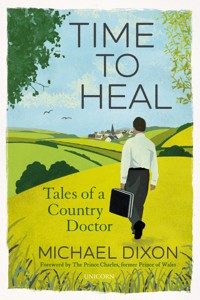
Time to Heal; Tales of a Country Doctor tells the story of the colourful life of a country doctor towards the end of his career. In turn shocking, sad and funny, they describe a doctor who feels poorly served by the conventional medicine of his time and finds new ways to relieve the suffering of his patients. This tale has a twist. Twenty-first-century General Practice and its patients have been betrayed by top-heavy regulation, performance management and a blame culture. Young doctors no longer want to enter General Practice. The author explores why and how pandemics might provide the answers.
Sie lesen das E-Book in den Legimi-Apps auf:
Seitenzahl: 473
Veröffentlichungsjahr: 2020
Das E-Book (TTS) können Sie hören im Abo „Legimi Premium” in Legimi-Apps auf:
Ähnliche













TIME TO HEAL
Tales of a Country Doctor
DR MICHAEL DIXON
FOREWORD BY THE PRINCE CHARLES, FORMER PRINCE OF WALES
DEDICATION
To Joanna, Finn, May and Liberty
CONTENTS
FOREWORD
This record of a life devoted to healing appears at a time when health has been at the forefront of people’s minds as never before in living memory.
As the world devotes immense resources of scientific endeavour and public commitment to tackling the global pandemic which has caused such disruption, we are all reminded of the precious gift of health, and how it can never be taken for granted. As we witness the dedication of those helping fight this invisible threat, we have all, I am sure, found renewed respect and admiration for the medical profession and all who devote themselves to the wellbeing of their fellow human beings.
For Dr. Michael Dixon, the mission of promoting health has been a lifelong passion. ‘Time to Heal’ is about science, but it is also about sympathy. It is about research, but it is also about relationship – about treating the whole person, not just the disease.
This account of four decades spent in the medical profession has the doctor-patient relationship is at its heart. Having known Michael for many years, I was touched, but not surprised, to find that the stories and anecdotes which illuminate this thought-provoking memoir are marked by the same empathy and humanity which I have long admired, and which make him such an inspiring example of what a family doctor should be.
This personal journey unfolds from medical student days to the fullness of a career devoted to the wellbeing of others, and it includes reminiscences ranging from the bizarre to the benign, without neglecting either appropriate clinical acumen or an essential sense of humour.
Few people can fail to be moved by such a record of care, empathy and sacrifice and none, surely, could dissent from the statement that what people want from their health service is ‘good service, that is easy to get, compassionate, provided to people by people they trust’.
However, while traditional values of human contact are central, this book is not a manifesto for the ‘good old days’. Its author recognises the enormous improvements that have been achieved in health, in the safety of medicine, in the promptness of diagnosis and the efficiency of treatment. The art, as always, is to keep the best of the traditional personal approach while making full use of the scientific knowledge and opportunities that we now have. As he says: ‘tales of this book are about relationships and don’t need to belong to the past’. Medicine is to some a science and to others an 8art form. ‘Time to Heal’ shows that it should be a balance of both. For instance, the recent introduction of ‘Social Prescribing’ is an excellent example of an integrated approach ‘offering the sort of professional care that doctors were previously able to offer when the pressures were not as great as they are today’.
Compiled over a long and rewarding career, ‘Time to Heal’ is a fascinating record of community life in Devon, as viewed from the unique perspective of the local doctor. Presented with great sensitivity and insight, it tells a story of steady clinical advance facing the constant challenge of the fragility of human life. Its message could be summed up in the quotation, ‘the good physician treats the disease, the great physician treats the patient who has the disease’.
I am sure that all who read this book, whether they are in the medical profession or not, will find themselves agreeing that they have been in the presence of a remarkable physician – and a great storyteller.
PREFACE
This is the story of my life as a country doctor. It is about relationships. Especially the relationship between doctor and patient. My story is as relevant to city dwellers as to country people. Healing relationships matter wherever you live.
As doctors we are fortunate to live as close to the reality of existence as anyone. We see our patients undressed in every sense – physically, mentally and spiritually. Sometimes it may seem as though we know our patients almost as well as they know themselves. We treat and diagnose illnesses but we must also understand our patients through and through – producing answers for every question and solutions for every eventuality. We must recognise when their symptoms are simply metaphors of an underlying problem and respect the symbolic status of many of the treatments that they choose. Above everything, we must value and refine our skills as healers over and above the pills and procedures that we may offer.
Scientific medicine has made stunning progress in treating diseases such as cancer and heart disease. In my early years as a GP these led to the premature death of many of my patients. Patients that would have died before sixty-five now live until eighty-five. The progress of the last forty years has been phenomenal, but times are changing.
Today, life expectancy is no longer improving. We are faced with an increasing epidemic of long-term diseases such as depression, stress, obesity, diabetes and cancer. These are not the fault of medical science. Their cause is far more human. In many cases they are the result of our catastrophic failure to care for the environment, the planet, ourselves and each other.
General Practice itself is facing extra challenges. Historically high rates of patient satisfaction are now beginning to fall. An increasing number of GPs now find their work stressful and far from fulfilling. This is not the fault of medical science either. It is because we are ceasing to value the importance of human medicine. Patients, doctors and communities are becoming less connected. One result of this is that ever fewer patients have a personal advocate and confidant whom they can call ‘my doctor’.10
These things matter less to those with episodic or minor illness, where virtual medicine may play a larger role in future. They do matter very much to the elderly, the very sick and those with long-term disease who represent 80 per cent of a GP’s work. They should also matter to NHS accountants. Much research has shown that less personalised medicine leads to much greater costs yet, in the face of such evidence, we continue to increase our rate of spending on hospitals at twice the rate of spending in General Practice.
Future medicine will need to embrace both the wonders of medical science and mysteries of healing relationships. It must aim for a better mix of information and evidence with intuition, experience and emotion. The philosopher, Bertrand Russell, predicted that ‘unless men increase in wisdom as much as knowledge, an increase in knowledge will be an increase in sorrow’. The evident sorrows of today’s patients and doctors suggest that it is now time to think again.
Much of what follows is about the true-life stories of my patients. You must make of them what you will. Are they simply of historical interest or are they relevant to medicine of the future? I believe that they carry some serious messages that have been made all the more relevant by the Coronavirus pandemic, which began to sweep through this country as I was completing this book. Time was already running out for General Practice 11but the pressing need for radical solutions can now no longer be ignored.
Time to Heal is about restoring humanity to medicine. It is about allowing our doctors sufficient time and supporting them to rediscover their role as healers. It is about enabling them to reconnect with their patients and local communities. COVID-19 has, if anything, made this message all the more urgent; demonstrating the crucial importance of such connections to the resilience of individuals and communities and the impact of social isolation. In future, we must enable our patients to play a far larger part in their own well-being and the well-being of their families and their communities. ‘Lockdown’ has given us the time to reflect and evaluate. Let us hope that we have learnt its lessons and that we use them wisely.
GIVE ME A DOCTOR
W. H. Auden 1907–1973
Give me a doctor partridge-plump
Short in the leg and broad in the rump
An endomorph with gentle hands
Who’ll never make absurd demands
That I abandon all my vices
Nor pull a long face in a crisis,
But with a twinkle in his eye
Will tell me that I have to die.
Chapter 1
THE BEGINNING
Men make their own history, they do not make it as they please: they do not make it under self-selected circumstances, but under circumstances existing already, given and transmitted from the past.
Karl Marx
Is any family normal? Ours certainly wasn’t. Being normal was not even an aspiration. Generosity, tolerance and loyalty – they did matter. For my parents, the worst sin, apart from showing off, was to be sentimental. “We can leave that to the Americans” they would say. The psychiatrist, R.D. Laing, said, ‘Our relatedness to others is an essential aspect of our being’. Early childhood experiences are such an important factor in our later happiness and ability to form fulfilling relationships. My loving and large family – certainly by today’s standards – prepared me well.
My mother went into labour with me while making jam tarts. Her midwife and GP, both local snobs, irritated her by discussing their social diaries while she struggled to bring me into this world. Once that had been achieved, she describes having had an extraordinary experience of feeling totally at peace and understanding everything. Whether this was due to low blood pressure after bleeding or to divine intervention, we shall never know.
It was only at this stage that my father was allowed upstairs to 14meet his fifth child before being dispatched to register me. The pub intervened on his journey and by the time he got to the registry office, he had completely forgotten what he and my mother had agreed to call me. They had previously decided at an early stage that they were going to name their boys after the British Patron Saints – hence my older brothers had been called Patrick and Andrew. My mother didn’t like the name George so the next one was to be called David. Shortly before my birth, my father’s RAF pilot brother, Michael, had been tragically killed in an air crash. He and my mother decided that instead I should be called Michael but in the confusion of my birth and his bereavement, not to mention the visit to the pub, he registered my name as ‘David’ though ever since I have been called Michael. It was a secret that he kept sheepishly from my mother and myself. I only saw my own birth certificate several years later. It was well after my youngest brother, also called David, had been born. It must be a rarity for two brothers in the same family to be called David. Anyway, when the General Medical Council saw it they insisted that I should be registered as Dr David Dixon even though everyone knew me, by then, as Michael. This has enabled my critics to say that ‘Dr Michael Dixon’ is an impostor and a quack.
My father’s real love had been the navy and the sea. He had spent the Second World War flying Swordfishes in the Royal Navy’s Fleet Air Arm. Most pilots of this antiquated biplane did not live for long – there were only two survivors from my father’s original squadron. As it was unlikely that he would survive the war, he and my mother were married aged twenty-two and nineteen respectively, in 1940. After the war, physically well but mentally scarred, he took to drink. I was fortunate to be born towards the end of his drinking days.
After the war, he stood as a Conservative Party candidate for 15Scunthorpe in Lincolnshire and though he increased the vote in his constituency, it was the election when Winston Churchill was discarded and he did not get elected. My maternal grandfather had made his fortune by running dealerships for American tractor companies – John Deere and Caterpillar – and had been extremely successful at it. My father took on the business and became a company director. I don’t think he really wanted to sell tractors, and alcoholism was his response to the pressures that he had endured during the war and a feeling of emptiness afterwards. We always got on terribly well except for my late teens when his views as a member of the Conservative Party were at odds with my left-wing views. When we went fishing though, we could agree to differ, and we were united by our passion for being on the river bank.
My mother was the best sort of matriarch, ensuring that the family stayed together. She was glamorous and had many secret admirers but devoted every ounce of her life to my father and her six children. She had to endure much unhappiness during my father’s drinking years but remained ever loyal in spite of many around her suggesting that she should leave him. It was she who would organise our holidays to Devon or Scotland and our outings to pick primroses in the spring and blackberries in the autumn. She was a very good cook and every year she would go to the Ideal Home Exhibition in London to pick up new tips. Increasingly, she had to protect us from my father, which was why she bundled us off to boarding school at an early age.
My eldest brother Patrick was the eternal protector. After one of my father’s worst atrocities, he declared that we had to blow up our house as punishment. There was a miniature canon in our garden and Patrick went off to the ironmongers to fetch the ingredients for gunpowder. When all was ready, we three younger boys lined up behind him and the canon waiting to take 16our revenge on whatever my poor father had done. There was quite a satisfying bang after he lit the taper but then our missile trickled out of the canon and dropped with a small thud on the grass just in front of us.
It was Patrick who drove me, aged fourteen, to the cinema with my first girlfriend Liffy. He then sat in the row behind us giggling, while we held hands. He was generous to the extreme. My elder brother Andrew was a rebel, always getting into trouble and with a dry sense of humour, while David, my youngest brother, was artistic and vulnerable.
I also had two elder sisters: Daphne and Penny, both of whom took on an extra mothering role for David and I. Daphne, together with Patrick, had caught the brunt of my father’s drinking days and both had gained an inner strength. She also had the softest heart for anyone that was struggling. I shall never forget the terrible pain of a boil in my nose and the utter relief, when Daphne carefully punctured it with a needle.
My elder brother Andrew, the rebel, was outspoken. Not afraid to question authority or challenge traditional thought. I remember him quizzing me on all manner of things, and being the younger, impressionable brother, I would look up to him and take his opinions seriously. One day he asked me “Michael, what do you think is the most disgusting part of the body?” It was a simple question with an obvious answer – or so I thought. My grin betrayed ignorance. “Most people get it wrong,” my brother continued with kind authority. “It is, in fact, the feet.”
I realised then that facts were odd things. Slippery and too often the reverse of what you might first think. The more that I pondered on my brother’s certainty, the more I began to wonder if there were any real facts. What if all presumed facts were just opinions? If truth was just simply a case of just building up a convincing story? It was this and other large questions to do with 17life and its meaning that were to keep me occupied through my long years at school and university.
Like Christopher Robin, I was dispatched to prep school at seven years of age, despite having been so happy at home with my mother, brothers and sisters. I was very homesick, crying myself to sleep each night, and never much good at being part of gangs and groups. Penny would bicycle over to my school bringing sweets and biscuits. We were allowed home three times a term and I so much looked forward to these occasions and well remember the misery of returning to school after them. In those days, the radio programme on Sunday evenings as we drove back was called Sing Something Simple. It brought little comfort to a ‘condemned man’ simpering during his last moments of freedom. I remember lining up for the lice checks by matron, the radio malt that we were given each morning as she asked us how our bowels had worked and the humiliations on the sports field, where I was always a disaster. The school was run by the ‘Major’ – Major George Pike who had a moustache and had apparently self-promoted himself from captain. He ran the school as his private army, giving us wooden rifles each morning to parade around the school grounds before going to our breakfast of invariably burnt porridge. Surprisingly perhaps, I rather liked him and never felt threatened by him. Even then I was well aware that he was bonkers and school even became tolerable by the time I had got to my twelfth year. But then I had to start all over again at public school.
If Andrew can be given some of the credit for inspiring me to question and challenge the status quo, my secondary education has to be given some as well, I attended a reputable public school; well-known for providing intellectual rigour and discipline where I succeeded academically. I didn’t like boarding school because my rebellious streak made me ever-allergic to institutions – I hated the restrictions and the competitive, testosterone-fuelled 18group behaviour of the boys around me. I was fortunate, however, to have been part of a large intake of nine or ten boys in my particular house and we managed to protect each other and frequently enjoy ourselves in spite of a rigid system of rules and values that we didn’t share.
There were plenty of good bits though – instead of games I was allowed to opt for social services and I used to bicycle off to a nearby town to teach English to young Pakistani children and help at youth clubs there. Whilst at school, I also, somewhat unfashionably, joined the St John’s Ambulance and would volunteer to attend at football matches and other events. Each term there would be a compulsory cross-country run, which thankfully, in its early stages, went past the weir pool of a river lock containing some large pike. Two of us would peel off to collect our tackle, hidden in a nearby bush, to enjoy a few hours fishing before muddying our knees and rejoining the run on its way back. Those were the times that I really felt free.
When asked to complete a careers form in my last year at school, I ticked the box saying ‘The Ministry’. My education thus far, both formal and familiar, had taught me to question and probe and I was not afraid to carve my own path, or be bundled along with the crowd. In my opinion, no one was better at that than those inscrutable civil servants. They were experts when it came to influencing the thinking of Government Ministers and without them even realising. Yes, I decided, I wanted to become one of those men from the Ministry!
There was some interest in my application and a special careers’ advisor was sent down from London to interview me. I thought it was odd that he was wearing a dog collar but dismissed this as yet another diversion created by those men from the Ministry. He seemed a bit perplexed when I asked him whether Ministers were really quite so gullible. I was equally puzzled 19when he started asking me about my religious beliefs – which were, at that time, slightly vague. Then, almost simultaneously, we both realised.
This whole area of truths and beliefs, fact and fiction became a sort of obsession and I applied, and was accepted, to read Philosophy and Psychology at Oxford. However, before embarking on my degree I took a gap year and went to South Africa on a Union Castle ship – The Windsor Castle. In those days, travelling coach class by ship was a much cheaper option than flying. The journey took eleven days and during the voyage various encounters took me from being a seventeen-year-old boy to a seventeen-year-old young man. I had gone to join my brother-in-law who was selling kosher butter and had a small factory with six or seven people and a conveyor belt that was about five feet long producing this butter from vegetables. It tasted awful and would stick to the palate like lard. My job was to try and encourage the non-Jewish community to buy the butter but the sales campaign, in spite of having girls in mini dresses fronting various supermarkets, was a total flop. I was quickly out of a job.
Then I was introduced to someone called Dave in Johannesburg who had a company that sold ballpoint pens. In fact, they were the rejects from the Scripto factory (Scripto was a well-known brand in those days). He used to send two of us – a bit like Fagin – in a car each week to various parts of South Africa to sell these leaky pens. Though we had many hilarious experiences, it was also a very serious lesson in how to persuade people to do something they might not otherwise want to do. It also taught me to understand and use the vanities and weak points of my potential customers.
On the ship to South Africa I had met a friend who had a job running an autoclave (sterilisation) machine in a missionary 20hospital in Zululand. We got in contact with each other and, as I had made a small fortune selling leaky ballpoint pens but didn’t feel that it was particularly useful to anyone, and he had really enjoyed his work but wanted to earn some money, we swapped jobs. It was while working in the missionary hospital at Nqutu in Zululand (the Charles Johnson Memorial Hospital) that I developed a complete fascination and passion for medicine. The doctor in charge, Dr Anthony Barker, was a cheerful and charismatic role model who always wore bow ties (possibly why I adopted them later when I became a doctor) and his hospital was near the site of Rorke’s Drift and Isandlwana of the Zulu war. He was an enthusiastic Christian and Marxist and had a strong influence on my thinking. He was also a rebel and it was the time of Apartheid repression. We were closely observed by the police and authorities and Dr Barker was constantly in trouble. I remember accompanying him one day to court because he had operated on a native Zulu in a ‘White designated’ operating theatre. I wasn’t allowed into the court because I didn’t have a tie and so we went next door, where a tailor cut us a thin strip of yellow cloth from which we made a makeshift tie. Returning to the court, though guilty in law, Dr Barker provided such an emotionally-charged and powerful defence of his actions that he shamed the prosecution and the case was dismissed.
Life in the hospital was utterly romantic, even though there would be four people to a bed – two each end (a single bed). After the morning ward round we would eat breakfast, which was a form of porridge, to the sound of Simon and Garfunkel’s Bridge over Troubled Water at full volume on his gramophone. The whole atmosphere was so full of compassion and caring that I suddenly discovered that this was exactly what I wanted to do. I applied to Oxford to change from Psychology and Philosophy to Medicine but they rejected my appeal. 21
At Oxford, I studied the great philosophers of the past, such as John Locke, who unsettled me by reasoning that you couldn’t say that a table was square or rectangular or even smooth or rough as it all depended upon where you were standing and how closely you looked. Emmanuel Kant put a further spoke in the wheel by pointing out that there were logical limits in our ability to think or ever reach the truth at all. A bad situation grew worse with psychologists adding that we are restricted still further in our depth and breadth of thinking by the nature of our biological thought processes and the limitations of our learnt languages.
These reflections begged the question of whether thought and reason mattered at all. After all, it was the philosopher David Hume, who declared that ‘Reason is, and ought only to be, the slave of passions, and can never pretend to any other office than to serve and obey them’. I concluded that there was probably no point in trying to think too much. A conclusion that was reinforced as I tried to answer the first question of my finals examination in Philosophy – ‘What is the difference between Rodin’s Le Penseur and a ballet dancer?’ I knew then that I was never going to progress more than a few millimetres along the path of infinite knowledge and following the exhilaration of my time in the African hospital, I was only more convinced that a life of action and practicality was what I wanted.
In a bid to offset the heady intellectuality of Oxford, I did seek some more practical experiences by joining the Oxford University Air Squadron. I wanted to be a pilot but was hopeless at navigation and on one occasion got lost over Marston Moor. I was only able to find my way back to the air base by following the main roads beneath me. The official reason for my discharge was ‘dogfighting’ – two of us had been doing battle darting up and down through the clouds in our aeroplanes. It was strictly not 22allowed. I pleaded guilty but Marston Moor had already taught me that I would never be a successful pilot. It was an abrupt end to my flying dreams, which had been fueled by Biggles, St Exupery and the previous generation of Dixon pilots – my father had torpedoed the great German Battleship, Bismarck.
I had to accept this particular defeat gracefully but kept on returning to the thought of becoming a doctor. Saving lives, relieving suffering and having something to show for a day’s work. It was the Russian country doctor and writer, Anton Chekhov, who said that knowledge is useless unless it is put into practice. I shocked my kind philosophy tutors, for whom ‘practical’ was something unimportant done by those with lesser brains, and applied to Guy’s Medical School.
Guy’s were perplexed as to what to do with a philosophy student with no medical background, who had never studied any science. They demanded that I should get a first-class degree as a condition of entry. I argued that no one ever got first-class degrees in the philosophy and psychology course because the philosophers didn’t like the psychologists and vice versa. They relented and then asked me to get an upper second. In those days Oxford did not offer upper or lower seconds – just seconds. Notwithstanding, exams over, I reported to them that I had got an upper second. My career as a doctor had at last begun.
Chapter 2
MEDICAL SCHOOL AND FIRST YEARS
Education is not the filling of a pot but the lighting of a fire.
W. B. Yeats
The first days of medical school were not as I had expected. I had arrived full of confidence: I was an Oxford graduate; I was well-acquainted with the demands of pushing myself intellectually, to studying hard and learning great swathes of information and was eager to get started on my chosen career path. But my confidence was shattered the week before lessons started when I had to attend a medical checkup – something required of all medical students before entry. “Go behind the screen and take your clothes off,” the rather beautiful but bored doctor had instructed. When she came behind the screen, she gave me an unforgettable look of total contempt and disgust. “I did not mean all your clothes, Mr Dixon!” This humiliation was also a well-learnt future lesson on what not to tell patients undergoing examination. Much later, I was to learn another lesson about examinations – never ask questions when a patient is undressing. Most of us are incapable of undressing and answering questions at the same time. It has to be one or the other – that is unless you want your consultations to go on forever.
I imagined that on arrival at medical school I would be ushered into an operating theatre to witness lives being saved, with the rest of the day being spent patrolling the wards enlivened 24with moments reminiscent of Carry On Doctor. Instead, I spent the whole of my first morning looking at flower petals under a microscope. No blood, no patients, no wards, no nurses or white coats. What on earth had I let myself in for? Having completed a colourful array of A-Levels, including French, Latin, Maths and Economics, together with my degree at Oxford, I had absolutely no experience of studying the science subjects. Therefore, I had to spend my first year working on the First MB course which provided a thorough introduction to all the sciences including Biology, Chemistry and Physics. Only on completion of this could I then embark on the traditional two years of rigorous non-clinical studies (the Second MB). I was, of course, also extremely conscious that I was several years older than the rest of my cohort and therefore keen to apply myself and prove my worth. Having previously concluded that there were no truths or facts, I was to spend five years having to parrot vast reams of them from biochemical pathways to the detailed anatomy of the body – 90 per cent of which I have never used to this day and most of which I have forgotten. But it was important to learn it all and have the information available: those first few years were a hothouse with endless examinations and vivas followed later by the nagging fear of being shown up on the ward rounds. It was also of crucial importance to make good relationships with the nurses and junior doctors who could help you to swim or sink.
Coming from a non-medical family, I had assumed that doctors (and nurses and others for that matter) were all ‘good’ and wanted to save lives and make the world better. Perhaps I should not have been surprised that medics – especially hospital medics – are as bitchy, competitive, ambitious and sometimes ruthless as anyone else. Much of those first two non-clinical years was spent on anatomy. One of the professors of anatomy would annually claim his ‘droits de seigneur’ and choose the most willing girl in 25each year for ‘extra tuition’ with a high probability that she would get the best marks at the end of the year. I could not complain as I had quite a crush on one of the anatomy demonstrators. She had a wide smile and natural blonde hair worn in a sleek bob. To my great fortune she was almost invariably my examiner during our many anatomy vivas. She looked uncharacteristically stern during these examinations – an image amplified by her wearing thick tortoiseshell glasses, which she never wore at any other time. Nevertheless, she seemed to have a twinkle in her eye and I was fortunate enough to pass the vivas.
The consultants were generally encouraging and affable, except for one. He looked severe and threatening in his black-rimmed spectacles and was widely known to have examined prisoners during the postwar Nuremberg trials before their execution. He reduced most medical students to tears at one time or another. Yet, being a stickler for detail, he was probably the best teacher I ever had – enforcing in us the skills of careful observation and thorough examination.
Despite the sheer volume of work and study, those first few years of being a medical student in London were extremely happy ones. I was fortunate to be the theatre reviewer for the medical school journal. This entitled me to two free seats in the front of the stalls of most new theatrical productions. Indeed, we sat so close to the actors and actresses that you could actually smell their Max Factor make-up. I was equally fortunate, at the time, to be going out with a young woman who happened to be the restaurant critic for magazine Harpers and Queen. So we progressed from the front seats of the theatre to some of the best restaurants in London with fawning waiters plying us with champagne, smoked salmon and endless other delicacies previously unknown to a medical student of small means.
At the same time, Paul, a medical school friend of mine and I 26were volunteers on Monday evenings at the ‘Good Fellows Club’ in Marylebone. This was a club for people in the community with serious mental health problems, run by a compassionate GP well into his eighties, whose own brain was well on the downhill run. We would hold quizzes, play charades, organise debates and dance, sing and read. Cheerful and portly George was a schizophrenic. He had flushed cheeks, an infectious grin and avoided any eye contact. He would frequently burst into fits of giggling as if enjoying a private joke. He also knew the whole train timetable off by heart and if you wanted to go somewhere he could tell you exactly which train to take and when. Gilbert was a thin and wizened old man who looked permanently anxious with a furrowed brow. He stuttered and trembled and spent most of the time looking at his feet but appeared to quietly enjoy our proceedings. Mavis would simply tap her feet, mumble and hum – never entirely joining in but mostly seeming content. There were about twenty of us in all including myself, Paul and the doctor. It was a constant challenge to think of new things to do each week.
One evening, using my theatrical contacts, we took the Good Fellows to see a play produced by a visiting Belgian stage company. The Good Fellows occupied the whole back row. It was a new experience for them and they became totally absorbed and involved in the performance. Only a little too much so. In the middle of the play, there was a feast scene and one by one the Good Fellows marched down the stairs barging past other members of the audience and on to the stage to help themselves to the various tasty bits of the theatrical food on offer. This culminated in a fight between them and the Belgian actors over a loaf of bread. It took some time to get our protesting group back to their seats but not before I had received an angry dressing down from the 5ft-high theatre manager with a flamboyant waxed moustache. He was flushed and bristling with rage. 27
Later on, the kindly GP leading the group died. The powers that be behind the Good Fellows Club decided that we needed modernising. In place of the late GP came a rather intense young psychiatric doctor with a Germanic accent. On the first evening, and in full hearing of all of us, he sat down beside Gilbert and asked, “Gilbert – how often do you masturbate?”
Medical school itself was a mix of high emotion, hard work and strong camaraderie. Perhaps this was due to the enormous pressure we found ourselves under coupled with a shared purpose and passion for our vocation. We drank too much and developed lasting relationships with our peers. Romantic attachments and high jinks were essential elements of the heady mix.
I will never be able to forget one birthday when my friends really dropped me in it. By this time I had progressed to accompanying a leading professor on his ward rounds, proudly wearing my white coat. I was excited, if a little daunted, that the Professor had asked me to ‘present’ one of the patients on his ward. Imagine my disappointment when we heard that the Professor was in America and the ward round had been cancelled. “No problem,” my friends said, “let’s go and celebrate your birthday with a piss-up in the pub.” That we did, with rather too much alcohol but comforted in the knowledge that there was not going to be a ward round that afternoon. That was until we returned to the Medical School in an alcoholic haze only to be told that the Professor was not abroad after all but on the ward and waiting for us. Walking was possible. Speech more difficult – slurred at best but mostly unintelligible. The Professor was standing by the bed of a patient. “Mr Dixon, tell me about this patient.” I felt every bit like Jim Dixon in Kingsley Amis’s 28Lucky Jim only far worse. I became acutely aware as I gave my slurred history that I was finding it difficult to move and, every time that I did so, the sheets started to come off the patient’s bed. My ‘friends’ had safety-pinned my white coat to them. Things went from bad to worse. The Professor asked me to listen to the patient’s heart and I found that my stethoscope had been similarly safety-pinned to the pocket of my white coat. The rest was a blur. Memory of that scene still fills me with misery.
Around this time, I received an unexpected letter from Helen Mirren. Particularly surprising because in my fantasy world, I had switched allegiance from the anatomy demonstrator to the equally unobtainable great actress. I had written to her, in no expectation of an answer, asking if she would like to come and speak at our debating society. She wrote back, almost immediately, saying that she would love to come and suggesting that she might take me out to dinner beforehand to discuss exactly what she was to say. She told me that she could tell from my letter that I was a kind and sensitive person and that she would like to get to know me more. Even better, she had also cut off a considerable amount of her hair and inserted it into the envelope ‘to remind me of her’. Love, as they say, is blind and vanity knows no limits. Perhaps I should have been a little bit more suspicious because the enclosed hair was red and I was pretty sure that Helen Mirren was blonde. Paul was the only person who knew that I had written the letter and his girlfriend happened to have red hair. On balance, the utter exhilaration of receiving the letter, fueled by blind infatuation, was well worth the low of realising that I was an idiot of self-deception.
I continued with my early student placements in and around the hospitals of London. The patients in Bermondsey and Southwark were ever-accepting, cheerful and long suffering. Those who had to wear glasses had often bought them from a stall in Borough market. They were very cheap largely because 29they were chosen at random by the stallholder without any pretence of an eye examination. Consequently, his victims were instantly recognisable from the multiple bruises up and down their bodies from walking into lamp posts and each other. Our patients were also plain spoken and practical. On my gynaecology attachment, I asked a lady well under thirty about her marital relations. She told me rather firmly that there was no point in having sex as she had finished having children. Patients were unphased by the silliest of medical questions. While preparing an elderly lady for admission, I ran down the usual check list – how are your waterworks, are the bowels working normally and do you have any problems with your back passage? In response to the last question, she paused for a few seconds to think and then replied in a matter of fact way, “Well there is just one – I wish my brother would stop leaving his bicycle there.”
I should add that it is not only medics that confuse patients with these expressions. A Devon patient recently telephoned me in a state of high anxiety to say that she was having ‘trouble in the basement’. Images of rising damp or rats came to mind until she added that it was itchy and sore. Quite by coincidence on the very same day, I asked another woman about her hospital investigations for pelvic pain and she told me, “The x-ray showed that I have got some subsidence but I can live with that.”
Eventually, the time came to put a hold on the high jinks and prepare for the final exams. An ordeal in those days, which involved numerous written papers and vivas in front of the frequently hostile professors of other medical schools. These didn’t seem to be going so well for me and halfway through a friend of mine, who had taken finals the previous year, came round to commiserate. We retired to a pub, where he told 30me about the difficult ‘long case’ that he had been given at St Thomas’ Hospital the previous year. It was an Irishman with a large liver, diabetes and a rare diagnosis of a disease apparently called hemochromatosis. He reassured me by telling me that he had messed it up completely but still got through.
The next day was my ‘long case’ at St Thomas’s and on arrival they ushered me through to see ‘the patient’. He spoke with an Irish accent, he had a large liver and when I tested his urine it was full of sugar. He had diabetes. I could not believe my good fortune. Finally, the great Professor arrived to grill me. “I don’t expect you to get the diagnosis but I just want you to tell me what you have found.” I gave him the history and examination faultlessly and then he asked me what I thought the diagnosis was.
“Well, I have been putting all this together. I am not entirely sure. I can only think of one diagnosis but it is extremely rare and so I think it is unlikely.” I knew I was treading dangerously but wanted to play this fish gently.
“So what do you think it is?”
“Well I thought about X, Y and Z but one by one I had to rule them out because….”
“Yes, yes – so tell me what do you think it is?”
“It is clear that he has got diabetes.”
“Yes. Yes. Yes.” The Professor was getting impatient.
“He has got a large liver,” I continued.
“Why do you think that is?” the Professor asked.
I hesitated. “Well there is only one thing that this could possibly be … this patient must have a very rare blood disease called hemochromatosis!”
The Professor was surprised – most likely shocked – and changed persona from inquisitor to smiling, avuncular friend. He told me that I had been the only student that year to make the correct diagnosis. 31
A few days later I received a telephone call to say that I was going to be given an interview for a highly coveted award given to the best graduating London medical student each year. Each London medical school proposes two or three candidates for what is called the University of London Gold Medal. Then, the ‘best’ twenty or so medical students face a panel of six professors to determine the winner. The competing medical schools propose their best candidates with the hope of winning the award and thus bringing prestige on the medical school. I am sure my candidacy was due to the Irishman at St Thomas’ incident and to be honest, I wasn’t remotely bothered about the Gold Award as I did not appreciate its importance or significance at the time. However, I was overjoyed at the news because being interviewed for the Gold Award automatically meant that you had passed finals and therefore, I was now a doctor.
The evening before my interview for the Gold Award, I was invited to an old friend’s birthday party. As I left the party for an early night, a young lady dropped her cigarettes on my shoes. She was an actress who was starring in one of the West End shows. After joyless months studying for exams, it was the cue that I needed to continue partying. I arrived very much the worse for wear at the Gold Medal interview the following morning. I did not understand many of the questions and was able to answer even fewer. I wasn’t bothered. Fortunately, my friend and very hard worker Paul of the Good Fellows and Helen Mirren incidents was also proposed from Guy’s and was the overall winner that year. I could not have been happier, for my friend and for my Alma Mater.
On my first day, I was so exhilarated to be a doctor, at last, that I ran up three flights of stairs to my new ward and raced through the 32swing door of the ward full of exuberance and enthusiasm. I had not noticed that the highly renowned Professor Maurice Lessof had also just entered the swing door. The force and momentum of my entry led to his projectile exit with exactly the same force and momentum. This catapulted him out of the ward and down a flight of stairs. I just caught this out the corner of my eye and rushed to his aid finding him in a sorry state with broken glasses. As we picked up the pieces of glass, we exchanged expletives on the bloody idiot (unknown) who just committed this heinous crime. Swing doors, I should add, have been an almost constant problem in my life. I once got stuck in the same section of one in a London hotel with the not-underweight broadcaster Clare Raynor. We were both on our way to speak at a conference on human sexuality. Anyway, the Professor surprised me on my last day by calling me into his office and saying he had a present for me. He handed over a rather large but light parcel. It reminded me of ‘pass the parcel’ as a child. That was exactly what it was. I unraveled layer upon layer of paper in front of him and eventually the present was revealed – a small comb. “You may find it useful in your next job,” he said.
My first two years as a junior on the wards contained the same mix of gravity, bonding and high spirits as my student days. Even in the late 1970s, the doctor on the ward could prescribe just about everything including brown ale, stout, brandy, port and sherry. It was a traditional part – even an accepted perk – of the late night round that sister would pour you a glass of ‘medicinal brandy’ before starting. Today this would be considered the double perjury of stealing from the NHS medical cupboard and drinking on duty. It was also quite in order for the registrar, senior house officer and junior house officer to have a drink or two before starting the evening ward round.33
The relationships between houseman (the most junior doctor in the hospital), registrar (middle grade doctor) and consultant (specialist and most senior doctor) were very close. There was so much suffering and so much dying and so much that we could not do. This led to a kind of camaraderie and Dunkirk spirit, which oscillated between feelings of desperation to feelings of joy, especially when things turned out all right in the end. What I remember most were our cheerful, supportive relationships. It is a far cry from the detachment that junior doctors have to face today when they start their first years as a doctor. No longer can consultants choose their junior doctors or vice versa and there is no time to build up the necessary mutual respect and understanding. Consequently, that bond of attachment and trust between houseman, ward sister and ward has all but disappeared. Instead, I witness fears, tears, stress and a good deal of cynicism towards an NHS that cares too little for its doctors, and sometimes too little for the patients as well. In previous years we may have been buccaneers but we were compassionate buccaneers and gave every ounce for our patients and, in return, our patients loved us for it.
After six years studying, qualifying and working in London, I decided to return to my family and moved to Exeter. I had not grown up in Devon but my parents had recently retired to the West Country. It was my second junior doctor job as a house surgeon and I worked 120 hours a week. That is five days a week plus two nights and two weekends in every three. Inconceivable these days. I was happy and fulfilled even though I had very little time off. Junior doctors today have much more time off but the pressures, when they are working, mean that too often they are neither happy nor fulfilled. We carried considerable responsibility, especially when the senior staff weren’t around, 34which meant that we learnt quickly. The downside of this was, perhaps, that too often we had to learn from our mistakes.
Long hours spent on the ward enabled us to get to know some patients very well. Two particularly stand out in my memory. One was the last of Devon’s clatters. Clatters were eel fishermen, who would thread worms onto a length of cotton and then wind this round a pole, which was then left in the river or lake overnight. Eels eating the worms would get their teeth stuck in the meshes of cotton wound round the pole with several being harvested each time the pole was lifted out of the water. Sadly, today, eels are now almost as rare as clatters. This particular patient was only thirty-five and had terminal pancreatic cancer. He bore his impending death with calm grace and resigned cheerfulness. Spending time with him prepared me for the premature death, aged forty-eight, of my own brother Andrew, who later developed pancreatic cancer. I knew by then, that it was all but impossible to escape the consequences of late pancreatic cancer.
Andrew’s consultant had rather blithely told him that there was no cure and that he should enjoy as many sunsets as he could with a glass of wine. We tried everything to avert the inevitable, however ludicrous, including sending off for shark’s cartilage, which was all the rage in the media at the time. Patients and particularly their relatives are blackmailed by the popular press and unauthenticated research to pay for these often expensive remedies that are not proven but might just help. Simply accepting the inevitable on behalf of a relative or patient at too early a stage carries the implication of not caring properly for them.
Another patient on the ward was called Don. He was quite a bit older. He had emigrated from Canada and had a tumour of the gullet. This had to be removed and then the gullet was reattached to the stomach. Unfortunately, following the operation, the 35gullet and stomach had become separated and he was far too ill for a further operation. Nothing could be done and he just lay in bed waiting for the inevitable. On Saturdays, I was left to run the ward on my own with a mixture of pride and terror. With his pain at last under control, I spent most of Don’s last Saturday afternoon distracting both of us from events to come. We discussed everything from the meaning of life to his war time experiences and speculating wildly about the sex life of our ward sister. After he died, his wife gave me some beautiful green and gold cufflinks imprinted with a little bird. She told me that he had specifically instructed that I should have them. I still wear them.
My boss was a respected young surgeon with, unusually for those days, a good bedside manner as well. I learnt much but that did not stop me having more ‘Jim Dixon’ moments.
We had operated on a lady with breast cancer and all had gone well. To make sure that the cancer didn’t come back we were going to try a completely new treatment – Tamoxifen – which had to be given by injection (today it is a routine treatment given orally to most patients after treatment for breast cancer). The ‘new’ treatment arrived specially from the pharmacy that evening and, as it was still an experimental treatment, I read the instructions very carefully. It was written in bold: ‘Keep in the Dark’. Not leaving anything to chance, I gave the injection and explained what needed to be done to the patient as I drew the blinds, turned off the lights and instructed the evening staff that she should only be given her supper by dim torchlight. No television, no visitors and a notice was placed on her door ‘Keep in the Dark’.
The next morning, I realised that though the instructions had said ‘Keep in the Dark’ they hadn’t specified for how long. I guessed that it must be for around twenty-four hours – guessing was a large part of medicine in those days. Intuition and a persuasive personality were the predecessors of today’s rather 36linear ‘evidence-based medicine’ that does admittedly save more lives than the old order. Our rotund ward sister came storming towards me, “Why is that patient in the dark, Dr Dixon?” she asked.
Rather self-importantly, I showed her the instructions on the new treatment which I had specially kept in the top pocket of my white coat. “See,” I said, “only it doesn’t say for how long.”
She looked at me. It was a slightly odd look. I knew that she liked me but she always made me feel as though I had more than one screw missing. “Are you sure that ‘Keep in the dark’ refers to the patient rather than how you store the medicine?”
I felt sudden panic. The consultant was due on the ward to start his morning round in only half an hour. There was no time to lose. I ran into the patient’s room, turned on the lights and cheerfully told her that her stay in the dark was now over as the medicine had passed through her system. She looked puzzled. In those days admitting mistakes and losing face had to be avoided at all costs. Doctors stood on pedestals and we still wore ties and white coats. Straightforward honesty did not have the laudable priority that it does have today. Shortly afterwards, the great man arrived on the ward and we entered the patient’s room. Behind him, sister made a ‘slit throat’ sign at me. The patient never mentioned her twenty-four hours of enforced darkness.
As house surgeon I had my own ‘lumps and bumps’ surgery list on Friday mornings. These would vary from draining abscesses and removing sebaceous cysts to biopsies and fatty lumps (lipomas). On one occasion matron brought in some clinical visitors to demonstrate how junior doctors in the NHS gained operating experience. I was removing a rather large sebaceous cyst from the head of a middle-aged woman. Head operations often bleed heavily but this just happened to be the worst ever. As I asked my operating sister to fetch a bag of fluid to replace 37the blood loss – which was now causing a drop in blood pressure – matron hastily ushered our visitors out of the operating room.
Such experience stood me in good stead for operating sessions during my early years in general practice though sadly, today, I no longer operate because the system has created all sorts of obstacles and the hospital now does this work, though far more expensively. This is an example of the rhetoric of the health service saying that it wants to move work from the hospital to the community but the system rigidly managing to prevent it.




