


7,19 €
Mehr erfahren.
- Herausgeber: New Island
- Kategorie: Poesie und Drama
- Sprache: Englisch
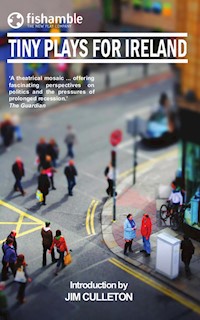
In Autumn 2011 Fishamble: The New Play Company, in partnership with the Irish Times, launched 'Tiny Plays for Ireland', commissioning short works by some of Ireland's best-loved writers and calling for submissions of tiny dramas from the public. There was an overwhelming response, with over 1,700 submissions received, reflecting the imagination, creativity and psyche of the nation. The result was an evening of plays by Maeve Binchy, Dermot Bolger, Colum McCann, Rosaleen McDonagh, Sean McLoughlin, Ardal O'Hanlon, Tom Swift and Michael West, presented alongside a selection of those submitted by members of the public. 'Tiny Plays For Ireland' offers a vivid glimpse of contemporary Ireland, as seen through a host of perspectives.
Das E-Book können Sie in Legimi-Apps oder einer beliebigen App lesen, die das folgende Format unterstützen:
Veröffentlichungsjahr: 2013
Ähnliche











Tiny Plays for Ireland
Tiny Plays for Ireland
TINY PLAYS FOR IRELAND
First published 2013
by New Island
2 Brookside
Dundrum Road
Dublin 14
www.newisland.ie
Introduction Copyright © Jim Culleton, each play is the intellectual property of the respective author, 2013.
The rights of all authors of these works have been asserted in accordance with Section 77 of the Copyright, Designs and Patents Act 1988.
PRINT ISBN: 978-1-84840-214-0
EPUB ISBN: 978-1-84840-215-7
MOBI ISBN: 978-1-84840-216-4
All rights whatsoever in these works are strictly reserved. Applications for permission for any use whatsoever, including performance rights, must be made in advance, prior to any such proposed use, to authors’ agents. No performance may be given unless a licence has been first obtained.
This book is sold subject to the condition that it shall not, by way of trade or otherwise, be lent, resold, hired out or otherwise circulated without the publisher’s prior consent in any form of binding or cover other than that in which it is published and without a similar condition including this condition being imposed on the subsequent purchaser.
All rights reserved. The material in this publication is protected by copyright law. Except as may be permitted by law, no part of the material may be reproduced (including by storage in a retrieval system) or transmitted in any form or by any means; adapted; rented or lent without the written permission of the copyright owner.
British Library Cataloguing Data. A CIP catalogue record for this book is
available from the British Library
New Island received financial assistance from
The Arts Council (An Comhairle Ealaíon), Dublin, Ireland
Contents
About Fishamble: The New Play Company
– Previous Productions of New Plays
Acknowledgements
Introduction
Tiny Plays for Ireland 1 – 25 plays
Tiny Plays for Ireland 2 – 25 plays
‘Fishamble puts electricity in the national grid of dreams.’
Sebastian Barry
‘In order to keep vibrant, theatre requires constant transfusions of new plays. This life-providing role is fulfilled enthusiastically and with wonderful results by Fishamble. Without them, Irish theatre would be anaemic.’
Brian Friel
About Fishamble: The New Play Company
Fishamble is an award-winning, internationally acclaimed company, dedicated to the discovery, development and production of new work for the Irish stage.
During 2013, Fishamble is celebrating its 25th birthday. Over the past 25 years, the Company has produced 131 new plays, including 42 stand alone plays and 89 short plays as part of longer works, by first-time and established playwrights. Fishamble is delighted that, in its 25th year, its body of work will be archived in Ireland by the National Library of Ireland, and in the U.S. by the University of Notre Dame.
Fishamble is committed to touring its work to audiences throughout Ireland and internationally, and typically presents approximately 200 performances of its plays in 80 venues per year. Fishamble has brought its productions to audiences in all parts of Ireland, as well as to England, Scotland, USA, Canada, Australia, Bulgaria, Romania, Turkey, France, Germany, Iceland, Croatia and the Czech Republic.
Fishamble’s awards include Fringe First Awards, Herald Angel Awards, Argus Angel Awards, Irish Times Theatre Awards, 1st Irish Awards and, for many of its first-time playwrights, Stewart Parker Trust Awards.
Fishamble is at the heart of new writing for theatre in Ireland, not just through its productions, but through its extensive programme of training, development and mentoring schemes. Each year, Fishamble supports 60 per cent of the writers of all new plays produced on the island of Ireland, approximately 50 plays per year. This happens in a variety of ways; for instance, Fishamble supports:
• the public through an ongoing range of playwriting courses in Dublin and off-site for literary and arts festivals nationwide;• playwrights and theatre companies through The New Play Clinic, which develops new plays planned for production by theatre artists and companies, and the annual Fishamble New Writing Award at Dublin Fringe;• actors through its Show in a Bag programme, which creates and showcases new plays for actors, in association with the Irish Theatre Institute and Dublin Fringe;• students through work in association with TCD, NUIG, NUIM, IES, DIT, and as Theatre Company in Association at UCD Drama Studies Centre;• emerging artists through mentoring schemes in association with venues and local authorities, for playwrights and directors.Fishamble is funded by the Arts Council and Dublin City Council.
Its international touring is supported by Culture Ireland.
Fishamble Staff
Artistic Director Jim Culleton
General Manager Marketa Dowling
Literary Manager Gavin Kostick
Fishamble Board: Tania Banotti, Caroline Cullen, Peter Finnegan, Vincent O’Doherty, Andrew Parkes, Brendan Rice.
Fishamble: The New Play Company
Shamrock Chambers
1/2 Eustace Street
Dublin 2
Ireland
Tel: +353–1-670 4018, fax: +353–1-670 4019
email: [email protected]
www.fishamble.comwww.facebook.com/fishamble
www.twitter.com/fishamble
Previous Productions of New Plays
2012
Tiny Plays for Irelandby 25 writers
Silentby Pat Kinevane (revival)
Mainstreamby Rosaleen McDonagh (script-in-hand)
The Great Goat Bubbleby Julian Gough*
The Wheelchair on My Faceby Sonya Kelly*
Forgottenby Pat Kinevane (revival)
2011
Silentby Pat Kinevane
The End of the Roadby Gavin Kostick
The Pride of Parnell Streetby Sebastian Barry (revival)
Forgottenby Pat Kinevane (revival)
The Music of Ghost Lightby Joseph O’Connor
Noah and the Tower Flowerby Seán McLoughlin (revival)
2010
Big Ole Piece of Cakeby Seán McLoughlin
Turning Pointby John Austin Connolly, Steve Daunt*, Stephen Kennedy and Rosaleen McDonagh
Forgotten(revival) by Pat Kinevane
2009
Strandlineby Abbie Spallen
The Pride of Parnell Streetby Sebastian Barry (revival)
Forgottenby Pat Kinevane (revival)
Handel’s Crossingby Joseph O’Connor
Noah and the Tower Flowerby Seán McLoughlin (revival)
2008
Forgotten by Pat Kinevane (revival)
The Pride of Parnell Street by Sebastian Barry (revival)
Rank by Robert Massey
2007
The Pride of Parnell Street by Sebastian Barry
Noah and the Tower Flower by Seán McLoughlin*
Forgotten by Pat Kinevane
2006
Monged by Gary Duggan (revival)
Whereabouts – a series of short, site-specific plays by Shane Carr*, John Cronin*, John Grogan*, Louise Lowe, Belinda McKeon*, Colin Murphy*, Anna Newell*, Jack Olohan*, Jody O’Neill*, Tom Swift and Jacqueline Strawbridge*
Forgotten by Pat Kinevane (work-in-progress)
The Gist of It by Rodney Lee*
2005
Monged by Gary Duggan*
She Was Wearing … by Sebastian Barry, Maeve Binchy, Dermot Bolger, Michael Collins, Stella Feehily, Rosalind Haslett, Róisín Ingle*, Marian Keyes* and Gavin Kostick
2004
Pilgrims in the Park by Jim O’Hanlon
Tadhg Stray Wandered In by Michael Collins
2003
Handel’s Crossing by Joseph O’Connor, The Medusa by Gavin Kostick, Chaste Diana by Michael West and Sweet Bitter by Stella Feehily (a season of radio plays)
Shorts by Dawn Bradfield*, Aino Dubrawsky*, Simon O’Gorman*, Ciara Considine*, Tina Reilly*, Mary Portser, Colm Maher*, James Heaney*, Tara Dairman*, Lorraine McArdle*, Talaya Delaney*, Ger Gleeson*, Stella Feehily* and Bryan Delaney*
The Buddhist of Castleknock by Jim O’Hanlon (revival)
2002
Contact by Jeff Pitcher and Gavin Kostick
The Buddhist of Castleknock by Jim O’Hanlon*
Still by Rosalind Haslett*
2001
The Carnival King by Ian Kilroy*
Wired to the Moon by Maeve Binchy, adapted by Jim Culleton
2000
Y2K Festival: Consenting Adults by Dermot Bolger, Dreamframe by Deirdre Hines, Moonlight and Music by Jennifer Johnston, The Great Jubilee by Nicholas Kelly*, Doom Raider by Gavin Kostick, Tea Set by Gina Moxley
1999
The Plains of Enna by Pat Kinevane
True Believers by Joseph O’Connor
1998
The Nun’s Wood by Pat Kinevane*
1997
From Both Hips by Mark O’Rowe*
1996
The Flesh Addict by Gavin Kostick
1995
Sardines by Michael West
Red Roses and Petrol by Joseph O’Connor*
1994
Jack Ketch’s Gallows Jig by Gavin Kostick
1993
Buffalo Bill Has Gone to Alaska by Colin Teevan
The Ash Fire by Gavin Kostick (revival)
1992
The Ash Fire by Gavin Kostick*
The Tender Trap by Michael West
1991
Howling Moons/Silent Sons by Deirdre Hines*
This Love Thing by Marina Carr
1990
Don Juan by Michael West
* denotes first play by a new playwright as part of Fishamble Firsts
New plays are under commission from Sebastian Barry, Gavin Kostick, Gina Moxley, Seán McLoughlin, Pat Kinevane, Deirdre Kinahan, Donal O’Kelly, Colin Murphy and Rosaleen McDonagh.
Acknowledgements
Fishamble wishes to thank the following Friends of Fishamble for their invaluable support:
Brian Friel, Alan and Caroline Gray, Noelle Maguire and Manus McClafferty, Colum McCann, Vincent O’Doherty, Andrew and Delyth Parkes, Lisa Cook and Richard Cook, David and Veronica Rowe, Patrick and Mo Sutton. Thank you to all who do not wish to be credited.
Fishamble is delighted to present this very special new production, which has been developed in partnership with The Irish Times and the Irish Copyright Licensing Agency. Special thanks to: David Parnell and all at the Arts Council, Gerry Smyth, Shane Hegarty, Fintan O’Toole and all atThe Irish Times; Samantha Holmes and all at the Irish Copyright Licensing Agency; Cian O’Brien, Niamh O’Donnell, Melanie Wright, Joseph Collins and all at the Project Arts Centre; Eoin Purcell and all at New Island Books; and all those who have helped Fishamble with the production since this publication went to print.
Introduction
Fishamble: The New Play Company is always searching for, and developing, plays that capture contemporary times. In order to reflect on the country’s current situation, we decided to put our trust in the Irish public and launched a national call for submissions, through The Irish Times, for tiny plays to add to the debate about where Ireland is, and where the country is going. We asked people to consider what they could achieve with three or four minutes of stage time, what issues they felt needed to be addressed, and what characters they wanted to bring to life on stage. We commissioned plays by some of Ireland’s top writers to start the project, and a selection of these were published in The Irish Times to share how some writers had dealt with the challenge of writing a 600-word play that captured a glimpse, moment or encounter of contemporary relevance.
We were thrilled with the response, receiving over 1,700 tiny plays, indicating how deeply the Irish public feels about the issues explored in the plays and the need to express them. In fact, the word count of all the plays submitted amounts to more than double that of War and Peace, or four times that of Lord of the Rings! We received plays about all aspects of life, from every county on the island of Ireland, as well as from over a dozen other countries. The youngest playwright was 7 years of age; the oldest was 81.
The plays were full of passion, whether it was expressing anger at Ireland’s current economic situation, sadness at instances of social injustice, or joy at an expression of love in an ordinary, everyday encounter. Writers were interested, of course, in perennial social issues including homelessness, bereavement, politics and the recession, but also in other, less expected areas. Reading all the plays gave us a very real, immediate insight into what the Irish public wanted to say about contemporary life. It was a privilege to read such a range of work and to get a picture of the ideas that people from all over the country, and outside it, decided to express through their tiny plays. We are particularly pleased that so many people, whether their play was chosen for production or not, remarked that it had been a great catalyst to write a play and that it had given them the confidence and motivation to work on another, more substantial work.
Our next challenge was to work out how to do justice to the level of creativity and interest that the project generated. The number of plays that seemed complete and satisfying, with a turning point, a moment of discovery, or a character progression, that seemed to be just right for the short timeframe of the play, was very impressive. So we decided to double the number of plays we would produce, and mount two separate productions – one production of 25 tiny plays in Project Arts Centre in March 2012 and another production of a different 25 plays in March 2013.
The plays chosen from those submitted depict events that include: a woman singing to her husband as they dance on a carpet of unpaid bills; two old friends milking cows by hand during a power cut; a whole lifetime condensed into four minutes; a mother and her teenage son arguing over a sexist billboard at a Dart station; an outrageous sexual encounter between two financial asset managers; a man discovering naked photographs of his mother when clearing out the attic; a teenager waiting on a platform for a train to arrive in four minutes as he contemplates committing suicide.
This last play is one of a total of 119 submissions which were written by young people – some of these were chosen for the full productions and Fishamble presented a free public reading of a selection of others, to share the thoughts and ideas of people under 18 years of age with the public. This was part of a larger programme of free debates and discussions accompanying the productions.
Once the plays were chosen, we needed to decide which plays would be part of each production and in what order they would be performed, so that the audience would have a unified and satisfying experience, hopefully. The running order of plays in production began with those set in early morning, progressing through the day, to night, back to early morning again. This hopefully allowed the action to progress through a 24-hour cycle, so a play in Dáil Éireann late at night, or following the evening news, takes place later in the production than a play with a separated father collecting his child from school, or two teenagers waiting outside the principal’s office following a violent incident.
The productions were staged in the round, so the theatre resembled a mini sports arena, or political forum. The set resembled two paths intersecting, to create a sense of plays happening ‘at the crossroads’. While the audience witnessed 25 plays, we were keen to avoid 24 scene changes, so the set allowed plays to exist in their own right, but also to help the momentum of the overall production.
On the first morning of rehearsals, it was wonderful to see the room full of almost 50 writers (from both productions) and to hear such a varied range of opinions and insights expressed through the plays. I am very grateful to everyone who has made it possible by sharing their work with us.
Jim Culleton
Credits
|
Tiny Plays For Ireland
Tiny Plays for Irelandwere first produced by Fishamble: The New Play Company on 15 March 2012 at the Project Arts Centre, Dublin with the following cast and production team:
Man 1
Peter Daly
Man 2
Don Wycherly
Man 3
Steve Blount
Woman 1
Mary Murray
Woman 2
Kate Stanley Brennan
Boy
Robert Donnelly
Voice over in A Body
Sean Doupe
Director
Jim Culleton
Dramaturgy
Gavin Kostick
Set Designer
Sabine Dargent
Costume Designer
Niamh Lunny
Lighting Designer
Paul Keogan
Sound Designers
Ivan Birthistle and Vincent Doherty
Producer
Marketa Dowling
PR
Sinead O’Doherty at Gerry Lundberg PR
Production Manager
Des Kenny
Stage Director
Diarmuid O’Quigley
Stage Manager
Clare Howe
Hair & Make-Up
Val Sherlock
Graphic Designer
Dave Darcy
Stills
Pat Redmond
Polish Accent Coach
Anna Wolf
Chaperone
Emma Ryan
Assistant Director
Aisling Smith
Costume Assistant
Tullia Giacomelli
Running Order
|
Tiny Plays For Ireland 1
Safety Announcement by Joseph O’Connor
Poster Boy by Antonia Hart
White Food by Ardal O’Hanlon
Beat Him Like a Badger by Rosaleen McDonagh
The King’s Shilling by Mark Hennessy
Between Us We Have Everything by Karl O’Neill
Don’t Take It Personally by Rachel Fehily
Pastoral Care by Gerald Murphy
Broken by Deirdre Kinahan
Rainout by Jesse Weaver
Calling Time by Michael West
Commiserations by Niamh Creely
A Deal Made in Drimnagh by Sean McLoughlin
A Body by Adrienne Michel Long
Dialogue by Gregory Rosenstock
Debris by Evan Lee D’Alton
A Life by Ronan Geoghegan
The Nation’s Assets by Michelle Read
Tuesday Evening (Following the News) by Darren Donohue
The Audition by Rory Nolan
Guaranteed Irish by Colin Murphy
It’s a Lovely Day, Bill Withers by Jody O’Neill
Sure This Is It by Ciara Ni Chuirc
Unrequited by Michael Cussen
Where Will We Go by Dermot Bolger
Safety Announcement
ByJoseph O’Connor
AnUsherin tuxedo walks onto the playing area.
Usher: Welcome to Project Arts Centre and FISHAMBLE’S production TINY PLAYS FOR IRELAND.
Please take note of your nearest fire exit, which may be behind you, and ensure that your mobile phone is switched completely off and not left on silent.
Photography and filming of any type is strictly prohibited in the auditorium.
Please note that patrons who leave the performance will not be readmitted.
You can find more information on our programme and to book tickets online at www.projectartscentre.ie
Please enjoy the show
Fáilte chuig Ionad Ealaíon Project
Tabhair faoi deara an doras éalaithe is giorra duit, b’fhéidir go bhfuil sé taobh thiar duit agus déan cinnte go bhfuil do ghuthán póca ní amháin curtha ina dtost ach múctha amach is amach.
Tá cosc iomlán ar ghriangrafadóireacht le splanc taobh istigh den amharclann…
(He now becomes aware that a man in the audience has his hand up for some moments.)
Audience Member: Excuse me?
Usher: (nonplussed) Yes?
Audience Member: Mr Daly?
Usher: Yes.
Audience Member: Mr Peter Daly of Le Fanu Avenue?
Usher: Who are you?
Audience Member: I’m sorry to interrupt, but can I have a word? When you’re ready?
Usher: Look, I’m actually trying to work here. What do you think you’re doing?
Audience Member: I’m a court-appointed officer and I’m here to serve you with a summons for mortgage arrears.
Usher: For God’s sake, this is a public place. A play is about to start!
Audience Member/Bailiff: You’ve been avoiding me for weeks. You haven’t returned my calls. I called up to you at the house and you pretended you were out.
Usher: I didn’t.
Audience Member/Bailiff: I saw you through the curtains.
Usher: I don’t have curtains.
Bailiff: Don’t be fuckin’ smart, pal. I meant the venetian blinds. [He approaches.] I’m authorised to repossess goods from you to the value of five thousand euros. That’s the way it’s gonna be, pal. It’s payback time.
Usher: I don’t have it, I swear. What are you suggesting?
Bailiff: I’m suggesting you pay me. I’ll give you five minutes.
Usher: Be reasonable, for God’s sake. Can we talk about this after the show?
Bailiff: The time for talking’s over. I need the money now.
(TheUsherthinks for a moment.)
Usher: Can anyone in the audience loan me five thousand euros?
(Silence.)
Usher: A tenner?
Bailiff: Of course they can’t lend you five grand! Look at the state of them! They’re broke! You don’t think they’d be dressed like alcoholic tramps otherwise??
Usher: I don’t have it. I swear. What you want me to do?
Bailiff: Right so. I’m performing a citizen’s arrest on you.
(In different parts of the audience, twoHeaviesstand up. They approach the stage menacingly.)
Usher(backing away fearfully) LADS!
(From backstage, every member of the cast very quickly appears, some costumed, some in wigs, some in their own clothes. Many of them quickly produce improvised weapons: coshes, chair legs, lengths of chain, bricks. An actor dressed as Hamlet produces a chainsaw.)
Bailiff: Do you think that pack of gobshites scares me? The money! Or else!
Usher: I warn you. These are trained actors. You don’t want to mess around.
(One of theActorsmimes producing a shotgun. He locks and loads.)
Bailiff: (to the actor) What in the name of Jaysus do you think you’re doing?
Usher: The arts have power. Don’t fuck with them, I warn you. They voted for Michael D Higgins!
Bailiff: Right so. I’m sick of this.
(AsHeavy Oneapproaches, theActorBLASTS him with the mimed shotgun. TheHeavyfalls to the ground, writhing in agony. TheActorturns his invisible shotgun on the secondHeavyand BLASTS him too. TheHeavycollapses. TheActorruthlessly reloads and finishes him off on the ground. A gang of otherActorsthen mime producing flick knives and attack theBailiffwith them, knifing him until he collapses in appalling and overacted agony.)
(All three bodies are dragged off stage by the company.)
Usher: Ladies and gentlemen, please excuse that interruption. Turn your phones off ... Or else.
Poster Boy
ByAntonia Hart
Platform at Pearse Station, DublinMumand young teenage sonSeánare sitting on a bench waiting for a DART, she’s upright and alert, he’s lolling on the bench with his legs sticking out, one of them bouncing in time to the music he’s listening to on his iPod.Mumis dressed in trendy mum clothes – an Avoca-style tunic, faux fur-lined gilet, leggings, skinny boots, with a slouchy, soft leather handbag. Good haircut and makeup.Seánwears school uniform – grey trousers with tie poking out of pocket, white open-necked shirt, navy jumper.
Something catchesMum’seye. The audience can’t see it.
Mum: (nudging son) I can’t believe they’ve done it again.
Seán: Hmm?
(Mumpulls his earphone out of the ear nearest to her.)
Seán:(sitting up) Mum! Get off! What?
(Seánsnatches back earphone.)
Mum:(gestures) Did you see the poster?
Seán:(rolls eyes) That crisp one?
Mum: Yes, can you believe they’ve done it again?
Seán:(puts earphone back in) I quite like it.
Mum:(pulls earphone out again) You what?
Seán:(stuffs earphones in pocket, shrugs) It’s OK.
Mum: How is it OK?
Seán: I like it. It doesn’t make me buy the crisps or not buy the crisps. It’s just a picture. Lighten up.
Mum: But Seán, do you think it’s right to use images of women in that way?
Seán: I dunno.
Mum:(exasperated) But we’ve talked about this!
Seán:You’ve talked about it.
Mum: Well, anyway, I’ve said it’s wrong.
Seán: They didn’t make the models do it, did they? They wanted to, they got paid, what’s the problem?
Mum: The problem is it’s perpetuating the idea that women are nothing more than sexual objects.
Seán:(pulls out earphones again and inspects them; picks something off one of them) I dunno what perpetuating is.
Mum: Keeping it going.
Seán: OK but if it’s women doing it that’s OK. Why should you tell other women how to be?
Mum: I don’t want to tell anyone how to be! The whole point of the struggle for equal rights was that women would have choices. I’m not saying the models shouldn’t work as models or shouldn’t show their bodies. Of course they, as women, should have a choice.
Seán: Well I don’t get it then.
Mum: Well, I suppose it’s the advertising agency I have a problem with, and the crisp company themselves. They are the ones who are promoting the idea that a woman’s place in society is determined by how attractive she is, by how big her…
Seán: Breasts?
Mum: Well, yes, by how big her breasts are. Or by how … (whispers) sexually available … she is.
Seán: Nobody cares, Mum.
Mum: How can you say that?
Seán: Nobody cares. If one of my mates sees that poster he doesn’t go, “Oh OK, women should definitely earn less than men” or “Oh right, like women should do more washing up or whatever.” If you see the poster you just go, “That’s a fit girl.” If you like the crisps you buy them. If you don’t, you don’t. You don’t have to go jumping around about it.
Mum: I’m not jumping around.
Seán: OK, well you don’t have to keep educating me.
Mum: It’s my job.




