


Erhalten Sie Zugang zu diesem und mehr als 300000 Büchern ab EUR 5,99 monatlich.
- Herausgeber: Eye Press
- Kategorie: Gesellschafts- und Liebesromane
- Serie: Eye Classics
- Sprache: Englisch
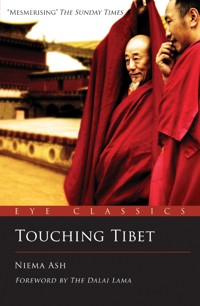
Niema Ash was one of the first Westerners to enter Tibet when its borders were briefly opened in 1986. Visiting at a time when tourists were few and far between allowed her to encounter people for whom traditional life had been unchanged for generations. Their humour, spirituality, and sheer enthusiasm for life had carried them through years of oppression. Niema relates her experiences in this absorbing personal tale with wit, compassion and sensitivity. Despite the determined efforts of the Dalai Lama to publicise the Tibetan cause, to this day the people, culture and traditions remain mysterious to many. Touching Tibet gives an insight into the heart and soul of this magnificent and enigmatic country.
Sie lesen das E-Book in den Legimi-Apps auf:
Seitenzahl: 449
Veröffentlichungsjahr: 2010
Das E-Book (TTS) können Sie hören im Abo „Legimi Premium” in Legimi-Apps auf:
Ähnliche




















This Eye Classics edition first published in Great Britain in 2011, by:
Eye Books
29 Barrow Street
Much Wenlock
Shropshire
TF13 6EN
www.eye-books.com
First published in Great Britain in 2003
Copyright © Niema Ash
Cover design by Emily Atkins/Jim Shannon
Text layout by Helen Steer
The moral right of the Author to be identified as the author of the work has been asserted.
All rights reserved. No part of this publication may be reproduced, stored in a retrieval system or transmitted in any form or by any means without the prior written permission of the publisher nor be otherwise circulated in any form of binding or cover other than that in which it is published and without a similar condition being imposed on the subsequent purchaser.
British Library Cataloguing in Publication Data
A catalogue record for this book is available from the British Library
The paperback edition of this book is printed in Poland.
ISBN: 978-1-903070-67-3
For my daughter Ronit
CONTENTS
ACKNOWLEDGEMENTS
FOREWORD
INTRODUCTION
ENTERING TIBET
IN LHASA
TIM, DOUNE AND NIEMA: FREAK SHOW IN CHINA
THE BANAK SHOL: MEDIEVAL GUESTHOUSE
OLD LHASA
NEW LHASA: PASCAL, IAN AND JAYE
THE SKY BURIAL
TASHI
OUTSIDE THE POTALA
CELEBRATING THE BUDDHA’S BIRTHDAY
INSIDE THE POTALA
TRIP TO NAGARZE
PEMA
SERA MONASTERY
REINCARNATION AND THE DALAI LAMA
THE MANI STONE
LEAVING LHASA
LEAVING TIBET
BACK IN CHINA
THE BROTHERS: A TIBETAN TALE
EPILOGUE
IMPORTANT DATES
KEY ISSUES
TIBETAN ORGANISATIONS
ABOUT THE AUTHOR
ACKNOWLEDGEMENTS
With thanks to Gil Elliot for his valuable suggestions in the early days and for his support throughout; to David Wallenchinsky, Cedric Smith, Ugyan Norbu, Gyurme Dorje, Phuntsog Wangyal and Stephanie Rayner for their help; to the Tibetan specialists, Stephen Bachelor and Glenn H. Mullin for their corrections. Very special thanks to Tim Fowkes and Doune Storey for helping me remember, and for a constant supply of encouragement, and especially to Tim for his patient understanding.
FOREWORD BY HIS HOLINESS THE DALAI LAMA
It has never been easy to visit Tibet, the high mountains and empty plains which surround it have deterred all but the hardiest travellers. In the past, even those who overcame such difficulties were viewed with suspicion by the local people and discouraged from continuing their journeys. Nowadays, despite great improvements in travel facilities, it remains almost impossible to visit Tibet, because the Chinese occupying forces wish to conceal their treatment of the Land and its inhabitants from outside view. As a result Tibet continues to be surprisingly unknown to the world at large, whether in terms of its spectacular landscape, its colourful history or the present plight of its people. For a brief period travellers were allowed almost unrestricted access and a fortunate few managed to take advantage of it. Niema Ash was one of those and in Touching Tibet she tells of her adventures.
No one can communicate an experience better than someone who has felt it themselves. Here the author shares her fervour not only for the awesome terrain with its striking landmarks, but also for the Tibetan people whose warm-hearted human qualities are undiminished by the hardship they have undergone. I hope that readers will enjoy the book as well as learning something about Tibet.
INTRODUCTION
This book does not profess to be a sociological, political or historical study of Tibet, nor is it an intellectual discourse, rather it is an experience, an adventure, a journey. You, the reader, will discover Tibet, as I, the writer, discover it. You will come to know the country and its people, their heartache, their joy, as I come to know them. You will travel with me, laugh with me, hurt with me as Tibet enfolds before us – its culture, its rituals, its celebrations, its sorrows. You will come to understand, as I came to understand, why such a remote country, with a culture, a life style and a spiritual focus so removed from our own, has captured the imagination of such a wide spectrum of people – travellers, artists, writers, movie directors, TV and film celebrities, pop stars, politicians, statesmen and women, world leaders, as well as ordinary people with interests neither in politics nor in travel. You will journey through a landscape which is no longer traversable, discover the spiritual richness, the incomparable treasures hidden in a poor, remote, isolated corner of the earth; you will see a picture of Tibet which can no longer be painted.
Entry into Tibet has been forbidden for centuries. Once, in bordering Nepal, I stood gazing up at the distant, towering, snow mountains encircling Tibet and I instinctively felt that those peaks enclosed a land truly different from others, a land unknown, a people unknown, and I experienced a great desire to know. Miraculously, I was granted that opportunity some years later, when Tibet’s Chinese occupiers, exploiting an opportunity to obtain hard foreign currency, earth to shout her cry for Tibet from its loftiest peak; or organizations like Tibet House in New York, chaired by the actor Richard Gere, who declared 1991, “The Year of Tibet” and initiated worldwide programs and events dedicated to the survival of Tibet – talks, exhibitions, performances, marches, candlelit vigils, anything possible, anywhere possible to build awareness of the great loss to civilization should the Chinese succeed in their 25 years of attempted genocide.
When I was in Tibet I hardly came into contact with the Chinese. I stayed in a Tibetan guest house, ate with Tibetans, travelled with them, visited their monasteries, their temples, and their homes. But all that has changed. Now Tibetans can be punished for talking to foreigners. Surveillance cameras are everywhere. It is only possible to enter Tibet as part of an organized group. Tour groups are assigned guides, agendas are set by Chinese officials and carefully monitored, deviation is forbidden. Armed soldiers stand guard to ensure this.
The Lhasa I knew was mainly a Tibetan city with a strong Tibetan identity. You will experience with me its smells, its sounds, its tastes, before the Tibetan section was reduced to 5% of the city, before the Chinese introduced bars, discos, prostitution; before they used karaoke and casinos to undermine the Tibetan identity, before Lhasa was ringed with gun posts, and resounded with military activity.
Along with me you will venture into the magnificent Potala Palace, home of successive Dalai Lamas, the sacred centre for all Tibetans, before it had a fun fair built at its back, before the village of traditional houses at its base was razed to the ground and replaced by a large Tiananmen style concrete square, decorated with military emblems and glaring lights; before it was studded with surveillance cameras both inside and out; before this most holy place for Tibetans, the very symbol of Tibet, had been reduced by the Chinese, to a quaint relic, an entertainment, at best, a museum.
However, the Chinese attempt to destroy the Tibetan soul by destroying its national identity, its language, religion, culture, customs, its heritage, even its dress, has not succeeded. Being in Tibet at a time when I was free to experience the land and its people, free to appreciate the beauty and value of its unique culture, allowed me to see why this is so. I came to know what sustains the Tibetans, what gives them the strength to survive the brutality of Chinese opened its doors to individual travellers. I was fortunate to come to Tibet during that brief period, before the Chinese sealed it once again from the eyes of the world, admitting only a peep-hole glimpse, with the spy glass under their strict control.
In Touching Tibet you will experience Tibet in a way which is no longer possible, participate in its most sacred rituals, now forbidden, travel with Tibetans, enter their homes, enter their world, see it both from the inside and the outside, as I was able to see it before the close association with Tibetans became too risky. I will take you with me to meet Tibetans, to spend time with them, to come to know a people who are not consumed with the acquisition of material things as their source of happiness, who do not devote their talent and energy to creating instruments to kill fellow humans, who believe that peace in one’s heart and peace in the world are connected, who have not attacked another country for over 1000 years. You will come to know a people whose religious beliefs do not compel them to convert others, who live toleration, caring for people, for animals, for the environment, for peace in the world; who honour a spiritual leader whose main platform is compassion and non-violence. You will contact one of the great spiritual civilizations on this planet. You will see, up close, what is being lost to humanity through the Chinese policy of cultural and spiritual extinction; to understand why Tibetan survival is so important for humankind; to understand why we have many lessons to learn from Tibet.
We live in a time when genocide is prevalent – the holocaust, Yugoslavia, Rwanda; when leaders wipe out millions of their own people – Hitler, Stalin, Mao, Saddam, when we have become hardened to massacres, to killing fields. Yet the plight of the Tibetans, the injustices perpetrated against them, has not only touched the hearts of so many diverse groups of people, but has moved them to action. Celebrities like Annie Lennox, Paul McCartney, John Cleese, George Harrison, Sting, David Bowie, Kate Bush, to name only a few, have added their voices to protest the unjust imprisonment of a Tibetan musicologist; Film makers like Martin Scorsese has movingly portrayed Tibetan life before the Chinese invasion, in a feature film, Kundun, centring on the Dalai Lama; ordinary people like Tess Burrows, who at the risk of her own life made a desperate climb to the top of the highest mountain on occupation, to survive their once peaceful country being turned into a military bastion. I came to understand why Tibet holds a special place in the human heart. I hope by reading Touching Tibet you too will come to understand.
ENTERING TIBET
Twenty minutes before landing, the clouds part like a heavy grey curtain heralding a drama to reveal a spectacular scene – the Himalayas. The sky is lit by sunshine, the blue laced with delicate white clouds. The mountains are magnificent: snow-capped summits, creased with purple shadows, glinting with frozen lakes, etched with glaciers. Rugged peaks jut through the clouds, piercing the fragile webbing with a powerful thrust. It’s a stunning vision – awesome, grand. Amongst these mountains lies Tibet, inaccessible.
I am totally entranced by the miracle which allows me to float above the Himalayas, delighting in the nuances of colour and texture, when suddenly the small Chinese aircraft dives through the mountains and plummets into a gorge, wrenched from the splendid panorama in the heavens. The mountain walls, hung with ice, loom steeply, tight against the plane, obliterating the sun. The floor far below is a dark desert, with sand rising into strangely sculpted dunes like alien gravestones, creating a death valley. The valley curves and the plane leans sharply and swerves around the side of a mountain like a racing car rounding a bend on two wheels. Hunched against the possibility of wings scraping against rock, I suck in my breath, cold on my teeth, as we dip through the precipices into a frigid moonscape. Flying at high altitude, the mountains were superb, majestically aloof. Now, deep in their midst, they are desolate and frightening.
The landing is terrifying. It’s as though the pilot is on a kamikaze mission. Abruptly, we plunge deeper into the mountains. A river with a shoreline of rock appears beneath us. We are falling fast toward the river. There is nowhere to land. I’m glued rigid against the window as we drop lower and lower, sweeping through crevasses with cold blue hearts, skimming over the river, engines screaming. We are so close I can see ripples on the water. It seems certain we will hurl ourselves into the river or smash into the mountains. My body is clenched like a vice, braced for the inevitable, when suddenly, magically, a thin ribbon of runway appears at the base of the mountains. With engines roaring, we glide to a stop. The pilot receives a standing ovation.
We disembark from the modern plane with its reassuring comforts into the disturbing landscape. A few yards from the plane the runway returns to the sand dunes, as though it never existed. There is no trace of welcome. No airport buildings, nothing to greet us except the bare mountains and several buses squatting in the sand.
I take a last look at the shining plane and follow the other passengers into the sand. Tim, Doune and myself were the only Westerners on the plane; the other passengers were Chinese. We had been travelling together in China for several weeks when we discovered Tibet was suddenly opened to individual travellers. The miracle had happened. We made an instant decision to go, and to go quickly before the Chinese authorities, who control Tibet, changed their minds. There is only one way to get to Lhasa quickly: by air from Chengdu, a town in the province of Sichuan. We took a train to Chengdu, and from there the first available plane to Lhasa, operated by CAAC, the National Chinese Airway.
I had always longed to visit Tibet, a yearning fired by the lure of the unattainable; Tibet was a forbidden kingdom, with no foreigner allowed entry. Once, in Nepal, I made a pilgrimage to the border, obsessed with getting even a glimpse of Tibet. That glimpse was the most anyone could hope for. Until the twentieth century, so little was known about Tibet that most maps left it blank. The mysteries of the remote mountain kingdom were kept jealously intact. For over a century, no foreigner was allowed to enter the city of Lhasa’s holy domain. Now I am on my way there. The trauma of the entry suddenly enhances the privilege.
Chinese buses are always packed, and in the desperate struggle to get on board, the usual courtesy shown to foreign guests vanishes. Boarding a bus is the only belligerent activity I have witnessed in China. All aggression is saved for this moment. Now the moment has arrived. The Chinese swing into action in a frenzied outbreak of pushing and shoving, which causes the gentle, soft-spoken Doune to shout, “Animals! You’re behaving like animals!” The Chinese take no notice.
Tim is more convincing. After two months in India, he has refined the skill of “push and shove” into an art. Tim is a master shover. Being a powerful six foot two helps; his featherweight competitors barely reach his shoulder. Releasing a martial arts scream which stuns the opposition, he claims the entrance and the choice seats. Doune and I recede from the fray, and after the others have squeezed on the bus, we enter, like ladies. Everyone is finally seated and the bus is about to pull away when Doune begins to look around frantically. “Where are the bags? They haven’t put the bags on the bus.”
“I’m sure they’ll meet us in Lhasa,” Tim says reassuringly. “Nobody else seems worried.”
We have to assume that somehow our baggage will appear in Lhasa. In any case, there is no one to consult. The aircraft staff didn’t bother leaving the plane. I can’t blame them. This isn’t exactly an ideal place for “R & R”.
The Lhasa bus is old and worn, but more comfortable than it looks. We settle into the thinly padded purple seats. I am secretly pleased. Purple is my favourite colour. Almost everything I have with me is a shade of purple. A good omen. It’s nine am, a lovely June morning, warm and sunny. We begin to relax. About half a mile from the landing strip we see several wooden huts with a stream of people leaving them, carrying luggage, heading for our plane and Chengdu. Later, we learn that they have spent the night there. Anyone leaving Lhasa by plane must spend the night by the runway. We soon discover why. The road from the airport to Lhasa is totally unpredictable, only partially paved, with roadworks in progress and inevitable long waits. With exceptional luck, the trip should take about two and a half hours, but can easily take seven or eight. Our luck is average, and the trip takes five hours on a dusty road strewn with rocks, holes and ditches. The landscape is parched and inhospitable, with a few stark villages set among the barren mountains. There is nothing green. The only colour comes from prayer flags on the roofs of huts, torn bits of rags impaled on twigs. What a bitter place to live.
Bumping along in the hot bus, I muse on my obsession with Tibet. Did it begin years ago when I first saw a picture of the Potala Palace? That image became permanently etched in my imagination, the symbol of my travel dreams. I was not alone – I had never met a traveller whose eyes did not light up at the mention of Tibet. Yet I had never met anyone who had actually been there. I knew nothing about Tibet, its history or its culture, and my travel information was limited to a few sentences hastily uttered during a chance encounter. The last day I was in Chengdu, I was lunching alone in the hotel dining room. Several Americans were at the next table and I overheard one of them saying he had just returned from Tibet. I was hungry for information.
“I’d like to help you, but I must run,” he said. “I have to meet this Swedish chick in the bar,” he added, with a gratuitous wink. However, he did manage to say, “You can’t get permission to go anywhere outside of Lhasa, and Lhasa gets boring after three days – absolutely no nightlife. And, oh yes, don’t forget to take surgical masks; it can get very dusty.” (This last bit of advice was to prove invaluable.) Then he mumbled something about the Number One Chinese Guesthouse being the best place to stay because it was sanitary and hygienic. I decided to avoid it. He started to leave, then suddenly turned back as though he had forgotten something especially important. “If you want to blow your mind, go to the sky burial.”
“The what?” I asked, but he’d already rushed off.
I try to console myself for my ignorance. Perhaps it’s an advantage that I know so little about Tibet. I can see it with a freshness untainted by expectations. A lurch jolts me out of my speculations as the bus stops abruptly. Roadworks. We line the roadside and watch the workers smashing rocks with sledgehammers. After more than an hour, I grow restless and wander away toward the mountains. In just minutes, the road, bus and passengers are swallowed by the landscape. I find myself alone in a valley of twisted rocks – tombstones in an alien cemetery. The silence is like eternity. I creep carefully among the boulders, conscious of their hostility, feeling soft and vulnerable as they graze my skin. I am the only living thing trapped in a soundless universe unchanged since creation.
I shudder as though someone has walked over my grave. Hurriedly, as if pursued by ghosts, I retrace my steps, startled by the voices of the passengers squatting by the roadside. I enter the bus tentative and silent.
As we approach Lhasa we begin to see foliage, meadows, trees, flowers. I drink in the moisture, nourished by the green life. Then, in the distance, I see golden domes shining in the barren hills: the Potala, with its miracle of smooth, rounded shapes rising in the blue sky, glowing like a vision. After the harsh mountain peaks tearing at the heavens like broken claws, the domes are a welcoming embrace, a circle of comfort. Then, suddenly, the full force of the Potala Palace. As though aware of the impact, the bus slows down.
Brilliantly etched in sunshine, a powerful structure of white, red and gold dominates the mountains. The image is so intense that for a moment my eyes shut tight as though encountering a dazzling light. But as I succumb to the sense of wonder, an unexpected surge of joy sweeps through me. It is more than the excitement of finally seeing something I’ve imagined for so long. It is an exhilaration, an elation, beyond the scope of reason.
I am not a religious person. I subscribe to no church. I have never been on a spiritual quest. Yet I am aware that I am entering an unexplored spiritual realm. I feel like the Wandering Jew first glimpsing the Wailing Wall, or the Arab pilgrim finally entering Mecca. Instinctively, I know that the Tibetans have some special secret to survive the unsparing Himalayas and create from bare rock this Potala Palace. I know too that I will have to experience both extremes to understand that secret, to fathom any of the mysteries of this mythic mountain kingdom. I have no idea how I will do this, but the possibility excites me. Travellers make lucky things happen. I hold the image of the Potala carefully, closing my eyes to preserve it, as the bus moves on into the Forbidden City.
IN LHASA
I say nothing to Tim and Doune. Not yet. In any case, there is no time. Within minutes, my spiritual reflections come to an abrupt end. The magic and the mystery vanish as we are unceremoniously ejected outside the CAAC office and plunged into the uninspired ordeal of baggage arrangements.
The CAAC office is a large, bare room with people milling about. There are no facilities of any kind. I watch enviously as fellow passengers disappear into waiting arms. No one expects us. Our bags are nowhere in evidence. We search inside and outside for some clue to their whereabouts. “Perhaps the bags are on one of the other buses,” Doune suggests, always hopeful. We wait until the last bus arrives and the last passenger disappears, but there is still no sign of our bags. Our twenty word vocabulary, so far at the “neehow” (hello) stage, gets us nowhere. Finally, Chinese phrase book in hand, I approach a man wearing a tarnished badge, who looks vaguely official. He smiles and I am encouraged. I find the perfect phrase under “travel by air,” sub-section “airports.” It reads, “Where are my bags?” I point enthusiastically to the Chinese version. The man shrugs his shoulders, still smiling. Tim takes the book and thumps his finger in staccato beats under “Where are my bags?” indicating he means business. The man looks bewildered. Suddenly, we realise he is Tibetan and doesn’t read Chinese. He has, however, understood that Tim is in earnest, and hurries off obligingly in search of assistance.
He returns with a young, efficient-looking Chinese lady. Assisted by the phrase book, I make another attempt. “Where are my bags?” I point, trying to convey a sense of urgency. She nods with crisp understanding. Thumbing through my book, her eyes light up as she points to a word. Relieved, I peer at the word. It translates as “tomorrow”.
My face squeezes into a perplexed grimace as I mutter “tomorrow” to Tim and Doune who are anxiously following the procedure. “She can’t mean ‘tomorrow’,” Doune moans.
“That’s exactly what she means.”
“Give it another go,” Doune urges.
I repeat the process from the beginning, and again the answer comes up “tomorrow”.
Conceding defeat, I hand the book to Doune. “You try. Maybe your Chinese is better than mine.”
With infinite patience perfected by her travels in the East, Doune (assisted by Tim, who is far less patient) begins the tedious process of search-and-point in an attempt to extract more information. The Chinese lady is coolly polite. She’s had enough of us by now, and is anxious to end the interview.
I collapse on the floor, suddenly worn out. My psyche has been fragmented like a kaleidoscope, shaken by the day’s turmoil of emotions and events; my body is shattered by the altitude. Lhasa is on a high plateau 12,000 feet above sea level. The air is extremely thin, and, for the newly arrived, exhaustion comes easily.
Finally, Doune relays the news. “Our bags are not here. We have to come back tomorrow to get them,” she sighs.
“I don’t believe it,” I say, believing it at once.
She thanks the Chinese lady and the Tibetan man, for whom the charade has been riveting, even if incomprehensible.
“Thanks for what?” I ask wearily. “Why didn’t anyone tell us? What will we do without our bags? Doesn’t it get cold at night? We have nothing to wear. What about toothbrushes? Soap? Look at us, we’re covered in dust.” Increasingly forlorn, I recite the hopeless litany, knowing there are no responses.
Tim and Doune join me on the floor, disheartened. We are feeling lost and more than a little faded – drained by excitement, altitude, fatigue and now no bags. We’ve been awake since four am. It’s one of the less exotic travel adventures. There follows some moments of replenishing silence during which the disjointed fragments of my brain slowly knit. “Never mind our bags,” I say, with renewed optimism.
“We’ll get them tomorrow. It’s better that way. At this point I couldn’t carry a handkerchief. The amazing thing is that we’ve made it to Lhasa. We’re actually here.” For a moment, overcome by exhaustion and frustration, I had forgotten to give thanks for being in Tibet.
“You’re absolutely right,” Doune agrees. “We’re in Lhasa, and that’s what really matters. I’m over the moon.” But in truth, it’s difficult to be over the moon, or even under it, while breathing thin air.
The ever-practical Tim is already studying a map drawn for him by a traveller he met who suggested we stay in a Tibetan guest house called the Banak Shol. “I’ve got it together,” he announces. “No point hanging around; let’s get out of here.”
Standing up feels like a day’s work. The Banak Shol is in the old part of Lhasa, a long walk from the CAAC building, which is in the new Chinese section. We make our way, too tired to talk, intent only upon getting there. As I struggle to keep pace with Tim and Doune, their legs much longer than mine, I make a point of looking only straight ahead, not wanting to spoil my first impressions with an unreceptive mood.
We arrive dusty, hot and faint from lack of oxygen, but the sight of the Banak Shol revives us. Like the embrace of an old friend, it bestows an immediate welcome. Unlike hotels in China which are often vast and formal, built by the Russians with Western conveniences, this guesthouse is small and primitive, and although there is nothing Western or modern about it, it has a familiar comforting feel. A boy of about fourteen, squatting by the open doorway, greets us with a friendly smile. “Room?” He enquires. We nod enthusiastically.
“You speak English?” I ask, delighted by even the possibility of verbal exchange.
“A leetle,” he says.
He shakes hands with each of us and the matter is settled. There are no forms to fill, no hassle with tourist currency, none of the usual Chinese formality. Grateful, we follow him upstairs to our rooms. “This is definitely where the Tibetans stay,” Tim observes, obviously pleased. I admire his ability to communicate. I can hardly breathe, let alone speak, my heart thumping wildly as I climb the two flights of stairs. We walk along a balcony which runs the length of the building. And in spite of my thumping heart, the sight of the mountains, sparkling with patches of snow, brings a flash of pleasure. I make a mental note to take a more leisurely delight in them once we are settled.
All the rooms are off the balcony. A door leads to an entrance room with three bedrooms leading off it. The rooms are small, with blue and yellow plywood walls, colourful quilts and two narrow beds, painted red. A chipped wooden table, a chair and a washstand containing a flowered enamel basin complete the furnishings. There are about eight of these units, each with three rooms and entrance. There are no amenities whatsoever. The loo is a slit in the floor of an outdoor shack at the top of the stairs, and there is no running water. Through mime and a few English words, the boy explains that we each get one flask of hot water daily for all washing and drinking needs. But right now it feels like the Hilton. We make a decision to splurge and take an entire unit, all three rooms. The idea of privacy is appealing, as we have been sharing rooms for some weeks, ever since we began travelling together. Besides, it’s not exactly a fortune at $2.50 a night each.
Clutching a thermos of water, I retire to the luxury of my own room, grateful to be alone and quiet. The first thing I do is pour some water into the basin, watch it cool and sink my face, hands and arms into the liquid, feeling my parched skin suck in the moisture. Over and over, slowly, carefully, like some healing ritual, I repeat the process until gradually I begin to revive. My dehydrated skin tingles as it dries quickly in the pure clean air. As I stretch out on the bed, the strands of muscles wound into knots begin to uncoil. The tension drains from my body in diminishing waves. The events of the day, tumbling through my brain, pause. I become stilled by a satisfying sense of achievement. Today I made it to Lhasa. It wasn’t easy, but in the end everything worked out; somehow it always does. And now, excited yet quiescent in the aftermath of exertion, contentment eases my body and mind into perfect tranquillity. Drifting into Tibet, I close my eyes for a short respite. The day is not over; the journey just beginning.
TIM, DOUNE AND NIEMA: FREAK SHOW IN CHINA
Three weeks earlier, Tim, Doune and I were strangers. We became acquainted in the Hong Kong check-in queue at Bangkok airport, and shared a seat on the plane. We also shared a taxi since we were all going to Chungking Mansions, known as Junkie Mansions by travellers forced to stay there, because reasonably priced accommodation was scarce in Hong Kong. It was soon evident that we had much in common. We all lived in London (although I was originally from Canada) and had been travelling in Asia for several months. We were all heading for China, about which we knew very little, and were planning to spend about three months there. We all had low but not desperate budgets. Most importantly, we all recognised that we had a special rapport, and decided to join forces in one of those frequent, if temporary, “comings together” – the overland traveller’s equivalent of the ship-board romance, usually minus the romance.
The decision to travel with others was unusual for me. If travelling was my favourite thing in life, being on my own was my favourite way of travelling. The experience was very different from travelling with a partner. I was more exposed, more vulnerable, but also more aware; my senses were finely tuned, absorbing the full impact of experience without the cushion of a companion. Being with someone else was like travelling with blinkers. You didn’t have to look right or left, but only straight ahead, or toward each other. Alone, I was dependent on the people I met, forced to engage.
There were more risks – but I enjoyed risks – and more rewards, like the time I waited on a small road in the mountains of Thailand, hoping for a bus to take me to the Hill Tribes Information Centre. A little pickup truck stopped with a Thai driver who spoke some English, plus several Chinese men and women. “You are too much alone standing on the road,” the driver said. “Better for you to come with us.” He offered me a ride to a Chinese refugee village deep in the mountains, totally out of my way. I had to make an instant decision. I accepted.
The experience was one of the most rewarding I had in Thailand. By the time we got to the village, struggling up recently widened roads where only donkeys had climbed a month earlier, it was late afternoon. Transport to and from the village was limited; the Chinese need official passes to enter and leave. Nothing was leaving that day or the next. For two days, I became the guest of the Thai military who were in control. I attended classes in Thai, ate and slept with the villagers and admired the opium poppies presented to me by grinning soldiers. I was part of village life, with a privileged glimpse into how the refugees lived and the military operated – a fascinating two days.
On my own, I made more contact and learned more about the local people, who trusted me because, being female and alone, I was no threat. I also learned more about myself, developing resources I never knew I had. I felt most alive, vibrating with a sense of adventure, like an explorer uncovering new territory.
Being a woman on my own in South-east Asia presented no special hazards. Unlike North Africa, especially Morocco, where the atmosphere was charged with sexuality, or Mediterranean countries like Italy, where men were always trying to rub up against you, the Asians – mainly Buddhists – were polite and respectful. There were no lecherous eyes, no lurid invitations, not even an obscene gesture. With the exception of India and Muslim countries like Malaysia and Java, there was hardly a trace of sexual innuendo. I was free to make my own choices.
However, although partial to the freedom and adventure of travelling alone, I wasn’t oblivious to the virtues of an alliance with fellow travellers. The advantages were undeniable: sharing experiences, dividing the tedium of being one’s own travel agent and not having to enter places alone, to say nothing of the comfort derived from knowing someone is there who cares if you live or die. Besides, it was cheaper. The disadvantages were equally undeniable: compromises, disagreements and having to submit to someone else’s rhythms, to name but a few.
However, my liaison with Tim and Doune was a union made in heaven. China was too difficult to navigate alone. In the infancy of its tourism, it had little experience with foreign tourists and less with individual travellers. It didn’t even know if it wanted them. Confusion and inconsistency prevailed. In London, when applying for a visa, it was not uncommon to be told that one could only visit China as part of an organised group. Yet in Hong Kong, there was no such restriction. Tourists travelling in tidy pre-packaged tours, bringing in big bucks, were definitely desirable. Travellers, over whom there was little control, who challenged the rules, who appeared in places for which permits were not granted, and who resisted paying inflated tourist prices, were at best a nuisance. China was not set up to accommodate them.
It was hard to find anyone who spoke anything but Chinese. Information was difficult to obtain, and the invaluable travellers’ grapevine was undeveloped. Desperate for information and advice, travellers meeting for the first time became instant bosom buddies, whereas in most countries they would have passed each other unnoticed. The resulting conversations were more like interviews than discussions. “Where did you stay?” “How did you get there?” “How much was it?” Essentially one was on one’s own, with only the help of a recent Lonely Planet guidebook, China, a Travel Survival Kit (affectionately known as ‘The Bible’), which every traveller clutched, even though it was already outdated. Although this made travel in China exciting, it also meant that it was fraught with frustrations, hard to bear alone.
One major frustration was caused by the inevitable ‘mayo.’ ‘Mayo,’ the big word in China, was a combination of all the negatives the traveller dreaded. “Don’t have, don’t know, don’t want to know, even if we did have we don’t have, go away.” It was used extensively by officials in ticket offices, hotel receptions, and other places where the traveller’s need not to hear it was greatest. It had a short, sharp finality which left the traveller, weighed down with backpack, miserable and hopeless. That is, until he learned the magic response to ‘mayo’: “Yo. You do have, if you don’t have you’d better get, because if you don’t I’m going to stay right here until you do. I’ll even sleep in the lobby; think of the impression that will have on the other guests.” A firm ‘yo’, accompanied by a smile – losing one’s temper was fatal – and the unbuckling of one’s rucksack, to show one meant business, worked wonders. The Chinese have a passion for neatness and order, coupled with a deep-seated respect for guests, especially foreign guests. They detest scenes. A determined ‘yo’ created havoc, challenging tradition and the foundations of their thinking. They were thrown by someone who defied authority, who willfully refused to obey, especially when that someone was a foreign guest. The ‘mayo-yo’ battle could be a protracted one, but if fought relentlessly yet tactfully, a room or a ticket somehow became available. However, it was a battle I could not fight on my own. Reinforcements were essential.
Another major frustration resulted from the tricky money situation. The official currency in China was called Remembi, or RMB, the people’s money. Foreigners, however, had a special currency all their own called FEC, Foreign Exchange Certificates. This currency, not available to the local Chinese, allowed foreigners to shop in special tourist places, like the Friendship Stores. Of course, the Chinese wanted FEC in order to shop in Friendship Stores and acquire scarce luxury items.
Although the tourist FEC and the Chinese RMB were theoretically equal in value, the Chinese were willing to give more RMB for FEC. A black market resulted, enthusiastically supported by travellers, who could increase the value of their money by fifty to seventy percent. The problem was disposing of the RMB once procured, since tourists were supposed to pay in FEC. Using RMB instead of FEC became a way of life.
Tim had a special talent in this field. He always carried a wallet containing only RMB. When someone – for example, a taxi driver – pointed to a sign saying, ‘FOREIGNERS MUST PAY IN FEC,’ Tim would insist, “Mayo FEC,” and open his wallet displaying only RMB. Being polite and kindly, like most Chinese, and not wanting to create a scene, the driver eventually acquiesced and accepted the RMB. The trick was to ignore the sign ‘FOREIGNERS MUST PAY IN FEC.’ It helped to flash a fake student card obtained in Junkie Mansions, certifying that ‘The bearer is a Student in Taiwan, studying Chinese.’ Since the Chinese considered Taiwan a renegade province but still part of China, this entitled someone studying there to the same privileges that the Chinese enjoyed, including paying Chinese prices, often half those foreigners paid, and of course paying in RMB. But, since many employees who worked for institutions like railway stations and hotels were becoming wise to the devious methods of travellers, this was no mean achievement. Skills in the art of bluffing and in ‘out-mayoing’ the Chinese were best pooled.
Aside from the effort exerted in spending RMB, there was the paranoia produced by procuring it. In Guangzhou (formerly Canton), where the majority of travellers entered China, the main streets were lined with ‘change money’ ladies. Every few yards a female would furtively approach the foreigner, surreptitiously chanting “change money, change money,” and attempt to lure him down some back street. I saw several of these ‘change money’ ladies pulled away by police, arms twisted behind their backs. The police, however, did not interfere with foreign guests, who officially had a special status and could do pretty much as they liked so long as they didn’t kill. Despite this, doing black market deals in dubious alleyways was unsettling. The required dedication, mathematical skill, bargaining ability and the fear of police interference resulted in a host of anxieties which were best shared.
In this atmosphere of uncertainty, where one invented the rules as one went along (because even the Chinese didn’t know them), it was a blessing to have Tim and Doune for support. Besides, a single room was the same price as a double, and a triple hardly more.
Visually, we were a trio of stunning impact. For the Chinese, isolated for so long, any Westerner is the object of intense curiosity and unabashed stares. But onto the spectacle provided by the ordinary Westerner, with his kettle-spout nose, strange attire and high-tech equipment which bleeped, buzzed, flashed and even played tunes, we superimposed extraordinary dimensions. Our act was unique. First of all, there was our height. In China, I was a good size, whereas in the West, I was several sizes too small. Just over five feet, I was described as ‘petite’ by kind friends. In my own view, I barely made it as a normal member of the human race; anyone shorter was deformed. Whereas I measured up to Chinese standards, Tim and Doune did not. Doune was an outrageous five-foot-eight, and Tim loomed six-foot-two, like some Swiftian giant.
As though the preposterousness of our heights weren’t enough to engulf us in a sea of mesmerised eyes, fixed in unblinking wonder, there were the dual phenomena of non-human hair and eyes. Except for the elderly, women in China all had straight black hair, usually long, and men were clean-shaven with straight short black hair. Both Doune and I had curly hair, like sheep, and Tim sprouted hair from his cheeks and chin, like a monkey. My hair had the sensitivity to be long and dark, and my eyes to be brown, but Tim’s hair was an indecent sand colour, his eyes cat-green. Doune was a worse transgression, with hair not only short and curly, but the colour of honey, and eyes the colour of sky or sea. Most Chinese had never imagined such variety in human appearance, let alone encountered it. We were the cause of major bicycle accidents. When we walked out together, the Lilliputian and the Giants, flagrant in our gross abnormalities, it was as though the freak show had come to town. We could have made a fortune selling tickets.
THE BANAK SHOL: MEDIEVAL GUESTHOUSE
As I stretch out on my narrow Banak Shol bed, slipping into a delicious sleep, my well-being suddenly dissolves. I am wrenched into anxiety by a heart thumping, rapid, erratic, boom-boom-boom, executing double somersaults, trapped like a wild thing crazy to escape. Instantly, I am wide awake. I take my pulse. It’s one hundred and twenty. Normally it’s around seventy. I remember Steve, a young American doctor I met in Burma, who had been working with mountain climbers in the Nepalese Everest base camp, about the same altitude as Lhasa. Steve confided to me that Hillary himself had once come to his post suffering from altitude sickness.
“Hillary!” I said, surprised. “But he’s climbed to the top of Everest. Surely he must be used to high altitudes.”
“That’s something the body never grows accustomed to, it has to make a new adjustment each time,” Steve said. “Hillary may have been used to high altitudes, but his body wasn’t and he came down with all the plebeian symptoms, nausea, dizziness, headache, the works.”
If Hillary succumbed to altitude sickness, what chance do I have? I will my heart to beat slower. It refuses. I try not to think about Mr Nolan, an American I met who worked for his embassy in Beijing, but our discussion over coffee returns to haunt me. I compulsively review every detail.
“Do you have any special problems with American tourists in China?” I asked, hitting on a neutral topic.
Without hesitation, he drawled, “Yup, elderly folk dying in Tibet.”
“Dying?” My voice was edged with hysteria. “Dying of what?”
“They arrive in Lhasa, step out of the plane and some of those buggers drop dead right then and there. Their hearts pack in.”
“Right on the runway?”
He paused to savour my distress. “Sometimes they wait until they climb the steps of a monastery. But last week we had one old biddy who began bleeding from the ears as soon as she stepped off the plane and haemorrhaged to death right on the runway.” He gazed deep into his cup. “Getting the bodies back home is a real pain in the butt.” He sipped his coffee with great concentration, reflecting on transportation difficulties, while I gulped mine, anxious to leave before I heard any more.
Although Tibet had only just been opened to individual travellers, it had already been opened to tour companies. Groups of tourists were flown into Lhasa and housed in a specially built hotel miles from town. They were whisked from palace to monastery in an attempt to minimise their contact with Tibet, and especially with Tibetans. Their tight schedules precluded acclimatisation to the drastic change in altitude. The price for this guided marathon was so exorbitant that only the rich and retired, mainly elderly Americans, could afford to pay it. They were not in the best physical condition, not used to exertion and often already suffering from some form of heart problem. It was no wonder their hearts couldn’t cope.
I lie on my bed, prying Mr Nolan loose from my brain (hand on heart in an effort to smooth the bumps), tormented by Steve, Hillary, blood-stained runways and Shelley, who wrote, ‘Caesar’s bust is on the shelf, and I don’t feel too well myself.’ I forbid myself to think of Caesar or the elderly Americans, and especially of the lady bleeding from the ears. Besides, my heart is strong and healthy. Nobody in my family ever had a heart problem. With this tiny consolation, I finally fall asleep.
When I awake about an hour later, I am no longer aware of the effort my heart is making on my behalf. But having appeased my heart, I now have to gratify my stomach. I am hungry. We last ate light-years ago, in that happy encapsulated time in the heavens, before we met the Himalayas, indulging in great wads of oxygen and awful sanitised sweets. My room is next to Tim’s and I tap lightly on the wall in case he’s asleep.
“I’m up,” he says immediately as though waiting for my signal.
“Me too.” Doune’s voice is as clear as Tim’s. We are really sharing one room with flimsy partitions.
“I’m hungry,” I say.
“I’m hungry too,” Tim replies.
“Me too and three,” Doune chimes in.
“Let’s find some food,” Tim suggests.
“Brilliant,” Doune agrees.
I come to a slow sitting then standing position, not wanting to suddenly drop dead.
“The restaurant, or whatever it is,” Tim corrects himself, careful not to raise false expectations, “is downstairs, through the back.” Somehow Tim always knows these things.
I open my door and stagger into Doune. “Remember we have to take it easy until we get used to the altitude,” Doune cautions, lending me support.
“How can I forget? I’ve got altitude sickness on the ears,” I mutter.
“It’s just a matter of resting and not drinking booze. We’ll be all right,” Tim says, as he leads us down a narrow dirty flight of stairs at the other end of the balcony. It’s almost seven pm, but still light, and mercifully not cold as we’re only wearing T-shirts.
We pass through a small yard – stepping over some dubious puddles – enter a door and cross the threshold into a medieval kitchen. Near the entrance, several Tibetan men wearing broad-brimmed hats and sheepskin jackets, are drinking tea and chatting around a long wooden table. Conditioned in China, we attempt to slip by unobtrusively, shoulders narrowed against the anticipated barrage of curiosity. They smile and nod as we pass, their talking uninterrupted. Our entrance is totally unsensational. Nobody is dumbfounded, nobody falls over in his seat, nobody even stares. We sit on a bench by an empty table, blissfully ignored, in the middle of a scene which has the energy and profusion of a Brueghel painting, Tibetan-style.
The room we are in is large and windowless, with damp stone-walls and a door at either end, dim after the daylight, and smoky. The ceiling is braced by great wooden beams black with soot. Near our table is a brick oven and a wooden board, beside which two Tibetan girls – black braided hair tied with bright ribbons – sit kneading dough, pounding it into round flat loaves while singing. Another girl takes hot loaves from the oven, piles them into a straw basket and pops uncooked ones into the oven. They smile at us and continue working.
In one corner a man is pouring small steaming glasses of tea from a large sooty kettle. Near him is a massive blackened stove with round holes for woks, and a shelf beside it holds wooden bowls filled with vegetables, jars of spices, and wreaths of garlic. A woman wearing a less than spotless apron is stirring something in a wok. Scattered around the room are chopping blocks where old men and girls wearing dirty aprons and boots with pointed curled-up toes, are peeling potatoes and chopping vegetables. On one block chunks of cooked meat are steaming, on another a man is dismembering a yak, hacking at its joints, its silky black hair lying on the floor with other bits of rubbish.
Cut into the stone floor, a gully runs through the centre of the kitchen. While we are watching, a woman strains a noodle pot into it, the murky liquid raising a cloud of steam, a man spits with a direct hit and several people dump assorted slops. A dog wanders in and heads for the gully, check-ing for scraps. He looks well fed. Against one wall, a large tank with a spout provides the washing facilities. A woman stands scrubbing glasses and bowls with a toothless brush, the grey water flowing into the gully and spilling over on to the floor. She wears rubber boots and layers of shabby black clothing. The smell of baking bread and frying garlic mingles with the burning wood and cigarette smoke.
The table is sticky with soggy noodles and spilled tea. I clean it as best I can, while we assess the chances of getting fed. No one approaches. We’re treated with the casual familiarity of regulars at the local café and are reluctant to shatter that illusion. Our problem is solved by the arrival of two Westerners, who head straight for our table. “This is Texas Dave and I’m Gina,” a plumpish short girl with dark eyes says, as she plonks herself beside me. She has straight black hair with a fringe, Eskimo-style, and a pleasant round face. We introduce ourselves.
Tim stands up to shake hands. Texas Dave towers over Tim, a lean sinewy six foot seven inches. He looks like he’s been on the road a long time and enjoying it. His face is a leathery brown, lined with sunshine, wind and a stubbly beard. His eyes are bright blue. He wears a cowboy hat, boots and a sheepskin waistcoat. He’s right out of a Spaghetti Western; the good guy.
“Just get here?” he asks.
“A few hours ago,” Doune replies. He nods sympathetically.
“We were just wondering how we go about getting ourselves fed,” Tim says.
“OK.” Texas Dave takes matters in hand. “What you do is walk right up there.” He points to a table with white porcelain bowls piled upside down. “Get yourselves one of those babies, head for the stove and fill it up with whatever grabs you. There’s meat, vegetables, eggs, you’ll see when you get there. That lady chef will cook it up for you Tibetan-style.”
“What does it cost?” I ask, from force of habit.
“Oh she charges according to her mood. She looks in a fine mood at the moment.”
I glance over just in time to see her embracing a small boy as she wipes his nose with her grubby apron. My involuntary grimace doesn’t escape Texas Dave. “All in a day’s work,” he says, “takes a bit of getting used to. This place is as clean as a baby’s ass compared to most.” The simile does nothing to reassure me. “The Tibetans aren’t big on hygiene, but the food is primo,” he smacks his lips.
“Do you have your own chopsticks and mugs?” Gina asks.
“They’re a must here.”
Tim dips into his bag, which is almost part of his body, and produces three pairs of chopsticks and three white mugs with lids, like those the Chinese carry. ‘The Bible’ had advised buying chopsticks, as the wooden ones served in Chinese restaurants are a source of hepatitis. It also advised carrying mugs – hot water for making tea being available in hotel rooms and trains throughout China. We were never without either.
“Good.” Gina nods approval.
Texas Dave does a short investigative round of the chopping blocks to sample the menu of the day and returns to report. “There’s some nice-looking yak meat, just cooked up fresh, and some good-looking vegetables.”




