


164,99 €
Mehr erfahren.
- Herausgeber: John Wiley & Sons
- Kategorie: Wissenschaft und neue Technologien
- Sprache: Englisch
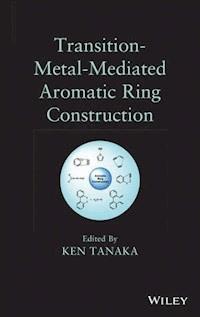
State-of-the-science methods, synthetic routes, and strategies to construct aromatic rings
The development of new reactions for the synthesis of aromatic compounds is a highly active research area in organic synthesis, providing new functional organic materials, functional reagents, and biologically active compounds. Recently, significant advances in transition-metal-mediated reactions have enabled the efficient and practical construction of new aromatic rings with useful properties and applications. This book draws together and reviews all the latest discoveries and methods in transition-metal-mediated reactions, offering readers promising new routes to design and construct complex aromatic compounds.
Integrating metal catalysis with aromatic compound synthesis, Transition-Metal-Mediated Aromatic Ring Construction offers a practical guide to the methods, synthetic routes, and strategies for constructing aromatic compounds. The book's five parts examine:
- [2+2+2], [2+2+1], and related cycloaddition reactions
- [4+2], [3+2], and related cycloaddition reactions
- Electrocyclization reactions
- Coupling and addition reactions
- Other important transformations, including methathesis reactions and skeletal rearrangement reactions
Edited by Ken Tanaka, an internationally recognized expert in the field of transition-metal catalysis, the book features authors who are leading pioneers and researchers in synthetic reactions. Their contributions reflect a thorough review and analysis of the literature as well as their own firsthand laboratory experience developing new aromatic compounds.
All chapters end with a summary and outlook, setting forth new avenues of research and forecasting new discoveries. There are also references at the end of each chapter, guiding readers to important original research reports and reviews.
In summary, Transition-Metal-Mediated Aromatic Ring Construction offers synthetic chemists a promising new avenue for the development of important new aromatic compounds with a broad range of applications.
Sie lesen das E-Book in den Legimi-Apps auf:
Seitenzahl: 820
Veröffentlichungsjahr: 2013
Ähnliche


















Copyright © 2013 by John Wiley & Sons, Inc. All rights reserved.
Published by John Wiley & Sons, Inc., Hoboken, New Jersey. Published simultaneously in Canada.
No part of this publication may be reproduced, stored in a retrieval system, or transmitted in any form or by any means, electronic, mechanical, photocopying, recording, scanning, or otherwise, except as permitted under Section 107 or 108 of the 1976 United States Copyright Act, without either the prior written permission of the Publisher, or authorization through payment of the appropriate per-copy fee to the Copyright Clearance Center, Inc., 222 Rosewood Drive, Danvers, MA 01923, (978) 750-8400, fax (978) 750-4470, or on the web at www.copyright.com. Requests to the Publisher for permission should be addressed to the Permissions Department, John Wiley & Sons, Inc., 111 River Street, Hoboken, NJ 07030, (201) 748-6011, fax (201) 748-6008, or online at http://www.wiley.com/go/permission.
Limit of Liability/Disclaimer of Warranty: While the publisher and author have used their best efforts in preparing this book, they make no representations or warranties with respect to the accuracy or completeness of the contents of this book and specifically disclaim any implied warranties of merchantability or fitness for a particular purpose. No warranty may be created or extended by sales representatives or written sales materials. The advice and strategies contained herein may not be suitable for your situation. You should consult with a professional where appropriate. Neither the publisher nor author shall be liable for any loss of profit or any other commercial damages, including but not limited to special, incidental, consequential, or other damages.
For general information on our other products and services or for technical support, please contact our Customer Care Department within the United States at (800) 762-2974, outside the United States at (317) 572-3993 or fax (317) 572-4002.
Wiley also publishes its books in a variety of electronic formats. Some content that appears in print may not be available in electronic formats. For more information about Wiley products, visit our web site at www.wiley.com.
Library of Congress Cataloging-in-Publication Data:
Transition-metal-mediated aromatic ring construction / edited by Ken Tanaka, Tokyo University of Agriculture and Technology, Tokyo, Japan. pages cm Includes bibliographical references and index. ISBN 978-1-118-14892-1 (hardback) 1. Aromatic compounds—Synthesis. 2. Transition metal catalysts. I. Tanaka, Ken, 1967– QD331.T73 2013 547′.6—dc23 2012049882
CONTRIBUTORS
Naoki Asao, WPI-Advanced Institute for Materials Research, Tohoku University, 2-1-1 Katahira, Sendai 980-8577, Japan; E-mail: [email protected]
Catherine J. Ball, Department of Chemistry, University of Oxford, Chemistry Research Laboratory, Oxford, OX1 3TA, UK
Shunsuke Chiba, Division of Chemistry and Biological Chemistry, School of Physical and Mathematical Sciences, Nanyang Technological University, Singapore 637371, Singapore; E-mail: [email protected]
Vincent Gandon, ICMMO (UMR CNRS 8182), University of Paris-sud, 91405 Orsay cedex, France; E-mail: vincent.gandon@u-psud.fr
Vladimir Gevorgyan, Department of Chemistry, University of Illinois at Chicago, 845 West Taylor Street, Chicago, Illinois 60607-7061; E-mail: [email protected]
Julien Grand, Laboratoire de Chimie Moléculaire et Thio-organique, UMR CNRS 6507, INC3M, FR 3038, ENSICAEN and Université de Caen, 6 Boulevard du Maréchal Juin, 14050 Caen, France
James Wallace Herndon, Jr., Department of Chemistry and Biochemistry, New Mexico State University, MSC 3C, Las Cruces, New Mexico 88003-8001; E-mail: [email protected]
Gerhard Hilt, Fachbereich Chemie, Philipps-Universität Marburg, Hans-Meerwein-Str., 35043 Marburg, Germany; E-mail: [email protected]-marburg.de
Yoshifumi Ishikawa, Department of Chemistry, Graduate School of Science, Tohoku University, 6-3 Aramaki aza aoba, Sendai 980-8578, Japan
Tsugio Kitamura, Department of Chemistry and Applied Chemistry, Graduate School of Science and Engineering, Saga University, 1 Honjo-machi, Saga 840-8502, Japan; E-mail: [email protected]-u.ac.jp
Puneet Kumar, Department of Chemistry, Henry Eyring Building, University of Utah, 315 S. 1400 E, Salt Lake City, Utah 84112-0850
Takuya Kurahashi, Department of Material Chemistry, Graduate School of Engineering, Kyoto University, Kyotodaigaku-Katsura, Nishikyo, Kyoto 615-8510, Japan; E-mail: [email protected]-u.ac.jp
Shi Li, State Key Laboratory of Organometallic Chemistry, Shanghai Institute of Organic Chemistry, CAS, 345 Lingling Lu, Shanghai 200032; E-mail: [email protected]
Janis Louie, Department of Chemistry, Henry Eyring Building, University of Utah, 315 S. 1400 E, Salt Lake City, Utah 84112-0850; E-mail: [email protected]
Seijiro Matsubara, Department of Material Chemistry, Graduate School of Engineering, Kyoto University, Kyotodaigaku-Katsura, Nishikyo, Kyoto 615-8510, Japan; E-mail: [email protected]-u.ac.jp
Takanori Matsuda, Department of Applied Chemistry, Faculty of Science, Tokyo University of Science, 1-3 Kagurazaka, Shinjuku-ku, Tokyo 162-8601, Japan; E-mail: [email protected]
Masahiro Miura, Department of Applied Chemistry, Faculty of Engineering, Osaka University, 2-1 Yamadaoka, Suita, Osaka 565-0871, Japan; E-mail: [email protected]-u.ac.jp
Itaru Nakamura, Research and Analytical Center for Giant Molecules, Graduate School of Science, Tohoku University, 6-3 Aramaki Aza Aoba, Aoba-ku, Sendai 980-8578, Japan; E-mail: itaru-[email protected]
Koji Nakano, Department of Organic and Polymer Materials Chemistry, Tokyo University of Agriculture and Technology, 2-24-16 Naka-Cho, Koganei, Tokyo 184-8588, Japan; E-mail: [email protected]
Yoshiaki Nishibayashi, Institute of Engineering Innovation, School of Engineering, The University of Tokyo, Yayoi, Bunkyo-ku, Tokyo, 113-8656, Japan; E-mail: [email protected]-tokyo.ac.jp
Hiroaki Ohno, Graduate School of Pharmaceutical Sciences, Kyoto University, Sakyo-ku, Kyoto 606-8501, Japan; E-mail: [email protected]-u.ac.jp
Tetsuya Satoh, Department of Applied Chemistry, Faculty of Engineering, Osaka University, 2-1 Yamadaoka, Suita, Osaka 565-0871, Japan; E-mail: [email protected]-u.ac.jp
Takanori Shibata, Department of Chemistry and Biochemistry, Advanced Science and Engineering, Waseda University, 3-4-1, Okubo, Shinjuku, Tokyo, 169-8555, Japan; E-mail: [email protected]
Yu Shibata, Department of Applied Chemistry, Graduate School of Engineering, Tokyo University of Agriculture and Technology, 2-24-16 Naka-Cho, Koganei, Tokyo 184-8588, Japan
Masaki Shimizu, Department of Biomolecular Engineering, Graduate School of Science and Technology, Kyoto Institute of Technology, Hashigami-cho 1, Matsugasaki, Sakyo-ku, Kyoto 606-8585, Japan; E-mail: [email protected]
Tamotsu Takahashi, Catalysis Research Center and Graduate School of Life Science, Hokkaido University, Kita-ku, Sapporo 001-0021, Japan; E-mail: [email protected]
Ryo Takeuchi, Department of Chemistry and Biological Science, Aoyama Gakuin University, 5-10-1 Fuchinobe, Chuo, Sagamihara, Kanagawa 252-5258, Japan; E-mail: [email protected]
Ken Tanaka, Department of Applied Chemistry, Graduate School of Engineering, Tokyo University of Agriculture and Technology, 2-24-16 Naka-Cho, Koganei, Tokyo 184-8588, Japan; E-mail: tanaka-[email protected]
Yi-Feng Wang, Division of Chemistry and Biological Chemistry, School of Physical and Mathematical Sciences, Nanyang Technological University, Singapore 637371, Singapore
Michael C. Willis, Department of Chemistry, University of Oxford, Chemistry Research Laboratory, Oxford, OX1 3TA, UK; E-mail: michael [email protected]
Bernhard Witulski, Laboratoire de Chimie Moléculaire et Thio-organique, UMR CNRS 6507, INC3M, FR 3038, ENSICAEN and Université de Caen, 6 Boulevard du Maréchal Juin, 14050 Caen, France; E-mail: [email protected]
Hiroto Yoshida, Department of Applied Chemistry, Graduate School of Engineering, Hiroshima University, Higashi-Hiroshima 739-8527, Japan; E-mail: yhiroto@hiroshima-u.ac.jp
Kazuhiro Yoshida, Department of Chemistry, Graduate School of Science, Chiba University, 1-33 Yayoi-Cho, Inage-Ku, Chiba 263-8522, Japan; E-mail: [email protected]-u.jp
Yoshihiko Yamamoto, Department of Basic Medicinal Sciences, Graduate School of Pharmaceutical Sciences, Nagoya University, Chikusa, Nagoya 464-8601, Japan; E-mail: yamamoto-[email protected]-u.ac.jp
Olga V. Zatolochnaya, Department of Chemistry, University of Illinois at Chicago, 845 West Taylor Street, Chicago, Illinois 60607-7061
PREFACE
Because complex aromatic compounds have been utilized in various functional organic materials (e.g., liquid crystals, organic light-emitting devices), functional reagents (e.g., ligands, catalysts), and biologically active compounds (e.g., medicines, pesticides), the development of new reactions for the synthesis of aromatic compounds is a hot research field in modern organic synthesis. A conventional synthetic route to aromatic compounds is that of substitution reactions of aromatic nucleus, but this approach is not satisfactory in some cases. Recent significant advances in the area of transition-metal-mediated aromatization reactions enable the efficient construction of substituted aromatic rings in practical as well as convenient ways. These aromatic ring construction reactions would open promising new routes to complex aromatic compounds. Consequently, these reactions have been the subject of intense research in recent years, as evidenced by the number of research papers and reviews that have appeared.
Although transition-metal-mediated substitution reactions of aromatic nucleus have been well described in a number of books, a book that focuses on the transition-metal-mediated construction of aromatic rings has not appeared to date. A book explaining the use of transition-metal-mediated aromatic ring construction reactions for the complex aromatic compounds targeted would, therefore be useful for both academic and industrial chemists. For these reasons, in this book we demonstrate comprehensively how to use transition-metal-mediated aromatic ring construction reactions for the synthesis of complex aromatic compounds.
I would like to thank the authors of the individual chapters, each of whom is as a world expert in their area of research into aromatic ring construction reactions, for their willingness to contribute. I would also like to thank the team at Wiley, especially Jonathan Rose, for his valuable assistance and encouragement during this project. Finally, I deeply appreciate students in my research group for their valuable assistances.
KEN TANAKA
November 2012
PART I
[2 + 2 + 2] AND RELATED CYCLOADDITION REACTIONS
Lesen Sie weiter in der vollständigen Ausgabe!
Lesen Sie weiter in der vollständigen Ausgabe!
Lesen Sie weiter in der vollständigen Ausgabe!
Lesen Sie weiter in der vollständigen Ausgabe!
Lesen Sie weiter in der vollständigen Ausgabe!
Lesen Sie weiter in der vollständigen Ausgabe!
Lesen Sie weiter in der vollständigen Ausgabe!
Lesen Sie weiter in der vollständigen Ausgabe!
Lesen Sie weiter in der vollständigen Ausgabe!
Lesen Sie weiter in der vollständigen Ausgabe!
Lesen Sie weiter in der vollständigen Ausgabe!
Lesen Sie weiter in der vollständigen Ausgabe!
Lesen Sie weiter in der vollständigen Ausgabe!
Lesen Sie weiter in der vollständigen Ausgabe!
Lesen Sie weiter in der vollständigen Ausgabe!
Lesen Sie weiter in der vollständigen Ausgabe!
Lesen Sie weiter in der vollständigen Ausgabe!
Lesen Sie weiter in der vollständigen Ausgabe!
Lesen Sie weiter in der vollständigen Ausgabe!
Lesen Sie weiter in der vollständigen Ausgabe!
Lesen Sie weiter in der vollständigen Ausgabe!
Lesen Sie weiter in der vollständigen Ausgabe!
Lesen Sie weiter in der vollständigen Ausgabe!
Lesen Sie weiter in der vollständigen Ausgabe!
Lesen Sie weiter in der vollständigen Ausgabe!
Lesen Sie weiter in der vollständigen Ausgabe!
Lesen Sie weiter in der vollständigen Ausgabe!
Lesen Sie weiter in der vollständigen Ausgabe!
Lesen Sie weiter in der vollständigen Ausgabe!
Lesen Sie weiter in der vollständigen Ausgabe!
Lesen Sie weiter in der vollständigen Ausgabe!
Lesen Sie weiter in der vollständigen Ausgabe!




