


8,39 €
Mehr erfahren.
- Herausgeber: Salt
- Kategorie: Gesellschafts- und Liebesromane
- Sprache: Englisch
Northumberland: the winter of 1937. In a remote moorland cottage, Steven Coulter, a young history teacher, is filled with sadness and longing at the death of his wife. Through a charismatic colleague, Frank Embleton, and Frank's sister, Diana, he is drawn into the beguiling world of a group of musicians, and falls gradually under their spell. But as war approaches a decision is made which calls all their lives quite shockingly into question. Moving between the beauty and isolation of the moors, a hill-town school and a graceful old country house, Trio delicately explores conscience and idealism, romantic love and most painful desire. Throughout it all, the power of music to disturb, uplift and affirm is unforgettably evoked.
Das E-Book können Sie in Legimi-Apps oder einer beliebigen App lesen, die das folgende Format unterstützen:
Veröffentlichungsjahr: 2016
Ähnliche




















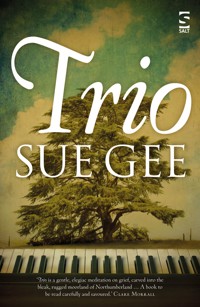
Trio
Northumberland: the winter of 1937. In a remote moorland cottage, Steven Coulter, a young history teacher, is filled with sadness and longing at the death of his wife. Through a charismatic colleague, Frank Embleton, and Frank’s sister, Diana, he is drawn into the beguiling world of a group of musicians, and falls gradually under their spell. But as war approaches a decision is made which calls all their lives quite shockingly into question.
Moving between the beauty and isolation of the moors, a hill-town school and a graceful old country house, Trio delicately explores conscience and idealism, romantic love and most painful desire. Throughout it all, the power of music to disturb, uplift and affirm is unforgettably evoked.
PRAISE FOR THIS BOOK
‘This is a beautifully written and moving account of loss and grief that spans two generations. Perhaps unusually, it’s a perceptive study of how a widower copes with bereavement rather than the more usual topic of the widow’s response to the death of the spouse. The landscape and natural world of southern Northumberland are evoked vividly and precisely. Its society in the 1930s is brought to life across the span from the wealthy to the poor with great conviction. The way in which the harshness of two wars and the diseases of poverty are faced by the author is just one of the elements that makes this novel so affecting.’ —Charles Palliser
‘Trio is a gentle, elegiac meditation on grief, carved into the bleak, rugged moorland of Northumberland, anchored firmly in a rich, ever-changing landscape. Sue Gee writes with perception about the healing power of music, setting the history of an ancient land into the context of a modern world, making sense of the inevitable sad passage of time. The enduring strength of love and family forms a fragile but supple backbone to the novel, maintaining its power in the face of looming cataclysmic world events. A book to be read carefully and savoured.’ —Clare Morrall
PRAISE FOR PREVIOUS WORK
‘Sue Gee writes subtly and deftly, observing with a wry and sympathetic eye … This is a hugely enjoyable and rewarding read.’ —The Independent
‘About The Mysteries of Glass:
one of the most moving and beautifully written stories that I can remember.’ —Readers Books of the Year, Guardian
‘About Reading in Bed:
as seductively readable as its title suggests ... draws the reader in with its skilful portrayal of real-life situations’ —The Times
‘A beautifully observed tale, written with boundless compassion and humour.’ —Woman and Home magazine
‘Profound and lyrical, it’s full of light and darkness and the most marvellous description.’ —Shena Mackay, Observer
Trio
Sue Geeis the author of ten novels, includingThe Hours of the Night, winner of the Romantic Novel of the Year award, andThe Mysteries of Glass, long listed for the Orange Prize. Her most recent novels areReading in Bed, a Daily Mail Book Club selection, andComing Home. She has also published a collection of short stories, Last Fling.
Sue Gee ran the MA in Creative Writing at Middlesex University from 2000–2008 and now teaches at the Faber Academy. She is a mentor with the Write to Life group at Freedom from Torture. She lives in London and Herefordshire.
ALSO BY SUE GEE
Novels
Spring Will Be Ours (1988)
Keeping Secrets (1991)
The Last Guests of the Season (1993)
Letters from Prague (1994)
The Hours of the Night (1996)
Earth & Heaven (2000)
The Mysteries of Glass (2004)
Reading in Bed (2007)
Coming Home (2014)
Short Stories
Last Fling (2011)
For Timothy
Book I
Part One
1
1936
Winter was closing in: propped up against the pillows, she could see through the one small window that the moor was speckled with snow. There was nothing else to see: no other house, no livestock; only the frozen ground, the pitiless pale sky from which more snow would fall today. That was a certainty.
He had lit the fire, before he left for work. Two weeks before the end of term, and he had to leave her, with coal in the scuttle, a box of wood – off-cuts and logs from the freezing shed – and a bowl of porridge on the chair at the bedside.
‘Just a little,’ he said, standing there in his old jersey, unravelling at the wrist. Something else she had not done, nor mended. ‘For me, Margaret – do it for me.’ His tie was askew, the collar of his shirt was frayed. Another thing. ‘Please,’ he said, and lightly – oh, so lightly – kissed her cheek. Then he clattered down the narrow stairs, took his jacket, hat and coat from the peg, called out goodbye again. The door slammed: keep in the warmth, keep it in! And he walked away down the track.
Small flames still leapt. She turned slowly from the window, saw firelight reflected in the dark varnished wood of washstand and skirting board and door. I’ll scrape that all off one day, he’d said, when they moved in two years ago, but he hadn’t. Too many other things to do: mend the roof, replace the rotting window frames, and the ill-fitting door that led straight from kitchen to moor. He had to fence in the little garden where they were growing vegetables, and make a gate. He had to replace the missing quarry tiles on the kitchen floor. He did everything well, like his father.
Geoffrey Coulter, Cabinet Maker, Birley Bank, Near Hexham
Steven had learned carpentry from him as a boy, could have followed in his footsteps; instead, went to university, the first person in his family ever to do such a thing. But the skill was still there: he sawed and planed and hammered, out in the old farmer’s woodshed which became a workshop. She took out a chair and sat sewing curtains in the shade of the thorn tree, looking up now and then to watch him through the open door. Birds flew by. It was summer then. To teach, as she used to do, with a long journey to and fro each day: over the windswept moor, with its single, sheep-worn track, down to the road where the bus to Kirkhoughton came only every hour. Who, except a lonely old farmer, dead a twelvemonth, as they’d said in town, would want to live here?
She tried to move a pillow behind her, up against the bars of the iron bedstead. Like washstand and dresser, it had been bought at auction. They’d walked, hand in gloved hand, amongst chests and tallboys and dismantled beds stacked up against a wall. This will be our marriage bed, they told one another. This one. The brass needed polishing. I’ll polish it, she said, her hand in his.
Farmers were looking at scythes and pitchforks, straw still on their boots; stout women in coats and felt hats went through china in boxes. The auctioneer mounted his steps as she found a mildewed mirror. They looked at their reflection; he reached out, touched her face within the glass, ran his fingers over her lips. She stood very still, and watched him do this.
The cold iron bars pressed through the pillow: nothing was comfortable to her now. Not leaning back, nor lying down on the mattress, on which, in the first year of their marriage, they had taken one another over and over again, the window open in spring and summer to their cries, to the calls of peewit and lamb, the scents of grass and heather.
The window was tight shut now. They had told her that fresh air was crucial, that if she insisted on staying at home it should be open day and night, but no, it was too cold, it was intolerable.
She shifted, just a little, reached for the bowl of porridge. Every movement had to be made so slowly. Every breath felt dangerous. He soaked her stained nightgown and sheets in a bucket; hung them over the range. She sat on the chair and watched him remake the bed, again and again. He helped her to wash, to brush her teeth; he took down the washstand jug and basin, and the chamber pot.
Don’t draw the curtains, she murmured sometimes at night, when he had done all these things, climbed the stairs and undressed, and gone to the window. He got carefully in beside her, turned out the paraffin lamp, lay still. He took her hand; they turned to look out at the stars. It felt as if it were the last thing left they could do together.
Not every day was difficult. She had rested and rested: this, as she had been told, over and over, was what she must do. If she were in the sanatorium, they told her, if she were sensibly down in the sanatorium near Barrasford, that was what she would do. If she – and if he – insisted that she stay at home, then rest was essential: no exertion, nothing, not even washing a teacup. Eating was what was needed, to keep her strength up. So he cooked, and she did nothing all spring and summer: he could manage, he told her in term time, and in the holidays what else would he want to do but bring her back to health?
On good days he took one of the chairs his father had made as a wedding present, when no one was thinking of illness – why should they be thinking of that? – and put it by the kitchen door he had made himself, that first year, and she sat there and watched him, digging in fitful spring sun. Clouds blew over the moor and curlew called. Sturdy sheep trotted up the track with their lambs from the farm below: white-faced Cheviots, bred for this particular stretch of the moor, as all Northumbrian sheep were bred for their own patch. The farmer lifted his cap, stopped, called his dog to, while they talked about sheep, and the weather, and she looking stronger now. And broad beans and potatoes were in flower, those onions doing well, look at that, that was a good sign.
It grew warmer. She brought out her sewing bag again, and stitched in the summer sun, making a quilt from scraps left over from bedspread and curtains, a small one because there weren’t that many scraps, and one day – oh, one day! – they might have a baby at last.
He dug up potatoes, brought them into the kitchen in a box, and she heard him pour rain water over them in the sink. She heard him scrape another chair over the tiles and turned to smile at him as he set it down beside her on the turf, and cleared her throat, and then a scarlet spray as fine as pinpricks speckled the quilt, and then there was suddenly more.
And then everyone said it was madness, to go on living up here. She should be in the sanatorium, flooded with light and air from the wide open windows and doctors on call and nurses to nurse you, you silly lass, so he wouldn’t have to, it was too much for him, surely it was.
They all said it, in letters which Steven picked up after school from the box on a tree at the bottom of the track: her mother, writing from Cawbeck; his mother, from Birley Bank. Then came one from Miss Brierley: they wanted her back to health, the girls had never forgotten her, they sent their best wishes, they all did. Would it not be better to take advantage of the sanatorium, my dear . . .
The district nurse, Miss Douglas, wheeling her bicycle up the track, taking her temperature, shaking her head: she said it, too. ‘Look at you, Margaret Coulter.’ She brought the spotted mirror to the bed, showed her the thin white face, eyes huge in dark sockets, the colour on her cheekbones bright as blood. ‘Hectic, we call that colour,’ she said, taking the mirror away as she closed her eyes. ‘Not a natural colour, my lass, and when will you two see sense? You know you could infect him, don’t you, you do realise that.’
She lay still as a mouse, and listened.
Autumn was coming, wind and rain blew hard. And perhaps she should do what they said, she told him that evening, as he sat beside her and held her hand. But he wouldn’t be able to see her, he said, they won’t allow visitors at Barrasford; and they looked at one another, unable to imagine nor bear it.
Especially, she thought, she could not bear it, because she had never known a time when she had not loved him, not since the day she had looked across the Museum gallery as her girls made notes from glass cases, and saw him shepherding in his boys. ‘Quiet, now, lads, that’s it.’ And something about the way he spoke, the way he reached out his arm to bring in one of them, small and hesitant—‘Come along, Moffat,’ – such a simple, ordinary thing, but all at once it wasn’t ordinary, it was his way of doing it. And everything fell into place.
‘You belong with me,’ he said on that wild autumn evening, as she lay back against the pillows. ‘Let’s see how you go on. If you’re not better by Christmas . . .’
He went downstairs again, and came up with two bowls of very hot soup on a tray and made her drink hers to the last drop and she did feel better then, and slept well, for once, knowing she wasn’t going to leave.
The fire was beginning to die, but the light at the window grew brighter. She turned her head once more, slowly, slowly, and saw the snow beginning to fall again, flakes blowing here and there entrancingly, the room filled with whiteness, until it was falling thickly, on and on, so she could no longer see the empty miles of moorland, only the whirling white. For a long time she lay there, watching, imagining its fall on the thorn tree and shed and water butt, coating them thickly; on the river far below, dark and racing. The bowl of cold porridge rested on the quilt. She had eaten three mouthfuls, for him.
Then she slowly put the bowl back on the chair. She must use the chamber pot, she must see to the fire. Slowly, slowly, she pushed back the blankets and quilt; unsteadily set her feet, in the socks her mother had knitted, down on the rug. If he were here, she’d be reaching for his arm.
She sat down on the edge of the bed, sat there for ages, hearing the last log fall to pieces in the grate; breathing lightly, from her upper chest, as she did all the time now, though what good fresh air could get into you like that, Nurse Douglas had asked her. ‘And if it’s dangerous to breathe more deeply you should be in the sanatorium, my girl, I’m not going to say it again.’
She got to her feet, bent down, reached for the pot and squatted over it. Oh, that was better. Slowly she pulled herself up again, and perhaps the porridge had done her good, she did feel a bit stronger now, enough to carry the pot to the door and put it down on the tiny space at the top of the stairs. She could hear the clock ticking in the kitchen, and the shift of wood in the range. Such a long time since she had been down there.
Now then. The fire. She shut the bedroom door again, saw the room filled with miraculous snowy light, so beautiful, and walked over the bare boards to the fire box and bent down to feed the flames with fresh wood, just a little at first, that was it, and she blew, as much as she dared, just a little, to fan it all, and a fresh flame leapt up towards her. She blew again, and sparks glowed and little bits of ash flew up, and she coughed.
Up the blood came.
She pulled herself to her feet and coughed again, impossible not to. She reached for the washstand as something to clutch at and steady her, something to hold on to, but the blood came up, chokingly, more and now more. She leaned over the bowl and saw its whiteness and blue-painted flowers disappear in a clotted crimson flood.
Help me – the words swam through her. She was gasping, her hands to her terrible mouth, then clutching at bed, bedclothes, anything, as the marvellous light went black and she crumpled to the dusty floor.
Which was where, hours later, after stumbling up the track, clearing the bank of snow at the door with the spade he had left there, pushing it open, calling her name, pulling his coat off and racing up the narrow stairs, he found her.
Part Two
1
Snow was falling again as he crossed the playground.
‘Sir!’ Footsteps came running after him. ‘Mr Coulter, sir!’
He turned, saw Johnny Mather racing up.
‘You forgot this, sir.’
He shook his head, took the textbook. ‘Silly of me. Thanks, Mather.’
He remembered cleaning the blackboard, as the boys went noisily out, and stacking up the exercise books at the desk; remembered putting them in his bag and leaving the classroom. He didn’t remember who he’d said goodbye to in the smoke-filled staffroom, nor putting his coat on, nor walking across the playground, though here he was, almost at the gates.
‘Wouldn’t have been able to do your marking, would you, sir?’
Mather was class monitor: it was one of his jobs to collect things left behind and hand them in to Miss Aickman’s office. Or to go running after a teacher with his mind elsewhere.
‘Thank you,’ he said again. ‘Off you go.’
And Mather touched his cap, and ran back to fetch his own stuff, half-skidding on an icy patch, shouting out.
Frozen slush was still heaped up by the railings; the sky was a yellowish-grey. He put the book in his bag, and went out into the street.
Snow was falling on snow: piled up in the gutters, all round the square, coating the war memorial and the great tall Christmas tree in the middle. Paths had been scraped along the pavement. There were boys everywhere, ragging about until they saw him, then walking away down the hill to Bridge Street or along the side streets, Middle Lane, Milk Lane, as the Kirkhoughton town clock struck the three-quarter hour. Tea time. Lights from the shops shone out. The afternoon ebbed away.
‘Never known a winter like it,’ said an old lady, half to herself and half to him, walking slowly along with her basket. It was what people said every year. He nodded, walked on to the bus stop.
‘Come on, come on.’ Snow fell down his collar, he stamped his feet. Then the bus came into view, lit up, the wipers going steadily. He climbed on, a few boys behind him, threw his bag on the seat. As they pulled away, a snowball suddenly hit his window, and he jumped, hearing Thompson splutter behind him. He looked out, saw Donald Hindmarsh, his hand clapped to his mouth. Not such a dreadful thing, but everyone was tiptoeing round him these days, pretending that they weren’t.
Deepest condolences, the card had read on the wreath. Miss Aickman would have ordered it; Mr Straughan had written the words: black ink, his strong distinctive hand.
They drove out of the town, as light on the ring of hills faded.
The house smelled of ash and cold air. He dropped his bag and stood in the unlit kitchen, putting his hands to his face. Each day it was such a relief to do this: after the greetings, the smiling, the ‘Come along, lads,’ the ‘Get out your books,’ the ‘Silence!’ Though he didn’t have to say that often. They were quiet and respectful, on the whole.
He shut his eyes, drew the deepest breath. That, too, felt an immeasurable relief.
‘Margaret.’ Each day he said it. He said it when he woke, and when he shaved at the washstand—
How long had she lain there, before he came home?
He said it as soon as he came in from school.
‘Margaret. My Margaret.’
You can’t stay in that house, said his parents, her parents. You mustn’t be up there all on your own. And, He’s stubborn, they said, when he’d shaken his head and left them. Like her. Neither of them would be told, and if only they’d listened—
He took his hands from his face, lit the paraffin lamp on the table. He refilled the range and sank into the chair beside it, where she used to sit and sew, or read. They used to read together, when he’d done his marking; reading together was one of their deepest connections.
‘Margaret?’
She’d look up at her name, put her hand out. They never tired of looking at one another. And they talked, they talked all the time. Until they learned the great beauty of silence.
‘My love.’ A murmur. And then—
They lay in the deepest quietude, the window open on to the cropping of the sheep, the calling of curlew and chough, and then the starlight.
Now – there were so many places where she was not. She was not in that chair by the fire, her head bent over her book, her sewing. She was not in her place at the table, passing his plate, listening as he told her about his boys. She should have been telling him about her girls, as she’d done when they were getting to know one another. Teaching was in her blood.
‘Good morning, girls!’
‘Good morning, Miss Ridley!’
The Ridleys had been teachers for as long as anyone could remember. Her grandfather had taught maths at the Board School in Hexham. Her father was Head of the Cawbeck village school. But then she became Mrs Coulter, and a married woman was not allowed to teach.
‘What shall I do all day?’
‘We’ll have children, won’t we?’
‘Margaret,’ he said to the empty kitchen, where the clock ticked on the wall. Where had she gone?
She was not sewing a quilt for the baby who never came, not humming as she took down her coat from the peg, pulling her gloves from the pocket as they set out at weekends to walk.
Sometimes they went down to the river, tumbling out of the forested hills, a great plantation dating back a hundred years or more, and picnicked on the bank. In summer, kingfishers flashed. ‘Look! Look at that!’ Sometimes they struck out across the moor, hand in gloved hand swinging as she sang: folk songs, border ballads.
‘You shall have a fishie, on a little dishie,
You shall have a fishie, when the boat comes in . . .’
She sang songs from her girlhood, too, heard on the wireless in her parents’ house in Cawbeck: ‘Tea for Two’; ‘Happy Days are Here Again’. Sometimes he joined in, though he didn’t think he had much of a voice, beside hers. She was the musical one.
‘We shall have a family, a girl for you, a boy for me . . . ’
Her sweet clear voice rang out. Sheep bolted into the bracken. Five miles across were the remains of a Roman fort: they ate their sandwiches leaning against the broken stone wall, the wind in their faces, hearing the high sad pipe of lapwing.
The schoolchildren knew all about the Romans, as if they were part of their own families, their ancestors.
Margaret had been in her first term at Kirkhoughton Girls when she walked Class One in pairs along Milk Lane and up into the Square. A fine day in early October, 1933, sun shining on the weathered sandstone of the Museum. Many of the great buildings in the Square – the Assembly Rooms, the Museum, the Judge’s Lodging – were sandstone, designed in the early eighteenth century, she had told her class, by a pupil of William Newton. In they went, through the big oak doors.
‘Ssh, now, girls. Take a sheet, each of you, that’s it.’
They gazed at coins, pots, fragments of pots, little figures, beaten bronze necklaces. The morning sun came in at tall windows. They pressed their faces to the glass-fronted diorama: women cooking, men marching over the hills. Then the rooms were suddenly noisy and crowded, as a class from Kirkhoughton Boys arrived.
‘Quiet, lads!’
She looked across, saw their teacher, tall and nice-looking, shepherding in a straggler. He caught her eye.
They knew, almost at once, though neither had ever thought it could happen like that.
Back at the school, the girls began a frieze. She painted an enormous backdrop in sections: long straight roads cutting across moorland and valley. She wrote in the names of real places and features – places the children would already know about, or could go to, on a trip: the Cheviot Hills to the north-west, Hadrian’s Wall, to the south; a long wavy blue line for Fallowleys Burn, which ran down from the hills and through Kirkhoughton, with its fine stone bridge. Their brothers fished there in the summer holidays. She marked pikes and crags. Hencote Moor had been just a name to her then.
One afternoon, coming out of the school gates, she found the young teacher from the Boys’ school waiting for her.
Her first years spent history classes drawing, painting with powder paint, cutting out: great grey stones to build the Wall, the barracks and milecastles set along it, the sally ports, the turrets and forts and settlements. They painted the helmeted figures of centurions, added foot soldiers, patrolling garrisons, to march along the wall, and along those great roads, rising and falling over the land.
The afternoons darkened, the gas lights went on. They cut out women in togas, huge amphorae, heaps of coins. There was a village, a bathhouse. Stables. Everything was glued on with flour paste, and by the end a whole Roman world ran round three walls of the classroom. Miss Brierley came in to admire.
All this, she had to give up.
‘But you still want to marry me?’
‘Kiss me again.’
Walking up the track to Hencote Moor one Saturday, the fifth they spent together, they’d come upon the empty little house. They peered in through dirty windows, tried the door. Someone must own it, surely, they said, sitting down on the grass. They looked out towards the distant town. They could ask at the agent in the Square.
You don’t want to live all the way up there, said her parents, out in Cawbeck, a thirty-minute bus ride from Kirkhoughton. That’s not very sensible. She and her brother had always been sensible, competent and clever. They were proud of them. She said it was what she and her fiancé both wanted, and since until then she had done almost everything she was asked, they said, Well, if that’s how it is.
When she fell ill, all sense deserted her.
Her coat still hung on the kitchen peg, and would always hang there, next to his. It smelt of wood smoke and paraffin, like everything else. Reddish-brown hairs still clung to the collar. One day, she might come back, and need it.
‘Margaret.’
Sometimes, saying her name aloud like this, like an incantation, he half expected to see her, singing as she ironed their clothes with the flat iron, or put the heavy kettle on the range. ‘Tea for two and two for tea . . .’ He saw her lighting the lamp, climbing the stairs to their bedroom, washing at the stand, there in her nightgown, splashing her face, brushing her teeth, turning to smile at him, saying his name as she climbed into bed beside him.
‘Steven.’
They say you know you love someone when you hear them speak your name. As if it had been waiting to be spoken, by just that voice. That was what it had been like, for both of them, when they went out together for the first time: Mr Coulter and Miss Ridley. Finding out each other’s first names, hidden behind those titles, was almost like undressing.
She was kneeling up before him while he slipped the gown over her head; looking into his eyes, smiling, murmuring, ‘Here I am,’ as he enfolded her.
There was no one to say his name now, no one to call it. He made tea, put the pie his mother had made in the oven. He got out his books and sat at the table, trying to do his marking. End of term essays.
‘The Battle of Alnwick took place in 1174, when William I of Scotland invaded Northumbria. He was met by Ranulf de Glanvill, leading four hundred knights . . .’
Snow blew against the window. The clock ticked into the silence. When she was here, he had hardly noticed it.
2
1937
The New Year began with the setting of her stone. On a freezing January afternoon they all stood round her grave in the Cawbeck churchyard.
Of course this was where she must lie, with all the old Ridleys around her, but although this was where they had married, her father walking with her through the village and along the grassy lane, so that today made it all of a piece, in a terrible way; it felt as lonely and pitiful as on the day of her funeral, to have her so far from him. Left to himself, he would have buried her up on Hencote, marked with a stone from the moor.
In life she had been his. In death she belonged to everyone: her white-faced mother; her father, biting his lip; her brother Andrew, silent all through lunch, who’d been the top student at Kirkhoughton Boys and now was studying law in Edinburgh.
Rooks cawed from the elms. Steven stood between his parents and they all looked at the fresh new stone, and its carving.
Margaret Coulter, née Ridley, beloved wife of Steven
19th June 1912–3rd December 1936
A June baby, born in the loveliest month of the year, sun and shadow dancing over the churchyard grass on the day of her christening, birds flitting into the yew. He thought that was how it would have been.
‘He’s made a good job of it,’ said his father, clearing his throat.
Her father nodded. Her mother began to cry. Andrew stood stiff and apart.
The pale winter sun was sinking. They walked back along the path to the lych gate, the grass stiff with frost, great big icicles hanging from the guttering on the church.
‘What will you do now, Steven?’ her father asked him, back at the house, by the fire. The cat was stretched out like a dead thing. Teacups chinked. He couldn’t answer. He stood looking out at the darkening garden; birds beat their way to the trees.
He went home, climbed the track up the moor, climbed the stairs, flung himself down on the bed.
A young man sobbing in an empty house.
This is it, this is it, this is it.
3
Spring crept over the moor. It came in the faintest green on the thorn tree by the shed, where one half-term morning, fetching in fresh wood for the range, he disturbed a hedgehog.
‘Hello.’ It lay in a corner beyond the log pile, uncurling with the sudden flood of light from the open door. At once, with his shadow, the sound of his voice, it curled up again, and he stepped quietly away. Next morning, it had gone. He felt painfully disappointed.
He stood looking round: at the saw on its hook, the work bench and planer, and remembered the carpentry he’d done in the first year of their marriage: the new kitchen door, the window frames. He thought of Margaret on summer days, sewing and watching him work, as his father had worked all his life, the finest cabinet maker for miles. He wanted to tell her about the hedgehog, felt a new wave of loneliness as he carried the logs out. It had rained in the night, and the branches of the thorn tree were dusted with fresh green, the tightest buds. Pools of peaty water lay in the grass.
Spring came with the sheep trotting up the track again, the farmer touching his cap and saying how sorry he’d been to hear the news, lambs racing and butting and crying as the flock spread out in the sun. The thorn tree was thick with white blossom, the tough moorland grass and the bracken greened up, the heather was a purple haze. Then came the call of the curlew.
He took down his coat and went walking. He was looking a bit less peaky, his mother told him, when he went home to Birley Bank at Easter. Ducks were nesting on the riverside, daffodils blew in the garden. ‘Got a bit of fresh air on your face again.’ She put lunch on the table. ‘Still too thin, though.’ ‘Leave him alone,’ said his father, carving spring lamb. ‘He’s too much alone as it is,’ she said. ‘How can you stay up there, Steven, love?’
Back at school the talk in the staffroom was suddenly of the bombing of Guernica, a little Spanish market town no one had ever heard of. ‘Have you seen this?’ Frank Embleton flung The Times on the table. ‘The boys must be made aware of this,’ he said. Then the bell rang, and the day’s routine began.
Routine was saving Steven. He had started the first years on border raids, fortifications, castles and peel towers. Things they had learned in infant school, but it did them good to come to it all again. They traced the outline of the county, marking in castles: Haydon Bridge; Alnwick and Bamburgh on the coast, Lindisfarne on Holy Island; Featherstone at Haltwhistle; Kirknewton, Newcastle. There were more castles to the mile in their county than anywhere else in the British Isles, he reminded them. More battle sites.
As the boys went up through the school they had local history under their belt, a solid foundation to anchor them for the rest of their lives: that was what Straughan said he wanted – another historian, and a Northumbrian to the last cell of his body. Then they could look at the world. He spun the great globe in the hall.
Everyone sensed that the world was changing: here, with men out of work and women scraping by; with the great march from Jarrow to London last autumn. Here, and in Europe: civil war in Spain, Hitler and Franco in alliance, women and children blown to pieces in a market square.
‘Listen to this,’ Frank Embleton told his sixth-formers, reading out from The Times.
But the bell rang, homework was given, exams loomed in the summer.
The second year was Steven’s own class. Each morning he took the register. Archbold, Aickman – that was Miss Aickman’s nephew. Here, sir. Bell, Carr and Cowens. Dagg. Here, sir. Herdman and Hindmarsh. All the old names. In medieval times they’d have been feuding in graynes, clans. There were one or two feuds here now.
‘Mather.’ ‘Here, sir.’ ‘McNulty. Moffat. Moffat?’ Moffat’s father had died two years ago, after months in the sanatorium. ‘He’s poorly again, sir.’ He put a cross. Later in the morning a note would come. Potts. Rigby. Stoker. ‘Here, sir.’ Neat ticks in the column all the way down. Wanless. Wigham.
Margaret had wondered if your place on the register affected your sense of yourself. Sometimes, she’d said, she started at the bottom with her girls: she thought it did them good, suddenly to be first and last when you weren’t used to it. And it made them laugh.
‘Wilson.’
‘Here, sir.’
‘Good.’ He closed the register. ‘Get out your books.’
The room smelled of chalk dust and boys. By break-time they could smell pot-pie, wafting from the kitchen along the corridor, where everyone walked to the left.
In the staffroom he took his tea from the trolley. ‘Have a bun,’ said Frank Embleton, fresh from the Lower Sixth, and the Boer War. He passed the plate.
‘Do you good, sir,’ said the girl behind the trolley.
‘That’s right,’ said Embleton, giving her a smile. Molly-on-the-Trolley was what Armstrong called her, a pretty girl. She brushed crumbs off her flowered pinny and smiled with a blush.
Embleton and Steven sat by the open window, away from all the smoke. Gowens had his pipe in his mouth almost before he was through the door; Armstrong and McLaughlin sat in clouds of Navy Cut. David Dunn stood in a corner, leafing through a heap of papers. One or two dropped to the floor.
Shouts of the boys came distantly from the playground at the front: on this side of the school they looked out over the hills. Frank Embleton’s mind had left Spain and the Boers for now: he talked about Tom Herron, deputy head boy, whom he was preparing for a scholarship. Steven listened. Frank had been to Oxford, he was very bright: Straughan had made him Head of Department as soon as old Ogilvie retired. Dunn hadn’t liked that, but no one had thought he would get it.
The morning sun shone on Embleton’s fine young face and fair hair. He polished off his fruit bun, changed the subject.
‘How were the holidays?’
‘Quiet.’ Steven looked away. ‘I saw my parents. You?’
Frank said there’d been a little concert at home. He had a sister, Diana, a cellist, who played in a trio of friends.
A boy and a girl: that was the family Margaret had said she wanted. At once, it was what Steven had wanted too, though until they met he had scarcely given it a thought. Perhaps only children didn’t. He’d had a dog as a boy.
Frank was still talking. He’d hardly heard a word.
‘Shall we go for a drink one evening?’
‘All right – thanks.’ It was a long time since he’d been out and about.
The bell rang from the playground and they got to their feet. Year Three: the Industrial Revolution. Railways taking coal down from Tyneside to the river, Puffing Billy, colliers taking coal down the Tyne to open sea, and to London. Stephenson’s Rocket. Stephenson’s High Level Bridge at Newcastle, an amazing achievement.
‘Me great-granddad worked on that, sir.’
‘Me uncle’s out of work, sir.’
Shipyards were closing. Steelworks were closing. The Jarrow march down to Westminster had changed nothing.
‘He’s on National Assistance now.’
Summer unfurled. In May they had a day off for the Coronation: bunting all around the Square, trestle tables set out beneath the trees. When Edward VIII abdicated so shockingly in December, it was days after Margaret’s funeral, and Steven had barely noticed. Now Miss Aickman played the National Anthem in Assembly as if she were at the Proms. She was all excited about the little princesses.
Then it was cricket, exams, meetings.
The yearly school exams were held in the classrooms; the big public ones, School Certificate, and Higher, in the hall: Miss Aickman welcoming the invigilators, Mr Straughan in his gown at Assembly, tall as a Scots Pine, telling his boys he knew they would be a credit to him. Kirkhoughton Boys, one of the best in the county, and don’t forget it. His general kindness made his rare anger all the more terrifying: unruly boys who were sent to him were sometimes sick whilst waiting outside his room. He used the cane rarely, but he used it.
Papers turned over, pen caps off, eyes down. You may begin.
Before that, as every term, came the departmental meetings, and in the summer Straughan sat in on them – summoned the staff to his office, in fact. It was like having an inspection, one or two new, younger staff muttered now and then, but it certainly focussed the mind.
‘Come in, gentlemen.’
His windows were open on to the fresh May morning; they could hear Miss Aickman clattering away next door, the ping of her typewriter as she came to the end of a line.
‘Have a seat.’
Embleton, Steven and Dunn took the chairs before the mahogany desk.
Straughan, an historian, was also something of a philosopher. He thought there were questions to be asked about the past, and the progress of mankind, liked to engage his staff in discussion. Frank had responded to all this at once, when he arrived in ’34, and Straughan had at once been alert to that, to his gifts and intellect.
And he’d passed over David Dunn, as everyone knew he would have to: a man who’d come back from the Somme with a smashed leg and shellshock, who was now in his fifties and still not quite right. Fit to teach? Just. Better in class than out of it, apparently. A man like Straughan wouldn’t get rid of a man like Dunn.
Steven had been passed over, too, or rather not encouraged to apply for the departmental headship when old Ogilvie retired, but he hadn’t expected anything else: a local boy who’d made it to university, he knew he needed a good few years under his belt before promotion. And now he was glad that he had no more responsibility: teaching steadily was as much as he could manage. Even in meetings, her face sometimes swam before him. It swam before him now, and he briefly closed his eyes.
Straughan lit his pipe. ‘Shall we begin with the reports?’
They went through them all, year by year, noting the rising stars, the strugglers. From Jack Bown and Tom Herron, destined for Oxford, to Donald Hindmarsh, who’d only just scraped through the first year. But a good lad, they all agreed.
‘History is about how men have learned to live, is it not?’ said Straughan, tamping down his pipe. ‘If a lad like Hindmarsh can be brought to understand that – how Alcibiades lived and suffered, as Aristotle had it – he might be a bit more interested.’ He dropped a match in a vast wastepaper basket. ‘How did men learn to make tools, build somewhere to live, use the wheel, reckon time? How did they learn to write? Even within the constraints of the syllabus we can go back to first principles, can we not, Mr Coulter?’
Steven said that they could. Straughan’s rhetorical questions could make you feel as if you’d been told to get up from your desk and stand by the blackboard.
‘And of course the individual man is subject to great events, is he not?’ Straughan went on, puffing away. ‘Why do men live where they do? Because of invasion, colonisation, war.’




