


Erhalten Sie Zugang zu diesem und mehr als 300000 Büchern ab EUR 5,99 monatlich.
- Herausgeber: Istros Books
- Kategorie: Gesellschafts- und Liebesromane
- Sprache: Englisch
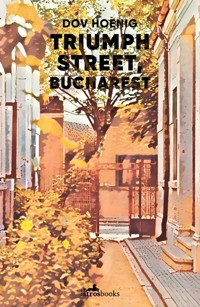
Bucharest, before and during World War II, where Bernard Davidescou lives with his parents and his older brother on Triumph Street, in the middle of a courtyard block inhabited by a dozen Jewish families and two Christian ones. When Romania, under General Ion Antonescu's dictatorship, allies itself with Hitler and invades the USSR, the Jews in Bucharest face the threat of being sent to the Nazi extermination camps, after having survived the terror of the fascist Iron Guard. However, each Sunday morning, young Bernard, age twelve, passionate about politics and history, amazes the adults in the courtyard, Jews and Christians alike, with his analysis of the political situation in Romania and the development of the war on all fronts. 'Rue du Triomphe' is the story of this young boy and his dreams and torments during this dark period of human history, while also chronicling a family in crisis, the discovery of sexuality and first loves, and the distraction offered by the cinema, religious searching and idealistic aspirations for a better world.
Sie lesen das E-Book in den Legimi-Apps auf:
Seitenzahl: 423
Veröffentlichungsjahr: 2022
Das E-Book (TTS) können Sie hören im Abo „Legimi Premium” in Legimi-Apps auf:
Ähnliche




















Dov Hoenig
Triumph Street, Bucharest
A novel
Translated from the French by
Gavin Bowd
For Zoe,
without whom I would be ‘o frunză pierdută’, a lost leaf
‘That eternal human wish: to leave!’
Anna de Noailles
1
The Courtyard, the House, the Hall
Today, my childhood home no longer exists. In the 1980s, mass demolition work took place in Bucharest and my courtyard, my street and my whole neighbourhood were reduced to dust. In the name of Marxism-Leninism and the holy class struggle, the tyrant Nicolae Ceaușescu had decided to give the capital wider avenues with monumental prospects and immense constructions. Thus, the magnificence of marble and the fury of reinforced concrete were to intimidate a people starved and condemned to despair. On the dictator’s orders, thousands of inhabitants were expelled from their homes and dispersed to the city’s periphery. They had to pack their things and agree, at barely a day’s notice, to relocate to housing blocks still under construction, without water or electricity, often without even doors and windows. The bulldozer’s blades and caterpillar tracks razed their homes, turning them into a pile of bricks, stones and scrap metal. More than forty thousand houses, along with many priceless churches, monasteries, synagogues, hospitals, theatres and monuments, were demolished or moved. Among the many neighbourhoods annihilated was the old Jewish quarter stretching across the suburbs of Vacaresti, Dudesti and Vitan, where thousands of poor emigrants, mostly from Russia and Ukraine, had settled since the nineteenth century. This is how several streets of my childhood, with their houses, whose bright, joyful colours guided me in winter like morning stars on my way to school, were wiped out with the occasional exception of a few mutilated, pitiful segments.
At the very heart of Ceaușescu’s urban ambitions was his megalomaniacal plan to build in the city centre a gigantic House of the People, conceived, in his imagination, as the Eighth Wonder of the World. He wanted this project to mark the apotheosis of his reign, ensuring him an eternal place in history. The construction works for the House of the People were launched in 1984 and a fifth of the old city of Bucharest (a surface equivalent to three Parisian arrondissements) was converted into a vast cemetery of rubble.
Ceaușescu and Elena, his wife, did not have the chance to attend the completion of this project in all its grotesque majesty. On 21 December 1989, a series of riots in Bucharest and other cities in the country led the population and the army to rebel and provoked the fall of the communist regime. The brutal and degrading execution of the Ceaușescu couple, on 25 December 1989, was worthy of their ignominy and the suffering they had inflicted on their people.
I had left Romania well before Ceaușescu came to power. For me, on a personal level, he was just the thief of a few precious traces of my childhood. I cast him into oblivion now in order to devote myself to the period preceding the Second World War, when my neighbourhood of Vacaresti-Dudesti enjoyed a quiet life, just like Triumph Street and the big combined courtyards of numbers 47 and 49, at the centre of which nestled the little house where we lived, behind the branches of an old plum tree.
Most importantly, there was our courtyard. It was entered through one of the two gates that opened onto two parallel alleyways where the two properties joined one another. On the left was number 47 with the house inhabited by the landlord, Nae Theodorescu. Although he was short of stature, and a little overweight, his elegance, intimidating look and powerful voice commanded respect and submission: ‘A man of great class’, said those in the know. I have kept quite a clear image of Theodorescu: greying hair under a wide-brimmed felt hat; bulging eyes; bushy black eyebrows; a long nose poised above a perfectly trimmed pencil-thin moustache. He liked striped suits of fine wool and double-soled English shoes that made him a little taller. A white silk handkerchief often spilled out of his breast pocket, like cream overflowing from a cup of coffee.
Proud of his social position and his success in life (he was the son of a rich landowner), Theodorescu had never been too familiar with his tenants. But, since his marriage to Lutetia Filotti, his distant and unapproachable manner had only become worse. In the courtyard, this attitude had, to quote Balzac, ‘aroused unfavourable suspicions about his character’, and malicious tongues began to wag: ‘If he wasn’t chasing after money, even though he already had plenty, why would he, at the age of fifty, have married a woman like Lutetia Filotti?’ Apart from the fact that she was skin and bone, morose and haughty, Lutetia brought, by way of dowry, her old mother, Valeria, while poor Nae already had a mother of his own to look after. His mother’s mind had gone since the death of her husband, Tudor Theodorescu, and she lived in her son’s house in a small isolated room, just behind the kitchen, under the care of a nurse. We often heard the old woman’s wails, like heartrending appeals for help, but with time the neighbours learned to ignore them. She was eighty-two years old, to believe Theodorescu’s young servant, Maria – a petite brunette, young and full of life, who liked gossip as much as Sunday dances in the Municipal gardens.
In contrast, Valeria Filotti, Theodorescu’s mother-in-law, maintained, despite her seventy-six years, robust health and a sound mind. Small and thin and always dressed in black, she would spend hours behind the curtain of her window, spying on the goings-on in the alley. She desperately sought someone to speak to and, as soon as the opportunity arose, she flung open the curtains, darting her head out like a snake flicking its forked tongue to taste the scents. ‘Ah, what a beautiful day!’ or ‘Oh, what awful weather!’ she would exclaim, her face cleft from ear to ear in a syrupy, toothless smile revealing three or four yellowing and decaying stumps clinging to her rotten gums. She knew how she looked and to hide her embarrassment, her smile vanished just as fast as it had come, her face returning to its severe and assertive expression. She would then launch into endless litanies that went from the national crisis to the rampant corruption in King Carol’s palace, not forgetting the punishment of sinners and rewards for the righteous. That would set off a series of imperious sighs, sometimes followed by a few tears, and ending with the interjection vai de loume! (‘world of misfortune!’). Motan, her big black cat, with long whiskers like those of an old Hungarian hussar, did not seem to worry about the misfortune of this world as much as she did. Seated like a sphinx on the windowsill, he ran his bushy tail across his mistress’s face with the regularity of a windscreen wiper. Motan had little time for the old woman’s conversations with passers-by, but his misanthropy did not bother Valeria. No cat was going to dictate to her how much of her time to spend on humans, for this depended solely on the interest she had in the passer-by. Those considered ‘poor of mind’ were summarily dismissed, whereas she latched on to the ‘elevated souls’ and I, vai de loume, was at the top of her list of elevated souls. ‘Bébé is one of us, he’s one of us’, she would tell Motan in the unlikely hope of persuading him to endure my presence, but despite her coaxing, Motan continued to observe me with the disdainful green-grey eyes of a spoilt and spiteful creature. I have never liked cats, black ones in particular, and Bébé is not my real name: my name is Bernard, but family and the neighbours had saddled me with the nickname ‘Bébé’, or even worse, to cajole me, ‘Bébéloush’. Naturally, I hated the one as much as the other.
In the same alley, facing the Theodorescus’, was the house of the Cassimatis couple, Radu and Cornelia. They too were of Greek origin like Theodorescu. Radu, dark-skinned and well-built, who smelled of perfume a mile off, was the director of a small import-export company trading with Greece. Cornelia, his beautiful wife, was a teacher at the primary school on Labyrinth Street, not very far from us, and she was the one who aroused in me the precocious desires of a barely pubescent boy.
The two conjoining alleyways of 47 and 49 Triumph Street, led from the entrance gates to a communal roundabout bordered with flowers that served as the meeting place of our little community. From this roundabout, three more alleyways ran in parallel to the back of the courtyard, where sturdy walnut trees and a fence separated us from a large empty lot. On either side of the alleyways, little houses succeeded one another like train carriages pulled up at a railway siding. About twenty families lived in our courtyard and with the exception of the Theodorescus, their servant Maria and the Cassimatis couple, all were of the Mosaic religion, in other words: Jews.
The entrance hall and the living room at the front of our house were situated opposite the Cassimatis’ kitchen, near the roundabout. But, other than on days when we received guests, we came in and out of our home, that is, of the Davidescus’ home which we rented, through the kitchen. The tall narrow door, with a rectangular transom, faced west, which was a pity, as the sun did not light up the room when my mother Jenny, started her day’s work, long before my father George, my brother Leo, and I, Bernard (and not Bébé!) began to stir.
On entering the kitchen, a table with four chairs was placed near a large cupboard in which the crockery and glassware were kept, along with a number of cooking utensils. An imposing old blackened cooker with a large oven held court from the opposite wall, beyond which a door led into a spacious square room, the dormitor,1 where my parents slept, where we took our meals and where Leo and I did our homework. A large Turkish rug with geometrical motifs, but without crosses (we did not like crosses!) covered the floor. In addition to our parents’ bed, a dining table, some chairs, a chiffonier and a wardrobe with three drawers, the room also contained a tall, brown, glazed-ceramic stove that looked like an old pagan tomb. It was this fine wood stove that kept us warm in winter when the ill winds from distant Siberia blew across the plains of the old kingdom of Wallachia, from whose womb the city of Bucharest was born. The room was a bit dark. Its two windows opened onto a small yard, on the other side of which lived an old widow, mother of the strange neighbourhood doctor, Samuel Lebensart. She had cancer and her son often came to look after her while trying to keep his visits discreet, which wasn’t hard, given that his mother’s windows and curtains were permanently closed. But what the house withheld from the eye, it offered to the ear. The mysterious doctor had one leg shorter than the other and used a cane, the noise of which was amplified by the resonance in the inner yard, betraying his presence. As my mother only very rarely left the house, she knew the days and times of his visits by heart as he attended his appointments with exemplary punctuality.
The doctor was a handsome man. His raven hair was combed back in a wave like that of Tyrone Power, the famous American actor in The Mark of Zorro. He had a long, thin face, a powerful nose and his pale, cold eyes resembled those of an inquisitive wolf. I dreamed of having a Prince of Wales suit like Doctor Lebensart’s, but I was too young to wear one… The doctor lived in a two-storey house with his wife and daughter, further up our street, where he also had his medical practice. When his old mother passed away, rumours circulated in the neighbourhood that it was he who had killed her to save her from unnecessary suffering. Rumours, as we know, have a logic of their own. He was disliked because his precise and honest diagnosis was often delivered with brutal frankness, and because he was accused of being too fond of money. He was believed to be heartless, when in fact he was not.
Next to our bathroom, which was situated at the back of my parents’ room, a door opened to the living room. It was a beautiful and spacious room reserved for family festive dinners and musafiri,2 but in which my brother and I shared a bed, for want of another solution. The main piece of furniture was a large oak table that could seat twelve. My father had bought it from an antique dealer for a price well above our means. Finely decorated baroque style chairs accompanied the precious table, five on each side and one at each end reserved for my mother and father. From the middle of the ceiling, centred above the table, hung an imposing bronze chandelier with twelve branches ending in lions’ paws, each holding a light bulb in its claws.It came from an old retired general whose wife was a client of the luxury fur shop where my father worked as a salesman. A big oval mirror, in front of which I often enjoyed conducting an imaginary orchestra, and a dresser of Viennese origin where my mother kept the silverware, crystal glasses and plates of the finest porcelain, completed the living room’s furniture. All this symbolised, for my father, the fulfilment of his ambition to succeed in the illustrious metropolis of Bucharest.
To the right of the big living room window, opposite the Cassimatis’ kitchen, a door led to the entrance hall of our house, a small bare room. On one of the walls, in front of the only window, hung an old painting of a Moldavian landscape, in front of which a small round table and a coat-stand were condemned to reclusive co-existence. A Persian carpet with floral motifs dominated by faded reds and blues, covered the parquet floor. That was all the room contained, but it was precisely its nakedness, its silence, that I liked. In winter, I went there very rarely, as we did not have the means to heat it, but during summer and autumn, I spent long hours there reading or playing chess alone; I felt protected, free and happy in my solitude.
One winter (was it in 1938?) I was gravely ill with scarlet fever and double pneumonia. At that time, before the discovery of penicillin, the law required that any child with scarlet fever had to be quarantined in a government hospital for infectious diseases and that the Ministry of Health take charge of the decontamination of their home. On a previous occassion, I had witnessed this procedure in Nerva Traian Street. Dressed in outfits resembling deep-sea divers, men surrounded by a crowd of curious bystanders stormed a hastily evacuated house. Each man was equipped with a canister with a long pipe connected to a white tanker-truck bearing the emblem of the Red Cross. They made me think of gangsters carrying out a hold-up in a silent action movie.
As anti-Semitism was already rampant in Romania at the time, my parents hesitated to send me to a government hospital where they feared I would be treated by hostile and surly nurses. Doctor Lebensart agreed to look after me at home, but for a short time only. He advised my parents to consult the head of the paediatric service at Caritas hospital, a Jewish hospital that only treated non-contagious diseases. The doctor was called Rafael Fruchter, and when he came to see me, my temperature was over forty degrees. He promised my parents he would take care of me, and he kept his word. The following day, I was admitted to Caritas and transferred to an isolated room where, with the exception of the head nurse and her two assistants, nobody knew that my pneumonia was combined with scarlet fever. We never found out why Doctor Fruchter had consented to such a risk, although we knew it was not for money, as my parents did not have any. Even Doctor Lebensart, little known for his philanthropy, had stopped making us pay for his visits. Had they discovered something unique in us, or was it rather the uniqueness of the doctors of those times?
After a week, my health had not improved, but the pains I suffered, especially in the ears and throat, were nothing compared to the terror caused by the punctures made to extract pus from my lungs with the use of terrifying long-needled syringes. I refused to undergo them, unless it was Doctor Fruchter himself who carried out the procedure. A week later, despite the punctures and the medication, my situation worsened. Exhausted and dehydrated, between two bouts of feverish delirium, I could read the fear on the faces of my parents and the nurses. They were afraid I would die. Only doctor Fruchter remained calm and confident. If he had his doubts, his face showed none. His serene voice and the reassuring look in his eyes revived hope and the will to live in me. Nevertheless, late at night, knowing he was no longer in the hospital, I feared that death was lurking by my bedside. I thought I could see his awful skull leaning over me and could sense his icy breath on my face. I was terrified that death would seize me all of a sudden and drag me into the land of shadows; that night would swallow me up forever. The past and the future would no longer exist, the present would come to a full stop. Everything would stop. The very instant when death took me would be my last breath of life. After, I would remember nothing. There would be no after, there would be no more me, ever… To protect me from these horrific thoughts, my mother brought me an old Hebrew-Romanian prayer book, which I kept under my pillow. Holding it close, I prayed silently early in the morning and late at night. Two weeks later, Doctor Fruchter’s treatments and the prayers proved that they were stronger than the illness. I was cured!
I spent the desquamation period in the house, happy to find my bed again, to be at home. I rejoiced in being well again, in knowing that soon I would be back at school and that I would walk, exhilarated, in the streets of the capital, as tirelessly as before! But I kept the habit of praying and the hall was the only place where I could pray unseen. In my own words, I thanked Heaven for having kept me from death and I prayed to the Almighty to guide me along my life’s path. I often mentioned the name of Doctor Fruchter in my prayers, who I was certain had been sent to my rescue by Providence.
Many times I’ve thought about the time spent at Caritas hospital with strange nostalgia, as though I wanted to feel again an old pain. How could I forget the strong odour of disinfectants and medications, the rattle of trolleys wheeled along icy corridors, the impenetrable mystery of voices and footsteps, coming and going with no rhyme or reason, the whisperings of the nurses, their white, starched bonnets crisscrossing against the blue background of the walls? And how could I avoid reliving the feverish agitation that took hold of me as I waited for the bleak stillness of night to relinquish its hold at the dawn of a new day? Through a gap in the curtains, a charitable ray of sunlight would come to settle on my bed as the hospital roused itself from sleep, filling each ward with morning clatter at the same time as it spread everywhere the aroma of the first coffee.
If scarlet fever had rewarded me with a new skin, the effort demanded to overcome the double pneumonia had armed me with a newfound vitality. In my mind, I had sketched out a precise plan: fortify my body, regain the position of top of the class and enjoy again the youthful pleasures that the long illness had denied me. I wanted to be like the other boys of my age, knowing full well that it was not possible, if only because I was Jewish. At my primary school, which was Christian, as well as in the street, the tram, and in the cinema theatres, I encountered this reality on a daily basis. Despite being Romanian by birth, like my parents and grandparents, I remained in the eyes of Christians a jidan, a dirty Jew, a Yid. How many times had anti-Semitic hooligans spat at me as I went to and from school? And in how many streets did my heart break to see, on billboards, deplorable posters caricaturing my race as spiders and rats?
It is in no way surprising that I began to hate the country of my birth. I hoped that soon fate would take me to the Jewish state that Theodor Hertzl had dreamt of, where my real life would begin. This hope was going to become reality sooner than I thought.
1 Bedroom.
2 Guests.
2
Pouica, History and Memory
I had learned to read before I started school, as I could not stand my brother being ahead of me, and always wanted to be his equal. Since he could read, I had to read too. One day, I asked him to help me and step by step, faintly amused, but hardly enthusiastic, he gave in to my pressures. After some effort, thanks to him, I realised my ambition. Later, when I started my fourth year at primary school, my brother entered his fourth year at high school. I was trailing behind him, without the slightest hope of ever catching up, which was hard to swallow except that with time, this disadvantage, which was due to the order in which our parents had conceived us, brought me an obvious benefit: I had access to his school books, which were much more advanced than my own. Therefore, in certain subjects, I was ahead of the others, helping me to reinforce my status as top of the class despite my mediocre marks in mathematics.
From my first year in school, I had shown a particular interest in history. I was fascinated by the lives and works of the great heroes of the past and by the ups and downs of peoples and nations. Unlike arithmetic and geometry, which I felt belonged to a lifeless and sterile planetary space, history offered me all that was most exciting in the adventure of humanity on earth. My passion for this subject ran alongside my interest in politics. This interest, which was unusual for a boy of my age, was greatly down to the fact that during my childhood, from 1938 to 1945, I had been the involuntary witness to a series of historic events of great importance, as much for the world as for Romania.
I was seven when, on 13 March 1938, Germany annexed Austria. In the month of September, Hitler, Ribbentrop, Mussolini, Ciano, Chamberlain and Daladier signed the infamous ‘Munich Agreement’ that forced the Czechs to cede the Sudetenland to the Third Reich. In Romania, King Carol II established a monarchist dictatorship. He outlawed the traditional political parties and created his own ‘mass’ party, the Front for National Rebirth, Jewish membership of which was forbidden. I was eight when in 1939, Czechoslovakia was annexed by the Reich and Albania fell to the Italians. In the same year, Ribbentrop and Molotov announced the Germano-Soviet non-aggression pact and Germany and the USSR carved up Poland. On 4 September 1939, France and Great Britain declared war on Germany and two months later the USSR invaded Finland. Between the months of April and June 1940, Denmark, Norway, the Netherlands, Belgium and France were defeated by the Wehrmacht. Thanks to the heroic effort of a flotilla of thousands of boats, most of the British Army in France could be evacuated from the port of Dunkirk as well as the French units that had fought ferociously to slow the Wehrmacht’s advance. In the month of June, Italy joined Germany. We were thrown into the Second World War.
In our courtyard, the subject that preoccupied us, as Jews, was knowing what Romania’s position would be in this bloody conflict. Our future, our very existence, depended on it. Now that the guarantees by France and Great Britain, its traditional allies, were no longer worth even the paper they were written on, preservation of its territorial integrity demanded that Romania ally itself to Germany. But King Carol II’s persistence in remaining neutral far from satisfied Hitler. When in June 1940, the USSR issued Romania an ultimatum demanding that it cede the territories of Bukovina and Bessarabia, Hitler did not oppose it. On the contrary, he demanded that the King submit unconditionally to the Soviet demands. More than to punish the King, the Führer wanted to subdue Stalin, while in secret he prepared to attack the USSR.
On 14 June 1940, petrified in front of the radio, we heard that the German Army was parading in the streets of Paris. A few days later, France chose a new head of State, Marshal Petain, who signed an armistice with Hitler on 22 June and installed his government in Vichy. Great Britain, where Winston Churchill had replaced Chamberlain at the head of the government, remained isolated, alone in Europe to have taken up the challenge against Hitler’s Germany and Mussolini’s Italy.
Such was the face of the world in which I grew up. And yet despite all of this, during the summer Sundays, with their blue skies and scent of acacia, the spectre of war did not prevent us from getting up late and enjoying the day of rest. Once Theodorescu’s servant Maria had hosed down the gravel and the boiling asphalt of the alleyways, doors began to open slowly, inviting into each home the scents of the refreshed earth. It was the awaited signal. Like theatre actors at the sound of the three strikes, who rush onto the stage to take up their places before the curtain rises, people came out in front of their doorways, sitting down on straw chairs and deckchairs, and the courtyard sprang alive like a fair. The women exposed their arms and shoulders to the burning sun – their legs, out of decency, only to the knees – and the men gathered in the shade around small tables covered with multicoloured cloths to discuss politics or to tease each other during animated games of poker and backgammon.
The lively political debates took place in front of the house of the Bercovici family, situated at the beginning of the alley opposite our kitchen. I was the main attraction of these animated discussions: Having passionately devoured the daily newspapers my father brought home, I had memorised the names of all the political parties and their leaders, as well as those of former and current ministers, and I knew about the dramas and intrigues of Romanian political life, thereby dazzling the adults. Every Sunday, weather permitting, a faithful audience of a dozen men gathered to listen to my analyses of the week’s events. I was proud of myself as much as my father was proud of his offspring, but the responsibility often weighed too heavily on my shoulders. Keeping up with the news was not everything in my remit. My audience included Radu Cassimatis, an Orthodox Christian and fervent supporter of a host of ferociously anti-Semitic politicians. This obliged me to filter my analyses and deliver them in such a way as not to upset the ‘goy’. For example, Kleinfeld, the father of Sergiu, my brother’s best friend in the courtyard, once dared to criticise King Carol II for having given, in his new government, three ministerial posts to the anti-Semitic Iron Guard, one of them going to its leader, Horia Sima. Radu Cassimatis responded drily that Horia Sima was above all else a very great Romanian patriot. That was a dreamed-of opportunity for me to show my objectivity by giving him my unconditional support: ‘On the contrary,’ I said, ‘the King was right to give a voice to Horia Sima. That’s democracy!’ While shooting Kleinfeld a triumphant look, Cassimatis rewarded me with a broad smile and complimented me with: ‘Bravo, Bébélush, you’re a good democrat!’ Another time, I expressed my sympathy for General Antonescu, then under house arrest on the King’s orders. I had read that, from 1923 to 1924, the general had served as military attaché in France and in England, and that, ever since, he had hugely admired these two western democracies. However, I had omitted the fact that after the humiliating defeat of France, Antonescu, persuaded like his supporters that the Germans were going to win the war, turned coat, becoming a great admirer of the Führer and the Wehrmacht. I had again wanted to please Cassimatis, who, being Greek, hated King Carol for having chased Queen Hélène, his Greek wife, out of the country in order to further his affair with the flame-haired Magda Lupescu, a converted Jewess with captivating green eyes. After all, Queen Hélène was none other than the daughter of the King of Greece, Constantin I, and of Princess Sophia of Prussia, as well as the great-granddaughter of Queen Victoria of England!
When I was facing difficulties during these political séances our neighbour opposite, Nicu Bercovici – a tall, paunchy man with owl-like eyes – came to my rescue. Well-versed in politics, he had the advantage of age and experience. He was director of the bedding department of the Bucharest branch of Galeries Lafayette, a position the importance of which was manifested by his imposing moustache. Unfortunately, his wife Sofia, who was tiny and frail, suffered from a serious heart condition. That those two had been able to bring into the world a creature as bubbly as Rozica, their thirteen-year-old daughter, with breasts as firm and round as cantaloupes, remained an impenetrable mystery for the courtyard. Rozica’s best friend was a girl of the same age called Chichi Herescu. We teased Chichi saying that, because of her height, she must surely bash her head on every ceiling. I was mean with Rozica, but kind to Chichi, under the spell of her sad eyes, which looked ready to fill with tears at any moment. ‘Chichi the weeping willow’ would have suited her perfectly. As the only adolescent girls in the courtyard, Rozica and Chichi were as inseparable as Siamese twins. They were always whispering something in each other’s ears and made no effort to hide their contempt for the courtyard’s three male adolescents: Nellu, Sergiu and my brother Leo. ‘Their loss!’ sniggered the three in retaliation; they were attracted neither by Rozica nor Chichi and did not lack success with other girls in the neighbourhood.
The political debates were exclusively the business of the ‘men’s club’, but there was nevertheless one exception: a nineteen-year-old girl, Pouica Marcovici, who I called Pouia. She had just finished her first year at the Faculty of Letters and sometimes joined the men, although she was too shy to express an opinion. Her parents, Mishu and Neta, lived in a house adjacent to the Bercovicis and I fell in love with Pouia. It was a boy’s first love for a shy, dreamy-eyed girl with freckles and a thick fringe of black hair cut straight across her forehead. Whether shy or not, the unfortunate fact was that, just when I fell in love with her, Pouia developed a crush on Marcel Fein, a young hairdresser from a salon on Vacaresti Street, which she sometimes frequented. Who could have imagined a university student taking a shine to a hairdresser?
At least once a week, in the afternoon, when she was alone in the house, Pouia received Marcel in her room. Though the big window was shut, the transom above it, kept open by a hook, let the noises from inside filter out as far as the alley in which I roamed nervously, pretending to be hunting butterflies.
Many times, as I approached the window to listen better, consumed by what was simply plain jealousy, I heard giggles, taunts, clicks of the tongue, and little stifled cries followed by long silences. One day, I heard Pouia whisper: ‘I don’t want to,’ and then Marcel’s voice insisting ‘Just a little, I promise’. Rapid and unintelligible words followed and when Pouia suddenly shouted, ‘If you continue, I’ll scream!’ I heard Marcel mumble hoarsely ‘Trust me’ and at that moment, in a state of agitation, I turned on my heels and fled home.
Not long afterwards, Pouia and I became good friends. It is possible that this friendship helped her to contain the attraction she felt towards Marcel – an inclination unworthy of the image she had of herself. To have an affectionate and innocent relationship with a boy like me (affectionate maybe, but innocent?) provided her with the serenity to better understand her torment. I made a habit of going to her place once I had finished my homework, on the days when she was not expecting Marcel.
Once, she received me in her little room, the window was wide open and the net curtain undulated at the whim of a light breeze. It was hot, and an iridescent light flooded the room. In the distance could be heard the cries of children playing at tzourka, the cricket of the poor, of gypsies and of ruffians. Intermittently, nightingales exchanged short staccato-like and repetitive musical phrases. Apart from the birdsong, it was as though all of nature had fallen asleep. I was sitting with Pouia on the couch. She had a very beautiful mouth and pink, finely drawn lips. Her teeth were gleaming white, like those of the black women I had seen for the first time in American films. A breath of air lifted the collar of her half-unbuttoned blouse (was it through negligence or to keep cool?). My eyes strayed briefly to the hollow where her breasts separated to hide in her brassiere, pinching the fine white cotton of her blouse. Her warm brown eyes smiled at me candidly: a smile that I could read as clearly in her eyes as I could have on her lips. A floral skirt covered her thighs up to her round and silky knees. Seized by emotion, I suddenly blurted out: ‘I think you’re very beautiful, Pouia.’
‘I think you’re a bit of a crazy boy!’ she replied in astonishment.
I felt my face turn crimson. She was right next to me and when our bodies happened to touch, I felt the heat of hers like a sudden blaze. She lifted my chin to raise my head, which I had lowered through shyness, her thumb brushing my lips.
‘Tell me the truth: how many beautiful women have you known?’
I placed my hand on hers, as it held my head up: ‘Only you. You’re the only one.’
Surprised, she blushed in turn and said, ‘So you see…’
‘I don’t see anything!’ I protested as she placed her finger across my lips to silence me.
‘You… can… see… that… you… are… lying,’ she said, detaching each word, her lips taking the shape of a kiss. ‘Like all men, in fact,’ she added, her body moving away from mine. I felt the separation like a sudden cold wind blowing in from Russia. As she took her finger away from my lips, her expression changed strangely and I exclaimed in a manner more childish than I would have liked: ‘But I am not yet a man!’
She scratched her head, looking for some way of getting out of this impasse. ‘Give me an example of another woman you find beautiful,’ she challenged. I hesitated. ‘Come on!’ she insisted.
As I was still hesitating, she pointed her finger at me and scolded in an amused tone, ‘Big or small, men are all the same. I’ll bet that she is blonde!’
‘No!’ I denied categorically. ‘I was thinking of Merle Oberon! She’s not blonde, she’s brunette and beautiful like you!’
Pouia jumped as though stung by a bee.
‘Where did you get that name from? The New Testament?’
‘From a film, not the New Testament!’ I proudly asserted.
And it was perfectly true. One day, I had taken my mother to the Tomis, my favourite neighbourhood cinema, to see Wuthering Heights. The film had touched me so deeply that I spent nights thinking about it. I was haunted by the sad love story between Catherine Earnshaw, from a rich aristocratic family, and Heathcliff, the poor boy with no family. Merle Oberon played Catherine and Lawrence Olivier, Heathcliff. Catherine was dying of remorse, having broken Heathcliff’s heart by marrying, under family pressure, the wealthy Edgar Linton. Just like Heathcliff who, late at night, heard the ghost of Catherine knocking at his window, I, during my sleepless nights, could not escape from the evanescent face of Merle Oberon and the tragic expression of her haunting dark eyes. Pouia had not seen the film, but she had read the book and she knew the works of the Brontë sisters well. She particularly liked Charlotte’s novel, Jane Eyre, which she considered better than Emily’s.
Coming suddenly back from work, Neta, Pouia’s mother, put an end to my tête-a-tête with her daughter. But, as I was ‘her Bébéloush’ as well, she would not let me leave before tasting her pastries, which, I have to confess, were not as delicious as my mother’s.
At the end of the courtyard, just opposite Theodorescu’s kitchen, was an alley less frequented than the others. An old oak tree with heavy, gnarled branches watched over the entrance with a Cyclops eye under a frowning brow. To the left of the alley lived the Halpern family, and to the right lived Nora Freiberg and her daughter, Anca. It was rumoured in the courtyard that Nora Freiberg, petite, slender and with slightly reddish hair, was a woman of questionable morals. Since the death of her husband, she had become, according to the same gossip, the mistress of a rich businessman, a married man, who kept her in exchange for the gifts in kind that she offered him. She was not seen often, as she came and went at unusual hours, leaving a trail of heady perfume behind her. She wore jersey-knit Chanel cardigans with a certain insolence over slightly short skirts, two-toned boots and, depending on the circumstances, either a cloche hat or big black straw one with a veil. For reasons that were hard for me to understand, her slightly bowed legs caused great excitement among the men of the courtyard. I had often even heard my brother and his friends talk about them. Sergiu, who was fifteen or sixteen, repeated the words ‘eroticism’ and ‘erotic’, which I did not understand. The dictionaries were hardly any help: according to them, the word referred to love, not legs.
When I had asked Pouia to explain, she blushed and laughed nervously, before launching into a long and convoluted speech, typical of grown-ups when a child asks them an embarrassing question. Subjects linked to the sexuality of men and women were too complex for my age, she said to me. It was better for me to be interested in less adult subjects. Childhood, she concluded, is the most precious period of our lives; it should be spent as much as possible in joy and happiness, far from the passions, worries and responsibilities inherent in the lives of grown-ups.
Anca, Nora’s daughter, was a little blonde girl with blue eyes. Everyone adored her cute nose and her cherry-shaped mouth. Her mother dressed her up like a doll: plaid skirt with cloth braces across a white blouse, and pink socks that covered her skinny legs right up her calves, along with patent leather shoes.
As Nora was rarely at home during the day, a governess, Sarina, took care of Anca, collecting her from kindergarten at midday and preparing her meals. But on Saturdays, if the weather was nice, Anca spent her time playing outside. One Saturday, taking advantage of the fact that the Halpern family next door had left on holiday and that Sarina was doing the shopping at the Vitan market, my brother and his two friends, Nellu and Sergiu, had the idea of playing ‘mummies and daddies’ with Anca. The game was conceived as a one-act play: Anca to play the mummy and Nellu, the daddy, whilst my brother and Sergiu took on the responsibilities of co-directors. I must have been about six, Anca five and my brother, Nellu and Sergiu ten or eleven, about the same age as Rozica and Chichi who were assigned the role of passive aunties (at that time, they hadn’t yet given themselves the airs and graces of the unapproachable princesses that they later adopted). I was permitted to remain as long as I kept quiet. The old oak, with its knobbly roots and a carpet of leaves spread around the foot of its trunk, served as a natural décor. When the imaginary curtain lifted, signalling the start of the play, Nellu, who already saw himself in a white medical coat, kneeled before Anca, grave and solemn like a priest reading from his breviary. We sat by in a semi-circle. Anca, propped up on her elbows, was lying on the ground, her legs wide apart, and her panties down to her ankles. Transfixed, we looked at her impudent little sex that resembled a fine cut vertically between the undulated triangle of her thighs. All we could hear around us was the drone of bees as Nellu succeeded to insert a straw into little Anca’s sex, after having carefully separated the lips with his other hand. Perfectly at ease in the role of mummy, Anca followed attentively, and without the least embarrassment, the activity of ‘Daddy’ Nellu. I was never to know the outcome of the scene that the directors have envisaged, as Sarina came back from the market earlier than expected and the curtain dropped prematurely before the end of the play.
A few years later, when I asked Anca if she remembered the game of ‘mummy and daddy’, she turned red and stalked off. Poor beautiful Anca, she still had the same angelic face and cherry-shaped mouth, but her legs were beginning to be bowed like her mother’s.
This children’s mischief, which fortunately never reached my mother’s ears, brings back the memory of two significant moments that we did share together. The first is linked to the image of a poor bear, reared up on its chained hind paws, its russet fur matted and filthy. At some forgotten intersection, a couple of dozen gawkers jeer and whistle over the frenetic, rhythmical sound of a tambourine as the gipsy’s whip goads the wretched animal into a shuffling dance. In the crowd, the gipsy woman, with one hand clutching an infant to her breast, picks up the coins that rain down on the pavement like manna from heaven. Clinging to my mother, I witnessed this scene in a street in Galatz, the lively and cosmopolitan port on the Danube, where I was born. The image of this bear, robbed of its freedom and all dignity, took root in my mind as another striking example of the acts of barbarism, ignominy and injustice that man is capable of. From the mistreated animal to man treated as an animal, the road is very short.
The second memory is linked to my induction into primary school. One day, just before the end of the last class, I felt terrible pains in my stomach and the urgent need to go to the toilet. As soon as I heard the liberating bell, I rushed for the door. Though I was quick, a dozen other boys were right behind me, no doubt headed for the same place as me. They were shouting, swearing, swinging their satchels at each other and giving each other kicks in the backside, like a bunch of hooligans. I didn’t like the look of them, nor their rough voices and coarse language and was afraid of finding myself alone with them in the toilets. Locking myself in one of the narrow, foul-smelling stalls wouldn’t have made me safer. How would I have defended myself if they prevented me from getting out and pushed lit papers or firecrackers under the door, just as they had done recently to another boy? I decided that I had to change my plan. I turned away suddenly and, taking the shortest path, made for the school gate. Once in the street, I bolted, making my way blindly, rushing between pedestrians, cars, trams, cyclists and carts, like someone possessed. The road ahead was still quite long and, afraid of not being able to contain myself, I clenched my muscles with all my strength and ran on, gritting my teeth and biting my lips until I tasted blood. I ran and ran. Cold sticky sweat, mingled with tears of shame and anger, streaked down my face. Everything was blurred, but I just kept running: haggard faces of men and women, street dogs, beggars, vagrants, prams, telegraph poles, walls – some blank, others covered in posters – windows and unfamiliar doors flashed by on all sides. This maelstrom of images whirled by like a dream, or as though seen through the grimy carriage window of a tram travelling at great speed. Suddenly, at the corner of Triumph Street and Nerva Traian, scarcely a few hundred metres from home, what I had feared happened: my muscles gave way. I froze, horrified: what had I done? Why hadn’t I been able to keep it in? After a few seconds, I calmed down somewhat, as the worst had already passed. I now had to prepare myself for what I was going to face at home. I had little chance to dodge between my brother and my mother without their realising the situation, but whatever happened, I had to get home as quickly as possible. However, the weight of the calamity in my pants prevented me from running. Dragging my feet like an old cripple and squeezing my thighs tight together, I made my way home at a snail’s pace, avoiding everyone on my path.
Reaching the house, I hammered on the kitchen door, which was opened by my brother. Seeing that my eyes were red, he asked why I was crying: ‘For nothing,’ I answered, pushing him aside roughly with my satchel. I saw my mother and Fanny, a distant cousin, with cups of coffee and a spoonful of cherry conserve set before them. Fanny, ‘the shame of the family’, was a prostitute by trade and had recently spent a month in a hospital specialising in nervous disorders, at the edge of the city. The conversation I interrupted touched on a certain ‘trafficker of living flesh’ who had ruined her life – a reference to her pimp, as my brother explained to me later. When things were going very badly for her, Fanny always turned to my mother, who out of all the family was the only one to treat her with kindness and compassion. Seeing me, Fanny rushed to kiss me. Turning my face away, I tended a cheek while protecting my mouth. She smelled of eau de Cologne and beer, quite a disgusting mixture, but, given the circumstances, the smell of eau de Cologne suited me perfectly. ‘How you’ve grown, little Bébélush! I almost didn’t recognise you!’ she exclaimed, pinching my ear with nails that looked like the claws of a predator. She had very black hair, large prominent blood-shot eyes and an enormous mouth with fleshy mauve lips. I freed myself from her thick arms to approach my mother as though to kiss her, but quickly whispered in her ear: ‘Mother, I’ve done it in my trousers!’ Taken aback, my mother rose quickly from her chair and, making her excuses to Fanny, rushed me out of the kitchen.
From then on, at family gatherings, the story of my misadventure made everyone laugh except my mother and I. She understood me. I had inherited her aversion for stupid and vulgar crowds; she who fled social life and disapproved of the indecency of the outside world to the point of avoiding restaurants, cafés, parks and street traders. As for my difficulties in adapting myself to the primary school in a Christian milieu, my mother could do nothing more than comfort me. I did not know why our parents had sent us to a State, and therefore Christian, primary school, rather than to the Moriah primary school, a Jewish school near our home: was it because the State school was free while Moriah would have cost them money? The fact is that, just like my brother before me, I had to spend my ‘primary’ years in a Christian school. And just like him, during those four years, I had to bite my tongue every morning, refusing to make the sign of the cross when ‘Our Father who art in Heaven’ was recited.
After a few months, Pouia broke up with Marcel. Well before admitting it to her parents, she told herself that the handsome hairdresser was not for her. Was it by pure coincidence that at the very same time, Aurel, son of Marta and Aron Halpern, became the young man that Pouia’s parents got it into their heads to have as their son-in-law? He was the complete opposite of Marcel Fein. Marcel was the same height as her, dark, virile, sporty, a cunning charmer and a smooth talker. Aurel was blonde, pale, skinny, shy, and shorter than her. There may have been doubts about how Pouia would react to her parents’ choice, but amazingly she seemed interested! When the meeting was craftily ‘arranged’ by Pouia’s family, with Aurel’s parents’ complicity, it wasn’t love at first sight for her, but a pleasant surprise: how could she have crossed paths so often with this young man always in a hurry, with his unruly blonde locks covering his forehead, without the desire to know him better? Then, during subsequent encounters, she discovered that she felt good in his company; comfortable, assured and, for the first time, in harmony with a man.
In our courtyard, the time a secret stayed secret is equal to the time it took for a whisper to travel from lip to ear. The word engagement spread at vertiginous pace, but, for once, even malicious tongues held back. The new couple inspired only good feelings in us! We were delighted to see them, arm in arm, confident and happy. I was not less happy for Pouia than the others, although since she had got involved with Aurel, she no longer had any free time for me. That my visits to her ceased, goes without saying. One day, meeting by chance in the street, she apologised for not having been able to see me due to her end of year exams. She had had to shut herself up in her bedroom, day and night, condemned to swot up on Latin, French and German, not to mention the writings of the great bearded and bald philosophers. I assured her that I understood completely, having my own ration of studies to digest.




