


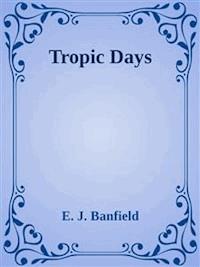
4,99 €
Mehr erfahren.
- Herausgeber: E. J. Banfield
- Kategorie: Poesie und Drama
- Sprache: Englisch
Edmund James "Ted" Banfield (4 September 1852 – 2 June 1923) was an author and naturalist in Queensland, Australia. He is best known for his book Confessions of a Beachcomber. His grave on Dunk Island is listed on the Queensland Heritage Register.
Das E-Book können Sie in Legimi-Apps oder einer beliebigen App lesen, die das folgende Format unterstützen:
Veröffentlichungsjahr: 2017
Ähnliche

















Tropic Days
E. J. Banfield
Table of Contents
Part I. — Sun Days
In Idle Moment
Eternal Sunshine
Fragrance and Fruit
The Scene-Shifter
Beach Plants
Shadows
“Smiling Morn”
Ancestral Shade
Quiet Waters
“The Lowing Herd”
Babbling Beaches
The Lost Isle
Part II. — The Passing Face
The Corroboree
The Canoe-Maker
Two Ladies
Soosie
Blue Shirt
The Forgotten Dead
Eagles-Nest Float
Nature in Retaliation
“Star Run About”
Blacks as Fishermen
Part III. — Miscellanea
Pearls
Snake and Frog Prattle
The Bush Track
The Little Brown Man
Up and Away
Tropic Days
“Passeth All Understanding”
Time’s Finger
The Soul Within the Stone
“Peace and silence . . . combined with the large liberties of nature.”
De Quincey
TO
MY BROTHER BEACHCOMBERS; Professing, Practising
Author’s Note
In my previous books the endeavour was to give exact if prosaic details of life on an island off the coast of North Queensland on which a few of the original inhabitants preserved their uncontaminated ways. Here is presented another instalment of sketches of a quiet scene. Again an attempt is made to describe — not as ethnological specimens, but as men and women — types of a crude race in ordinary habit as they live, though not without a tint of imagination to embolden the better truths.
I thankfully acknowledge indebtedness to my friends Mr. Charles Hedley, of the Australian Museum (Sydney); Dr. R. Hamlyn-Harris, Director of the Queensland Museum; and Mr. Dodd S. Clarke, of Townsville, N.Q., for valuable aid in the preparation of my notes for publication.
DUNK ISLAND.
Part I. — Sun Days
In Idle Moment
“‘Are you not frequently idle?’ ‘Never, brother. When we are not engaged in our traffic we are engaged in our relaxations.’”— BORROW.
On the smooth beaches and in the silent bush, where time is not regulated by formalities or shackled by conventions, there delicious lapses — fag-ends of the day to be utilised in a dreamy mood which observes and accepts the happenings of Nature without disturbing the shyest of her manifestations or permitting ‘the-mind to dwell on any but the vaguest speculations.
Such idle moments are mine. Let these pages tell of their occupation.
As the years pass it is proved that the administration of the affairs of an island, the settled population of which is limited to three, involves pleasant though exacting duties. It is a gainful government — not gainful in the accepted sense, but in all that vitally matters — personal freedom, absence of irksome regulations remindful of the street, liberty to enjoy the mood of the moment and to commune with Nature in her most fascinating aspects. Those who are out of touch with great and dusty events may, by way of compensation, be the more sensitive to the processes of the universe, which, though incessantly repeated, are blessed with recurrent freshness.
The sun rises, travels across a cloudless sky, gleams on a sailless sea, disappears behind purple mountains gilding their outline, and the day is done. Not a single dust-speck has soiled sky or earth; not the faintest echo of noisy labours disturbed the silences; not an alien sight has intruded. What can there be in such a scene to exhilarate? Must not the inhabitants vegetate dully after the style of their own bananas? Actually the day has been all too brief for the accomplishment of inevitable duties and to the complete enjoyment of all too alluring relaxations.
Here is opportunity to patronise the sun, to revel in the companionship of the sea, to confirm the usage of beaches, to admonish winds to seemliness and secrecy, to approve good-tempered trees, to exchange confidences with flowering plants, to claim the perfumed air, to rejoice in the silence —
“Not learning more than the fond eye doth teach,
Which pries not to th’ interior.”
How oft is the confession that the fullest moments of life are achieved when I roam the beaches with little more in the way of raiment than sunburn and naught in hand save the leaves of some strange, sand-loving plant? Then is it that the individual is magnified. The sun salutes. The wind fans. The sea sighs a love melody. The caressing sand takes print of my foot alone. All the world might be mine, for none is present to dispute possession. The sailless sea smiles in ripples, and strews its verge with treasures for my acceptance. The sky’s purity enriches my soul. Shall I not joy therein?
Though he may be unable to attain those moments of irresistible intuition which came to Amiel, when a man feels himself great like the universe and calm like a god, one may thrill with love and admiration for Nature without resigning sense of superiority over all other of her works or abating one jot of justifiable pride.
Even in tropical Queensland there is a sense of revivification during the last half of August and first of September, and the soul of man responds thereto, as do plants and birds, in lawful manner. Perhaps it is that the alien dweller in lands of the sun, when he frisks mentally and physically at this sprightly season, is merely obeying an imperative characteristic bred into him during untold generations when the winter was cruelly real and spring a joyful release from cold and distress. The cause may be slight, but there is none to doubt the actual awakening, for it is persuasive and irresistible.
Lesen Sie weiter in der vollständigen Ausgabe!
Lesen Sie weiter in der vollständigen Ausgabe!
Lesen Sie weiter in der vollständigen Ausgabe!
Lesen Sie weiter in der vollständigen Ausgabe!




