


Erhalten Sie Zugang zu diesem und mehr als 300000 Büchern ab EUR 5,99 monatlich.
- Herausgeber: Nick Hern Books
- Kategorie: Poesie und Drama
- Serie: NHB Modern Plays
- Sprache: Englisch
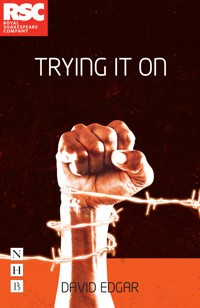
It's 1968. David is twenty. It is the height of the worldwide student revolt. The Vietnam war rages. Enoch Powell delivers his 'Rivers of Blood' speech. Martin Luther King is assassinated. These events will define David's politics and give focus to his writing. It's fifty years on. The seventy-year-old is confronted by the twenty-year old. Do they share the same beliefs? If not, is it the world that's changed, or him? David Edgar's Trying It On is an autobiographical monologue, written to be performed by its author. It was first presented by Warwick Arts Centre and China Plate, touring the UK in 2018, including performances at the Birmingham Repertory Theatre, the Midlands Arts Centre and at the Royal Court Theatre, London – as well as at the Royal Shakespeare Company, alongside the RSC's revival of Edgar's landmark play Maydays.
Sie lesen das E-Book in den Legimi-Apps auf:
Seitenzahl: 75
Veröffentlichungsjahr: 2018
Das E-Book (TTS) können Sie hören im Abo „Legimi Premium” in Legimi-Apps auf:
Ähnliche

















David Edgar
TRYING IT ON
NICK HERN BOOKS
London
www.nickhernbooks.co.uk
Contents
Introduction
Dedication
Original Production
Characters
Setting
Note on Text
Trying It On
About the Author
Copyright and Performing Rights Information
Introduction
I was lucky enough to be born in 1948, and thus to be twenty (and in my second year at university) in 1968, the annus mirabilis of the worldwide student revolutionary Left. I’m not an autobiographical playwright, but the events and legacy of that momentous year have informed my writing ever since. In my 1983 play for the Royal Shakespeare Company, Maydays, I used my life story as the basis of a kind of counter-factual thought experiment about how that life might have turned out differently. Now, fifty years on from 1968, I’ve made a directly autobiographical solo show, in which I’m not only writing my life but playing it. At the same time, I’ve had the opportunity to revisit Maydays for a new production at the RSC.
Maydays arose out of my first play for the RSC, Destiny, which was a warning play about the rise of the neo-fascist National Front (a forerunner of the British National Party) in 1970s England. Turned down by theatres across the land (including my home theatre, the Birmingham Rep), the play was taken up by the RSC, and presented in its small Stratford studio theatre The Other Place (then a tin hut) in 1976, transferring to the company’s large London theatre, the Aldwych, the following year. The play got many things right (predicting the rise of a pseudo-respectable tendency on the neo-fascist right in the 2000s) but its big mistake was underestimating how an enfeebled Conservative Party was being rejuvenated under its new leader Margaret Thatcher. By the time Destiny was televised in 1978, the National Front was in terminal decline, and the Conservatives were constructing a potent ideological cocktail of economic liberalism and social conservatism, the latter a backlash against the sexual permissiveness, youth counter-culture and hostility to traditional authority which defined the late 1960s. This cocktail attracted a winning coalition of traditional Conservatives, free-market libertarians and working-class voters to bring Mrs Thatcher to power in May 1979.
By then I was halfway through a year-long trip to the United States, where a similar coalition was being forged, between traditional Republicans, socially conservative religious voters (increasingly organised into campaigning groups like the Moral Majority) and, overlapping, a significant proportion of white working-class voters. But the alliance which was to take Ronald Reagan to victory in 1980 included another, much more surprising component, which couldn’t be more different from the evangelical Christians of the Bible belt or the Redneck Republicans of the declining northern industrial states. This was a group of New York intellectuals, all of whom had been on the Left (some on the Communist or even Trotskyite Left) in their youths, but who had shifted dramatically to the right in middle age. Led by Irving Kristol (co-editor of the journal The Public Interest) these Neo-Conservatives defined themselves as ‘liberals mugged by reality’. They were charily supportive of the free market (one of Kristol’s essay compilations was titled Two Cheers for Capitalism) but defiantly hostile to the counter-culture of the 1960s. They provided a valuable intellectual endorsement to the Reagan campaign.
Returning to Thatcher’s Britain, it was obvious that she – too – had relied on political defectors to bring her to power. As the death agony of the 1974–79 Labour government unfolded, former socialists and Communists rushed to contribute to proto-Thatcherite tirades with titles like The Future that Doesn’t Work and An Escape from George Orwell’s 1984. In 1978, former left-wingers such as Kingsley Amis, Max Beloff, Reg Prentice, Paul Johnson and Alun Chalfont anthologised their apostasy in a book proudly titled Right Turn. Their conviction that the late 1960s had unleashed a multi-headed demon of indiscipline was confirmed during the wave of strikes which broke over Britain in the chilly winter of 1978–9. As Tara Martin López points out in her book on The Winter of Discontent, many of the private- and public-sector strikers were black or female, had grown up in the late 1960s, and were inspired by the general rebelliousness of the time.
The Conservative response to these events was summed up graphically by Thatcher guru Alfred Sherman, who, as a young Communist, had fought for the Republican side in the Spanish Civil War. ‘As for the lumpen proletariat, coloured people and the Irish,’ he declared, ‘the only way to hold them in check is to have enough well-armed and properly trained police.’ For Margaret Thatcher, who was to blame the urban riots of 1981 on the ‘fashionable theories and permissive claptrap’ of the 1960s, ‘we would never have defeated socialism if it hadn’t been for Sir Alfred’.
Thatcher and Reagan’s defectors were by no means the first generation of radicals to leapfrog the centre ground and vault directly from the far-left to the die-hard right, a tendency satirised by critic Edmund Wilson in his satirical couplet about the formerly left-wing novelist John Dos Passos: ‘On account of Soviet knavery / He favours restoring slavery.’ For former radical beat critic and later neo-Conservative Norman Podhoretz, homosexuality was a death wish and feminism a plague.
The importance of defectors to the Conservative renewal of the 1980s led me to speculate about my own generation, radicalised not in the 1930s and 1940s, but in the era of Black Power, Women’s Liberation and Vietnam. Certainly, there were examples of left–right movement, notably in France (the so-called nouveaux philosophes) and among some notable former radicals – black and white – in America. It was surely only a matter of time before a significant cohort of British soixante-huitards took the same journey. To write Maydays, I asked myself how someone like me would move rightwards. I used to quip – not entirely unseriously – that I wrote a play about a public-school-educated 1968 leftist moving to the Conservative right in order to stop that happening to me.
As the fiftieth anniversary of 1968 approached, I asked the RSC to think about reviving the play they’d premiered in the early 1980s. Increasingly, it was clear that the story of the play was growing ever more apposite. First, there were an increasing number of people from my generation heading right. Most notably, the brothers Christopher and Peter Hitchens became spokesmen for defection. Both had been members of the Trotskyite International Socialists; Peter jumped first, and is now a virulently social-conservative columnist on the Daily Mail. Christopher’s desertion of the Left came to public prominence when he joined a number of formerly-Left belligerati in backing the 2003 invasion of Iraq, but his revealing 2010 memoir Hitch-22 shows that he had sympathised with Margaret Thatcher since 1979 (supporting, among other things, the Falklands War).
Then, in the 2010s, there was an upsurge of youth protest, the most sustained and effective since the late 1960s, echoing the movements of the late 1960s in style and substance. From Wages for Housework to MeToo, from Black Power to Black Lives Matter, from Yippies levitating the Pentagon to UK Uncut invading Fortnum and Mason, the form and content of late sixties protest saw itself renewed nearly fifty years later. At the same time, the 2010s have seen the rise of a populist right which – like the Reagan and Thatcher movements – sought to unravel the gains of the 1960s, most dramatically in their opposition to mass immigration, but also in demands to roll back social and sexual reforms. While, behind both phenomena, there lay an underlying and growing political generation gap. In the 1960s, radicals counselled young activists not to trust anyone over thirty. At the 2017 General Election, the age at which a Labour majority turned into a Conservative one was forty-seven.
The RSC generously organised a couple of invaluable workshops on Maydays, during which two groups of actors explored how to turn what had been a contemporary play in the early 1980s into a history play for now (reminded that 1968 is as far away from 2018 as it is from 1918). This involved the creation of a chorus of contemporary actors, to guide a 2018 audience through the background history of post-war Britain, as well as pointing up contemporary resonances. The process gave me the opportunity to sharpen and deepen the personal stories of the characters. I also restructured the play’s chronology, grouping together a series of scenes telling the story of a Soviet dissident, to point up the parallels and differences between Western and Eastern dissent. Finally, the chorus allowed us to reduce the massive 1983 Barbican Theatre cast to an Other-Place-manageable company of ten. The flexibility of The Other Place studio theatre allowed designer Simon Wells to create not one setting environment but three. I owe a huge amount to director Owen Horsley for an inspiring and inventive production, and to dramaturg Pippa Hill for deftly guiding the play on its journey from 1983 to now.
Revisiting a play that started with my biography obviously begged the question of what’s happened to me in the thirty-five years since Maydays was premiered. Happily, I had a unique opportunity to address it. Around the time I started talking to the RSC about Maydays




