


2,49 €
Mehr erfahren.
- Herausgeber: Scarlet Leaf
- Kategorie: Poesie und Drama
- Sprache: Englisch
A compelling native voice from Ontario, Canada,
Denis Stokes remembers the province and the city of Toronto in verses. His verses portray an age, a city, a province, and the people inhabiting them.
Though the author's childhood was unlike mine, all the same these poems resonate, drawing me backward into my own. The poems are tightly crafted, but gently, rooted in the area where he grew up, and where I have recently landed as a stranger, not relating to it, not really feeling it at all. And yet, now, perhaps, I do.
I have so many favourite poems, especially Kiss `n' Ride, with its beautiful hypnotic rhyme scheme. Other readers will discover favourites of their own.
These are poems paying homage. they are heavily rooted in nature, honouring childhood experiences, childhood friends. And family, especially a father and grandfather. I love that grandfather! A reader would give anything to have that grandfather. I know I would, despite already having a beloved one of my own.
This is not a book to be scanned quickly. Slow down. Savour it. Enjoy the ride.
-Carol Malyon
'a voice with many compass points…'
Susan Ioannou
Das E-Book können Sie in Legimi-Apps oder einer beliebigen App lesen, die das folgende Format unterstützen:
Veröffentlichungsjahr: 2020
Ähnliche














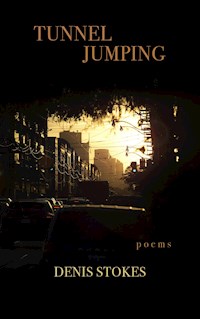
TUNNEL JUMPING
POEMS
––––––––
DENIS STOKES
––––––––
Scarlet Leaf Press
2020
SCARLET LEAF PRESS
TORONTO ONTARIO CANADA
COPYRIGHT BY:
DENIS STOKES
COVER DESIGN: SCOTT MURDOCH
AUTHOR PHOTO: MARY STOKES
All rights reserved.
No part of this book can be used or reproduced in any manner whatsoever without written permission, except in the case of brief quotations embodied in critical articles and reviews.
For information address to Scarlet Leaf Publishing House:
TUNNEL JUMPING
––––––––
For my mother
The city was my shadow, and no man jumps off his own shadow.... It is dyed into me, part of my way of seeing and feeling forever. Somebody else who lived there, unknown to me at the same time, might well see it differently.
-Sean O’Faolain
This is all I know: we are born out of darkness. One day darkness pulls us back. In between there is light.
-Ian McCulloch, in memorium
The great instigators of violence have encouraged themselves with the thought of how, blind, mechanical force is sovereign throughout the whole universe.
By looking at the world with keener senses than theirs, we shall find more powerful encouragement in the thought of how these innumerable blind forces are limited, made to balance one against the other, brought to form a united whole by something which we do not understand, but which we call beauty.
If we keep ever present in our minds the idea of a veritable human order, if we think of it as of something to which a total sacrifice is due should the need arise, we shall be in a similar position to that of a man traveling without a guide, through the night, but continually thinking of the direction he wishes to follow. Such a traveler’s way is lit by a great hope.
-Simone Weil
Acknowledgements
––––––––
MUCH THANKS FOR THE support of the following:
––––––––
WAVES... “LEFTOVER Tanka”
The Crafted Poem...”Pitcher in the Rain”
Acta Victoriana... “Bus Shelter”
Grammateion...”Swimming”
U.C. Review... “Dedication”
Canadian Forum... “Wayne is on the train/looking”
Images (York University)... “Warden Station”
Descant... “Damsels”; “Closet News”
(W)rites of Spring (League of Canadian Poets): Licking Honey from the Thorn... “Tunnel Jumping”
Arc... “Fields”
Carrying the Branch (Glass Lyre Press)... “Tasting Africa”
Leaping Clear... “Zen”
Iowa Source... “Arriving Light”
Several of these poems appeared in the anthology, Collected Words (with Bill Dunphy, Cecilia Petierse Kennedy, Des Daley, Paul McGraw)
Several of these poems appeared in the chapbook, Scarborough Poems (Wordwrights Canada).
Several other poems appeared in the chapbook What the Street Knows (Albernum Press).
Several of these poems appeared in the chapbook Peace Comes Dropping Slow (Albernum Press).
“Zen” and “Tasting Africa” appear in the collection, A Wolf Rages Down the Little Jocko.
“The Blackstock Children” appears in the collection by the same name.
The author is most grateful for the support of the Ontario Arts Council, without which many of these poems would not have been written.
Much thanks to the Teachers Union of Malawi for their gracious, inspiring welcome.
Table of Contents
Acknowledgements
I
Leftover Tanka
Pitcher in the Rain
My Creek
Autumn Moths
Bus Shelter
Altars
Moving
In Elegy
This Bridge Ices
What the Street Knows
Leper’s Song
Warden Station
Kiss ’n’ Ride
Prayer upon Cleaning out the Yonge Street Washroom
Wayne is on the train/looking
Gethsemane
Crossing the Road
II
Dedication
Closet News
The Calling
Damsels
Tunnel Jumping
Fields
Woods
Final Suns
Kennedy Road, Woodyard Homings
Zen (from Deer Park)
Reasons
Swimming
III
In the Dark Hall the Key
Updates
In Summer Heat, Norland
From Lakes Revisited
Simcoe
Death is Romantic
North Oshawa, The Given Road
Chevrons
Sheds
The Blackstock Children
Installing the Light
Otto Preminger Begins
Near the Reservoir
The Enfield Searches
Old Song
Towards Lilongwe, A Walk
Tasting Africa
Girls of Ekwendeni
Ode to Malarone
Flashing*
Massau
Kapuscinski, Shadowing Sun
Foxridge Wonder
Half Penny
Arriving Light
Author’s Biography
I
––––––––
HE PUSHED OPEN THE door and found himself walking in a labyrinth,
Corridors, elevators. The livid light was not light but the dark of the earth.
Electronic dogs passed him noiselessly.
He descended many floors, a hundred, three hundred, down.
-Orpheus and Eurydice, Czeslaw Milosz
Leftover Tanka
THE PIGEONS, GRAY AS the evening soon,
descend. The world chills a bit and
Feet shuffle over loose stones. A man
begs, too tired for a ragged violence.
You throw him a key to the city. He’s
lived long here. He remembers the tinges
of each sunset, the orders of noise- the angry
or humorous honking, the popular songs
telling us how we almost. Now a paper mist
is coming. Your eye pierces its covers,
searching for better words. Is this sky
spilling, or is it only giving us blood?
Wars, hungers and wounds, the lonely
sedentary travellers- it is sad, love, sad.
We are too weak for flames here. Our clasp
has loosened its joy. There’s only evening.
––––––––
EVENING AND IT COVERS, spreads sad news:
‘No joy, no truths left to save us’. Tell
me only of beauty, a flame burning these mists
for gods. Soon the stars attend, but now
it’s only air we have, simple facts of breathing.
Pitcher in the Rain
THERE’S AN IDIOT DOWN there
across the church parking lot
in the schoolyard five stories down
pitching against the wall, pitching in the rain
so heavy the traffic’s slowing down,
so dark all the headlights keep flicking on.
A room or two’s
being used in the school.
They light up
the walls outside spilled with stains,
countless waterings-
road hockey pee breaks, berby, tennis and basketball,
spud every year or so.
Schoolyards know the stories.
Gulls circle by, remembering
this idiot pitching against the wind, perhaps
in this rain getting heavier by the minute
insisting upon the rhythms of his attempts
as if I were looking down instead through sunlight,
some benevolent summer.
But you can see the kapok, his skinned planet
hopping trout quick and mad off that wall
to the glove’s rapid snapping
at each sudden swerve for spin or stone.
The idiot- he must be soaked to the bone by now.
His arm must be hurting bad.
A starling or grackle laughs,
observes from a window ledge above,
can’t believe it, I bet
can’t believe anything worth such release,
such defiance of this dusk.
What game up ahead could it be?
Why would he bother to be here
knocking and knocking at those bricks, skip stepping
into each downswing of arm,
no batter there,
no catcher even,
just some hurt, some deepening dream and need,
this reason no one but he can see
signalled from that wall?
My Creek
I STILL CALL THIS MY creek, chasing through this ravine
past the odd doll carriage fallen from houses
up there on the hill, or bags and shopping buggies
wilder kids have rolled over miniature bluffs
like cars stolen from the plaza.
Rocks, cattails, two wooden bridges
join muddy banks to paths
worn to those same stores and houses.
Of course, I should not call this creek mine only,
or honour its more sickening odors. No one could,
though gray, swaying poplars, sullen willows,
even the giant elm, almost bare now,
the kids keep swinging on, say it’s a creek.
A creek- merely alive, or slowly dying.
In the coldest cold, I’ve seen some skate on it.
In hot spells, there’s a mad splashing,
reddened eyes fearless of rumoured fevers.
If this creek could talk, it would tell of turtles,
a fish, and ten or fifteen years ago, muskrats




