


17,99 €
Mehr erfahren.
- Herausgeber: John Wiley & Sons
- Kategorie: Wissenschaft und neue Technologien
- Sprache: Englisch
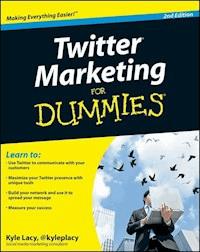
Get the latest tweets, tools, tips, and techniques and kick-start your Twitter marketing campaign! As the fastest-growing social networking service with more than 50 million tweets posted per day, Twitter poses a plethora of marketing possibilities. Boasting more than 50 percent new or updated content, this fun and friendly second edition reflects the latest features that Twitter has implemented to make the service more appealing to business users. Twitter Marketing For Dummies, 2nd Edition helps you build a following, promote your product, and drive more traffic to your Web site. * Details the changes to Twitter since the previous edition and explores the newest features and functionality that Twitter now offers to businesses looking to market their product on the fastest-growing social networking service * Shows you how to effectively increase your visibility and promote your message via Twitter * Looks at the new promoted Tweets and Twitter lists * Delves into the marketing possibilities that exist with the new feature of sharing tweets on other social networking sites So stop twiddling your thumbs and start tweeting today with the Twitter marketing advice shared within the pages of Twitter Marketing For Dummies, 2nd Edition.
Sie lesen das E-Book in den Legimi-Apps auf:
Seitenzahl: 411
Veröffentlichungsjahr: 2011
Ähnliche



















Twitter Marketing For Dummies®
Visit www.dummies.com/cheatsheet/twittermarketing to view this book's cheat sheet.
Table of Contents
Twitter® Marketing For Dummies®, 2nd Edition
by Kyle Lacy
Twitter® Marketing For Dummies®, 2nd Edition
Published byWiley Publishing, Inc.111 River St.Hoboken, NJ 07030-5774www.wiley.com
Copyright © 2011 by Wiley Publishing, Inc., Indianapolis, Indiana
Published simultaneously in Canada
No part of this publication may be reproduced, stored in a retrieval system or transmitted in any form or by any means, electronic, mechanical, photocopying, recording, scanning or otherwise, except as permitted under Sections 107 or 108 of the 1976 United States Copyright Act, without either the prior written permission of the Publisher, or authorization through payment of the appropriate per-copy fee to the Copyright Clearance Center, 222 Rosewood Drive, Danvers, MA 01923, (978) 750-8400, fax (978) 646-8600. Requests to the Publisher for permission should be addressed to the Permissions Department, John Wiley & Sons, Inc., 111 River Street, Hoboken, NJ 07030, (201) 748-6011, fax (201) 748-6008, or online at http://www.wiley.com/go/permissions.
Trademarks: Wiley, the Wiley Publishing logo, For Dummies, the Dummies Man logo, A Reference for the Rest of Us!, The Dummies Way, Dummies Daily, The Fun and Easy Way, Dummies.com, Making Everything Easier, and related trade dress are trademarks or registered trademarks of John Wiley & Sons, Inc. and/or its affiliates in the United States and other countries, and may not be used without written permission. All other trademarks are the property of their respective owners. Wiley Publishing, Inc., is not associated with any product or vendor mentioned in this book.
Limit of Liability/Disclaimer of Warranty: The publisher and the author make no representations or warranties with respect to the accuracy or completeness of the contents of this work and specifically disclaim all warranties, including without limitation warranties of fitness for a particular purpose. No warranty may be created or extended by sales or promotional materials. The advice and strategies contained herein may not be suitable for every situation. This work is sold with the understanding that the publisher is not engaged in rendering legal, accounting, or other professional services. If professional assistance is required, the services of a competent professional person should be sought. Neither the publisher nor the author shall be liable for damages arising herefrom. The fact that an organization or Website is referred to in this work as a citation and/or a potential source of further information does not mean that the author or the publisher endorses the information the organization or Website may provide or recommendations it may make. Further, readers should be aware that Internet Websites listed in this work may have changed or disappeared between when this work was written and when it is read.
For general information on our other products and services, please contact our Customer Care Department within the U.S. at 877-762-2974, outside the U.S. at 317-572-3993, or fax 317-572-4002.
For technical support, please visit www.wiley.com/techsupport.
Wiley also publishes its books in a variety of electronic formats. Some content that appears in print may not be available in electronic books.
Library of Congress Control Number: 2011922793
ISBN: 978-0-470-93057-1
Manufactured in the United States of America
10 9 8 7 6 5 4 3 2 1
About the Author
Kyle Lacy loves everything about social media and the Internet. He believes in the massive potential to communicate and change the world in which we live by using online tools. Kyle started his obsession with social media and marketing at Anderson University, where he helped run a start-up record label called Orangehaus Records. With Kyle’s leadership, the marketing team dove into the world of MySpace and Facebook to gain recognition for their artist, Jon McLaughlin, who was eventually signed to Island Records in New York City.
After graduating college in December 2006, Kyle and his good friend, Brandon Coon, decided to start a graphic design and marketing company called Brandswag in July 2007. Brandswag started out designing identities for small businesses and eventually turned to consulting on social media. In August 2010, Brandswag merged with another company and became MindFrame. Six people currently work at MindFrame, and the company is mainly working on helping companies and nonprofits understand the world of integrated marketing. They strive to understand the ideas and models that drive measured marketing and campaigns.
Kyle loves the idea of educating business owners and C-level employees on the power of social media (mainly Twitter). He writes a regular blog at www.kylelacy.com and is a regular contributor to the Personal Branding Blog, http://personalbrandingblog.com. His blog has been featured on the Wall Street Journal’s Web site and in numerous articles in Indianapolis and abroad. In 2010, Kyle was recognized as one of the top Forty-under-40 business professionals in Indianapolis and young alumni of the year for Anderson University. Twitter Marketing For Dummies was also named one of the top Twitter marketing books for 2010.
Dedication
To my parents and my family (middle-America and the northwest). I would not be where I am today without your continuing support and encouragement.
Author’s Acknowledgments
First off, I would like to thank the awesome team at Wiley — Amy Fandrei and Pat O’Brien — for putting up with my hectic schedule and my early, early, early morning writing habits. Also, thanks to Manny Hernandez (@askmanny) for helping with the content of the book from a technical side. Manny is the man!
Publisher’s Acknowledgments
We’re proud of this book; please send us your comments through our online registration form located at www.dummies.com/register/.
Some of the people who helped bring this book to market include the following:
Acquisitions, Editorial, and Media Development
Project Editor: Pat O’Brien
Acquisitions Editor: Amy Fandrei
Copy Editors: John Edwards, Annie Sullivan
Technical Editor: Michelle Oxman
Editorial Manager: Kevin Kirschner
Media Development Project Manager: Laura Moss-Hollister
Media Development Assistant Project Manager: Jenny Swisher
Media Development Associate Producers: Josh Frank, Marilyn Hummel, Douglas Kuhn, and Shawn Patrick
Editorial Assistant: Amanda Graham
Sr. Editorial Assistant: Cherie Case
Cartoons: Rich Tennant (www.the5thwave.com)
Composition Services
Project Coordinator: Katherine Crocker
Layout and Graphics: Samantha K. Cherolis, Joyce Haughey, Corrie Socolovitch
Proofreaders: John Greenough, The Well-Chosen Word
Indexer: Cheryl Duksta
Publishing and Editorial for Technology Dummies
Richard Swadley, Vice President and Executive Group Publisher
Andy Cummings, Vice President and Publisher
Mary Bednarek, Executive Acquisitions Director
Mary C. Corder, Editorial Director
Publishing for Consumer Dummies
Diane Graves Steele, Vice President and Publisher
Composition Services
Debbie Stailey, Director of Composition Services
Introduction
Greetings, and welcome to Twitter Marketing For Dummies. You have officially entered into the joyous world of marketing on Twitter. If you want to think about the tool in terms of celebrity, Twitter is the Oprah of social-networking sites. Twitter is huge, both in the number of users and excitement.
This idea of communicating on the Internet is continually evolving, and with Twitter, you have the opportunity to reach millions of people in a matter of seconds. The future of online communication is rendering business owners lifeless because of how slow they are to adopt new technology for communication. What if your customers stopped using the phone and moved somewhere else? Would you be ready? Would you read about Twitter if your competitors bought this book? Guess what — they already did.
This book is full of ideas created by the masses about how to communicate through Twitter. Success is the only option, and Twitter can help you with your business goals and aspirations.
So, is Twitter life, and the rest just details? Not exactly, but Twitter can help you create a sustainable communication model to drive more leads, revenue, and customer evangelists to your product. And the best part is, you don’t have to spend countless hours researching how to use Twitter to market your products. I did it for you!
About This Book
If you’ve received your citizenship papers from Twitter and are just starting to dip into the world of 140-character communication, this book is for you. It gives an in-depth look into the world of marketing on Twitter. The majority of the concepts discussed deal with combining Twitter with your traditional marketing plan, creating your following of brand evangelists, and finding the best tools for productivity on Twitter. Most of all, you discover how Twitter can transform the way your business communicates with clients (both current and potential) and increase your sales.
Twitter offers a fun way to communicate with your followers, but it also has huge business potential. This book deals with Twitter as a business tool. As a famous rapper once said, “We are makin’ it rain benjamins.” To the layman, this expression means one-hundred-dollar bills are falling from the sky (which probably makes the cash a little awkward to gather).
I wrote this book to help you gain traction on Twitter and to drive revenue to your business. If you can successfully market through Twitter, you can drive more leads and potentially more business to your door! Do you have a specific topic that you want to find out about, such as building your followers? Jump to the chapter that discusses assembling your Twitter posse (Chapter 7, if you want to go there now).
Avoid blinding yourself with the light bulb that bursts above your head when you read this book. If you tear a page out to post on your wall, or put sticky notes and highlights all over the pages of this book, I’ve done my job. In fact, flag and highlight as many pages as you want. Consider this book a reference guide to help you define and improve your marketing concepts, goals, and communication strategies on Twitter.
Also, this book doesn’t look good gathering dust on a bookshelf. Use it! (Everyone knows that the color yellow doesn’t blend well with anything.)
Foolish Assumptions
Every author has to assume a few things about his or her audience when writing a book. I made the following assumptions about you:
You’re an awesome individual because you picked up this book.
You either already have a Twitter account or are planning to create one soon.
You own a small business, or you work in marketing or sales for a large business.
You want to combine the two preceding bullets and use Twitter to market your business and/or products.
You are sending out tweets but have no idea what type of return you are getting on your time investment. Further, you have no idea whether your boss is going to fire you the next time she finds out you’re using Twitter.
I also assume you have some basic Web-fu skills, such as knowing how to surf the Web. I assume that you may have your own Web site and/or blog, and that you may even have a few social media sites that you visit and update frequently (such as Facebook, MySpace, LinkedIn, and so on).
Conventions Used in This Book
I know that doing something the same way over and over again can get boring, but sometimes consistency is a good thing. For one thing, consistency makes stuff easier to understand. In this book, those consistent elements are conventions:
I use italics to identify and define new terms. (I even used this convention to explain the word “conventions” in the preceding paragraph!)
Whenever you have to type something, I put the stuff you need to type in bold so that you can easily tell what you need to enter.
When I type URLs (Web addresses), code, or e-mail addresses within a paragraph, they look like this: www.wiley.com.
How This Book Is Organized
The idea of marketing on Twitter has a wide variety of subject matter and ideas, which is part of the reason why this book is broken down into parts, chapters, and sections. The whole point of organizing the book in the For Dummies way is for quick reviewing and reading. If you want to know about creating one or two accounts, you can go directly to the section that discusses that topic in Chapter 2. If you want to know about creating a Twitter marketing plan, head to Chapter 4.
The following sections describe how the book is organized.
Part I: The Future of Twitter in Business
If you need to understand the concepts and future trends of Twitter as a business tool, this part is for you. I discuss the ideas of business development, the growing number of Twitter users, and what Twitter means to your business. This part also describes ideas about how to use Twitter effectively for newbies (people who are new to a given situation or technology). If you’re not new to Twitter, you can skip Chapter 2, which discusses how to get signed up for an account and create a profile.
Part II: Building and Implementing Your Twitter Marketing Roadmap
Part II is the most important part of the book. You absolutely must plan your Twitter marketing strategy before you dive directly into the churning waters of Twitter marketing. Twitter can be a powerful marketing tool if you plan your roadmap to success. Read and reread Part II to gain the knowledge that you need to successfully implement the rest of the ideas in this book.
Part III: Devising Online Strategies for Twitter Marketing Domination
From building your following to implementing communication strategies, Part III takes a look at how you can use Twitter to grow your business. Does it matter whether you have quantity over quality in your followers? Should you use the auto-direct-messaging feature? (Please don’t.) This part provides many answers for you. You need to successfully devise an online strategy before you try to implement that strategy (which Part IV covers). Mastering the online use of Twitter is your key to success.
Part IV: Implementing Twitter Strategies for Offline Marketing Domination
Integration, integration, integration. Nothing can help you market your business more than the combination of an offline and online strategy. Twitter can become much more powerful when you use it to push offline marketing strategies as well as online strategies. If you want to use Twitter to execute a live event, add spice to your brochure, or strengthen your offline network, you can. This part shows you how to integrate and strengthen all your marketing endeavors by using Twitter, online and off.
Part V: The Part of Tens
Tradition. Plain and simple. The Part of Tens caters to a couple of traditions. First, the For Dummies books all have a Part of Tens, which in this case sums up the more important information to help you on your Twitter journey. For example, I guide you through the top ten don’ts of Twitter, such as annoying people with a hard sell. (Don’t do it!). Second, Internet communication lends itself to placing things in numbered lists, so the chapters in the Part of Tens are concise and to the point.
Appendixes
Hundreds of people contributed to Appendix A. Twitter users from around the world gave their opinion on how to use Twitter for marketing. You can find more than 100 of their ideas near the back of this book for your perusing enjoyment. You can really make the most of driving business and ideas through Twitter by implementing some of these ideas.
Applications and support sites are what drive productivity and time management in the world of Twitter. Appendix B has exhaustive lists of sites and applications that can help you make the most of your time on Twitter. From prescheduling content to developing content calendars, the following applications revolutionize your usage time.
Icons Used in This Book
I use the following icons throughout the book to highlight paragraphs that you should pay particular attention to.
A Tip is kind of self-explanatory, right? The Tip icon points out information that can help you use or implement your ideas differently. You may find these simple suggestions very useful.
I look at Remember icons as massive tips to remember. These icons mark information that you really should commit to memory when you use Twitter for marketing purposes.
The Technical Stuff icon marks information of a highly technical nature that you can normally skip over. I hardly ever read the technical stuff! So why should you? Honestly, who reads the directions?
The Warning icon is the equivalent of the warning label on a lawn mower that tells you not to stick your foot underneath the blades. Warnings help you along your way so that you don’t cut off your little Twitter toes.
The Case Study icon points out real-life examples of how companies have used the Twitter marketing concepts and techniques discussed in this book.
Where to Go from Here
You’re ready, my young Jedi. Go forth into the world of Twitter and dominate your efforts in marketing and driving business through the Internet. But where should you start?
If you already know the basic Twitter ropes, you can skip Part I. But I strongly suggest that you read Part II before you start trying to use Twitter as a marketing tool. You must have a plan in place that measures your Twitter marketing success rate and indicates how you use the tool. Part II describes how to plan and develop a strategy.
If you have a specific topic in mind that you want to know more about, check the Index or the Table of Contents, and then flip to that chapter, section, or page and start reading. And, of course, you can always just start your Twitter marketing adventure at Chapter 1.
If you have any questions regarding marketing on Twitter, feel free to check out my blog at www.kylelacy.com or e-mail me at [email protected].
Please note that some special symbols used in this eBook may not display properly on all eReader devices. If you have trouble determining any symbol, please call Wiley Product Technical Support at 800-762-2974. Outside of the United States, please call 317-572-3993. You can also contact Wiley Product Technical Support at www.wiley.com/techsupport.
Part I
The Future of Twitter in Business
In this part . . .
You’re stepping into the world of Twitter marketing. You know that Twitter is one of the most popular social-media sites on the Internet, but how can you use it to drive business? What’s the difference between micro-blogging and blogging? Who’s on Twitter, and why are they using it? I answer these questions in this part.
In Chapter 1, you get a glimpse into the world of using Twitter for business. If you haven’t already signed up for Twitter, Chapter 2 helps you sign up and get going. So, get a cup of coffee or tea (or a 12-hour energy drink) and jump into Twitter marketing.
Lesen Sie weiter in der vollständigen Ausgabe!
Lesen Sie weiter in der vollständigen Ausgabe!
Lesen Sie weiter in der vollständigen Ausgabe!
Lesen Sie weiter in der vollständigen Ausgabe!
Lesen Sie weiter in der vollständigen Ausgabe!
Lesen Sie weiter in der vollständigen Ausgabe!
Lesen Sie weiter in der vollständigen Ausgabe!
Lesen Sie weiter in der vollständigen Ausgabe!
Lesen Sie weiter in der vollständigen Ausgabe!
Lesen Sie weiter in der vollständigen Ausgabe!
Lesen Sie weiter in der vollständigen Ausgabe!
Lesen Sie weiter in der vollständigen Ausgabe!
Lesen Sie weiter in der vollständigen Ausgabe!
Lesen Sie weiter in der vollständigen Ausgabe!
Lesen Sie weiter in der vollständigen Ausgabe!
Lesen Sie weiter in der vollständigen Ausgabe!
Lesen Sie weiter in der vollständigen Ausgabe!
Lesen Sie weiter in der vollständigen Ausgabe!
Lesen Sie weiter in der vollständigen Ausgabe!
Lesen Sie weiter in der vollständigen Ausgabe!
Lesen Sie weiter in der vollständigen Ausgabe!
Lesen Sie weiter in der vollständigen Ausgabe!
Lesen Sie weiter in der vollständigen Ausgabe!
Lesen Sie weiter in der vollständigen Ausgabe!
Lesen Sie weiter in der vollständigen Ausgabe!
Lesen Sie weiter in der vollständigen Ausgabe!




