


22,99 €
Mehr erfahren.
- Herausgeber: John Wiley & Sons
- Kategorie: Wissenschaft und neue Technologien
- Sprache: Englisch
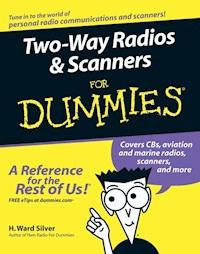
Discover a fun new hobby with helpful possibilities Get directions, talk to folks overseas, or find out whether the fish are biting Want to check out the morning news in London, help out in emergencies, or tune in to the big race? Two-way radios open up a world of possibilities - literally. This handy guide tells you about the equipment you need, fills you in on radio etiquette, shows you how to stay legal, and gives you lots of cool ideas for family-friendly radio activities. Discover how to * Use the right radio lingo * Choose and operate different types of radios * Get a license if you need one * Communicate in emergencies * Program a scanner * Tune in to sporting events
Sie lesen das E-Book in den Legimi-Apps auf:
Seitenzahl: 553
Veröffentlichungsjahr: 2011
Ähnliche

















Two-Way Radios and Scanners For Dummies
by H. Ward Silver
Two-Way Radios and Scanners For Dummies®
Published byWiley Publishing, Inc.111 River St.Hoboken, NJ 07030-5774www.wiley.com
www.wiley.com
Copyright © 2005 by Wiley Publishing, Inc., Indianapolis, Indiana
Published by Wiley Publishing, Inc., Indianapolis, Indiana
Published simultaneously in Canada
No part of this publication may be reproduced, stored in a retrieval system or transmitted in any form or by any means, electronic, mechanical, photocopying, recording, scanning or otherwise, except as permitted under Sections 107 or 108 of the 1976 United States Copyright Act, without either the prior written permission of the Publisher, or authorization through payment of the appropriate per-copy fee to the Copyright Clearance Center, 222 Rosewood Drive, Danvers, MA 01923, (978) 750-8400, fax (978) 646-8600. Requests to the Publisher for permission should be addressed to the Legal Department, Wiley Publishing, Inc., 10475 Crosspoint Blvd., Indianapolis, IN 46256, (317) 572-3447, fax (317) 572-4355, or online at http://www.wiley.com/go/permissions.
Trademarks: Wiley, the Wiley Publishing logo, For Dummies, the Dummies Man logo, A Reference for the Rest of Us!, The Dummies Way, Dummies Daily, The Fun and Easy Way, Dummies.com, and related trade dress are trademarks or registered trademarks of John Wiley & Sons, Inc. and/or its affiliates in the United States and other countries, and may not be used without written permission. The Icom logo is a registered trademark of Icom, Inc. All other trademarks are the property of their respective owners. Wiley Publishing, Inc., is not associated with any product or vendor mentioned in this book.
LIMIT OF LIABILITY/DISCLAIMER OF WARRANTY: The publisher and the author make no representations or warranties with respect to the accuracy or completeness of the contents of this work and specifically disclaim all warranties, including without limitation warranties of fitness for a particular purpose. No warranty may be created or extended by sales or promotional materials. The advice and strategies contained herein may not be suitable for every situation. This work is sold with the understanding that the publisher is not engaged in rendering legal, accounting, or other professional services. If professional assistance is required, the services of a competent professional person should be sought. Neither the publisher nor the author shall be liable for damages arising herefrom. The fact that an organization or Website is referred to in this work as a citation and/or a potential source of further information does not mean that the author or the publisher endorses the information the organization or Website may provide or recommendations it may make. Further, readers should be aware that Internet Websites listed in this work may have changed or disappeared between when this work was written and when it is read.
For general information on our other products and services, please contact our Customer Care Department within the U.S. at 800-762-2974, outside the U.S. at 317-572-3993, or fax 317-572-4002.
For technical support, please visit www.wiley.com/techsupport.
Wiley also publishes its books in a variety of electronic formats. Some content that appears in print may not be available in electronic books.
Library of Congress Control Number: 2005924591
ISBN-13: 978-0-7645-9582-0
ISBN-10: 0-7645-9582-2
Manufactured in the United States of America
10 9 8 7 6 5 4 3 2 1
1O/RS/QX/QV/IN
About the Author
H. Ward Silver has experienced a 20-year career as an electrical engineer developing instrumentation and medical electronics. He also spent 8 years in broadcasting, both programming and engineering. In 2000, he turned to teaching and writing as a second career, producing Ham Radios For Dummies in2004. He supports Seattle University’s Electrical and Computer Engineering Department in laboratory instruction. He is an avid Amateur Radio operator, Extra Class, first licensed in 1972. Each month, his columns and articles can be found in the national ham radio magazine, QST, published by the American Radio Relay League (ARRL). He is the author of the ARRL’s online courses in Antenna Design and Construction, Analog Electronics, and Digital Electronics. When not in front of a computer screen, you will find him working on his mandolin technique and compositions.
Dedication
This book is dedicated to my mom, who enabled her mad scientist son to conduct his basement activities in radio and science. Also to our family cat, Mirage, who carefully supervised the author throughout the creation of this book.
Author’s Acknowledgments
I would like to gratefully acknowledge the Uniden America Corporation for providing equipment, a number of excellent graphics, and for their technical reviews of several chapters. Paul Opitz, Uniden Marketing Manager, was particularly generous with his time and assistance. I must also recognize the professional contributions of my editor, Nicole Haims, who patiently trimmed and guided each chapter to the polished form you enjoy. My technical editor, Kirk Kleinschmidt, also provided invaluable review and commentary. Thanks also to Melody Layne at Wiley for enabling me to write this second title.
Much gratitude also goes to the members of the Vashon-Maury Island Radio Club and of the Vashon Disaster Preparedness Coalition, who were the guinea pigs for many of my planning and training experiments.
Thank you!
Publisher’s Acknowledgments
We’re proud of this book; please send us your comments through our online registration form located at www.dummies.com/register/.
Some of the people who helped bring this book to market include the following:
Acquisitions, Editorial, and Media Development
Project Editor: Nicole Haims
Acquisitions Editor: Melody Layne
Technical Editor: Kirk Kleinschmidt
Editorial Manager: Carol Sheehan
Permissions Editor: Laura Moss
Media Development Manager: Laura VanWinkle
Media Development Supervisor: Richard Graves
Editorial Assistant: Amanda Foxworth
Cartoons: Rich Tennant (www.the5thwave.com)
Composition Services
Project Coordinator: Maridee Ennis
Layout and Graphics: Carl Byers, Andrea Dahl, Kelly Emkow, Joyce Haughey, Mary Gillot Virgin, Lynsey Osborn
Proofreaders: Leeann Harney, Jessica Kramer, Joe Niesen, TECHBOOKS Production Services
Indexer: TECHBOOKS Production Services
Publishing and Editorial for Technology Dummies
Richard Swadley, Vice President and Executive Group Publisher
Andy Cummings, Vice President and Publisher
Mary Bednarek, Executive Acquisitions Director
Mary C. Corder, Editorial Director
Publishing for Consumer Dummies
Diane Graves Steele, Vice President and Publisher
Joyce Pepple, Acquisitions Director
Composition Services
Gerry Fahey, Vice President of Production Services
Debbie Stailey, Director of Composition Services
Contents
Title
Introduction
About This Book
What You’re Not to Read
Foolish Assumptions
How This Book Is Organized
Conventions Used in This Book
Where to Go From Here
Part I : Making Radio a Habit, a Hobby, or a Helper
Chapter 1: Introducing Radios and the Wireless World
Understanding How Radios Fit into a Wireless World
Introducing Radio’s Unique (And Magical) Forms
What You Can Do with a Radio
Knowing Radio Rules and Regulations
Getting Training (If You Need To)
You, Too, Can Build and Fix Your Own Radio
Chapter 2: Discovering the Art and Science of Radio
Doing the Wave: How Radio Waves Work
Getting From Here to There: Propagation
What You Hear Is What You Get: Modulation
Terms of Endearment: Using the Language of Radio
Chapter 3: Making Radio Fit Your Life
Seeing What Makes Radio Services and Allocations Different
Comparing Two-Way Radio Services
Choosing Between the Services
Buying Equipment to Fit Your Budget
Getting a License When You Need To
Coloring Inside the Lines: Basic Rules
Where to Find All the Rules and Regulations
Part II : Two-Way Radios at Home, Work, and Play
Chapter 4: A Radio in Your Pocket: FRS/GMRS Radios
Introducing the FRS and GMRS Services
Getting a GMRS License
Understanding Basic Radio Features
Basic Operating Skills
Using Your Radio at Public Events and Places
Using Your Radio in the Great Outdoors
Maximizing Your Range
Repeating Yourself
Choosing a Radio
Adding Antennas and Accessories
Chapter 5: Breaker, Breaker: Using Citizens Band
CB Basics
Finding Uses for Your CB Radio
Getting To Know Your Radio
Operating Your CB
Going Out and About with Your CB
Using Your CB for Emergency Communications
Shopping on the CB Channel
Operating on the Right Side of the Law
Chapter 6: Communicating in Emergencies
Matching Radios and Emergencies
Being Ready
Making and Responding to Calls for Help
Disaster Response
Practice Makes Perfect
Chapter 7: Workaday Wireless: Business Radio Services
Choosing the Right Business Radio Service
Using a Professional Radio Service Provider
Operating Your Business Radio
Chapter 8: Ladies and Gentlemen, Ships at Sea: Marine Radio
Introducing VHF Harbor and Waterway Radio
Introducing Marine Radio’s Advanced Features
Saltwater Communications: HF Marine Radio
Basic Marine Radio Do’s and Don’ts
Performing Basic Radio Tasks in the Water
Satellite Radio and Marine E-mail
Getting That License
Chapter 9: Citizen Wireless: Amateur Radio
Tuning In Ham Radio Today
Finding the Ham Bands
Getting a Ticket: The Ham Kind
Part III : Listening In: Scanning and Shortwave Listening
Chapter 10: One Adam 12: Scanner Basics
Listening: Oh, the Signals You’ll Hear
Introducing the Radio Population
Learning How to Use A Scanner
Knowing the Rules of Scanning
Trunking Systems
Programming Your Scanner
Choosing Scanners and Antennas
Chapter 11: Scanning Public Service and Safety Radio Transmissions
Tracking Down Your Local Government
Scanning Trunked Systems
Setting Up a Trunked System on Your Scanner
Cracking Codes and Learning Lingo
Helping, Not Hindering
Chapter 12: Radio Aloft: Aviation Radio Transmissions
Activity on the Aviation Bands
Finding Frequencies
Ground Control to Major Tom: Airport Operations
Listening to Air Traffic Between Airports
Strangling Your Parrot: Aviation Jargon
Chapter 13: Radios in Uniform: Government Radio Transmissions
Scanning the Military
Accessing Civilian Agencies
Step Away from the Radio: Following the Rules of Sensible Scanning
Chapter 14: Radio in Action: Recreational Radio Transmissions
Taking a Scanner to the Races
Winging It at Air Shows and Fly-Ins
Taking Your Radio on the Run and into the Crowd
Getting the Right Accessories
Want to Get Involved?
Scanning Tips
Chapter 15: Surfing the Air World: Shortwave Listening
Finding Shortwave Broadcasters
Choosing and Using SW Radios and Antennas
Shortwave Signal Propagation
Introducing World Time
Using a Program Guide
Confirming Your Reception
SWL Web References
Part IV : Getting Technical with Your Radio
Chapter 16: Building Your Radio Toolbox
Acquiring the Right Tools
Stocking Stuff
The Mechanics of Stocking Spare Parts over Time
Finding Education and Training
Chapter 17: A Spark of Electronic Know-How
Understanding the Relationship between Amps, Volts, Watts, and Ohms
Wires, Cables, and Connecters
Dealing with Safety Issues
Chapter 18: Installing Radios Right
Installing Your Radio at Home
Getting Your Mobile Installation Rolling
Choosing and Installing Connectors
Chapter 19: Getting a Charge Out of Batteries
Getting Battery Basics
Ah . . . Introducing Amp Hours and Characteristic Voltage
Disposable Batteries versus Rechargeable Batteries
Exploring the World of Battery Packs
Following Basic Battery Tips
Adhering to the Rules of Battery Safety
Chapter 20: Putting Your Computer to Work
Making Sure Your PC and Radio Are Compatible
Choosing a Signal Interface
Making the Connection
Troubleshooting Your Computer and Your Radio
Chapter 21: Troubleshooting Your Radio
Hunting the Wily Mr. Murphy
Prosecuting Power Problems
Solving Operating Problems
Banishing Noise
Dealing with Interference
Visiting the Radio Doctor
Part V : The Part of Tens
Chapter 22: Ten Radio Secrets
Listening Rules
Talking Louder Doesn’t Do You Any Good
It’s All in the Antenna
The FCC Does, Too, Care
Setting Up Your Radio Correctly the First Time
Finding the Hot Spot
Planning for the Worst
Getting What You Pay For
Following the Ten Count
Discovering the Best Way to Relax
Chapter 23: Ten Emergency Tips
Using Your Radio Regularly
Getting Yourself under Control
Supplying Just the Facts
Being Smart with Resources
Knowing Where to Tune
Taking Advantage of Geography
Writing Everything Down and Keeping It Short
Following the Plan
Using the Buddy System
Practice, Practice, Practice
Chapter 24: Ten Radio First-Aid Techniques
Resetting the Radio
Replacing Lost Antennas
Putting the Wrong Batteries to the Right Use
Fixing a Faulty Pushbutton
Working around a Broken Speaker
Splicing Together Torn Wires
Working through Wind and Noise
Rescuing an Immersed Radio
Building an Emergency Charger
Making Do with the Tools around You
Chapter 25: Ten New Ways to Have Fun with Your Radio
Direction Finding
Hilltopping
Conducting Coverage Tests: Can You Hear Me Now?
Going on a Radio Scavenger Hunt
Riding at a Radio Rodeo
Creating Radio Scoreboards
Going to a Hamfest
Weather Watching
Wildlife Tracking
Joining a Club
Appendix: Glossary
Introduction
T o all my readers, welcome to the amazing world of radio that awaits you just behind the front panel power switch. There’s a lot more radio out there than you might think! This book helps introduce you to it.
If you’ve just become interested in radio, Two-Way Radios & Scanners For Dummies contains plenty of information to explain what radio is all about. You’ll have more fun and success by mastering the basics, and so will the friends, family, and associates with whom you’re trying to communicate. This book answers a lot of questions about the jargon being thrown around by manuals and by other radio aficionados. It’s the perfect companion for people who want to maximize their radio experience and utility. Whether you’re using your radio for work or for recreation, whether you already own a radio or are still browsing for the right system, this book gives you all you need to know in one convenient package.
About This Book
This book is designed with two reading audiences in mind:
New users: New to radio? Welcome! This book helps you become a confident, knowledgeable radio user. All the new activities, particularly the technical ones, can be intimidating to newcomers. If you’re still shopping for a radio, I give you some tips on what to look for in a good radio. If you just bought a radio, this book gives you a tour of the main features. By keeping Two-Way Radios & Scanners For Dummies handy, you will have an easier time getting your radio or scanner connected and working right. I cover the basics of properly putting together a station and give you the fundamentals of on-the-air behavior. Use this book as your personal radio buddy and soon you’ll be sounding (and listening) like a pro!
Radio users who want more information: Those of you already using a radio can find new ways of putting that radio to work and get a better understanding of how the radio does what it does. You can find out about other types of radios and services, as well. I give you lots of resources to help you get more out of the radios you have and make good choices about antennas, accessories, and new radios. There is a little something for every level of operator!
What You’re Not to Read
If you just got a radio, I’ll bet you’re wondering, “What do I do now?” New radio users need a helping hand to find out how to use it properly. Two-Way Radios & Scanners For Dummies will be there to look over your shoulder until you are confidently making good use of your equipment. I make the basics of radio available in the first parts of the book so you won’t have to be a radio whiz to assemble and use your equipment. If you already know these basics, you can skip Part I and move on to the chapters that cover specific radio services and functions.
As you make your way through Two-Way Radios & Scanners For Dummies, feel free to skip around to whatever areas your interests take you. Within a chapter, you can ignore the sidebars, if you like, which contain extra-technical details or slightly off-the-beaten-path information. The book is written so that you can open it anywhere at any time.
Foolish Assumptions
The first thing I assume is that you either have a radio or will soon be purchasing one. Maybe you have fiddled around with a radio that belongs to a friend and want to know a bit more about what types of radios and scanners are available before you take the plunge. This book helps you select a radio based on your needs; to get the most out of the book, you’ll need to borrow or buy your own radio so that you can tinker around.
If you’re just getting started, the amount of information available about radios, radio technology, electronics, and more can be overwhelming! You can start relaxing right now. I assume that you don’t know a single thing about radio technology, so you can enjoy Two-Way Radios & Scanners For Dummies. Every chapter offers supporting explanations of radio jargon and conventions in plain English.
I assume that you know how to use a computer and that you have Internet access to use the online resources I provide. Internet access is also useful for finding expanded explanations of more complex topics related to radio technology.
If you need to obtain a license to use your type of radio, Two-Way Radios & Scanners For Dummies assumes that you need information about and guidance through the licensing process.
How This Book Is Organized
Two-Way Radios & Scanners For Dummies is divided into parts to meet the needs of beginners, dabblers, and radio enthusiasts.
Part I: Making Radio a Hobby, a Habit, or a Helper
If you don’t have much information about radios but you know enough that you’re interested in using them, or if you’ve just obtained a radio, this is where you start reading. Part I gives you the big picture of how radio technology works. Find out the differences between the various radios and radio communications. Because some of the radios require a license to use, this part also covers what you need to do to get the required paperwork in place.
Part II: Two-Way Radios at Home, Work, and Play
Radios that connect people are more popular than ever and there are so many types! Just about every activity you can think of has its own specialized radio service and Part II gives you information about the most popular services around. It starts with a discussion about the handy palm-sized units for short-range person-to-person chatting and moves on to investigate Citizens Band radio, emergency communications, and using radios for your business. You can also find out about radios used for boating. The part concludes with a chapter on the most powerful personal radio service of all, amateur radio. If you already have a radio, this part shows you how to use it. If you’re trying to choose a radio to fill a specific need, this is where you get the information needed to decide.
Part III: Listening In: Scanning and Shortwave Listening
If you’re into radios (which you are); then you’ll enjoy finding out about high-performance receivers that pull in signals from across town (scanners) and around the world (shortwave receivers). Part III discusses what distinguishes the various types of listen-only radios from each other and helps you choose the right technology. It offers several popular ways of using these special radios.
Part IV: Getting Technical with Your Radio
After Parts II and III, your appetite will be whetted to get busy putting together a complete radio station. While you could just rush out and lash it all together, you’ll have much better results if you set everything up the right way first! Part IV shows you how to do a proper installation, whether at home or on the road. It offers helpful information to guide you in choosing the right accessories and batteries. Many radios can interact with computers, so I cover setting up an interface between your PC and your radio, too. Finally, the reality is that occasionally you’ll have to do some troubleshooting. This bothersome, but inevitable task is much easier if you master the fundamentals.
Part V: The Part of Tens
A familiar facet to all the books in the For Dummies books is the Part of Tens, which consists of several condensed lists that provide some really helpful and hopefully memorable ideas. The chapters in Part V reinforce and support the extended discussions of the earlier chapters to guide you in your use of a radio. This part offers tips, secrets, radio first-aid goodies, and ideas for enjoyable radio operation.
Appendix
The appendix contains a glossary that is chock-full of terms and definitions for easy accessibility and use. Look here to find an abbreviation or check out a technical fine point.
Conventions Used in This Book
To make the reading experience as clear and uncluttered as possible, a consistent presentation style is used.
Italics are used to note a new or important term, such as ham radio.
I use italics and lowercase when I recommend search terms for further investigation online, like this: “Try entering citizens band club [your hometown] in an Internet search engine to find like-minded individuals near you.”
Web site URLs (addresses) are designed by using a monospace font. Hyperlinks are underlined.
You see the following icons used as markers for special types of information:
The Tip icon alerts you to a hint that will help you understand a technical or operating topic. Sometimes radio mavens refer to tips as hints and kinks.
This icon signals a useful, but geekily technical radio fact. You might not need to know the information contained here, but if you’re a closet (or not so closet) radio dork, you will find the information both interesting and handy.
Whenever a common problem or potential “oops” arises, this icon is nearby. Before you become experienced, it’s easy to get hung up on some of the little things, so this icon helps you out if you get stuck.
This icon lets you know that there are serious legal, safety, or performance issues associated with the topic of discussion. Watch for this icon to avoid damaging your radio, getting harmed by electricity, or getting yourself into some other serious hot water along the way.
This icon indicates information that you need to know — if not now, soon. Store this information away for that moment (it will come) when you need to know it and you’ll have more fun on the air.
Where to Go From Here
If you are just beginning to find out about using two-way radios or scanners, I recommend that you read through Part I before proceeding. For those of you who are more experienced with radio and are looking for in-depth information, you’ll probably make the best use of this book by jumping around from chapter to chapter as your interests carry you. You can find the right chapter by browsing through the table of contents, index, or just skimming the headings along the way.
All readers will benefit from cruising through the Appendix for helpful definitions of common radio terms.
Will radio go the way of the rotary phone, bypassed by high-speed digital technologies? I don’t believe so. Its personal utility and innate ability to be used directly without requiring the support of communications networks virtually guarantee it a place in the communications pantheon. Invented more than 100 years ago, radio continues to serve us faithfully and will for the foreseeable future.
Part I
Making Radio a Habit, a Hobby, or a Helper
In This Part . . .
Welcome to the world of two-way radios! Whether you plan on talking on a radio or just listening, radio technology is a fascinating medium that has long captured the imagination of folks just like you. The more you know about the technology of radios, the more you’ll understand what’s happening on the airwaves.
This part contains chapters that introduce you to two-way radios and explain some of the technology that makes them work. I begin with a general overview of the modern radio. I also cover some technological basics. Armed with that knowledge, you can discover in Part I the different ways you can put radio to work in your daily life. Because some radios require a license, I introduce you to the Federal Communications Commission. You must follow the FCC’s guidelines, and you may need to use its licensing system, depending on what kind of radio service you use. You’ll be a budding radio maven by the time you finish reading these chapters.
Chapter 1
Introducing Radios and the Wireless World
In This Chapter
Seeing where radios fit in the wireless world
Introducing different kinds of radio signals
Understanding what you can do with a radio
Finding out a bit about the rules and regulations
Getting extra help
Building and fixing your own radio
I f you go to the local electronics emporium, I bet you will see a display labeled Two-Way Radios. There you’ll find the radios about which this book is written — handheld radios that use the unlicensed Family Radio Service (FRS) and their big brothers in the General Mobile Radio Service (GMRS). You may see some ham radios or maybe radios that use the dot frequencies. By talking as well as listening, these two-way radios connect people together when they talk business, participate in recreational activities, or need to communicate in emergencies.
Lesen Sie weiter in der vollständigen Ausgabe!
Lesen Sie weiter in der vollständigen Ausgabe!
Lesen Sie weiter in der vollständigen Ausgabe!
Lesen Sie weiter in der vollständigen Ausgabe!
Lesen Sie weiter in der vollständigen Ausgabe!
Lesen Sie weiter in der vollständigen Ausgabe!
Lesen Sie weiter in der vollständigen Ausgabe!
Lesen Sie weiter in der vollständigen Ausgabe!
Lesen Sie weiter in der vollständigen Ausgabe!
Lesen Sie weiter in der vollständigen Ausgabe!
Lesen Sie weiter in der vollständigen Ausgabe!
Lesen Sie weiter in der vollständigen Ausgabe!
Lesen Sie weiter in der vollständigen Ausgabe!
Lesen Sie weiter in der vollständigen Ausgabe!
Lesen Sie weiter in der vollständigen Ausgabe!
Lesen Sie weiter in der vollständigen Ausgabe!
Lesen Sie weiter in der vollständigen Ausgabe!
Lesen Sie weiter in der vollständigen Ausgabe!
Lesen Sie weiter in der vollständigen Ausgabe!
Lesen Sie weiter in der vollständigen Ausgabe!
Lesen Sie weiter in der vollständigen Ausgabe!
Lesen Sie weiter in der vollständigen Ausgabe!
Lesen Sie weiter in der vollständigen Ausgabe!
Lesen Sie weiter in der vollständigen Ausgabe!
Lesen Sie weiter in der vollständigen Ausgabe!
Lesen Sie weiter in der vollständigen Ausgabe!
Lesen Sie weiter in der vollständigen Ausgabe!
Lesen Sie weiter in der vollständigen Ausgabe!
Lesen Sie weiter in der vollständigen Ausgabe!




