


131,99 €
Mehr erfahren.
- Herausgeber: John Wiley & Sons
- Kategorie: Wissenschaft und neue Technologien
- Serie: IEEE/OUP Series on Electromagnetic Wave Theory (formerly IEEE only), Series Editor: Donald G. Dudley.
- Sprache: Englisch
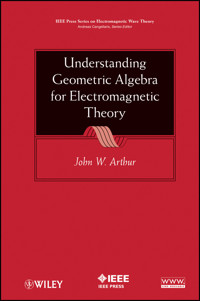
This book aims to disseminate geometric algebra as a straightforward mathematical tool set for working with and understanding classical electromagnetic theory. It's target readership is anyone who has some knowledge of electromagnetic theory, predominantly ordinary scientists and engineers who use it in the course of their work, or postgraduate students and senior undergraduates who are seeking to broaden their knowledge and increase their understanding of the subject. It is assumed that the reader is not a mathematical specialist and is neither familiar with geometric algebra or its application to electromagnetic theory. The modern approach, geometric algebra, is the mathematical tool set we should all have started out with and once the reader has a grasp of the subject, he or she cannot fail to realize that traditional vector analysis is really awkward and even misleading by comparison. Professors can request a solutions manual by email: [email protected]
Sie lesen das E-Book in den Legimi-Apps auf:
Seitenzahl: 602
Veröffentlichungsjahr: 2011
Ähnliche



















Table of Contents
Cover
Series page
Title page
Copyright page
Dedication
Preface
Reading Guide
Chapter 1 Introduction
Chapter 2 A Quick Tour of Geometric Algebra
2.1 THE BASIC RULES OF A GEOMETRIC ALGEBRA
2.2 3D GEOMETRIC ALGEBRA
2.3 DEVELOPING THE RULES
2.4 COMPARISON WITH TRADITIONAL 3D TOOLS
2.5 NEW POSSIBILITIES
Chapter 3 Applying the Abstraction
3.1 SPACE AND TIME
3.2 ELECTROMAGNETICS
3.3 THE VECTOR DERIVATIVE
3.4 THE INTEGRAL EQUATIONS
3.5 THE ROLE OF THE DUAL
Chapter 4 Generalization
4.1 HOMOGENEOUS AND INHOMOGENEOUS MULTIVECTORS
4.2 BLADES
4.3 REVERSAL
4.4 MAXIMUM GRADE
4.5 INNER AND OUTER PRODUCTS INVOLVING A MULTIVECTOR
4.6 INNER AND OUTER PRODUCTS BETWEEN HIGHER GRADES
4.7 SUMMARY SO FAR
Chapter 5 (3+1)D Electromagnetics
5.1 THE LORENTZ FORCE
5.2 MAXWELL’S EQUATIONS IN FREE SPACE
5.3 SIMPLIFIED EQUATIONS
5.4 THE CONNECTION BETWEEN THE ELECTRIC AND MAGNETIC FIELDS
5.5 PLANE ELECTROMAGNETIC WAVES
5.6 CHARGE CONSERVATION
5.7 MULTIVECTOR POTENTIAL
5.8 ENERGY AND MOMENTUM
5.9 MAXWELL’S EQUATIONS IN POLARIZABLE MEDIA
Chapter 6 Review of (3+1)D
Chapter 7 Introducing Spacetime
7.1 BACKGROUND AND KEY CONCEPTS
7.2 TIME AS A VECTOR
7.3 THE SPACETIME BASIS ELEMENTS
7.4 BASIC OPERATIONS
7.5 VELOCITY
7.6 DIFFERENT BASIS VECTORS AND FRAMES
7.7 EVENTS AND HISTORIES
7.8 THE SPACETIME FORM OF ∇
7.9 WORKING WITH VECTOR DIFFERENTIATION
7.10 WORKING WITHOUT BASIS VECTORS
7.11 CLASSIFICATION OF SPACETIME VECTORS AND BIVECTORS
Chapter 8 Relating Spacetime to (3+1)D
8.1 THE CORRESPONDENCE BETWEEN THE ELEMENTS
8.2 TRANSLATIONS IN GENERAL
8.3 INTRODUCTION TO SPACETIME SPLITS
8.4 SOME IMPORTANT SPACETIME SPLITS
8.5 WHAT NEXT?
Chapter 9 Change of Basis Vectors
9.1 LINEAR TRANSFORMATIONS
9.2 RELATIONSHIP TO GEOMETRIC ALGEBRAS
9.3 IMPLEMENTING SPATIAL ROTATIONS AND THE LORENTZ TRANSFORMATION
9.4 LORENTZ TRANSFORMATION OF THE BASIS VECTORS
9.5 LORENTZ TRANSFORMATION OF THE BASIS BIVECTORS
9.6 TRANSFORMATION OF THE UNIT SCALAR AND PSEUDOSCALAR
9.7 REVERSE LORENTZ TRANSFORMATION
9.8 THE LORENTZ TRANSFORMATION WITH VECTORS IN COMPONENT FORM
9.9 DILATIONS
Chapter 10 Further Spacetime Concepts
10.1 REVIEW OF FRAMES AND TIME VECTORS
10.2 FRAMES IN GENERAL
10.3 MAPS AND GRIDS
10.4 PROPER TIME
10.5 PROPER VELOCITY
10.6 RELATIVE VECTORS AND PARAVECTORS
10.7 FRAME-DEPENDENT VERSUS FRAME-INDEPENDENT SCALARS
10.8 CHANGE OF BASIS FOR ANY OBJECT IN COMPONENT FORM
10.9 VELOCITY AS SEEN IN DIFFERENT FRAMES
10.10 FRAME-FREE FORM OF THE LORENTZ TRANSFORMATION
Chapter 11 Application of the Spacetime Geometric Algebra to Basic Electromagnetics
11.1 THE VECTOR POTENTIAL AND SOME SPACETIME SPLITS
11.2 MAXWELL’S EQUATIONS IN SPACETIME FORM
11.3 CHARGE CONSERVATION AND THE WAVE EQUATION
11.4 PLANE ELECTROMAGNETIC WAVES
11.5 TRANSFORMATION OF THE ELECTROMAGNETIC FIELD
11.6 LORENTZ FORCE
11.7 THE SPACETIME APPROACH TO ELECTRODYNAMICS
11.8 THE ELECTROMAGNETIC FIELD OF A MOVING POINT CHARGE
Chapter 12 The Electromagnetic Field of a Point Charge Undergoing Acceleration
12.1 WORKING WITH NULL VECTORS
12.2 FINDING F FOR A MOVING POINT CHARGE
12.3 Frad IN THE CHARGE’S REST FRAME
12.4 Frad IN THE OBSERVER’S REST FRAME
Chapter 13 Conclusion
Chapter 14 Appendices
14.1 GLOSSARY
14.2 AXIAL VERSUS TRUE VECTORS
14.3 COMPLEX NUMBERS AND THE 2D GEOMETRIC ALGEBRA
14.4 THE STRUCTURE OF VECTOR SPACES AND GEOMETRIC ALGEBRAS
14.5 QUATERNIONS COMPARED
14.6 EVALUATION OF AN INTEGRAL IN EQUATION (5.14)
14.7 FORMAL DERIVATION OF THE SPACETIME VECTOR DERIVATIVE
References
Further Reading
Index
IEEE Press
445 Hoes Lane
Piscataway, NJ 08854
IEEE Press Editorial Board
Lajos Hanzo, Editor in Chief
R. AbhariM. El-HawaryO. P. MalikJ. AndersonB.-M. HaemmerliS. NahavandiG. W. ArnoldM. LanzerottiT. SamadF. CanaveroD. JacobsonG. ZobristKenneth Moore, Director of IEEE Book and Information Services (BIS)
IEEE Antenna Propagation Society, Sponsor
APS Liaison to IEEE Press, Robert Mailloux
Copyright © 2011 by the Institute of Electrical and Electronics Engineers, Inc.
Published by John Wiley & Sons, Inc., Hoboken, New Jersey. All rights reserved
Published simultaneously in Canada
No part of this publication may be reproduced, stored in a retrieval system, or transmitted in any form or by any means, electronic, mechanical, photocopying, recording, scanning, or otherwise, except as permitted under Section 107 or 108 of the 1976 United States Copyright Act, without either the prior written permission of the Publisher, or authorization through payment of the appropriate per-copy fee to the Copyright Clearance Center, Inc., 222 Rosewood Drive, Danvers, MA 01923, (978) 750-8400, fax (978) 750-4470, or on the web at www.copyright.com. Requests to the Publisher for permission should be addressed to the Permissions Department, John Wiley & Sons, Inc., 111 River Street, Hoboken, NJ 07030, (201) 748-6011, fax (201) 748-6008, or online at http://www.wiley.com/go/permissions.
Limit of Liability/Disclaimer of Warranty: While the publisher and author have used their best efforts in preparing this book, they make no representations or warranties with respect to the accuracy or completeness of the contents of this book and specifically disclaim any implied warranties of merchantability or fitness for a particular purpose. No warranty may be created or extended by sales representatives or written sales materials. The advice and strategies contained herein may not be suitable for your situation. You should consult with a professional where appropriate. Neither the publisher nor author shall be liable for any loss of profit or any other commercial damages, including but not limited to special, incidental, consequential, or other damages.
For general information on our other products and services or for technical support, please contact our Customer Care Department within the United States at (800) 762-2974, outside the United States at (317) 572-3993 or fax (317) 572-4002.
Wiley also publishes its books in a variety of electronic formats. Some content that appears in print may not be available in electronic formats. For more information about Wiley products, visit our web site at www.wiley.com.
Library of Congress Cataloging-in-Publication Data:
Arthur, John W., 1949–
Understanding geometric algebra for electromagnetic theory / John W. Arthur.
p. cm.—(IEEE Press series on electromagnetic wave theory ; 38)
Includes bibliographical references and index.
ISBN 978-0-470-94163-8
1. Electromagnetic theory—Mathematics. 2. Geometry, Algebraic. I. Title.
QC670.A76 2011
530.14′10151635—dc22
2011005744
oBook ISBN: 978-1-118-07854-3
ePDF ISBN: 978-1-118-07852-5
ePub ISBN: 978-1-118-07853-2
… it is a good thing to have two ways of looking at a subject, and to admit that there are two ways of looking at it.
James Clerk Maxwell, on addressing the question of two versions of electromagnetic theory, one due to Michael Faraday and the other to Wilhelm Weber, in a paper on Faraday’s lines of force presented at Cambridge University, February 1856 [1, p. 67].
Preface
Geometric algebra provides an excellent mathematical framework for physics and engineering, particularly in the case of electromagnetic theory, but it can be difficult for someone new to the subject, in particular a nonspecialist, to penetrate much of the available literature. This book has therefore been addressed to a fairly broad readership among scientists and engineers in any of the following categories:
those who are interested in electromagnetic theory but mainly wish to see a new approach to it, either with or without special relativity;those who already have some knowledge of geometric algebra but wish to see how it is applied to electromagnetic theory;those who wish for further explanation on the application of geomagnetic algebra in order to access more advanced material; andthose who may simply wish to gain some understanding of the role of special relativity in electromagnetic theory.It is the aim of this work to provide an introduction to the subject together with a tutorial guide to its application to electromagnetic theory. Its readers are likely to be familiar with electromagnetic theory by way of traditional methods, that is to say, vector analysis including linear vector spaces, matrix algebra, gradient, divergence, curl, and the like. Knowledge of tensors, however, is not required. Because the emphasis is on understanding how geometric algebra benefits electromagnetic theory, we need to explore what it is, how it works, and how it is applied.
The new ideas are introduced gradually starting with background and concepts followed by basic rules and some examples. This foundation is then built upon by extending and generalizing the basics, and so on. Equations are worked out in considerable detail and ample time is spent on discussing rationale and points of interest. In addition, before moving on to the next level, care is taken over the explanation of topics that tend to be difficult to grasp. The general intent has been to try to keep the presentation self-contained so as to minimize the need for recourse to external material; nevertheless, several key works are regularly cited to allow the interested reader to connect with the relevant literature.
The mathematical content is addressed to those who prefer to use mathematics as a means to an end rather than to those who wish to study it for its own sake. While formality in dealing with mathematical issues is kept to a minimum, the aim has nevertheless been to try to use the most appropriate methods, to try to take a line that is obvious rather than clever, and to try to demonstrate things to a reasonable standard rather than to prove them absolutely. To achieve simplicity, there have been a few departures from convention and some changes of emphasis:
The use of indices is kept to a minimum, for example, basis elements are written as rather than The basic intuitive ideas of parallel and perpendicular are exploited wherever this may be advantageous.The term “translation” is introduced to describe a mapping process between spacetime and 3D as distinct to the spacetime split.A notation is introduced whereby a vector underscored with a tilde, for example, , is to be identified as a purely spatial vector. Since such vectors are orthogonal to a given time vector, this contributes to the aim of exploiting parallel and perpendicular.To maximize the readability of equations, a system is introduced whereby SI units are retained but equations are simplified in a way similar to the mathematical physicist’s convention taking the speed of light to be 1.A geometric algebra is a vector space in which multiplication and addition applies to all members of the algebra. In particular, multiplication between vectors generates new elements called multivectors. And why not? Indeed, it will be seen that this creates valuable possibilities that are absent in the theory of ordinary linear vector spaces. For example, multivectors can be split up into different classes called grades. Grade 0 is a scalar, grade 1 is a vector (directed line), grade 2 is a directed area, grade 3 is a directed volume, and so on. Eventually, at the maximum grade, an object that replaces the need for complex arithmetic is reached.
We begin with a gentle introduction that aims to give a feel for the subject by conveying its basic ideas. In Chapters 2–3, the general idea of a geometric algebra is then worked up from basic principles without assuming any specialist mathematical knowledge. The things that the reader should be familiar with, however, are vectors in 3D, including the basic ideas of vector spaces, dot and cross products, the metric and linear transformations. We then look at some of the interesting possibilities that follow and show how we can apply geometric algebra to basic concepts, for example, time t and position r may be treated as a single multivector entity t + r that gives rise to the idea of a (3+1)D space, and by combining the electric and magnetic fields and into a multivector , they can be dealt with as a single entity rather than two separate things. By this time, the interest of the reader should be fully engaged by these stimulating ideas.
In Chapter 4, we formalize the basic ideas and develop the essential toolset that will allow us to apply geometric algebra more generally, for example, how the product of two objects can be written as the sum of inner and outer products. These two products turn out to be keystone operations that represent a step-down and step-up of grades, respectively. For example, the inner product of two vectors yields a scalar result akin to the dot product. On the other hand, the outer product will create a new object of grade 2. Called a bivector, it is a 2D object that can represent an area or surface density lying in the plane of the two vectors. Following from this is the key result that divergence and curl may be combined into a single vector operator that appears to be the same as the gradient but which now operates on any grade of object, not just a scalar.
Armed with this new toolset, in Chapter 5 we set about applying it to fundamental electromagnetics in the situation that we have called (3+1)D:
In free space, Maxwell’s four equations reduce to just one, .Circularly polarized plane electromagnetic waves are described without either introducing complex numbers or linearly polarized solutions.The electromagnetic energy density and momentum density vector fall out neatly from .The vector and scalar potentials unite.The steady-state solution for the combined electric and magnetic fields of a moving charge distribution has a very elegant form that curiously appears to be taken directly from the electrostatic solution.Once the basic possibilities of the (3+1)D treatment of electromagnetic theory have been explored, we then prepare the ground for a full 4D treatment in which space and time are treated on an equal footing, that is to say, as spacetime vectors. Geometric algebra accommodates the mathematics of spacetime extremely well, and with its assistance, we discover how to tackle the electromagnetic theory of moving charges in a systematic, relativistically correct, and yet uncomplicated way.
A key point here is that it is not necessary to engage in special relativity in order to benefit from the spacetime approach. While it does open the door to special relativity on one level, on a separate level, it may simply be treated as a highly convenient and effective mathematical framework. Most illuminatingly, we see how the whole of electromagnetic theory, from the magnetic field to radiation from accelerating charges, falls out of an appropriate but very straightforward spacetime treatment of Coulomb’s law. The main features of the (3+1)D treatment are reproduced free of several of its inherent limitations:
A single vector derivative ∇ replaces the multivector form .Maxwell’s equation in free space is now simply .The Lorentz force reduces to the form .Maxwell’s equations for polarizable media can be encoded neatly so as to eliminate the bound sources through an auxiliary field G that replaces both D and H.The proper velocity υ plays a remarkable role as the time vector associated with a moving reference frame.The phase factor for propagating electromagnetic waves is given by the simple expression where the vectors r and represent time + position and frequency + wave vector, respectively.The general solution for the electromagnetic field of charges in motion follows directly from Coulomb’s law.The significance of Maxwell’s equation taking the form is that the range of analytic solutions of Maxwell’s equation is extended from 2D electrostatics and magnetostatics into fully time-dependent 3D electromagnetics.The relationship between (3+1)D and spacetime involves some intriguing subtleties, which we take time to explain; indeed, the emphasis remains on the understanding of the subject throughout. For this reason, in Chapters 7–12, we try to give a reasonably self-contained primer on the spacetime approach and how it fits in with special relativity. This does not mean that readers need to understand, or even wish to understand, special relativity in any detail, but it is fairly certain that at some point, they will become curious enough about it to try and get some idea of how it underpins the operational side of the spacetime geometric algebra, that is to say, where we simply use it as a means of getting results. Nevertheless, even on that level, readers will be intrigued to discover how well this toolset fits with the structure of electromagnetic theory and how it unifies previously separate ideas under a single theme. In short,
The essentials of this theme are covered in Chapter 11, and in Chapter 12 we work through in detail the electromagnetic field of an accelerating charge. This provides an opportunity to see how the toolset is applied in some depth. Finally, we review the overall benefits of geometric algebra compared with the traditional approach and briefly mention some of its other features that we did not have time to explore. There are exercises at the end of most chapters. These are mostly straightforward, and their main purpose is to allow the readers to check their understanding of the topics covered. Some, however, provide results that may come in very useful from time to time. Worked solutions are available from the publisher (e-mail [email protected] for further information). The book also includes seven appendices providing explanatory information and background material that would be out of place in the main text. In particular, they contain a glossary of key terms and symbols. It is illustrated with 21 figures and 10 tables and cites some 51 references.
Finally, I wish to express my sincere thanks to my wife, Norma, not only for her painstaking efforts in checking many pages of manuscript but also for her patience and understanding throughout the writing of this book. I am also most grateful to Dr. W. Ross Stone who has been an unstinting source of help and advice.
JOHN W. ARTHUR
Reading Guide
The benefit of tackling a subject in a logical and progressive manner is that it should tend to promote better understanding in the long run, and so this was the approach adopted for the layout of the book. However, it is appreciated that not all the material in the book will be of interest to everyone, and so this reading guide is intended for those who wish to take a more selective approach.
Chapters 1–2 provide some background on geometric algebra before exploring the basic ideas of what it is and how it works. The basic ideas of parallel and perpendicular are exploited. Readers who prefer a more axiomatic approach can refer to Appendix 14.4.Chapter 3 addresses how geometric algebra fits in with electromagnetic theory and how we begin to apply it.Chapter 4 develops the idea of a geometric algebra more fully. Although the ideas of parallel and perpendicular are still referred to, more formality is introduced. The aim is to provide a grounding on the essential mathematical tools, structures, and characteristics of geometric algebra. This chapter may be skimmed at first reading and referred to for further information as and when necessary. Appendix 14.4 may also be used for ready reference or as supporting material.Chapter 5 is sufficient to show how some of the key topics in electromagnetic theory can be dealt with using (3+1)D geometric algebra. Readers should be able to form their own opinion as to its superiority compared with traditional methods.Chapter 6 recaps what has been achieved thus far. This may be a convenient stopping or resting point for some readers, but hopefully, their curiosity will be sufficiently aroused to encourage them to carry on to the spacetime approach.Chapters 7–8 provide an introduction to the spacetime geometric algebra with minimal involvement in special relativity. Readers are encouraged to attempt at least these sections before starting Chapter 11. It is also recommended that Chapter 4 should have been studied beforehand.Chapters 9–10 deal with different frames and transforming between them. These sections are primarily intended for those readers who are interested in the underlying physics and wish to get a better appreciation of the spacetime approach to special relativity. It is not essential reading for other readers who may simply prefer to refer to these chapters only when they require more information.Chapter 11 covers the treatment of key topics in electromagnetic theory through the spacetime geometric algebra. Readers who have not covered Chapters 9–10 in any detail may need to refer to these sections as and when necessary. The results are to be compared with the (3+1)D results of Chapter 5 where, despite the many successes, we were encouraged to hope for more. It is hoped that by this point, readers will feel obliged to conclude that spacetime approach is not only superior to the (3+1)D but in some sense it is also an ideal fit to the subject in hand.For those who wish to go the whole way, Chapter 12 covers the process of differentiating the spacetime vector potential as the means of obtaining the radiated electromagnetic field of an accelerating point charge. Being familiar with Chapters 9–10 beforehand is fully recommended.Appendices 14.1–14.7 include explanatory information and background material that would be out of place in the main text. In particular, it opens with a glossary that provides a ready reference to key terms and notation.Several chapters have exercises. These are mostly straightforward and their main purpose is to allow readers to check their understanding of the topics covered. Some, however, provide results that may come in very useful from time to time.Chapter 2
A Quick Tour of Geometric Algebra
As has been made clear, this book is not intended as the basis of a mathematical treatment of geometric algebra; rather, it is directed at understanding its application to a physical problem like classical electromagnetic theory. The reader is therefore assumed to be familiar with the conventional rules of linear vector spaces [10, 11; Appendix 14.4.1] and vector analysis [12]. Most of the basic rules and principles still apply, and so we will give our attention only to the main extensions and differences under geometric algebra. We will, however, take care to go into sufficient detail for the unfamiliar reader to be able to get to grips with what is going on. If there is any sort of catch to geometric algebra, it may be that by dispensing with so much of the comparative complexity of the traditional equations, there occasionally seems to be a lack of detail to get to grips with! For example, we shall eventually see Maxwell’s equations in free space in the strikingly simple form , where J is a vector comprising both charge and current source densities, F is a multivector comprising both the electric and magnetic fields, and is the vector derivative involving both space and time. Notwithstanding the question of what this new equation actually means, it is not hard to appreciate the amazing degree of rationalization of the usual variables and derivatives, namely ρ, J, E, B, , , and , into just three. By comparison, tools such as components, coordinates, matrices, tensors, and traditional vector analysis seem like low-level languages, whereas geometric algebra also works as a higher level one. As can be seen from this example, geometric algebra can sweep away the minutiae to reveal what is a common underlying structure, a feature which has often been referred to as “encoding.” Four separate equations in four variables are therefore found to be encoded in the simple form . Not only that, this tells us that Maxwell’s four separate equations are simply different manifestations of a common process encapsulated in .
Maxwell’s original equations were actually written in terms of simultaneous differential equations for each component of the field quantities in turn without even using subscripts; for example, the field vector is represented by the three separate variables , , and [13]. In his later treatise [14], he revised his approach by employing the quaternions of William Rowan Hamilton [15], which bear some similarity to a geometric algebra (see Appendix 14.5). Maxwell’s equations were cast in their familiar form by Oliver Heaviside [16] based on the now conventional 3D vector analysis developed by J. Willard Gibbs [17]. Although the theory of dyadics and tensors [18–21] was well developed by the end of the nineteenth century and the theory of differential forms [3, 22] was introduced by Elié Cartan in the early twentieth century, these have generally been regarded as the province of theoretical physics rather than as a tool for general use. Geometric algebra, however, is much older but does have several points of similarity, notably provision for the product of vectors and the new entities so created. Its ideas were originated by Hermann Grassmann [23] and developed by William Clifford [24] around the mid-nineteenth century, but it languished as “just another algebra” until relatively recently when it was revived by David Hestenes [25] and promoted by him [6] and others [26–28]. In common with many other specialized mathematical techniques, such as group theory, it combines some points of difficulty in the mathematics with great usefulness in its application. Nevertheless, both disciplines provide important physical interpretations, which are surprisingly intuitive and relatively easy to master. Once the mind has become used to concepts that at first seem unfamiliar or even illogical, things begin to get easier, and a clearer picture begins to emerge as the strangeness begins to wane and by and by key points fit into place.
Lesen Sie weiter in der vollständigen Ausgabe!
Lesen Sie weiter in der vollständigen Ausgabe!
Lesen Sie weiter in der vollständigen Ausgabe!
Lesen Sie weiter in der vollständigen Ausgabe!
Lesen Sie weiter in der vollständigen Ausgabe!
Lesen Sie weiter in der vollständigen Ausgabe!
Lesen Sie weiter in der vollständigen Ausgabe!
Lesen Sie weiter in der vollständigen Ausgabe!
Lesen Sie weiter in der vollständigen Ausgabe!
Lesen Sie weiter in der vollständigen Ausgabe!
Lesen Sie weiter in der vollständigen Ausgabe!
Lesen Sie weiter in der vollständigen Ausgabe!
Lesen Sie weiter in der vollständigen Ausgabe!
Lesen Sie weiter in der vollständigen Ausgabe!
Lesen Sie weiter in der vollständigen Ausgabe!




