


168,99 €
Mehr erfahren.
- Herausgeber: John Wiley & Sons
- Kategorie: Wissenschaft und neue Technologien
- Serie: RMS - Royal Microscopical Society
- Sprache: Englisch
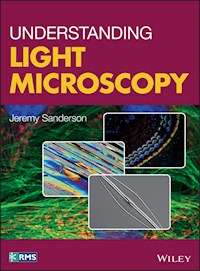
Introduces readers to the enlightening world of the modern light microscope
There have been rapid advances in science and technology over the last decade, and the light microscope, together with the information that it gives about the image, has changed too. Yet the fundamental principles of setting up and using a microscope rests upon unchanging physical principles that have been understood for years. This informative, practical, full-colour guide fills the gap between specialised edited texts on detailed research topics, and introductory books, which concentrate on an optical approach to the light microscope. It also provides comprehensive coverage of confocal microscopy, which has revolutionised light microscopy over the last few decades.
Written to help the reader understand, set up, and use the often very expensive and complex modern research light microscope properly, Understanding Light Microscopy keeps mathematical formulae to a minimum—containing and explaining them within boxes in the text. Chapters provide in-depth coverage of basic microscope optics and design; ergonomics; illumination; diffraction and image formation; reflected-light, polarised-light, and fluorescence microscopy; deconvolution; TIRF microscopy; FRAP & FRET; super-resolution techniques; biological and materials specimen preparation; and more.
- Gives a didactic introduction to the light microscope
- Encourages readers to use advanced fluorescence and confocal microscopes within a research institute or core microscopy facility
- Features full-colour illustrations and workable practical protocols
Understanding Light Microscopy is intended for any scientist who wishes to understand and use a modern light microscope. It is also ideal as supporting material for a formal taught course, or for individual students to learn the key aspects of light microscopy through their own study.
Sie lesen das E-Book in den Legimi-Apps auf:
Seitenzahl: 2418
Veröffentlichungsjahr: 2019
Ähnliche



















Current and future titles in the Royal Microscopical Society – John Wiley Series
Published
Principles and Practice of Variable Pressure/Environmental Scanning
Electron Microscopy (VP-ESEM)
Debbie Stokes
Aberration-Corrected Analytical Electron Microscopy
Edited by Rik Brydson
Diagnostic Electron Microscopy – A Practical Guide to Interpretation and Technique
Edited by John W. Stirling, Alan Curry & Brian Eyden
Low Voltage Electron Microscopy – Principles and Applications
Edited by David C. Bell & Natasha Erdman
Standard and Super-Resolution Bioimaging Data Analysis: A Primer
Edited by Ann Wheeler and Ricardo Henriques
Electron Beam-Specimen Interactions and Applications in Microscopy
Budhika Mendis
Biological Field Emission Scanning Electron Microscopy 2V Set
Edited by Roland Fleck and Bruno Humbel
Understanding Light Microscopy
Jeremy Sanderson
Forthcoming
Correlative Microscopy in the Biomedical Sciences
Edited by Paul Verkade and Lucy Collinson
The Preparation of Geomaterials for Microscopical Study: A Laboratory Manual
Owen Green and Jonathan Wells
Electron Energy Loss Spectroscopy
Edited by Rik Brydson and Ian MacLaren
Understanding Light Microscopy
Jeremy Sanderson
Mammalian Genetics Unit, MRC Harwell Institute, Oxford, United Kingdom
This edition first published 2019
© 2019 by John Wiley & Sons Ltd
All rights reserved. No part of this publication may be reproduced, stored in a retrieval system, or transmitted, in any form or by any means, electronic, mechanical, photocopying, recording or otherwise, except as permitted by law. Advice on how to obtain permission to reuse material from this title is available at http://www.wiley.com/go/permissions.
The right of Jeremy Brittain Sanderson to be identified as the author of this work has been asserted in accordance with law.
Registered OfficesJohn Wiley & Sons, Inc., 111 River Street, Hoboken, NJ 07030, USAJohn Wiley & Sons Ltd, The Atrium, Southern Gate, Chichester, West Sussex, PO19 8SQ, UK
Editorial OfficeThe Atrium, Southern Gate, Chichester, West Sussex, PO19 8SQ, UK
For details of our global editorial offices, customer services, and more information about Wiley products visit us at www.wiley.com.
Wiley also publishes its books in a variety of electronic formats and by print-on-demand. Some content that appears in standard print versions of this book may not be available in other formats.
Limit of Liability/Disclaimer of WarrantyWhile the publisher and authors have used their best efforts in preparing this work, they make no representations or warranties with respect to the accuracy or completeness of the contents of this work and specifically disclaim all warranties, including without limitation any implied warranties of merchantability or fitness for a particular purpose. No warranty may be created or extended by sales representatives, written sales materials or promotional statements for this work. The fact that an organization, website, or product is referred to in this work as a citation and/or potential source of further information does not mean that the publisher and authors endorse the information or services the organization, website, or product may provide or recommendations it may make. This work is sold with the understanding that the publisher is not engaged in rendering professional services. The advice and strategies contained herein may not be suitable for your situation. You should consult with a specialist where appropriate. Further, readers should be aware that websites listed in this work may have changed or disappeared between when this work was written and when it is read. Neither the publisher nor authors shall be liable for any loss of profit or any other commercial damages, including but not limited to special, incidental, consequential, or other damages.
Library of Congress Cataloging-in-Publication Data
Names: Sanderson, J. B. (Jeremy B.), author.Title: Understanding light microscopy / by Jeremy Sanderson.Description: First edition. | Hoboken, NJ : John Wiley & Sons, 2018. | Series: Royal Microscopical Society/John Wiley Series | Includes bibliographical references and index. |Identifiers: LCCN 2018004188 (print) | LCCN 2018009681 (ebook) | ISBN 9781118696743 (pdf) | ISBN 9781118696811 (epub) | ISBN 9780470973752 (cloth)Subjects: LCSH: Microscopy.Classification: LCC QH205.2 (ebook) | LCC QH205.2 .S32 2018 (print) | DDC 570.28/2--dc23LC record available at https://lccn.loc.gov/2018004188
Cover Design: WileyCover Images: © Cochlear hair cells courtesy of Doctor Mike Bowl. All other cover photos courtesy of Jeremy Sanderson.
Dedicated to the memory of:
Savile Bradbury6th February 1931 – 29th November 2001
Teacher, mentor, friend
CONTENTS
Cover
Titlepage
About the Author
Acknowledgements
Look-Up Guide to Feature Boxes by Theme
Autobiographical Boxes
Information Boxes
Exercise Boxes
Glossary and Definitions
Notes
Introduction
Notes
1 Our Eyes and the Microscope
1.1 Introduction
1.2 How Our Eyes Work
1.3 The Anatomy of the Eye
1.4 Aberrations of the Eye
1.5 Binocular and Stereoscopic Vision
1.6 Why We Need Optical Aids
1.7 Using Lenses to Correct Eye Defects
1.8 Seeing the Scientific Image
1.9 Sizes of Objects
1.10 Nomenclature and History
1.11 Chapter Summary
Key Reading
References
Further Reading
Internet Resources
Notes
2 Light
2.1 Introduction
2.2 The Nature of Light
2.3 The Nature of Waves
2.4 Wave-Particle Duality
2.5 The Visible Light Spectrum
2.6 Important Properties of Light
2.7 Interaction of Light with Matter
2.8 Reflection of Light
2.9 Refraction of Light
2.10 Total Internal Reflection
2.11 Dispersion
2.12 Refraction and the Action of Lenses
2.13 Chapter Summary
Key Reading
References
Further Reading
Internet Resources
Notes
3 Basic Microscope Optics
3.1 Introduction
3.2 Lenses
3.3 Thin and Thick Lenses
3.4 The Focal Length of a Lens
3.5 Ray-Tracing
3.6 Lenses in the Microscope
3.7 Conjugate Planes
3.8 The Single Lens Magnifier, or Loupe
3.9 The Compound Microscope
3.10 Magnification in the Compound Microscope
3.11 Useful Magnification
3.12 Similarities between Different Optical Instruments
3.13 Chapter Summary
Key Reading
References
Further Reading
Internet Resources
Notes
4 Microscope Anatomy and Design
4.1 Introduction
4.2 The Function of the Light Microscope
4.3 Inspection of the Microscope
4.4 Anatomy of the Microscope
4.5 Different Types of Microscope Design
4.6 Stereomicroscopes and Macroscopes
4.7 Chapter Summary
References
Further Reading
Internet Resources
Selected Company Information
Manufacturer Lite Software Versions
Notes
5 Ergonomics
5.1 Introduction
5.2 Ergonomics
5.3 Eye Fatigue
5.4 Safety and Lamps
5.5 Dismantling Microscopes
5.6 Health and Safety Risk Assessments
5.7 Chapter Summary
Reference
Further Reading
Internet Resources
6 Optical Aberrations of the Microscope
6.1 Introduction
6.2 Lens Aberrations
6.3 Spherical Aberration
6.4 Chromatic Aberration
6.5 Coma
6.6 Astigmatism
6.7 Distortion
6.8 Image Field Curvature
6.9 Lateral or Transverse Chromatic Aberration
6.10 Testing for Chromatic and Spherical Aberration
6.11 The Star Test
6.12 Chapter Summary
Key Reading
References
Further Reading
Internet Resources
Notes
7 The Microscope Objective
7.1 Introduction
7.2 Different Types of Objective
7.3 Inscriptions on the Objective
7.4 Numerical Aperture and Resolving Power
7.5 Homogeneous Immersion
7.6 Working Distance
7.7 The Importance of Coverslip Thickness
7.8 Objective Correction Collars
7.9 Parfocality and Tubelength
7.10 Infinity-Corrected Microscopes
7.11 Depth of Field and Depth of Focus
7.12 Brightness of the Image
7.13 Specialised Objectives
7.14 Delamination and Fungal Contamination
7.15 Handling Objectives
7.16 Chapter Summary
Key Reading
References
Further Reading
Internet Resources
International Standards ISO/TC 172/SC 5 Microscopes and Endoscopes
Notes
8 Condensers and Eyepieces
8.1 Introduction
8.2 The Condenser
8.3 Condenser Designs
8.4 Different Types of Condenser
8.5 The Substage Mirror
8.6 The Eyepiece
8.7 Dioptre Adjustment Control of the Eyepiece
8.8 Eyepiece Designs
8.9 Different Types of Eyepiece
8.10 Field-of-View Number
8.11 Linear Measurement with the Microscope
8.12 Microscopes without Eyepieces
8.13 Chapter Summary
Key Reading
References
Further Reading
Internet Resources
Notes
9 Illumination in the Microscope
9.1 Introduction
9.2 Incandescent Lamps
9.3 Metal Halide, Xenon and Mercury Lamps
9.4 Cold Light Sources
9.5 Light-Emitting Diodes
9.6 Filters
9.7 Changing Lamps
9.8 Requirements of the Illumination System
9.9 Illumination in the Microscope: Source-Focused and Köhler Illumination
9.10 Conjugate Planes for Köhler Illumination
9.11 Adjusting a Microscope for Köhler Illumination
9.12 Köhler Illumination with Reflected Light
9.13 Floaters and Illumination
9.14 Chapter Summary
Key Reading
References
Further Reading
Internet Resources
Osram Datasheets
Notes
10 Diffraction and Image Formation in Microscopy
10.1 Introduction
10.2 Rays, Point Sources and Extended Sources of Light
10.3 Coherence and the Interference of Waves
10.4 Diffraction
10.5 The Geometry of Diffraction Patterns
10.6 Airy Patterns
10.7 Resolution in the Light Microscope
10.8 Rayleigh’s Resolution Criterion
10.9 Ernst Abbe and Image Formation
10.10 Apparent Paradox
10.11 Optimising the Image in the Microscope
10.12 Test Objects for the Microscope
10.13 Chapter Summary
Key Reading
References
Further Reading
Internet Resources
Online YouTube Demonstration of the Theory of Microscope Image Formation
Notes
11 Contrast Generation and Enhancement
11.1 Introduction
11.2 Perceiving Contrast
11.3 How Light Interacts with the Specimen
11.4 Bright-Field, Oblique and Dark-Field Microscopy
11.5 Our Perception of Colour
11.6 Contrast Using Colour: Staining and Filters
11.7 Colour Filters
11.8 Rheinberg Illumination and Variable Asymmetrical Contrast
11.9 Contrast by Exploiting Refractive Index Differences
11.10 Dispersion Staining
11.11 The Importance of Conjugate Planes
11.12 Phase Contrast
11.13 Hoffman Modulation Contrast
11.14 Interference Contrast
11.15 Post-Acquisition Contrast Enhancement in the Image
11.16 Chapter Summary
Key Reading
References
Further Reading
Internet Resources
Notes
12 Reflected-Light Microscopy
12.1 Introduction
12.2 Reflectance of Light
12.3 Coverslip Requirement
12.4 The Optical Pathways in Reflected-Light Microscopy
12.5 Types of Reflector
12.6 Practical Use of the Reflected-Light Microscope
12.7 Contrast Mechanisms in Reflected-Light Microscopy
12.8 Bright-Field Reflected-Light Microscopy
12.9 Dark-Field Reflected-Light Microscopy
12.10 Phase Contrast with Reflected Light
12.11 Polarisation Contrast in Reflected Light
12.12 Nomarski Differential Interference Contrast
12.13 Reflection-Contrast and ‘Antiflex’ Microscopy
12.14 Reflected-Light Fluorescence Microscopy
12.15 Samples for Reflected-Light Microscopy
12.16 Chapter Summary
References
Further Reading
Notes
13 Polarised-Light Microscopy: Part 1 – Theory
13.1 Introduction
13.2 Isotropic and Anisotropic Materials
13.3 Formation of Polarised Light
13.4 Formation of Polarised Light by Reflection and by Scattering
13.5 Optical Anisotropy and Polarisation of Light by Double Refraction
13.6 Types of Double Refraction
13.7 The Behaviour of Light in Anisotropic Materials
13.8 Using Vectors to Understand Double Refraction
13.9 Elliptically and Circularly Polarised Light
13.10 Fast and Slow Directions
13.11 Pleochroism, Dichroism and Bireflectance
13.12 Uniaxial and Biaxial Materials
13.13 Ray Velocity Surfaces and the Optic Axis
13.14 The Indicatrix
13.15 Observing Double Refraction in Calcite
13.16 Chapter Summary
Key Reading
References
Further Reading
Internet Resources
Notes
14 Polarised-Light Microscopy: Part 2 – Applied
14.1 Introduction
14.2 The Polarised-Light Microscope
14.3 The N-S/E-W Convention for Polars
14.4 Polaroid Filters
14.5 Objectives and Eyepieces for Polarised-Light Microscopy
14.6 Centring the Microscope
14.7 Examining Doubly Refracting Materials with a Single Polar
14.8 Optical Path Difference
14.9 How Optical Path-Length Differences (OPD) Give Rise to Colour
14.10 Newton’s Colour Scale – Another Manifestation of OPD
14.11 Polarised-Light Contrast in Reflection
14.12 Compensators
14.13 How Compensators Work
14.14 The 1
λ
Full-Wave ‘Sensitive-Tint’ Plate
14.15 The de Sénarmont
λ
–Wave Plate
14.16 The Quartz Wedge
14.17 Conoscopic Microscopy
14.18 Chapter Summary
Key Reading
References
Further Reading
Internet Resources
Notes
15 Fluorescence Microscopy
15.1 Introduction
15.2 How Fluorescence Occurs
15.3 The Importance of Fluorescence in Biological Research
15.4 The Discovery of Fluorescence
15.5 Fluorescence Yield
15.6 Choosing a Fluorophore
15.7 Fluorescence Microscope Design
15.8 Fluorescence Filter Sets
15.9 Chapter Summary
Key Reading
References
Further Reading
Internet Resources
Notes
16 Fluorophores and Fluorescent Proteins
16.1 Introduction
16.2 Chemical Fluorophores
16.3 Natural Fluorophores – GFP
16.4 Other Fluorescent Proteins
16.5 Quantum Dots
16.6 Covalent Labelling Strategies
16.7 Autofluorescence
16.8 Chapter Summary
Key Reading
References
Further Reading
Internet Resources
Notes
17 Optical Sectioning and Confocal Microscopy
17.1 Introduction
17.2 Blurring and Optical Sectioning
17.3 Confocal Microscopy
17.4 Development of the Confocal Microscope
17.5 Advantages, Disadvantages and Resolving Power of the Confocal Microscope
17.6 The Spinning Disc Microscope
17.7 Line-Scanners and Array-Scanning Confocals
17.8 The Structured Illumination Approach to Optical Sectioning
17.9 The Airyscan Principle
17.10 The Mesolens
17.11 Concluding Remarks
17.12 Chapter Summary
Key Reading
References
Further Reading
Internet Resources
Notes
18 Operating the Confocal Microscope
18.1 Introduction
18.2 Laser Safety and Interlocks
18.3 Lasers for Confocal Microscopy
18.4 Operation of the Confocal Microscope
18.5 Fluorescence Intensity
18.6 Signal-to-Noise Trade-Offs
18.7 Nyquist Sampling
18.8 Effect of Refractive Index Mismatch
18.9 Objectives for Optical Sectioning
18.10 Should a 100x Objective Be Used on a Point-Scanning Confocal?
18.11 Reflection Confocal Scanning
18.12 Chapter Summary
Key Reading
References
Further Reading
Internet Resources
Notes
19 Light-Sheet Microscopy
19.1 Introduction
19.2 Historical Development of the Light-Sheet Microscope
19.3 The Rationale of Light-Sheet Microscopy
19.4 Sample Handling
19.5 Data Handling
19.6 Self-Built Microscopes
19.7 Clearing Tissues
19.8 Chapter Summary
Key Reading
References
Further Reading
Internet Resources
Notes
20 Bleed-Through and Spectral Unmixing
20.1 Introduction
20.2 Managing Bleed-Through
20.3 Controls for Cross-Talk and Bleed-Through
20.4 Spectral Imaging
20.5 Sources of Experimental Error
20.6 Protocols for Spectral Unmixing
20.7 Chapter Summary
Key Reading
References
Further Reading
Internet Resources
Notes
21 Deconvolution
21.1 Introduction
21.2 The Process of Convolution
21.3 Fourier Transforms and the Missing Cone
21.4 Deconvolution
21.5 The PSF (Point Spread Function)
21.6 Obtaining the PSF
21.7 Practical Aspects of Image Collection
21.8 Deconvolution of Thick Specimens
21.9 Which Deconvolution Algorithm to Choose?
21.10 Chapter Summary
Key Reading
References
Further Reading
Internet Resources
PSF Calculators
Notes
22 Multi-Photon Microscopy
22.1 Introduction
22.2 Two-Photon and Multi-Photon Microscopy
22.3 Equipment for Multi-Photon Microscopy
22.4 Fast Frame Multi-Photon Microscopy
22.5 Second Harmonic Generation
22.6 Chapter Summary
Key Reading
References
Further Reading
Internet Resources
Notes
23 Total Internal Reflection Fluorescence Microscopy
23.1 Introduction
23.2 The Phyiscal Principles of TIRF Microscopy
23.3 Designs of TIRF Microscope
23.4 Practical Considerations
23.5 The Importance of Refractive Index
23.6 Multicolour TIRF
23.7 Chapter Summary
Key reading
References
Further Reading
Internet Resources
Notes
24 FRAP and FRET
24.1 Introduction
24.2 FRAP – Fluorescence Recovery After Photobleaching
24.3 FLIP and FLAP
24.4 FRET – Förster Resonance Energy Transfer
24.5 FLIM – Fluorescence Lifetime Imaging Microscopy
24.6 Chapter Summary
Key Reading
References
Further Reading
Internet Resources
Notes
25 Colocalisation
25.1 Introduction
25.2 Colocalisation Defined
25.3 Collecting Images, Locating your Protein in the Cell
25.4 Red-Green Analysis for Co-occurrence
25.5 Measuring Colocalisation – Pearson’s Correlation Coefficient
25.6 The Purpose of Scatterplots
25.7 Measuring Overlap Using Manders’ Overlap Coefficient
25.8 Manders’ Colocalisation Coefficients M
1
and M
2
25.9 Thresholding
25.10 Analysing Product Differences from the Mean (PDM)
References
25.11 Analysis Choices and Software
25.12 Statistical Analysis
25.13 Object-Based Colocalisation
25.14 Chapter Summary
Key Reading
References
Further Reading
Statistics Texts and References
Internet Resources
Notes
26 Super-Resolution Fluorescence Microscopy
26.1 Introduction
26.2 Circumventing Abbe’s Limit
26.3 Increasing the Size of the Collection Aperture
26.4 RESOLFT and STED Microscopy
26.5 Localisation Microscopy
26.6 Structured Illumination Microscopy (SIM)
26.7 Future Directions
26.8 Chapter Summary
Key Reading
Nobel Lectures
References
Further Reading
Single Molecules References
Correlative Microscopy References
Internet Resources
Notes
27 Choosing a Microscope Platform and Core Imaging Facilities
27.1 Introduction
27.2 Which Optical Sectioning Method to Use?
27.3 Which Objective to Use?
27.4 Planning an Imaging Experiment
27.5 Light Microscope (LM) Imaging Facilities
27.6 Performance Testing for Quality Control
27.7 Free and Open-Source Imaging Software
27.8 Chapter Summary
Key Reading
References
Further Reading
Internet Resources
Notes
28 Biological Specimen Preparation
28.1 Introduction
28.2 Initial Specimen Preparation
28.3 Preparing Fluorescently Labelled Samples
28.4 Immunohistochemistry
28.5 Finishing the Preparation
28.6 Live-Cell Imaging
28.7 Chapter Summary
Key Reading
References
Further Reading
Correlative Microscopy
Internet Resources
Cleaning Slides
Dako Education Guides
Gray Institute links
Notes
29 Materials Specimen Preparation
29.1 Introduction
29.2 Fidelity of Specimen Preparation
29.3 Sampling and Cutting the Bulk Material
29.4 Impregnation and Mounting of Samples
29.5 Grinding and Lapping Thin Sections
29.6 Polishing Samples
29.7 Preparing a Grain Mount
29.8 Preparing a Rock-Section Peel
29.9 Etching Samples
29.10 Staining Samples
29.11 Chapter Summary
Key Reading
References
Further Reading
Internet Resources
Contracting specimen preparation
Company contacts
Notes
30 Recording the Image: Part 1 – Theory
30.1 Introduction
30.2 Advantages of Digital Imaging
30.3 How Digital Images Are Formed and Encoded
30.4 Overview of Electronic Camera Operation
30.5 Digital Image Resolution
30.6 Bit Depth and Dynamic Range
30.7 Black Pixels and Pixel Pathology
30.8 Types of Electronic Detector
30.9 Encoding Colour in Digital Images
30.10 Digital Camera Noise
30.11 Choosing a CCD or sCMOS Camera
30.12 Chapter Summary
Key Reading
References
Further Reading
Internet Resources
Notes
31 Recording the Image: Part 2 – Applied
31.1 Introduction
31.2 Producing a Real Image onto the Electronic Camera Sensor
31.3 Coupling a Camera to the Microscope
31.4 Illuminating the Specimen
31.5 Flat-Field Correction
31.6 Nyquist Sampling
31.7 Matching the Microscope Magnification to the CCD Pixel Size
31.8 Scale Bars
31.9 Resolution and Display or Print Size
31.10 Relocating the Image
31.11 How Important Are Megapixels?
31.12 Gamma
31.13 Colour Management
31.14 Image Stacking
31.15 Image Analysis
31.16 Saving Images and Data
31.17 Digital Imaging Ethics
31.18 Chapter Summary
References
Further Reading
Internet Resources
Camera coupler contacts
Register distance
Eyepiece adapters
Remote capture software
Ruled coverslips
England Finder
Colour-blind display
Gamma adjustment
Image-stacking software
Printer calibration
Monitor calibration
Colour management:
Nyquist sampling calculators
Notes
Appendix 1 Buying, and Tendering for, a Light Microscope
Further Reading
Appendix 2 Troubleshooting Poor Image Quality
Appendix 3 The Michel-Lévy Interference Colour Chart
Worked examples
References
Notes
Appendix 4 Cleaning and Maintenance of the Light Microscope
Locating dirt
Inspecting the surfaces of objective lenses
Cleaning Procedure
Cleaning solvents
Cleaning summary
References
Appendix 5 Selected Suppliers
Microscope lamp suppliers
Independent service agents
Microscope automation, cameras & Illumination systems
Fluorescence microscopes, illumination & detection hardware, filters and custom solutions
Camera connectors
Microscope incubation chambers
Image capture and analysis software
Stage Micrometre & Graticule suppliers
Suppliers of arranged diatom test-plates
Appendix 6 Historical Background
References
Further Reading
Appendix 7 Timeline of Key Events
Index
Foldout
WILEY END USER LICENSE AGREEMENT
List of Tables
Chapter 2
Table 2.1
Table 2.2
Table 2.3
Table 2.4
Chapter 6
Table 6.1
Table 6.2
Chapter 7
Table 7.1
Table 7.2
Table 7.3
Table 7.4
Table 7.5
Table 7.6
Table 7.7
Chapter 10
Table 10.1
Table 10.2
Table 10.3
Chapter 12
Table 12.1
Chapter 13
Table 13.1
Chapter 15
Table 15.1
Chapter 16
Table 16.1
Table 16.2
Table 16.3
Table 16.4
Chapter 17
Table 17.1
Chapter 18
Table 18.1
Table 18.2
Table 18.3
Table 18.4
Chapter 19
Table 19.1
Table 19.2
Table 19.3
Table 19.4
Chapter 20
Table 20.1
Chapter 21
Table 21.1
Chapter 22
Table 22.1
Chapter 23
Table 23.1
Chapter 24
Table 24.1
Chapter 25
Table 25.1
Chapter 26
Table 26.1
Table 26.2
Chapter 27
Table 27.1
Table 27.2
Table 27.3
Table 27.4
Table 27.5
Table 27.6
Chapter 28
Table 28.1
Table 28.2
Table 28.3
Table 28.4
Table 28.5
Chapter 29
Table 29.1
Table 29.2
Table 29.3
Table 29.4
Table 29.5
Chapter 30
Table 30.1
Table 30.2
Chapter 31
Table 31.1
Table 31.2
Table 31.3
Table 31.4
Table 31.5
List of Illustrations
Introduction
Figure 1.1: Source: Baker, H. (1742). ‘The Microscope made Easy’, Chapter 15, pp. 62–63.
Chapter 1
Figure 1.1 The Electromagnetic spectrum The electromagnetic spectrum extends from beyond l...
Figure 1.2 Human sensitivity to light Visible light corresponds closely to the wavelengths...
Figure 1.3 Structure of the retina The upper row shows a photomicrograph of a section of p...
Figure 1.4 Response of the eye to luminance Each greyscale luminance step of brightness on...
Figure 1.5 Photopic and scotopic vision Daylight vision in bright light is called photopic...
Figure 1.6 Sensitivity of scotopic vision All four panels of the figure show the image on ...
Figure 1.7 Anatomy of the eye The blind spot occurs because no photoreceptors can exist wh...
Figure 1.8 The fovea and foveal pit This area of highest visual acuity contains slimmer co...
Figure 1.9 Spherical aberration The top two illustrations were taken with a highly correct...
Figure 1.10 Optimum pupil diameter In bright light, under photopic conditions, a pupil of 3...
Figure 1.11 Chromatic aberration Try to focus sharply on the red stripes, and the green str...
Figure 1.12 Distribution of cones in the retina (a) shows the sensitivity of each of the th...
Figure 1.13 Astigmatism The vertical and horizontal planes are identified as tangential and...
Figure 1.14 Test for astigmatism Close one eye, and view this figure without glasses or con...
Figure 1.15 The visual field If our eyes were to operate in a fixed fashion without employi...
Figure 1.16 Ray diagram of an image being formed on the retina The diagram shows the ray co...
Figure 1.17 Shape of the lens during accommodation In the relaxed eye the lens is about 3.6...
Figure 1.18 Presbyopia As we age, our ability to accommodate is gradually lost as the lens ...
Figure 1.19 Action of a single lens to increase visual acuity A positive (biconvex) lens ac...
Figure 1.20 Myopia In myopia the image is focused in front of the retina.
Figure 1.21 Hyperopia In hyperopia the image is focused behind the retina.
Figure 1.22 Correction of myopia, hyperopia and presbyopia A myopic eye (a) will have exces...
Figure 1.23 Using colour to discriminate patterns and detail The eye is good at recognising...
Figure 1.24 Calculating the appearance and shape of a 2D section A bagel is a simple torus,...
Figure 1.25 Reconstructing a 3D object from a set of plane images Here the reverse problem ...
Figure 1.26 Top hat illusion Our brains generally consider vertical dimensions to be more i...
Figure 1.27 The size range of specimens studied with microscopes The human eye will resolve...
Chapter 2
Figure 2.1 Newton’s prism experiment In 1666 Isaac Newton decomposed sunlight into visible...
Figure 2.2 Characteristics of a wave A wave repeats regularly in space and time. A wave ma...
Figure 2.3 Longitudinal and transverse waves Sound waves in air propagate as longitudinal ...
Figure 2.4 The wave nature of electromagnetic radiation (a) An electromagnetic wave is one...
Figure 2.5 Important characteristics of a wave A wave is characterised by velocity, wavele...
Figure 2.6 Photons as energy quanta Just as we can stand upon individual steps in a flight...
Figure 2.7 The visible spectrum The visible spectrum rendered into the sRGB colour space. ...
Figure 2.8 Properties of light Eight waveforms depicting variations in the quality of ligh...
Figure 2.9 Specular reflection of light The incident ray, normal and reflected ray are all...
Figure 2.10 Diffuse reflection of light At the microscopical level, the law of reflection h...
Figure 2.11 The refraction of light The velocity of light is inversely proportional to the ...
Figure 2.12 The refraction of light When a beam of light is refracted, some light is also r...
Figure 2.13 Fermat’s principle of least time (a) Light takes the shortest optical path betw...
Figure 2.14 Refraction and image formation Refraction of the image-forming rays causes the ...
Figure 2.15 Homogeneous immersion A refractive index ‘mismatch’ gives rise to contrast in t...
Figure 2.16 Total internal reflection The relationship between the angle of incidence (
θ
i
) ...
Figure 2.17 Total internal reflection by laser light A laser beam shining through water in ...
Figure 2.18 Dispersion The refractive index plots of the optical glasses listed in Table 2....
Figure 2.19 Action of a lens A lens may be considered to be a continuous set of a large num...
Figure 2.20 Focusing a plano-convex lens See also endnote 13. What small boy isn’t aware of...
Figure 2.21 Cardinal points and planes of simple lenses The principal axis, also called the...
Chapter 3
Figure 3.1 Interaction of light with lenses The rectilinear propagation and diffraction of...
Figure 3.2 Real and virtual images While negative diverging lenses always produce virtual ...
Figure 3.3 Positive and negative lenses Different configurations and different possible po...
Figure 3.4 The thin lens A lens can be considered as ‘thin’ when its thickness (often deno...
Figure 3.5 The thin and thick lens compared (a) shows the relationship between the focal l...
Figure 3.6 Calculating the focal length of a lens An LED torch is secured in position on a...
Figure 3.7 Constructing the size and position of the image by ray-tracing Showing how the ...
Figure 3.8 Formation of images by lens with differing object and image distances (See text...
Figure 3.9 Formation of images by a pair of convex lenses Two convex lenses that are separ...
Figure 3.10 How a magnifying glass works An object (D-O) placed at any distance up to the n...
Figure 3.11 The reference viewing distance How the reference viewing distance is used to ca...
Figure 3.12 The single lens microscope A replica of the Leeuwenhoek single lens microscope ...
Figure 3.13 The compound microscope Construction of the ray path of the compound microscope...
Figure 3.14 Image formation in the compound microscope The objective forms an image in the ...
Figure 3.15 The microscope and telescope compared Since the rays from the object glass in a...
Chapter 4
Figure 4.1 Parts of a microscope
Figure 4.2 Two upright microscopes
Figure 4.3 Exploded modular design This figure, taken from a manufacturer’s catalogue, sho...
Figure 4.4 The illuminated field diaphragm All microscopists need to know where the contro...
Figure 4.5 The condenser diaphragm Both designs of condenser control on uprights stands (l...
Figure 4.6 Binocular head designs and dioptre adjustment controls When using the laterally...
Figure 4.7 Bertrand lens A Bertrand lens (the control for which is shown here denoted BL) ...
Figure 4.8 Epi-illumination configuration
Figure 4.9 Discussion and comparison bridges The discussion bridge shown here (top left) i...
Figure 4.10 Stereomicroscope specimen This pharmaceutical sample has been chosen to illustr...
Figure 4.11 Stereomicroscope designs and ray paths The two principal designs of stereomicro...
Figure 4.12 The Axio Zoom V.16 macroscope
Figure 4.13 The Lynx inspection stereomicroscope
Chapter 5
Figure 5.1 This older design of microscope, whilst perfectly good, was manufactured in the ...
Figure 5.2 This microscope has been designed to allow the microscopist to use it with a str...
Figure 5.3 Another modern microscope design allowing extended use whilst maintaining the na...
Figure 5.4 See the text for further details.
Figure 5.5 Two designs of adjustable binocular head fitted to stereomicroscopes are shown. ...
Figure 5.6 ISIS expanded pupil eyepieces (right-hand panel) compared to conventional eyepi...
Figure 5.7 Typical procedure for evaluating equipment and protocol risk for writing a risk ...
Chapter 6
Figure 6.1 Spherical and chromatic aberration These illustrations show (a) the ideal and s...
Figure 6.2 Spherical aberration in the image An image of urethra with (left-hand panel) a ...
Figure 6.3 The ray path of spherical aberration The ray path of under-corrected spherical ...
Figure 6.4 Correcting spherical aberration Spherical aberration can be minimised by using ...
Figure 6.5 Correcting spherical aberration The ray path of spherical aberration arising in...
Figure 6.6 Chromatic aberration in the image The colour tints possible with uncorrected le...
Figure 6.7 The ray path of coma The ray path of an image point suffering from coma.
Figure 6.8 The ray path of astigmatism The ray path and effect of imaging a point through ...
Figure 6.9 On-axis astigmatism If a perfect lens has a plano-cylindrical lens placed after...
Figure 6.10 Off-axis astigmatism In (a) the chief ray of an off-axis object point, passes t...
Figure 6.11 Distortion Distortion: (a) shown the perfect non-distorted image; (b) an image ...
Figure 6.12 Image field curvature Field curvature often occurs, panel (a), in conjunction w...
Figure 6.13 Field curvature in the image Images showing field curvature. These images are o...
Figure 6.14 Lateral chromatic aberration and its correction Chromatic difference of magnifi...
Figure 6.15 Lateral chromatic aberration in the image Chromatic difference of magnification...
Figure 6.16 Colour shift between channels in fluorescence microscopy Colour shift occurring...
Figure 6.17 Correcting spherical aberration in the image Thin (0.5 μm) perfusion-fixed kidn...
Figure 6.18 High-tolerance coverslips High-tolerance coverslips for use with objectives of ...
Figure 6.19 Evaluating spherical aberration The effect of spherical aberration on the point...
Figure 6.20 Spherical aberration in the image Each column equates to those in Figure 6.19. ...
Figure 6.21 Residual secondary spectrum Chromatic under-correction is shown in the left-han...
Figure 6.22 Effect of defocusing and of spherical aberration on the PSF The top panel (a) s...
Chapter 7
Figure 7.1 10x Objective selection A selection of different types of 10x objective availab...
Figure 7.2 Chromatic correction plots These three graphs show the focal position according...
Figure 7.3 Apochromat objectives A sectioned plan-apochromat objective together with marke...
Figure 7.4 Water, oil and immersion objectives A selection of high numerical aperture imme...
Figure 7.5 Finite tubelength and infinity tubelength objectives compared A 10:1 objective ...
Figure 7.6 Epiplan objectives for viewing opaque specimens.
Figure 7.7 Diffracted rays leaving the specimen Only a proportion of all rays diffracted b...
Figure 7.8 Function of immersion oil versus refraction/diffraction of a dry objective The ...
Figure 7.9 Objectives of similar numerical aperture and different magnification & correcti...
Figure 7.10 Immersion objective used without correct immersion medium The two panels (top),...
Figure 7.11 Water-immersion objectives, multi-immersion objective dipping objective and Imm...
Figure 7.12 Illustration of free working distance It is worth knowing the working distance ...
Figure 7.13 Objectives with correction collars These semi-apochromat and apochromat objecti...
Figure 7.14 Illustration of ray path for spherical aberration and the coverslip and Graph s...
Figure 7.15 Automatic correction collars When using an inverted microscope within a live-ce...
Figure 7.16 Finite and infinite tubelength ray paths/infinity space from an infinite tubele...
Figure 7.17 Very low magnification and dipping objectives Dipping objectives are useful for...
Figure 7.18 Mirror reflecting objective Long working distance mirror objectives are nowaday...
Figure 7.19 Antique objectives This figure is included to show that antique objectives made...
Chapter 8
Figure 8.1 Low-power condensers Two low-power condensers for use with objectives of less t...
Figure 8.2 Achromatic-aplanatic oil-immersion condensers Three achromatic-aplanatic oil-im...
Figure 8.3 An oil-immersion condenser limited to working dry An oil-immersion condenser li...
Figure 8.4 The centring controls on a condenser for Köhler illumination adjustment The cen...
Figure 8.5 The centring controls on a multi-purpose universal condenser Two differing desi...
Figure 8.6 The two-lens Abbe illuminator The two-lens Abbe illuminator design of condenser...
Figure 8.7 A universal condenser on an inverted microscope The panel on the left shows a m...
Figure 8.8 Two designs of mirror Two designs of mirror, found on older microscope stands. ...
Figure 8.9 Two ways in which divergent light from the objective is made parallel Two ways ...
Figure 8.10 High eye-point eyepieces The top two illustrations (a) and (b) show, respective...
Figure 8.11 Diagram explaining the function of the field lens of an eyepiece Diagram explai...
Figure 8.12 Eyepiece designs The design of (a) the internal-diaphragm (Huygenian) and (b) t...
Figure 8.13 Kellner eyepieces with achromatised eye lenses Kellner eyepieces with achromati...
Figure 8.14 Pointer and goniometer eyepieces The pointer (a) and (b) goniometer eyepieces. ...
Figure 8.15 Location of the field-of-view number on an eyepiece The FoV number, here 22, is...
Chapter 9
Figure 9.1 Incandescent lamps Seven incandescent lamps commonly used in microscopes are sh...
Figure 9.2 Spectra of various light sources High-pressure short-arc mercury lamps, rated a...
Figure 9.3 Short-arc mercury and xenon arc lamps 50 watt mercury (left), 100 watt mercury ...
Figure 9.4 Metal halide lamp Metal-halide lamps are cheaper to operate than mercury lamps....
Figure 9.5 A liquid light-guide illuminator This cold light source is particularly useful ...
Figure 9.6 Diagram of LED construction A diagram of the construction of a light-emitting d...
Figure 9.7 The wavelengths available with modern LEDs
Figure 9.8 A full-spectrum LED light source These units can be retrospectively fitted to e...
Figure 9.9 Changing a tungsten-halogen lamp and centring it See the text for further gener...
Figure 9.10 Design of a mercury-arc lamp house On the left, the lamp alignment window can b...
Figure 9.11 Heat sinks on short-arc lamps Two designs are shown. The Nikon heat sink looks ...
Figure 9.12 Changing a fluorescence lamp and centring it The anode on 50 W lamps is the sam...
Figure 9.13 Aligning a 100 watt and 50 watt short-arc mercury lamp
Figure 9.14 Sliding window to aid fluorescence changing
Figure 9.15 Source-focused illumination
Figure 9.16 Lamp collector image on the condenser front focal plane The lamp collector lens...
Figure 9.17 Two sets of conjugate planes Ray paths of the finite tubelength transmitted-lig...
Figure 9.18 Two sets of conjugate planes shown separately In the accompanying diagrams, onl...
Figure 9.19 The two sets of conjugate planes for an infinity-corrected transmitted-light mi...
Figure 9.20 Conjugate planes in a reflected-light microscope The reflected-light microscope...
Figure 9.21 Possible locations of the illuminated field diaphragm
Figure 9.22 Location of the condenser diaphragm
Figure 9.23 Location of the condenser diaphragm in a motorised condenser This is an example...
Figure 9.24 Angle of illumination focused by the condenser
Figure 9.25 Relative positions of the field diaphragm and condenser diaphragm in a reflecte...
Chapter 10
Figure 10.1 Huygens’ approximation of plane waves Huygens’ principle states that every poin...
Figure 10.2 Point sources and extended sources The differences between these two light sour...
Figure 10.3 Young’s double-slit interference experiment If light were particulate, it shoul...
Figure 10.4 Superposition of waves Interference of two identical sinusoidal waves. Two coin...
Figure 10.5 Diffraction of water waves Plane waves are bent, or diffracted, by an obstacle ...
Figure 10.6 Diffraction and interference at a single slit Where the slit width is less than...
Figure 10.7 Diffraction by monochrome and white light White light diffracted by a slit is d...
Figure 10.8 Diffraction and interference at double slits This is an illustration of Young’s...
Figure 10.9 Diffraction at two slits The phase relationships for the waves scatted by the t...
Figure 10.10 Diffraction at two slits to calculate wavelength This illustration, taken from ...
Figure 10.11 Diffraction with lenses The path length between the double slits and the screen...
Figure 10.12 Diffraction patterns The diffraction pattern from a piece of net curtain with a...
Figure 10.13 Diffraction patterns and the Fourier transform The images formed at the imaging...
Figure 10.14 Airy patterns and resolving power When focused properly, the minima of the inte...
Figure 10.15 Difference of axial and lateral intensity profiles Resolving power is poorer in...
Figure 10.16 Resolving power criteria The well-known Rayleigh limit occurs when the first mi...
Figure 10.17 Image formation in the microscope Image formation in the light microscope. The ...
Figure 10.18 Increasing resolving power by oblique and conical illumination Panel (a) shows ...
Figure 10.19 Optical transfer and the Abbe frequency limit An optical transfer function (OTF...
Figure 10.20 Abbe Diffractionsplatte
Figure 10.21 Diffraction experiments The Abbe Diffraction Apparatus contains a diffraction p...
Figure 10.22 The diatom test object These numbered diatoms are from a test plate of eight fo...
Figure 10.23 Diatom resolving power nomogram The nomogram does not take into account individ...
Chapter 11
Figure 11.1 Contrast and colour in the natural world
Figure 11.2 Fluorescently stained specimens A section of mouse kidney (left-hand panel) sta...
Figure 11.3 Stained tissue sections Both the tissue sections and the stained glass differen...
Figure 11.4 Comparison of phase change and amplitude change A so-called amplitude object wi...
Figure 11.5 How fluorescence occurs A valence electron is boosted briefly to a higher energ...
Figure 11.6 Example of the specificity and sensitivity of fluorescence staining These fluor...
Figure 11.7 The inter-relationship between bright-field, oblique and dark-field contrast me...
Figure 11.8 Oblique illumination Oblique illumination can be used (a) to increase the resol...
Figure 11.9 Dark-field microscopy An example of the test diatom Pleurosigma angulatum image...
Figure 11.10 The design of dark-field condensers
Figure 11.11 Colour formation by additive and subtractive means The colours of many objects:...
Figure 11.12 The CIE colour space plot The CIE 1931 Yxy colour space chromaticity diagram. T...
Figure 11.13 Contrast enhancement of coloured specimens using filters A specimen of adrenal ...
Figure 11.14 How filters work
Figure 11.15 Using a green filter to enhance resolved detail The left-hand panel shows an im...
Figure 11.16 How the Becke line is formed Named after the Austrian mineralogist and petrolog...
Figure 11.17 Dispersion staining To produce dispersion staining colours, both particles and ...
Figure 11.18 Formation of phase shift from direct and diffracted rays This figure shows the ...
Figure 11.19 Ray diagram in a phase-contrast microscope The direct zero-order light is const...
Figure 11.20 Aligning the phase annulus to the phase plate The phase annulus in the condense...
Figure 11.21 Centring controls for the phase annulus On all but entry-level microscopes, the...
Figure 11.22 Comparison of positive and negative phase contrast Erythrocytes shown by phase ...
Figure 11.23 The halo effect in phase contrast Macrophages imaged with positive phase contra...
Figure 11.24 The ‘shading off’ effect The artifact occurs because for a large, thick specime...
Figure 11.25 Colour with phase contrast and interference contrast Comparison between phase c...
Figure 11.26 Hoffman modulation contrast microscopy The left-hand panel shows the ray diagra...
Figure 11.27 Ray diagram showing how the image is formed in a differential interference cont...
Figure 11.28 Consequence of using the wrong DIC Wollaston/Nomarski sliding prism The left-ha...
Figure 11.29 How a differential interference contrast image is formed Primary oocytes of the...
Figure 11.30 Squamous epithelial cheek cell by different contrast modes Comparison of squamo...
Figure 11.31 Positive and negative bias in interference microscopy Differing bias retardatio...
Figure 11.32 The azimuth effect in DIC microscopy The only way of changing the shear axis re...
Figure 11.33 Design of a Nomarski DIC prism The oblique orientation of the axis of the upper...
Chapter 12
Figure 12.1 Ray diagram of reflection of light off a glass surface When light is incident f...
Figure 12.2 Markings on the barrel for transmitted-light and reflected-light objectives Met...
Figure 12.3 Illumination methods for low-power objectives With some ingenuity, various lens...
Figure 12.4 Annular and oblique illumination for stereomicroscopes Ring illuminators and ob...
Figure 12.5 The ray path of the reflected-light microscope Showing the difference between t...
Figure 12.6 The constancy of the IFD when changing objectives in the reflected-light micros...
Figure 12.7 Position of the field diaphragm and condenser diaphragm in reflected-light micr...
Figure 12.8 Gauss-type coverslip reflector, prism illuminator, Smith-type illuminator See t...
Figure 12.9 Vickers M73 reflected-light microscope and Zeiss Axio Lab A1 reflected-light st...
Figure 12.10 The use of homogeneous (oil) immersion to improve image contrast Upper panel sh...
Figure 12.11 Comparison between reflected-light bright-field compared to transmitted-light b...
Figure 12.12 Adjustment of the aperture diaphragm with different reflector designs Refer to ...
Figure 12.13 Comparison between reflected-light and transmitted-light images Top row: reflec...
Figure 12.14 Lapis lazuli by reflected light Top row: reflected-light dark-field (left) of a...
Figure 12.15 Stained thin sections viewed by reflected light Stained histological sections c...
Figure 12.16 Ray path and appearance of reflected-light dark-ground objectives (a) Catoptric...
Figure 12.17 Comparison of reflected-light bright-field compared to reflected-light dark-fie...
Figure 12.18 Reflected-light phase contrast The phase plate may be situated either above or ...
Figure 12.19 Ray path for reflected-light DIC Recall from Figure 11.33, that the Nomarski pr...
Figure 12.20 Image of opaque copper sample by reflected-light DIC A specimen of copper with ...
Figure 12.21 Ray diagram of the ‘Antiflex’ and RCM method for low-contrast specimens Plane-p...
Chapter 13
Figure 13.1 Ray of light The direction of propagation of a ray of light is represented by a...
Figure 13.2 Unpolarised and polarised light In Figure 13.2a (left) the vi
Figure 13.3 Examples of polarising filters Several different examples of polarising filters...
Figure 13.4 Isotropic crystal structure Crystal lattice of an isotropic cubic crystal. Sodi...
Figure 13.5 Polarisation of light by double refraction The formation of mutu
Figure 13.6 Polarisation of light by reflection The experiment of Malus. The acute angle, I...
Figure 13.7 Reflected light and Brewster’s angle When unpolarised light strikes a transpare...
Figure 13.8 Polarisation of light from the sun by scattering Light scattered by small molec...
Figure 13.9 Polarisation by reflection from a stack of glass plates A simple linear polaris...
Figure 13.10 Action of a Nicol prism These prisms consist of two right-angled calcite prisma...
Figure 13.11 Form birefringence in biology Form birefringence of accumulated amyloid plaque ...
Figure 13.12 Birefringence Calculation of the magnitude of birefringence. The magnitude of b...
Figure 13.13 Vectors A Euclidian vector describes both magnitude and direction. As such, it ...
Figure 13.14 Using vectors to describe the o-ray and e-ray magnitude A beam of light polaris...
Figure 13.15 The proportion of each of the o-ray and e-ray that are able to pass through the...
Figure 13.16 How an optical path difference arises between the o-ray and the e-ray. In this ...
Figure 13.17 Origin of elliptical and circular polarised light This figure shows the relatio...
Figure 13.18 Pleochroism The double-headed arrows show the orientation of the polar (without...
Figure 13.19 Ray velocity surface Differing velocity of the e-ray through anisotropic materi...
Figure 13.20 The optic axis, or c-axis An imaginary crystal of anisotropic material in which...
Figure 13.21 Wavefronts and wave normals The relationship of the wavefront and wave normal i...
Figure 13.22 Calcite rhombohedra A calcite crystal rhomb, with the principal angles and the ...
Figure 13.23 The principal section of calcite The behaviour of calcite in splitting non-pola...
Figure 13.24 Double refraction with calcite (1) Here, a beam of light is shown entering the ...
Figure 13.25 Double refraction with calcite (2) On rotation of the crystal, one of the image...
Figure 13.26 An explanation for double refraction with calcite A side-on sectional view thro...
Chapter 14
Figure 14.1 Parts of the polarised light microscope
Figure 14.2 The extinction cross
Figure 14.3 Relationship of polariser, analyser and accessory plates The polariser lies Eas...
Figure 14.4 Objectives for polarised light microscopy It is important to select ‘strain-fre...
Figure 14.5 Centring a polarised light microscope Instructions on how to centre the stage o...
Figure 14.6 Pleochroic behaviour under one polar With the analyser removed, the polariser p...
Figure 14.7 Optical path differences by double refraction The incident light is split by th...
Figure 14.8 Colour formation by optical path difference in Sellotape (Scotch tape) strips A...
Figure 14.9 Optical path difference and interference of light The left-hand panel shows des...
Figure 14.10 Formation of Newton’s polarisation colours (a) shows how the...
Figure 14.11 Higher-order polarisation colours Graphs showing how the intensity of the highe...
Figure 14.12 The quartz wedge compensator The design of a six-order quartz wedge. Quartz is ...
Figure 14.13 Interference by monochromatic light Interference colours seen through a quartz ...
Figure 14.14 Birefringence and relative retardation This illustration shows a quartz crystal...
Figure 14.15 Formation of interference colours Light is reflected off the surface of the oil...
Figure 14.16 Compensator accessory plates At the top is a quarter-wave de Sénarmont compensa...
Figure 14.17a Determination of optic sign by compensation The compensator accessory plate wil...
Figure 14.17b Compensation with a 1
λ
plate The most commonly used retardation plate is the 1
λ
...
Figure 14.18 The 1
λ
full-wave ‘sensitive-tint’ plate Two designs of red ‘sensitive-tint’ com...
Figure 14.19 Continuation Michel-Lévy polarisation colour chart The colour chart has been su...
Figure 14.20 Newton’s interference colours through parallel polars A unique Michel-Lévy char...
Figure 14.21 Uniaxial interference figures Diagram showing the formation of interference fig...
Figure 14.22 Viewing interference figures A hemispherical screen, named a Quirke hemisphere ...
Figure 14.23 Biaxial interference figure The interference figure of a thick section of musco...
Chapter 15
Figure 15.1 Fluorescence aromatic ring structure Stains that absorb visible light have ring...
Figure 15.2 Fluorophore spectral curves A typical absorption and emission spectrum is shown...
Figure 15.3 Photobleaching The widefield microscope delivers a smaller photon flux onto the...
Figure 15.4 Fluorophore emission tail The tail of the emission spectrum of DAPI is very lar...
Figure 15.5 The specificity and sensitivity of fluorescence Whether in individual cells or ...
Figure 15.6 Transmitted-light fluorescence diascopic light path Ray path of the original di...
Figure 15.7 Reflected-light configuration Epi-illuminator carousel holding a series of fluo...
Figure 15.8 Fluorescence exposure graph – quadratic relationship The left-hand panel shows ...
Figure 15.9 Fluorescence filter set Filter and dichromatic beam splitters are used to separ...
Figure 15.10 Filter set with hole in it The design of modern filter sets incorporates advanc...
Figure 15.11 Spectral curves of a typical filter set Knowing the spectral absorption and emi...
Figure 15.12 Filter set, retaining rings and diagram (a) Tool for removing filter-retaining ...
Figure 15.13 Orientation of filters Filter components. The two upper panels show the marking...
Figure 15.14 Avoiding pixel shift with multicolour imaging Image shift, which may appear lik...
Figure 15.15 Multi-pass and Pinkel filter-set diagram The spectral profile of a multi-band b...
Figure 15.16 Different possible arrangements of excitation and emission filters The previous...
Chapter 16
Figure 16.1 The size of fluorophores
Figure 16.2 A comparison of the physical size of eGFP to the size of its image in the fluor...
Figure 16.3 How a fluorescent protein is manufactured A schematic representation of how a m...
Figure 16.4 Green fluorescent protein The molecular structure of GFP is shown in the left-h...
Figure 16.5 Absorbance spectra of some fluorescent proteins The brightness of a fluorescent...
Figure 16.6 The palette of fluorescent proteins.
Figure 16.7 Excitation and emission spectra of quantum dots The broad excitation and narrow...
Figure 16.8 Formalin-induced autofluorescence Shorter, higher-energy, wavelengths give off ...
Chapter 17
Figure 17.1 Why a confocal microscope is used Showing blurring of signal in two different i...
Figure 17.2 Generic design of single-beam point-scanning confocal Features of the confocal ...
Figure 17.3a Image acquisition by confocal Figure 17.3a summarises the image collection poss...
Figure 17.3b Pinhole illumination and detection Figure 17.3b shows a 16 μm thick section of ...
Figure 17.4 Illumination intensity fall-off above and below focus Ray diagram showing the i...
Figure 17.5 Confocal PSF Comparison of the relative size and shape of the PSF between the w...
Figure 17.6 How the Acousto-Optical Tuneable Filter works The AOTF is a solid state device ...
Figure 17.7 The design of the photomultiplier tube, and how it works The PMT consists of a ...
Figure 17.8 Comparing the quantum efficiency between PMT and CCD camera detectors Comparing...
Figure 17.9 The Spinning disc microscope design, how it works Panel (a) shows the Nipkow di...
Figure 17.10 The Spinning disc microscope, cross-talk Where the size of the pinhole is too s...
Figure 17.11 The VivaTome The Zeiss VivaTome attached to the side port of a widefield micros...
Figure 17.12 The ApoTome structured illumination optical sectioner See the text for explanat...
Chapter 18
Figure 18.1 Pinhole graph Optical performance of a confocal microscope as a function of the...
Figure 18.2 Use of a look-up table for balancing signal dynamic range See the text and Box ...
Figure 18.3 Oversaturation of signal into the PMT This streaking is typical of a gain setti...
Figure 18.4 Undersaturated signal level in the image Occasionally, by setting the black lev...
Figure 18.5 Maximum intensity projection A maximum intensity projection allows the in-focus...
Figure 18.6 Combined fluorescence and phase or DIC image taken by confocal Combining these ...
Figure 18.7 Pinhole setting and the optical section With the pinhole set wide open to maxim...
Figure 18.8 Fluorescence saturation The left-hand panel shows how the int...
Figure 18.9 Bidirectional scanning and phase shift distortion Bidirectional scanning is use...
Figure 18.10 The line step function The line scan control is, in general, rarely used. Its o...
Figure 18.11 The effect of vibration on the image
Figure 18.12 Average scanning to improve SNR All images were taken at 512 × 512 pixels per f...
Figure 18.13 The relationship between pixel size and SNR There is a fixed relationship betwe...
Figure 18.14 Implementing Nyquist’s criterion The Optimal macro buttons on the Zeiss Zen sof...
Figure 18.15 Recording a zoom setting A screen-grab is a useful way of capturing a record of...
Figure 18.16 Effect of refractive index mismatch The image in the left-hand panel (a) was ta...
Figure 18.17 Refractive index mismatch Where the refractive indexes n
1
and n
2
are perfectly ...
Figure 18.18 Effect on the image of RI mismatch A series of 6 mm fluorescent microspheres ar...
Figure 18.19 The edge effect on the image of RI mismatch These curves show signal intensity ...
Figure 18.20 An objective with a variable aperture diaphragm used for confocal A variable ap...
Figure 18.21 Imaging opaque specimens with the confocal microscope An old farthing scanned i...
Figure 18.22 The appearance of the laser in reflection confocal scanning Concentric Newton’s...
Chapter 19
Figure 19.1 The light-sheet microscope In a conventional widefield fluorescence or confocal...
Figure 19.2 Architecture of the light-sheet microscope Panel (a) a beam expander, cylindric...
Figure 19.3 Design of the illuminating light sheet In the simplest SPIM configuration of a ...
Figure 19.4 Multi-view illumination and detection In a scattering sample, the illumination ...
Figure 19.5 Live imaging with the light-sheet microscope The low photobleaching and low pho...
Figure 19.6 Studying cells and tissues in 3D with the light-sheet microscope
Figure 19.7 Specimen handling in the light-sheet microscope The light-sheet microscope is m...
Figure 19.8 The inverse light-sheet microscope This inverted configuration, using two 40x/N...
Figure 19.9 Light sheet and chamber from the OpenSPIM microscope The OpenSPIM Gaussian beam...
Figure 19.10 Methods for clearing tissues Light scattering, which causes translucency and op...
Chapter 20
Figure 20.1 Categories of bleed-through Three categories of bleed-through. (a) Cross emissi...
Figure 20.2 Typical overlapping spectra for bleed-through Alexa 488 and Cy3 spectra. Bleed-...
Figure 20.3 Characteristic skew on typical spectra The skewed emission tail towards the low...
Figure 20.4 Alexa 488 with FM4-64 The benefit of a large Stokes shift allows the emission s...
Figure 20.5 Minimising cross-talk and bleed-through by utilising a...
Figure 20.6 Fluorophore excitation When a fluorophore is excited at a wavelength away from ...
Figure 20.7 Selection of laser lines for optimal excitation Using the 561 nm laser line is ...
Figure 20.8 Simultaneous and sequential confocal acquisition in practice In this...
Figure 20.9 Collecting a lambda stack, taking spectral intensity measurements A series of d...
Figure 20.10 Types of spectral detector Spectral detectors used in widefield microscopes use...
Figure 20.11 Spectral unmixing Unmixing separates the total emission signal into weighted co...
Chapter 21
Figure 21.1 The point spread function In a perfect world, the image point would equate exac...
Figure 21.2 The point spread function The point spread function is composed of a diffractio...
Figure 21.3 The convolution function symbol.
Figure 21.4 Convolution upon a single point A point object and the convolution mask ‘signat...
Figure 21.5 Image formation with the convolution ‘mask’ The photon intensity values at each...
Figure 21.6 Image formation of two points by convolution The resulting image of two closely...
Figure 21.7 Fourier transform description of a square wave ‘object’ A periodic object, such...
Figure 21.8 The ‘missing cone’ The area of missing information in frequency space is the re...
Figure 21.9 The ovoid PSF of the confocal microscope With the pinhole set at 1 Airy unit, t...
Figure 21.10 Comparisons of differing point spread functions The half-angle of the sides of ...
Figure 21.11 Correcting for chromatic aberration Panels (a), (d), and (g) show three images ...
Figure 21.12 Improving resolution by deconvolution (a) The left-hand original data panel sho...
Figure 21.13 Examples of deconvolved images (a) Examples of a thin (circa 5 μm) cell monolay...
Figure 21.14 Iteration A generalised scheme showing how a constrained iterative deconvolutio...
Chapter 22
Figure 22.1 Two-photon absorption of photons The Franck-Condon energy level diagram shows t...
Figure 22.2 Light absorption differences between single-photon and multi-photon microscopy ...
Figure 22.3 Bleach volume differences between single-photon and multi-photon microscopy A ...
Figure 22.4 Spectral profile of eGFP Both fluorescent proteins and intrinsic fluorophores e...
Figure 22.5 Volume of the focal spot
Figure 22.6 Comparison of the power output of pulsed and continuous wave lasers The Ti:S la...
Figure 22.7 Location of the non-descanned detector and long-pass detection filter
Figure 22.8 Sensitivity of the non-descanned detector The GaAsP NDDs are incredibly sensiti...
Figure 22.9 GVD and signal chirp correction Each pulse is a small wave packet, and so the e...
Figure 22.10 Jabłoński diagram showing how SHG occurs Comparison of two-photon excited fluor...
Figure 22.11 Second harmonic generation imaging Intra-vital SHG of individual collagen and s...
Chapter 23
Figure 23.1 Principles of TIRF microscopy (a) In routine fluorescent imaging, (i) the beam ...
Figure 23.2 Designs of TIRF microscope This figure shows four possible arrangements for ach...
Figure 23.3 TIRF evanescent field depth Graph showing typical evanescent field depths for a...
Chapter 24
Figure 24.1 A typical FRAP curve Anatomy of a typical FRAP curve. (a) From the initial (pre...
Figure 24.2 Optimal letter-box bleaching shape for FRAP Author’s photomicrograph.
Figure 24.3 Various bleaching stratagems Techniques used in FRAP and related dynamic imagin...
Figure 24.4 FRET efficiency R
0
curve Panel (a) The inverse sixth power dependence of the cu...
Figure 24.5 Requirement of donor/acceptor spectral overlap for FRET FRET occurs when the do...
Figure 24.6 Intensity-based and spectral FRET Fluorescence emission spectra of donor (cyan ...
Figure 24.7 Widefield FRET with bandpass filters Three filter cubes are used to acquire FRE...
Chapter 25
Figure 25.1 Analysing red-green co-occurrence Using the RGB line profiler plug-in from Imag...
Figure 25.2 The scatterplot How a scatterplot is constructed and used to derive tPCC values...
Figure 25.3 How Manders’ colocalisation coefficients work in the context of tPCC Manders us...
Figure 25.4 Thresholding setting by the Costes’ algorithm See the text for an explanation o...
Figure 25.5 Testing unequal fluorophore signal distributions Using Li’s intensity correlati...
Figure 25.6 Testing correlation Testing the statistical significance of the tPCC value. Fur...
Figure 25.7 Flow diagram Decision tree for colocalisation analysis
Chapter 26
Figure 26.1 Near-field scanning microscopy An optical fibre tip (SNOM: scanning near-field ...
Figure 26.2 Jabłoński diagrams of conventional, RESOLFT and STED transitions These diagrams...
Figure 26.3 The effect of nonlinear emission saturation (a) The diffraction-limited excitat...
Figure 26.4 PSFs of the various super-resolution techniques A schematic 3D representation o...
Figure 26.5 The STED microscope-1 The top figure shows the usual fluorescence excitation of...
Figure 26.6 The STED microscope-2 The STED Jabłoński diagram in the original figure from wh...
Figure 26.7 Optical highlighters The principal classes of optical highlighter fluorescent p...
Figure 26.8 How localisation microscopy works (a) An object labelled with switchable fluoro...
Figure 26.9 How a moiré pattern is formed in structured illumination microscopy If an unkno...
Figure 26.10 Rotation and phase-shifting of the SIM grid to fill the ‘missing cone’ Left-han...
Figure 26.11 Fourier space and the Abbe limit to resolving power Every object, whether it is...
Figure 26.12 Clipping of the SIM sinusoidal frequencies in nonlinear SSIM Where the emission...
Chapter 27
Figure 27.1 Objective lens performance (a) The brightness of the image and the depth into t...
Figure 27.2 Image facility flow chart This flow chart illustrates the decision-making proce...
Figure 27.3 Imaging experiment flow chart A flow chart for planning, initiating and perform...
Figure 27.4 Accuracy and precision Since images represent scientific data that will later b...
Figure 27.5 Image of a nano-lithography resolution test plate A lithographically-etched res...
Figure 27.6 Screengrab of mirror slide analysis An x-z section through a silvered mirror, s...
Figure 27.7 The effect of chromatic aberration Three 40x objectives from the same manufactu...
Figure 27.8 Screengrab of field illumination intensity analysis An intensity plot taken acr...
Chapter 28
Figure 28.1 Tissue processing chart Flow chart showing an overview of tissue-processing ste...
Figure 28.2 The H&E stain; marking a location Kidney cortex stained by the classical haemat...
Figure 28.3 Immuno-staining and a humidity chamber Top panel. Indirect immuno-staining with...
Figure 28.4 Sample preparation artifacts Besides poor washing technique causing high backgr...
Figure 28.5 The ‘iron triangle’ The restrictions imposed by the photon budget and the very ...
Figure 28.6 Features of unhealthy cells In the four left-hand panels, the effects of photo-...
Figure 28.7 Automatic focus compensation A focus compensation system projects an image of a...
Figure 28.8 A typical live-cell time-lapse apparatus The microscope incubator contains a ga...
Figure 28.9 Designs of objective heaters A heated chamber on the microscope stage may be ab...
Chapter 29
Figure 29.1 Types of preparation Polished blocks are simple to prepare and are robust, sinc...
Figure 29.2 Artifacts from slurry Adventitious material introduced into a thin section of f...
Figure 29.3 Low viscosity mountant Rock thin section impregnated with fluorescent dye withi...
Figure 29.4 Sawing and slicing samples The Logitech GTS1 thin section cut-off and trimming ...
Figure 29.5 Slides for petrographic thin sections Example of slide sizes for petrographic t...
Figure 29.6 Support clips Examples of support clips used when casting opaque samples for re...
Figure 29.7 Spring-loaded bonding jigs and cramps Devices to hold slices securely onto micr...
Figure 29.8 Grinding sections A classic grinding plate and the modern Pelcon automatic thin...
Figure 29.9 Lapping plates The Logitech PM6 and the Pelcon lapping and polishing machine.
Figure 29.10 Struers System Abele The Struers System Abele specimen preparation equipment wi...
Figure 29.11 White cast iron example specimen Example of polished opaque preparation.
Figure 29.12 Inspecting the ground surface under reflected-light, Marks to polish out A grou...
Figure 29.13 Sample press This spring-loaded press presses resin samples into a bed of Plast...
Figure 29.14 Making an acetate peel Illustration showing the steps involved in making an ace...
Chapter 30
Figure 30.1 Formation of a raster digital image The Bayer mask overlying the CCD/sCMOS face...
Figure 30.2 Photon capture and conversion to an electronic signal The CCD/sCMOS faceplate i...
Figure 30.3 Digital image formation A specimen interacting with light (a) forms an image op...
Figure 30.4 Binning Groups of pixels, here 4 pixels in a 2 × 2 binning raster, can be read ...
Figure 30.5 Bit depth Our eyes perceive 8-bit depth as a smooth transition of grey levels f...
Figure 30.6 CCD operation At its simplest, the manner in which the charge accumulated in ea...
Figure 30.7 Quantum efficiency values As electronic sensors improve, QE values continually ...
Figure 30.8 CCD designs This figure shows (a) a full frame readout, usually with a mechanic...
Figure 30.9 EM-CCD designs The EM-CCD has, as the name suggests, a high-voltage electron-mu...
Figure 30.10 CMOS design The CCD (left) is more complex to manufacture and requires more tim...
Figure 30.11 CCD versus sCMOS camera designs compared A comparison of the size of the field ...
Figure 30.12 The Bayer mask An electronic sensor will only register the intensity of light, ...
Figure 30.13 Demosaicing Besides co-site sampling and micro-scanning, using a demosaicing al...
Figure 30.14 Poisson shot noise Detecting photons is a quantum-mechanical event. There is an...
Figure 30.15 The relative contributions of noise to the image
Figure 30.16 Photon transfer curve A representative photon transfer curve generated with a 1...
Chapter 31
Figure 31.1 Ray diagrams for visual and photographic observation The ray diagram for Köhler...
Figure 31.2 Methods of forming a real image
Figure 31.3 Spherical aberration in the recorded image Left-hand panel (a): Leitz Dialux – ...
Figure 31.4 Register distance and the C-mount The register distance is the lengt...
Figure 31.5 Flat field correction An original image (a) and the inhomogeneous background (b...
Figure 31.6 Binning and bit depth The effect of reducing bit depth and the separate stratag ...
Figure 31.7 Nyquist sampling-1 An analogue signal (a) is continuous in some form: in tone, ...
Figure 31.8 Nyquist sampling-2 The 3 × 3 array of squares represents a small raster and the...
Figure 31.9 Nyquist sampling-3 The picture (a) in the top-mid panel is a C-mount...
Figure 31.10 Scale bar The micrometer scale – an absolute scale shown in (a) – is used to ca...
Figure 31.11 Calibrating the eyepiece graticule Because the specimen plane and the primary i...
Figure 31.12 Scale bar calibration graph A graph showing the calibration of the eyepiece mic...
Figure 31.13 Filar micrometer scale Since the measuring scale is engraved around the circumf...
Figure 31.14 Relocating a field of view Here a slide marker, which has an objective thread t...
Figure 31.15 The England Finder Using the England Finder to record the position of a field o...
Figure 31.16 Gamma adjustment of the display Where
γ
= 1, the relationship between the data ...
Figure 31.17 Digital contrast enhancement in the image/histogram adjustment of the display T...
Figure 31.18 Bit depth and image display A 12-bit image of actin tubules from the Thermo-Fis...
Figure 31.19 Image manipulation From the overview image in (a) showing bovine pulmonary arte...
Guide
Cover
Table of Contents
Chapter
Pages
ii
iii
iv
v
ix
xi
xii
xiii
xiv
xv
xvi
xvii
xviii
xix
xx
xxi
xxii
xxiii
xxiv
xxv
xxvii
xxviii
xxix
1
2
3
4
5
6
7
8
9
10
11
12
13
14
15
16
17
18
19
20
21
22
23
24
25
26
27
29
30
31
32
33
34
35
36
37
38
39
40
41
42
43
44
45
46
47
48
49
50
51
52
53
54
55
56
57
58
59
60
61
62
63
64
65
66
67
68
69
70
71
72
73
74
75
76
77
78
79
80
81
82
83
84
85
86
87
88
89
90
91
92
93
94
95
96
97
98
99
101
102
103
104
105
106
107
108
109
110
111
112
113
114
115
116
117
118
119
120
121
122
123
124
125
127
128
129
130
131
132
133
134
135
136
137
138
139
140
141
142
143
144
145
146
147
148
149
150
151
152
153
154
155
156
157
158
159
160
161
162
163
164
165
166
167
168
169
170
171
172
173
174
175
177
178
179
180
181
182
183
184
185
186
187
188
189
190
191
192
193
194
195
196
197
198
199
200
201
202
203
204
205
206
207
208
209
211
212
213
214
215
216
217
218
219
220
221
222
223
224
225
226
227
228
229
230
231
232
233
234
235
236
237
238
239
240
241
242
243
244
245
246
247
248
249
250
251
252
253
254
255
256
257
258
259
260
261
262
263
264
265
266
267
268
269
270
271
272
273
274
275
276
277
278
279
280




