


53,99 €
Mehr erfahren.
- Herausgeber: John Wiley & Sons
- Kategorie: Wissenschaft und neue Technologien
- Sprache: Englisch
Pick up any hydrology textbook and it will not be long before you encounter pages listing sequences of equations representing complex mathematical concepts. Students and practitioners of hydrology will not find this very helpful, as their aim, generally, is to study and understand hydrology, and not to find themselves confronted with material that even students of mathematics would find challenging. Often, equations appear to be copied and pasted into hydrological texts in an attempt to give a more rigorous scientific basis to the narrative. However, they are commonly wrong, poorly explained, without context or background, and more likely to confuse and distance the reader than to enlighten and engage them in the topic.
Understanding Mathematical and Statistical Techniques in Hydrology provides full and detailed expositions of such equations and mathematical concepts, commonly used in hydrology. In contrast to other hydrological texts, instead of presenting abstract mathematical hydrology, the essential mathematics is explained with the help of real-world hydrological examples.
Sie lesen das E-Book in den Legimi-Apps auf:
Seitenzahl: 192
Veröffentlichungsjahr: 2015
Ähnliche



















Table of Contents
Cover
Title Page
Preface
How to use this book
CHAPTER 1: Fundamentals
1.1 Motivation for this book
1.2 Mathematical preliminaries
Reference
CHAPTER 2: Statistical modelling
2.1 The Central European Floods, August 2002
2.2 Extreme value analysis
2.3 Simple methods of return period estimation
2.4 Return periods based on distribution fitting
2.5 Techniques for parameter estimation
2.6 Bayesian parameter estimation
2.7 Resampling methods: bootstrapping
References
CHAPTER 3: Mathematics of hydrological processes
3.1 Introduction
3.2 Algebraic and difference equation methods
3.3 Methods involving exponentiation
3.4 Rearranging model equations
3.5 Equations with iterated summations and products
3.6 Methods involving differential equations
3.7 Methods involving integrals
References
CHAPTER 4: Techniques based on data fitting
4.1 Experimental and observed data
4.2 Rating curves
4.3 Regression with two or more independent variables
4.4 Demonstration of decaying quantities
4.5 Analysis based on harmonic functions
References
CHAPTER 5: Time series data
5.1 Introduction
5.2 Characteristics of time series data
5.3 Testing for time dependence
5.4 Testing for trends
5.5 Frequency analysis
5.6 Other analysis methods
5.7 Smoothing and filtering
5.8 Linear smoothing and filtering methods
5.9 Nonlinear filtering methods
5.10 Time series modelling
5.11 Hybrid time series/process-based models
5.12 Detecting non-stationarity
References
CHAPTER 6: Measures of model performance, uncertainty and stochastic modelling
6.1 Introduction
6.2 Quantitative measures of performance
6.3 Comparing measures
6.4 The Nash–Sutcliffe method
6.5 Stochastic modelling
6.6 Monte Carlo simulations
6.7 Non-uniform Monte Carlo sampling
6.8 Uncertainty in hydrological modelling
6.9 Uncertainty in combined models
6.10 Assessing uncertainty given observed data: Bayesian methods
References
Glossary
Index
End User License Agreement
List of Tables
Chapter 02
Table 2.1 Return period estimates for flows during the August 2002 floods.
Table 2.2 Ten largest return periods for observed flows on the Vltava at Prague, 1827–2002 (including the events of 2002), estimated using the Weibull plotting formula (2.1).
Table 2.3 Ten largest return periods for observed flows on the Vltava at Prague, 1827–2001 (excluding the events of 2002), estimated using the Weibull plotting formula (2.1).
Table 2.4 Return periods to two significant figures for observed flows on the Vltava at Prague, estimated by fitting the Gumbel extreme value distribution to the annual maximum daily flow, 1827–2002.
Table 2.5 Example bootstrap computations to estimate standard deviation of the average depth of rainfall from a synthetic time series.
Chapter 03
Table 3.1 Load calculation using Equation (3.16) based on concentration and flow data.
Table 3.2 SPRHOST values in Equation (3.17) for different soils for the hypothetical catchment shown in Figure 3.1.
Chapter 05
Table 5.1 An example of a soil water balance time series, computed using Equation (5.14), and starting with a day 0 soil moisture deficit of 0 mm.
Chapter 06
Table 6.1 Comparing results of measures quantifying the accuracy of predictions from models A and B, for the catchment sediment load data shown in Figure 6.1.
Table 6.2 Statistical properties of the catchment sediment load data and predictions shown in Figure 6.1.
Table 6.3 Example computation of the Nash–Sutcliffe efficiency for a set of observed and modelled data, using Equation (6.7).
Table 6.4 Example uniform random number combinations within known ranges of rainfall and snow depth.
Table 6.5 Example slices for 2-day rainfall ranging from 0 to 250 mm, using non-uniform random stratified sampling to emphasize extremes.
List of Illustrations
Chapter 01
Figure 1.1 Approximate integration of the area under the curve
x
2
(black) using rectangles (grey), over the interval 0–1, with coarse partition (top) and finer partition (bottom).
Chapter 02
Figure 2.1 Annual maximum flows on the Vltava at Prague, 1827–2006.
Figure 2.2 Gumbel plot of the annual maximum daily flows on the Vltava at Prague, 1827–2006. The dotted line is the best straight line obtained by least-squares fitting.
Figure 2.3 An example of the flow (
y
axis) plotted against reduced variate (
x
axis) and return period.
Figure 2.4 An illustration of selecting peaks over a threshold for a period of observations.
Chapter 03
Figure 3.1 SPR values for different soil types 1–4 within a hypothetical catchment.
Figure 3.2 Calculation of channel flow by combining subdivision measurements of width, depth and velocity.
Chapter 04
Figure 4.1 An example of water level monitoring.
Figure 4.2 The effects of increasing water levels on the area and flow of water in a natural river channel.
Figure 4.3 Rating curves and equations for the Glomma at Nor for (a) levels below 0.75 m and (b) levels between 0.75 and 10.5 m.
Figure 4.4 A scatter plot of log of
Q
2
against log of area for example data (not that used to derive Eq. (4.7)).
Figure 4.5 The decay of inorganic nitrogen (N) in the soil during autumn and winter drainage for two different soil types.
Figure 4.6 Variation of soil moisture deficit over time from January (1) to December (12) for Croydon, near London.
Figure 4.7 3D scatter plot of the data from Figure 4.6 showing how the data lies approximately on a circle embedded in a plane in 3D.
Figure 4.8 Data from Figure 4.6 plotted from the start of the data collection period showing the harmonic fit.
Chapter 05
Figure 5.1 Surface runoff measured at 1 minute resolution from experimental 1 ha plots at North Wyke Research, UK (Rodda and Hawkins 2012), for 13 May 2007, from 09:00 to 12:00.
Figure 5.2 Observed daily rainfall during 1998 near Hancheng, China.
Figure 5.3 Maximum annual discharge on the Morava River, Czech Republic, 1916–1972.
Figure 5.4 Number of meteorological droughts observed at Oxford, UK, per decade from 1853 to 2002.
Figure 5.5 A 3-year running mean of maximum annual flows for the Morava River, shown in solid, with the original data shown as the dashed line. This is the centred running mean (mean of three values: previous, current and following) as opposed to a lagged running mean taking the previous 2 years and the current one.
Figure 5.6 The application of filtering to produce a digital ground surface model from LiDAR elevation data, where trees and other spurious elevation values in (a) (dark spots) have been removed to form the bare earth model in (b).
Figure 5.7 Mean sea levels for Oslo, 1910–2005.
Chapter 06
Figure 6.1 Hypothetical model predictions from two different sediment load models compared with observed sediment load for a catchment.
Figure 6.2 A histogram derived from stochastic stratified sampling using the data ranges and sampling slices (10 values per slice) as shown in Table 6.5.
Guide
Cover
Table of Contents
Begin Reading
Pages
iii
iv
vii
viii
ix
x
xi
1
2
3
4
5
6
7
8
9
10
11
12
13
14
15
16
17
18
19
20
21
22
23
24
25
26
27
28
29
30
31
32
33
34
35
36
37
38
39
40
41
42
43
44
45
46
47
48
49
50
51
52
53
54
55
56
57
58
59
60
61
62
63
64
65
66
67
68
69
70
71
72
73
74
75
76
77
78
79
80
81
82
83
84
85
86
87
88
89
90
Understanding Mathematical and Statistical Techniques in Hydrology
An Examples-Based Approach
Harvey J. E. Rodda
Max A. Little
This edition first published 2015 © 2015 by Harvey Rodda and Max Little
Registered OfficeJohn Wiley & Sons, Ltd, The Atrium, Southern Gate, Chichester, West Sussex, PO19 8SQ, UK
Editorial Offices9600 Garsington Road, Oxford, OX4 2DQ, UKThe Atrium, Southern Gate, Chichester, West Sussex, PO19 8SQ, UK111 River Street, Hoboken, NJ 07030-5774, USA
For details of our global editorial offices, for customer services and for information about how to apply for permission to reuse the copyright material in this book please see our website at www.wiley.com/wiley-blackwell.
The right of the author to be identified as the author of this work has been asserted in accordance with the UK Copyright, Designs and Patents Act 1988.
All rights reserved. No part of this publication may be reproduced, stored in a retrieval system, or transmitted, in any form or by any means, electronic, mechanical, photocopying, recording or otherwise, except as permitted by the UK Copyright, Designs and Patents Act 1988, without the prior permission of the publisher.
Designations used by companies to distinguish their products are often claimed as trademarks. All brand names and product names used in this book are trade names, service marks, trademarks or registered trademarks of their respective owners. The publisher is not associated with any product or vendor mentioned in this book.
Limit of Liability/Disclaimer of Warranty: While the publisher and author(s) have used their best efforts in preparing this book, they make no representations or warranties with respect to the accuracy or completeness of the contents of this book and specifically disclaim any implied warranties of merchantability or fitness for a particular purpose. It is sold on the understanding that the publisher is not engaged in rendering professional services and neither the publisher nor the author shall be liable for damages arising herefrom. If professional advice or other expert assistance is required, the services of a competent professional should be sought.
Library of Congress Cataloging-in-Publication Data
Rodda, Harvey. Understanding mathematical and statistical techniques in hydrology : an examples-based approach / Harvey Rodda, Max Little. 1 online resource. Includes index. Description based on print version record and CIP data provided by publisher; resource not viewed.
ISBN 978-1-119-07659-9 (pdf) – ISBN 978-1-119-07660-5 (epub) – ISBN 978-1-4443-3549-1 (cloth)1. Hydrology–Mathematical models. 2. Hydrology--Statistical methods. I. Title. GB656.2.M33 551.4801′51–dc23
2015023562
A catalogue record for this book is available from the British Library.
Wiley also publishes its books in a variety of electronic formats. Some content that appears in print may not be available in electronic books.
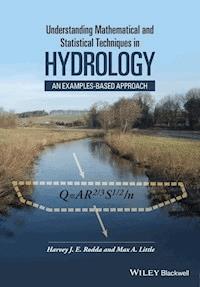
Cover image: The River Avon at Upavon, Wiltshire, UK © Harvey J. E. Rodda
Preface
Understanding Mathematical and Statistical Techniques in Hydrology: An Examples-Based Approach is primarily intended as a textbook to assist undergraduate and postgraduate students with courses or modules in hydrology. In higher education, hydrology as a subject is not usually taught in its entirety as a separate course at undergraduate level but is generally included as a module of geography, environmental science or earth science courses. It can also be included in civil engineering courses which deal with river engineering, drainage, water supply and sewage treatment. More specialized postgraduate courses such as water resources management focus on hydrology. Such undergraduate and postgraduate courses do not generally include any supplementary mathematics and in many cases an advanced school leaving qualification in mathematics is not an essential entry requirement. However, many of the current hydrology textbooks for undergraduate and postgraduate courses assume a high level of mathematical expertise, such as that attained when studying for a mathematics degree. For example, textbooks often present a sequence of differential equations which are impossible to comprehend without having this high level of mathematical knowledge. Instead of assisting the students with their studies these texts when full of mathematical notations are of little interest to the reader. They can also distance students from using mathematics to the extent that they are discouraged from attempting any mathematical-based questions in final exams.
Lesen Sie weiter in der vollständigen Ausgabe!
Lesen Sie weiter in der vollständigen Ausgabe!
Lesen Sie weiter in der vollständigen Ausgabe!
Lesen Sie weiter in der vollständigen Ausgabe!
Lesen Sie weiter in der vollständigen Ausgabe!
Lesen Sie weiter in der vollständigen Ausgabe!
Lesen Sie weiter in der vollständigen Ausgabe!
Lesen Sie weiter in der vollständigen Ausgabe!
Lesen Sie weiter in der vollständigen Ausgabe!
Lesen Sie weiter in der vollständigen Ausgabe!




