


Erhalten Sie Zugang zu diesem und mehr als 300000 Büchern ab EUR 5,99 monatlich.
- Herausgeber: BoD - Books on Demand
- Kategorie: Gesellschafts- und Liebesromane
- Sprache: Englisch
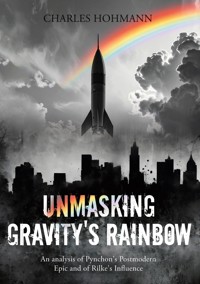
Gravity's Rainbow remains one of the most enigmatic and ambitious novels of the 20th century - a kaleidoscope of paranoia, power, sex, science, and entropy set against the crumbling ruins of World War II. In Unmasking Gravity's Rainbow, Charles Hohmann unravels the novel's dense web of references and motifs, and guides the reader through the novel's key symbols - from the mysterious V-2 rocket to the silent systems of control - and situates it within the broader landscape of postmodern literature and Cold War anxiety. Whether you're a first-time reader or a seasoned Pynchon scholar, this book offers a clear-eyed entry point into one of the most formidable literary achievements of our time.
Sie lesen das E-Book in den Legimi-Apps auf:
Seitenzahl: 726
Veröffentlichungsjahr: 2025
Das E-Book (TTS) können Sie hören im Abo „Legimi Premium” in Legimi-Apps auf:
Ähnliche

















This thesis was accepted as a doctoral dissertation by the Faculty of Arts of the University of Zürich in 1986 on recommendation of Professor Dr. Max Nänny.
TABLE OF CONTENTS
FOREWORD
PART ONE: GRAVITY'S RAINBOW: A CLOSE READING
CHAPTER I: Between a Writable and Readable Text
A. A Survey of Criticism
B. Gravity's Rainbow: Story and Narration
1. Gravity's Rainbow and the "Story of Identity" of the Sixties
2. Narration: A Multitude of Voices
C. A Menippean Satire
D. The Referential Code
CHAPTER II: The "Paranoid" Predicament
A. The Nature of "Paranoia"
B. "Paranoia" and Primal Anxiety
C. The Self-Transcendental Momentum of "Paranoia"
1. The "Zero" and "Anti-Paranoia"
2. "Operational Paranoia" and "Mindless Pleasures"
3. Mass "Paranoia" and Its Charismatic Phase
4. Rationalized Forms of Mass "Paranoia"
5. Creative "Paranoia"
D. A Way Out?
E. The City as an Extension of the Self
CHAPTER III: A Universe on Three Planes
A. The "Kinder" Universe
1. Entropy
2. Gravity
3. Temporality
4. Contingency
5. Conclusions
B. The Gnostic Cosmos
C. The "Other Side"
D. The Zone
CHAPTER IV: Oppressors and Victims
A. The Universal Conspiracy and the Father Imago
B. Sado-Masochism and the Archetypal Sacrifice
CHAPTER V: The Rocket
PART TWO: GRAVITY'S RAINBOW AND THE DUINESIAN ELEGIES
CHAPTER I: Pynchon and Rilke: A Survey of Criticism
CHAPTER II: The Human Predicament in Gravity's Rainbow and the Duinesian Elegies
A. The Self and the World
B. Extramental Reality
C. The Human Lot
D. Preliminary Conclusions
CHAPTER III: The Life-Death Opposition in Gravity's Rainbow and the Duinesian Elegies
A. The Life-Death Opposition and Its Resolution in the Elegies
B. Death in the Elegies and in Gravity's Rainbow
CHAPTER IV: The Angel in the Elegies and in Gravity's Rainbow
CHAPTER V: Heroic and Orphic Transcendence in Gravity's Rainbow: Major Weissmann and Tyrone Slothrop
A. Rilke's Concept of "Verwandlung" and Its Kafkaesque Inversion in Gravity's Rainbow
B. Major Weissmann and Rilke's Hero
C. Tyrone Slothrop: A Parody on Rilke's Orpheus
CHAPTER VI: Gravity's Rainbow as an Expansion of Rilke's "Tenth Elegy"
AFTERWORD PYNCHON’S STYLE: BETWEEN MYTHOPOEIA AND MYTHOCLASM
BIBLIOGRAPHY
INDEX OF NAMES
INDEX OF SUBJECTS
FOREWORD
The purpose of this study is first to delineate what I conceive of as Gravity's Rainbow's conceptual structure and then to relate it in a meaningful way to Rilke's Duinesian Elegies, a text which was a major influence on Pynchon's novel.
It was only after having worked on Gravity’s Rainbow that I turned to Rilke and my thesis reflects these independent readings in two distinct sections. I have resisted the temptation to unify these readings into a whole because I felt I could avoid blurring nuances in this way, a defect to which studies on literary influence are prone.
I have quoted more liberally from Pynchon's own words than is perhaps consistent with the best principles of literary criticism. This for two reasons: Pynchon criticism often takes as a starting point one aspect of what is, in fact, a spectrum of possibilities: a procedure which has led to a vast amount of mutually incompatible interpretations. Hence, to do justice to the novel's multifariousness and to avoid reductive fallacies, it is necessary, when commenting on specific extracts, to keep an eye on analogous passages and not to overlook others that might contradict them.
Furthermore, in the context of current discussions of Gravity's Rainbow, to suggest that the novel is ordered on an intellectual plane smacks of the type of paranoia Pynchon precisely sets out to cure in his reader. It is for this reason that some literary critics, heedful of 'interpretative paranoia', have come to believe that the novel cannot be made available conceptually. Hence they opt for the type of intuitive response that highly devious texts seem to call for. However, such a stance ignores the fact that Pynchon sees no alternative to the predicament of "paranoia" and that as long as the quest for patterns or meanings does not outgrow its "charismatic" phase of "mindless pleasure" it fulfills a basic human need.
My debts in this undertaking are many and considerable. First of all, to Professor Max Nanny, who directed my work with kindness and keen perception and whose studies in Jakobsonian poetics and on Menippean satire have profoundly influenced my arguments. I also wish to thank Professor Wolfgang Binder whose fascinating lectures on the Duino Elegies opened new horizons in my readings. My thanks are due to Mrs Catherine Schelbert who devoted many laborious hours to the correction of the manuscript, considerably improving the clarity of my style, and to Mrs Joe Kenworthy who assisted me in a first draft. In addition I should like to express my gratitude to Mrs Cornelia Laemmel, who typed the manuscript and to the staff of the English Seminar in Zürich, in particular, to the librarian Mrs Marianne Kaempf and to the secretary Mrs Ursula Ricklin for their innummerable services.
Zürich, April 1986
LIST OF ABBREVIATIONS
The major writings of Thomas Pynchon quoted in this study are referred to by the following abbreviations:
v.
v. New York: Bantam, 19'64.
GR
Gravity's Rainbow.
New York: Viking, 1973.
SL
Slow Learner : Early Stories.
Boston: Little, Brown, 1984.
So as to make a distinction between Pynchon's frequent stylistic use of ellipses and my own omissions in quotations, I have set ellipses that appear in Gravity's Rainbow closed up, without space between the points (e.g. ... )
I. BETWEEN A "WRITABLE" AND A "READABLE" TEXT
A. A Survey of Criticism
There is still little consensus among scholars about the degree of readability of a novel like Gravity's Rainbow and critical responses can be located all along a scale which lies between what Roland Barthes calls a "texte de plaisir", the traditional, more conventionally structured novel, and the "texte de jouissance", what has come to be known as the post-Modern ist novel.1
Critics with the first type of response anchor their readings in explicit paraphrases of the novel. This is, to a large extent, the case with Joseph W. Slade, Douglas Fowler or Molly Hite among others.2 Mark R. Siegel suggests along what grounds such attempts can be successful when he declares that the "only thematic perspective" which fully accounts for the novel's events is a "threefold" examination of, first, "the possibilities for personal salvation,” second, "the socio-cultural movement towards apocalypse" and, third, "an attempt at divining what lies in the future for both individuals and for society by examining the available patterns of political, economic, technological, and psychological lines of force...."3
However, scholars who emphasize this kind of hypothetical central perspective often disagree in their final evaluation of the narrative. For instance, critics like Josephine Hendin or James W. Nash stress the novel's nihilism.4 In contrast, Lawrence C. Wolfley or Lance W. Ozier see the narrative, in general, as affirmative. Wolfley claims that the "nihilism of Gravity's Rainbow is only apparent" since the novel's style affirms man's freedom5, while Ozier suggests that Pynchon's concept of "death-transfigured” is akin to Rilke's notion of "transformation.6
Charles Clerc remarks that the challenge of "ascertaining whether Pynchon is ultimately a diabolic prophet of doom," an opinion prevalent among earlier Pynchon critics, "or a human visionary" will "probably continue to remain tantalizing."7
To the same group of studies belongs the work of scholars who believe that Gravity's Rainbow discloses its significance when it is approached from many angles simultaneously. Critics like John O. Stark, William Plater, David Cowart and Peter L. Cooper tackle the novel under such headings as film, language, history, music, religion, science and technology.8 Significantly, their conclusions are often at variance, illustrating the novel's ebullient and labyrinthine heterogeneity since "conflicting interpretations" can always be abundantly corroborated.9
A glance at the wealth of recent publications in journals, most of which approach the novel from partial aspects such as paranoia, entropy, religion, social criticism, intertextuality or comedy, to give but a few examples, serves to confirm Siegel's observations and to prove how much the success of such studies depends on prior assumptions concerning the central meaning of the literary artefact.10
The second type of critics declare that Gravity's Rainbow "defies reduction because the sum of its parts is so vast we don't even have a chance to compare it to the whole"11 or contend that it is "unplottable" because "it lacks a central. subject (vehicle) or even a hierarchy of subjects, and because it moves from place to place without any apparent reason or purpose."12 In general, this group of literary critics has little patience with the above mentioned paraphrastic renderings since they claim that the novel purposely seeks to make us "feel the inadequacy of conventional modes of making sense — of analysis, causal explanation, logic."13 They reject paraphrase because as Brian McHale explains.
nearly everything is lost in the translation. From first to last the reader's experience proves that Gravity's Rainbow will not boil down quite so readily to intelligible patterns of theme, or indeed to any of the patterns which we have learned to expect from Modernist texts.14
McHale argues that Gravity's Rainbow is structured in a way that will thwart every form of reconstruction, including that proper to Modernist texts, since it destabilizes "novelistic ontology," an element on which readers generally found their points of view. While pre-Modernist texts permitted a reconstruction through the mediation of an omniscient and more or less reliable narrator. Modernism made the task more difficult by using narrators with a limited point of view or even by making them imperceptible. Moreover, unreliability was limited to the "fictive world" and was of an "epistemological" rather than "ontological" nature, still permitting the reconstruction of an "external (fictive) reality."
This also remained the case when several mediating consciousnesses were introduced into the Modernist novel as it still permitted "triangulation," that is, the passage from one consciousness to another through "coordinates in the 'real' visible, audible, tangible, etc. world" which remained relatively stable.15 According to McHale, the narrator in Gravity's Rainbow is not only out to disorientate the reader of pre-Modernist texts but also those conditioned to Modernist ones, since "triangulation" here does not allow the reconstruction of a "'real' situation in which the contents of one mind are accessible to another."16 Reading Gravity’s Rainbow, then, simply becomes an exercise in what Keats called "Negative Capability," the state of “being in uncertainties. Mysteries, doubts without any irritable reaching after fact & reason...."17
Thomas Schaub, in his Pynchon; The Voice of Ambiguity argues along different lines yet comes to similar conclusions when he says that the experience of ambiguity in reading Pynchon is essential. For him it is a necessary result of Pynchon's design "to bring readers to the uncertainties of the precarious balance where the familiar is strange, where the benign is evil, and where the rage for order is persistently denied."18 Readers who believe that there must be more to the constant flouting of "the logical groundrules we have internalized for making sense of novels"19 than a mere re-education or de-conditioning of the reader and who do not want to relinquish their aspirations to a unified form of response are, finally, left with the kind of "intuitive synthesis" Susan Davis proposes:
We must read Gravity's Rainbow in a manner analogous to the manner in which we listen to non-traditional jazz or watch surrealistic film -- by paying attention to the emotional impact of individual moments, by perceiving the interface between one moment and another.20
Apart from the possibility of "intuitive synthesis, " the former kind of interpretation immediately raises important questions: How can a subversion of the narrative succeed without being itself internally organized in certain ways? In other words, how could Gravity's Rainbow break rules without stating them implicitly? This is, indeed, one of the major paradoxes in which post-Modernist aesthetics is caught. As David Lodge remarks, "if postmodernism really succeeded in expelling the idea of order (whether expressed in metonymic or metaphoric form) from modern writing, then it would truly abolish itself, by destroying the norms against which we perceive its deviations."21 Pynchon himself seems aware of this double-bind when he lets the anarchic "Counterforce" fail because of its refusal to organize itself. Barthes, among other post-Structuralists points to this difficulty when he says:
Certains veulent un texte ... sans ombre, coupé de l'"ideologiedominante" ; mais c'est vouloir un texte sans fécondité, sans productivité, un texte stérile... Le texte a besoin de son ombre: cette ombre c’est un peu d'ideologie, un peu de représentation, un peu de sujet: fantômes, poches, traînées, nuage nécessaire: la subversion doit produire son propre clair-obscur.22
But even a text that merely casts a "shadow" poses insurmountable difficulties to traditional critical appreciation. Barthes himself claims that texts which elicit in the reader "rapture[s] of dislocation produced by ruptures or violations of intelligibility"23 are "hors-critique", beyond criticism altogether.24
In the light of this claim it is useful to recall the main difficulty imposed by such texts. It is a characteristic of language, and by extension, of literary systems, that while the number of signifieds is potentially infinite the number of signifiers is not. For interpretation to become possible a text has to give us some indications as to which meanings are licit and which are to be excluded. Now, since the post-Modernist text does not seek to restrict meanings but on the contrary to disperse them playfully, or, to use Barthes' terms, to replace "denotation" by "connotation,"25 not only does a formal evaluation of features of style, genre, perspective, etc. become impossible but the sole distinction between relevant and irrelevant devices becomes arbitrary.26 If this was the case in Gravity’s Rainbow, for example, a reader could not decide how Pynchon's narrative intricacies are internally motivated, whether they are to be understood as a mimetic reflection of the complexities of the modern world as has been suggested27 or whether they are due to particular intellectual assumptions implicit in the narrative. Jean Paul Sartre encapsulates the point at issue when he declares: "Une téchnique romanesque renvoie toujours à la métaphysique du romancier. La tâche du critique est de dégager celle-ci avant d'apprécier celle-là."28
Whether the type of freedom Barthes professes is possible in literature remains a matter of debate. David Lodge is rather sceptical:
Writing, especially the writing of narrative, is a process of constant choice and decision-making: to make your hero do this rather than that, to describe the action from this angle rather than that. How can one decide such questions except in terms of some overall design -- which is in some sense a design upon one's putative readers?29
Lodge, who as an author has misgivings about the post-Structuralist belief in the radical indeterminacy writing implies, also points out that it is in particular comedy which "offers most resistance to post-Structuralist aesthetics," a mode which, incidentally, informs large sections of Gravity's Rainbow.30
If we consider the way fictional material has been processed in Gravity's Rainbow we notice that Pynchon's writing is constantly spurred on by an urge to impose patterns on his texts, designs which often go beyond his disruptive techniques. In his foreword to Joseph W. Slade's booklength study Thomas Pynchon, Terence Malley sketches this creative disposition when he says:
... the fantastically diverse elements of Pynchon's world are bewilderingly interconnected. A throwaway detail on an early page of one of Pynchon's novels is likely to grow into a central motif by the end of the book. Like Milton Gloaming — a very minor character in Gravity's Rainbow — Pynchon could be said to have a mind that is "always gathering correspondences ...."31
This attitude of mind could, perhaps, be described by G.S. Klein's concept of "leveling," a cognitive predisposition to suppress differences and emphasize similarities so as to preserve perceptual stability32 which finds its literary analogon in a bias towards what Roman Jakobson has identified as the "metaphoric" pole.33 The way in which Pynchon combines totally different areas of human behaviour and understanding such as theology, history, science and technology, politics, literature, in brief, his narrative encyclopedism34 is indicative of his sensitivity to similarities and his predilection for systems.
Although one should be wary of authorial comment, it is fruitfull to quote one of Pynchon's own judgements on his early fiction. In the introduction to Slow Learner we are told:
The problem here [ with "under the Rose" ] is like the problem with "Entropy": beginning with something abstract — a thermodynamic coinage or the data in a guidebook — and only then going on to try to develop plot and characters. This is simply, as we say in the profession, ass backwards. Without some grounding in human reality, you are apt to be left only with another apprentice exercise.35
This quotation, which reminds us of Lodge's statement cited above, shows that Pynchon feels his early fictions suffered from their conceptual origin. If we want to take what he says at face value, the author himself lends support to our argument.
But Pynchon is not only conscious of his mental bias and its distortive potential -- hence his disruptive strategies — he also suggests that it is an analogous drive to establish systems at the cost of perceptual differentiation on the social level which has led to the repressive technocratic society he portrays.
The reflections above suggest that whether Gravity’s Rainbow is taken to be a novel which has suffered its own "deconstruction" at its inception or whether it is read as a text which will allow a meaningful assimilation, the quest for designs cannot be avoided. The post-Structuralist approach requires the expectation of significant patterns if the reader is to experience the "raptures" their disruption produces, whereas a conventional reading depends on the reconstruction of meaningful structures if it is to assess a writer's fictional techniques, a procedure which, to my mind, is justified when reading Pynchon's novel.
The reconstruction of meaningful patterns in the act of reading has been variously referred to as "recuperation," "naturalization,"or "vraisemblablisation" and corresponds roughly to the reading operations on the level of Barthes' "referential code," as Jonathan Culler points out.36 Expanding on Barthes and Todorov, Culler further subclassifies this code in references to such sub-texts as the "real world," the "cultural text," "conventions of genre," the "natural attitude to the artificial," and "specific intertextualities."37
While the following two sections will attempt to describe Gravity's Rainbow in generic terms, namely in those of the novel and the Menippean satire, and show in what ways it still responds to conventional reading procedures, the main body of my study will be devoted to the reconstruction of a meaningful "cultural text."
B. Gravity's Rainbow: Story and Narration
Gravity's Rainbow deviates from much "post-Modernist" fiction38 in that the novelistic conventions it flouts still make up for a large part of the narrative. In other words, unlike the reading experience of anti-novels, comprehension is not subverted to the point where reading becomes a completely alienating performance. This effect is awkward for the reader who is eager to classify the novel as a "writable" text.39 Narrative conventions and subversive elements coexist without invalidating each other, and if the disrupting strategies in the end subvert anything it is the law of contradiction. As will be demonstrated below, this carnivalesque rejection of our natural assumption that "A is B and A is not B cannot both be true,"40 can be found at other narrative levels as e.g. the deadlock between the "System" and the "Counterforce" at the story level.41
In what follows, I will point to different planes of the narrative to show in what ways orthodoxy and rebellion interact, dealing first with the surface structure of the story and turning then to various levels of narration.42 Naturally, the distinctions themselves are but a heuristic device and must not be reified.
1. Gravity’s Rainbow and the "Story of Identity" of the Sixties
While it is possible to establish a chronology for the events of the novel as a whole, an account of Gravity's Rainbow’s storylines, let alone its complete story would be more than uphill work.43 The reconstruction of the temporal sequence underlying the novel is made difficult because, as D. Cowart points out, it is "suppressed in the telling and further subverted by adherence throughout to present tense."44
Steven Weisenburger, in a very perceptive article, shows that many episodes in Gravity's Rainbow, such as the macaronic carolling scene in the church in Kent, are based on the London Times of 1944-45 and that the whole story takes place between mid-December 1944 to mid-September 1945.45 His account is most illuminating, but does not entitle the reader to take external chronological references at their face value. Such a reading would imply that scenes like the one involving a "30th century" Slothrop (GR 436) would be considered fictive, thus disregarding one of the novel's main strategies which is to undermine epistemological categories as a whole. In reading this novel, we can never be certain as to the ontological status of time or place because what seems real often proves to have been fantastic while the fantastic may end up being true. An example of the former would be the pie throwing scene from Schnorp's balloon (GR 335); of the latter, the effect of the drug "Oneirine theophosphate" in producing hallucinations which appear to be more real than the world itself (GR 702). Tony Tanner aptly characterizes the effect of this ontological indeterminacy when he observes that "[a]t times... it is not always clear whether we are in a bombed-out building or a bombed-out mind...."46
a) Story-lines
Similarly, an analysis of the novel's predominant story-line or of a hierarchy of story-lines is beset with difficulties. Slothrop's quest has been suggested as a main story-line,47 yet he disappears 'physically' from the last section. Scott Simmon and Douglas Fowler both give such accounts, but acknowledge that the task is unyielding, the former by conceding that his account is "somewhat arbitrary,"48 the latter by suggesting that the stories' intractabilities can only be understood through "the chains of coded symbols and images" that hold the book together.49
While the intricate warp and weft of the many story-lines defies a coherent critical description, we can still recognize that they are basically all variations on the same narrative syntagm, the quest motif. Admittedly this concept of the "Journey," that "oldest and most universal" story,50 must be taken in its widest sense so as to include mental processes such as volitional acts and to permit a reading of literal quests as their factual correlatives.51 Herbert Stencil in v. and Oedipa Maas in The Crying of Lot 49 are also on dogged quests for some ultimate knowledge or truth and it can be said that the quest story forms, in fact, "the single indispensable ingredient in Pynchon's books."52 In Gravity's Rainbow the theme of the quest pervades love, spy, cowboy, sexual deviation, detective, picaresque or businessman stories and occurs in sacral (e.g. Kabbalist, Masonic, Gnostic, etc.), mythical or magical (e.g. quest for the Grail, Tarot and astrological divination, etc.), and scientific or technological (e.g. psychology, mathematics, aerodynamics, rocket engineering, etc.) varieties. To make sure that the latter modalities of the Faustian drive to understand "was die Welt / Im Innersten zusammenhält" are read as defiled versions of the sacral or mythical "Journey," Pynchon takes great care in placing appropriate indicators throughout the text, as when one of his narrators compares Pointsman, the Pavlovian psychologist, to a medieval knight (GR 43) or when he devises a petrochemical plant ressembling a "Castle" with chemists inside gathering around a chalice of "methyl methacrylate"(gr 486-88).
In its less "destructive" forms the quest motif appears carnivalized. Not only do characters sometimes not know whether they are on a quest or an escape but spiritual and material goals often multiply in such a way that characters find it difficult to cope with them. Some individuals pursue clusters of objectives composed of such diverse elements as personal identity, a lover, a relative, drugs, perceptual order, individual power, etc. and modify these clusters inadvertently by abandoning goals or adopting new ones in the course of the story. Slothrop finds himself at one point in the narrative to be after such targets as Imipolex G, the S-Gerät, Tantivy's avenge, his own ID -- an allusion to his quest for identity (GR 561)— and his discharge (GR 526). If in this case the quest motif appears to be parodied, in the case of the reader, who is often addressed, it becomes ludicrous. Not only is he often at a loss in choosing clues to his own quest for meaning, but he constantly labours under the suspicion that he is being taken for a ride.
However, in Pynchon's versions of the quest story, goals often change while their motivation remains constant. They all promise some form of redemption from a predicament judged insufferable: The desire to 'transcend' the human condition is of primary concern. Another trait of Pynchon's quests is that they generally end in failure either because the questing hero never makes it or, if he does, he finds annihilation. The only times when questers achieve success, mostly against incredible odds, is when their goal is not their own redemption but the protection or salvation of others. Such is the case when Slothrop warns the Schwarzkommando (GR 562), when von Göll alias "der Springer" is rescued (GR 514), when Geli prevents Enzian and Tchitcherine from killing each other (GR 735) and when Ludwig finds his lemming again (GR 729). The only example of a successful quest after a sacred goal is the old aqyn's voyage to the Kirghiz Light (GR 358), although we are never sure in the end whether it remains a myth. But his is a special case since he has to come back to deliver his message of hope against hope.
At the story-line level we can roughly distinguish two reasons for the failure of the quest: on the one hand questers commit some grave error like setting out in the wrong direction, arriving too late, failing or being powerless to act at decisive moments; on the other hand the "System" interposes obstacles to prevent individuals from attaining their goal.
Slothrop best illustrates the first case: on his hunt for rocket debris he remains a "Saint George after the fact" (GR 24), Jamf's spirit never appears to him in the cave (GR 268), and later we are told that he still has "not recorded, tagged, discovered, or liberated a single scrap of A4 hardware or intelligence" (GR 391). He will finally dissolve without fulfilling any of his aspirations. In addition, there are the Moon colonists who always miss their connections (GR 723), the Polish undertaker who cannot get a thunderbolt to hit him (GR 663-65), Roger Mexico who simply runs out of water when he wants to urinate on Pointsman (GR 636), fathers and sons who constantly fail in their attempts to kill each other (GR 674; 747). Examples of a joürney in the wrong direction are: the escape route of the Anubis (GR 667-68) or Enzian realizing that his goal should not have been the rocket but the destroyed gasworks (GR 520). A significant omission is made by Slothrop when he refuses to read the teletype message which might have contained the clue to his mystery (GR 244).
In the second type of unsuccessful quest, a powerful anonymous authority beyond the reach of individual characters intervenes with the purpose of redirecting the questers' energies to its own ends. For instance, when Pointsman or Brigadier Pudding are prevented from attaining their goals, for the former death (GR 143), for the latter truth (GR 234), when Tchitcherine is prevented from going on his personal quest to kill his half-brother Enzian (GR 705), or when Slothrop cannot return to Mingeborough, his hometown, because of a military posse (gr 144).
The syntagm described above is a variation on what Manfred Pütz calls the "story of identity," which he develops syncretically from the narrative theories of Propp, Brémond, Todorov, Greimas and Barthes, among others. Pütz compares his undertaking to Todorov's attempt to identify recurrent story structures in the Decamerone and draws on novels from the sixties by J. Barth, R. Brautigan, T. Pynchon, L. Rinehart, R. Suckenick and V. Nabokov.53 An "identity story" consists of the following elements:54
1) In the initial situation we find an alienated figure suffering under an intolerable predicament;
2) a pervasive wish on the figure's part to transcend this condition ;
3) actual or imagined counterforces responsible for the predicament preventing any form of escape into a redeemed realm;
4) a mediator, often the alienated figure itself.
5) Either the struggle is carried out or the figure resigns, thereby experiencing a final frustration.
6) If the former is the case, the figure will attempt to go beyond the identity negating realm.
7) Either the struggle ends in success or failure or a third option, part success, part failure. Pütz interprets the concept of "identity" very broadly to embrace all attempts at "self-definition" in "interrelations between the world and the self and individuals among each other as well as the act of playing roles."55 Naturally, Pütz's definition, which proves invaluable for synchronic and diachronic studies, loses some of its general validity when applied to one particular study concerned with the many intricacies in the realization of such an abstract syntagm. Basically, we may say that in Gravity's Rainbow attempts at "self-definition," in particular when they are collective, are satirized since they lead to annihilation and that wisdom is to be found in resignation and accomodation to the predicament.
In the description of the novel's chronology, settings and story-lines, we saw that conventional and subversive narrative elements are interrelated in the novel. On the one hand references to events in the 'real' world and detailed descriptions impart fictional credibility, on the other hand violations of realistic conventions have an unsettling effect and the reader finds himself in the dilemma of having to decide whether the verisimilar is merely fantastic or vice versa. The only unambiguous element is the uniform structuring of the story-lines. They are all patterned on some variation of the "identity story."
b) Characters
The characters embody the same ambiguous interrelation of realistic descriptions and fantastic elements which make the "ontological status of the figures... radically uncertain,"56 although not to the point where one feels one should abandon 'verisimilar' reading.
At times, protagonists have "appropriate allusion and depth of characterization" like Pointsman and Roger Mexico,57 while at other times they tend to be rather "flat." J. Stark agrees with T. Tanner that many of Pynchon's characters "have theatrical traits and perform roles rather than express a consistent self"58 and M. Siegel observes that Pynchon "is not interested so much in how his characters think as in what they think."59 Such flat characterization does, in fact, predominate and is reflected in Pynchon's predilection for stock figures. Marjorie Kaufman has shown that the multifarious female characters in the novel fit "into three not-very-tight categories: the young, pretty, nubile, well-intentioned; the generally older, generally aristocratic, rather thoroughly decadent; and Mothers."60
The same may be said of the characters' different social roles which are of a limited and relatively small repertoire, considering that the novel deals with over 300 characters. The repertoire is more or less constant and repeats itself in the different ethnic communities, be they Argentinian, German, Russian, Kirghiz, Herero, exclusively American or Allied.61 This is because Pynchon has chosen those activities in which he, often in a very idiosyncratic way, sees avatars of the quest for salvation. What interests him about his scientists, mystics, politicians, artists, revolutionaries, film directors, exiles, radio operators, dancers, addicts, etc. is the means they find either as individuals or as members of larger groups to 'transcend' the human condition.
Not only are characters' activities reduplicated but their relationships with each other prove to be variations of a stock repertoire. An enumeration of the more relevant of these parallelisms gives an impression of their importance: What Frans Van der Groov is to Katje Borgesius, William Slothrop is to Tyrone Slothrop and old Tchitcherine to his son; what the pig is to the Puritans, the dodoes are to the Dutch, the pheasants are to the Germans and the aardvark is to the Hereros; Slothrop's relation to his kazoo is paralleled by Tchitcherine's relation to his balalaika, Martin Fierro's to his guitar and the old aqyn's to his dombra.
The most striking examples of such parallelisms are those of homosexual couples and love triangles. The latter relationship which is less common than the former appears stereotyped: the Roger Mexico / Jessica Swanlake / Jeremy Beaver love triangle mirrors the Pirate Prentice / Scorpia Mossmoon / Clive Mossmoon relationship, the Caroll Eventyr / Nora Dodson Truck / Sir Stephen Dodson Truck love affair, the Peter Sachsa / Leni Pökier / Franz Pökier triangle and maybe the Tchitcherine / Galina / Luba relationship.
In some cases characters explicitly merge into each other. This motif of the "double" already appeared in the short story "Mortality and Mercy in Vienna"62 and was taken up again in v. (V. 183; 224) and in The Crying of Lot 49;63 in Gravity's Rainbow it applies mostly to children. Bianca and Ilse (GR 577; 610), Leni and Solange (GR 610), Gottfried and Bianca (GR 672) and hence Geli and Bianca, Pan and Major Weissmann (GR 720) are all said to be, at one time or another, the same persons. In one instance a cryptic reading of a Tarot pack suggests that Major Weissmann becomes "what he first loved," i.e. Enzian (GR 749).
Such parallelisms between a protagonist's social activities, human relationships or characters' merging into each other denote a tendency to uniformity in characterization and contrast sharply with the multiplication of identities that sometimes plagues Pynchon‘s characters. Already in v., Herbert Stencil could not cope with the proliferation of his identities and decided to refer to himself in the third person so as to “appear as only one among a repertoire of identities" (v. 50). In the same novel Fausto Maijstral was seen reflecting on all his "successive identities" (v. 286). In Gravity's Rainbow we are told that Greta "had more identities than she knew what to do with" (GR 482). Both Enzian and Blicero appear to change personality several times and the former explicitly refers to a former self as "a fool, an insufferable ass ... you'd no more turn ... out than you'd turn out any other kind of cripple" (GR 660).64 The same case could be argued for Nora Dodson Truck who at first identifies with entropy (GR 149) but later claims she is gravity (GR 639). Fowler observes that "the Slothrop of any now is not really the Slothrop of any Then,"65 a statement which can easily be substantiated if we consider that Slothrop is sometimes capable of deep insights, for instance, when he realizes that he is "no knightly hero" but only playing someone else's game (GR 364) or when he wonders whether the lemmings' deathwish is not an anthropomorphic projection (GR 554). But then on other occasions, he seems totally unconscious of his schlemielhood, as when he takes his Rocketman role seriously or remains ignorant of his own deathwish since, apparently, he invented the Jamf-story to deny that he was in love with his own death (GR 738). This kind of inconsistency in which a character sometimes has access to knowledge incompatible with the role he plays in the novel or, conversely, in which a supposedly omniscient figure appears stunned by events, is quite common. The former is illustrated by Blodgett Waxwing who is not supposed to know about Pointsman's 'top secret' (GR 248), or Enzian who for reasons which remain obscure is familiar with the Slothrop-Geli affair (GR 328), and the latter by von Göll, alias "der Springer," who is conversant with almost everything that has happened in the novel, who is one of "the very few who can comprehend ... in toto" (GR 495) its cosmic design and who even knows that Tchitcherine was in Semirichie (GR 500) yet has no idea that Slothrop travelled on the Anubis (GR 528).
The fact that a character may supply more or less information than is consistent with the predominant range of his ken could be attributed to authorial oversight or carelessness. Such a view, however, is invalidated if we consider how meticulous Pynchon is in other respects, as when he handles scientific, historical or geographical details. The sporadic occurrence of these inconsistencies in characterization, on the contrary, suggest that Pynchon is undermining the fictional concept of identity without, however, destroying it completely.
An analogous type of inconsistency can also be found in the way Pynchon handles allegorical or 'give-away' names. Pynchon goes to great lengths to give his characters meaningful names. In Weissmann's name, "weiss" alludes to the colour of death; Enzian is named after the mountain gentian in Rilke's "Ninth Elegy," Jamf is apparently an acronym for "Jive- Ass Mother Fucker" 66 and refers to a typical representative of the evil "System," Slothrop's name contains the abbreviation of "Second Law of Thermodynamics,"67 the physical law which might be responsible for his disintegration; that an entrepreneur should be called G.M.B. Haftung (cf. Gesellschaft mit beschränk-ter Haftung), finally, comes as no surprise. This narrative technique which is reinforced by countless "grotesque post-Dickensian names"68 with their onomatopoeic or symbolic characteristics like "Brigadier Pudding" (size). "Whappo" (whip), "Morituri" (from Hiroshima), "Blowitt" and "Overbaby" (two airmen killed in flight), could be helpful in identifying the many characters in the novel if Pynchon did not suddenly ignore their meaning or negate it,69 thus confirming Greta Erdmann's conviction that people don't have real names (GR 395). The fact that Pynchon painstakingly selects the names of his characters and then disrupts his own allegorical web suggests that he proceeds with the utmost care. I believe Tony Tanner interprets this strategy correctly when he observes that its objective is to "undermine and mock the very act of naming ... a gesture against the tyranny of naming itself."70
This subversion of the concept of identity in characterization makes it difficult for the reader to identify characters through their individual centres of consciousness. On the one hand, what he takes to be multiple perspectives on the fictional universe converge and suggest a unified englobing consciousness; on the other hand, to attempt to perceive the fictional world through a single mind, as some critics have suggested, remains equally unsatisfactory. These critics explain away inconsistencies by seeing them as fantasies of Pirate Prentice, who, as we know can live in the mental worlds of other characters.71 Such a procedure could account for many of the text's contradictions but, as McHale remarks, would be "too powerful ... ultimately leaving too little unresolved."72 Another more cogent argument against such naturalization is the fact that Pynchon makes it impossible for us to agree on which character we are to attribute such powers to. As McHale observes, other characters have abilities similar to those of Pirate Prentice73 and since consciousness can also be attibuted to any inanimate object, like bulbs (GR 747 ff.), ball-bearings (GR 583-85), trees (GR 552-53), rocks (GR 612), the earth (GR 589; 720) or the universe itself (GR 89), we realize that there is no criterion for giving any one consciousness priority over any other and that we are trapped in what may be called a mise en abyme on the plane of the story.74
Douglas Fowler observes that of "all Pynchon's departures from the conventions of the novel ... his most significant, subtlest and unusual departure is his rejection, in every significant instance, of human motive as the most important fact in dramatic event."75 Although the mental worlds of characters can change, it would be erroneous to assume an evolution of the kind we are familiar with from "round" characterization. When mind-sets change the motivation is not of a psychological kind. Already in v. the reader is puzzled by some of Fausto Maijstral's or Kurt Mondaugen's reactions. In Gravity's Rainbow Frans Van der Groov cannot understand his compulsion to kill dodoes (GR 108); Enzian has no idea why he is emotionally committed to Major Weissmann (GR 325) or whose decisions he has been making all along since they are evidently not his own (GR 327); Slothrop does not know why he must leave Bianca (GR 472) or why he wants to find Sqalidozzi at all (GR 681). In one case at least, when Katje leaves the "Schussstelle," an omniscient narrator makes one perfectly aware that he has no explanation at hand (GR 107).
Commenting on this particular aspect of characterization Fowler compares Pynchon's figures to those of T.S. Eliot: "... like Eliot's harrowed speakers, Pynchon's favorites always fall victim to colossal forces from beyond the limits of human identity."76 But this is only half the truth because the concept "limits of human identity" proves to be rather mercurial. The borderline of consciousness constantly changes and cannot be pinned down, as the mise en abyme makes manifest, and "inside" and "outside" become irrelevant as descriptive categories for the story-level as a whole.
We may not know where these "colossal forces" come from but, as some of the above examples show, they are patterned on a common hierarchical principle, namely that of submission and dominance or victim and aggressor. Just as Pynchon seems less interested in the objectives to which his characters aspire than in the modalities of an omnipresent drive which compels them to transcend their predicament, he is less concerned with the psychological motivation of individuals than with the nature of the forces to which they are subject in their consciousnesses. Consciousness, here, must not be understood as a determinate individual's emotional and cognitive perspective of the world but as a focal point which can be located as much at the core of a transitory emotional state as at the centre of the universe. Human aggressors and victims in the novel enact the workings of these forces, and their activities are not psychologically but metaphorically motivated, a narrative aspect that neatly dovetails with the symbolic "Journey."
Hence, although conventional and subversive strategies of characterization make accurate critical description difficult, the patterns of forces at work and personified in the sado-masochism of characters remain unambiguous and give explanatory criticism access to the novel.
2. Narration: A Multitude of Voices
It may generally be said that every increase in ontological scepticism is followed by a greater awareness of epistemological operations, in especial of the important role of perceptual distortion and hallucinatory projection. The history of ideas tells us that the degree of such awareness has often changed according to cultural patterns, and we know that different sciences attach a different weight to them.
In the case of contemporary literature, especially prose fiction, the landslide has been towards epistemological awareness, a fact which is manifest in the heightened attention to processes of fictional mediation as in the case of the nouveau roman or the American post-Modernist novel.
This evolution can be lamented as some pessimistic culture critics have done,77 but undoubtedly, it is only through it that the contemporary novel has been able to open up new horizons of experience and that significant breakthroughs in modern narrative poetics have become possible.
In Gravity's Rainbow a parable explicitly refers to this theme (GR 533-35). At the "White Visitation" Katje sees a film in which "two trail-weary cowboys," S.Z. Sakall78 and Basil Rathbone are threatened by a midget sheriff. In the course of the film the two cowboys quarrel about the actual existence of the sheriff who is ready to fire and who, as we are told, personifies "the whole dark grandiose Scheme, " the "plot" or, as we may interpret here, 'reality'. While S.Z. Sakall, who doubles as the fiendish scientist Pointsman, knows the difference between what is 'real' and what is fictive and therefore sees the menace as a "clear target" which can be destroyed, Basil Rathbone, alias the notorious drug addict Osbie Feel, is incapable of differentiating between such categories and considers the authenticity of the "plot / Midget" to be irrelevant. In the meantime, the sheriff, who is following the heated debate, becomes increasingly nervous and suddenly turns tail and "vanishes, frightened into the dust." Although the parable remains ambiguous -- we are not sure whether the sheriff was put to flight because of the the quarrel about his 'reality' or whether he was simply afraid of being killed —, his flight, which is unambivalent, becomes for Katje a "kindness" and a "prophecy."
The parable, of course, is not only philosophical but also metafictional, since it must be understood as a mise en abyme of the fictional process, as the allusion to the "plot / Midget" indicates, and we can rephrase it in the following terms:"the whole dark grandiose Scheme" or the "plot," which we said stands for 'reality', also represents fictional closure or totalization," a final incarnation of meaning which for Pynchon, and here I am anticipating one of my main theses,79 is tantamount to annihilation; Pointsman and Osbie Feel, the two "trail-weary" cowboys or, as we may read in accordance with the novel's codes, two 'Journey-weary' questers, personify two different aspects of the implied author: the former stands for the urge to take possession of the truth and thereby destroys it, thus personifying conventional fictional strategies; the latter, Pointsman's protractor Osbie Feel, stands for their subversion. Pynchon's aesthetic stance if we read this second level of significance correctly, consists then in pitting the two against each other, not to invalidate one of the antagonistic principles but to render the drive towards closure, which is inherent in conventional modes of representation, temporarily ineffective.
As we mentioned above, this fictional ploy makes it difficult to deal with the story-level of the novel. But when we turn our attention to the narrative mediating processes the task becomes sisyphean. It is true that narrative devices are often handled unambiguously and thus remain tractable but an overall classification, I believe, is beyond critical wisdom. Gravity's Rainbow has given rise to a whole 'Pynchon industry' and is one of the most discussed novels of the past decades, but it has not yet found its Genette, a fact which may be a measure of its success.80
In the following I shall briefly sketch some pervasive devices of the mediative process in Gravity's Rainbow. A full interpretation of these devices must, however, await a delineation of the metaphysical assumptions which, I suggest, motivate them.
As Linda Westervelt points out, Pynchon uses "nearly every means available to an author in telling his story"81 and, in consequence, readers are confronted with the whole register of narrative devices.
Pirate Prentice's dream at the opening of the novel already contains in nucleo the novel’s major themes (GR 3-4). It is cast in free indirect discourse, a form of speech representation which prevails for long stretches in the novel. But it often wavers, drifting either into more mimetic or more diegetic modes. In the former case, the discourse shifts into elliptical or first person narration characteristic of interior monologue (GR 531; 759), as in the many passages relating to journeys beyond consciousness like Gottfried's "Ascent" (GR 759-60) or Slothrop‘s climb down into the engine room of the Anubis (gr 530-32).82 In the latter, distance is heightened by overt intrusions from anonymous omniscient narrators (GR 531; 759). Such an erratic handling of distance does not allow the reader to immerse himself in a character’s consciousness for long and has an unsettling effect. Both Elisabeth Davis and Mark Siegel comment on this manipulation of mimesis and diegesis. Davis observes that "the contradictory signals we are to feel about the distance" are more intense in this novel than in v. or The crying of Lot 49, while Siegel claims that Pynchon both 'shows' and 'tells' at the same time.83
This instability is reinforced by constant oscillation between internal and external focalization. A typical example is the passage where Katje Borgesius and Osbie Feel are being observed by a secret cameraman in Pirate Prentice's flat (GR 92-94). The focus in this section switches from an omniscient non-focalized narration to an external focalization through Teddy Bloat's camera where the voice appears to be ignorant of what Katje and Osbie are feeling. However, it soon falls back into an omniscient stance evoking the city outside the flat as well as Katje’s thoughts (GR 93). This is followed by an explicative flashback set in free indirect discourse focussing on her experiences with Blicero and Gottfried at the "Schussstelle" (GR 96). A little later the narration of these experiences, now and again interrupted by an omniscient voice, suddenly appears visualized from Major Weissmann's perspective. The changes of perspective 'triangulating' around Katje's idea of betrayal (GR 97) occur without appropriate markers of transition. However, transition is often indicated by an ellipsis, as in the case of the passage recounting Tchitcherine's exile in Semirichie. Here, the focus shifts from Tchitcherine to Galina (GR 340), to an anonymous omniscient narrator and back to Tchitcherine before finally locating itself again in the consciousness of an omniscient narrator (GR 341).
The difficulties the "rapidity of the switches" pose,84especially when the perspective drifts in and out of the minds of specific characters, animals or objects, become totally intractable in the last section of the novel (GR 749-54) where focalizers can no longer be identified.
Most critics assume that there is a single voice behind the whole narrative which can be invested with interpretative authority and refer to it as Gravity's Rainbow's narrator.85 This reading is substantiated by many passages where an omniscient voice seems to predominate. However, the mere fact that the voice contradicts itself, as will be shown below, suggests that we should distinguish between the novel's several anonymous narrators and the virtual or implied author who can 'explain' such contradictions. The implied author is not a voice, for he can tell us nothing; he is rather a "set of implicit norms"86 which can be reconstructed from the text and helps determine to what degree narrators are reliable. With due consideration for some measure of inconsistency we may roughly say that a narrator's reliability depends on the extent to which he forbears "paranoid" delusions. Most of the anonymous narrators, characters and inanimate objects (e.g. Enzian, Geli, Nora, Byron the Bulb, etc.) may be considered reliable when they have either relinquished their delusions or find themselves in visionary or hallucinatory states. Also belonging to this category are those narrators who have transcended the "Zero" and are on the "other side" (GR 153). The opinions of these characters suggest authenticity and are thus useful in sketching an implied author. This is certainly not the case with highly "paranoid" characters like the executives of the "System," Richard Zhlubb, Major Marvy, or Sir Marcus Scammony whose 'evil' natures are usually stressed by the novel's codes.
As a general rule we may say that anonymous voices play the same roles as characters, albeit more self-consciously.87 On the one hand anonymous narrators act the masters or the henchmen of the evil "System" and frequently use the second person88(GR 136, 389, passim) to lure imaginary readers into the roles of victimized 'quester-narrateesleading them astray either by spinning highly improbable yarns (e.g. GR 663 ff.) or by offering them bogus advice on how to interpret events (e.g. GR 302, 680), even feigning to help them on when they flounder in the narrative (GR 587). Then again, they will not only mock their victims’ "bookish" reflexes (GR 241) or their inclination to archetypal readings (GR 411) but will also shower them with insults (GR 415, 695-96).
At other times, anonymous narrators themselves pose as victims and manoeuvre narratees into the role of masters or at least of acolytes of the repressive "Firm," for instance, when they address one of them as Zhlubb's driver (GR 757)89 or another as the cruel father who did not respond to his daughter's love, in this case Bianca (GR 472, 577). In an odd episode a narrator is not sure whether his narratee is only a fellow-victim or a henchman of the "System" who, in the latter case, would not differentiate between the international "Kartell" and the "World" (GR 411). Sometimes narrators will acknowledge that events are beyond their scope (gr 107, 228, 345, 659) and pose as the victims of their own narrative yarns.
Finally, "we-addresses" make narrators and narratees accomplices who have sided either with the masters (GR 712-13) or more often with the victims (GR 202, 694). This union is carefully established by hinting at the common 'Journey' (gr 239) under the same apocalyptic threats (GR 236, 677, 760) or at shared experiences as when both are supposed to be simultaneously hearing Advent carols (GR 128) or voices whose distance they are both unable to establish (GR 231). This two-someness becomes rather embarrassing when narrators allude to facts they are certain their fellow-narratees are familiar with, about which, however, the latter obviously have no clue (GR 168, 287), or when, immediately after appearing to offer intimacy, they frighten narratees with gruesome incidents (GR 275, 285), a technique which, according to Linda Westervelt, is a Pynchonian innovation.90
To reconstruct the implied author we must examine the relationships between the different narrative voices in the novel, in particular the way they modulate into one another across narrative levels or the way they contradict themselves on one and the same narrative plane.
When the focus changes and the narrative voice rapidly moves from an omniscient stance into a character's consciousness and temporarily shares his limited field of vision we have what Genette calls a narrative metalepsis.91 Such an apparently unmotivated change of diegetic level by a voice was already implicit in the two examples cited above in the commentary on focalization (GR 92-94, 340-42) and is relatively frequent. Sometimes the voices can appear in combination with a mise en abyme as when the spokesman of the Counterforce who talks to an interviewer of the Wall street Journal — thus betraying his comrades -- suddenly modulates into an I-narrator who implicitly refers to himself as the "author" of Gravity's Rainbow and confesses to having betrayed his "preterite" readers by yielding to the wishes of his "editors" (GR 738-39).
Narrative voices can be seen to contradict themselves in three different ways: the contradiction can be implicit in the description of an event; a scene which has been introduced as 'real' is suddenly debunked as fictitious; or, conversely, what was taken to be a figment reveals itself a posteriori to have boon a fact.92
Instances of the first type of contradiction can be found, for example, when the narrative voice is inconsistent about the reality of the events it refers to. We have such a case when Greta Erdmann tries to ask a dead corpse about the reality of the "other world" and the reader is told that she is, in fact, making it "say and think exactly what she wished" (GR 483). In other cases the reality of an event is implicitly impugned by suggestions that it might, after all, be a dream or a hallucination. Pointsman, on whom Maude Chilkes performs a fellatio, cannot decide whether he is actually experiencing this act or whether it is a drug induced hallucination (GR 168-69). An analogous case is Steve Edelman's claim that the "delta-t" has been found, a statement which is doubtful since he has been introduced on the preceding narrative level as a "Thorazine" addict (GR 753).
The destabilizing effect can also be produced through "verbal blurring or hedging of reality"93 as when hypothetical conditional clauses (GR 699), or verbs like "seem" (GR 360), "may" (GR 410) or adverbs like "somewhere" (GR 722) clash with realistic descriptions and the reader no longer knows whether the scene is to be taken at its face value or as fictitious.
The second type of contradiction occurs, for example, when the realistic opening scene of the novel is eventually revealed as Prentice's dream (GR 4) or when Pökier's incestuous relationship with his daughter Use proves a posteriori to have been only a fantasy he decided not to carry out (GR 420-21). In the case of the episode involving Slothrop, Darlene and Mrs Quoad (GR 114-20), contradictions and assertions mutually invalidate each other. The detectives H. Speed and F. Perdoo find out that Mrs Quoad never existed (GR 271), thereby making the famous "wine jellies" episode (GR 115-19) doubtful. However, the reader is also told that the two detectives are fond of "mindless pleasures" and prone to hallucinations (GR 270), a remark which gives the Mrs Quoad episode credibility again.94
In the third type of contradiction, scenes marked as dreams or as drug-induced hallucinations later turn out to have been true, like Slothrop's fantasy about Enzian (GR 360). Again, with this type of contradiction we find chains of mutually exclusive statements. Bianca, who first appears to have drowned (GR 491), is later found dead hanging below deck on the Anubis (GR 531, 576), and still later seems to be alive again (GR 610). In the case of the Schwarzkommando which starts off as a cinematic fiction (GR 74-75, 112-13) and later turns out to be operating in the "Zone" (GR 361-62), the incarnation is impugned by Enzian who wonders whether he and his people are not fictional after all (GR 361-62).
As the description of the drug "Oneirine" illustrates, the purpose of these devices is to make the reader lose track of what is ultimately fictive reality and what fantasy. The drug produces hallucinations with "a definite narrative continuity, as clearly as, say, the average Reader's Digest article"(GR 703) which is so 'real' that it can only be exposed through a "radical-though-olausible-violation-of-reality (GR 704). What is fictively 'real' and what is, in fact, disclaimed becomes impossible to distinguish, a fictional strategy we have already commented upon above95 and which has the effect of subverting closure. Fantasies, dreams and hallucinations tend to become incarnate or 'real' and, for reasons which we still have to explain, the implied author tries to undermine this process of reification.
Readers of Pynchon's novel, accustomed to conventional texts, will react like an "Oneirine" addict seeking perceptual continuity. They will instinctively try to reduce the din of signals to a single voice and to overlook ambiguous or contradictory passages to avoid having to modify previously acquired patterns of understanding. But the constant badgering through techniques of the kind mentioned above will gnaw at this interpretative stability, so much so that the reader may feel like Brigadier Pudding trying to write his book on "Things That Can Happen in European Politics" and who mutters: "Never make it ... it's changing out from under me. Oh, dodgy — very dodgy" (GR 77). However Pynchon does not want to kill his patient and carefully administers his subversive effects so as not to jeopardize the conventional reading process completely and break the "narrative contract."96
If there is one aspect of the novel upon which most critics agree, it is on this didactic purpose of Pynchon1s narrative strategies. Mark Siegel for instance thinks that conflicting interpretations are introduced to point up "the danger of generalizing ... world views uncritically" and Brian McHale believes that Pynchon is out to decondition the reader, in particular the Modernist one, from his cultural and literary habits.97 Elisabeth Davis, finally, contends that we are to
become a Counterforce of readers — skeptical, flexible, rebellious, and above all aware of both our need for order and the exhilarating possibilities we can perceive when we risk disorientation.98
C. A Menippean Satire
E. Mendelson holds that to read Gravity's Rainbow as a novel is to "misconstrue it."99 This is symptomatic of those critics who suggest that the text should be read as an instance of that satiric genre which has somewhat misleadingly been termed the "anatomy," the "encyclopedic narrative" or the "Menippean satire."100
The question of genre attribution is, of course, a central problem for any kind of textual criticism since, as R. Wellek and A. Warren have pointed out, "any critical and evaluative — as distinct from historical — study involves, in some form the appeal to such structures."101 But before coming back to our novel, we need to clarify our terminology. Although the terms "Menippean satire," "anatomy" and “encyclopedic narrative" have many features in common, they refer to "distinct species."102
To my mind, Eliot Braha has succeeded in straightening out the terminological muddle by making some useful distinctions. He finds that Northrop Frye's description of the "anatomy" permits the inclusion of too many texts and reformulates it as "an intellectual foray, a dissertation on or a dissection of a specific topic, not a development of characters in a narrative." He adds that the anatomy "has the potential for being satiric, but it does not always exercise that potential."103




