


16,99 €
Mehr erfahren.
- Herausgeber: Nick Hern Books
- Kategorie: Poesie und Drama
- Sprache: Englisch
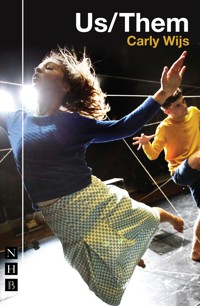
In September 2004, a group of terrorists stormed School Number One in Beslan, Russia, taking hundreds of children, their parents and teachers hostage. The ensuing siege lasted three days and left many dead. Us/Them is not a straightforward account of this terrible tragedy, but an exploration of the entirely individual way children cope with traumatic situations. Originally created for BRONKS, a theatre company for young audiences, Us/Them had a sell-out run at the Edinburgh Festival Fringe 2016, winning a Scotsman Fringe First Award, and transferred to the National Theatre, London, in 2017. It was co-produced by BRONKS and Richard Jordan Productions, with Theatre Royal Plymouth and Big in Belgium, in association with Summerhall.
Das E-Book können Sie in Legimi-Apps oder einer beliebigen App lesen, die das folgende Format unterstützen:
Veröffentlichungsjahr: 2017
Ähnliche









Carly Wijs
US/THEM
NICK HERN BOOKSLondonwww.nickhernbooks.co.uk
Contents
Title Page
Original Production
Introduction
Characters
Us/Them
About the Author
Copyright and Performing Rights Information
Us/Them was produced by BRONKS and Richard Jordan Productions with Theatre Royal Plymouth and Big in Belgium in association with Summerhall. It premiered in Dutch at BRONKS Theatre in Brussels on 27 September, 2014. The production received its UK premiere in English at Summerhall as part of the Edinburgh Festival Fringe on 3 August 2016. It subsequently transferred to the Dorfman auditorium of the National Theatre, London, on 16 January 2017. The cast was as follows:
Gytha Parmentier
Roman Van Houtven
Director
Carly Wijs
Created with
Thomas Vantuycom
Designer
Stef Stessel
Lighting Designer
Thomas Clause
Sound Design
Peter Brughmans
Dramaturg
Mieke Versyp
IntroductionCarly Wijs
BRONKS are a theatre company for young audiences based in Brussels, Belgium. When they asked me if I was interested in creating a performance for them, in 2013, the terrorist attack in a shopping mall in Nairobi, Kenya, had just occurred. I had read about it in the newspapers and watched footage of it on television, but I had not discussed it with my then eight-year-old son.
But he had seen it for himself on the news and he came to tell me. The way he talked about the attack was very specific: objective, aloof, with the ability to overlook the emotional implications. He handled the news factually, as a sequence of events, and without having to connect it to a judgement. It was as if the horror for him as an eight-year-old child had a completely different meaning because it was not possible to relate it to his own life. A child, unlike an adult, does not think: ‘That could have been me.’
I started to think about another horrifying act of unspeakable violence – the Beslan school siege of September 2004 – and how this dark episode in history could combine with the thoughts and impressions of children about such acts, to make a piece of theatre for young people. I subsequently managed to persuade Oda Van Neygen, who was at the time artistic director of BRONKS, and to this day I thank her for her courage in allowing me do it.
If you type ‘Beslan’ into Google and look at the pictures, it is riveting. You cannot let go of the horror. The fact that it involves children makes that feeling even stronger. It is an abomination in the extreme. But how can we put such indescribable acts on stage? How can we make something that is totally incomprehensible, understandable? And isn’t it taboo to make a piece of theatre about terrorism, aimed at audiences of children? Ultimately, I do not believe it is taboo – in fact, no subject should be taboo for children. It is just important that you use the right words. Discussing the topic of terrorism with children is a challenge, but it can be done. And must be done.
Why Beslan? Well, the drama took place at a school, and the first day of school is something to which every child can relate. The fact that the terrorists chose that specific day and environment to stage their atrocity reflects a profound perversion – but I did not want to talk about the perversity of it all. That’s just an ongoing debate by adults: why is this happening? A child cannot answer and does not have to answer that question. That is the privilege of being a child.
Whilst doing research, I came across a gripping BBC documentary called Children of Beslan, in which the story of the siege is told by the children who were held hostage (it’s available to watch on YouTube). These children gave the same factual account of those events as my son had given about the Nairobi attack. Aloof almost. Which, of course, does not mean that these children do not have an enormous trauma to process. Unfortunately, the horrifying implications of what happened to them will probably hit them when they grow up. But the only thing that seemed to count for the children in the documentary was that the story was told as accurately as possible.
It was because of this documentary that I decided to tell the story entirely from the perspective of the children involved: one boy and one girl. There is a difference between their perspectives, but they both try to be as precise as possible in their accounts of what happened during the three-day siege. This precision sometimes takes the form of a ‘Show and Tell’ presentation, a scientific paper or a maths lesson, like you get in school…
But sometimes the children flee from the horror, straight into the comforting arms of the imagination. In the documentary, a boy fantasised that Harry Potter would arrive wearing his invisibility cloak and kill the terrorists one by one. Others fantasised that they were part of a film and none of this was really happening to them. In the play, the children devise their own endings to the siege that are either extremely happy or extremely sad.
Almost 1,200 people, including 777 children, were held hostage during the siege. Outside the school there must have been several thousand people. And yet, in the news footage, Google searches and documentaries, you keep seeing the same group of about fifty photogenic people. In all of the footage that has survived from those fateful days, it’s always the scenes of greatest desperation and devastation that play on a loop, that come back time and time again. Even though the story – and other stories like it – need no further dramatisation, the media keep pushing that sentimental ‘drama’ button. And we keep watching.
This manipulation of our feelings, and the fact we allow it to happen, is neither innocent, or inconsequential. If – or when – we are blinded and overwhelmed by emotions, we stop being able to think and reflect and analyse. Our only response becomes ‘Oh my god, this is terrible.’ And yet it is essential that we don’t stop thinking and reflecting and analysing. Only by doing so can we get to the origins of these atrocities – and then, we hope, start to think about preventing them.
As adults, we are conditioned by our overly dramatised perspective, by the media, by ourselves, into black and white thinking: ‘Us’ versus ‘Them’. The refreshing thing about a child’s gaze is that it is not coloured by the need for ‘dramatic interpretation’, because that view of things does not connect to their own life. And if it does connect to their own life, it is tackled through imagination. That is what Us/Them is about.
Characters
GIRL BOY
An empty stage. At the back there is a wall or blackboard with coat hooks sticking out of it.
On the floor in front of the blackboard there are two pieces of chalk and a sponge. To the right of the stage, a bunch of black helium balloons, held down by a large block of wood. ABOYand aGIRLappear. They walk past the balloons and each take a piece of chalk. Then they walk to the front of the stage and begin to draw lines on the floor. Although they start at the same spot, there is soon a clear difference between their two drawings.
GIRLandBOY. These are the outbuildings. That’s where the toddlers are.
While theGIRLis drawing, she constantly mumbles measurements to herself and checks whether they match what she is drawing on the floor. She looks irritated at theBOYwho is drawing a different-sized plan. In turn, theBOYis annoyed with theGIRLbecause she is getting in his way.
This is the gymnasium. Adjoining it is the large main building. There are three floors. The main building towers over the other buildings. From here you can see the whole terrain. There are twenty classrooms spread over three floors. On the ground floor to the right is a canteen.
They have finished drawing. On the floor we see two versions of the school plan drawn over each other in chalk, overlapping in places. TheBOYand theGIRLexplain the layout of the buildings, pointing out the various locations. But as their drawings and stories are not exactly the same, they point in different directions. Sometimes they complement each other, sometimes they contradict each other, and sometimes they try to outpace the other.
On the third floor the offices of the director and the administration.
They each point out a different place for the library.
And a library with two thousand eight hundred and seventy-nine books. Mainly textbooks, but also five hundred and thirty-three children’s books with stories. Surrounding the buildings, a large play area in a U-shape. There are three entries or exits.
In front of the main building, on the left, the main entrance. On the right side a side entrance. Very practical: if you are late for school, you can sneak in and join the rows. In between the main building and the first extension is another exit.This exit is very useful: in case of a fire, people can escape in all directions.
In case of danger, you only have to barricade three doors. Next to the canteen is a small kitchen. That’s where they make the soup and the potatoes that we eat for lunch. On the other side of the kitchen is a staircase. That leads to a hidden cellar. That basement cannot be seen from the outside, but also not from the kitchen. At the front of the building is the small town. The school is the largest in the town.
BOY. According to many people also the best school.
GIRL. It’s School Number One.
The following summary of facts is completely rattled off with accompanying gestures.
BOYandGIRL.The town has approximately thirty-three thousand six hundred and forty-six people. Three swimming pools. One Museum of Folk Art. Twenty-one churches. Fifty-three mosques. Five tennis courts. Seven parks, most of which without ponds and ducks. One hundred and four baker’s. Forty-eight butcher’s. Twelve supermarkets, three of which are very large. Five thousand registered cats.Eight thousand six hundred and twenty-four chickens that lay forty-two thousand one hundred and twenty eggs per week. Four vegetarians. Two hospitals, three hundred nurses. Fifty-eight doctors. Three police stations with fifteen policemen. Nothing much happens here.
TheGIRLwalks forward and points at a spot behind the audience.
GIRL. Behind the school there’s a forest. There’s a path from the school that leads straight through the forest to the border.
GIRLandBOY. A hundred and twenty kilometres away.
GIRL. On the other side of the border is Chechnya, with its capital Grozny. There the children can only go to school until they are eight. Then they must work. Mostly in brothels for paedophiles. The fathers are addicted to drugs.The mothers all have moustaches and have to work like horses. There are no tennis courts.
BOY. No, no tennis courts.
TheBOYwalks to the back and tries to get theGIRLto go with him, but she wants to tell us more about Chechnya. He goes and draws a large rectangle in chalk on the right side of the stage. Round the bunch of balloons. Then he sees that, in her enthusiasm, theGIRLhas erased his version of the gymnasium with her foot. Angrily he walks to the spot and carefully redraws the lines that she has erased.
GIRL. When you enter Chechnya from the border, the forest changes into boring fields. But on our side it is stunning.Really marvellous. A paradise-like nature. In a well-known hiking guide for professional hikers this path has been described as:
BOY. ‘The most beautiful trail in the region, with magnificent views.’
GIRL. You’ll see the white-headed duck, the black vulture, the Caucasian salamander, but also lots of wild sheep, which are known for their long woollen fleece. As a child I used to lay on one. They are very popular all over the world.
TheGIRLshuffles over towards the spot where theBOYis at the balloons.
BOY(indicating the chalk rectangle he has just drawn). Here is a podium.




