


Erhalten Sie Zugang zu diesem und mehr als 300000 Büchern ab EUR 5,99 monatlich.
- Herausgeber: Nick Hern Books
- Kategorie: Poesie und Drama
- Serie: NHB Modern Plays
- Sprache: Englisch
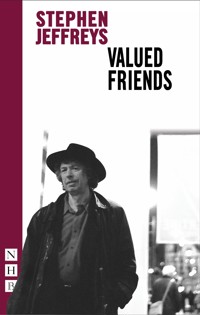
A comedy of manners about the property market. Four people live together in a large old house in London. They include Sherry, a wacky girl trying to make it as a comedienne; Paul, a pop music journalist; Paul's girlfriend Marion; and Howard, who is writing a left-wing analysis of the corruption of capitalism under the Thatcher government. They all are perfectly content living where they are; until, that is, a developer offers them a huge sum of money to vacate. Soon, their talk about music and idealism gives way to heated discussions about real estate, capital appreciation and negotiating tactics. They decide that they can force the developer to raise his offer by renovating the house; and three years of this leave them with a huge capital gain, and a deep spiritual loss. Stephen Jeffreys' play Valued Friends was first performed at Hampstead Theatre, London, in 1989. Jeffreys was named Most Promising Playwright at both the Evening Standard and Critics' Circle Awards that year.
Sie lesen das E-Book in den Legimi-Apps auf:
Seitenzahl: 120
Veröffentlichungsjahr: 2018
Das E-Book (TTS) können Sie hören im Abo „Legimi Premium” in Legimi-Apps auf:
Ähnliche












Stephen Jeffreys
VALUED FRIENDS
NICK HERN BOOKSLondonwww.nickhernbooks.co.uk
Contents
Foreword by Ian Rickson
Introduction by Annabel Arden
Epigraph
Original Production
Characters
Valued Friends
About the Author
Copyright and Performing Rights Information
Foreword
Ian Rickson
Like the beautiful billiard tables made by the family business in his 1993 play A Going Concern, Stephen’s plays always bear the kitemark of unique, handcrafted quality. They’re built from the bottom up with great love and care, yet you never feel they exhibit technique in a dry way. Stephen is too subtle a writer for that. Crucially, he begins from a place of empathy with all of his characters, and is then able to sensuously feel his way into worlds as diverse as Restoration London in The Libertine, or the more experimental zones of Interruptions.
The plays are frequently leavened by Stephen’s mischievous wit, rarely at the expense of character, frequently through their own articulacy. And throughout the tremendous achievement of this considerable body of work what most people wouldn’t know is how continually generous Stephen is with his time and support for other writers. He can give himself in the most egoless way to the process of helping another play ‘becoming itself’ because he is naturally, generously immersed in the craft of playwriting. This volume of plays is testament to that vital spirit.
This foreword is taken from the collection Stephen Jeffreys: Plays.
Introduction
Annabel Arden
Stephen Jeffreys was born on April 22 1950 and spent his childhood in Crouch End, North London. His father’s family ran a business making billiard tables, where he himself spent a short time working after university and which he immortalised in his play A Going Concern. According to family legend his great-grandfather taught the Pankhurst sisters how to play billiards. His mother’s family were originally from Ireland. The house Stephen grew up in, 45 Weston Park, had been acquired by his paternal grandfather in 1936, and three generations as well as many lodgers lived there in a very particular post-war austerity. It was a childhood full of eccentric characters, English humour and stoicism. His monologue Finsbury Park (commissioned by Paines Plough for their 2016 series of Come to Where I’m From, and performed by Stephen himself) captures the essence of this. The house remained inhabited by his sister, the writer and journalist Susan Jeffreys, and Stephen later returned to share it with her, bringing his wife Annabel and his two sons Jack and Ralph to this almost mythical extended family home. It was known to all as ‘The Chateau’.
Stephen was educated in Crouch End, at Rokesly Primary School, and then at a boys’ grammar, the Stationers’ Company’s School in Hornsey, before going to read English at Southampton University. While there he revitalised the student theatre scene and took a company to the Minack Theatre in Cornwall, directing Indians, in which he cast all the Indians as women – an idea ahead of its time and setting the trend by which he gave great parts to women in all his plays. After his short spell in the family business and work as a supply teacher, he wrote Like Dolls or Angels, taking it to 1977 National Student Drama Festival, where it won the Sunday Times Playwriting Award. Later he would join the board of the NSDF, which he served on for many years.
A part-time job teaching theatre in an art college in Carlisle gave him time and solitude to write, as well as the experience of putting on enormous community plays combining street theatre with carefully staged disruption and spectacle, such as The Garden of Eden (1986) about nationalised beer performed by the people of Carlisle. While living in Carlisle he also spent time at the Brewery Arts Centre in Kendal, where he met Gerry Mulgrew, Alison Peebles and Robert Pickavance, who would go on to found Communicado. Together with Stephen they formed Pocket Theatre Cumbria, which toured the north.
Round this time, Stephen decided to devote his talents to writing plays. His first big success came in 1989 when Valued Friends (with Martin Clunes, Peter Capaldi and Jane Horrocks in the cast at Hampstead Theatre) won the Evening Standard and Critics’ Circle Awards for Most Promising Playwright. There followed The Clink (1990) for Paines Plough, for whom he was Arts Council Writer-in-Residence from 1987–89; A Going Concern (Hampstead, 1993); and The Libertine, a considerable success at the Royal Court Theatre in 1994, where he began an eleven-year stint as Literary Associate, which brought him into contact with a whole generation of emerging writers. He also began giving writing workshops at the Court, which were attended by then little-known playwrights such as Simon Stephens, Roy Williams and April De Angelis.
The American premiere of The Libertine, directed by Terry Johnson at Steppenwolf Theatre, Chicago, in 1996 with John Malkovich as Rochester, led to an ongoing association both with Malkovich and with Steppenwolf, where Lost Land, about Hungary at the end of World War One, was premiered in 2005, again with Malkovich in the lead. When The Libertine was made into a movie (released in 2005) starring Johnny Depp, it was Malkovich’s company that produced it.
Meanwhile, Stephen wrote I Just Stopped By to See the Man (directed by Richard Wilson at the Royal Court in 2000), a tribute to the old-time blues singers of the Mississippi Delta, which was also staged by Steppenwolf and many other American theatres; Interruptions (written while resident at the University of California, Davis, and staged there in 2001), which sprang from his fascination with the Japanese aesthetic principle of Jo-ha-kyu and his desire to create a particular narrative form to express our struggles with democracy and leadership. The Art of War (Sydney Theatre Company, 2007) was inspired both by the ancient Chinese military treatise by Sun Tzu and by Stephen’s own response to the Gulf War. In 2009 he contributed the first play (Bugles at the Gates of Jalalabad) in the series The Great Game: Afghanistan at the Tricycle Theatre, London. This landmark series toured to the US and was performed to senior military personnel at the Pentagon.
Throughout his career, Stephen has kept up a steady stream of adaptations. One of the earliest, in 1982, was of Dickens’s Hard Times for Pocket Theatre Cumbria. Two years later came Carmen 1936 for Communicado, which won a Fringe First and played in London at the Tricycle Theatre. He adapted Richard Brome’s seventeenth-century comedy, A Jovial Crew (RSC, 1992), and, in 2000, The Convict’s Opera (premiered in Australia at Sydney Theatre Company and in the UK by Out of Joint), based on The Beggar’s Opera but set on a convict ship heading for Australia. In 2011 his stage adaptation of Backbeat, Iain Softley’s film about The Beatles, opened in the West End, while his characteristically witty and erudite translation in 2013 of the libretto of The Magic Flute in Simon McBurney’s radical production has been performed all over Europe. And for the RSC he helped adapt their 2016 production of The Alchemist.
As well as the one for The Libertine, Stephen’s other screenplays include Ten Point Bold, a love story set against the tumultuous political background of the Regency period, written in 2003 but so far unfilmed, and the biopic Diana, released in 2013, directed by Oliver Hirschbiegel and starring Naomi Watts as the Princess of Wales.
Ever since his experience as a selector for the annual NSDF, which involved him in mentoring and launching many careers, Stephen has been steeped in the practicalities of theatre and has relished collaborative creative relationships with young companies and young playwrights. He is also the ‘go to’ person for short celebratory plays for leaving dos, birthdays, weddings, etc., all of which have made him a hugely popular and enormously well-liked figure in the theatre community. In 2018 he was diagnosed as suffering from an inoperable and aggressive brain tumour. His book encompassing his teaching, entitled Playwriting: Structure, Character, How and What to Write, is to be published soon after this volume of plays.
Annabel Arden is a theatre and opera director, co-founder of Complicité, and married to Stephen Jeffreys.
This introduction is taken from the collection Stephen Jeffreys: Plays.
‘An acre in Middlesex is better than a principality in Utopia.’
Thomas Babington Macaulay
Valued Friends was first staged at Hampstead Theatre, London, on 9 February 1989, with the following cast:
SHERRYJane HorrocksHOWARDPeter CapaldiPAULTim McInnernyMARIONSerena GordonSCOTTMartin ClunesSTEWARTPeter CaffreyDirector
Robin Lefevre
DesignerSue PlummerLighting DesignerGerry JenkinsonCharacters
SHERRY, late twenties
HOWARD, early thirties
PAUL, early thirties
MARION, early thirties
SCOTT, thirty
STEWART, early forties
Setting
The action of the play takes place in the basement flat of a large Late-Victorian house in Earl’s Court. A sitting room. One door leads off to a bedroom, another to the rest of the flat, and a pair of French windows looks on to a small concrete garden. At the shill of the play, the flat is cosy and cluttered.
ACT ONE
Scene One
Early June 1984. We hear The Searchers’ ‘Needles and Pins’. Lights up.
The sitting room of the flat, just before midnight. HOWARD has commandeered the table, sitting at his typewriter surrounded by papers, books and card-index systems.
SHERRY is standing next to him. She wears a short dress, an absurd floppy hat and a huge shoulder bag. She has just come in and speaks with great excitement and volume.
SHERRY. The train is packed, Howard, I mean I’ve trodden on faces to get a seat. We’re somewhere between Knightsbridge and South Kensington, there’s this just incredible smell of sweat, you know, not stale sweat, excited summer sweat. Suddenly there’s this guy, lurching towards me through the pack and he is crazy, there are no questions about this, the man is gone and he has singled out me, no one else will do. He shoves aside the last remaining body and looms over me, hanging from the strap, swaying like a side of beef, I mean he’s enormous and he starts stabbing his finger at me: ‘How much do you care? How much do you care?’ That’s all he’s saying, over and over. ‘How much do you care?’ Everyone’s looking at me. He’s crazy but they’re staring at me. They want to know how much I care too. About what, nobody’s saying, so I take a chance, put my hand on my heart and say: ‘Very deeply, very deeply indeed,’ thinking this might get the crowd on my side, but no, nobody applauds, nobody cries, nobody even laughs. They’re just waiting for the crazy to come back at me, and, Howard, he does. ‘What about? What do you care so much about?’ And they all stare at me again. I can feel the mood of the train switching against me. We get to South Ken but nobody gets off. They all live there, I know they do, but they’re saying to themselves: ‘We’ll walk back from Gloucester Road.’
The doors shut, the train starts. ‘What about? What do you care about?’ Howard, I can’t think of anything. In a calmer moment I might have said: ‘The early films of Ingmar Bergman, my mum and being the greatest stand-up comedian the world has ever seen.’ But I can think of nothing. The silence is just incredible. I mean I’m not ignoring the guy, I’m racking my brains. The whole carriage is racking my brains. Eventually I look the guy in the face, admission of defeat, and he just says: ‘You see, you see.’ And the doors open and he gets off at Gloucester Road. All those people who really live in South Ken are now saying to themselves: ‘What a glorious evening – we’ll walk back from Earl’s Court.’ Howard, they’re prepared to stay on till Hounslow Central, gawping at my embarrassment. We get to Earl’s Court, I’m so paranoid I can’t face them all in the lift, I have to climb the emergency stairs to escape. Have you any idea how many emergency stairs there are at Earl’s Court?
HOWARD. Eighty-four.
SHERRY. Are there really?
HOWARD. I counted them.
SHERRY. What a nightmare. Are you going to make some tea?
HOWARD. No.
SHERRY. I put the kettle on when I came in.
HOWARD. I don’t want any tea.
SHERRY. Oh. Did you go out collecting tonight?
HOWARD. They phoned me up. I told them I was ill.
SHERRY. Howard!
HOWARD. I’ve been out twice. What’s the point? Collecting for the miners in the Royal Borough of Kensington and Chelsea? I was stood two hours outside the Tube on Monday with me plastic bucket, copped one pound forty and I put the quid in meself. If I’d been up in Glasgow I’d not have been able to hold the thing up after five minutes.
SHERRY. So you’re writing the book instead?
HOWARD. That’s it.
SHERRY. Going well?
HOWARD. No.
SHERRY. Oh.
Pause.
Are the others in?
HOWARD. I’m sorry.
SHERRY. No, I didn’t mean you were being –
HOWARD. I’m just tired, I’d like to go to bed.
SHERRY. – boring or anything. Well go to bed.
HOWARD. I can’t, I need to speak to Paul and Marion.
SHERRY. Where’ve they gone?
HOWARD. Concert. The Searchers.
SHERRY. Oh yeah. More sixties nostalgia. Is it healthy I ask? I mean, you can’t imagine these destruction metal bands getting together for twenty-first-anniversary gigs.
HOWARD. Destruction metal?
SHERRY. Very big in Germany. These guys, they hire a warehouse and smash the stage up with drills and amplified sledgehammers. It’s pretty loud. Paul did a piece about it in the NME.
HOWARD. You mean, they use, like, manufacturing tools for – SHERRY. Yeah, cement mixers and stuff –
HOWARD. – signalling the decline of manufacturing culture, that’s…
He makes a note.
SHERRY. Apparently it gets pretty dangerous. I mean you’re standing there listening and the walls fall in on you, it’s meant to be great.
HOWARD. Well it would be.
SHERRY. You gonna put that in your book?
HOWARD. Might make a nice little footnote. The section on deindustrialisation.
SHERRY. Howard. You couldn’t lend me some money could you?
Pause.
HOWARD. How much d’you want?
SHERRY. Just… a tenner. Is that all right? Brian at The Queen’s Head owes me for my last three gigs – and he wasn’t around tonight, bastard, and there’s a few
HOWARD. I’ll lend you ten quid, Sherry.




