


0,99 €
Niedrigster Preis in 30 Tagen: 1,99 €
Niedrigster Preis in 30 Tagen: 1,99 €
Mehr erfahren.
- Herausgeber: Booksell-Verlag
- Kategorie: Gesellschafts- und Liebesromane
- Sprache: Englisch
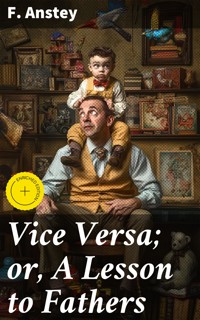
F. Anstey's "Vice Versa; or, A Lesson to Fathers" is a satirical exploration of parental expectations and the often comical consequences of miscommunication between generations. This 1882 novel is written in a whimsical literary style, employing wit and irony to delve into the complexities of familial relationships. Through the whimsical device of a body-swap narrative, Anstey reveals the absurdities of adulthood from a child's perspective, providing both entertainment and astute social commentary relevant to Victorian society's rigid norms surrounding family and propriety. F. Anstey, the pen name of Thomas Anstey Guthrie, was an English novelist and humorist, known for his keen observations on the quirks of human behavior. Drawing from his own experiences in a Victorian family setting and his background in law and journalism, Anstey possessed a unique vantage point from which to critique society's expectations, particularly concerning fatherhood. His insight into children's thoughts and desires made him an engaging storyteller, capable of blending humor with poignant lessons. This delightful and thought-provoking novel is a must-read for those interested in the interplay of humor and philosophy in literature. Readers will find themselves both laughing aloud and reflecting deeply on the nature of identity and the father-son dynamic. "Vice Versa" serves as a timeless reminder that understanding and empathy are crucial in bridging generational divides. In this enriched edition, we have carefully created added value for your reading experience: - A succinct Introduction situates the work's timeless appeal and themes. - The Synopsis outlines the central plot, highlighting key developments without spoiling critical twists. - A detailed Historical Context immerses you in the era's events and influences that shaped the writing. - A thorough Analysis dissects symbols, motifs, and character arcs to unearth underlying meanings. - Reflection questions prompt you to engage personally with the work's messages, connecting them to modern life. - Hand‐picked Memorable Quotes shine a spotlight on moments of literary brilliance. - Interactive footnotes clarify unusual references, historical allusions, and archaic phrases for an effortless, more informed read.
Das E-Book können Sie in Legimi-Apps oder einer beliebigen App lesen, die das folgende Format unterstützen:
Veröffentlichungsjahr: 2021
Ähnliche













Vice Versa; or, A Lesson to Fathers
Table of Contents
Introduction
A magical exchange of places between parent and child exposes the limits of authority and the hard education of sympathy. In Vice Versa; or, A Lesson to Fathers, the familiar frictions between generations become the engine of a bright, bustling comedy in which perspective is the true protagonist. The novel treats parental certainty with a light, teasing touch, inviting readers to watch assumptions unravel under pressure. Without preaching, it aligns everyday domestic anxieties with a playful twist of fantasy, letting embarrassment do the moral work that lectures cannot. What emerges is less a scolding than an invitation to reconsider what understanding costs.
First published in 1882, F. Anstey’s comic novel belongs to the late-Victorian moment when social manners, school discipline, and middle-class ambition were ripe for satire. It blends domestic comedy with a gently fantastical premise, situating its action in London and the world of the English boys’ school. The book’s humor is unmistakably Victorian—urbane, quick, and fond of puncturing pomposity—yet it aims for accessibility rather than insider wit. Readers encounter a brisk narrative that treats a single implausible event with matter-of-fact realism, using that device to illuminate ordinary life. The result is a hybrid of farce, social observation, and moral reflection.
The premise is disarmingly simple: a prosperous father, Paul Bultitude, and his schoolboy son, Dick, swap bodies after an ill-considered wish, each forced to inhabit the other’s daily trials. The father learns firsthand the rigors of classrooms, rules, and peer hierarchies that he had dismissed as trifling; the boy discovers the constraints, expectations, and performances demanded by adult respectability. Anstey structures the comedy around this misalignment of identity and circumstance, using mistaken attitudes rather than elaborate plotting to drive the story. The initial setup catalyzes a series of social tests that push both characters to measure what they value, endure, and understand.
Anstey’s voice is genial, ironic, and alert to the absurdities of decorum. Scenes unfold with the pace of stage comedy—tight entrances and exits, escalating embarrassments, crisp reversals—yet the narration remains hospitable and clear. The humor comes less from ridicule than from precision: details of routine, polite phrases under stress, and the stubborn persistence of habit when roles change. Dialogue carries much of the energy, but the prose also revels in small observational jokes, sharpening the novel’s satirical edge without sourness. The fantastical mechanism is kept deliberately minimal, allowing tone and situation to do the lifting while preserving a sense of everyday plausibility.
At its core, the book concerns authority, education, and the fragile construction of adulthood. It probes the distance between how parents imagine school life and how it feels to endure, as well as the reverse—how a child imagines the ease of adult freedom without seeing its layered obligations. The body-swap sharpens questions of responsibility, obedience, and fairness: What is discipline for, and who benefits from it? Where do courage and conformity meet? Anstey also toys with identity’s theatricality, suggesting that social roles are costumes we rehearse until they fit, and that empathy begins when those costumes stop obeying their wearers.
Contemporary readers will find the novel engaging for the same reason it entertained its first audience: it converts generational argument into an experiment in perspective. Its comedy does not depend on obscure allusion but on recognitions—of family dynamics, school pressures, and the face-saving instincts that cross eras. The book also prompts reflection on how we measure success, how institutions justify severity, and how easy it is to mistake comfort for virtue. Without sermonizing, it proposes that understanding requires discomfort and that the imagination can be a moral instrument. In this way, the story’s lightness proves to be part of its seriousness.
Approached today, Vice Versa; or, A Lesson to Fathers offers a compact, lively reading experience: fast-moving episodes, clear stakes, and a consistent blend of amusement and insight. It rewards readers who appreciate social comedy with a speculative twist and those curious about Victorian attitudes as seen from within. The narrative does not merely depict a quarrel between generations; it constructs a playful laboratory for testing convictions. By the end, the book has made its argument not by stating it but by letting embarrassment, effort, and changed vantage points do their work. The lesson is never heavy-handed, yet it lingers where it matters—on judgment, care, and humility.
Synopsis
Vice Versa; or, A Lesson to Fathers, a Victorian comic novel by F. Anstey, begins in London with prosperous merchant Paul Bultitude laying down firm parental rules as the school holidays end. His son, Dick, dreads returning to term and resists his father’s confident claims that schooldays are the happiest time of life. Their exchanges establish a brisk contrast between adult certainty and youthful complaint, hinting at a wider misunderstanding between generations. Anstey sets the domestic scene, sketches office routines and household expectations, and positions Paul as a model of conventional authority certain of his judgments, while Dick appears as the ordinary schoolboy bracing for discipline and drudgery.
A small, exotic stone from the East enters the household with a reputation for granting the heart’s desire. In a moment of impatience, and half in jest, Paul expresses a wish to be young again and to take his son’s place, convinced that he would flourish under school rules. The wish takes literal effect, and father and son exchange bodies without warning. Confusion follows as each confronts a mirror and a changed world. Anstey maintains a light, practical tone, describing the immediate necessities both must address while the marvel remains unexplained beyond the talisman’s reputed power and the strength of a careless wish.
Shunted into his son’s routine, Paul is bundled back to a strict boarding school governed by unquestioned hierarchy. Masters, monitors, and rules accept his outward identity without debate, and any claim to adult status is punished as impertinence. He meets set lessons, cold dormitories, compulsory games, and a headlong schedule that erases privacy. The academic demands, especially classics and composition, expose his rusty knowledge. Anstey depicts punishments and misunderstandings as the father tries to assert the habits of an employer among boys who recognize only peer standing. The comic momentum grows from the mismatch between his self-importance and the school’s impersonal machinery.
Paul’s attempts to explain himself fail, and his letters and stratagems are treated as excuses. He experiments with truancy and argument, yet the school’s routines absorb resistance. Along the way he observes friendships, small acts of kindness, and quiet endurance among pupils, glimpsing the pressures his son had not fully voiced. Practical skills that served him in commerce prove useless in the classroom, while the fear of public embarrassment grows. The talisman’s conditions, only partially understood, complicate any direct remedy. The narrative charts his mounting discomfort through classes, games, and holidays deferred, keeping focus on immediate predicaments rather than supernatural exposition.
Meanwhile, Dick must inhabit his father’s office and social circle. Clerks, clients, and acquaintances assume the authority of Paul’s familiar presence, and the boy must improvise through meetings, signatures, and polite conversation. A routine business matter becomes risky when confronted with unfamiliar terms, schedules, and credit. Social obligations—dinners, calls, and expectations of gravitas—press in on his lack of experience. The early thrill of liberty gives way to unease as each offhand decision threatens reputation and livelihood. Anstey plays out misunderstandings with a brisk pace, letting practical details and small errors accumulate into larger complications that demand maturity he has not yet developed.
Twin lines of tension rise. At school, a major examination, a disciplinary scrape, and a public athletic event expose Paul’s limits, forcing him to choose between expedient deceit and difficult perseverance. In town, Dick faces a contractual commitment and a looming deadline that could unsettle his father’s affairs. Pride keeps both from easy confession, while chance meetings and partial messages sow further confusion. The stone’s promise hangs over them as possibility rather than guaranteed escape. Anstey crosscuts the settings, balancing boisterous schoolroom comedy with the quieter strain of office responsibilities, and nudging both characters toward active choices instead of wishful protests.
Experience begins to teach what argument could not. Paul notices how rules both discipline and burden boys, and he recognizes the courage required simply to keep pace. He sees where his expectations were unrealistic and where small encouragement might change outcomes. Dick, wrestling with ledgers and civility, senses how authority entails duty, foresight, and restraint. Each gains partial insight into the other’s daily strain. Signals and clues gradually point toward what the talisman might require for any change, but certainty remains elusive. The narrative emphasizes steady learning from consequences rather than a lecture, keeping the moral visible through action and choice.
Pressure converges on a day when mistakes threaten to harden into lasting damage. Paul must face a test that invites either open defiance or humble endurance, while Dick confronts a decision that could safeguard or imperil the business. Their separate efforts align as both act with the other’s welfare in mind, setting aside self-justification. Information, objects, and timing have to meet precisely, yet obstacles multiply—watchful authorities at school, social engagements in town, and the practical challenge of reaching the necessary place at the right moment. The pacing quickens, holding the resolution just out of reach while strengthening the book’s central contrast.
The aftermath resets priorities without dwelling on mechanics. Roles, however arranged, are now tempered by a deeper regard for what each stage of life asks and grants. Paul’s authority learns flexibility, and Dick’s youthful confidence acquires caution and respect. Domestic scenes return with a new tone of attentiveness, and the bustling world of office and classroom seems less absolute. Anstey closes on the comic note with which he began, yet the lesson to fathers—and to sons—has passed from maxim to experience. The novel’s enduring appeal lies in its playful means to a practical end: understanding reached through walking in another’s shoes.
Historical Context
Vice Versa; or, A Lesson to Fathers is set in late-Victorian England, principally in London and in a boys’ boarding school within commuting distance of the capital. The time frame aligns with the early 1880s, when urban middle-class households combined domestic comfort with symbols of empire, and fathers worked in the City’s professional and mercantile offices. Railways and horse trams enabled smooth movement between suburbs and central business districts, while schools cultivated discipline through rigid timetables, chapel, and games. The novel’s school, presided over by a disciplinarian headmaster (Dr. Grimstone), mirrors the ethos of the period’s public and proprietary schools and their intensely hierarchical routines.
The book’s central arena—an elite boys’ school—sits squarely within reforms and controversies that reshaped English secondary education between the 1860s and 1880s. The Clarendon Commission (1861–1864) investigated nine leading public schools and recommended governance and curricular changes; Parliament responded with the Public Schools Act 1868, restructuring Eton, Winchester, Westminster, Harrow, Rugby, Charterhouse, and Shrewsbury. Simultaneously, the Schools Inquiry Commission (the Taunton Commission, 1864–1868) surveyed hundreds of endowed grammar schools, prompting the Endowed Schools Act 1869 and subsequent schemes that redirected funds, modernized management, and widened access for the middle class. Despite reform, most schools retained a classics-heavy curriculum, stringent discipline (caning and birching), prefect and house systems, and quasi-military routines that promoted obedience and resilience. Thomas Arnold’s earlier leadership at Rugby (1828–1842) had established the headmaster as moral guardian, a model that endured into the 1880s alongside ideals of Christian manliness and team sports. By the 1870s–1880s, pressure mounted to introduce modern subjects—science, modern languages, and practical mathematics—yet classical entrance requirements for universities slowed change. The novel’s depiction of a father forced to endure a pupil’s lot under a hard-driving headmaster aligns with the period’s lived experience of bullying, fagging, and ritualized punishments overseen by masters who prized conformity as character-building. Its detailed attention to timetables, dormitories, and sanctioned student hierarchies reflects the post-Clarendon settlement: an educational world simultaneously reformed in governance yet conservative in daily practice, which sustained Britain’s ruling-class culture while exposing boys to physical and psychological ordeals.
The narrative’s Indian talisman points directly to Britain’s imperial order after the Indian Rebellion of 1857 and the Government of India Act 1858, which transferred power from the East India Company to the Crown. The British Raj (1858–1947) intensified flows of people and goods: officials, soldiers, and merchants returned with textiles, carvings, and so-called Oriental curios. Displays like the Great Exhibition (Crystal Palace, 1851) and the Colonial and Indian Exhibition (South Kensington, 1886) popularized imperial consumption and spectacle. By locating the catalyst of transformation in an Indian object, the book mirrors Victorian fascination—and anxiety—about empire, exotic commodities, and the moral consequences of Britain’s reach into the subcontinent.
The father’s world reflects the City of London’s commercial capitalism in an era of volatile credit and global trade. After the Companies Act 1862 normalized limited liability, incorporations multiplied, expanding opportunities for middle-class businessmen whose reputations underpinned access to capital. The Long Depression (approximately 1873–1896) brought price deflation and trade competition from the United States and Germany; failures such as the City of Glasgow Bank collapse in 1878 rattled confidence across Britain. Respectability, punctuality, and probity became economic assets. The protagonist’s obsession with status and control evokes this climate, where a misstep could damage creditworthiness, and domestic order was expected to mirror the disciplined routines of the counting-house.
Victorian debates about corporal punishment and schoolroom cruelty form a stark backdrop. The notorious Eastbourne case of 1860, in which tutor Thomas Edwin Hopley was convicted of manslaughter after fatally beating his pupil Reginald Cancellor, ignited national outcry and press scrutiny of educational violence. Although practices varied, caning and birching remained lawful and common in the 1880s, defended as essential for character formation. The London Society for the Prevention of Cruelty to Children (founded 1884) signaled growing concern about child welfare. The novel’s scenes of fear, public chastisement, and the headmaster’s authoritarian posture echo these controversies, exposing how institutional discipline shaded into intimidation and sometimes abuse.
Compulsory schooling for the masses reframed national conversations about childhood, duty, and discipline. The Elementary Education Act 1870 (Forster Act) created elected school boards to provide elementary schools; the 1876 (Sandon) Act tightened attendance via by-laws, and the 1880 (Mundella) Act made attendance compulsory, generally to age ten. These measures professionalized teaching and normalized the idea that the state had a stake in children’s formation. Though the novel depicts a fee-paying boarding school rather than a board school, it reflects the same preoccupation: punctuality, attendance, standardized routines, and moral oversight. Its satire dramatizes the widening gap between parental ideals of education and the lived, often coercive, discipline of institutional life.
A late-Victorian fascination with spiritualism and psychical phenomena frames the book’s transformative device. The Theosophical Society (founded 1875; a London lodge active by 1878) and the Society for Psychical Research (established in London, 1882) cultivated elite interest in hypnotism, apparitions, and telepathy. Public séances and stage exhibitions blurred science, faith, and entertainment. Within this milieu, an enchanted stone from India was not merely fantasy but a resonant symbol linking empire, occult knowledge, and the porous boundary between rationalism and wonder. The novel leverages this social craze to invert identities, using a fashionable paranormal premise to probe everyday power relations between parents and children.
As social and political critique, the book exposes the coercive underside of Victorian respectability. It interrogates paternal authority forged in the City’s competitive economy and replicated in school hierarchies backed by law and custom. By forcing a successful merchant to endure prefects, punishments, and arbitrary rules, it indicts institutions that prize obedience over empathy and classical display over practical understanding. The Indian talisman destabilizes imperial complacency, suggesting that moral lessons may return from the periphery to correct the metropole. The work thus challenges class-bound assumptions about merit, questions the justice of corporal discipline, and hints at the need for reciprocal accountability within family, school, and nation.




