


9,59 €
Mehr erfahren.
- Herausgeber: Saqi Books
- Kategorie: Poesie und Drama
- Sprache: Englisch
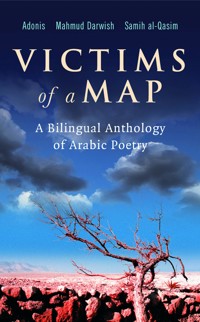
Mahmud Darwish, Samih al-Qasim and Adonis are amongst the leading poets in the Arab world today. Victims of a Map presents some of their finest work in translation, alongside the original Arabic, including thirteen poems by Darwish never before published - in English or Arabic - and a long work by Adonis written during the 1982 siege of Beirut, also published here for the first time.
Das E-Book können Sie in Legimi-Apps oder einer beliebigen App lesen, die das folgende Format unterstützen:
Veröffentlichungsjahr: 2005
Ähnliche








Adonis (the pen-name of Ali Ahmad Said) was born in Syria in 1930. He was exiled to Beirut in 1956 and later became a Lebanese citizen. The founder of the influential journal Mawaqif, a critic as well as a poet, he has exercised enormous influence on Arabic literature. He is the author of Sufism and Surrealism, also published by Saqi.
Mahmud Darwish was born in 1942 in al-Barweh, a village in Palestine. His first collection of poetry was published in 1960, and since then he has become perhaps the best-known Palestinian poet in the world.
Samih al-Qasim is a Palestinian born to a Druze family of Galilee in 1939. He grew up in Nazareth and has long been politically active in Israel, suffering imprisonment many times. A prolific writer, he had published six collections of poetry by the time he was thirty.
Adonis Mahmud Darwish Samih al-Qasim
VICTIMS OF A MAP
A Bilingual Anthology of Arabic Poetry
Translated from the Arabic byAbdullah al-Udhari
SAQI
British Library Cataloguing-in-Publication Data
A catalogue record for this book is available from the British Library
ISBN 978 0 86356 310 2
EAN 9-780863-565243
First published in 1984 by Saqi Books
copyright © Abdullah al-Udhari, 1984 & 2005
All rights reserved. No part of this book may be reproduced or transmitted in any form or by any means, electronic or mechanical, including photocopying, recording or by any information storage and retrieval system, without permission in writing from the publisher.
This book is sold subject to the condition that it shall not, by way of trade or otherwise, be lent, re-sold, hired out, or otherwise circulated without the publisher’s prior consent in any form of binding or cover other than that in which it is published and without a similar condition including this condition being imposed on the subsequent purchaser.
This edition published 2005
SAQI
26 Westbourne Grove
London W2 5RH
www.saqibooks.com
Contents
Introduction
Mahmud Darwish
Biographical Note
The Earth Is Closing on Us
When the Martyrs Go to Sleep
We Fear for a Dream
We Are Entitled to Love Autumn
Give Birth to Me Again That I May Know
If I Were to Start All Over Again
Is It in Such a Song?
A Gypsy Melody
We Travel Like Other People
We Go to a Country
We Are Here Near There
Athens Airport
They’d Love to See Me Dead
The Wandering Guitar Player
A Gentle Rain in a Distant Autumn
Samih al-Qasim
Biographical Note
Slit Lips
Sons of War
Confession at Midday
Travel Tickets
Bats
Abandoning
The Story of a City
Conversation Between an Ear of Corn and a Jerusalem Rose Thorn
How I Became an Article
The Story of the Unknown Man
End of a Discussion With a Jailer
Eternity
The Will of a Man Dying in Exile
The Boring Orbit
The Clock on the Wall
Adonis
Biographical Note
A Mirror for the Executioner
A Mirror for the Twentieth Century
A Mirror for Beirut
Worries (A Dream)
The Golden Age
Song
Prophecy
Psalm
The Wound
A Woman and a Man (Conversation, 1967)
The New Noah
The Seven Days
The Pearl (Dream – Mirror)
The Minaret
The Desert (The Diary of Beirut Under Siege, 1982)
Introduction
Ever since pre-Islamic days, poetry has been the mass art form of the Arab language. Through the centuries of classical Arab civilization in the Middle Ages, the long years of Arab decline, and into the decades of confrontation with European culture in the twentieth century, the poets have never lost their place of esteem in the minds of the people of the Arab world. In modern times, poets have had a greater impact on popular culture than novelists: there are more published poets than authors of literary prose in the Arab countries today, and public readings by poets consistently attract mass audiences, in settings ranging from rural villages to sprawling and sophisticated capital cities.
There can be little doubt that in this vast reservoir of talent, Mahmud Darwish, Samih al-Qasim, and Adonis are among the leading figures. Certainly their names would appear on nearly anyone’s list of the best-known, most prolific, and most innovatory contemporary Arab poets. This book presents a selection of fifteen poems by each of them, with the original Arabic printed on the left-hand pages, the English translations on the right. All of them are newly translated for this volume. The first thirteen of Darwish’s poems, written in November 1983 as the fighters of the Palestine Liberation Organization were preparing to leave Lebanon, are published here in Arabic for the first time in book form. The final poem of the collection, ‘The Desert’, by Adonis, appears here in Arabic for the first time ever. The poems of each contributor are introduced by brief biographical notes. From the information contained in these—and from the poems themselves, which speak more eloquently than any factual account of the lives of their authors—it will be clear how much these works express the fate not only of Arabs or Palestinians, but also of humanity itself trapped in a contemporary tragedy.
Modern Arab poetry has evolved against the background of the turmoil of the Arab world. The years since the end of the Second World War alone have seen five Arab-Israeli wars, major civil wars in Yemen and Lebanon, the repeated victimization of the Palestinian people, and a host of military coups in more than half a dozen countries. Through it all—in particular through the bitter disappointment with political leaders of various hues—the Arab people have looked to poets to express their aspirations. This is exemplified in the resistance poetry of the Palestinians Darwish and al-Qasim, whose poetic accomplishments have raised a local tragedy to the level of a universal one.
The evolution of poetry itself has also been marked by profound changes since the Second World War. The publication of two experimental poems by two Iraqi poets in 1947 marked the real inception of modern Arab poetry. In 1957 the Lebanese poet Yusuf al-Khal and Adonis launched their epoch-making poetry magazine Shi‘r, whose contributions eventually led to the breakdown of classical Arab poetic conventions and redrew the map of Arab poetry. The role of Adonis in this literary upheaval has been central.
This collection is meant to provide English-speaking readers with a sense of the frontiers of Arab poetry today—and hopefully with some appreciation of the poetry in its own right as well.
I should like to express my indebtedness to George Wightman for his suggestions and encouragement.
Abdullah al-Udhari
The Poems
Mahmud Darwish
Biographical Note
Mahmud Darwish was born in 1942 in the village of al-Barweh in Palestine. One night in 1948, the Israeli armed forces assaulted the village. The Darwish family fled through a forest, bullets winging overhead, and reached Lebanon, where they remained for more than a year, living on the meagre handouts of the United Nations. Finally, Darwish was led by his uncle back across the border to the village of Deir al-Asad, in Galilee. They could not return to al-Barweh, for it had been obliterated by Israeli soldiers. ‘All that had happened’, Darwish told the Israeli Communist newspaper Zo Hederekh in an interview in 1969, ‘was that the refugee had exchanged his old address for a new one. I had been a refugee in Lebanon, and now I was a refugee in my own country.’
The phrase was not simply metaphorical. Any Palestinian not accounted for in the first Israeli census was regarded by the new Israeli state as an ‘infiltrator’ and was therefore not entitled to an identity card. Darwish had been in Lebanon during the census and thus lived illegally in his own land. He recalled in the Zo Hederekh interview that both the Arab headmaster of his primary school and his parents used to hide him whenever police or other officials made an appearance. In the end, the family told the government that young Darwish had been with one of the Bedouin tribes of the North during the census. He was thus able to acquire an identity card.
Darwish became interested in poetry very early. He read much classical Arab literature when still at school, and in his first poetic attempts, he imitated pre-Islamic poetry. He was soon to find, however, that poetry could land him in serious trouble. He was asked by his headmaster to take part in a celebration, in Deir al-Asad, of the anniversary of the founding of the state of Israel. ‘There’, Darwish says, ‘I stood before the microphone for the first time in my life and read a poem which was an outcry from an Arab boy to a Jewish boy. I don’t remember the poem, but I remember the idea of it: you can play in the sun as you please, and have your toys, but I can’t. You have a house, and I have none. You have celebrations, but I have none. Why can’t we play together?’
The next day, Darwish was summoned by the military governor, who insulted and threatened him. Darwish left the office shaken: ‘I wept bitterly because he concluded by saying, “If you go on writing such poetry, I’ll stop your father working in the quarry.” I couldn’t understand why a poem could disturb the military governor. He was the first Jew I met and talked to. His behaviour upset me. If that was how the Jews were, why should I speak to a Jewish boy? The military governor became a symbol of evil who harmed relations between the two peoples.
‘A few months later I was transferred to another school, where I was fortunate enough to meet a Jewish woman teacher. She was completely different from the military governor. She wasn’t just a teacher, she was like a mother. It was she who saved me from the fire of distrust. She was a symbol of the good work a Jew does for his people. She taught me to understand the Old Testament as a literary work. She also taught me to appreciate the poetry of Bialik for its poetic verve rather than for its political message. She never tried to force on us the official syllabus, which was devised to distort and discredit our cultural heritage. She demolished the walls of distrust erected by the military governor.’
Until 1971, Darwish worked as a journalist in Haifa. In that year, he left Israel for Beirut, where he remained until 1982. He now lives in Paris and edits the magazine Karmal. He has published ten collections of poetry, and was awarded the Lotus Prize in 1969 and the Lenin Peace Prize in 1983. He is probably the best-known Palestinian poet in the world.
The Earth Is Closing on Us
The earth is closing on us, pushing us through the last passage, and we tear off our limbs to pass through.
The earth is squeezing us. I wish we were its wheat so we could die and live again. I wish the earth was our mother
So she’d be kind to us. I wish we were pictures on the rocks for our dreams to carry
As mirrors. We saw the faces of those to be killed by the last of us in the last defence of the soul.
We cried over their children’s feast. We saw the faces of those who’ll throw our children
Out of the windows of this last space. Our star will hang up mirrors.
Where should we go after the last frontiers? Where should the birds fly after the last sky?
Where should the plants sleep after the last breath of air? We will write our names with scarlet steam.
We will cut off the hand of the song to be finished by our flesh.
We will die here, here in the last passage. Here and here our blood will plant its olive tree.
When the Martyrs Go to Sleep
When the martyrs go to sleep I wake up to guard them against professional mourners.
I say to them: I hope you wake in a country with clouds and trees, mirage and water.
I congratulate them on their safety from the incredible event, from the surplus-value of the slaughter.




