


3,99 €
Mehr erfahren.
- Herausgeber: Imaginarium Kim
- Kategorie: Gesellschafts- und Liebesromane
- Sprache: Englisch
In a labyrinthine penal colony where perfect posture means survival, a single seed challenges the absurd machinery of oppression.
Welcome to Convict Country—a Kafkaesque realm of bureaucratic torture where prisoners die at the first bend of their backs, their lives broadcast as entertainment for the outside world’s cramped masses.
When a defiant newcomer discovers a watermelon seed at the threshold, an illogical, surreal rebellion begins. In this grotesquely ordered society where humans are reduced to pill-consuming spectators, the seed becomes both metaphor and mission.
As convicts navigate the bizarre, paradoxical rules of their punishment, their desperate cultivation effort transforms into something the system never calculated: meaning.
*
A strangely sweet, darkly whimsical tale of humanity flowering in sterile soil—where the most irrational act becomes the only sane response to an incomprehensibly rational world.
Das E-Book können Sie in Legimi-Apps oder einer beliebigen App lesen, die das folgende Format unterstützen:
Veröffentlichungsjahr: 2023
Ähnliche



















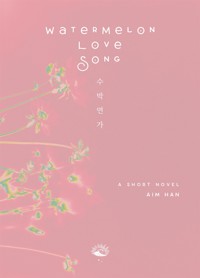
WATERMELON LOVE SONG
AIM HAN
Translated byITHAKA O.
IMAGINARIUM KIM
© 2023 Aim Han
All rights reserved.
This story is a work of fiction. Names, characters, places, and incidents either are the products of the author’s imagination or are used fictitiously. Any resemblance to actual persons, living or dead, businesses, companies, events, or locales is entirely coincidental.
No part of this story may be reproduced in any form or by any electronic or mechanical means, including information storage and retrieval systems, without written permission from the author.
CONTENTS
Preface
Chapter 1
Chapter 2
Chapter 3
Chapter 4
Chapter 5
Chapter 6
Chapter 7
Chapter 8
Chapter 9
Chapter 10
Chapter 11
Chapter 12
Chapter 13
Chapter 14
Thank you for reading
PREFACE
I once wrote a series called Random Word Grotesqueries. It was a game-like project, for which I took three random words and wrote a story. That way, I figured I could write some microfiction. I figured, if I was required to use random words selected from a dictionary or selected by a person who wasn’t me, the consequent story was bound to be concise.
At first, this was indeed the case. “Golf, leather, king” was barely a 5-minute read. “Sneakers, harmonica, boast” and “mail, fried rice, art” were the same. (Translator’s note: the word “fried rice” is one word in Korean. In fact, all words that became the seeds of these stories are one word in Korean. Thus, even though some of them were transformed into two-word phrases in the process of translating, the spirit of randomness still holds. No two-word phrases were pieced together intentionally to make the stories less random and more planned.)
But while those three stories had been firmly in the microfiction territory, they were also getting longer and longer. Eventually, a story like “scalp, drum, wallet” ended up being as long as a short story. Then, in “tap water, scribble, backcountry,” my writing briefly recovered its micro-characteristic… Until, once again, in “trial, fever, chin,” the length of what I wrote became as long as that of any regular short story.
Why can’t I write microfiction?!, I lamented, when the following three words popped up as keywords: posture, country, and watermelon.
Gotta make this one short. Then I can include the story in the Random Word Grotesqueries collection.
But alas. Instead of an intended microfiction becoming a short story due to my inability to control length, I got a novella/short novel due to my extreme inability to control length. This one wasn’t a story that could be read for the sake of its short-and-sweetness. It required its own title.
That story became this book, Watermelon Love Song.
My sincerest apologies to the words ‘posture’ and ‘country,’ which were omitted from the title. The watermelon was simply too sweet.
1
There once was a country, where, if you bent your back, you died. This wasn’t just a figure of speech. If the back, which should be upright at all times, skewed anything more than five degrees to the front, or back, or even to the left or right, that person died.
It wasn’t because someone approached and killed that person with a knife or a gun. There were no modern-day executioners or olden-day garroters. It was simply because this small country existed for the purpose of sending convicts from neighboring nations. A country-wide prison, a penal country, it was. Hence, here, state-of-the-art laser technology had been installed at innumerable locations.
Have you ever seen a heist movie? It’s a genre in which several people form a team to rob places like banks, where lots of money or jewelry are stored. Lasers, just like the ones in the room where the most expensive objects are kept in such movies, were installed everywhere within the territory designated to this small country. Not only that, such lasers were so very state-of-the-art that they were invisible to human eyes. Meaning: you couldn’t expect to get away by simply spotting the red rays.
Thus, when someone adopted a poor posture, zzzzzip! went the laser, as it detected that movement. In that way, it activated the chip that was implanted behind that convict’s ear. It was a very small chip—as small as a pinky nail. It gushed out poison, and when the convict’s heart pumped the hard-working blood all throughout the body, the convict died.
The poisoned-tainted blood remained solely within the convict’s body. The blood never flowed on the wood floors or marble floors, or anywhere else. The neighboring nations that sent the convicts to this country didn’t like spending their tax money on frivolous clean-ups. If this punishment, called “Proper Posture Torture,” hadn’t gained huge popularity in the form of a reality show in those nations, and thereby actually contributed to the reduction of the crime rate, they never would’ve kept these convicts alive, to begin with. Room? Board? Who the hell had money to waste on the human rights of convicts?
Which was why their clothes were just pieces of cloth. It was an insult to call these cloth pieces “clothes.” Have you ever seen one of those half-assed onesies with a hole in the back, the types that patients get at a hospital prior to getting tested? Well, the convicts’ clothes (cloths) didn’t have a hole in the back, but they looked about the same. Basically, they resembled sacks made of thin cloth. This was especially the case in the warm seasons, because the sleeves were short and the sack only reached down to the knees. In the cold seasons, the convicts received cold-season uniforms, which had long sleeves and came down all the way to the ankles. Despite the authorities pretending to care about human rights this way, the summer-winter or winter-summer Uniform Switch Ceremony resulted in the most convict deaths. The viewer ratings skyrocketed.
All clothes were white. In fact, all the sneakers that were provided to everyone, equally, were also white—even the rubber soles attached to the bottoms of those sneakers. These visuals conjured up images of a mental asylum. Perhaps this white was chosen to facilitate easy fainting caused by vertigo.
At any rate, the situation was that participating nations had created this “crime nation” with difficulty and had surrounded it, and thereby were suppressing riots. The world had never been anybody’s oyster, but especially in the current era, it was no oyster anybody could claim as their own.
Trees died and the oceans had no more fish.
The world overflowed with humans.
Thus, if “The Country of the Proper Posture Torture” hadn’t served any function, of course the convicts wouldn’t have been allocated this much space.
The reason they deserved space, in these circumstances, was obvious. If it were crowded with people, the reality show viewers wouldn’t be able to see whose posture grew crooked, would they? That was why, despite the lack of beds, there existed rooms for sleeping.




