


18,99 €
Mehr erfahren.
- Herausgeber: ibidem
- Kategorie: Wissenschaft und neue Technologien
- Sprache: Englisch
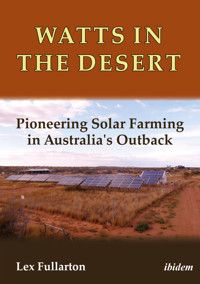
This unique book offers an introduction to the development of renewable energy in Australia in the early 2000s. Examining the rise of dispersed, embedded solar energy systems in Western Australia, it looks specifically at the Solex project in Carnarvon, WA, which pioneered the harvest of solar energy from what was once considered the pursuit of the lunatic fringes of society to a viable energy source for mainstream society and industry. In this fascinating case study Fullarton shows how a practical demonstration of innovative existing technology can have an incredible impact on a national scale. The ideas behind the Solex project slowly became adopted by the broader community and were eventually taken up enthusiastically by the general population of Australia. Analyzing government and utility policies throughout the 2000s, the book traces how ambivalence was followed by wholehearted incentives to the roll-out of alternative energy and subsequent active opposition to alternative energy in favor of traditional fossil fuel as government philosophies changed.
Das E-Book können Sie in Legimi-Apps oder einer beliebigen App lesen, die das folgende Format unterstützen:
Seitenzahl: 360
Veröffentlichungsjahr: 2016
Ähnliche
![[T]axing Greenhouse Gases - Lex Fullarton - E-Book](https://legimifiles.blob.core.windows.net/images/f60ef112bafaaf4c9dcfedc67edce9f0/w200_u90.jpg)















ibidemPress, Stuttgart
Table of Contents
Acknowledgements
This book acknowledges the Gnulli people who are the traditional owners of the land known to them as Mungullah.The town of Carnarvon and the Solex project on Grey’s Plane are situated on Mungullah.We thank the Gnulli people for sharing this land with us.
A special thanks to my old friends Ron Crow and Bob Price who inspired the inception of this development.
Of course, to my wife Julie and my family, who made this possible and to my good friend John Craig who has acted as editor of this story—thank you.
To all of theFruitloops,it is humbling to think that so many would think so much of a person who probably doesn’t really deserve it.In particular I thank the influence of Tony and Oscar Sala.Without all of you this story would never have existed and certainly never prospered.
The Board and staff of Horizon Power, Western Australia’s rural and remote energy utility, who were most supportive of the incorporation of renewable energy.At times conflict has arisen as to the role of the utility as a competitor in energy generation, but all that has resulted in active participation and full discussion of the difficulties faced by the changing face of energy technology.I believe that conflict has resulted in the outcome we have experienced.I thank those parties involved in these processes over the years.In particular Mr Brendon Hammond the Chairman of Horizon Power, and Mr Mike Laughton-Smith PSM for their personal dedication and time contributed to the rise of solarpvgeneration in rural and remote Western Australia.
To Jim and Wendy Andreoli for their valiant assistance in not only designing and constructing the Solex ice-works by also for their never failing support to keep it running efficiently and effectively.
A special thank you to the Rowe family of CaltexStarmart Carnarvon.Without their belief in the product, Solex solar ice would never have got to market.As with any new product there were teething problems are we refined bagging, sealing, curing and storage problems.Five years on we are masters at ‘the ice game’ but it was not always that way.
Finally acknowledgement is made to Genevieve Simpson who co-authored Chapter Five who incorporated her research into this book to provide social richness to its story.
Abbreviations
A
ampere
ABC
Australian Broadcasting Commission
ABARE
Australian Bureau of Agriculture and Resource Economics
ABRES
Australian Bureau of Agricultural and Resource Economics and Sciences
ABS
Australian Bureau of Statistics
ACT
Australian Capital Territory
ALP
Australian Labor Party
ASIC
Australian Securities & Investments Commission
ATO
Australian Taxation Office
BOM
Bureau of Meteorology
CEEM
The Centre for Energy and Environmental Markets (UNSW)
CER
Clean Energy Regulator
CSIRO
Commonwealth Scientific and Industrial Research Organisation
FCA
Federal Court of Australia (Single Judge)
FCAFC
Federal Court of Australia Full Court (3 or more Judges)
FiT
Feed-in Tariff
GST
Goods and Services Tax, see also VAT
GW
Gigawatt (1000Megawatts)
GWh
Gigawatt hour (1000 MWh)
Hz
SI unit for frequency hertz – 1 cycle per second
ITAA 1936
Income Tax Assessment Act 1936 (Cth)
kW
Kilowatt (1000 Watts)
kWh
Kilowatthour (1000 Watt hours)
LGCs
Large-scale generation certificates, a type of REC
LP
Liberal Party of Australia
MPPT
Maximum power point tracking
MRET
Mandatory Renewable Energy Target
MW
Megawatt (1000 kW)
MWh
Megawatt hour (1000 kWh)
NASA
National Aeronautics and Space Administration (USA)
NEM
National Energy Market
NOCT
Nominal operating cell temperature
NWIS
North West Interconnected System
OECD
Organistaion for Economic Co-operation and Development
ORER
Office of the Renewable Energy Regulator (now CER)
pv
photovoltaic
REC
Renewable Energy Certificate see also LGC and STC
RET
Renewable Energy Target
RRPGP
Renewable Remote Power Generation Program
SEDO
Sustainable Energy Development Office(Government of Western Australia)
STC
Small-scale Technology Certificate, a type of REC; Standard Test Conditions for solar panel comparisions.
TBL
Triple Bottom Line
TAFE
Colleges of Technical and Further Education
UNSW
the University of New South Wales
USA
United States of America
UWA
the University of Western Australia
V
volt
W
watt
WA
Western Australia
WASC
Supreme Court of Western Australia
The Gascoyne Region Western Australia.
Preface
My story begins on the sailing shipMinden, anchored off the coast of Fremantle Western Australia, on the morning of October 14,1851. Twelve-year-old John Fitzpatrick peered into the morning sun to see his new home in the burgeoning British Colony of Western Australia.[1]Thus began the story of the British Colonization of the Gascoyne Region of Western Australia and the part my ancestors played in it.
It is rather a long story and bears little relevance to the development of the Solexproject, other than to provide context and background as to why I would launch into the hitherto little known world of harvesting solar energy using solar photovoltaic (pv) panels. The story of the Fitzpatricks’ arrival in Western Australia, and how they trekked to the Gascoyne region in 1883, can be found in the bookDaurie Creek,which was written by my cousin Merton Fitzpatrick in 2004.
Another cousin“Bonnie”Milne has written a number of books on the history of the development of the Gascoyne region and the parts played by the Fitzpatrick and Collins families in that history.[2]I am a great-great grandson of that boy who peered over the rail of the barqueMindenand went on to establish pastoral stations in the Upper Gascoyne region of Western Australia, over 160 years ago.
For over 100 years,my family have raised sheep in the Gascoyne. Initially,the Gascoyne region was a“land of milk and honey”for the British Colonists, who brought their flocks of sheep to graze the virgin pastures of land that had served the Aboriginals who had wandered over and lived off the land for thousands of years. The original inhabitants maintained a semi-nomadic lifestyle and worked in symbiosis with the land, on which they depended for survival.
The British, on the other hand, ignorant of the sensitive nature of the natural environment in this near desert, simply saw it as an opportunity to exploit the apparently bountiful herbage to grow their wool. The wool provided by their sheep was sent by ship to feed the woollen mills of“Mother England.”For nearly 100 years,the Glenburgh[3]wool rolled westward to the sea.[4]
However,by the 1960s, the sensitive desert scrub surrounding the town of Carnarvon had become a wind-blown, barren clay-pan. It was largely abandoned, desolate,and useless to man or beast,exceptfor the horticultural industry that clung to the banks of the Gascoyne River.
The land on which the Solexproject was to develop had gone unnoticed, and unwanted, until it came to the attention of a great-great grandson of the boy who had peered over the rail of the barqueMindennearly 130 years earlier. That is the beginning of this story.
I was born in Carnarvon in 1956 and raised there, except for a short period in Broome, in the early 1960s. Mother’s family were old pastoral station folk who loved awongi,[5]usually over a very long cup of tea or better a beer or whisky (if there was any to hand). It was a very large family with links across the state and years. By the time I arrived on the Earth,most of the family members had moved out of the Bush to the City. However,whether they lived at Glenburgh, Carnarvon,or Mt Hawthorn (a suburb of PerthWestern Australia),they were very much Bush people.
They all liked, or had liked,“a cool shandy on a hot day.”[6]There was a sprinkling of“teetotallers,”[7]but in fairness, generally,that was more to do with health or economic reasons rather than moral temperance. Long and short though, they loved yarning and poetry about the days of old and the heroes of the Bush. The tales were sometimes a little far-fetched but“each of the tellers always swore that the tale that he told was true.”[8]
From an early age,Father and I wandered the Bush around Carnarvon fishing and shooting. Our small family was not wealthy by any stretch of the imagination, but Mother and Father were very resilient and able to do quite a lot with very little. Mother was a devout Catholic, as were most of her family, and I was required to attend Mass regularly. Father considered the whole religious thing a confidence trick—he had little faith in the religious. It was under that parental influence that I grew up as an only child in Carnarvon.
As an only child,I was a little socially distant. To compound that isolation, most of the children in our neighborhood attended the State School while I went to St Mary’s Catholic School. My school friends were Catholic and chiefly recent immigrants from southern Europe or“New Australians,”as was the term in those days. The neighborhood chiefly comprised White Anglo-Saxon Protestants(WASPS). Both terms have fallen into archaic use and reflect a more pre-WWII era social culturethatprevailed in Carnarvon in the early 1960s. I developed a very multi-cultural attitude to society and find myself comfortable across a broad range of social environments.
Of particular significance to this story are two brothers who came to Carnarvon in 1963. They lived nearby, had Italian migrant parents,and also attended St Mary’s. They were the sons of one of the scientists at the United States’ National Aeronautics and Space Administration (NASA) space program at the Carnarvon Tracking Station,which was built in the early 1960s. We became lifelong friends and I was drawn into the excitement of the NASA space program.
To add to my“unusual upbringing,”at the ripe old age of 12, I began spending my school holidays Jackerooing[9]on friends’ sheep stations. On my 15thbirthday,I commenced working as a bookmaker’s clerk at the Exmouth racecourse, for an elderly bookmaker whose clerk had failed to turn up. It was decided that, despite my tender years, I had a Diploma in Bookkeeping from Newton’s Business College and was studying bookkeeping at high school;so, for the Bush, in the early 1970s,that was ample enough qualification.
This background may appear a little irrelevant,but three important factors arise from that. I was learning to be resilient from living and working in the Bush, fencing, maintaining wells and windmills,and handling stock; learning the practical application of education; and,by making friends with the sons of rocket scientists,developing a thirst for experimentation. Those experiences were to later serve me well in conceiving and developing the Solexproject.
Chapter1—Introduction
“Two more long days from Rocky Pool, and then Carnarvon Town,So sixty bales of Glenburgh Wool, from Inland heights go down.”
John Alfred “Jack” Sorenson, Western Australian Poet (1907–1949)
1.1Introduction
This book looks at the greatest challenge facing humankind. In the modern age, it is the destructive impact that the highest density of humans ever to exist on the planet is having on the Earth’s ecosystem. It is not the planet that is in jeopardy,whichis simply a mass of rock swirling in space; it is the carboniferous life forms that cling perilously to its skin that are in peril.
Alexander and Boyle state“society’s current use of fossil and nuclear fuels has many adverse consequences. These include air pollution, acid rain,thedepletion of natural resources and the dangers of nuclear radiation.”[10]This book looks at the development of a renewable energy project, in rural and remote Australia,whichaddresses two of those problems—air pollution and the reliance on fossil fuel as an energy source.
The purpose of this book is to share the experience of the development of the first privately owned, commercial solar energy farm in Western Australia. Initially, it broadly examines the interaction between the, apparently competing, economic,environmental, andsocialfactors that influence sustainable development. It then looks briefly at how the economic,environmental, andsocialinfluencing factors, referred to as thetriplebottomline(TBL), have formed the philosophical viewpoints,which underpin Australia’s principle political organizations—the“Socialist Left,”the“Industrialist Right,”and the“Environmentalist Greens.”Broadly, the Left supports renewable energy, the Right opposes it, and the Greens promote it.
However, apart from consideration of Australia’s attempt to reduce carbon dioxide emissions caused through fossil-fueled electricity generation, in-depth discussion of the views of the respective Australian political parties as to climate change generally is beyond the scope of this book. In 2001,Australia introduced legislation to establish a quantifiable target to displace fossil-fueled energy generation with energy sourced from renewable, and nonpolluting, sources such as wind and solar energies. The operation of Australia’s renewable energy target (RET) is examined inthis book as the sale of carbon credits created under that legislation forms part of the revenue stream of the Solexproject.
The research supporting this book was conducted by way of comparing the identified and forecast economic,environmental, andsocialfactors established at the commencement of the project, in 2005, with the findings of actual data collected during the period under review, and the economic,environmental, andsocialoutcomes of the project in 2015. It also consists of a review of the legislation supporting Australia’s RET. That examination also considers the financial impact on renewable energy and fossil fuelled energy producers.
It is acknowledged that the harvest of renewable energy is not a modern concept to Australia’s Outback community. Outback pastoral properties have been usingwind generators since the mid-1930s and the“Dunlite”wind generator is as iconic as the“Yankee”windmill used for pumping water. The reader is reminded that,for the first 10 years of British settlement in Australia,colonial settlements used no fossil fuel. Settlement began in 1788,and the first coal mining began in 1798.
The incorporation of solarpvpanels into farm and pastoral homestead electricity generation was broadly taken up in the late 1970s and 1980s. However,while solar technology was being used on isolated properties,they were“standalone”systems exclusively for electricity supplies to the homesteads and surrounding buildings.As fossil fuel prices rose in the early 1970s, solarpvsystems became essential to ameliorate the escalating costs of diesel fuel, as well as the costs associated with its transport and storage.
Of significance to the Solexproject was the Australian government’s policy of diverting fuel excises imposed on the sale of diesel fuel into a diesel fuel replacement program called the Renewable Remote Power Generation Program (RRPGP). As detailed inChapter3, funding from the RRPGP was sourced to finance the initial stages of the Solexproject.
However,the subject of this book is not the small, standalone integrated energy systems common onOutbackpastoral properties and farms, but solarpvelectricity generation systems that began to be integrated into the distribution grids of national utilities in the 2000s.The use of dispersed, embedded solarpvinstallations configured as uninterrupted power supply systems is also beyond the scope of this book.
This book presents a case study of the solar energy project conducted over a period of 10 years from 2005 to2015. The purpose of the project was to establish a solar energy installation to investigate the economic,environmental, andsocialbenefits of renewable energy.
The principle objective of the Solex Carnarvon Solar Farm is to ameliorate environmental damage caused by over 100 years of industrial development in the Gascoyne region and to act as a catalyst to promote the benefits of renewable energy by the broader Australian community. It also intended to demonstrate renewable energy sources are not only practically achievable but also economically viable.
Discussed inChapter5, the community of Carnarvon were quick to adopt the new technology.On the basis ofa self-help type of program where the people helped their neighbors, the solar community embraced the solar energy resource with great enthusiasm. The rate of acceptance of solarpvsystems by the broader community in Carnarvon is illustrated in Figure 1.
Once termed“Fruitloops”by mainstream society, the solar community of Carnarvon realized the benefits harnessing the natural resource of the sun,and solarpvinstallations became normal household fixtures on roof tops across the town. It was not long before the electrical utility placed restrictions on further installations as it feared disturbances to electricity generation quality might negatively impact on the Carnarvon Town distribution system.
Citing potential stability issues effecting electricity supplies arising from a high capacity of dispersed embedded solarpvinstallations, the state utility placed amoratorium onthe connection of solar pv systemsin 2011. It is believed that Carnarvon was the first town in Australia to receive that distinction.
Figure 1:Small-scale solarpvinstallation rates by year Carnarvon Town Distribution Grid:2001–2015.(Sources: Solex data, Australian Clean Energy Regulator,andAustralian PV Institute[11])
Note that the number of installations begins to rise from 2005 and, apart from 2008, continued until the state utility ceased to approve further connections in 2011. It was not until the end of 2012 when installations, approved prior to 2011,were completed.
The followingFigure 2 illustrates theinstallation rate ofsolarpvsystemsin the broader Western Australian and Australian communities within the comparative time frame of 2001–2015.Itindicates that a similar growth rateoccurredin the broader community;however,that growth was a year later than in Carnarvon.
There are a number of factorsthatmight contribute to that time delay, but a key factor was the source of financial support through government incentives. Part of those fiscal initiatives are examined in further detail in Chapter2’s review of Australia’s RET legislation.
Figure 2:Small-scale solarpvinstallation rates by year Western Australia and Australia:2001–2015.
(Sources: Solex data, Australian Clean Energy Regulator,andAustralian PV Institute[12])
The development of the Solex project wasalso to ascertain if solar energy could compete favorably in economic terms with fossil-fueled energy production. That demonstration was conducted in an industrial application, with the technology of solarpvinstallations available in Australia, in the early 2000s.
In 2005,the solar farm component of the Solexproject was constructed, in Carnarvon Western Australia. Its purpose was to demonstrate that“a positive contribution to thesocial and environmentalwell-being of the community”[13]was not only, what may have been considered by sections of the community as, at best an academic, or at worst an irrational, project development to combat atmospheric pollution and consequential climate change generally, but also be economically viable.
It has also formed a point of reference to attempt to unify the opposing political factions to adopt policies away fromenvironmentally andsocially damaging energy generation systems and encourage them to move toward developing enduring, or sustainable, industrial practices.
1.2Structure
Initially,this book looks broadly at the concept ofsustainable development. It examines the concept of theTBL,which considers theenvironmental andsocialconsequences of economically, or fiscally, orientated development. It then focuses on the displacement of finite, and polluting, fossil fuel as a source of industrial energy by renewable, and nonpolluting, solar energy.
By harvesting non-polluting solar energy as an energy source, the Solexproject demonstrates that an environmentally“sustainable development [can] be achieved whilst maintaining the ecological processes on which life depends”[14]and,at the same time, being profitable by giving a reasonable return on investment—that is,economically viable in fiscal terms. The social, and third, aspect of the Solexprojectis the creation of employment in occupationsthatwere previously nonexistent—to contribute to the benefit to society.
It presents a description of how electricity generated from renewable energy sources contributes to combating climate change. It examines Australia’s RET legislation to present an understanding of how the administrative processes of reducing atmospheric pollution from fossil-fueled energy sources operates. It describes how the Solexprojectwas developed, the results of its operations, as well as its impact on social acceptance of solar energy and reduction of damage to the environment.
Chapter2explores the concept of the TBL and how its compositeeconomic,environmental,and socialfactors interrelate. It suggests that the relationship is strongly influenced by overarching political forces,which attempt to place those influencing factors in balance with each other.
The chapter further suggests that rather than coordinatingand balancingthe TBL, in Australia,political interests often set theeconomic,environmental,and socialfactors in conflict and are destructive, rather than setting them in harmony for the benefit of current and future communities. It also examines the operation of the Australian Government’s legislation supporting the RET. It looks at the fiscal impact of that legislation on renewable energy producers and fossil-fueled energy generators and how the Solexprojectreceives economic benefits from the creation and sale of“carbon credits.”
Chapter3looks at the history, construction,and development of the Solexproject. It looks at how the land was acquired and how the Solexprojectwas conceived. It examines how the project developed to establish a research program from which reliable fiscal and scientific data could be collated from the solarpvinstallations.
In 2008,wind generation capacity was integrated into the solar enabling equipment to create a hybrid energy generation to the purely solar photovoltaic (pv) installation constructed in 2005. This innovation not only extended energy harvest beyond daylight hours butalsoprovided data to monitor, compare,and contrast energy harvest effectiveness and efficiencies of solar and wind energy in Carnarvon.
Chapter3also describes how the Solexproject“value added”to its renewable energy by way of constructing an ice-works powered from the solar/wind farm. The integration of the ice-works with the solar/wind farm was not only intended to improve the fiscal bottom line of the project but also to demonstrate a practical application of an“alternative use for alternative energy.”
Chapter4examines the outcomes of the Solexprojectfrom the fiscal oreconomicperspective, as well as theenvironmentalimpact of“landcare”activities carried out on the previously barren land. It looks at the data collected from the Solexprojectand analyzes the economic and associated environmental outcomes from the aspect of avoided economic and environmental costs. It also looks at the outcomes of land restoration activities.
Chapter5,contributed by Simpson,considers the broadersocialimpact and outcomes of the Solexprojectand its influence on the attitudes of the general community and government organizations. It looks at how the example of the Solexprojectled to the community of Carnarvon adopting solar energy harvesting to improve their domestic, commercial,and industrial activities at reduced fiscal and environmental costs. It also considers the impact on the production of fossil-fueled based energy by the electricity utility servicing the region and the changing attitudes of that organization to solar energy integration in the period from commencement of the Solexprojectuntil the end of 2015.
Chapter6reviews and concludes the book. Itbrings the economic,environmental, andsocialfindings and outcomes together. It outlines the limitations of the case studyand suggestsareas for further research and development.Itsuggests thatthe leadership displayed by the Solexprojectmay haveplayeda pivotal role in theacceptanceof solar energy in broader community of Western Australia owing to itssuccess.
1.3Summary
This chapter introduced the concepts to be examined in the book and laidout how it will address the issues relating to harmonizing the conflicting elements of the TBL. It looked at the growth of small-scale solarpvsystems in Carnarvon, Western Australia,Australia. It laidout how the book is structured to provide an examination of Australia’s RET and describesthe experiences of the development of solar farming in Carnarvon,Western Australia,and the development of the Solexprojectin Carnarvon,Western Australia,over the decade 2005–2015.
Chapter2examines the concept of the TBLandhow the groups of influencing factors relate to each other and the division between Australian political parties as they seek to represent their respective interests in relation to their philosophical position in the TBL structure. It begins by defining the TBL and then places the Australian political viewpoints in relation to their place in that structure. Finally,to provide context and background, it briefly examines an aspect of Australia’s attempts to redress the problem of air pollution caused by the burning of fossil fuel—the Australian RET.
Chapter2—The Problem
“You have enemies? Good.That means you’ve stood up for something, sometime in your life.”
Sir Winston Leonard Spencer Churchill, British Prime Minister and Writer (1874–1965)
2.1Introduction
In order to provide background and context, this chapter looks broadly at the concept of sustainable development. It reviews the concepts of the three major aspects of sustainable industries: the economic viability of industrial development, the influences of industry on society,and the impact industry has on the natural environment.
It is suggested that,unless those three factors are positive contributors, or at least have a neutral impact on each other, a particular industry will ultimately fail. A fiscally profitable venturethatdamages society and/or the natural environment cannot continue indeterminately. Likewise, a socially desirable projectthatcontinually requires external financial inputs and/or damages the natural environment cannot be sustained indeterminately. Furthermore, a practice of conservation and preservation of the natural environment which totally prevents the exploitation of those resources by excluding industry and society will ultimately be destroyed by the economic and social interests that desire to exploit those natural resources for the benefit of mankind.
The problem facing mankind is how to manage the conflicting interests of the three groups of factors: that is, those resources, human wants and needs in such fashion that the use of those natural resources is not destroyed in the long term, and the development of industrial projectsthatare able to function without creating a negative impact, thereby destroying society and/or the natural environment.
This chapter initially looks at how the three aspects of sustainable development correlate. It considers the philosophies of Australia’s major political factions and how they represent the interests of each group of factors that compromise the TBL.
It then considers the atmospheric pollution, caused by industrial development since the late 19thcentury,and Australia’s attempts to mitigate greenhouse gas emissions from the combustion of fossil fuels as an energy source.
Finally, it places the operations of the Solexproject within the context of Australia’s carbon dioxide emission control legislation.
2.2TheTriple Bottom Line
In 1987, the United Nations World Commission on Environment and Development issued itsReport of the World Commission on Environment and Development: Our Common Future (the Brundtland Report). It defined sustainable development as being“development that meets the needs of the present without compromising the ability of future generations to meet their own needs.”[15]
The report further defined sustainable development as
a process of change in which the exploitation of resources, the direction of investments, the orientation of technological development; and institutional change are all in harmony and enhance both current and future potential to meet human needs and aspirations.[16]
From the concept of sustainable development, a corporate reporting systemwasdeveloped,which incorporated theenvironmental andsocialimpacts of its operations, as well as its fiscal accounting reports.
TheMacquarie Dictionarydefines the“triplebottomline(TBL)”as“a form of auditable company reporting which seeks to balance financial gain against responsibility to society and to the environment, in response to a corporate strategy that aims for economic, environmental and social gain.”[17]Therefore,“progressive businesses”[18]or“responsible corporations”not only report their operations in terms of the fiscal, or economic, profit of an enterprise expressed in monetary units but also in terms of their contributions to the benefit of society generally, with consideration to the preservation and conservation of the natural environment.
Twidell and Weir suggest that“the aim of sustainable development is for the improvement [in the quality of life and standard of living of the world] to be achieved whilst maintaining the ecological processes on which life depends.”[19]They further suggest that“at a local level, progressive businesses aim to report a positivetriple bottom line,i.e. a positive contribution to the economic, social and environmental well-being of the community in which they operate.”[20]
Strange and Bayley consider that“the core of sustainable development is the need to consider ‘three pillars’together: society, the economy and the environment.”[21]Thatframework for sustainable developmenthas crystallized into theecono-enviro-societalconcept of the TBL. The influencing factors of economic–environmental–social impactsand the relationship between those factors are illustrated in Figure 3.
Figure 3:An illustration of the triple bottom line factorsincorporating some examples of each.
In 1990, the Australian Government recognized that ecologically sustainable development represented one of the greatest challenges to the nation’s government, industry, and society in coming years. It recognized that there was no universally accepted definition of ecologically sustainable development but suggested the following definition:
Using, conserving and enhancing the community’s resources so that ecological processes, on which life depends, are maintained, and the total quality of life, now and in the future, can be increased.[22]
The national strategy document identified the goal for ecologically sustainable development as being “development that improves the total quality of life, both now and in the future, in a way that maintains the ecological processes on which life depends.”[23]To support that strategy, the Australian Government enacted theEnvironment Protection and Biodiversity Conservation Act 1999 (Cth). The act is intended toprovide a legal framework to protect and manage, nationally and internationally, important flora, fauna, ecological communities, and heritage places defined in the Act as matters of national environmental significance.
Specifically, section 3 (1) of the Act prescribes its goals:
(a)toprovide for the protection of the environment, especially those aspects of the environment that arematters of national environmental significance; and
(b)topromote ecologically sustainable development through the conservation and ecologicallysustainable use of natural resources; and
(c)topromote the conservation of biodiversity; and
(ca)to provide for the protection and conservation of heritage; and
(d)topromote a co-operative approach to the protection and management of the environment involvinggovernments, the community, land-holders and indigenous peoples; and
(e)toassist in the co-operative implementation of Australia’s internationalenvironmentalresponsibilities; and
(f)torecognise the role of indigenous people in the conservation and ecologically sustainable use ofAustralia’s biodiversity; and
(g)topromote the use of indigenous peoples’ knowledge of biodiversity with the involvement of, and inco-operation with, the owners of the knowledge.[24]
In September 2003, the Western Australian government produced a sustainability strategy policy that, among other objectives, was intended to
[d]evelop a State Strategic Planning Framework for the Public Sector that reflects sustainability and the triple bottom line [and]
[i]ncorporate sustainability principles and practices based on the Sustainability Act into relevant legislation as it is reviewed or drafted.[25]
In 2004, the Western Australian Local Government Act 1995 (WA) was amended to address a range of matters, including provisions to incorporate the sustainability themes into the content and intent of the legislation. The Act states:
In carrying out its functions a local government is to use its best endeavours to meet the needs of current and future generations throughan integrationof environmental protection, social advancement and economic prosperity.[26]
The Planning and Development Act 2005 (WA) introduced a specific purpose of the Act regarding sustainability.[27]Among the purposes of the Act, it specifically states that it is “to promote the sustainable use and development of land in the State.”[28]
The emphasis on sustainability within the principal legislation governing planning practice in Western Australia is an important reflection of the role of promoting sustainable development through planning. In 2006, the City of Cockburn became oneof the first local authorities in Australia, and the first in Western Australia, to adopt the definition of sustainability.
In 2011, the City of Cockburn adopted a sustainability strategy to embed that philosophy into its administration.
In the document prescribing its sustainability strategy, the City of Cockburn defines sustainability as:
Pursuing governance excellence to meet the needs of current and future generations throughan integrationof environmental protection, social advancement and economic prosperity.[29]
Despite those changes to legislation and the adoption of environmental conservation policies byfederal andlocal authorities, theSustainabilityBill(WA) was never introduced to the Western Australian Parliament.Therefore, the proposedSustainability Act(WA) did not come into existence.
The brief history of the adoption of sustainability legislation in Western Australia indicates that the implementation of policies for sustainable development is determined by the actions of government.
While it is generally considered in Western Democracies that parliament reflects the“will of the people,”in fact, in Australia,parliament tends to consist of a loose conflagration of political groups each with their own focus or political philosophy.
Fullartonwas an Independent Candidate for the Gascoyne region’s Western Australian parliamentary seat for three election campaigns:2001–2008.[30]As such, he was involved in negotiations with the candidates of other political parties and closely studied the political philosophies of the major political factions in the Australian Parliaments.[31]He has noted the differing underpinning philosophies of each of those parties and their differing primary focus in relation to the primary factors of the TBL.
It is suggestedthat a fourth factor should be considered when examining the concept of the triple bottom line—that of its“binding agent”—the political philosophies of governing bodies, as illustrated in Figure 4.
Figure 4:Thetriplebottomline factors showing the political factor binding the relationship.
Figure 4 is an “ideal” framework. In Australia, the interests of political factions function in such fashion that, rather than government acting as a cohesive force, to co-ordinate and harmonize the TBL, or sustainability development framework, into a stable structure, the fragmented political factions tend to destabilize the harmony of the TBL.
In Western Australia, the“left-wing”[32]Australian Labor Party (ALP) government lost office in September 2008, and it appears that government action regarding ‘sustainable development”ceased at that point.The succeeding“right-wing”[33]Liberal Party (LP) subsequently advised that the Western Australian Sustainability Strategy“is no longer being referred to as it was a policy of a previous government and is out-dated.”[34]It appears that governmental policies, and governmental approaches to the concept of sustainable development, differ between the“left”ALP and the“right”LP.
A detailed examination of left-wing and right-wing political philosophies is beyond the scope of this study;however, it is reasonable to suggest that the“left,”generally represented by the ALP, tends toward social democracy and the welfare of society, while the“right,”generally represented by the Liberal and National Parties, tends toward industrialism and the welfare of the economy in fiscal terms.
Furthermore, this book considers that, in Australia, it is the Australian Greens Party that represents environmental interests. However, they also state“today, the Greens recognise that speaking for the environment is not enough—we also need tospeak on behalf of others who are disadvantaged in our society: children, refugees, students, individuals and families living in poverty.”[35]
Figure 5 develops the illustration of the TBL shown in Figure 1 to show the Australian political parties’ general philosophical perspectives.
Figure 5:Thetriplebottomline factors showing the Australian political parties representing the respective factors.
Further discussion in this book is based on theabovementionedbroad assumption. It is suggested that,in attempting to bring all aspects of the TBL together, the Solexprojectis considered to be an amalgamation of the three political philosophies.
This book now moves on to discuss the impact of industrial development on the Earth’s natural environment. In particular,it looks at the discharge ofgreenhousegasesinto the atmosphere caused by the combustion of fossil fuels as an energy source. Those greenhouse gases affect the constituency of atmospheric gases and contribute to an increase in the Earth’s atmospheric temperature, a concept referred to asglobalwarming.
2.3Global Warming and the Carbon Cycle
This section examines part of Australia’s attempt to reduce the impact ofglobalwarming. While a detailed examination of the causes ofglobalwarmingis beyond the scope of this study, there is good evidence that the major factor affecting global warming is attributed to a rise in the level of atmospheric carbon dioxide (CO2).“We know for sure that, because of human activities especially the burning of fossil fuels, carbon dioxide in the atmosphere has been increasing over the past two hundredyears and more substantially over the past fifty years.”[36]It is generally accepted that action must be taken to mitigate the impact of rising CO2emissions on global warming.[37]
Prior to outlining the operations of Australia’sRET,this section provides the following outline regarding mankind’s impact on changing the carbon dioxide composition of Earth’s atmosphere. The overview provides background as to why it is considered desirable to substitute fossil-fueled energy sources with nonpolluting, renewable energy generation systems.
Figure 6:The modern composition of Earth’s atmosphere.
As illustrated in Figure 6, the modern composition of Earth’s atmosphere is roughly 78 per cent nitrogenand21 per cent oxygen. The other 1 per cent is made up of 0.037 per cent carbon dioxide and the remainder, which is mostly inert gases such as argon, neon,and the like, as well as water vapor, methane, nitrous oxide,and chlorofluorocarbons.[38]
To provide an understanding of the dynamic processes“




