


46,99 €
Mehr erfahren.
- Herausgeber: ibidem
- Kategorie: Fachliteratur
- Sprache: Englisch
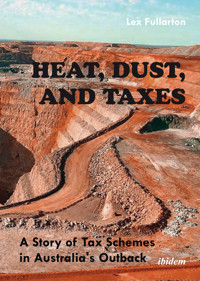
In ‘Heat, Dust, and Taxes,’ Lex Fullarton explores the taxpayer compliance behavior of blue-collar workers in the Pilbara region of Western Australia in the 1990s who participated in mass-marketed tax avoidance schemes at significantly higher rates than any other group of Australian taxpayers. Investigating the motivational factors which might have caused that and providing a broad background and context, Fullarton considers the physical, economic, and social environments of the Pilbara region, highlighting the extremely harsh physical and social environments in which the locals live and work. He examines the history of tax avoidance schemes in Australia from the 1970s to the 1990s to illustrate the development of mass-marketed tax avoidance schemes. Drawing on first-hand interviews with the miners as well as archival and statistical material, this rich and detailed study skillfully reveals the dominant motivational factors leading to the remarkable spread of tax avoidance schemes.
Das E-Book können Sie in Legimi-Apps oder einer beliebigen App lesen, die das folgende Format unterstützen:
Veröffentlichungsjahr: 2015
Ähnliche


![[T]axing Greenhouse Gases - Lex Fullarton - E-Book](https://legimifiles.blob.core.windows.net/images/f60ef112bafaaf4c9dcfedc67edce9f0/w200_u90.jpg)















ibidem Press, Stuttgart
Acknowledgements
One person has been my constant companion throughout decades of study and research.It has sometimes been fun and sometimes boring, but always challenging.She has never faulted in support of my ramblingson my quest to find the perfect taxation system—my wife Julie.She has been the wind beneath my wings fornearly fortyyears.
I have special thanks to Chris Evans for accepting the challenge to be my supervisor for the final stages of my quest,withouthim the end would not be possible.Chris has seen fit to include me in his unbelievable workload.I am humbled that he took the time to include me in his Herculean burden.Also to Dale Pinto, his co-supervisor, who has put up with me and my unusual circumstances and approach since the late 1990s.
To the staff ofCurtin Universityin particular Doug Yorke.We started together many years ago when I was a first year student in 1974 and he a junior lecturer.Thanksalsoto the staff ofAustralian School of Business, School of Taxation and Business Law of the University of New South Waleswhohave supported me despite the tyranny of distance across Australia—from'Sydney to the Bush'.
Finally to all those people who took part in the research—a very special thanks.Of course they cannot be named but they know who they are.I hope in some small way I have given them a voice which will be heard byhigherauthority.These interviews were not easy.At times they were emotionally challenging.I appreciate the honesty and sincerity of all those who took part in compiling this historic story.
Table of Contents
Figure1The Pilbara Region Western Australia.
Abbreviations
ABC
Australian Broadcasting Commission
ABS
Australian Bureau of Statistics
ACT
Australian Capital Territory
ALP
Australian Labor Party
ASIC
Australian Securities & Investments Commission
Atax
Australian School of Taxation
ATO
Australian Taxation Office
BISEPS
Business Industry Sociology Economy Psychology Systems
BPS
Budplan Company Syndicate
CSIRO
Commonwealth Scientific and Industrial Research Organisation
CTSI
Centre for Tax System Integrity
DCS
Deputy Crown Solicitor
ELS
Electronic Lodgement System
FBT
Fringe Benefits Tax
FCA
Federal Court of Australia (Single Judge)
FCAFC
Federal Court of Australia Full Court (3 or more Judges)
FSDU
Federated Ship Painters and Dockers Union
GAARs
General Anti-avoidance Rules
GST
Goods and Services Tax, see also VAT
HWIs
High Wealth Individuals
IRS
Internal Revenue Service (USA)
ITAA 1936
Income Tax Assessment Act 1936(Cth)
LP
Liberal Party of Australia
MMTAS
Mass marketed tax avoidance scheme
OECD
Organisation for Economic Co-operation and Development
PAYE
Pay-as-you-earn (later part of PAYG below)
PAYG
Pay-as-you-go
QC
Queens Counsel
TAFE
Colleges of Technical and Further Education
USA
United States of America
VAT
Value Added Tax, see also GST
WA
Western Australia
1.ChapterOne:Introduction
'I call a spade a bloody shovel'
Frederick Sidney Cotton,Australianaviator,inventor andspy(1894–1969)
Set in the picturesque, but treacherous landscape in the Outback of North-western Australia, this book portrays the story of one of the greatest series of taxavoidanceschemes in Australia's history.
Prior to the 1970s, the North-west was, by European standards, largely uninhabited.A few inland towns, not much more than settlements, served the pastoral industry.The ranches, or stations as they are known in Australia, were owned and managed by European-Australians.Theyrelied heavily on the labour services of local Aboriginals,who had occupied the land for thousands of years prior to settlement by the British in the 19thCentury.
Fortunes had been made, and lost, by large family pastoral holdings since'colonisation'.However by the late 1960s much of the pastoral industry was in decline.This book describes the two critical eventsthatinfluenced the Pilbara region in the early 1970sandled to the development of one of the World's, and certainly Australia's, largest mining industries.
As with the hordes of'booms'in human history, the mining boom in Australia was little different to the'gold fevers'that struck California and Eastern Australia in the 19thCentury.Towns sprang up where, only a few short years before sheep and cattle had meandered seeking sustenance.Sleepycolonial seaports became major international ports for the World's giant bulk carriers seeking iron ore.
Record after record was broken, as immense railway trains, laden with seemingly endless tonnages of ore, were dragged down the rivers of railway line, rapidly laid from the ranges to the sea for that one single purpose.Exports to Japan turned from nothing to negligible to enormous volumes almost overnight.Industry had arrived in the Pilbara.
As with earlier booms in history, workers of all kinds'headed north'to make their fortunes in'the mining game'.This book focuses on the tradespeople and labourers who chased the'big money'in one of the World's last frontiers.
They certainly found the high incomes that the mining industry promised.They also found the isolation and harsh physical environment that had kept the region unpopulated for so long.They also encountered something they had neverpreviously experienced—Australia's high marginal income tax rates, reserved for the high income earners at'the high end of town'.
Suddenly'Joe the Worker'was making as much money, or even more,asaccountants, lawyers and medical practitioners.He was also paying the rates of tax that they had been subject to for years.'Joe', however, was engaged at work for as much as 80 hours a week, as well as living and working in extreme temperatures.All in what the Australians call'the bulldust-out-the-back.'The all pervading talc-like dust bonds with everything it touches—and it touches everything.
It is small wonder,that in this land ofheat,dust andtaxes,that the silk-tongued salesmen of the'white-shoe brigade'found very willing audiences to the promises of avoiding tax, with ever increasingly complex and mind boggling schemes,to alleviate at least one of the plagues of the Pilbara blue-collar worker.
History says'showme the miner, and I'll show you the gambler who preys on him'—read on.
Fromthe beginning of the 1970s,almost the entire population of taxpayersofthe Pilbararegion of Western Australia have beenengaged in the mining industry.Apart from a very small minority of indigenous Australians in remote communities and a handful of Europeans engaged in the waning pastoral industry, almost every worker is directly, or indirectly, connected to the mining industry.Seamen engaged in the ports of Dampier, Port Walcott,and Port Hedlandarefocussed on bulk ore and salt carriers.Railway workers and maintenance crews are exclusively engaged in the carriage of bulk ore.Service industries such as educational and medical and health servicesexist almost exclusively to provideforthe mining industry.
In the context of the research covered in this book, it is instructive to develop an understanding of what it is like to live and work in the Pilbara,and this section explores the physical and social environment of the mining communities of the region.This examination takes the form of an ethnographic study and is provided to establish a clear understanding of thephysically harshliving environmentand heavy working conditionsendured by taxpayers of the Pilbara region during the 1990s.
1.1.ThePilbara:landscape and climate
In terms of overall size, the Pilbara is approximately 300,000 square kilometres, roughly the size of Poland.It consists of the local authority Shires of Port Hedland, Roebourne, West Pilbara,and East Pilbara.
The map of Western Australia shows that thePilbararegion is bordered in the north by Port Hedland, in the east by Marble Bar and Newman,andto the west bythe coastline from the bottom of Exmouth Gulf to PortHedland.[1]
Exmouth(at the top of Northwest Cape)is not a mining centre.Ithas arelativelyclement climate and is a holiday resort townatthe northern most point of the Ningaloo reef.Its primary industry is tourism, and thousands of Pilbara miners holiday there on a regular basis to seek respite from thetorridPilbara climate.Exmouthisthereforenot considered apart of the Pilbararegion and consequently has not been examined in this study.
The local governmentnames and boundariesof the Pilbaraare based on the towns existingat the time ofFederation in 1901.Theybear little reference to the presentlocalities andtownships.For example the Shire of Roebourne, on the coast,encompasses Dampier, Karratha, Wickham, Port Samson, Cossack,and Roebourne, as well as the hinterland to Tom Price and Paraburdoo(which arebothin the Shire ofAshburton).The administration centre for the Shire of Roebourne isnowKarratha,and the town of Roebourne isshown asa small village east of Karratha,while Cossack, the original port,islongabandonedand does not appear.
Initially districts were referred to by the river systems that flowedthrough them—Murchison, Gascoyne, Ashburton, Fortescue and De Gray (from south to north).In modern times most of thoseappellations are meaningless and have fallen into disuse.ThesouthernShires of Murchison and Upper Gascoyne are vestiges of the post-colonial era and consist of hamlets of less than 50 people, though they continue to service the pastoral industry.
The first observation to be made by a visitor to the Pilbara is the distance between communities.The Great Northern Highway from Newman to Port Hedland is 450 kilometres, or about five hours'drive.From Onslow to Port Hedland it is 540 kilometres or about six and a half hours; it is over 650 kilometres from Onslow to Newman, over eight hours by road.There are few communities between the towns.There are none between Newman and Port Hedland, onlyKarratha and Roebourne between Onslow and Port Hedland, and Tom Price or Paraburdoo (depending on the route taken) between Onslow and Newman.
Early European settlers,who arrived in the 1880s,discovered what they thought to be endless grassy plains ideal for the burgeoning pastoral industry.What they hadin factfound was openSpinifex plains of coarse and almost unpalatable grasses.Their livestock were forcedto grazearoundthefew natural perennial waterholes alongseasonalwatercourses.
Vegetation that had taken hundreds, perhaps thousands,of years to establish was virtually wiped out in little over sixty years, from settlement in the 1880s to the outbreak of World War II.A handful of small settlements were established as ports to service the pastoral industry at Carnarvon, Onslow, Point Samson (Cossack), Port Hedland,and Broome.Apart from a few small mining'shows'at Marble Bar, Whim Creek and the now infamous Wittenoom Gorge asbestos mine, the region was generally considered'Blackfella country'—areference to theindigenous Australians who inhabited the region around the few permanent water holesandmission settlements andwho were'employed'on the scattered pastoral stations.Broome and Carnarvon,respectivelynorth and south of the Pilbara,relied on their pearling and fishing fleets with intensive, irrigated agriculture at Carnarvon.
The following temperature map shows that the average annual maximum temperature is between 30 °C in the south and 33 °C in the north.The lower temperatures of 24 °C north-west of Newman are misleading as this is due to a mountain range that is too rugged for any human occupation.It is these Hamersley ranges that provide the main source of iron ore that attracts the large mining companies and produces employment for the Pilbara blue-collar workers.
Figure2Western Australia's average annual maximum temperatures
Note: the original map is in colour. Isotherms are all above 15 °C and not under 12 °C (which are similar shades of grey in this reproduction)
The mining communities of Paraburdoo, Pannawonica, and Tom Price are to the west of Newman.The ports of Dampier (and its service town of Karratha), Wickham and Port Hedland—despite being on the coast, which should result in cooler climates—are all within the 33 °C zone.There are a few roadhouses for fuel and water, but generally it is no place for the inexperienced traveller.With summer daytime temperatures in excess of 50 °C, humans can perish very quickly.Traffic is generally limited to the major highways, and straying away from them can be fatal.
The community of Pannawonica, arguably the most isolated community in the Pilbara,is of particular interest in this study.Pannawonica is some 46 kilometresoff the North West Coastal Highway and is a final destination as there is no other land access other than the railway that serves the iron ore trains to Cape Lambert (Wickham).The nearest town to Pannawonica is Karratha, which is a comparatively short distance of 200 kilometres or two and a half hours drive.
Despite being mid-way between Newman and Exmouth, Pannawonica is situated within a 33 °C zone, even though surrounded by a cooler temperature zone.This is also due to the topography of the land in that it is situated on a plain at the end of a re-entrant or gully that prevents surface airflow from the sea.The Cape and Rough Ranges to the west also provide a localised barrier to prevailing south-westerly winds.
As shown inthe following temperature map, the average annual daily temperature does not appear excessive,with an average maximum temperature of around 33°Cfor the most part.However,daily maximain the summer months reach over 40°C andclimatic conditionsare most unpleasant.
Figure3Western Australia's average daily maximum temperature for January
Note: the original map is in colour. Isotherms are all above 15 °C and not under 12 °C (which are similar shades of grey in this reproduction)
Thenorthwest ofWestern Australiais largelyabarren,stonydesert landscape with sparse vegetation.It has long periods of drought coupled with flooding rains when rotating tropical storms cross the northern coastline.Attimes,the desert is flooded,vegetationbloomsand thenthe landreturns to its parched state for months and sometimes years.
The rotating tropical storms (known as cyclones) bring rain to the region, but they also bring devastating tempests and flash flooding.The damage can be considerable: lives are lost, stock destroyed, and communities isolated for days, sometimes weeks, due to damage to transport infrastructure.[2]
As indicated in the map of cyclone tracks below,tropical cyclones can cross the coast anywhere between Carnarvon and Broome, but the Pilbara region is under the greatest threat.As many as six cyclones a year can occur in the Pilbara.In contrast, Carnarvon may not be subject to cyclone threats in many years.
Figure4Thepattern of tropical cyclone paths in Australia
The seasonal cyclones bring with them another discomfort.Generally the heat of the Pilbara is a'dry heat'.While it is uncomfortable, humans can survive in temperatures of up to 50°C.However, the sudden influx of moist tropical air brought with the cyclones raises the humidity to extremely uncomfortable levels.Periods of high humidity can last for days, weeks or even months if successive cyclones pass through the region.
The inhospitable region of the Pilbara was largely ignored by European Australians untilthe 1960s.Twosignificantevents occurredthen, which directly affected the Pilbara region.Firstly,the embargoby the Australian governmenton the sale of iron ore to Japan was lifted.Secondly,discoveries of large iron ore deposits were made in the Pilbara.Areport by the National Conference of Public Works and Environment Committees in 2003noted that:
The Pilbara had long been known to contain immense deposits,and a boom began which was to see the establishment of nine new towns in the region by 1970 (Dampier, Tom Price, Paraburdoo, South Hedland, Newman, Wickham, Pannawonica, Goldsworthy (now closed) and Shay Gap (now closed)).Almost over-night the Pilbara's population increased tenfold.[3]
In addition to that, in the late 1970sdiscoveries of oil and natural gas off thenorth-west shelf were also madeand'[i]n the'70s and'80s the development of these resources expanded the region's economy and population enormously'.
1.2.ThePilbara'ssocio-economic andworkingenvironments
This book covers the 30-year period from 1977 to 2007with a particular focus on the 1990s.It is not intended to reflect subsequent changes to work practices by industry and/or public services and infrastructure by governments that may have influenced social and economic conditions after that time.
Since the 1960s,the effect of mineral and later gas/oil exploitation has been enormous and spectacular.In 1961, the population of the Pilbara was estimated at 3,240; in 1997 it was 41,225.[4]
The native inhabitants of the region, both European andindigenous Australians, were largely ignored by the newcomers.It is notedthat few'locals'are employed by the mining companies,andlocalsgenerally continueinthe employment theyengagedin prior to the'new arrivals'.Pastoral properties continue to exist with minor changes to livestock management,and the locals enjoy the amenities that the larger population has attracted, but social intercourse between the two groups is limited.
It was not only the enormousincreasein the number ofpeople that has affected the social structure of the Pilbara, but also thefocus of age and sex.The stabilising influence of a broad spectrum of individuals, normally found within a communityable toprovidesocial and educationalguidance to younger individuals, did not exist:
The aged population for the Pilbara has typically been low,and this trend is expected to continue.In 2001, 3.1per centof the population were over 70 years of age.The median age for Pilbara in 2001 was 31 years.[5]The Pilbara has the second youngest population of the state after the Kimberley- it has a strong bias towards young families.[6]
The followingquote from Scadding,[7]who focussed on the development of the US Navy communications base in Exmouth in the 1960s, gives an indication of what happened in the 1970s in the Pilbara:
From the 1960s onwards, the Pilbara was to undergo rapid development,and this had considerable impact on social developments of living in the Pilbara.There were two primary social change drivers occurring: firstly, the US Navy Communication Station was established in 1963 at Exmouth and '…a thriving community of over 3,000 mostly single personnel with a lot of money and little else to do'[8]integrated with the local population and enabled such industries as tourism to rapidly develop;secondly, the iron ore mining boom with so many single men seriously changed the social scene in the Pilbara.
The economic background of the Pilbarablue-collarworker is quite differentfromthat of similar classes of workers engaged in other regions of Australia.Asshown in the following table, theyreceive remunerationup to nearly 70 per centhigher than the national average in compensation for the dangerous working conditionsthat they have to endure,as well as theisolation and the harsh natural environmentthat confronts them.
The explosion of mining activities in the 1970s and onwards not only ledtohigher incomes but was accompanied byincome tax rates significantly higherthan previously experienced byPilbarablue-collarworkers or their peers.The phenomenon of high remuneration for such work and conditions is not uncommon and is often experienced in similar types of activities(such as oil production and exploration)in other regions of Australia and theworld.
Comparisonsofincomein the following tablereveal that Pilbarablue-collarworkers are paid significantlymorethan their occupational peersin the Goldfields, Western Australia and the nation generally.For example, in 1999 the average annual taxable income in Paraburdoo in the Pilbara was $52,191, compared with averages of $41,191 in Kalgoorlie-Boulder in the Goldfields, $34,360 in Western Australia and $34,798 in Australia generally.
Town
Post
code
MeanAverage Annual Taxable Income in $A
1995
1996
1997
1998
1999
2000
2001
2002
Goldfields
Coolgardie
6429
32 414
36 357
35 443
37 101
37 968
38 961*
38 699
42 092
Kalgoorlie-Boulder
6430
35 410
36 788
38 382
39 867
41 191
41 338
43 168
44 429
Pilbara
Dampier
6713
44 702
44 612
45 647
47 495
50 434
50 957
54 286
55 153
Karratha
6714
38 261
38 294
39 751
41 912
43 578
44 231
47 186
49 836
Newman
6753
47 191
47 473
48 653
49 203
50 540
50 650
51 282
53 896
Paraburdoo
6754
42 716
42 752
46 176
46 918
52 191
55 092
59 187
56 290
Pannawonica
6716
43 688
41 875
43 328
45 599
45 631
50 162
58 121
67 412
Port Hedland
6721
38 764
41 396
42 387
45 541
46 917
47 772
49 310
53 641
Tom Price
6751
43 777
44 855
45 492
46 889
50 769
52 379
55 262
53 957
Wickham
6720
38 305
37 562
40 448
42 142
43 939
45 160
48 086
52 169
Gascoyne
Carnarvon
6701
26 378
27 193
27 746
28 832
31 098
32 295
34 203
34 828
Kimberley
Broome
6725
27 970
29 104
29 658
31 216
34 888
35 069
35 748
36 484
Metropolitan
Perth
6000-6175
29 146
30 129
31 133
32 825
34 622
35 750
37 779
38 681
WA
29 204
30 268
31 120
32 735
34 360
35 379
37 318
38 330
Australia
29 339
30 344
31 345
32 902
34 798
36 161
38 539
39 254
Table1Goldfields and Pilbara taxable income comparisons 1995–2002[9]
*Figures not available for Coolgardie, this is forthe surroundingYellowdine-Marvel Lochregion.
The AustralianBureau ofStatistics (ABS)referred to thisin its feature article'RegionalWage andSalaryEarners in Western Australia':
In 2000-01, four of the ten SLAs [Statistical Local Area] with the highest average annual wage and salary income inWestern Australiawere located in regions with significant mining activity, including Ashburton, East Pilbara, Coolgardie,and Port Hedland.Average annual incomes in these regions ranged from $44,770 in Port Hedland to $51,781 in Ashburton—the highest of any region in the state—reflecting the comparatively high earnings of those working in the state's mining industry.The proportion of wage and salary earners in these SLAs earning in excess of $52,000 per year ranged from 37.0per centin Port Hedland to 47.6per centin Ashburton—compared to 16.6per centacrossWestern Australia.
In comparison to the metropolitan SLAs in the top10, these mining regions had relatively few Professionals and Managers and administrators and relatively more 'blue-collar' workers.More than half of the wage and salary earners in these regions were employed as either Tradespersons, Plant and machinery operators and drivers, or Labourers and related workers in 2000-01.These workers earned higher incomes than those working in the same occupations elsewhere in the state.Between 52.4per cent(Port Hedland) and 67.8per cent(Ashburton) of Tradespersons in these regions earned more than $52,000 in 2000-01, compared to 18.7per centof all Tradespersons in the state.Over half of the Labourers and related workers in Coolgardie and East Pilbara earned over $52,000 in 2000-01, compared to the state average of 12.0per cent.
Among the ten SLAs with the highest average wage and salary incomes inWestern Australia, Ashburton recorded the highest proportion of Plant and machinery operators and drivers (82.0per cent), Professionals (53.0per cent) and Managers and administrators (51.9per cent) earning in excess of $52,000 a year.[10]
From Australian Taxation Office (ATO) statistics, comparisons can be made with other occupational groups such as agricultural labourers,whoare among the lowest paid workers in the nation.Workers engaged inprimary productionhave an averageincome of $29,966 comparedwithfellow workers in the mining industrywhose average wage was$45,008 in 1997-98.
Numerically,the trade qualified and unskilled, blue-collarworkers are a vastly larger social group than the,tertiary qualified,professionals of the Pilbara.An example of that proportion is demonstrated by statistics extracted from a report of the Burrup Skills Taskforce.[11]Theyreveal the population of engineers engagedon the Burrup project,[12]in 2006,to be approximately 40 of a total operational workforce in excess of 1,000.
Information from a regional real estate agent[13]indicates a stratification of Pilbara society onanoccupationalbasis.There exists a stable, long-termblue-collarresidentpopulationand a transient,short-term professional residentpopulation.In general, professionals and supervisors such as engineers, surveyors, and senior administrative staff are engaged on a'fly-in-fly-out'basis and have little personal contact with the resident blue-collar workers.
In addition, those professionals, and others,such as medical practitioners, accountants,and teachers aregenerallypaidthe same rates astheir city dwelling peers, though they do receive small compensatory benefits such as subsidised housing, remote area allowances and the like.In mostcases,however,they attend the Pilbara on a very short-term basis and aregenerally domiciled in Perth.
Professional residentsdo not generally interact with the long-termblue-collarresidents and haveother social and sporting interests.Some temporarily move their families to the Pilbara,but the terms are generally limited to 12 months to two years.In contrast theblue-collarworkers view themselves as long term residents with some of them having been there sincethe early days of miningconstruction in the 1970s.Sales and rental data keptby real estate agents in the Pilbaraalso confirmthe transient nature of the professional populationandthecomparativepermanence of theblue-collarworkers.
Blue-collar workersinteract amongst themselves and have a general distrust of the professional classes.In the words of one professional'[t]hey[theblue-collarworkers]don't have much to do with us.They are either on shift, asleep or out fishing.At work, we are in the office and they are outside.'[14]
According to the manager of college information systems of KarrathaCollege ofTechnical andFurtherEducation (TAFE),a third-year trades apprentice employed byamining companyreceives an income approximatelyequal to that ofhis teachers.The social outcome is that, at least as to income, thePilbara blue-collarworker perceives himself to be the social equal, if not superior, to the equally or lower paid professional.Consequently retention rates of students are very low with most students preferring to discontinue studies to work as blue-collar workers with the mining companies.
A consequence of this disruption from general Australian social structure is indicated in the table below.According to the census of 1996, the general population of the Pilbaraisnot as well-educated as the general population of the state ofWestern Australiaandiswell below that of the nation.More particularly, on average only 9.36 per cent of Pilbara residents have received a tertiary education compared with Western Australian and Australian averages closer to 13 per cent.
Town
Postcode
Founded
Population1996
Tertiary qualified (%)a
Goldfields
Coolgardie
6429
1893
5 652
8.12
Kalgoorlie-Boulder
6430
1894
29 685
9.24
Total
35 337
9.06
Pilbara
Dampier
6713
1972
1 424
9.68
Karratha
6714
1969
10 057
9.68
Newman
6753
1972
4 790
9.68
Paraburdoo
6754
1972
1 980
9.68
Pannawonica
6716
1972
779
9.23
Port Hedland
6721
1896b
12 846
8.92
Tom Price
6751
1965c
3 872
9.23
Wickham
6720
1971
1 649
9.68
Total
37 397
9.36
Gascoyne
Carnarvon
6701
1883
8 620
7.70
Kimberley
Broome
6725
1883
13 714
10.89
Metropolitan
Perth
6000-6175
1829
1 244 320
13.87
WA
1829
1 726 095
12.38
Australia
1788
17 892 423
12.84
Table2Goldfields and Pilbara educational comparisons 1996
(a)Associate Diplomaandabove; (b)Developed existing town and port facilities 1972;(c)Private town established 1965 not gazetted until 1985[15][16]
Despite earning higher than average incomes, in the 1990s the Pilbarablue-collarworkerstended toincreasetheirspending on consumer productsandrecreational activitiesrather than investingthe extra incomeorpurchasingassets to improvetheirliving standards after leaving the Pilbara.Some purchased rental properties in cities, chiefly Perth as it was the nearest, with a view to some'negative gearing'and investment advantages,[17]but in the main thehigher than averagecostsof living,[18]the purchase of consumer products such as four-wheeled drive vehicles, recreational boats,[19]electronic entertainment systems,andfrequent holidays to nearby Asia, consumed most of their disposable income.
As noted above, one indicator of this economic activity is demonstrated by the propensity for recreational boat ownership.The Pilbarahas a considerably higher recreational boatownership densitythan any other region inWestern Australia.The table of recreationalboatregistration inWestern Australia 2001,prepared from information provided by theWestern Australian Department for Planning and Infrastructure,shows that inthat yearthehighest densityof boat ownership inWestern Australiawas in the Pilbararegion(identified as the North West in this table).A map showing the density of recreational boat ownership in Western Australia is provided in Appendix A.
Region and postcode
Boat registrations
Population
Ownership density (%)
Metropolitan (6000–6199)
45 581
1 397 000
3.26
South West (6200–6299)
8 672
191 100
4.54
Great Southern (6300–6399)
4 208
80 500
5.23
Eastern (6400–6499)
1 575
85 600
1.84
Central West (6500–6599)
3 449
77 200
4.47
Central North (6600–6699)
254
12 200
2.08
North West (6700–6799)
4 756
82 700
5.75
Table3Recreational boat registration in Western Australia 2001
It is also noted that asharp growthof real estate investment bythe mining communities of the Goldfields and Pilbaraoccurredin the early 2000s.There arelikely to bemany other social and economic factors which influencedWestern Australia's growth in the real estate market in the early 2000s,but the sharp growthof real estate investment bythe mining communities of the Goldfields and Pilbaramaynot beregarded as merely beingcoincidental.
That investment may reflect a switch from mass-marketed tax avoidance schemes (which were under intense ATO scrutiny at the time) to other tax-effective investment strategies.However, the further analysis of'negative gearing'activities of the blue-collarworkersisoutside the scope of thisbook.
1.3.ThePilbara: political environment
Taylor has argued that'[p]erceptions of the ATO are affected by perceptions of the government.Illegitimacy of one implies some illegitimacy of the other.'[20]Therefore the political attitudes and voting patterns of residents of the Pilbara may also be an important factor in determining their attitudes to tax avoidance and aggressive tax planning.
In Australia the Liberal Party(LP)tends to represent conservatism or the'right'and theAustralianLabor Party(ALP)socialdemocracyor the'left'.Heywood[21]definesthe'right'as being'a broad ideological disposition that is characterised by sympathy for principles such as authority, order, hierarchy,and duty.'The'left'is'a broad ideological disposition that is characterised by sympathy for principles such as liberty, equality,fraternityand progress.'
In general terms, the Liberal Party tends to represent industry and the industrialists, while the ALP tends to represent the populace and the workers.However in modern times those lines are beginning to blur, as both parties seek to represent the majority of electors and have both become more moderate in their views.
The pre-1960 population of thePilbarawaspredominantly Britishcolonial.Thesedescendantsof the early settlers of the 1880shave more in common with theindigenous Australians through their connections to the land than they do with the Labor voting, trade unionistsof the mining industry.The pastoraliststended to befervent Liberal/National Party supporters andview membership of the party as a social necessity.
However theindigenous Australians tendedtosupport the ALP, oftensimply out of spite to the'White Bosses', orthey didnotvoteat all.With the influx of blue-collar workers into the Pilbara in the 1970s support for the Liberal Partybecamealmost non-existent north ofExmouth, save for the vestige of pre-1960 inhabitants.Until the recent rise of the National Party, all Western Australian state parliamentary seats north of the Gascoyne have been held by the ALP since that time, often with large majorities.
The state electoral results for the district of Pilbara are illustrated in the tablebelow.It indicates the level of political support of Pilbara blue-collar workers for the ALP.The percentage of blue-collar workers is based on census information provided by the ABS.Voter turnout is based on the number of electors enrolled in the Pilbara electoral district.All voters may not be workers, but all workers are entitled to be voters.
A further disparity is that the electoral boundaries have not been consistent.In 2001, the major mining towns of Dampier and Karratha were not in the seat of Central Kimberley-Pilbara.This table is indicative of the general trend of voting patterns only.
Election
14 December 1996
(%)
10 February 2001
(%)
26 February 2005
(%)
Labourers, production, tradespersons, transport and related workers (as a percentage of voters)
48.31
53.22
40.90
Turn out
68.08
68.41
68.57
ALP
63.82
26.82
50.12
Liberal
29.26
12.36
27.39
National
6.93
Ind (ex-ALP)
54.57
One Nation
6.26
1.55
CDP
1.41
Ind
10.51
Green
9.02
Table4Election results Western Australian district of Pilbara[22]
Voters generally do not discern between State and Federal issues and simply view'the party'as being responsible for government decisions.In 1996 the Howard Liberal government was elected to Federal Parliament, and ATO action to combat the mass-marketed tax avoidance schemes began in 1997.To the Labor voting Pilbara electors it appeared that the Liberal Party had stopped the mass-marketed tax avoidance schemes and that the ALP had done little to oppose it.
Insummary, the aboveanalysis suggests thatPilbara minersarenot only geographically but also socially isolated.They live and work in one of the harshest climates in Australia and are subject to the highest marginal rates of personal income tax in the Australian taxation system.They also demonstrated the highest propensity of all Australian taxpayers to participate in the mass-marketed tax avoidance schemes of the 1990s.
It is also noted that the Pannawonica taxpayers demonstrated the highest propensity to engage in the mass-marketed tax avoidance schemes of all the Pilbara communities.Arguably, not only is Pannawonica the most isolated community in the Pilbara, but it also has the harshest physical environment of the region.What is more, Pannawonica taxpayers enjoy some of the highest annualincomes in Western Australia and consequently most of them are on the highest rate of personal income tax.
This background information about the extreme climate as well as the living and working conditions in the Pilbara and its political environment provides a necessary context for the central arguments of this book: that the propensity to engage in tax avoidance activity may be significantly influenced by the level of the tax rates and the nature of the working environment in which income is derived.
This section has given an overall view of the physical and social environments of the living and working conditions endured by the blue-collar workers of the Pilbara in the 1990s.Generally, most of those working conditions in the Pilbara remain unaltered from those in the 1990s.
Against this background, thisbookfocuses ontaxpayers who were engaged in mining and related activities in the Pilbara region ofWestern Australiain the 1990s.In particular it focuses on blue-collar workers who engaged in the mass-marketed tax avoidance schemes identified as such by the ATO.It examines the operation of a range of schemes identified by the ATO as being'tax-effective'[23]mass-marketed tax avoidance schemes and attempts to identify the key factors that attracted the blue-collar workers of Western Australia's mining communities in such large numbers.
In the past,certain high wealth individualshave taken advantage of boutique or specifically tailored tax avoidance schemes,but the mass-marketed tax avoidance schemes of the 1990sin Australiawere mass-produced.Economies of scale, resulting from the implementation of the mass-production process, reduced costs.This made such schemes available to a very broad range of taxpayers.Through these schemestheblue-collarworkers of the mining industry were able to enter tax avoidance arrangementswhich werepreviouslyonlythe domain ofhigh wealth individuals (HWIs).
Tax avoidance schemes are generally an artificially created commercial entity, and/or a series of financial transactions, which serve no purpose other than to reduce an individual's taxation burden. They may be legal structures, such as incorporated companies, that are formed to take advantage of deliberately legislated tax concessions to particular economic activities, or mere contrivances structured to appear as though they are legitimate operations.Some of the mass-marketed tax avoidance schemes of the 1990s took the form of afforestation operations or other agricultural enterprises granted favourable taxationconcessions, but in fact they were not.Tax avoidance schemes which function for no other purpose than to artificially avoid tax are illegal.
Earliertax avoidance schemeswere notusually marketedcommercially butweregenerally available to allhigh income individuals.In contrast, the mass-marketed tax avoidance schemesof the 1990s appear to have beenspecifically targeted atsalaryandwageearners.The1990sschemesdeveloped from more or less genuine investments into little more thanshamsthatconvertedtaxpayers'refundsintoincome forthe promoters.Employeeswith tax credits,andthereforeeligible for refunds,as well as sub-contractors, usually tradespeople operating as small business entities and subject totax withholdingor provisional tax credits,[24]were theprimarytargets of the promoters.For these reasons the scope of thisbookis primarily concerned with that class of taxpayer, theblue-collarworkers of Western Australia.
Once the ATO had become aware of the magnitude of the mass-marketed tax avoidance schemes in the late 1990s, it began to take steps to counter them.The ATO response included disallowing scheme related tax deductions previously granted under Australia's'self-assessment'tax return filing system.The ATO re-assessments met with great resistance, particularly in the Goldfields region ofWestern Australia.However, it is interesting to note that the Pilbara miners—though faced with exactly the same ramifications of the ATO re-assessmentsas was the case in the Goldfields—generally accepted the decision andappearedcomparativelycompliant with the recovery action taken by the ATO.
The general attitude inWestern Australia's Goldfields region to the ATO'ssubsequent rejectionof mass-marketed tax avoidance scheme deductions was'you gave me the money, why should I give it back?'A campaign of resistance was established in the Goldfields—with slogans like'Say No to the ATO'.The protestsbecame the subject of an Australian Broadcasting Commission (ABC) Four Corners program in 2001[25]
The Prime Minister addressed public meetings, andATO officers visited Kalgoorlie, the centre of the Goldfields region.Manyof the submissions toa subsequentSenate inquiry[26]were fromaffectedKalgoorlietaxpayers.
In response to that resistance a survey was commissioned in 2002 by the ATO to investigate taxpayer attitudes to its handling of taxpayers engaged in the schemes.[27]Murphy, who conducted the survey, stated that'to date, there has been little empirical research conducted on the attitudes and beliefs of taxpayers actually known to be engaged in aggressive tax planning'.[28]Aggressive tax planning is essentially a euphemism for tax avoidance activity.
Afurther survey wasthereforeconducted in the Goldfields,particularly inKalgoorlie,enquiringto why taxpayers resisted ATO efforts to recover the lost revenue.That survey briefly addressed the circumstances of howinvestors became involved in the mass-marketed tax avoidance schemes.Hobsonconducted the second survey andput forward the view that the population of Kalgoorlie had a unique culture which causedits populationto rebel against the payment of taxation.However, the survey was inconclusive.Hobson states in her report'research can never truly uncover individuals'motivations for investing in schemes, [e]venthough many interviewees admitted wondering if they had been foolish and inept in their[tax avoidance]actions, they were reluctant to take the blame for events.'
Apart froma few exceptions, such asHobson's survey, littleresearchhas been carried out as to whyso manyblue-collarworkers engaged in mass-marketed tax avoidance schemes.
The Senate inquiry touched on how the mass-marketed tax avoidance schemes were marketedbut did not examine taxpayers'motivation to participate in the schemes.This book seeks to contribute to the body of knowledge in this area by undertaking an examination of taxpayer participation in the mass-marketed taxavoidance schemes of the 1990s.It focuses in particular on the participation in those schemes by blue-collar workers of the mining industry in the Pilbara region of Western Australia.
The author suggeststhat thePilbara taxpayerswerehighlymotivated towardsparticipating inthe mass-marketed tax avoidance schemes by the combination of two key factors.Those two factors werehigh personal income tax rates andthephysically harshliving environmentand heavy working conditionsendured by the blue-collar workers engaged in the mining and associated industriesof thePilbara region in the 1990s.
The extent of taxpayer participation in mass-marketed tax avoidance schemes was revealed in1997, whenthe Australian Taxation Officedetecteda'surge'[29]inthe number of taxpayers participating insuch activities throughout Australia.Thesurgewas highlighted bythe increase in the volume of tax deductions claimed bywage and salary earningtaxpayersas indicatedinthe following graph.
Figure5Thegrowth of mass-marketed tax avoidance scheme deductions in the 1990s
It was estimated by the ATO that in the 1997-98 financialyearthere wasover $1.0 billion ofassessable income on which incometaxshould have been paid butwas avoided.That figure increasedfurtherto over $1.5 billion in the 1998-99 financialyear.Thesignificantgrowthin tax deductions claimed through the useof the mass-marketed tax avoidance schemes ultimately represented nearly2 per centof Australia's annual tax revenue.
ATO statistics, tabled below, revealthat while the schemes were available to all Australian taxpayersit was thetaxpayers of Western Australia who accounted for over 40 per cent of all Australian participants in mass-marketed tax avoidance schemes in the period 1996-99.It is of significancehere, thatWestern Australians made up only roughly 10 per cent of the Australian population.
State
Population of scheme participants
Scheme participants (%)
Australian Capital Territory
559
1.72
New South Wales
7 423
22.84
Northern Territory
364
1.12
Queensland
4 365
13.43
South Australia
1 817
5.59
Tasmania
192
0.59
Victoria
4 032
12.41
Western Australia
13 741
42.29
TOTAL
32 493
100.00
Table5State by State distribution of tax scheme investors 1996–99
The ATOlateridentified the largest population ofschemeparticipants to be the highly paidtradespeopleand labourers(blue-collar workers)of the mining industry in remote and rural Australia.In 2000 the ATO issued a media statement which said'[the promoters] haverecruited the largest number of investors inWAfollowed by NSW, Victoria, Queensland,and South Australia with smaller numbers in Tasmania, Northern Territory and[the]ACT'.[30]
In 2002,the ATOcollaborated with theCentre for Tax System Integrity(CTSI)to investigate taxpayer attitudes to its recovery processes.As a result, furtherinformation,provided by the ATO,identified thatit wasnot onlyWestern Australiathatwas the focus of the tax avoidance,butthatitinitiallyappeared to beespecially focussedon the mining centre of Kalgoorlie,the principal town of the Goldfields region of Western Australia.
However, as shown in the next table,further analysis ofATOstatistics revealedthat the propensity to engage in the schemes was considerably higher in the Pilbara thanit wasin the Goldfields.Therefore, while the Goldfields region, which is spread around its central town of Kalgoorlie and geographically well-removed from the Pilbara, shares a very similar harsh physical environment with the Pilbara region, as well as having a heavily mining-based economy, the focus of this study is centred on the Pilbara region.It is also noted that theliving environmentandworking conditions experienced in the Pilbara are harsher,and the population more isolated,than thoseof theGoldfields region.
Town
Postcode
Population1998
Taxpayers
Scheme participants
Density of scheme participants (%)
Taxpayer population
Total scheme participants
Goldfields
Coolgardie
6429
1 258
467
38
8.14
0.12
Kalgoorlie-Boulder
6430
28 087
11 162
363
3.25
1.12
Total
29 335
11 629
401
3.45
1.23
Pilbara
Dampier
6713
1 424
734
49
6.68
0.15
Karratha
6714
10 057
5 330
244
4.58
0.75
Newman
6753
4 790
2 507
135
5.38
0.42
Paraburdoo
6754
1 980
712
70
9.83
0.22
Pannawonica
6716
779
332
60
18.07
0.18
Port Hedland
6721
12 846
2 350
124
5.28
0.38
Tom Price
6751
3 872
1 428
97
6.79
0.30
Wickham
6720
1 649
887
76
8.57
0.23
Total
37 397
14 280
855
5.99
2.63
Gascoyne
Carnarvon
6701
8 616
2 636
0
0.00
0.00
Kimberley
Broome
6725
11 368
4 324
49
1.13
0.15
Town
Postcode
Population1998
Taxpayers
Scheme participants
Density of scheme participants (%)
Taxpayer population
Total scheme participants
Metropolitan
Perth
6000/6175
1 334 992
619 920
9 600
1.55
29.54
WA
1 726 095
838 114
13 741
1.64
42.29
Australia
17 892 423
8 251 120
32 493
0.39
100.00
Table6Detailed regional distribution of Western Australian tax scheme investors 1998
As illustrated in the table, nearly 6 per cent of taxpayers in the Pilbara region participated in mass-marketed tax avoidance schemes in 1998.That is a remarkably high proportion when compared with the national average of less than 0.4 per cent.In particular, over 18 per cent of taxpayers resident in the Pilbara mining community of Pannawonica engaged in the mass-marketed tax avoidance schemes, a rate nearly 46 times higher than that of the average Australian taxpayer.
This book seeks to fillgapsin thebroaderknowledge of taxpayercompliance behaviourandto further developan understanding as to whytaxpayersengage in tax avoidanceactivity.The principal aim of this book is to investigate the motivational factors which may have influenced individual taxpayers to engage intax avoidance activity in the context of the participation of the blue-collar workers of the Pilbara region of Western Australia in the mass-marketed tax avoidance schemes of the 1990s.
To conduct the investigation, thisbookspecificallyexploresand analysesthe influencing factors grouped into four major categories;demographic, socio-psychological, economic, and legal and administrative factors.This isto establish those factors most dominant in influencing somanyblue-collarworkers—located in such a small,yet harsh,regionand from a particular, and also harsh, industry—to beattracted to the schemes.
The key influencing factors remain significant on taxpayer motivation towards tax avoidance activity.The findings of this book therefore, may assist in earlier detection of such schemes and the process of countering such widespread avoidance activity from being repeated in the future.
1.4.Theresearch
An overview of the research design is provided here to place the following chapters in context.
Generally,whathappened can be quantified and analysed empirically using a'positivist'or'scientific'research approach.However, this book seeks to investigatewhythe particular behaviour was focussed in a particular region.Therefore a'non-positivist'research approach is also used to interpretsocio-psychological influencesthat contributed to the particular tax compliance behavioural posture under investigation.
This research philosophy viewpoint has influenced the decision to adopt a mixed-method research design, which combines both quantitative and qualitative research approaches.A combination of aspects of both positivist and non-positivist, or a'middle ground'research approach, is required.
A pragmatic research approach considers elements of both'positivist'and'non-positivist'research approaches.Therefore, a pragmatic research approach has been adopted in order to investigate the phenomenon under scrutiny and to understand its causes and antecedent conditions.
Aquantitativeapproachisusedto analyse statistical data gathered bythe ABS andthe ATO.In addition,data collected from previous researchconducted by CTSI is used for corroborative analysis.A survey is also conducted using the ABC'sinternet'On-line opinion'polling resource facility.[31]The ABC'On-line'internet survey is examined to provide evidence to support or refute the findings of the previous research and statistical data of the ABS and the ATO.
The main aim of the quantitative research is to provide support and a basis for the qualitative research approach to be conducted.The quantitativeexaminationestablishesparticipation rates and reveals




