


2,99 €
Mehr erfahren.
- Herausgeber: Edizioni del Faro
- Kategorie: Gesellschafts- und Liebesromane
- Sprache: Englisch
An Italian story that began in 1959, in a small mining town, one of many, in the hinterland of Tuscany. The signs of well-being of the economic boom are upon us. People dream of a better life, a home, school for their children, some money to satisfy the simplest ambitions. The mine feeds everyone, but everyone suffer a lot. The miners in the first trade union movements, through strikes, they suffer badly to obtain improvements in wages and safety at work. And there's the sufferance of the families who live in the uncertainty of an increasingly small salary and in the fear of inevitable tragedy that can happen inside the unhealthy guts of the galleries.
Marta, a seven-year-old girl, suddenly finds herself thrown from a serene reality, made of runs at breakneck speed in the fields, to that sad and bleak of the immigration in a large and cold northern city, Turin. In fact, the father Nanni, miraculously escaped from a great tragedy, together with his wife Valeria, decides to try his luck by moving to the large industrial center in the north. It will be a long and painful journey, made of sacrifices, humiliations and renunciations. The girl, very close to his father, receives fundamental lessons from him to transform the sudden difficulties of his small life into a long and exciting flight test. There will be wonderful take-offs and dramatic landings, but with courage, determination and obstinacy, Marta will learn to fly, she will learn to detach herself from the ground to reach the highest peaks of her desires.
Das E-Book können Sie in Legimi-Apps oder einer beliebigen App lesen, die das folgende Format unterstützen:
Veröffentlichungsjahr: 2020
Ähnliche




















Nadia Cappai
We are Born without Wings
Copyright© 2020 Edizioni del Faro
Gruppo Editoriale Tangram Srl
Via dei Casai,6 – 38123 Trento
www.edizionidelfaro.it
First Digital Edition: August 2020
ISBN 978-88-5512-838-4 (ePub)
ISBN 978-88-5512-839-1 (mobi)
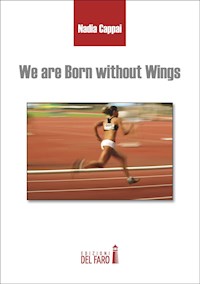
Cover Image: Running © Orlando Florin Rosu, Fotolia.com
Translation by Frances Scott
http://www.edizionidelfaro.it/
https://www.facebook.com/edizionidelfaro
https://twitter.com/EdizionidelFaro
http://www.linkedin.com/company/edizioni-del-faro
We are born without wings.
In a cold night full of stars and promises
or at the rosy dawn of a warm lazy day
we are born without wings and without dreams.
Who, in life, believes in dreams
takes flight and loses themselves in the blue.
To my Husband, and my Children
We are Born without Wings
Prelude
My mother did everything possible to bring me into this world on a beautiful March morning.
The intense fragrance of the flowering mimosa filled the rooms, the grain was sprouting in the fields, the birds songs were consoling, but she didn’t succeed, despite a whole night of labour.
I was born at dawn the following morning, blue in the face and already with one foot in the grave.
The midwife, my grandmother and my father won’t have looked at me with love when the doctor managed to tear me away from that magical pod where for nine months, perhaps, I was already dreaming of being able to fly one day or the other.
Everyone’s comments, when they did decide to clean me up and dress me, were regarding the misfortune of that poor woman, as white as a sheet who, after a birth of the kind wouldn’t be able to have any more children and the bitter prediction of my brief future.
***
«Little one, how thin she is. She’s breathing with difficulty. Doctor, what do you say, will she make it?» Nanni asked the doctor timidly, tired and worn out by such a difficult birth.
«I’ve seen very few who make it to the following day, in these conditions! Listen to me, don’t build up your hopes too much, we needed oxygen and an incubator, but by now it’s too late to rush to the hospital. I am so sorry Nanni, truly.
***
On his way out the doctor advised my father to pray and my grandmother not to lose sight of me for one moment.
But my father didn’t pray, he had never prayed, and my grandmother went, as usual that morning, to waken the men, open the chicken house and prepare breakfast for all those who, before long, would be off to sweat in the fields.
***
When he awoke from a brief nap, Nanni noticed that he had fallen asleep on the chair beside the bed where his wife was resting, stunned by the sedatives and the disappointment.
The newly born, lying by her side, violet in the face, was breathing with immense fatigue. At every slow breath there was imperceptible grimace on the little one’s face. On nearing the ear to the small breast, the heart seemed to beat every now and again and with irregularity. Not knowing what to do, trembling with desperation, Nanni began to blow his own breath through the little mouth, with delicacy and fear.
Every now and again, tired, he stopped and massaged the breast of that fragile little body with his hands, as delicately as possible.
While he was caressing the so very thin skin, Nanni spoke to the baby. He was telling her all about life and all that she would lose if she were to give up.
The colour of the sky at dusk, the rustling of the trees in the wind, the stars like diamonds in the moonless nights, the fragrance of the mimosa outside, the summers yellow as the grain, the warm winters under the covers.
Then he went back to blowing and he hoped to blow a little of his life into these idle lungs, a little of his anger into these little veins, a little of his courage into that tiny heart.
When everything seemed by now useless, the little girl had a jolt, and immediately afterwards, gave a small cough.
A regurgitation of brown sticky liquid slid out of the half open mouth, staining her vest.
Then the little one cried.
A long whimper, strangled at the beginning.
Immediately after much stronger, decisive and desperate from hunger and cold.
Nanni too was crying while he handed over his little daughter to his wife who, pulling herself up on her pillows with great fatigue, tried to attach that little mouth which had come back to life, to her dark nipples.
***
Life was gifted to me by two people who, believed to be lucky, due only to the fact that they existed, despite the fatigue, the poverty, the uncertainty of the present, the fear of the future. They, by holding hands, knew how to fly, they both had wings.
My father, at that time a miner, loved nature passionately.
He contemplated the miracle of creation in every bud of a plant, in every newly born animal.
And in the bowels of the earth where for years he consumed his health and youth he didn’t let his soul be destructed by the sadness of his work.
He managed to survive by consoling himself with the thought of his beautiful wife, Valeria, who waited for him and his daughter who was growing just as he desired: strong, courageous, kind and a dreamer, just what was needed to take life with infinite enthusiasm.
My mother, a dressmaker, knew how to carry out miracles, besides with a needle and thread, also with the little amount of money from her husband’s salary.
She dressed us all, for me coloured ambitious dresses, for my father fustian trousers and every possibility of shirts, suits of the latest fashion for herself, so as to make her friends jealous and always attract new customers.
She sang during the day while she sewed. I’ve always heard her singing, with a slightly trembling voice, but in tune and expressive.
One Saturday evening my father returned home from work with a huge parcel. It was a radio for her, so as not to feel too alone, to listen and learn the latest songs. My mother jumped for joy and they hugged each other.
I couldn’t understand why there was so much excitement, I had never seen a wooden box like that. They sent me off to my grandmother so she could explain to me what a radio was, telling me not to return before one hour. My grandmother, patient as she was, who probably had never touched one in her whole life, tried to invent and explain to me the miracle of hearing the voice of the people inside that strange wooden thing, which illuminated with the turn of a knob.
***
The nearing sixties opened a door for everyone. The women shortened dresses, they wore high heels, they discovered eyeliner, back combed hairstyles.
They all imitated the posture, the elegance of the great Italian and American actresses followed with passion at the Sunday afternoon cinema.
The men carried out enormous sacrifices in order to buy a Vespa or Lambretta, they covered their hair in brilliantine, they listened to the football match with the transistor attached to their ears.
Hunger and misery left the homes and there entered, together with hope, the fridge, the hairdryer, the radio and the television.
There was a procession in the evening after dinner to go to someone’s house, with chair in hand, to see a performance. The houses were filled up with smiling people, excited for the evening in front of the TV, where a film, or a comedy or a quiz transmission heated their souls with comments, laughs and, sometimes little cultural disputes, which the host tried to calm down with glasses of wine for the adults and sweet lemonade for the little ones like me.
No-one was rich but everyone was happy because, finally, with a little sacrifice, it was possible to save a little and one could look ahead, without fear.
No longer only bread, managing to survive, but finally the resources for their dreams found space in their wallets.
It was necessary to know more, to make progress, to free oneself.
School was no longer seen as an obligation to be respected by law or a deprivation of support to the family for the arms which escaped from the fields, but as an unique opportunity of liberation and an enrichment of one’s own intellect.
At that time even the people who didn’t know how to read and write found not only the will, but a sincere enthusiasm to learn the first elementary rudiments, thanks to a TV transmission conducted, late afternoon, by a very humane and understanding
gentleman with a kindly face.
Absolutely without shame, of the uncertainties and the wonder of the far away mature scholars.
Chapter 1
Nanni contemplated bringing up little Marta with love and pride.
The child, tall, minute, very agile and very restless, jumped about in the fields from morning to night like a baby goat. Little inclined to respect the rules and as far as obedience goes, forever in punishment at home and at school.
A child unaware of being in love with life with lots of dreams in her head which often were confused with reality, resulting in the appearance to the eyes of others, a little strange, hard headed and on occasions, impertinent.
Valeria reproached her husband nearly daily:
«You spoil her, you never reprimand her, she’s growing up like a savage!»
She was ironing on the kitchen table and she blocked her husband with a severe tone of voice while he ran into the house to get the ball to throw to the child who was playing in the garden.
«Yes, maybe you’re right, but look how happy she is. Don’t you hear her laughing all day? She will have time to worry.»
«Yes Nanni, but education is fundamental at this age. She doesn’t know how to stay seated, she eats like a little animal. At school she’s a disaster. She’s 7 years old and she gets dirty like a 2 year old. Always in amongst mud, dust or even worse climbing trees like a tomboy.
And then the lies, she tells you things that don’t make any sense.»
«But they’re not lies, they’re her stories, which she invents with me at night, in bed, before she falls asleep.»
He tried to embrace his wife, but she was agile in escaping him by ducking down quickly. Now he had her in front of him with her arms folded and an angry face.
«Yes, but she pretends they are real and then it’s me who has to make a mend when they are unmasked by her friends or the teacher.
Look it’s just not right, not right at all!»
She was agitated and her chest became violet, as usually happened in these circumstances. Nanni knew this reaction very well and also knew that it was the limit, one which he should never exceed.
He went around the table and sat down in front of the woman, who with her head lowered continued to pass the iron skilfully over a shirt collar.
He was lost in his thoughts, watching his wife’s quick hands handling one of Marta’s dresses.
His Valeria, was a sweet and sensible woman, but also strong and determined.
Reflective, serious, a woman who wouldn’t lose time in gossiping.
She always knew what to do and her choices were always the most intelligent driven by a strong sensibility.
A woman who knew her place.
Never excessive in her speech or the way she dressed, or in her appearance towards others. Also with her emotions.
She was jealous of her own emotions, which she managed to dominate skilfully so much so, as to seem unpleasant and for those who didn’t know her well, almost a little arrogant. She seemed never to want to lose control of herself and it was difficult for her to abandon herself to a sudden embrace, a spontaneous secret or a bout of anger.
It wasn’t easy for her to let herself go, open her heart to share suffering, grief and when she was troubled she preferred to stay away from others and close herself in a defensive silence, waiting for the turmoil of impulses to calm down in the slow flow of daily life.
She protected herself like this, lifting a glass wall on the world.
No-one could touch her and she would remain there behind, for hours, for days, watching silently who was waiting for the barrier to breakdown.
Nanni, patient, left her alone.
He knew how to wait.
Without getting agitated, without asking questions, because this was the way to do it.
He loved her also for this.
He persuaded himself that this wish to disappear, the fear of speaking, could have been the effect of the loneliness she suffered as a child.
Valeria had grown up outside the family, taken away by an older aunt, childless, to whom her mother had turned to ask help. A woman without a history, saddened by sterility, put aside by her relatives.
She, blushingly, had accepted the proposal, happy to look after the child with the illusion of a late maternity and to alleviate her younger sister, exhausted, from the fatigue of working in the fields and from the strain of bringing up three, still small, children, born at a brief distance one from the other.
The sufferance undergone for having been far from her mother, at only four years old, for having been torn away without reason from the confidence of her world, had made the woman’s sentiments and affection vulnerable which Nanni was now looking at while she was folding the ironed clothes with care.
Valeria didn’t like discussions, angry voices, separation from the people she cared for. She continually needed to be reassured, through words, caresses or the simple calm presence of the person near to her.
It was, without a doubt, the weakest aspect of her character and the one which Nanni sincerely loved the most, because that fragility made him feel important, unique, indispensable to their serenity.
«Alright, come on don’t get angry. As from tomorrow the music will change – Nanni said whimpering – I promise you that I will get her on the right tracks. At school, though, it’s not true that she’s a disaster, she’s very good. She knows her tables better than anyone and she resolves her arithmetical problems in a flash. She writes some beautiful little stories, the teacher told me yesterday when I went to pick her up.»
«Yes, but the teacher didn’t tell you that in order to read them you’ve got to do a gymkhana between sodden blotches, ink and who knows what else. Her exercise books are all creased and her diary, by now, is a mess, without a cover and she still needs to use it for two years!»
Nanni nearly burst out laughing, but he thought better of doing so.
Valeria, for some time had been agitated and irritable, things weren’t going well at home, due to the strikes in the mine.
Salaries were reduced and little money was hard for all.
Her worries were real since the money she usually managed to earn by sewing, by now, was very little and they had debts to pay for the house and the little furniture they had bought to make it look decent.
«Nanni, what are you doing, are you going out tonight too?»
«Yes go on, I’ll meet my friends for a little at the Club. We’ll have a drink and have a game of “briscola” and I’ll be home soon, as tomorrow I must get up at six o’clock.»
It was a lie.
Nanni wasn’t going to the club, he wasn’t meeting his friends to play cards.
It was a few weeks now that he was going, only quickly, to say hello to some friends and then take the road that went on to the seat of the PCI, where Celestino, head of the group, led the men and convinced hearts towards the popular left wing doctrine and to the workers organised resistance.
There had been many strikes in the preceding years, especially those against individual piece-work, which the small emerging mining trade union saw as an instrument of coercion by the owners of the company.
Celestino, a miner himself, lately had been heating the souls of his workmates with the memory of the burning defeat which hadn’t stopped that perverse mechanism instated by the company, whereby, if one did not reach the results requested, by the way, with very little extra pay, they would be blamed for scarce output and put on to the dismissal list.
In the preceding months, mobilisation and demonstrations had come about against the unjust measures emanated by the Mining Company who punished the workers with salty fines, if found getting their breath back during working hours. More strikes and accusations to the mining district for the lack of recognition for the heat indemnity1, foreseen by the mining law, which wasn’t applied, because the maximum levels foreseen by the same law had not been reached when, all were well aware that the supervisors were under pressure by the Head office to register temperatures inferior to the existing ones.
1 Work should be carried out with a minimum temperature of 34 and a maximum of 42 degrees. If 42 degrees were exceeded, the “heat”, according to the contract, should be subject to an additional indemnity.
Abstention from work, which despite all efforts, finished unsuccessfully. Concluded painfully due to the miners exasperation and fatigue after months of uninterrupted demonstrations which cost sacrifice, renunciation, and in many cases hunger.
The mining company went ahead with its projects and had, with the many dismissals and retirement incentives, reduced the mining organic by more than one thousand units, declaring on more than one occasion to maintain the site in life for social more than economical reasons. It was obvious, to everyone, that the company intended to close definitively.
The coal deposit was running out and the quality of the brown coal was becoming poorer.
Two shafts had been closed and the cultivation of the remaining three substituted from the system called “filling” whereby the empty spaces left after extraction were filled in with external material, usually earth, to the system called “roof collapsing” whereby the empty spaces were filled in through explosions in the gallery roof, much more economical, but tremendously dangerous as far as fire and landslides were concerned.
From two thousand five hundred miners, now there remained little more than one thousand two hundred, descending into the unhealthy bowels of the earth, divided in three shifts, as usual with prolonged hours and superficial security regulations.
There was Celestino, on his feet, with his shirt sleeves rolled up to the elbows and the endless cigarette between his fingers, addressing his workmates as well as members of the party, with a deep tone of voice.
«It’s years that we’ve been suffering hell. We must continue to fight. Fellows, I want to remind you continuously, our lives have deteriorated, work has increased and without the just pay, without the right security! We risk our lives every day when we descend the shafts, at every blow of the pick we make on that black sweaty wall. We must continue to fight. For our lives, as well as those of our families!»
«Right! We can’t take it anymore!» thunders Mario’s powerful voice, Nanni’s workmate as well as his best friend.
He was the tallest, touching one meter ninety, the most powerful, he could lift a ton with ease and also the most generous of souls. He was the one that would sacrifice himself for others and he would voluntarily offer himself for the more heavy and risky jobs. He was always first in line because, as he continuously repeated, if he were to die he wouldn’t leave a widow or orphans.




