


Erhalten Sie Zugang zu diesem und mehr als 300000 Büchern ab EUR 5,99 monatlich.
- Herausgeber: The Poetry Business
- Kategorie: Poesie und Drama
- Sprache: Englisch
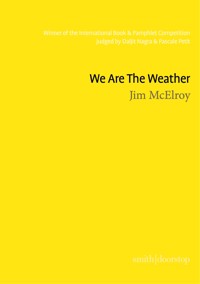
We are the Weather is a mature and coherent first collection by a distinctive and compelling writer. The poems present vivid and often pungent scenes of rural life in exuberant and hardworking language, with childhood and family relationships at their heart.
Sie lesen das E-Book in den Legimi-Apps auf:
Seitenzahl: 24
Veröffentlichungsjahr: 2022
Das E-Book (TTS) können Sie hören im Abo „Legimi Premium” in Legimi-Apps auf:
Ähnliche















Published 2022 by
Smith|Doorstop Books
The Poetry Business
Campo House,
54 Campo Lane,
Sheffield S1 2EG
Copyright © Jim McElroy 2022
All Rights Reserved
ISBN 978-1-914914-06-5
eBook ISBN 978-1-914914-07-2
Typeset by The Poetry Business
Printed by People for Print, Sheffield
Smith|Doorstop Books are a member of Inpress:
www.inpressbooks.co.uk
Distributed by NBN International, 1 Deltic Avenue,
Rooksley, Milton Keynes MK13 8LD
The Poetry Business gratefully acknowledges the support of Arts Council England.
Contents
Hoor
The Oak Tree
Doodlebugs
Bully
Sacrificed
Coal Hole
The Attic Room
Hard Knocks
Spray Gun
Sheep Carcass
Pouring the Yard
Weatherbeaten
The Auctioneer is Selling Our Cow
Enough
Noirish
Audit at the Slaughter House
His Work
Everything Related
The Crows
Shit Happens
My Father’s Store
Unmaking His Chair
Second Chances
A Message from The Dead
i.m. Bernard McElroy 1927–1990
Hoor
He called Widow Welsh that poor oul hoor,
in winter he’d send me up with fresh eggs;
next door, Joe McNab was tight oul hoor,
said he would count every bleedin’ penny;
the right oul hoors lived on the Rock Hill,
I was let play with their right wee hoors.
Passing pedlars, scammers, were all cute hoors,
the tax man, a connivin little hoor’s bollix.
I followed his hobnail crunch, oily overalls,
round the farm, annoyin his hoorin head:
too many questions, go ask your mother.
At school, if I passed exams, he gave me
right quick wee hoor. Out on the moor,
neck veins bulging like baler twine,
he’d scrum hug boulders into position,
build ditches; at stubborn stones, sleeve
off brow sweat, stare at its granite belly,
christen it a heavy oul hoor; over lunch,
on top of stones, he’d share out soda farls,
cheddar slabs, pour our cuppa tay, tell me
thank your Mother; as he lit his pipe,
he’d point out hedges needing trimmed,
the opening crops: ripening corn, barley.
When I left for the city, autumn’s thresher
was gulping sheaves of wheat; I watched him
grimace as he kneed obese seed bags up
to the trailer; through the belt slew, baler hum,
he yelled mind yourself, to watch out for all
them cute hoors. Later that winter, the switch
put her call through, told me, your mother’s
on the line – I was to come home quick.
Still in his overalls, he lay on the bed; fresh
muck clung to his hobnails: right oul hoor
found him slumped over granite; I bent down
for our first kiss – his hoorin head, cold as stone.
The Oak Tree
In the field, we climbed into the oak bough.
The eldest took the bow-saw to its crown.
Branches splintered off, whished to earth,
became farm machinery that we attached




