


Erhalten Sie Zugang zu diesem und mehr als 300000 Büchern ab EUR 5,99 monatlich.
- Herausgeber: Parthian Books
- Kategorie: Gesellschafts- und Liebesromane
- Sprache: Englisch
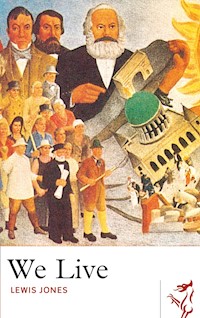
We Live takes up Len's tale, in which he is influenced by Mary, a teacher, and the Communist Party, which becomes central to his work both underground and in union politi, and to his decision to leave and fight in the Spanish Civil War.
Sie lesen das E-Book in den Legimi-Apps auf:
Seitenzahl: 644
Veröffentlichungsjahr: 2014
Das E-Book (TTS) können Sie hören im Abo „Legimi Premium” in Legimi-Apps auf:
Ähnliche



















Contents
About the authorTitle PageFOREWORDWE LIVECLOUDS OVER CWMARDYANOTHER VICTIMTHE LOCK-OUTCONFLICTING LOYALTIESBACK TO WORKTHE BREAKING OF A FRIENDSHIPSPEED-UPSTRIFE IN THE VALLEYNIGHT ON THE MOUNTAINPREPARATION FOR TRUGGLETHE BIG STRIKELEN GOES TO GAOLMARY JOINS THE PARTYBREAKING POINTEZRA’S DEATHLOCAL POLITICSA SEAT ON THE COUNCILTHE UNEMPLOYEDCWMARDY MARCHESSTAY-IN STRIKEA VICTORY FOR THE WORKERSA PARTY DECISIONA LETTER FROM SPAINForeword by Hywel FrancisLIBRARY OF WALESCopyright
Lewis Jones was born in Clydach Vale in 1897. He started work underground at the age of twelve in the Cambrian Combine Colliery, which was central in the famous 1910-1911 strike that culminated in the Tonypandy riots. Jones absorbed the syndicalist philosophy of direct action and workers’ control by which he was surrounded, and, in the Central Labour College which he attended in London from 1923 to 1925, the Marxism that led him to join the Communist Party. Jones became a full-time worker for the National Unemployed Workers’ Movement, and led a number of the famous hunger marches of the 1930s from Wales to London. He was elected to the Glamorgan County Council in 1936, and died of a heart attack in 1939, after addressing numerous public meetings in support of the Spanish Republic.Cwmardy(1937) andWe Live(1939) are his two epic novels of the experience of South Wales from the 1890s to the 1930s.
WE LIVE
LEWIS JONES
LIBRARY OF WALES
FOREWORD
Some notable Welsh public figures were once asked to choose their heroes and give a radio lecture about them. The writer Gwyn Thomas chose Lewis Jones, a seemingly long-forgotten leader of the Rhondda’s unemployed. Gwyn talked memorably about Lewis’ refusal to jump through other people’s hoops. All the time I puzzled over the phrase and what Gwyn intended it to mean – for Lewis.
Having been brought up in a ‘communist’ family I was not unfamiliar with the facts of Lewis Jones’ remarkable life: Labour college student, imprisoned in 1926, Cambrian Colliery checkweighman, victimised union activist, leader of several hunger marches, remarkable orator, Communist councillor and proletarian novelist. He was even capable of holding an audience of over a thousand people for two and a half hours with his lecture ‘The Social Significance of Sin’.
All that was packed into a life of just forty-two years. He died in 1939 on the day that he had addressed over thirty meetings in support of the besieged Spanish Republic. To many he was a hero and a martyr.
At about the same time as I heard Gwyn Thomas’ radio broadcast I spoke to Billy Griffiths, close friend and comrade of Lewis, who had served in the International Brigades in Spain. Imagine, he suggested, the British Communist leader Harry Pollitt coming into Judge’s Hall, Tonypandy. The packed hall would of course stand in respect. Imagine, then, he said, attending the Seventh World Congress of the Communist International in Moscow in 1935. Stalin arrives. The thousands in attendance rise. Everyone except Lewis, who was one of the small band of British delegates. He was sent home in disgrace and disciplined by the British Communist Party. Some say he was overwhelmed with emotion and could not rise; others said he was too busy reading a novel or a comic and could not be bothered. I prefer to accept a further explanation: he did not believe in the cult of personality and believed that no one should be worshipped, least of all Stalin. Some say he was capable of all three responses. Take your own pick. Certainly, for me, the deeper reason and how Lewis manifested it fits best.
He was a maverick in the best sense of the word. Born illegitimate, he was shaped by riotous and cosmopolitan Tonypandy. He married young, enjoyed the company of men and women, could never be a party ‘apparatchik’ and would never jump through other people’s hoops. His was a discordant revolutionary voice like that of Federico Garcia Lorca, Aneurin Bevan and Antonio Gramsci.
I still remember sitting with Billy Griffiths in his home in Dunraven Street, Tonypandy in November 1969, in the very room where Communist Party meetings took place in the 1930s – meetings that are so vividly described in Lewis’ two novels. Billy Griffiths spoke with difficulty, as he was suffering badly from emphysema. Among all the interviews I did as an historian, his description of Lewis Jones remains the most powerful evocation of one man’s purpose in life, and it explains why Lewis Jones the novelist is important to us today:
His main quality I think was love of people and compassion, it superseded everything else. I have seen Lewis… sitting down listening to two old people telling him about their troubles, and tears running down his cheeks. That’s the kind of man he was, he felt it, it was for him more than logic. The rules that could do nothing for these people had to be broken, understand? …. I remember recruiting people, we had a meeting here for some people to go to Spain. We used to have a long table here and Lewis sat in by there, by the fire, and I was trying to interest people to go to Spain…. And when they had gone out, Lewis got up in the end, he couldn’t stand it any more, he said: ‘You’ve no right, to do that, to get the young boys to go there and die…’ You see it was more important than the politics, [it] was the humanism and compassion… it was this that people loved about him….
His powerfully evocative speeches painted such vivid pictures of his people’s individual and collective struggles it was thought that he would make a natural novelist. That was the view of Arthur Horner, the President of the South Wales Miners’ Federation. Lewis acknowledged this in his foreword toCwmardy, referring to Horner as ‘my friend and comrade… whose fertile brain conceived the idea that I should write it’. According to Lewis, Arthur Horner ‘suggested that the full meaning of life in the Welsh mining areas could be expressed for the general reader more truthfully and vividly if treated imaginatively’.
And that, expressed in Lewis’ own words, is the essence of both the work and the man for us today. He was the ‘people’s remembrancer’ who had also contributed actively to the people’s chronicle. In that sense Lewis Jones is unique in the political culture of Wales in the twentieth century, standing alongside only Saunders Lewis (and what an intriguing contrast) in combining political activism with literary aspirations and, indeed, with literary achievement. The difference between the two, however, was that Lewis Jones was directly of the Welsh working class and gave voice to their pain and suffering. For that reason he stands apart from all other activists and writers in that remarkable generation of self-educated working class men and women, the organic intellectuals who provided local and national leadership for communities broken by economic depression. He wastheorganic intellectual of the South Wales valleys in the inter-war period.
I suppose the people inCwmardyandWe Livehave resonance for me because I feel I knew many of them. Big Jim, Len, Siân were an amalgam of many of Lewis’ friends. I knewthemtoo – albeit a generation later. Jack Jones, the Rhondda miners’ agent, and Will Paynter, later general secretary of the NUM, were both International Brigaders, and frequent visitors to our home. Mavis Llewellyn and Annie Powell, schoolteachers and councillors both, were also well known to me because they too were my father’s ‘friends and comrades’. They all come alive again when I read Lewis’ two novels. My first acquaintance with the novels, in the late 1960s, occurred when I was beginning my research into the Welshmen who fought fascism in Spain by joining the International Brigades. It was at this time I met Dai Smith. We read the books at the same time. Fresh from New York, he was hoping for a Joseph Conrad; I was looking for a Will Paynter. The characters for him were somewhat stereotyped; for me they were ‘flesh and blood’.
The only conversation which compares with the one I had with Billy Griffiths in 1969 was one I had with Mavis Llewellyn in 1972. Lewis and Mavis had been ‘close’ in a way that was a problem in the puritanical communist world of the South Wales valleys in the 1930s. Mavis explained to me that when Lewis diedWe Livewas incomplete. The last two chapters – ‘A Party Decision’ and ‘A Letter from Spain’ – were essentially hers, and that is why the voice is softer, more poignant, more reflective. The description of the relationship between Mary and Len is a description of their own relationship.
When in the 1970s and 1980s I wrote about the political pressures and sacrifices of those who went to Spain, and argued that there was an ‘inner party conscription’, my research was disputed by some in the Communist Party, but the survivors from Spain only needed to point to their tribune, Lewis Jones, for confirmation of that truth, and for confirmation of the deep and troubled circumstances that had made it true.
‘The full meaning of life’ is surely given in these novels.
I agree with Gwyn Thomas’ words to me on the occasion of a Llafur Day School in the Rhondda which first re-launched the novels back in 1978: ‘Any residual dust left from the passing of that astonishing star should be cherished.’ Cult of the personality? Read the books and judge for yourself.
HywelFrancis
WE LIVE
CLOUDS OVER CWMARDY
The wind howled over the mountain and swept down on Cwmardy as though chased by a million nightmares. Dark corners roared and whistled when they encountered the onslaught, while telephone wires twanged under the pressure. Street lamps turned the moisture into miniature rainbows that glistened on the slimy road. The tumult echoed high up over the valley, where the tempest spied the fissures in the mountain and battered its way in, to return with increasing fury on the village beneath.
A tall smokestack stuck its head through the ruddy glow of the pit furnaces, too proud to notice the clamour of the storm, above which sounded the ‘chug-chug’ of the pit engines, broken at short intervals by a ‘clanketty-clang’ as the pit spewed two trams full of coal into the storm and sucked two empties out of it. The wind howled more loudly still at the theft, but to no avail; for immediately the empty trams were in the grip of the cage it tore them from the elements and plunged them into the blackness of the pit. The heavy wooden droppers on the shaft-head beat back the chasing wind and rain, which sought revenge on the houses lower down the valley.
The little lights in the cottage windows of Cwmardy winked at the storm, inviting it to burst open the doors and share with the family inside the cosy heat of the open fireplace. Behind one of these windows an old woman sat patiently darning a sock. Her drawn face, with its yellowish skin, reflected the shadows from the fire, before which she sat with parted knees. A huge man was stretched languidly in an armchair nearby. His slightly bowed shoulders and silver-streaked hair betrayed advancing age, and his face was remarkable for its long, stiff moustaches and the black scars that emphasized its lines.
For about the twentieth time in as many minutes the old woman raised her eyes from the wool in her lap and looked towards the window, down whose cracked panes the water streamed.
‘I wonder what in the world our Len and Mary do want out on such a night as this?’ she muttered disconsolately. ‘They will be sure to get wet to the skin, and with her bad chest that will mean pewmonia so sure as God is my judge.’ She stopped for some moments and listened to the squealing storm, while the old man grumbled a curse at the smoke which every now and then belched from the chimney into the kitchen where the old couple were sitting.
After a while she turned her attention to her companion. ‘Fitter if you went out to look for them, James, instead of sitting by there on your backside, like if they was safe and sound in the house and you didn’t have a worry in the world,’ she complained. Jim looked at her a moment, then spat heavily into the fire before replying.
‘Huh! What you talk about, ’ooman? If the son of Big Jim is ’fraid of a little drop of water and a little puff of wind, it is time for you to ask what is the matter with you,’ and with this trenchant remark he placidly resumed his pipe.
The steel-rimmed spectacles on the tip of her nose quivered with her indignation. ‘Shame on you, James, talking ’bout your only son like that! But there, I do only waste my time talking to you. Huh! It is all right for you to talk, with your body so big as a bull’s and your head just so dull as one.’
She got up from the chair and went to the door, which she opened just wide enough to push her head through; but though she shouted her son’s name at the top of her sharp voice, it got lost in the wind even as the cry left her lips. Big Jim turned his head and growled.
‘Shut that bloody door, Siân fach, or this smoke will make me into a kipper. There’s nothing for you to worry ’bout, mun. I ’spect they have gone to a meeting and ’on’t call here ’cos it is too rough to come up the hill.’
Siân banged the door and shuffled back to the chair, her unlaced boots flapping on the stony kitchen floor with every step.
‘That’s how you men always is,’ she grunted. ‘Always your own comforts first, never mind ’bout nobody else. No, not even your own flesh and blood. Well, well! There have never been such a night since the ’splosion, and there you be, James, so happy as a tomcat on the tiles, knowing all the time that they are out in the middle of it.’
This brought him erect in his chair. ‘Hell-fire, ’ooman! Have I not told you they is safe enough? You be nuff, mun, to give a man the bile and diarrhoea all in one. And you do call this a storm – ha, ha! It is nothing but a sun shower. Good God! I ’member once in Africa––’
Siân forestalled the threatened reminiscence. ‘I don’t want to hear nothing ’bout your old Africa or your storm. No. Pity it hadn’t took you then; it ’ood have saved me a lifetime of worry and trouble.’
She bent her head and went on with her darning, raising her eyes every few minutes to glance at the ticking clock, whose rhythmic monotone for some time dominated the kitchen. Big Jim went on smoking contentedly, occasionally spitting into the grate and twisting his soap-stiffened moustache with a slow, dignified twirl. He looked up once at the garishly painted almanac on the mantelshelf, and a distant look stole into his eyes when he remarked:
‘Duw, duw! The years is slipping by pretty quick now, Siân fach. Only the other day us was in the middle of the ’splosion, and here it is 1924 already. The years are going over our heads like months, muniferni.’
Siân glanced from her darning to reply softly: ‘O Aye; you are right. Us is getting on now, James bach, and the earth will soon be calling to us.’
Outside the house the storm seemed to have swept the streets clear of humans, but the structure known as the Fountain on the village square glistened as the lights from the Boar’s Head chased the shadows over its body of rusted iron.
Ben the Barber’s doorway looked like a black blob painted into the darkness stretching beyond the rim of light cast from the windows of the Boar’s Head. But occasionally the blob was pierced by a tiny gleam as the two policemen crouching within the door exposed a button. Both were well protected from the storm, but this did not prevent the moisture dangling from the end of their noses. The taller of the two raised his head from the keyhole for a moment to whisper excitedly: ‘I’m sure I heard something about lock-out.’
His mate merely growled:
‘Huh! I wish they’d pack up for the night. Perhaps we could sneak into somewhere dry, then.’ He noticed the other’s head still lifted from the keyhole, and broke off his grouse to say: ‘Keep your bloody head down, mun, or we might lose something important, ’specially if you heard right about the lock-out.’
The other obeyed, at the same time retorting: ‘Huh! What do that matter? We can always put it down in the station the same as if we have heard it, can’t we?’
A shuffle of chairs came from the room and he sprang erect immediately, with a sibilant warning. ‘Sssh! They’ve finished and are coming out.’
His mate, draping the cape more closely about his shoulders, hastened towards the Fountain to be pulled up sharply.
‘Not that way, you fool. You’ll be right in the light there.’ He hurriedly retraced his steps and the two had hardly pressed themselves into the black recess of another doorway when a number of people came out of Ben the Barber’s.
One of the men muttered to the woman next him, as he buttoned his coat up to the neck and watched her do the same: ‘Good God, what a night, Mary!’
‘Aye, Len. Terrible, isn’t it? We’d better run or we’ll be soaking long before we reach your mother’s.’
He caught her arm and both ran into the driving rain, burying themselves in the darkness beyond the Fountain. Half-way up the hill they came to an involuntary stop, panting and dripping. Len put his arm round the thin shoulders of his wife as he heard her breath wheeze in her throat, and gently drew her small form into the shelter afforded by the pine end of a house. A racking cough suddenly tore at her chest, and he helped her wipe away the stained sputum that wetted her lips, his slim body nearly hiding hers.
After a while she broke the silence that had followed the fit of coughing, her voice still harsh with the strain.
‘I’m sorry I went to that meeting.’
He stooped a little to peer more closely into her face as he voiced his surprise. ‘Sorry? What have you got to be sorry about, Mary?’
‘Oh, I don’t know. Only I thought, when you asked me to come, we were going to hear something definite about all these rumours of a lock-out. But instead of that, all I’ve heard is blabbing about revolutions and politics.’
He drew himself up in a hurt manner, his arm still about her shoulders. ‘Half a minute, Mary. Don’t say that politics is nonsense. Didn’t you hear the chairman say that politics is everything for the workers? Good God! If we had more politics we wouldn’t be in the hole we’re in now.’
She interrupted him petulantly. ‘Oh, shut up for goodness sake! You take everything that Harry Morgan tells you as if it was gospel. You make me sick, Len. Here we’ve been talking all night about revolutions, when very soon we might want all our strength to face the lock-out that is coming if what our women say is true.’
Her words stung him and he lost his temper. ‘Aye, women’s cackle – with their arms folded on their bellies, while we are in work! Huh! You’d sooner listen to rubbish like that than to sense the same as you had tonight. But I don’t care a hang! You can say what you like, I’m glad I joined the Party tonight.’
She looked up into his face, and even in the darkness he saw the whites of her eyes gleam as she said: ‘Aye, I know that. But what else could I expect from a husband whose head is as soft as his heart?’
Len swallowed audibly and tried to say something, but the words wouldn’t come. He was used to her vehemence, particularly when she felt something deeply, and had only asked her to the meeting in the hope that Harry Morgan, the Party leader, would have shaken the convictions bred in her by Ezra Jones, her father, the local miners’ leader. He was himself susceptible to the same influence and always hesitated when they combined forces against him in an argument, although he never admitted this fact even to himself.
To cover his discomfiture he suggested that they proceed, and neither of them said any more as they plodded up the hill. They entered Siân’s house without knocking; but the old woman looked up from her darning when she heard the latch rattle.
‘Huh! Fine time of the night, indeed, for a young stripling of a boy to be out,’ she began, at the same time making place for them near the fire. ‘When I was your age, my boy, I ’oodn’t dare to be out after seven o’clock, and here you strut in with Mary fach and her bad chest at ’leven ’xactly like it was first thing in the morning. You ought to be ashamed of yourself, Len.’
He said nothing, and squatted comfortably in a chair, but before he had time to settle down properly she ordered:
‘Come here. Leave me feel if your clothes is wet.’
‘Oh, let me alone, mam. We’ve only been to a meeting, and it’s bad enough to have Mary nagging without you helping her,’ he replied petulantly.
‘Ah, answering your only mother back, is it? Don’t forget my boy, when I was your age I ’oodn’t dare to look at my mother twice, let alone answer her back, God bless her!’ She raised the canvas apron to her nose. ‘But there. What is the use of arguing? Children today is too big for their boots and half of them don’t know they are born. Huh!’
She turned to Mary. ‘Take your wet clothes off, my gel, and put them by the fire while I do make a cup of tea.’
‘Don’t bother, mam. We’ll be going before long,’ Mary replied, at the same time drawing her chair up, and continuing: ‘What do you think have happened tonight?’
Siân interestedly cocked her ears up at once and Mary went on, without looking at Len, who wondered what on earth she was driving at.
‘Our Len have joined Harry Morgan’s Party.’
Siân gave a little scream: ‘What? Joined those infidels?’ She was overcome with emotion for some moments, during which Jim slyly opened one eye which he immediately closed when he saw her looking at him.
‘Wake up, James,’ she demanded. ‘Something awful have happened to our Len. Oh, Duw! After me rearing him tidy and ’spectable all these years and taking him to chapel every Sunday like a clock and now to come to this!’ She covered her eyes with her apron, and did not see Jim stirring awkwardly and blinking his eyes like a man suddenly awakened from a deep sleep.
‘How be, Mary fach. What is all this bloody fuss about?’ he greeted them.
‘Our Len have joined the Party,’ Mary informed him. ‘Huh! Well, that’s better than joining the militia, in’t it?’
Len smiled at the remark, knowing by it that his father was siding with him against the two women.
Siân turned to Mary. ‘There! What did I tell you? The man have got no shame in him. You can see now what I have had to put up with all these years. No wonder my hair have gone white years before its time.’
This statement stung Jim, and he drew himself erect in the chair. ‘Don’t you listen to all she do tell you, Mary fach. I have been man and wife to her for more than forty years, and she have got nothing to say against me.’ He lost his temper. ‘Hell-fire! What can I help if our Len have joined the Party. He haven’t kilt nobody, have he? No, by damn, and if I was only twenty years younger, I ’ood do the same as him.’ The challenge brought no response, so with many sighs and groans he stood up, and Mary let him take off her wet coat and arrange it on the brass rod over the fireplace.
Siân was busily buttering some bread when her wandering glance noticed thin spirals of steam ascend from Len’s trousers. She stared hard for a moment and bent her head to have a better look before declaring triumphantly:
‘There you are! Whatever I do say is always wrong, but now you can see for yourselfs. Look at that trousers, Mary. It is wet to the skin. Come on, my boy, off with it this minute.’
There was some commotion while Len, realising the futility of argument, changed into an old pair of his father’s trousers, which hung about him like a blanket. Thus satisfied, Siân called them to the supper table, and it was some time before the rattle of crockery and the crunching of homemade pickles was interrupted by her abrupt query.
‘How is your father, Mary fach? I haven’t seen him since old Mrs. Davies, Ty-top, was buried.’
Mary hastily swallowed the food in her mouth. ‘He’s not half well.’ Then, turning to Big Jim, she said: ‘I believe he’s worrying about all this talk of a lock-out. He went off early yesterday morning to see somebody or other, and he’s been moping like a bear ever since.’ She sighed. ‘I wish I knew what is the matter with him, but he won’t tell me or Len a word.’
Jim sucked the drops of tea from the end of his moustache with his lower lip, then commented: ‘Well, I don’t know what you do say about it, Len, but there’s something in the wind. Look how us was on stop today for more than an hour waiting for trams. It never used to be like that. No, muniferni! Aye, gels; I heard Shenkin the fireman tell Sam Dangler that they have closed two of the pits the other side of the mountain and have rosed the horses.’
‘Why is that, Len?’ asked Siân, now anxious to placate him. ‘I thought they did only rise the horses when there is going to be a strike or something like that, and I have never heard of a strike over the mountain. No, nor have Mrs. Jones, Number two, either, because she was talking to me today and she never said a word, although she have got brothers working over there.’
‘No, mam. The men are not on strike, but the owners say that they have shut the pit for good and are sending some of the horses over here and selling the others.’
Mary had remained singularly quiet during this conversation, but she now broke in sharply: ‘That’s what makes me so mad, and why I went to the meeting with Len tonight – worse luck. They’ll find work for horses. Aye, they’ll see to it they are not left to wander about the pit; but they don’t care a hang what happens to the men.’ Her voice rose passionately. ‘No, they’ll be left on top with no one to find work for them or to see that they are fed.’
Big Jim leaned forward in his chair and tapped her shoulder patronisingly with a huge forefinger. ‘Aye, aye, Mary, my gel, you is quite right. If old Cwmardy and the company do close down our pit, they will see to it that the horses is all right, but us will have to look after our bloody selves. That’s the way of the world, my gel. It have always been like that ever since I have knowed it, and always will be. What say you, Siân?’
It was Len who answered. ‘That’s one of the things for which I joined the Party tonight,’ he declared, glad for some reason to justify his action. But Siân only glared at him, and Mary opened her mouth to say something when the donging tones of the clock interrupted her. They looked at it simultaneously and Len got to his feet in a flurry, the ends of the trousers dragging under his boots. ‘Come on, Mary,’ he pleaded; ‘five o’clock in the morning will soon be here. I can call for my trousers tomorrow night after I come home from work.’
They all rose to their feet and the young couple, after bidding the others good night, left, with Siân admonishing: ‘Now, be careful where you do tread, ’cause it is the easiest thing in the world to break your necks on a night like this.’
Meanwhile two policemen in the station were slowly removing their waterproof leggings. One was too fat to bend sufficiently and had to wait until his mate could help him. ‘Ah,’ he gasped, straightening his tunic, ‘thank Godthatlot’sover.’
‘What lot – your leggings?’
‘No, you silly fathead! I’m talking about that bloody meeting.’
A head poked itself around the door of the mess-room in which the two officers were sitting, and a voice hissed: ‘Look out, boys. He’s just come in.’
The fat policeman gulped nervously, then said: ‘Funny for the old man to be around this time of the night. I thought he’d be safely tucked up in bed with one of his dames by now.’
‘Don’t you worry about them tales, mate. Old long ’un is more concerned about his duty and these bloody Bolshies that are springing up all over the valley than he is about women.’
The door opened and the two men sprang to attention as the inspector, followed by another uniformed individual, walked in. Their salute was barely acknowledged by the painfully elongated man who walked direct to the fireplace and then turned his back to the flames. From this point he scrutinised the remaining inmates of the room with eyes that were red-rimmed, as though he slept little or drank much. A short, bristly moustache emphasised the thickness of his lips, and he stared at his subordinates for some time with a fish-like, glassy look. When he spoke his voice was as thin as the hair he tried to spread all over his head.
‘Well, who was at the meeting?’
‘Harry Morgan, Fred Lewis, Len Roberts and his wife, sir––’
‘Yes – yes, hurry up and don’t eat your words!’ he snapped, gently stroking his posterior as the heat warmed his flesh.
The man so addressed coloured and hastened his recital of names. When he had finished, the thin man remained thoughtfully silent for some moments before saying: ‘Hmm. Len Roberts and his wife, eh? It seems this chap Morgan is beginning to spread his wings. Hmm.’
He looked up sharply to ask: ‘What did they say?’
The two policemen looked uncomfortable and fidgeted uneasily without speaking.
‘Come, come. Haven’t you heard what I said?’
The fatter constable drew himself erect and saluted again. ‘Well, it’s like this, sir. It was such a dirty night and the wind was howling so much that it was impossible to hear a word of what was going on inside except a blur of voices.’
The thin face before him turned from red to purple and a little time elapsed before the lips parted to bark out: ‘What? Do you mean to tell me you heard nothing? That you listen to a nest of Bolsheviks plotting sedition and have nothing to report?’
He swallowed hard, then turned abruptly from the flabbergasted constables: ‘Inspector, I want a full report of that meeting first thing in the morning.’
The inspector saluted and both left the room, but the discomfited policemen remained standing for a long while, both looking miserable and awkward.
At last the taller gave a deep sigh. ‘Ah well. The old man must have been upset about something. Perhaps he’s had a row with his old woman.’
‘Maybe. But that’s no reason why he should have his bang out on us. No good arguing about it now, however. The best thing we can do is to prepare that report.’
They pulled their coats off and drew the table nearer the fire.
Outside the station the wind still howled round the streets of Cwmardy, seeming to gather greater fury because the rain had deserted it. A group of men, their heads bent to the beating wind that ballooned their coats behind them like bustles, battled past the police station and its two busy occupants.
‘What a hell of a night!’ one remarked, his words partially strangled by the wind.
‘Aye, but we can be thankful the rain have stopped, or we’d be soaked long before we reached the pit,’ another remarked.
‘Not much odds about that. You want to see Dai Cannon’s heading. The water pours down from the top, and bubbles up from the bottom. Gee! And the stink – ugh! It’s like a thousand lavatories and polecats all in one. He’s got to work under zinc now to keep the water from his body.’
‘Ach! Zinc be damned! What bloody use is that to a man? He can’t carry it about with him from the face to the tram. Better for him to stick the water than try to dodge something that can’t be dodged.’
They continued to fight against the wind and presently one of them asked: ‘What’s all this talk about us going to be locked out?’
The reply came instantly: ‘By damn, they might as well shut the bloody hole for good for any use it is to us on the wages they pay now.’
Further conversation was lost in the noise of the pit- hooter, which suddenly split the air with reverberating blasts that echoed through the crevices of every house in the valley. The group of men hurried their pace in response to the command, and in a short time Cwmardy was left to the mercy of the wind as the clanking of hobnailed boots on stone died away.
ANOTHER VICTIM
The following afternoon Len wearily dragged his feet out of the pit-cage and was glad to find that the storm had blown itself out and a yellow sun was poking its thin rays through the murk of the valley. The sight and the cool air invigorated him and he wasn’t long reaching home, where Mary was busily cooking his dinner.
Before pulling off his dirty coat he asked: ‘Where’s your father, Mary?’
She looked up from the saucepan over which she was bending, and although her face was flushed with the heat from the fire, he noticed that her eyes were sad in the dark shadows that circled them.
‘I don’t know, Len. He’s been out again since early this morning.’ She paused and stirred the contents of the saucepan, then continued, without looking at him: ‘I’ve told him you joined the Party last night.’
Len stopped short, his coat hanging loosely from one arm. ‘What did you want to do that for?’ he demanded sharply. ‘But there, what does it matter? He was bound to know sooner or later.’
He went on with his preparations for dinner, and while she was serving it up he asked: ‘What did he say?’
She waited until she had shared the dinner on three plates, one of which she put on the hob, then answered: ‘I don’t know what he said altogether. Here, eat your dinner; we can talk after.’ She sat tiredly in the chair beside him and pecked at her food, leaving half of it untouched. Having finished his dinner, he noisily moved his chair back and reached up to the mantelpiece for a cigarette, while Mary poured him a cup of tea. He puffed away silently, trying to look unconcerned, but all the time watching her through the smoke that left his mouth, as she patiently began clearing the dinner things.
At last his impatience bubbled over and he again asked: ‘Tell me, Mary, what did he say?’
Her hands trembled fretfully when she replied: ‘Oh, for God’s sake don’t let’s bother our heads about that nonsense now!’ She went on with her work and after it was finished sat down, drawing her hand across her forehead. Len became immediately solicitous, and tried to soothe her. ‘Your head is bad, my dear?’ he queried. ‘Why don’t you take a powder and have a lie down. I can manage by myself now.’
The gentle tones made her ashamed of her irritability, and she looked at him affectionately as she replied: ‘It’s all right, Len. Only I’m worried about dad.’
She paused to wipe her perspiring hands on her apron. ‘I don’t know what’s coming over him. He’s getting more miserable every day and hardly touches a bit of food. Oh, Len, he’s breaking up fast and is not the same dad I’ve known in the past.’
Len, conscious of how deeply she loved her father and how she was affected by the change taking place in him, hardly knew what to say, but managed to murmur: ‘Aye, I’ve noticed him myself these last few weeks. It must be his age,’ he added consolingly. ‘Look at my old man – he’s getting so miserable that it’s hellish to work with him. We’ll be the same ourselves when we’re their age, I suppose.’ He tried to laugh, but the half-hearted attempt drew no response from his wife.
Len knocked the light off his cigarette and carefully put the stump back on the mantelshelf before going out into the backyard to fetch the tub, which he placed in the centre of the kitchen. This done, he pulled off his dusty shirt and wet singlet; then, naked to the waist, lifted the boiler of hot water from the fire and poured it into the tub, where Mary cooled it with panfuls of cold water. Bent double over the edge of the tub, he began bathing, and Mary gathered together the discarded pit clothes.
His head was a mass of black lather when he heard her say: ‘There have been more compensation cases here for you today.’
Len hurriedly swilled the soapsuds from his head and sat on the tub-rim while she handed him a towel. He wiped himself, but his hair was still damp, although his face was pink with rubbing. ‘Who’s been, Mary?’ he asked.
‘Oh, old Reuben and the boy with the broken back,’ she answered, washing his back vigorously, then taking the towel from him to use it herself.
Len stood up and, unbuttoning his trousers, let them fall about his feet before stepping naked into the tub.
‘Well, well,’ he said while he soaped his legs. ‘It’s a shame the way they’re mucking about with the compo people.’ Mary watched the ripple of the skin over his ribs as he raised water with his cupped hands to swill his legs.
‘Yes, you’re right, Len,’ she commented bitterly, her mind focused on the thin body before her. ‘The company have now offered them a lump sum each to square them off.’
Len’s amazement was demonstrated by the way he let his hands drop limply to his sides and looked at her, utterly unconscious of his nakedness. ‘What? Offered them a lump sum?’ He clicked his tongue against his teeth in audible disgust. ‘Well, well. That means the rotters want to wash their hands of them, now the poor dabs are no use. No wonder your old man is worried, by damn.’
He came out of the tub and began dressing in his evening clothes. He had already pulled the clean shirt over his head, when a new idea entered his mind.
‘But why do they want to buy the compo men off, now?’ he asked in bewilderment.
Mary shook her head. ‘I don’t know, unless it’s something to do with all this talk that we are going to be locked out,’ she replied hesitantly.
Len shook his head, as puzzled as she was, but he made no further comment as she helped him take the tub back out.
A further smoke revived his spirits and he asked her to come to the pictures.
‘I’m sorry, Len, but you know I’ve got a Woman’s Guild tonight, and I can’t let them down,’ she replied.
This upset him again, and he muttered half savagely: ‘I don’t know, but whenever I ask you to come with me, Mary, you’ve got this, that, or something else on. I tell you straight I’m just fed-up.’ He began to shout. ‘I would be treated much better if I was a lodger.’
Mary seemed to compress her body into knots as he continued his tirade, but she kept control of herself until he said, ‘Only last night, you were nagging me about joining the Party, but you don’t say a word about yourself and this Guild, which is only a bloody gossip-shop, I expect.’
This brought her bounding to her feet. ‘Don’t you dare say that about our Guild, Len Roberts! Those women do more work in a month than your Party, as you call it, can do in twelve.’
‘Aye,’ he sneered, ‘they’ll work blue hell organising mystery tours and trips round the coast in a charabanc, but when it comes to anything that counts, they’re all blab.’ Mary’s face went white. ‘Oh, so that’s what you think, is it? Now we know where we are. But let me tell you this, you and your Party will be glad to come on your hands and knees to our women for help before you’ll be any good.’
Len laughed loudly. ‘Ha-ha-ha! That’s a good un! Ha-ha, the best I’ve heard for a long time! Come to you for help – there’ll be something wrong with us when we do that.’
The sneer stung her deeply. ‘I don’t know so much about that. You are all pretty good talkers. Aye, you’ll talk all night about revolutions and Russia or anything that doesn’t concern our people. But when it comes to a lock- out or something about the pit you’re all dumb.’
She challenged him with a direct question. ‘Tell me, how much time was spent last night talking about conditions in Cwmardy?’ She answered herself without giving him time. ‘Five minutes and not a second more. Bah! Fitter if you and Harry Morgan thought a bit less about people in other countries and a bit more about your own.’
This was unexpected and caught Len awkwardly, but he tried to defend the position. ‘Half a minute, Mary. You’ve got to understand the conditions all over the world, mun, to know how to alter things here. Good God! Haven’t we got something to learn from the Russian revolution? You’re talking like a sledge, mun.’
She made no reply other than with her eyes, which looked at him pityingly as she rose from the chair and prepared herself for the Guild. When she was ready, he put his coat on and took his cap from the peg near the door.
Mary smiled quietly to herself and asked: ‘Where are you going, then?’
‘Oh, I might as well come with you down the road. I might see Will Evans or some of the boys,’ he replied in tones that made Mary regret her sharp words, but neither spoke again as he accompanied her down Main Street and left her at the house where the Guild held its weekly meetings. Len continued his way aimlessly, his mind occupied with the row he had just had with Mary. But he soon forgot this and began to think of the work he had to do next day. He planned to go down earlier than usual so that he could stand some timbers before the haulier came. Having settled this, his thoughts wandered to the compensation men and the talk in the pit.
‘It’s a funny thing,’ he mused. ‘Ten years ago next August the Great War started, and now, nearly exactly ten years after, there’s all this talk about the pit shutting down and all of us being thrown out of work. It’s like as if things go in waves every so often.’
He was deep in meditation of the problem when his attention was attracted by someone shouting his name. He stopped and looked behind to see two young men hurrying towards him, whom he recognised as Will Evans and Fred Lewis. The former was slim, but even with his clothes on his body gave an impression of sinewy strength. His cap, pushed carelessly to the side of his head, and the blade of grass which dangled loosely from his mouth were symptomatic of his whole approach to life. He never troubled about his appearance, and his eyes gleamed with a mischief which prompted him to see the humour in everything. He had a habit of bursting unexpectedly into a loud laugh that rolled in recurring gusts and rising resonance from his mouth in a manner that made it irresistibly infectious. Fred Lewis, his companion, was the opposite in every way. Rather tall, his black hair made his face sallow and exposed the fallacy of the ‘hail, fellow, well met’ demeanour which, in a patronising way, he deliberately cultivated. Fred boasted to everyone that he was among the first to join the Party and was no less assertive in declaring that he was its foremost theoretician. But he never told anyone he hated Ezra, the miners’ leader, because of the latter’s influence over the workmen, and detested Harry Morgan because of his growing ability and eloquence. All other men he regarded with contempt, as nincompoops made to follow people like himself. Will had long ago at work detected these weaknesses in his mate, and never failed to take advantage of the fact, secure against all retort in his extreme lack of self-consciousness.
The pair came up to Len, who greeted them with a casual ‘How be, boys?’ But Will was bubbling over with impatience and made no attempt to return the salutation.
‘Is it true what I have heard, that you have joined the Party?’ he asked.
Len merely nodded his head and Fred said, ‘There you are. Will you believe me now?’
Will Evans looked at Len with open mouth, then began to laugh unrestrainedly. ‘Well, by damn, I never thought you had nuff sense, Len, to do a thing like that. Ha-ha! Ho-ho-ho!’
Len appeared hurt by this doubtful compliment, but had no time to say anything before Fred interjected: ‘Oh, I don’t know about that, Will. Len has got the average intelligence, and in any case he can always turn to me for help when he’s in a knot.’
Will turned to the speaker, his eyes filled with admiration. ‘By damn, Fred, if you keep on you will so sure as hell land up in Parliament one day.’
Fred unconsciously expanded his chest. ‘Well, there’s many worse and less clever than me there, so I don’t see why not.’ Will glanced at Len’s face, but the misery he saw on it made him change the subject. ‘You’re looking like a dog with the colic. Buck up, mun,’ he remarked.
‘Oh, I’m all right,’ came the dejected reply. ‘Only I thought to go to the pictures tonight, but Mary went to the Guild instead, and I was wandering about on my own till you chaps came up.’
Will burst into another guffaw of laughter, which impelled a passer-by to ask: ‘Happy, tonight, in’t you, Will? Have the old man lost a leg, or what?’
‘You mind your own bloody business, Twm. Len by here have lost his missus in the Guild, and he don’t know what to do with hisself.’
The newcomer, although uninvited, joined the company, and the conversation continued for a long time. It was only eventually interrupted when Fred’s restless eyes saw a cortege of men in pit clothes slowly coming towards them down the street.
‘Hush, boys, somebody has had a tap.’ In an instant the whole street was silent but for the sharp ‘tip-tap’ of iron- shod boots as the men, four of them carrying a stretcher covered completely with brattice cloth, passed by.
Someone whispered: ‘Who is it?’
To be answered in a softer whisper: ‘Si Spraggs. He was caught by the journey, poor dab, and never had a chance.’ The news passed from mouth to mouth as quickly as a telephone message, and even before Len reached the door of the Guild-room the women were already coming out, their eyes full of fearful queries till he told them who it was. They immediately became relieved and solicitous. One stout woman who had reared a houseful of children, all of whom were now working, muttered disconsolately: ‘Well, well. There have been nothing but worry and trouble in that house ever since I have knowed it.’ She outlined the history of the bereaved family while the other women listened attentively, at the same time inwardly congratulating themselves that the corpse did not belong to them.
When the recital was finished, one asked, ‘She is going to have another baby, in’t she? I fancy I saw her looking like it the other day in the shop, but I didn’t have much time to notice.’
They went back into the house and continued the discussion there. Before they finished they had planned to provide a wreath, and had allocated themselves in pairs to be responsible for the widow’s house and to keep her company until the body was buried.
Len felt like following Mary, whose face had gone grey when she heard the news, into the Guild-room. Common sense held him back, and he retraced his steps up the street, to find his mates had disappeared. This did not worry him, however, because the tragedy had swept everything else from his mind and he automatically followed his feet while his imagination ran riot.
His first conscious knowledge of direction came with the increased palpitation of his heart. He stopped to rest and looking around saw below him the narrow strip of valley which Cwmardy headed like a black bonnet. The evening was now brilliantly fine, and the air on the mountain clear as he slowly continued his way to the top. But the thought of the corpse followed him and stamped itself more deeply into his brain with every step he took across the mountain, till he sighted the valley on the other side. He sat down, and after a while his thoughts drifted and he began to appraise the scene before his eyes. He compared the gloom of the village beneath and the thousands of dark lives it contained with the bright sky and clear air above in which the larks tinkled their tunes. Len followed the ascending music and wondered if the larks sang because they were happy. The people he knew mostly sang hymns, which were always sad and seemed to harmonise with their sorrows. He let his eyes wander down the length of the ragged valley and saw the smokeless stacks of the idle pits near its end, a sight which prompted him to wonder how soon Cwmardy pits would be equally silent and dead. It seemed that everything he saw and heard was a portent of impending dereliction and despair, a thought which made him mentally forgive Mary the quarrel for which he was at least equally responsible. He sighed and turned in the direction of the Channel, which glistened in the distance like a ribbon of light.
His boyhood’s romantic ambition to become a sailor had evaporated with the passing years, but a strange tenderness and longing still surged through him whenever he caught a glimpse of the sea. It always took his mind back to the time his mother had taken him on the chapel excursion and to the day in Blackpool at the beginning of the War, when he had first made love to Mary. Musing in this manner, he lost all consciousness of time until the night began to wrap him in its cold blanket. Presently he began to shiver, and rising to his feet, he slowly made his way home down the mountain.
THE LOCK-OUT
The Big House, perched on a jutting crest half-way up the mountain, brooded whitely in the dusk. Its windows, already reflecting the lights behind, shone through the trees that surrounded this mansion belonging to the colliery company. From its altitude it looked down on the pits and valley its occupants dominated.
Lord Cwmardy, head of the company controlling the pits, rose from a chair and looked at the three men who sat with him in the drawing-room of the Big House. They sat in different postures, but each of them accepted the warm invitation of the cushioned chair which nearly buried him. Cwmardy’s square, clean-shaven face with its silvered hair and the poise of the broad shoulders demonstrated the strength and the self-confidence of the man. Pouring himself a glass of liquor from the decanter on the table, he sipped it appreciatively, then began to speak in deep tones that fitted in with his general build. He told his listeners the banks were pressing and that nothing faced the company but liquidation followed by complete reorganisation of the pits. His voice shook a little when he explained that the working conditions and price- lists would have to be drastically altered. He had been born in Cwmardy and reared with its people, and always felt a vague sentimental attachment to them, but he soon gripped himself as he concluded his report.
Mr. Higgins, the representative of the banks, stretched his long body more comfortably in the chair and carefully stroked his grey moustache, with a hand noticeable for its slender whiteness, before saying, ‘I believe Lord Cwmardy has explained the position fully. I don’t pretend to understand the technique of mining. That is your business, gentlemen; but I do understand it is high time something was done to ensure payment of interest on the money we have invested.’
He kept on for some time, and when he finished his statement there was a long silence which was eventually broken by Mr. Hicks, the general manager of the pits.
‘I don’t believe the men will accept lower price-lists,’ he commented hesitatingly.
Mr. Higgins drew himself from the chair to say coldly: ‘That is their responsibility. We have done all we can,’ and the conversation drew to an abrupt close.
There was an awkward pause; the bottles on the table glowed in the firelight, some blood-red, others bright yellow, like gold. At last Mr. Higgins introduced a new subject. ‘What is this affair I understand you are presiding over, Lord Cwmardy?’ he asked with assumed interest. The coalowner’s eyes sparkled immediately.
‘Oh, it’s a kind of musical festival, a gymanfa ganu, as our people call it,’ he replied. ‘We usually get some very good singing, and I enjoy attending them.’
Once started on this subject he was in his element and for a long time entertained his listeners with anecdotes relating to it. When his guests retired, Lord Cwmardy strolled to the window and watched for many minutes the twinkling lights of the valley. Something like a sigh escaped him as he turned back to the room.
Next morning Len was sleeping like a log and Mary had to shake him roughly before he woke. Once down the stairs, however, he soon recovered his faculties and began dressing in his pit clothes, while Mary, her nightdress covered with Siân’s shawl, prepared breakfast. Before the meal was finished they heard sounds from her father’s bedroom, followed by his entry into the kitchen. Ezra’s hair was bushy but grey, and the ends of his once-trim moustache were ragged, as though they were continually being gnawed. His eyes, dark like Mary’s, were sunk into his head. The brows were so thick that his eyes appeared to be half closed; but the shortish, broad body showed the essential alertness which, together with a stubborn tenacity in doing what he regarded as right, irrespective of other people’s opinions, were his main characteristics.
Mary hastened to pour her father a cup of tea as he took his seat in the armchair at the side of the fire. This helped to ease the tightness in his chest a little, and he asked: ‘Did you hear anything particular in the pit yesterday, Len?’
Before he could receive a reply, the old miners’ leader hastened out at the back, where he coughed painfully for a while then returned to the kitchen.
‘Ah, that’s better,’ he gasped, licking his moustache. ‘Hand me that cup, Mary.’ He took a sip of tea and continued: ‘What was I talking about? Oh, I know. Yes, there’s something big in the wind. Lord Cwmardy is down again. That’s the third time now, and he doesn’t come here for nothing. I wish I knew what was in his mind.’
His voice had become puzzled, and he stuffed his pipe with the herb mixture which Big Jim was prepared to gamble his life was the best cure for asthma.
Len looked over the rim of the saucer he held to his lips, gulped down the tea in his mouth and nodded his head as he commented: ‘Aye, Will Smallbeer was talking about it yesterday. The trams have been coming pretty slow these last few days, and he said we can expect short time before very long now.’
Ezra looked up sharply. ‘Will Smallbeer? What does he know? What he says isn’t worth taking notice of. But, all the same, listen to what the men are saying, Len. Their guesses are never far off the mark.’
Len rose and put his coat on, wondering what Ezra was driving at, but he made no further remark. When he was dressed he kissed Mary, bade the two good morning, and left them alone together.
Big Jim was ready and waiting for his son when the latter reached his parents’ house, where, as usual, Siân insisted on his drinking the cup of steaming cocoa she had waiting for him. As the men left the house she warned them: ‘ ’Member to take care of your selfs.’
Jim merely laughed and waved his hand airily as he joined the long line of silent men making their way to the pit. Before they had reached half-way a whisper ran back through the line. ‘No work today. Stop trucks.’ The men stopped and looked questioningly at each other, as though someone had pulled a lever that tied their feet to the paving-stones.
The spell was broken by a loud shout from Jim: ‘Good God, couldn’t they have telled us before we put our dirty clothes on? Now us will have to bath all over for nothing. Blast ’em!’ He spat disgustedly into the roadway. A group of men came down the hill, pouring water from their jacks and loudly declaring: ‘It’s no good, boys. The sidings is full of coal; not a bloody empty to be seen anywhere, and the lamp-men have been ordered to give no lamps out.’
Dai Cannon, one of the local preachers and Big Jim’s close friend, indignantly pulled his overhanging belly back under the leather belt, while his loose lower lip dangled wetly beneath his moustache.
‘Why didn’t they blow the hooter to let us know there was no work?’ he demanded of no one in particular.
All the men now began pouring their water into the road and some of the younger ones started to sing lustily as they turned and retraced their steps to the strains of:
Mae bys Mary Ann wedi gwiwo A




