


Erhalten Sie Zugang zu diesem und mehr als 300000 Büchern ab EUR 5,99 monatlich.
- Herausgeber: Books on Demand
- Kategorie: Gesellschafts- und Liebesromane
- Sprache: Englisch
What We Thought We Remembered: A Collection of Warped Memoirs is a book of short stories inspired by Dr. Daniel Schacter's The Seven Sins of Memory: How the Mind Forgets and Remembers. Each story explores the balance between vice and virtue, harmony in the company of duality, through stories depicting each of Schacter's "sins": transience, absent-mindedness, blocking, misattribution, suggestibility, bias, and persistence. Sofie uses evocative imagery to bring her warped memoirs to life in a surreal world beyond our seen reality. So let your imagination take flight and your feet groove to the ebb and flow of these twisted tales.
Sie lesen das E-Book in den Legimi-Apps auf:
Seitenzahl: 102
Veröffentlichungsjahr: 2022
Das E-Book (TTS) können Sie hören im Abo „Legimi Premium” in Legimi-Apps auf:
Ähnliche




















DEDICATION
TO MY SISTER for calling on me to write this book
TO MY PARENTS for endlessly spitballing with me about it
IN LOVING MEMORY OF John R. Elliott (Grandpa in the Sky)
Unterstützt durch das NATIONALE PERFORMANCE NETZ - STEPPING OUT, gefördert von der Beauftragten der Bundesregierung für Kultur und Medien im Rahmen der Initiative NEUSTART KULTUR. Hilfsprogramm Tanz.
SPECIAL THANKS
A very special thank you to Dr. Daniel Schacter whose text, The Seven Sins of Memory: How the Mind Forgets and Remembers, inspired this book and the Elliott Dance Collective’s production of I forgot to remember. We sincerely appreciate your permission to use, explore and express your ideas through prose and movement.
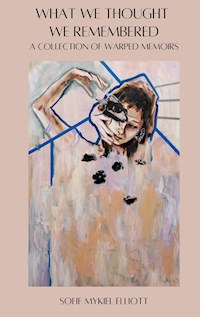
I would also like to extend an enormous thank you to Barbara Muhr who set the tone for this book by channeling the essence of each memoir into a screen print for the illustrations inside and a portrait in oil for the cover. You have brought this book to life beyond expectation!
Loving thanks also go to the production members of I forgot to remember for letting me climb into their heads and source material for these short stories. Alessio, Jelena, Melanie, Péter, Simone, Tiana, and Yosuke, I hope you all find your tracings on these pages.
Colossal gratitude goes to Callae Frazier, as well, who served as the editor for this book and my writing coach (“fairy godmother”) during the process. You were instrumental in getting this thing to print! Your insights, creativity, and grace as an editor and coach are beyond treasured.
Last but most certainly not least, I want to thank the sponsors on the left for funding this venture. Your support of the arts makes it possible to contribute fruitful works that will continue to mark the beautiful city of Regensburg, Germany as one of culture for years to come.
PREFACE
Dear reader, welcome! Before you feast on the oddities of these warped memoirs, I would like to whet your appetite with a morsel of origin story, a nibble of my inspiration, and a sip of the process (to wash it down). To give you that first morsel, though, I am going to have to take you back to the beginning…It all started with an empty stage.
First on that stage was my sister, Simone Elliott, who is a professional dancer and choreographer of sixteen and eight years, respectively (at the time of printing). She was offered a blank stage space at the DEZ Bühne in Regensburg, Germany. With the freedom to create any full-length production she pleased, she was interested in integrating an existing text into her choreography to make the abstract nature of contemporary dance more tangible for audiences. At the same time, she was struggling with recalling the true nature of certain memories, making her keen on focusing her production theme on memory. So she began to research why we remember certain things in certain ways and why we forget others. In her concept research for the piece, she came across a Harvard professor and psychologist whom she calls “the father of memory”: Dr. Daniel Schacter, the author of The Seven Sins of Memory: How the Mind Forgets and Remembers.
Schacter’s book captivated my sister with how his “sins of memory” affect our reality and inspired her to shift her perspective from one that feared losing treasured memories to one that wanted to better understand the loss of memory. Simone knew she wanted to convey this new perspective on the stage, but found the neuroscience-focused concepts were simply too overwhelming to bring to life through movement in a way that did them justice. That’s when she asked me to write a creative text about the sins that could be more smoothly adapted to choreography.
An aspiring writer, I jumped at the opportunity. I have spent my life in the performance arts, so I was eager to develop my writing for an audience I knew so well: movers and dreamers. Once I joined my sister on that stage, we started to breathe life into our joint production of I forgot to remember.
In the beginning, I, too, read Schacter’s book to establish what kind of relationship I would have with how the mind forgets and remembers. So let me give you a nibble of how Schacter's depiction of the seven sins inspired the development of the stories that you will find within these pages.
As a play on the seven deadly sins, Schacter coined the “Seven Sins of Memory" to explain through a series of case studies and neuroscience the flaws of our memory. He asserts that these flaws—or sins—of memory can be categorized into seven fundamental transgressions: Transience, Absentmindedness, Blocking, Misattribution, Suggestibility, Bias, and Persistence. I followed this structure and crafted a narrative for each of the sins built on felt experiences rather than told through factual scientific observations.
Before I could get to that point, though, I first had to reconcile my understanding of "sins" with Schacter's. Often used to describe immoral acts against divine laws, sins are wrong-doings—religious crimes. Having come up in a fervent religious community, the term “sin” comes with heavy connotations for me of shame and an intense focus on abstaining from shortcomings rather than on how to create harmony in spite of them. Fortuitously, Schacter’s book has encouraged me to lean into a perspective change that leads to embracing a balance between vice and virtue. If living in perfection is such an unreasonable or unachievable goal, then recognizing “sins of memory” as fundamental to our existence encourages an exploration of how we live with imperfection.
Such shortcomings, seen through the lens of Schacter's sins, do result in a variety of nuisances though. These can range from minor incidents such as forgetting where you placed your keys, to major offenses like the complete loss of memory in Alzheimer's patients. Imagine the violent outbursts of a veteran who experiences Persistence in the form of Post Traumatic Stress Disorder (PTSD) or the detrimental effect of Suggestibility within a partnership in the form of gaslighting. Or picture the lack of culpability from a politician who experiences Transience in the form of decreased memory over time (even if only a seemingly convenient lapse in memory). Once I realized the sins could be recognized in a host of different scenarios, I knew I'd found a way to focus each sinful story in the book. I also knew I was ready to interact with others on our stage.
Our team collaborations began when I decided on a sub-theme for each sin: Absent-mindedness in the form of hyperfocus; Bias in the form of rosy retrospection, to give you two examples. Then I assigned one sin to each of the seven members of our quickly growing production team and interviewed them to pick their memories and observe aspects of their personalities. It was clear that each member had light and dark memories to share, which supported our greater theme of balance between vice and virtue, harmony among duality. My notes also inspired and informed my fictional lead character's experiences. This memoir-esque way of sharing our team’s partial memories became a little warped when my inner narrator took the reins and my own memories began to color each tale, bringing to the surface a series of warped memoirs. At times, this led us down some dark roads.
However dark those roads seemed, they only proved harmful when the sins, the transgressions of memory, threatened to take over, creating imbalance. Schacter acknowledges this quality in his book as well, explaining that, "We shouldn't think of these fundamentally as flaws in the architecture of memory…but rather as costs we pay for benefits in memory that make it work as well as it does most of the time." In other words, in spite of the flaws (sins) that get us into trouble, there are many benefits for which to be grateful. And in fact, it is possible to maintain or regain balance in order to moderate the effects of these sins through conscious effort, support which Schacter kindly offers. One of these antidotes is visual imagery mnemonics—the utilization of vivid or even peculiar imagery to elaborate on incoming information so as to make it more unique, therefore more memorable.
At this point, I had a grasp on my relationship with Schacter’s sins and began diving into my story crafting. So as you enjoy these final sips, I will share what informed my process and how we integrated that into our collective production.
In order to approach this exploration of living with both vices and virtues, I worked heavily with concepts from taiji, like yinyang. Yinyang is sometimes written as one word to acknowledge that the light and dark are not two separate entities but rather one composed of complementary opposing forces. Up and down, fire and water, or light and dark: everything has an opposing force, and each force has a dual nature within itself. This concept of duality assisted me in the trials and euphorias of these memoirs. I let the stories ebb and flow from light to dark and back, creating harmony as they became one collection.
As my stories evolved, so did our production. Initially, Simone and I worked alone: She'd express a movement she desired in a piece that would in turn stir something in my storyteller's mind. I used Schacter's mnemonics antidote, making my stories come to life in a surreal world beyond our seen reality. As more members joined us, our process became more collaborative and those vivid images inspired the production members. Their triggered responses further inspired Simone's nuanced choreography. It was truly a collective effort of give-and-take exchanges.
Our production has since blossomed into a creative collective of over a dozen artists and supporters: a number of dancers, a visual artist, a composer, a filmmaker, a photographer, an energy practitioner, a writer, an editor, and a production manager. With the support of our sponsors, Simone's unique choreographic adaptation of the stories inside this book will be performed over the course of two months at multiple venues in Germany. And we are all thrilled to share this experience with you, our audience.
The overall process has brought rich beauty and harmony to our team as we dug into our memories and learned to look at them from a gentler perspective. We hope that audiences who see the choreography based on this text will feel empowered to engage in dialogue and to gain deeper insights into their memories and felt experiences, truly giving in to the dance with harmony. And I hope the same for you, dear reader: may you give in to the impulse to recall these stories in the small moments of your day, perhaps even continuing their warping by connecting your own memories to them.
And now that your taste buds have been thoroughly aroused, please enjoy digging into the main course: What We Thought We Remembered: A Collection of Warped Memoirs.
TABLE OF CONTENTS
Preface
Ringmaster
On the Tip of My Tongue
Maison de l’Amour
A Rosy Sunset
Soapbox Scripture
Enigma
It’s You!
Drifting Particles
Time to Clock Out
Finale
The Seven Sins of Memory: In a Nutshell
RINGMASTER
(PROLOGUE)
Jackpot! I had been buzzing around the complex all day before I smelled his apartment through the cracked window. The Time of Isolation had been wondrous for scavenging and collecting data, but the recent rainy weather encouraged most of the residents to close their windows. Not this man. His apartment emitted the ripe, scrumptious aroma of banana peels, pizza boxes, and dead skin cells. Perhaps he needed the window open to air the place out for his sake, but for my sake, it was heaven. I flew right on in and landed on the still-open pizza box from the night before. The amount of oil was intoxicating—I immediately stuck my feet in and began to taste those delectable fatty acids, but a swift breeze blew in from the cracked window and wafted the man’s body odor my way. My antennas were positively stimulated by his body warmth and exposed skin.




