


21,59 €
Mehr erfahren.
- Herausgeber: Independent Thinking Press
- Kategorie: Bildung
- Sprache: Englisch
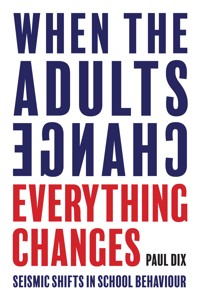
You can buy in the best behaviour tracking software, introduce 24/7 detentions or scream 'NO EXCUSES' as often as you want but ultimately the solution lies with the behaviour of the adults. It is the only behaviour over which we have absolute control. Drawing on anecdotal case studies, scripted interventions and approaches which have been tried and tested in a range of contexts, from the most challenging urban comprehensives to the most privileged international schools, behaviour training expert and Pivotal Education director Paul Dix advocates an inclusive approach that is practical, transformative and rippling with respect for staff and learners. An approach in which behavioural expectations and boundaries are exemplified by people, not by a thousand rules that nobody can recall. When the Adults Change, Everything Changes illustrates how, with their traditional sanction- and exclusion-led methods, the 'punishment brigade' are losing the argument. It outlines how each school can build authentic practice on a stable platform, resulting in shifts in daily rules and routines, in how we deal with the angriest learners, in restorative practice and in how we appreciate positive behaviour. Each chapter is themed and concludes with three helpful checklists Testing, Watch out for and Nuggets designed to help you form your own behaviour blueprint. Throughout the book both class teachers and school leaders will find indispensable advice about how to involve all staff in developing a whole school ethos built on kindness, empathy and understanding. Suitable for all head teachers, school leaders, teachers, NQTs and classroom assistants in any phase or context, including SEND and alternative provision settings who are looking to upgrade their own classroom management or school behaviour plan. When the Adults Change Everything Changes was a silver winner 2017 Foreword INDIES Awardsin the Education category. Named one of Book Authority's best education reform books of all time. Named one of Book Authority's best education books of all time.
Das E-Book können Sie in Legimi-Apps oder einer beliebigen App lesen, die das folgende Format unterstützen:
Veröffentlichungsjahr: 2017
Ähnliche


















PRAISE FOR WHEN THE ADULTS CHANGE, EVERYTHING CHANGES
Having worked with Paul Dix for the last two years, I have seen the benefits that adopting Paul’s consistent routines and kind approach to managing students’ more challenging behaviours can have – not only for the atmosphere around school but also for the health and well-being of the staff. This book is an absolute must-read for anyone who feels caught up in the madness of endless internal behaviour referrals and detention-chasing. I’ve been there – it’s exhausting!
Through his writing, Paul brings a refreshing approach to the issues facing educators today with a mixture of hard-hitting questioning that will get you squirming about some of your own practice combined with fantastic, practical solutions that can be rolled out with ease for the benefit of all. Be prepared to face the odd expletive … while the injections of humour will have you laughing out loud on the train!
Whatever your setting, and whatever stage of the journey to getting off the punishment road you are on, you will find this book really helpful in maintaining the ‘drip, drip, drip’ of consistency and kindness. I’ve been inspired to launch ‘legendary line-ups’ in the staff briefing this morning … and I may even get a goat!
DOROTHY TRUSSELL, DEPUTY HEAD TEACHER – CULTURE, ETHOS AND SAFEGUARDING, FLIXTON GIRLS SCHOOL
Paul Dix gets it. Paul lays out in plain terms the lessons he has learnt from his school experiences as a child, from his early days as a teacher and from leading significant behaviour change in many schools. This book is packed with practical advice that you can start using tomorrow: however, Paul makes it very clear that you must commit to working on your own behaviour before things will truly change. Paul pulls no punches – he will tell you why you are wasting your time with the punishment escalator and why you are becoming ever more frustrated by the child’s seeming unwillingness to bend to your will.
Paul Dix gets it. After reading this book, you will too.
JARLATH O’BRIEN, HEAD TEACHER, CARWARDEN HOUSE COMMUNITY SCHOOL
This book is a game changer. Your students need you to read When the Adults Change, Everything Changes.
Reading this book is like sitting down and having a coffee and a chat with Paul Dix while he lays out a road map showing you how to avoid pitfalls and transform lives. Rather than a list of quick behaviour tips, it offers a how-to mindset shift that sets staff (and students) up to win. If you came into teaching to make a difference, make this the next book you read.
It’s typically generous of Paul to create such a gift of a resource for trainees, teachers and veterans alike – a blueprint for building authentic relationships with students, even in seemingly impossible situations.
On a personal note, teachers like Paul (and like you if you choose to read this fantastic book) literally saved my life. It’s not easy being a hero, but this book gives you all of the tools and wisdom you need to put your intentions into action.
JAZ AMPAW-FARR, SPEAKER, AUTHOR AND ‘RESILIENCE NINJA’
Far from being just another book on behaviour, this is a blueprint for how behaviour should be in schools: starting from the simple premise that when the adults change, everything changes. Much of what is in this book is not rocket science – it is practical, day-to-day, common-sense advice written by an author who has more than earned his ‘behaviour stripes’ in real schools, working in real classrooms with real children.
Paul’s ideas won’t appeal to everyone. Some adults will find holding the mirror up to themselves and looking at how they manage behaviour in school far too uncomfortable. However, for the more enlightened who realise that how we have managed behaviour in the past is simply not the way to manage behaviour in the future, this book will be a revolutionary read. It is a book that you will go back to repeatedly and each time you will find something new to think about; potentially this is the book that could bring about seismic changes in the behaviour in your school.
RUSSELL J. INGLEBY, HEAD TEACHER, HIGHTOWN JUNIOR, INFANT AND NURSERY SCHOOL
Paul has a non-judgemental approach and clearly wants to help solve some of the common behavioural issues found in schools today.
An easy and entertaining read, the book offers concrete strategies to help teachers implement the ideas recommended. For example, the repeated use of certain ‘script’ phrases is one of Paul’s highlights and is a strategy I have used very successfully with young children.
Paul has developed his philosophy from a wide range of mainstream primary, secondary and special schools based here and abroad.
LISA BLACKBOURN, YEAR GROUP LEADER AND ENGLISH COORDINATOR
When the Adults Change, Everything Changes is a fabulous, must-read book for all educators and people working with children and young adults.
The strategies should be adopted by all schools as a blueprint for behaviour. If it were, it would dramatically improve learning, make children feel safer and positively change lives. This book oozes common sense and made me significantly reflect on my own practice. I can’t wait to share this book with my colleagues and prove, with this evidence, that when the adults change, everything changes!
ROB HACKING, ASSISTANT HEAD TEACHER, LEOPOLD PRIMARY SCHOOL
This book is a must-read for anyone who works with children or young people. Teachers, youth workers and support staff at the beginning of their careers will discover a wide range of useful strategies and explanations as they begin to tackle the sometimes mystifying behaviours exhibited by young people today. More seasoned leaders are guaranteed to find behaviour management gems that will both enhance and strengthen their toolkit. Paul’s writing is incisive and challenging; it successfully conveys a clear sense of his extensive and dedicated experience of all sectors of education. I am particularly pleased to see his recognition of the wealth of valuable experience and excellent practice that can be found amongst staff who work within the alternative provision sector, who have long been undervalued. Each chapter of this book is themed and concludes with three helpful checklists – Testing, Watch out for and Nuggets – which the reader will return to again and again for reference.
SEAMUS OATES, CBE, CEO, TBAP MULTI-ACADEMY TRUST
In When the Adults Change, Everything Changes, Paul Dix shows us how, if we really want to change behaviour in schools, we need to think about our own behaviour and how this impacts on the behaviour of the children in turn. Picking apart soundbites about ‘no excuses’, and showing what they really mean for the most vulnerable children, Paul outlines his vision of how the schools of the future could work. This book does not put the blame for poor behaviour on teachers; rather it empowers teachers to make better choices and shows them how to support their students to manage their behaviour for themselves.
SUE COWLEY, TEACHER AND EDUCATION AUTHOR
World-class expertise is hard won over the space of many years of devoted study and practice, and it is characterised by seeing the gaps in things, inhabiting them and getting to know every angle, every nuance of the bits of your subject that no one else has seen fit to investigate. Paul Dix is a world-class expert in behaviour management: his knowledge and experience seeps into the cracks of the formerly unknown. He is also possessed of a burning desire: to alter teacher behaviour so that our young people are taught in environments that nurture their burgeoning humanity with consistency, respect and empathy. As a practitioner from the sharp end, and a former naughty boy himself, he is alive to students’ hurt, to the pain they sometimes bring to the school gates and to how our students’ lives sometimes set them up with challenges that are too hard to bear; and he is acute at the ways in which an interested practitioner might manage the behaviours that result from such lives.
You always learn something useful from engaging with Paul, and the fact that he writes with the old one-two of passion and compassion makes this learning easy and pleasurable. I have learnt much from this book that will shape and amend my future practice and whole-heartedly recommend it to even the most experienced teacher.
PHIL BEADLE, TEACHER AND AUTHOR
For Ellie, Alfie and Bertie
CONTENTS
INTRODUCTION
The support available for teachers who struggle with behaviour is woeful. They are constantly bombarded with training that is focused on ‘progress’, pleasing Ofsted and analysing data. They are trained in reinvented, rehashed pedagogy and hammered by performance and forever shifting standards. Ask any teacher what the gap in their training is and the answer is managing behaviour. Teachers don’t need the scattergun approach of a thousand funky strategies or the frankly insulting suggestion of lines and running around the playground from politicians who want to look tough. Teachers need training in managing behaviours that cannot be solved with simplistic checklists or the odd half hour lecture. They need effective training that is frequently updated and that addresses the real problems in some of our schools, not to be patronised, ignored and told that their only purpose is results.
The unrelenting drive for exam results has blunted pastoral care in many schools. Mix this with the increasing emphasis of a ‘them’ and ‘us’ culture and high stakes everything, and you have a dangerous cocktail. As children are reduced to ‘units of progress’, many head teachers are forced to hide behaviour issues from inspectors and classroom teachers are left to drown. In some schools pastoral care is reduced to voluntary acts of love from individual teachers who care too much to teach by numbers. The funding and status of pastoral care was thrown out of the window when the bean counters arrived. Now, anything that is not measurable in results is worthless. Only recently I witnessed a PE teacher saving the life of a child in a swimming pool, a teaching assistant talking down a child with violent intent and a teacher counselling a child whose father had just been incarcerated. Performance manage that.
However, the tide is turning on the behaviour debate. The ‘punishment brigade’ are losing the argument, and as they do so they are finding themselves isolated. And the world is turning: children are less tolerant of nasty adults and parents demand more than just detention, meetings and exclusion.
Twenty years ago nobody thought twice about Mr Wright holding Robert against the wall by his tie with his feet dangling. Now he would be arrested. Even 10 years ago the idea that you could eliminate detention in schools with restorative practice was sneered at. Today, a story about a school in Baltimore that has replaced detention with meditation is looked at with genuine interest and intrigue.1 The direction of travel is clear. In another 20 years will we look back at isolation booths, detentions and exclusions with the same horror that we look back at beating children with canes?
The appalling lack of respect for teachers is stirred by greedy politicians, arrogant inspectors and the ugly opinions of those who would sell out teachers before breakfast for a slither of dirty self-promotion. The esteem in which we hold our teachers is reflected in the eyes of every child and in the behaviour in every classroom. Our teachers deserve respect. They deserve our admiration. They deserve our investment. Our teachers have a right to be better prepared and better trained to deal with the increasingly severe problems that are parked at their door.
The idea that behaviour management is simply about learning a set of techniques that emerge from a teacher’s ‘toolkit’ is a dangerous one. Outstanding management of behaviour and relationships is simply not skills led. Neither is it imported with ‘magic’ behaviour systems, bought with data tracking software or instantly achieved by calling a school an academy. In behaviour management, culture eats strategy for breakfast. Getting the culture right is pivotal. With the right culture the strategies that are used become less important. The culture is set by the way that the adults behave.
1 D. Bloom, Instead of Detention, These Students Get Meditation, CNN (8 November 2016). Available at: http://edition.cnn.com/2016/11/04/health/meditation-in-schools-baltimore/.
Chapter 1
VISIBLE CONSISTENCY, VISIBLE KINDNESS
Let’s stop waiting for the magic behaviour solution. It isn’t coming. The answer lies in the ability of adults to deliver behaviour policy and practice that is simple, highly effective and utterly consistent. The consistency that is required to create rapid seismic improvements in behaviour is one that is worth fighting for. It is the kind of consistency that great parents have. You get the same response from each, the same boundaries, the same mantras. You could not put a cigarette paper between their rehearsed responses. Their consistency is palpable, planned, safe.
In teaching there is a rampant desire for consistency. Teachers and support professionals repeatedly clamour for it, leaders get cross about it and learners need it to feel safe. Yet for most staff teams it is a desperate plea from the principal at the beginning of the year to check for planners, a big push on punctuality or a one day purge on jewellery/hats/thought crimes. It is a series of grand gestures that are ultimately futile. Phrases like ‘zero tolerance’ are bandied about, huge rises in confrontations are immediately ignited and within a few days most have decided that it is all too much hassle.
The consistency that is needed to bring an organisation from chaos to calm is the same as is required to go from good to great. This is not a restrictive consistency that limits flair and patronises poor communities, but a solid base on which to build authentic, exciting behaviour practice. It is a consistency routed in kindness, not in the machismo of zero tolerance.
As teachers we are grown from different seeds. Our philosophies have been nurtured in different directions. In a staff meeting 150 teachers might resolve to be consistent: ‘Yes! We must all be more consistent!’ Everyone then leaves with their own idea of what that consistency means.
Overworked teachers look at initiatives, quite rightly, through a very sharp lens. The key question is, ‘Are we still going to be doing this in six months’ time?’ If the answer is no, then they nod in the right places, fill in the right paperwork and carry on as usual. If the answer is yes, then they will shift, adapt and, with support, buy into the changes with heart and soul.
THIS IS HOW WE DO IT HERE
The best schools have a sign above the door regardless of what context they are working in, which says, ‘This is how we do it here.’ When you walk through the doors of that school, the expectations of behaviour are different from those outside. The behaviours that you use in the community or the behaviours that you use with your parents might well work out there, but when you walk through that door, that is how they do it there. The best schools have absolute consistency. I don’t care whether the system they use is behaviourist or whether the system they use is extremely old-fashioned, the critical difference is that people sign up to it and teachers act with one voice and one message: ‘This is how we do it here.’
You can find those beacons of hope in the communities in most poverty, and you also find that the best independent schools do exactly the same thing, such as, ‘This is the Harrow way,’ or whatever it might be. It is, ‘When you walk through the door, this is how we do it here.’ The best teachers have the same sign above their door. What works is consistency, not trying to tackle all behaviour at once but deciding which behaviours are to be taught. It is not relying on the parents to teach it, but saying, ‘You need these behaviours to be a successful learner in this school. We are not going to hide them. We are going to teach you them. We will teach the staff how to do it.’ I see that evidence every day in schools that are moving forward in the hardest circumstances. It is not necessarily an issue of resources. It is an issue of commitment and focus for the school and of absolute consistency.
PAUL DIX, HOUSE OF COMMONS EDUCATION SELECT COMMITTEE, BEHAVIOUR AND DISCIPLINE IN SCHOOLS, 17 NOVEMBER 20101
In schools where behaviour is breaking down you can find consistency, but it is a perverse consistency. In some teacher lounges there is a siege mentality. Battered by the relentless barrage of poor behaviour they naturally hunker down and protect one another. In these places cheap instant coffee meets universal despair.
On the first day of my first full time post as a qualified teacher, the deputy head teacher sat down next to me in the staffroom. His opening gambit was an interesting one: ‘Paul, I can see that you are very enthusiastic, it is lovely to see. But a word to the wise – don’t bother!’ I was completely taken aback and asked him to explain. ‘You see Paul, I’ve been here 30 years and it’s the same problem: it is those kids, living with those families on that estate. You’ll never change that.’ Fortunately I have a habit of ignoring such advice and a determination to prove it wrong.
If you don’t shape a visible positive consistency between the adults, then you open the door to them breeding their own negative consistency. There are horrific models of practice where the consistency is not kind but bullying. It is often a highly aggressive system with tally charts in the staffroom of ‘how many children I have made cry’, lashings of punishment and adult hostility that is just plain abusive. This is consistency for control and force. The frustration is that it is not only cruel, it is completely unnecessary.
It is not just the frailty of human beings that corrupts the consistency, but also the chaos of initiatives and constant curriculum change that works against it. In schools, initiative overload is more than groovy management speak, it is a way of life. A great idea is quashed by a thousand apparently better ones, a shift in practice is subsumed by inspection priorities and there is a lot of, ‘Oh well, that’s good enough.’ Nothing is constant and few things are refined until they are truly excellent.
The foundation of every school must be excellent behaviour. We should be keeping the focus on a visible culture of impeccable conduct, and making the consistency palpable, audible and highly visible. Every single day. Small, persistent and visible shifts in adult behaviour have an incredible effect on children’s behaviour. The message is: don’t be distracted by temporary distractions; get behaviour right first. Innovative teaching and learning cannot be built on inconsistent behaviour practice.
Shaping, refining and adapting the consistency is the challenge. Moving away from a thousand good and worthy ideas in a dusty policy document and refining it down to simple consistencies that are workable. Slimming down the rules to three is an important step. Simplification of policy is essential in building consistency. When you get to Chapter 10 and realise that your behaviour policy sucks your first act should be to delete the chaos of rules and allow yourself just three. Three rules are easily remembered by all so that everyone uses them all the time. The rules begin to fall from the mouths of all adults and consistency tightens. At the same time you will want to strip back the sea of punishments and remove the bureaucratic chaos that sucks teaching time away. The best schools have a behaviour plan that is based on tight agreements, simply framed and relentlessly pursued.
MEETING AND GREETING
Let’s start with the simplest consistency: how learners enter a classroom. A quick straw poll among your colleagues will reveal that even this most basic routine is inconsistent. Some will prefer their classes to line up outside, others want them straight in, some want equipment out, others want it stored away, some want learners standing behind chairs, others want them to get to work immediately. At the first hurdle there is contradiction and confusion.
It is easy to make something confusing out of something that should be straightforward. In a school where learners move from class to class, the demand for the child to recall the individual preferences of each adult without fail should be completely unnecessary. In settings where punishment is king, the anxiety of forgetting and being punished can easily shift the focus away from the learning.
The simplest things work best. At the start of the day or at the start of the lesson, stand at the door and shake hands with your learners – like you might do if someone knocked at your front door at home. I am sure you wouldn’t sit on the sofa and scream, ‘Let yourself in.’ You would engage in a well-mannered social routine. Moreover, you would make your guest feel welcome with a small kindness or generous word.
Imagine for a moment that this consistency alone was followed to the letter by every adult for the next school year. Every morning there are senior leaders on the gate, team leaders strategically placed around the site and teachers at every door, with every adult shaking hands, welcoming and demonstrating a visible enthusiasm. As you stand at the door of your room with a learning support assistant you look down the corridor and see every member of staff doing the same. Imagine that there had never been a day when anyone lost their focus, not a routine out of place or a door that is unwelcoming. What would the effect be on the learners, the environment, the behaviour in corridors? What would the ripples be out into the community? Would parents start talking about the meet and greet? Would other schools/local officials/MPs come and see your consistency in perfect form? Would the learners be more punctual to lessons, the adults feel more supported and smaller people feel safer?
FANTASTIC WALKING
In the UK most primary schools are architecturally challenged. Many are built from a 1970s blueprint that had clearly bypassed the aesthetics department on its way to the architect. Walking up to one school in the north of England reminded me of a thousand other schools, but inside it was anything but ordinary. Touring around the school with the excellent head teacher, I noticed a 6-year-old walking towards us in the corridor. He was walking very tall, head up, chin up, chest out with a purposeful stride and his hands clasped tightly behind his back. It immediately struck me as odd but I thought it best not to mention it. Probably just a slightly eccentric 6-year-old playing a game.
As we turned another corner we came across a class of 9-year-olds snaking through the school on their way to a PE lesson. Every child held the same posture: hands behind their back, chest out, walking tall and proud. Realising that this was an organised routine I asked the head teacher what it was about. ‘Oh, that is fantastic walking,’ she proclaimed proudly. ‘Fantastic walking?’ I replied. ‘Is this one of those cult schools I hear so much about?’ ‘No, no, no,’ she explained. ‘It is what we do – it is how we walk around our school. When I took over as head there was a lot of pushing and shoving, boisterous behaviour, particularly in the corridors. Small children were collateral damage in times of mass movement and everyone was going into lessons a bit frazzled.’ (At that moment three members of staff came out of the teacher lounge, modelling perfect fantastic walking!)
She knew that something had to be done, so she taught everyone fantastic walking – with love, humour and a sense of pride in ‘our school’. The children took to it immediately, and the staff too. Even parents crossing the line between the street and the school yard struck the pose. When staff went to visit other schools that didn’t have fantastic walking they felt that something was missing. On returning, they would always comment on how inconsistent other schools felt. Their relief in being back in fantastic walking land was obvious.
In this school the visible consistency made everyone feel safe. It is done with kindness and consent. The adult model was constant, consistent, predictable. This doesn’t mean that fantastic walking is right for your school or class, but the question is clear: what are the visible consistencies in your setting? What could they be? Are they embedded with love or punishment?
Of course, you could choose to apply the same principle of consistency to a more aggressive and punitive system. You might distribute lunchtime detentions for children who are seen running or pushing in the corridor. You could plaster your school with ‘no running’ posters and create extra capacity for lunchtime detentions by digging a cellar to house the offenders. After weeks of punishment, explosive confrontations and broken trust the children may behave well in the corridors – when the adults are watching.
But why crush behaviours with punishment when you can grow them with love? Visible consistency with visible kindness allows exceptional behaviour to flourish.
NOBODY GETS TO SEE THE HEAD WITHOUT A TOUR!
‘Just confirming the meeting with the head tomorrow – 11 a.m., is that right?’
‘Oh yes. Well, 11 a.m. for the meeting but it is 10.30 a.m. for the tour.’
‘Tour?’
‘Yes, nobody gets to see the head without a tour.’
This was my introduction to a school for excluded children. I had spoken at a conference and casually mentioned over lunch that I was interested in school governance. Before I had taken another mouthful I had been invited to see the school, and forms were miraculously produced. A school where nobody gets to see the head without a tour was going to be interesting.




