


Erhalten Sie Zugang zu diesem und mehr als 300000 Büchern ab EUR 5,99 monatlich.
- Herausgeber: Stonewood Press
- Kategorie: Fantasy und Science-Fiction
- Sprache: Englisch
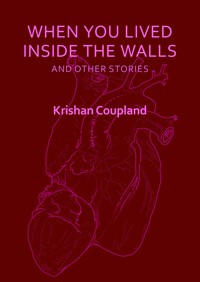
This is the sixth book in the Thumbprint pocket book series and Krishan Coupland's first collection of stories. At once dark and tender, mundane and extraordinary the stories here speak of strange realities where a child takes to living in the walls with the friends who love her, and a young man preserves the body of his lover, who has returned from the dead, in a freezer in his garage. Coupland writes in language elegant yet simple as if he were telling you a story while you shared a pot of tea or a bottle of beer. It's this simplicity that belies a complexity of ideas and a mastery of the short form that is such a pleasure to read and makes this debut collection truly remarkable.
Sie lesen das E-Book in den Legimi-Apps auf:
Seitenzahl: 39
Veröffentlichungsjahr: 2017
Das E-Book (TTS) können Sie hören im Abo „Legimi Premium” in Legimi-Apps auf:
Ähnliche


















First published in 2017
by Stonewood Press
www.stonewoodpress.co.uk
All rights reserved
Copyright © Krishan Coupland, 2017
The author asserts his moral right to be indentified as the author of this work
ISBN: 978-1-910413-21-0 (ebook)
Represented by Inpress, tel: 0191 230 8104
Cover illustration and endpapers by Martin Parker
Acknowledgement: ‘Days Necrotic’ was the winner of the Manchester Fiction Prize 2011 and ‘When You Lived Inside The Walls’ was previously published by The Masters Review in March 2016.
This is the sixth book in the THUMBPRINT series.
Contents
When You Lived Inside The Walls
Days Necrotic
Holdings
When You Lived Inside The Walls
You hear them scuttling under the floorboards. There are few at first, pinpoint claws clicking wood. At night you think you can discern their squeaking – so high-pitched it is almost inaudible. It is a month before you actually see one. You come into the kitchen one night, empty glass in hand, and flick on the light. A brown body – larger than you had imagined – streaks for the gap beneath the fridge.
On instinct, you throw the glass. It shatters so loud it hurts your ears. Fragments skitter across the tiles, but the rat is already gone.
You tell Dinah about it while she sits up in bed reading the paper. On the cover are pictures of bombs detonating over foreign cities, smoke curdling into fist-shaped clouds. ‘We’ll have to get some traps,’ you say. ‘Traps and poison. We have to deal with this quickly.’
‘That sounds like your department, Dear,’ says Dinah. ‘Do you want to take the car tomorrow?’
You nod. You think of your daughter Millie tucked up in bed. The rat was the size of her tiny arm. Bigger maybe. ‘Yes,’ you say. ‘Yes, I will. I’ll take care of it.’
*
Millie’s school has a teacher training day, so you take her with you to the hardware store. She likes it there – begs to come whenever you need a new lightbulb or a screw for the kitchen shelf. While you look at traps, she browses the reels of cord and chain and wiring, touching each as though she longs to unwind them.
‘The ones with jaws are best,’ says the man behind the counter. He’s old enough to be your father, so you trust his wisdom. Twice he’s duplicated keys for you on the squeaky machine in the back room. You’ve always found it a marvel that a man with hands as big and broad as his can do such delicate work.
‘Aren’t they dangerous?’ you say. ‘I’ve got a little girl.’
The hardware man looks past you to where Millie is rattling a rack of graded screwdrivers like wind chimes.
‘Vermin are dangerous. Traps are just traps.’ But he disappears into the back room and emerges with two bulky corridors of wire – humane traps. Used, he tells you, but in working condition. It isn’t until you come to load them into the back of the car that you notice the wire is stained with blood.
*
Clearing laundry from the floor of Millie’s room, you find a saucer beneath her bed, the surface of it curdled yellow with old milk. Beside it lies a plate loaded with stale rinds of bread. You observe the nibbled edges of the food. It makes you feel odd; never before, to your knowledge, has your daughter been capable of keeping secrets from you.
You tell Dinah about it while she completes her crossword. On the front cover of the paper that day are thermal images of human bodies, broken into pieces but still flaring warm against the sand on which they lie. ‘It’s a worry, don’t you think?’ you say.
‘She probably just wants a pet,’ says Dinah. ‘Most kids do, don’t they? When they get to a certain age.’
‘There’s pets and then there’s pets,’ you say.
‘Quite,’ says Dinah, arching her eyebrows.
*
For days the traps sit empty, their wire mouths gaping. The more time passes the more foolish they look to you. What creature of any intelligence would fall for such an obvious ploy? Still you switch the bait religiously, trying anything you can think of: cake, cheese, sweets and chunks of salami. Peanut butter. Grapes.
At night an army of claws taps against wood. You can barely sleep from it, and when you do manage to doze your dreams are filled with red feral eyes peering from shadows, with gangrenous teeth and bald pink tails like stripped snakes.




