


Erhalten Sie Zugang zu diesem und mehr als 300000 Büchern ab EUR 5,99 monatlich.
- Herausgeber: Carcanet Poetry
- Kategorie: Poesie und Drama
- Sprache: Englisch
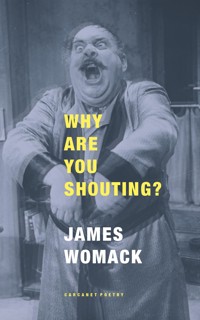
Why Are You Shouting?, James Womack's fourth Carcanet collection, thinks about two things in particular: our struggle as individuals to find connections between ourselves, with friends, family and lovers, and the efforts we make as groups to connect to the environment we live and die in. Written in the shadow of the climate crisis and the pandemic years, the poems set out to find points of hope and solidarity, against a common backdrop of disruption and collapse to which we are often wilfully blind. Alongside these concerns runs a narrative of personal blindness and self-enchantment, a willingness to allow oneself to be misled in order to have a quiet life. If the collection's title suggests that raising one's voice is the readiest way to reach other people, the poems themselves dare to offer quieter solutions, too: there is space for humour and kindness, even a degree of positive thinking about the state the world is in. The ghost of Cassandra, the Trojan princess given the gift of prophecy but condemned to have no one believe her words, haunts the collection: her life is a warning, but also an antidote to willed ignorance. 'The God of whom I speak is dead. I did my makeup in a disco ball. I looked at the whole magnificent creation of the Lord, and asked, sadly, "Is it cake?"'
Sie lesen das E-Book in den Legimi-Apps auf:
Seitenzahl: 75
Veröffentlichungsjahr: 2024
Das E-Book (TTS) können Sie hören im Abo „Legimi Premium” in Legimi-Apps auf:
Ähnliche












1
2
Contents
7
—Voici donc un syllogisme exemplaire. Le chat a quatre pattes. Isidore et Fricot ont chacun quatre pattes. Donc Isidore et Fricot sont chats.
—Mon chien aussi a quatre pattes.
—Alors, c’est un chat.
Eugène Ionesco, Rhinocéros8
Why Are You Shouting?
10
I
12
The City, an Argument
I.
Beloved, the city curves as a sickle. Politicians have written rhapsodies to its impermanence, its occasional gross expansions. Month on month the city drags the sea close into its formal harbours and casual inlets. An odd kind of embrace followed soon after by predictable rejection. The walls do not yield.
Beloved, the city does not stay still. Where was wasteland a month ago now a suburb: uninhabited, pristine, bright. The arterial roads mirage from the sun. The direction of travel is not yet determined. Running to or running away. A liquid, it fills all available space. Alleyways writhe and cross.
Beloved, the city knows its worth. No traveller comes here but is informed of this fact. Chauvinism shades into a kind of weeping arrogance. Microcosm, every barrio believes itself better than the others. After the match each weekend there is always violence. This is not unusual. A boy is stabbed.
Beloved, the city is still a child. Incontinent, satisfied with a breast and a swaddled bed. Useless from labour. Useless for work. The city does nothing: it takes and grows. The city has your eyes. We look at the city with the love we cannot spare for our own children.
Beloved, the city is sexless. The ripe displays of our childhood have disappeared. A new louder kind of innocence. Mystics and stylites have a vocabulary we cannot coincide. Vows are asked of them. To flee in a desert the approach of mankind. The city asks no new vows of us.14
Beloved, in a mirror the city confuses us. We never invited mirror trust. It seems a test of some kind. To have your own face given back to you upside-down. Your teeth where your windows should be. Roads instead of the tight squirms and curls of a more legitimate brain.
Beloved, the city wakes up after the weekend. The city is in the corner of your eye. You hope that some fragment of the dead days will survive. An abandoned high-heel shoe. An abandoned pint glass of shocking orange urine. Full of commuters an abandoned train passes over a bridge.
II.
Beloved, the city is nothing if not just. A single glance, the wrong word at the wrong time means honour must be satisfied. Duels, rapier or pistol, take place on the dusty backlots. When the city is called to join our larger wars, then all personal affronts are temporarily abandoned.
Beloved, the city splits and runs like a silver ball. Touched it does nothing other than yield, for all that we wish it to resist. In the harshest winters it moves sluggishly. In high summer it hurtles around like a mad thing, separating and resolving into grand bridges and towers.
Beloved, the city makes great claims for its intellect. Coupled with a certain moral flexibility, this has led to its current line of work. The machine works slowly but is always effective. Shipping movements are relayed to its superiors. Blood bubbles out and drips from the side of its head.
Beloved, the city feeds itself. It can nourish itself on perfumes—road tar and frying fish, the sweat and Chanel of summer—as well as the more recognisable steaks and garbage. Roles forced upon us. We are à la carte anatomists. This is not just food. It is unjust food.15
Beloved, there are times when the city is generous. The tables spread to groaning. The mother runs unchallenged from the corner shop, her child both shield and excuse of the tins stashed under the pushchair. Pavements split with dandelions, purslane. Feast at the corner where dogs piss. Burdock and bedstraw.
Beloved, the city can never say it is sated. Ephemera we think we lose are never fully vanished. The scroll of a price tag picked off and rolled away. The playing cards spilled from a window. Flirtatious auto-destruct online messages. The city gathers it all, the city always wants more.
Beloved, the city shows its morning face. That noise the grim of adolescent complaint, the background hum of everything not being perfect. Shells and slime! Move it, move it! A step slower than our slowest participant. Industrial concrete suddenly an object of deep interest. The end of it an education.
III.
Beloved, a city for lovers. Lovers congregate at sites of least offensive photographic interest. Bridges collapse under the weight of padlocks. A single man cannot move from the hospital to the churchyard unless he elbow himself past crowds of the infatuated. Buses arrive daily on swift turnarounds. Open for business.
Beloved, the city is an undelivered city of messengers. News is borne from the northern hills to the curve of the central river, in the movement of an eye and the turn of a hand. All is information, messages transmitted and eternally received. A letter always arrives at its destination.
Beloved, your city is an angry city. Peevish even before the morning fog has been burned away, we notice the first signs in earbud executives, 16their wasp-sharp faces. One spark could set the Whole. Thing. Off. A man jostled at the wrong moment, a car changing lanes. Don’t touch me!
Beloved, the city is a clamshell on the waves. There was land, and then there was hell, and then there was the eternal city. Born naked. It drives you mad, the city, that itch at the edge of your waking mind. No way but this. When desire fades, you weep.
Beloved, the city can restrain itself. Gourmet and not gourmand, we are invited to know the city as a set of experiences, of visits to the planetarium, the pumping station, the light on the sandy college walls, wondering if here, here will be a first kiss, a first brief declaration.
Beloved, this week’s monster is the city. Baleen-mouthed, it battens on the excreta of its parasites, our abandoned residue, gorging itself on grease and turds, wet-wipes and condoms, slow water and the unbearable rush of the tunnel bore. You know this sick greed, the squabble to consume, vomit, consume again.
Beloved, the city eats and shits its citizens. One glorious morning! Our impedimenta tied in a handkerchief, stick slung over our shoulder, we arrive and see the skyline awaken before us in its watercolour gold. No illusion can hold this back: each tower is hard enamel, mouth whole, tongue river.
IV.
Beloved, the city is always upwards. Complaints no longer reach the tops of the tallest buildings. The skyline that so impressed our ancestors is seen now as prelude. The future tall, a ladder to the moon. Glass and steel hacked from the Welsh mines, dragged overland at immense human cost.17
Beloved, the city blows a trumpet. Boots and saddles. Drop everything and prepare for war. There on the coast the enemy hordes, weapons concealed in torn canvas bags, their uniform ragged, their pockets empty, most of them dead. The survivors disguised as women and children. As expected, we shall resist.
Beloved, the city this morning looks cruel. Her lip a harsh slash of Rouge Diabolique, her eyes defined into oblivion. Sometimes one dresses to impress, sometimes one must dress to intimidate. Makeup is an environment. Even the clouds seem to catch themselves and redress. Even the clouds, even the rain.
Beloved, the city is a noted carouser. Drink so deep from the ramshorn that the seas sink and drowned villages rise above the waves. Eat so greedily that the plates themselves are consumed. Relax with one final sherry in the Senior Common Room, the World Serpent purring at your feet.
Beloved, the city is an ant-nest miracle. From the gritted outyards to the nucleus, that black hole which drags everything—mostly money—into its orbit, each eusocial part seems to work for the good of the whole. What a fine place to sink into, one might think, sinking irreparably in.




