


61,99 €
Mehr erfahren.
- Herausgeber: John Wiley & Sons
- Kategorie: Wissenschaft und neue Technologien
- Sprache: Englisch
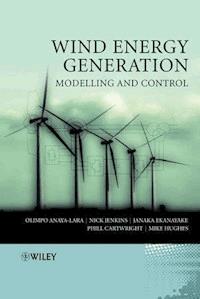
WIND ENERGY GENERATION WIND ENERGY GENERATION MODELLING AND CONTROL With increasing concern over climate change and the security of energy supplies, wind power is emerging as an important source of electrical energy throughout the world. Modern wind turbines use advanced power electronics to provide efficient generator control and to ensure compatible operation with the power system. Wind Energy Generation describes the fundamental principles and modelling of the electrical generator and power electronic systems used in large wind turbines. It also discusses how they interact with the power system and the influence of wind turbines on power system operation and stability. Key features: * Includes a comprehensive account of power electronic equipment used in wind turbines and for their grid connection. * Describes enabling technologies which facilitate the connection of large-scale onshore and offshore wind farms. * Provides detailed modelling and control of wind turbine systems. * Shows a number of simulations and case studies which explain the dynamic interaction between wind power and conventional generation.
Sie lesen das E-Book in den Legimi-Apps auf:
Seitenzahl: 302
Veröffentlichungsjahr: 2011
Ähnliche



















Contents
About the Authors
Preface
Acronyms and Symbols
1 Electricity Generation from Wind Energy
1.1 Wind Farms
1.2 Wind Energy-generating Systems
1.3 Wind Generators Compared with Conventional Power Plant
1.4 Grid Code Regulations for the Integration of Wind Generation
REFERENCES
2 Power Electronics for Wind Turbines
2.1 Soft-starter for FSIG Wind Turbines
2.2 Voltage Source Converters (VSCs)
2.3 Application of VSCs for Variable-speed Systems
REFERENCES
3 Modelling of Synchronous Generators
3.1 Synchronous Generator Construction
3.2 The Air-gap Magnetic Field of the Synchronous Generator
3.3 Coil Representation of the Synchronous Generator
3.4 Generator Equations in the dq Frame
3.5 Steady-state Operation
3.6 Synchronous Generator with Damper Windings
3.7 Non-reduced Order Model
3.8 Reduced-order Model
3.9 Control of Large Synchronous Generators
REFERENCES
4 Fixed-speed Induction Generator (FSIG)-based Wind Turbines
4.1 Induction Machine Construction
4.2 Steady-state Characteristics
4.3 FSIG Configurations for Wind Generation
4.4 Induction Machine Modelling
4.5 Dynamic Performance of FSIG Wind Turbines
REFERENCES
5 Doubly Fed Induction Generator (DFIG)-based Wind Turbines
5.1 Typical DFIG Configuration
5.2 Steady-state Characteristics
5.3 Control for Optimum Wind Power Extraction
5.4 Control Strategies for a DFIG
5.5 Dynamic Performance Assessment
REFERENCES
6 Fully Rated Converter-based (FRC) Wind Turbines
6.1 FRC Synchronous Generator-based (FRC-SG) Wind Turbine
6.2 FRC Induction Generator-based (FRC-IG) Wind Turbine
REFERENCES
7 Influence of Rotor Dynamics on Wind Turbine Operation
7.1 Blade Bending Dynamics
7.2 Derivation of Three-mass Model
7.3 Effective Two-mass Model
7.4 Assessment of FSIG and DFIG Wind Turbine Performance
Acknowledgement
REFERENCES
8 Influence of Wind Farms on Network Dynamic Performance
8.1 Dynamic Stability and its Assessment
8.2 Dynamic Characteristics of Synchronous Generation
8.3 A Synchronizing Power and Damping Power Model of a Synchronous Generator
8.4 Influence of Automatic Voltage Regulator on Damping
8.5 Influence on Damping of Generator Operating Conditions
8.6 Influence of Turbine Governor on Generator Operation
8.7 Transient Stability
8.8 Voltage Stability
8.9 Generic Test Network
8.10 Influence of Generation Type on Network Dynamic Stability
8.11 Dynamic Interaction of Wind Farms with the Network
8.12 Influence of Wind Generation on Network Transient Performance
REFERENCES
9 Power Systems Stabilizers and Network Damping Capability of Wind Farms
9.1 A Power System Stabilizer for a Synchronous Generator
9.2 A Power System Stabilizer for a DFIG
9.3 A Power System Stabilizer for an FRC Wind Farm
REFERENCES
10 The Integration of Wind Farms into the Power System
10.1 Reactive Power Compensation
10.2 HVAC Connections
10.3 HVDC Connections
10.4 Example of the Design of a Submarine Network
Acknowledgement
REFERENCES
11 Wind Turbine Control for System Contingencies
11.1 Contribution of Wind Generation to Frequency Regulation
11.2 Fault Ride-through (FRT)
REFERENCES
Appendix A: State–Space Concepts and Models
Appendix B: Introduction to Eigenvalues and Eigenvectors
Appendix C: Linearization of State Equations
Appendix D: Generic Network Model Parameters
Index
This edition first published 2009© 2009 John Wiley & Sons, Ltd
Registered officeJohn Wiley & Sons Ltd, The Atrium, Southern Gate, Chichester, West Sussex, PO19 8SQ, United Kingdom
For details of our global editorial offices, for customer services and for information about how to apply for permission to reuse the copyright material in this book please see our website at www.wiley.com.
The right of the author to be identified as the author of this work has been asserted in accordance with the Copyright, Designs and Patents Act 1988.
All rights reserved. No part of this publication may be reproduced, stored in a retrieval system, or transmitted, in any form or by any means, electronic, mechanical, photocopying, recording or otherwise, except as permitted by the UK Copyright, Designs and Patents Act 1988, without the prior permission of the publisher.
Wiley also publishes its books in a variety of electronic formats. Some content that appears in print may not be available in electronic books.
Designations used by companies to distinguish their products are often claimed as trademarks. All brand names and product names used in this book are trade names, service marks, trademarks or registered trademarks of their respective owners. The publisher is not associated with any product or vendor mentioned in this book. This publication is designed to provide accurate and authoritative information in regard to the subject matter covered. It is sold on the understanding that the publisher is not engaged in rendering professional services. If professional advice or other expert assistance is required, the services of a competent professional should be sought.
Library of Congress Cataloguing-in-Publication Data
Wind energy generation : modelling and control/Olimpo Anaya-Lara ... [et al.].p. cm.Includes index.ISBN 978-0-470-71433-1 (cloth)1. Wind power. 2. Wind turbines. 3. Synchronous generators. I. Anaya-Lara, Olimpo.TJ820.W56955 2009621.31’2136–dc222009012004
ISBN: 978-0-470-71433-1 (HB)
A catalogue record for this book is available from the British Library.
About the Authors
Olimpo Anaya-Lara is a Lecturer in the Institute for Energy and Environment at the University of Strathclyde, UK. Over the course of his career, he has successfully undertaken research on power electronic equipment, control systems development, and stability and control of power systems with increased wind energy penetration. He was a member of the International Energy Agency Annexes XXI Dynamic models of wind farms for power system studies and XXIII Offshore wind energy technology development.Heis currently a Member of the IEEE and IET, and has published 2 technical books, as well as over 80 papers in international journals and conference proceedings.
Nick Jenkins was at the University of Manchester (UMIST) from 1992 to 2008. In 2008 he moved to Cardiff University where he is now the Professor of Renewable Energy. His career includes 14 years of industrial experience, 5 of which were spent in developing countries. His final position before joining the university was as a Projects Director for the Wind Energy Group, a manufacturer of large wind turbines. He is a Fellow of the IET, IEEE and Royal Academy of Engineering. In 2009 and 2010 he was the Shimizu visiting professor at Stanford University.
Janaka Ekanayake joined Cardiff University as a Senior Lecturer in June 2008 from the University of Manchester where he was a Research Fellow. Since 1992 he has been attached to the University of Peradeniya, Sri Lanka and was promoted to a Professor in Electrical and Electronic Engineering in 2003. He is a Senior Member of the IEEE and a Member of IET. His main research interests include power electronic applications for power systems, renewable energy generation and its integration. He has published more than 25 papers in refereed journals and has also coauthored a book.
Phill Cartwright has 20 years of industrial experience in the research, analyses, design and implementation of flexible power systems architectures and projects with ABB, ALSTOM and AREVA in Brazil, China, Europe, India and the USA. He is currently the Head of the global Electrical & Automation Systems business for Rolls-Royce Group Plc, providing integrated power systems products and technology for Civil Aerospace, Defence Aerospace, Marine Systems, New Nuclear and emerging Tidal Generation markets and developments. He is a visiting professor in Power Systems at The University of Strathclyde, UK.
Mike Hughes graduated from the University of Liverpool in 1961 with first class honours in electrical engineering. His initial career in the power industry was with the Associated Electrical Industries and The Nuclear Power Group, working on network analysis and control scheme design. From 1971 to 1999, he was with the University of Manchester Institute of Science and Technology teaching and researching in the areas of power system dynamics and control. He is currently a part-time Research Fellow with Imperial College, London and a consultant in power plant control and wind generation systems.
Preface
The stimulus for this book is the rapid expansion worldwide of wind energy systems and the implications that this has for power system operation and control. Rapidly evolving wind turbine technology and the widespread use of advanced power electronic converters call for more detailed and accurate modelling of the various components involved in wind energy systems and their controllers. As wind turbine technology differs significantly from that employed by conventional generating plants based on synchronous generators, the dynamic characteristics of the electrical power network may be drastically changed and hence the requirements for network control and operation may also be different. In addition, new Grid Code regulations for connection of large wind farms now impose the requirement that wind farms should be able to contribute to network support and operation as do conventional generation plants based on synchronous generators. To address these challenges good knowledge of wind generation dynamic models, control capabilities and interaction with the power system becomes critical.
The book aims to provide a basic understanding of modelling of wind generation systems, including both the mechanical and electrical systems, and to examine the control philosophies and schemes that enable the reliable, secure and cost-effective operation of these generation systems. The book is intended for later year undergraduate and post-graduate students interested in understanding the modelling and control of large wind turbine generators, as well as practising engineers and those responsible for grid integration. It starts with a review of the principles of operation, modelling and control of the common wind generation systems used and then moves on to discuss grid compatibility and the influence of wind turbines on power system operation and stability.
Chapter 1 provides an overview of the current status of wind energy around the world and introduces the most commonly used wind turbine configurations. Typical converter topologies and pulse-width modulation control techniques used in wind generation systems are presented in Chapter 2. Chapter 3 introduces fundamental knowledge for the mathematical modelling of synchronous machines and their representation for transient stability studies. Chapters 4 to 6 present the mathematical modelling of fixed-speed and variable-speed wind turbines, introducing typical control methodologies. Dynamic performance under small and large network disturbances is illustrated through various case studies. Different representations of shaft and blade dynamics are explained in Chapter 7 to illustrate how structural dynamics affect the performance of the wind turbine during electrical transients. The interaction between bulk wind farm generation and conventional generation and its influence on network dynamic characteristics are explained in Chapter 8. Time response simulation and eigenvalue analysis are used to establish basic transient and dynamic stability characteristics. This then leads into Chapter 9 where more advanced control strategies for variable-speed wind turbines are addressed such as the inclusion of a power system stabiliser. Enabling technologies for wind farm integration are discussed in Chapter 10 and finally Chapter 11 presents different ways in which the wind turbine can be controlled for system contingencies.
The text presented in this book draws together material on modelling and control of wind turbines from many sources, e.g. graduate courses that the authors have taught over many years at universities in the UK, USA, Sri Lanka and Mexico, a large number of technical papers published by the IEEE and IET, and research programmes with which they have been closely associated such as the EPSRC-funded SUPERGEN Future Network Technologies and the DECC-funded UK SEDG. Through these programmes the authors have had the chance to interact closely with industrial partners (utilities, power electronic equipment manufacturers and wind farm developers) and get useful points of view on the needs and priorities of the wind energy sector concerning wind turbine generator dynamic modelling and control. The authors would like to thank Prof. Jim McDonald and Prof. Goran Strbac, co-directors of the UK SEDG. Thanks are also given to Dr. Nolan Caliao and Mr. Piyadanai Pachanapan who assisted in the preparation of drawings, to Dr. Gustavo Quinonez-Varela who provided input into the operation of fixed-speed wind turbines, and to Ms Rose King who provided useful material for Chapter 10. Special thanks go to Dr. Ramtharan Gnanasambandapillai who gave permission to include material from his PhD thesis in Chapter 7.
Olimpo Anaya-LaraNick JenkinsJanaka EkanayakePhill CartwrightMike Hughes 2009
Acronyms and Symbols
ACAlternating currentAVRAutomatic voltage regulatorCB-PWMCarrier-based PWMDCDirect currentDFIGDoubly fed induction generatoremfElectromotive forceFCFixed capacitorFMACFlux magnitude and angle controllerFRCFully rated converterFRC-SGFully rated converter wind turbine using synchronous generatorFRTFault ride-throughFSIGFixed-speed induction generatorGSCGenerator-side converterHVACHigh-voltage alternating currentHVDCHigh-voltage direct currentIGBTInsulated-gate bipolar transistorLCC-HVDCLine-commutated converter HVDCNRS-PWMNon-regular sampled PWMNSCNetwork-side converterPAMPulse-amplitude modulationPIProportional–integral controllerPLLPhase-locked loopPMPermanent magnetPoCPoint of connectionPPCPower production controlPSSPower system stabilizerpuPer unitPWMPulse-width modulationRMSRoot mean squareRPMRevolutions per minuteRS-PWMRegular sampled PWMSFOStator flux orientedSFO-PWMSwitching frequency optimal PWMSHEM-PWMSelective harmonic elimination PWMSTATCOMStatic compensatorSVCStatic var compensatorSV-PWMSpace vector PWMTCRThyristor-controlled reactorTSCThyristor-switched capacitorVSCVoltage source converterVSC–HVDCVoltage source converter HVDCPairPower in the airflowρAir densityASwept area of rotor, m2νUpwind free wind speed, ms−1CpPower coefficientPwind turbinePower transferred to the wind turbine rotorλTip-speed ratioωRotational speed of rotorRRadius to tip of rotorVmMean annual site wind speedVDCDirect voltageOver−Per unit quantitybBase quantitysStator magnetic fieldrRotor magnetic fieldids, iqsStator currents in d and q axisvds, vqsStator voltages in d and q axisψds, ψqsStator flux linkage in d and q axisTeElectromagnetic torqueTmMechanical torquePeElectrical powerPmMechanical powerQReactive powerωb Base synchronous speedωsSynchronous speedωrRotor speedJInertia constantHPer unit inertia constantKShaft stiffnessfSystem frequencyCCapacitanceSynchronous Generator
ifField currentikd , ikq1, ikq2Damper winding d and q axis currentsLlkd , LlkqLeakage inductance of damper windings in d and q axisLmd , LmqMutual inductance in d and q axisLlfLeakage inductance of the field coilLlsLeakage inductance of the stator coilrsStator resistancerfField winding resistancerkd , rkq1, rkq2Resistance of damper d and q axis coilsvfdField voltagevkd , vkq1, vkq2Damper winding voltages in d and q axisψfField flux linkageψkd , ψkq1, ψkq2Damper winding flux linkage in d and q axisδrRotor angleCsSynchronizing power coefficientCdDamping power coefficientInduction Generator
idr, iqrRotor currents in d and q axisvdr, vqrRotor voltages in d and q axisψdr, ψqrRotor flux linkage in d and q axised , eqVoltage behind a transient reactance in d and q axisLmMutual inductance between stator and rotor windingsXmMagnetizing reactanceLr, LsRotor and stator self-inductanceXr, XsRotor and stator reactanceLlrRotor leakage inductanceLlsStator leakage inductancerrRotor resistancersStator resistancesSlip of an induction generatorpNumber of poles1 Electricity Generation from Wind Energy
There is now general acceptance that the burning of fossil fuels is having a significant influence on the global climate. Effective mitigation of climate change will require deep reductions in greenhouse gas emissions, with UK estimates of a 60–80% cut being necessary by 2050 (Stern Review, UK HM Treasury, 2006). The electricity system is viewed as being easier to transfer to low-carbon energy sources than more challenging sectors of the economy such as surface and air transport and domestic heating. Hence the use of cost-effective and reliable low-carbon electricity generation sources, in addition to demand-side measures, is becoming an important objective of energy policy in many countries (EWEA, 2006; AWEA, 2007).
Lesen Sie weiter in der vollständigen Ausgabe!
Lesen Sie weiter in der vollständigen Ausgabe!
Lesen Sie weiter in der vollständigen Ausgabe!
Lesen Sie weiter in der vollständigen Ausgabe!
Lesen Sie weiter in der vollständigen Ausgabe!
Lesen Sie weiter in der vollständigen Ausgabe!
Lesen Sie weiter in der vollständigen Ausgabe!
Lesen Sie weiter in der vollständigen Ausgabe!
Lesen Sie weiter in der vollständigen Ausgabe!
Lesen Sie weiter in der vollständigen Ausgabe!
Lesen Sie weiter in der vollständigen Ausgabe!
Lesen Sie weiter in der vollständigen Ausgabe!
Lesen Sie weiter in der vollständigen Ausgabe!
Lesen Sie weiter in der vollständigen Ausgabe!
Lesen Sie weiter in der vollständigen Ausgabe!




