


2,99 €
Mehr erfahren.
- Herausgeber: Wildside Press
- Kategorie: Fantasy und Science-Fiction
- Serie: The Talera Cycle
- Sprache: Englisch
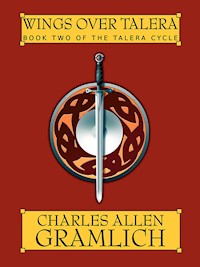
Talera is a world of warriors and heroes, not all of them human, a world where sailing ships ply the skies as well as the waters, and where beasts are as likely to hunt men as be hunted by them. On Talera, beauty and steel are equally dangerous companions, and sorcery is the deadliest of them all. Ruenn Maclang is a 19th-century Earthman mysteriously transported to this wondrous world. His sword is his constant companion, and war a daily promise that is seldom broken. But now he must battle the woman he loves, and either kill his own brother-or die in the attempt! A grand fantasy adventure in the tradition of Edgar Rice Burroughs and Robert E. Howard!
Das E-Book können Sie in Legimi-Apps oder einer beliebigen App lesen, die das folgende Format unterstützen:
Seitenzahl: 360
Veröffentlichungsjahr: 2022
Ähnliche












Table of Contents
ALSO BY CHARLES ALLEN GRAMLICH
COPYRIGHT INFORMATION
DEDICATION
WHAT HAS GONE BEFORE
INTRODUCTION
PROLOGUE
CHAPTER ONE
CHAPTER TWO
CHAPTER THREE
CHAPTER FOUR
CHAPTER FIVE
CHAPTER SIX
CHAPTER SEVEN
CHAPTER EIGHT
CHAPTER NINE
CHAPTER TEN
CHAPTER ELEVEN
CHAPTER TWELVE
CHAPTER THIRTEEN
CHAPTER FOURTEEN
CHAPTER FIFTEEN
CHAPTER SIXTEEN
CHAPTER SEVENTEEN
CHAPTER EIGHTEEN
CHAPTER NINETEEN
CHAPTER TWENTY
CHAPTER TWENTY-ONE
CHAPTER TWENTY-TWO
CHAPTER TWENTY-THREE
CHAPTER TWENTY-FOUR
CHAPTER TWENTY-FIVE
CHAPTER TWENTY-SIX
CHAPTER TWENTY-SEVEN
CHAPTER TWENTY-EIGHT
CHAPTER TWENTY-NINE
EPILOGUE
ABOUT THE AUTHOR
ALSO BY CHARLES ALLEN GRAMLICH
Bitter Steel: Tales and Poems of Epic Fantasy
Midnight in Rosary: Tales of Vampires and Werewolves in Crimson and Black
Swords of Talera (The Talera Cycle, Book One)
Wings Over Talera (The Talera Cycle, Book Two)
Witch of Talera (The Talera Cycle, Book Three)
Write with Fire: Thoughts on the Craft of Writing
Writing in Psychology: A Guidebook (with Elliott Hammer and Y. Du Bois Irvin)
COPYRIGHT INFORMATION
Copyright © 2007 by Charles Allen Gramlich
Published by Wildside Press LLC
www.wildsidebooks.com
DEDICATION
To My Father,
J. V. Gramlich
And to My Son,
Joshua Gramlich
WHAT HAS GONE BEFORE
In 1914, on a sea voyage to Japan, Ruenn Maclang and his brother Bryce stumbled on a gate to another world—a world named Talera. They were following the trail of some of the vessel’s crew—including their cousin Eric Ryall—who had shipped with them but disappeared. The gate exploded, sucking Ruenn and Bryce through it, but separating them. The first book in this trilogy, Swords of Talera, was Ruenn’s story of what happened to him on the other side of that gate.
Ruenn was cast into the Taleran Sea and rescued by a dwarfish race of humans named the Koro. It wasn’t long, however, before the Koro met the Klar—who were reptiles, pirates, and slavers. Captured by the Klar, Ruenn met a lovely human woman named Rannon Jystral. He found himself attracted to her, but they, too, were separated.
Ruenn learned the discipline of the sword. He learned how to kill. He fought his way free of slavery and in time gathered a band of warriors around him and ventured to the Klar homeland in search of Rannon, and in hopes of discovering his brother, his cousin, and his shipmates. There, he led a slave revolt and overthrew a nation, but he could not locate any of those he sought from earth. He did find Rannon, and discovered that she was a princess in the distant island kingdom of Nyshphal. But he already loved her, and he told her that. She told him the same.
At the end of Swords of Talera, Ruenn returned to Earth to see about the rest of his family. Though not revealed in that book, Ruenn found his immediate family—parents and two sisters—dead, for decades had passed on our world during his one year absence on Talera. He enlisted the aid of a distant relative to see that money was provided for his sisters’ descendents, and he gave that relative the manuscript for Swords of Talera.
But Talera called. Rannon called. And there was the need in him to find Bryce and Eric, still lost somewhere on that violent yet beautiful new world. This book, Wings Over Talera, is the story of what happens when Ruenn goes back.
INTRODUCTION
BY ONE WHO HAS MET RUENN MACLANG
October is a month of cold rains and of autumn leaves piled high and burning. It is a month of corpse-gray fogs that twine in low places, and of shadows that do not flee the rising moon. It was in October that I first met a man known as Ruenn Maclang, and it was amid the early frosts of that month, in another year, when he returned. I was standing at my cabin window, watching pale Luna hanging over the wind-tossed trees, when a dark figure came from the forest. I knew at once who it must be.
I met him at the door and held out my hand. “Ruenn,” I said. “It’s good to see you again.”
“As it is you, Charles,” he said.
“I’ve been expecting you,” I told him.
He looked at me strangely.
“Or at least I’ve been expecting something odd to happen today.”
He nodded in agreement. “I too have had that feeling this day.”
“Come in,” I invited.
He did so, a tall, lean man, with dark brown hair hanging long. He was dressed in black jeans and a t-shirt. A white scar twisting along the left side of his jaw, coupled with eyes that glittered green, made his face seem cold. Yet, his smile was warm when it came.
I motioned him to an old recliner and sat on the worn couch facing him. I had thought often of seeing this man again. There were many things I wanted to ask him. At our first meeting he had handed me a book called Swords of Talera. In it, a man bearing the name Ruenn Maclang is transported to an alien world of swords and savage warriors. Separated from his only brother, who has been drawn to the planet with him, Ruenn fights his way across a quarter of that world, finding slavery and escape, finding honor in the bloody heart of war, finding loyal friends and the touch of a beautiful woman.
But not finding his brother.
At first, of course, I had taken Swords of Talera to be simply an adventure novel. Then a series of strange mysteries created doubts in my mind. According to what records I could find amid the tattered documents of decades past, Ruenn Maclang had been born in 1888 and had disappeared in 1914 on a sea voyage that he captained to Japan. His brother had been with him. Neither had been seen again—dead or alive. And over two years before this night, the man who claimed now to be Maclang had given me gold coins minted by an empire unknown to Earth’s history.
It was almost as if they came from another world.
Yes, there was much I wanted to ask this man. But now, seated across from him in my book-cluttered living room, all questions seemed lost to me. It remained quiet between us, the only sounds the crackling of oak logs in the fireplace and the ticking of the mantel clock. It was he who broke the silence.
Ruenn rose and walked over to me. He grasped my shoulder with powerful fingers and drew me to my feet. His eyes seemed to read me.
“There is something you wish,” he said. “What is it?”
“I want to know the truth,” I blurted.
His lips quirked, and he nodded. “Very well,” he said, so quietly that I scarcely heard him.
His hand dropped from my shoulder and he turned to look into the fire. The flames glinted off the sharp planes of his face. Then his back straightened.
“If it is the truth you want then you shall have it,” he said. “My name is Ruenn Maclang and I have been to a planet called Talera. There is a woman there that I love. Her name is Rannon Jystral. I have made a place for myself in her world, and now I call it my world as well. Is that the truth you wanted, my friend?”
I said nothing for a moment. I had known what his answer must be, had promised myself not to accept it. What he claimed to be truth was impossible. Yet, with him standing there before me I could not think him a liar.
“I believe you,” I said.
He sighed, and I realized that he had hoped for and wanted my belief. Perhaps he had needed it. He went and sat down again, seeming heavy with exhaustion. I asked him why.
“To cross the distance to Earth takes something out of one,” he said.
“Then why come?”
“There are always old acquaintances to renew,” he said. “And, too, I wanted to ask after the money that I left with you on my previous visit.”
I nodded. “For your sisters’ descendents. They’ve been well taken care of. Grants. And trust funds, of course.”
“Have there been any questions? Inquiries?”
“A few. Nothing serious. The trail is well hidden.”
“Good,” he said. “I appreciate your efforts on my behalf.”
“You’re welcome,” I said, smiling. “And there is something else as well.”
He frowned in question.
I went over to my bookshelf and removed a slim paperback volume with a rather garish cover. I handed it to him and sat down. He looked at the title and then turned to the first page. He read for a moment before looking up and laughing.
“So, the record of my first adventure was published,” he said.
“Yes. It sold well. But tell me. What has happened to you since the night we last met, when you left Earth to return to your new world of Talera?”
“Much,” he said, leaning forward.
PROLOGUE
RUENN BEGINS HIS STORY
I sat by a small fire, in a clearing within the pine-forested hills of northern Arkansas, waiting for something to happen while I scratched my name idly in the dirt with a stick—Ruenn Maclang. About me, night’s face was dark and cold and lovely. Above me, the stars seemed as clear and brittle as icicle teeth. Looking up at those stars, I could see the familiar constellations of my youth, the big and little dipper, and to the north the pole star.
Seeing those brilliant and familiar points reminded me of my father, Kendall, who had taught me the constellations, and of late evenings in the California vineyards of my mother’s family where the first star was a joy. But that was youth. There are other heavens that are important to me now. They hold no stars. I waited in this clearing tonight, not to watch the skies of Earth but to be drawn back to a new land under those other skies, the skies of a world called Talera.
I had arrived on Earth sixty days before this night. I had taken care of a need that had to be met. Now I would return the same way I had come. For there was a gate in this clearing. It could not be seen in the blanket of fallen leaves or the thin topsoil. It could not be heard in the late autumn stillness of a chilled night. It could not even be opened from where I sat. But it could be opened—it would be opened—on Talera. And when it was, I would be drawn through it to the place where—with my parents and sisters dead—I called home.
I closed my eyes to better picture that home. There was one image, one face that I most wanted to see. But it did not come at first. Instead, I saw the bright flash of steel and heard the sharp twang of releasing arrows. There had been a battle fought two months before this night, on the very day that I had left Talera for Earth. These scenes had been a part of it.
With my friends—Heril Rolvfshern, Valyan Tiersal, and others—I had been flying slowly north within the borders of the island kingdom of Nyshphal, the home of Rannon Jystral, the woman I loved. Above our open airship rode the winter sun of Talera, and to the north lay the gate that would take me to Earth. And then there had been smoke on the horizon.
That smoke rose from a burning village called Rakii, which lies on the Sahtern River in a wild land where sheep* are the only livelihood of a poor people. I had ordered our airship down to investigate, and we surprised dark raiders at their work. They were mounted upon hyr-qualls, saddle lizards that somewhat resemble an iguana of monstrous size, and they were dressed as outlaws. This they were not. Their steel was too good, their armor too well matched. I did not know what they were, though I was to eventually find out.
[*I used the term “sheep” for the animals that I saw in Rakii because they were clearly descended from Earth ancestors brought to Talera by the Asadhie race that created this artificial world. Many other Earth species can be found on Talera as well: horses, hawks, cattle of various kinds, deer, pigs, and elephants. Among Earth plants transported to Talera are oak and apple trees, rice, wheat, grapes, and onions.—Ruenn Maclang.]
Despite their formidable appearance, however, the raiders had not been prepared for much resistance to their attack. And they had received little where the villagers were concerned. This changed abruptly when our ship flew down low over their heads and two dozen trained warriors dropped in on them from the sky.
Our pilot brought the ship to man-height and I was first over the side rail, landing lightly on my feet with a naked sword drawn in one fist and a crossbow locked and loaded in the other. The raiders gaped, smoke and heat rippling in the air above them, and I bow-shot the first one who recovered himself, the quarrel catching him high in the throat and blowing him back over his saddle.
Sheep milled in the dirt street. People ran. Our enemies lowered their lances and came against us. I heard the screams of the villagers for a moment, then nothing to distract me as my mind centered on the task at hand.
There were men around me now. My men from the ship. Other crossbows released. Other enemy saddles were emptied. A red-bearded raider shouted at his fellows to kill us, and by that I knew him for a leader. I charged him even as he moved toward me, his mount snarling and showing its teeth. A hyr-quall is trained to attack anything that is not on its back. To distract this one, I hurled the unloaded crossbow into its face. It shied, and I ducked beneath the lance tip of its master and sliced upward with my blade, nearly severing the man’s arm above the elbow.
Blood sprayed. A new scream cut through the old ones. The fellow reeled in his saddle and I got hold of his boot with my hands and hurled him from his seat. The hyr-quall struck at me over its shoulder and I hammered its face with the pommel of my blade to make it behave. Then I mounted. I had ridden a hyr-quall before. Once. I hoped that I remembered what I had learned.
Heril was near me. I saw him axe down a second raider who he had thrown from the saddle. Valyan had taken yet a third hyr-quall for his own and I signaled him to join me. Heril mounted too, and the three of us moved up the street toward the far end of the town where half a dozen of the enemy had begun setting fire to the huts. They seemed more intent on doing damage than on acquiring loot for themselves. This, too, told me that we were dealing with no common marauders.
There were extra lances beneath my right knee and I drew one out and weighed it in my hand. I knew little of mounted spear work—swords were my strength—but I knew enough not to let better lancers close with me. Our foes dropped their torches as we approached and couched their own lances. Our two groups charged at the same time.
The hyr-quall does not run as smoothly as a horse or a tasaber. They are more like drums, and now their feet were pounding and pounding. And the dust was rising around us. I saw the glittering heads of spears, heard the rattle of armor and the creak of leather.
At ten paces from our enemies, I stood in my stirrups and hurled my lance into a dark-clad marauder. The wedge-shaped head of the weapon shattered through the man’s face-plate and exploded into splinters. He went backward, hauling convulsively on the reins, and the lizard that he was riding reared up on its hind legs and fell over into its fellows.
Chaos followed. One hyr-quall snapped its teeth into the neck of another. Heril went past the pile-up on the left, his Koro axe shearing through enemy bone and mail. Valyan’s mount smashed head on into the imbroglio, but the Nakscherii warrior had already loosed his feet from the stirrups and he somersaulted over the heap to safety. He left his lance buried in an enemy throat.
We closed on the survivors, our steel hacking. More of my men joined the slaughter, and in a few red moments the battle was over, though it would be long and long before the village would recover completely from its wounds. I left half my crew behind to start that recovery and flew on toward my meeting with a sphere gate. That could not be delayed if I wanted to reach Earth.
In the end, the battle had not delayed my quest. I’d made it to Earth. Now, tonight, I was going back to Talera. There, I would join the woman I intended to marry, and would begin another quest—to locate my brother Bryce, who had been drawn to Talera with me nearly two years before and who had never been found.
But I did not want to go back remembering blood. I opened my eyes from my thoughts and in that moment I saw Rannon’s sweet face, Rannon Jystral, the dark-haired Taleran princess who had said she loved me. Her visage seemed to float in the clearing before me and I took it as a sign that the gate was near.
I waited, and there was no sound.
Then there was.
One moment there were the stars and the shadowy trees and the quiet. In the next there came a humming, and a gray, whirling vortex opened in the air a few feet from my fire. I stood up, dashed the flames to blackness, and went forward, carrying nothing with me save a present for Rannon.
I stepped into the swirling air and felt something pluck lightly at my body, at my clothes, at my hair. There was an instant of chill and of twisting in my stomach, an instant of pain. And then I stepped out of the same air onto a flat wheel of stone that lay half buried amid drifts of snow. It was morning in this place, the sun rising blue-white, and the breeze that stroked my body was that of Talera.
Of home.
CHAPTER ONE
COMING HOME
Where before it had been dark, it now was light, the sharp-edged light of the Taleran dawn. I stepped down from the stone upon which I stood, and behind me a whisper died as a door into void closed. The prickling on my skin was gone as well. I was wholly of this world now, wholly of Talera. I breathed deeply, mouth open to taste the sweetness in the chill morning. The first sound of home that I heard was the wakening cry of the kryshawk, the second, the soft crunch of snow beneath a shifting boot.
Four figures stood before me, hooded and cloaked against the cold. All were human, though one bore the yellow eyes and green skin of a Llurn, of that people who call themselves Nakscherii. One was bearded; one was tall; one was broad; one was a woman. It was the last that I watched.
Rannon Jystral came forward across the snow and put herself into my arms. I held her tightly for a moment before kissing her. Valyan Tiersal—the Llurn—joined us, coming up to place a firm hand on my shoulder. I smiled at him as I clasped Rannon’s slender form. The broad figure was Kreeg, once a gladiator, a rahnvin slave of the Klar. He nodded, shaved head bobbing once on a bull neck, but did not speak. His presence said enough.
The last of the four, with a face heavy and bearded, was a man named Tovaris. It was he who had opened the gate between Earth and Talera. From the stone wheel where I had stood he took up the toir’in-or, the milky jewel that held the power of the sphere gates inside it. He then turned and left the rest of us alone.
“Heril?” I asked, somewhat worried. I had expected the Koro warrior, perhaps my closest friend on Talera, to be here.
“His father,” Valyan replied, knowing my unspoken concerns.
“I am sorry,” I said.
“Heril swore he would return when matters were settled. That may not be soon, though. The Rolvfsherns are an important family among the Koro. His father was a leader among them.”
“If word can be sent then I would like to send it,” I said.
“I will see it done,” Rannon said. “Our ships trade with Korosphal regularly now.”
“And my brother?” I asked. “Bryce?”
“Nothing has been heard,” Rannon answered. “But the word is spread and many are searching. For your cousin, Eric, as well. Or any sign of others from your Earth.”
“Good,” I said.
“And now we drink, yes?” Kreeg asked.
“And now we drink,” I agreed.
It was only a short walk to the hunting lodge of Hurnan Jystral, father of Rannon and Emperor of Nyshphal. Other friends awaited us there, and for refreshments there were wines of Thresh and the Starkayan Islands, cheeses and meats from Pangala and northern Nyshphal, and—as always—rich verhlis tea by the flagon.
I drank and ate heartily. It seemed long that I had been away from decent food after the processed chicken and processed beef of the new Earth. It was good to bite into a terval steak and feel the juices bursting ripe into the mouth. It was good to have wine in brass goblets. And after the food there was good talk of many things, with Rannon always there beside me.
In the evening I forced my muscles to recall the sword while fencing with Valyan. After that I slept, as if that, too, I had been long without. I awoke refreshed in the very early morning, well before the dawn, and dressed myself in the clothes of two worlds. I pulled on the jeans I’d worn from Earth, and gray wool socks that were covered with soft boots of stugah hide. I slid on a shirt of green Starkayan silk that lay open at the throat, and tucked it into the jeans.
A heavy belt of Taleran make went around my waist, and stitched to it were the heavy steel hooks upon which I hung my scabbarded sword, the same sword I’d left behind on Talera so many days before. I drew the blade out and held it to the ceiling where the glassine light of the night lanterns burst along it. The glistening died when again the sword was sheathed.
It was early enough so that only the cook was awake, and he busy at laying a fire for the heating of the morning tea. I nodded to him and went out, striding through the chill and the low drifts of snow that lay on the ground. The sky was graying.
About a hundred tahng from the door of the lodge there ran a majestic gorge through which the morning mists flowed like rivers. I leaned against a boulder there and watched those mists. Dawn birds were just beginning to hunt, wheeling about me in search of early rising insects. There was little wind.
I was still there half a dhaur* later when Rannon came up and took my hand. She was dressed in trousers of tanned leather, rust-colored boots, and a white silk shirt beneath a brocaded vest of yellow and green. I loved the heart shape of her face, and the brilliant violet-blue of her eyes against her dark hair, and the clean scent of her skin. The two of us stood quietly for a time, feeling comfortable there together, and at last I turned to her as if to speak. She hushed me with a hand over my mouth.
“Wait a bit,” she whispered.
A moment later the rising sun touched the great atmospheric shield that envelops Talera, and jade and purple streamers of light burst outward like wagon spokes from a central rotating core of gold. The display lasted only seconds and was gone. It is called the dawn lights by most cultures and occurs only in northern areas. Rannon had told me of them before, and of the belief in some religions that the lights are a sign of the sky menstruating. Knowing of them was not the same as seeing them, however. I stood in awe of their beauty.
Even after nearly two years on Talera, it was still hard for me to believe that this was an artificial world condensed from the heart of a gas-giant planet. The advanced race who built it—the Asadhie—may have been cruel, but they were skilled at creation.
The atmospheric shield that surrounds the planet protects the living world from the poisonous gases above. And somehow the sun and moons have been placed inside that shield, though I suspect some kind of optical illusion gives those orbs the appearance of rising and setting naturally. Rumors have it that Taleran adventurers have even tried to reach the moons aboard powerful flyers. There are some who claim to have succeeded, though I do not know the truth of such tales.
Only with the ending of the dawn display did Rannon turn and kiss me. She told me that she loved me, and I said the same as I gave her the present I had brought her from Earth. She gasped in surprise, then clapped her hands and laughed as she kissed me again.
She thought it only a clever necklace at first, till I showed her how the hands moved and what they represented. That left her even more enthralled. Hers was the only watch on Talera, though there are timekeeping devices such as sundials and water clocks. I’d had the devil’s own time persuading a watchmaker on Earth to make me a chronometer that measured twenty, extra long hours instead of the usual twenty-four. It was worth it to see Rannon smile.
Soon, we heard the cook shout for breakfast and went in to eat among friends. After that we loaded our gear aboard Rannon’s airship for a trip to the south, to Timmuzz, the capital of Nyshphal and Rannon’s home. The ship we boarded was called the Aestor, named for a quicksilver little beast that haunts high mountain valleys. The Aestor is winged and fox-like, arctic colored. It hunts dangerous prey and its name seemed aptly applied to the swift and white ship of Rannon Jystral.
The airships of Talera are not like the airplanes of Earth. They are slower for one thing, and open to the sky—more like a sea going yacht than a pressurized jet. Their power source comes from the same toir’in-or stones that opened the world gate—the sphere gate—for me. These are mind-amplifying crystals that can be used by adepts to work “sorcery,” and by the pilot caste of Talera to guide airships of inanimate wood and metal. Smaller craft, like the Aestor, get both lift and drive from crystalline wands that have been charged from a toir’in-or and attached to rotors that run propellers. Larger ships get only lift and must use sails to move their bulk through the air. Both types of craft need pilots to initiate and manipulate the wands’ energy flow, however
The open nature of Taleran airships invites attack and most all are armed. Rannon’s ship was no exception. At fore and aft were ballista that could hurl four pound arrows upwards of four hundred yards. Amidships was a trebuchet for throwing stones. Also aboard were two dozen gray-cloaked guards of the Princess’s Own Elite, among them the massively thewed figure of Rhandh the Vlih.
Rhandh and I had fought side by side in the lava mines of the Klar and I knew him as a professional, worth as much on his own as any dozen other guards. With steel strapped to both his prehensile tail and to the glistening dark tentacles that writhed below his arms, Rhandh made a formidable opponent. I regretted that I could not count him a great friend of mine, as I did Heril and Valyan, but we did share a mutual respect, not least of which came from our love of Rannon.
It was Rhandh’s love for Rannon, for his Jhesana, that kept him by us as we lifted into the blue-white Taleran sky and turned our prow to the south. It was love that kept his huge, dark fist on a sword. And I believe that it was love that sent him away from us when Rannon moved closer under my arm and lifted her face to be kissed.
So much time had passed since we’d seen each other that I wanted the kissing to last forever. But Rannon was too excited by something she had to show me on the way to Timmuzz. As it turned out, I was not to find out that day what she meant. For even as the torpedo shape of the Aestor cut swiftly through the wind, our enemies stalked upon us. And even as I stood there with Rannon and felt a moment of incredible peace, I should have known better. This was, after all, Talera.
Ten verlangs north of the capital, nearly a mile above a river called the Shauval, the reivers struck from out of the sun’s glare.
CHAPTER TWO
THE END OF AN IDYLL
When the attack came, it marked the end of an idyll. Rannon had gone below, out of the cold, and I was standing at the stern with Kreeg and Valyan, on what would have been called the poop deck on a sailing vessel. The pilot was in his glass enclosed cage amidships, and Rhandh had positioned himself at the hatch leading below to his Jhesana, his princess. At the prow were a few more of Rannon’s gray-cloaks.
The raiders struck first at the prow. They were mounted on vullwings, huge saddle birds the likes of which had never graced the skies of Earth. Before now, I had only seen such creatures on the ground. There was no comparison to when they were in flight. They were savage and beautiful, their eagle-shaped bodies bearing elongated necks and massive wingspreads, the sunlight spilling dark from their indigo feathers. Their riders wore swords and carried short, recurve bows, light metal lances, and multi-bladed throwing knives called wheel-daggers.
The plan was clearly to take the Aestor and those aboard her. They had perhaps fifty men to do it. We had fewer to stop them.
The first wave of attackers came in above the front of the ship and their heavy bows cleared the forecastle of everything living. The second wave consisted of vullwings carrying double, and the spare warriors were soon dropping onto the foredeck with drawn blades. They had to board us. The vullwing is swift but a flyer can outpace it. They must have dived on us to pick up speed, and now they had to rain men onto our decks if they were to hold us. Our job was to throw them back overboard.
Rhandh stood closer to our foes than the rest of us did. He shouted below for more guards, then charged forward, broadsword clutched hard in a black fist. His off hand carried a shield and the two tentacles below his arms were strapped with daggers. Only his prehensile tail bore no weapon. An arrow caromed off his brigandine; another cut flutters from the coarse mane of hair that ran the mid-line of his scalp before falling down his back. Then he was among the enemy, raging.
Valyan, Kreeg, and I were right behind, slowing only long enough to pluck up three of the shields that were commonly lashed to the inside of an airborne flyer. These would be put over the side when the ship was landing so everyone could see the vessel’s origins and history from the lacquered designs on their surfaces. They would serve us now against arrows instead. I blocked several such darts as I raced forward.
In my right fist glittered a saber. I did not remember drawing it. It was the same weapon I had used in the lava mines of Andertalen when we had broken the slave chains of the Klar (see Swords of Talera). It had served me well there. I hoped it would again.
Rhandh was hard pressed at the prow and the three of us battered a way to him and threw his attackers back. Steel edges shrieked across metal and leather. In almost an instant my saber drank two men’s lives; my shield grew new designs, inscribed without artistry by the tips of thrusting swords. The taste of blood fogged my throat.
It wasn’t my blood.
Behind us, then! A shout!
I turned to see more of Rannon’s guards boiling up from below. Then a third wave of vullwings went over and dropped reivers to the aft. They took out the first of our guards to reach the open air and seized the hatchway to prevent others from following. It looked as if it would be four of us against many—the kind of battle of which songs are written.
Kreeg was not one to care for such songs. He merely grunted in angry pleasure as fresh enemies rushed upon us. His sword was knocked aside as a man lunged at him with naked steel. Kreeg avoided the cut to the left, caught the fellow’s arm and jerked him forward. He broke the man’s wrist, hurled him into a second raider. Both men fell back, and over the Aestor’s railing while we were half a verlang in the air. Both screamed. But not for long did we hear them.
Valyan and I went to sword strokes with new foes. I took an arrow in my shield; a cutlass’s edge crashed against the bronze boss and rebounded. My own blade licked out, sliced through a throat, then leaped back to parry a thrust, driving an enemy’s sword-tip down to scrape the planks of the deck. The vullwings were past us now. They’d not catch the ship again unless the pilot could somehow be taken. He would not be killed unless by accident, for the skills of the pilot caste are rare and are greatly valued on Talera.
That didn’t mean he couldn’t be threatened.
The absence of bird-riders around us meant no more arrows and for that I was grateful. It made me wish for a parrying dagger rather than the shield. I had never felt comfortable with the heavy things dragging on one arm. I wasn’t about to drop this one, though. Not just yet.
Beside me, Rhandh was a devil in iron, his knife-strapped tentacles whipping up under opponents’ defenses to slash flesh while his broadsword demanded their attention. Valyan was almost as quick, and with a bit more élan in the way his blade twinkled, and danced, and ripped.
I carved my way through, parrying, thrusting, riposting, but going mainly for the cut and bludgeon. The middle of a melee is no time for refinement. One reiver thought to fence with me. He styled himself a talent. I barreled past his guard, using the shield to ward his tip, and smashed the hilt of my saber savagely into his mouth. He went backward over the railing and his talent didn’t keep him from dying.
Rhandh bellowed in frustration beside me as he realized that he’d come too far forward, too far from his Jhesana, who was now trapped below deck. He sought to disengage, to forge a road back to the hatchway—where I wanted him too. But struggling bodies clotted his path. I yelled for Kreeg and Valyan, and the three of us hacked a space for the huge Vlih to slip through. As Rhandh began to run, I ordered Kreeg to go with him, leaving Valyan and myself to hold at the prow.
Valyan’s green skin sheened with perspiration. That only meant he was warmed up. He flashed a quick white grin in my direction as he slipped away from two raiders and left them stabbing empty air. His own attacks didn’t miss and both of his foes went down.
I ducked under a sidearm swipe, slashed open an unarmored thigh. A wheel-dagger whirred past my ear. I caught a second one against my shield, hearing the thunk and letting it anger me. A sword clattered along mine. I thrust the enemy weapon aside, forced my steel down the length of the raider’s blade, let the tip leap up to take him in the face. He screeched, fell back. I kicked a second warrior in the chest, hurling him from his feet.
Our attackers were a mixture of Humans and other, which meant they were probably mercenaries—verdredi. National armies usually consist of only one race, and even outlaw bands often form along racial lines. Talera has its prejudices. Most of these verdredi were Human, but I saw a few variations among them. I was glad there were no Black Llurns or Nokarra, who are among the deadliest of warriors. There were Vhichang, lithe and avian within their covering of feathers, and there were the members of a race called the Ss’Korra, which I had heard of but had not seen before.
Humans sometimes call the Vhichang “birds” and the Ss’Korra “the wolf people.”* Neither is accurate. The Vhichang resemble birds only in their feathery coats and in the sharp, hooked shapes of their faces, which sport small beaks. They are not winged and do not have a bird’s hollow bones. They do not lay eggs, though they do not suckle their live-born young as mammals do.
[*I once asked a Taleran savant why so many of the planet’s races resemble Humans. Like Humans, most of them walk upright, have various numbers of limbs, have something like hands at the end of those limbs, and see with two eyes in the front of Human-type heads. Yet, they are supposed to have developed under far distant suns. He told me that the intelligent races brought to Talera, including Humans, were probably all guided in their development toward this common pattern. I asked if he thought the Asadhie were responsible for this, and he said that they were themselves likely products of this vast manipulation.—Ruenn Maclang.]
The Ss’Korra are mammals, though they can only generally be said to resemble wolves. They have fur, except on their bellies, and they do have something that might be construed as a muzzle. But their overall appearance reminds me most of a baboon. They have the same small ears lying close to the head, and the same facial expression. Both races are superb fighters, with the Ss’Korra being the more vicious of the two.
It was an Ss’Korra who came against me next. He was bigger than the average for his race, almost as tall as my six feet, and was given to hacking with the strength of his arm. I caught that arm with a hand. We strained together for a moment—he trying to kick my legs from under me, I trying to block with my knee. He spat the word “Human” in my face. I didn’t hold it against him. But when I got my shield past his guard, I hit him hard enough with it to break his jaw and stretch him senseless.
Beneath me, abruptly, the airship faltered. I could see amidships that the pilot was unharmed, but perhaps the frothing savagery around him had broken his concentration on the power wands that drove the ship. For whatever reason, the flyer staggered and slowed. That meant the vullwings would come up to us again. I didn’t relish that idea.
Two Vhichang, working in tandem, tried to isolate me from Valyan and cut me down. It didn’t work. Valyan and I had fought side by side too many times. I killed one attacker, watched the second one back away with fear in his eyes. In that lull, I saw that Rhandh and Kreeg had freed the Aestor’s hatchway. Gray-clad members of the Princess’s Own roared up from below, anxious to come to hand strokes with the enemy who had bottled them up.
For an awful moment I had the fear that Rannon would come up with them, a sword in her own slim fist. I should have known that Rhandh would not have allowed it. He shouted one word, “Jhesana,” before dropping down the hatch to keep his princess safe below. It felt good to know that Rannon had the Vlih to protect her, that she was all right for now. Unless we lost the war above.
I’d not let that happen.
The reinforcements provided by Rannon’s guards were winning the fight for us when the slowing of the ship let the vullwings catch us from behind. Once more the rain of enemy arrows loosed, but this time our people were ready with shields and few of the darts found their mark. Those arrows would slow our attempts to clear the decks, however, and given a chance the reivers would land more of their own to counter our hard won advantage. We had no bows on deck, no way to strike back at them in the air.
Or did we?
I was on the midship riser, the aft ballista sitting below me. I dropped down beside the weapon, Valyan warding my back, then spun it outward from the ship and pulled the lanyard to fire the five side-by-side arrows. Those arrows weighed almost four pounds apiece. They cut the air with a heavy swish, and they scarcely slowed as they went through the feathers and flesh of two vullwings flying close together. I regretted the birds. But not the men on their backs.
A slap of my hand reloaded the weapon and I swiveled the mechanism to the left and fired again. A vullwing was just landing at the stern. Two raiders stood beside it. The ballista load swept the deck clear like a broom, spraying crimson over the railing.
A vullwing was above me then, on its back a lean Human in black leathers. His dark brown hair was braided at the sides and a savage scar writhed palely through the stubble of beard at his chin.
Strange how one notices details at such times. I noticed most the man’s crossbow, jaguar-spotted and of an odd design. Its quarrel was triple sized and glittered like the sun. He fired it at me. And Valyan, who was beside me with his emerald skin splashed red with blood, dove in front of me and caught the quarrel in his shield.
The glittering bolt thunked home in the lacquered surface of the buckler and exploded, literally exploded, as if pregnant with gunpowder. I’d thought there was no gunpowder on Talera, though there were the materials to make it. It seemed someone had discovered how.




