


139,99 €
Mehr erfahren.
- Herausgeber: John Wiley & Sons
- Kategorie: Wissenschaft und neue Technologien
- Sprache: Englisch
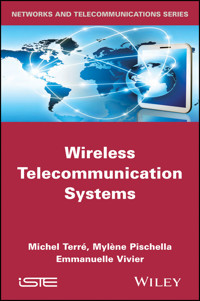
Wireless telecommunication systems generate a huge amount of interest. In the last two decades, these systems have experienced at least three major technological leaps, and it has become impossible to imagine how society was organized without them. In this book, we propose a macroscopic approach on wireless systems, and aim at answering key questions about power, data rates, multiple access, cellular engineering and access networks architectures.
We present a series of solved problems, whose objective is to establish the main elements of a global link budget in several radiocommunications systems.
Sie lesen das E-Book in den Legimi-Apps auf:
Seitenzahl: 174
Veröffentlichungsjahr: 2013
Ähnliche



















Table of Contents
Foreword
Preface
Chapter 1. Radio Propagation
1.1. Free-space loss link budget and capacity
1.2. Link budget and free-space loss
1.3. Linear expression of the Okumura–Hata model
1.4. Frequency, distance and propagation model
1.5. Link budget and diffraction
1.6. Link budget and refraction
1.7. Link budget and diffusion
1.8. Frequency and time selectivity
1.9. Doppler effect
Chapter 2. F/TDMA and GSM
2.1. Maximum transmitter–receiver distance
2.2. Extended maximum transmitter–receiver distance
2.3. Reuse distance, interference reduction factor K and regular pattern
2.4. Radio resources dimensioning in GSM
2.5. Link budget in an isolated GSM cell
2.6. Deployment of a GSM network along a highway
2.7. GSM network dimensioning and planning in a rural area
2.8. GSM network dimensioning and planning in an urban area
2.9. SMS transmission in a GSM network
2.10. Frequency reuse pattern determination
2.11. Traffic and Erlang for GSM cell dimensioning
2.12. Signal to noise plus interference ratio
Chapter 3. CDMA and UMTS
3.1. Spreading and CDMA
3.2. Hadamard spreading codes: a perfect orthogonality between the users?
3.3. Relation between Eb/N0 and the reception threshold in UMTS networks
3.4. Required number of codes in CDMA
3.5. UMTS link budget
3.6. Cell breathing in UMTS networks
3.7. Intersite distance calculation in UMTS networks for different frequency reuse patterns
3.8. Case study in UMTS networks
Chapter 4. OFDM and LTE
4.1. Useful throughput of an OFDM waveform
4.2. OFDM and PAPR
4.3. Frequency selectivity and OFDM dimensioning
4.4. OFDM dimensioning
4.5. OFDM dimensioning for 4G networks and data rate evaluations
4.6. LTE data rates evaluation
4.7. LTE link budget
4.8. LTE link budget taking into account the number of users
4.9. Modulation-coding scheme relation, spectral efficiency and SINR in LTE networks
Chapter 5. MIMO and Beamforming
5.1. Beamforming and signal-to-noise ratio
5.2. Space diversity and chi-square distribution
5.3. MIMO and capacity
Chapter 6. UWB
6.1. Impulse UWB
6.2. UWB and OFDM
6.3. Link budget for UWB transmission
Chapter 7. Synchronization
7.1. Cramer–Rao bound
7.2. Modified Cramer–Rao bound
7.3. Constant parameter estimation
7.4. Radio burst synchronization
7.5. Phase estimation for QPSK modulation
Chapter 8. Digital Communications Fundamentals
8.1. Review of signal processing for signal-to-noise ratio
8.2. Review of digital modulations
8.3. Review of equalization
8.4. Signal-to-noise ratio estimation
8.5. ASK 2 modulation error probability
8.6. Spectral occupancy, symbol rate and binary throughput
8.7. Comparison of two linear digital modulations
8.8. Comparison of two-PSK modulation and power evaluations
8.9. Zero-forcing linear equalization
8.10. Minimum mean square error linear equalization
8.11. Noise factor in equipments
8.12. Data rate calculations
Chapter 9. Erlang B Tables
Bibliography
Index
First published 2013 in Great Britain and the United States by ISTE Ltd and John Wiley & Sons, Inc.
Apart from any fair dealing for the purposes of research or private study, or criticism or review, as permitted under the Copyright, Designs and Patents Act 1988, this publication may only be reproduced, stored or transmitted, in any form or by any means, with the prior permission in writing of the publishers, or in the case of reprographic reproduction in accordance with the terms and licenses issued by the CLA. Enquiries concerning reproduction outside these terms should be sent to the publishers at the undermentioned address:
ISTE Ltd27-37 St George’s RoadLondon SW19 4EUUK
www.iste.co.uk
John Wiley & Sons, Inc.111 River StreetHoboken, NJ 07030USA
www.wiley.com
© ISTE Ltd 2013
The rights of Michel Terré, Mylène Pischella and Emmanuelle Vivier to be identified as the authors of this work have been asserted by them in accordance with the Copyright, Designs and Patents Act 1988.
Library of Congress Control Number: 2013941767
British Library Cataloguing-in-Publication DataA CIP record for this book is available from the British LibraryISBN: 978-1-84821-543-6
Foreword
In the world of telecommunications, radio systems possess an essential characteristic that has led to their success: they are universally accessible and they allow mobility. This is a huge advantage compared with wired systems, which are limited to fixed access but, however, provide higher data rates and quality of service. Consequently, in order to decrease the gap between wired and wireless systems, the main research effort in radiocommunications aims to increase data rates while improving the quality of service.
The main drawback of universal access is complexity, since very different techniques must be implemented and combined in order to efficiently exploit the frequency spectrum, while offering an easy and user-friendly interface. The technical challenges are, indeed, phenomenal. First, the radio transmit channel varies and needs to be estimated in real time to adapt the data rates accordingly. Second, coexistence of a large number of users and several services must be guaranteed. Finally, the frequency spectrum that can be exploited under favorable economic conditions and a tolerable respect level for the environment is limited, and its usage must be optimized. To cope with all these challenges, we require theories, algorithms and the most evolved technologies, and must integrate them easily.
Multidisciplinarity and complexity are two challenges present in radiocommunications teaching. Indeed both specialized and non-specialized students must be trained. Specialized students must be able to lead research, break new ground and complete developments in their area of expertise. After having understood and evaluated the available techniques, non-specialized students must define systems, integrate their subsets, carry out their deployments and follow their exploitations.
The collection of solved problems proposed by Michel Terré, Mylène Pischella and Emmanuelle Vivier is the fruit of their experience in both industry and teaching. It is particularly suitable for non-specialists’ training, as it covers important and specific themes of radiocommunication networks, with an approach based on knowledge tests and integration checking. More generally, it can allow professionals, especially those who work as operators, to refresh their knowledge and remind them of some scale orders and key values. It can even encourage radiocommunication non-specialists to go into, or deepen their knowledge of, a particular area, starting from a concrete problem. Thus, through training, this book will contribute to the progress of wireless systems.
Maurice BELLANGEREmeritus Professor at CNAMMember of the French Academy of Technologies
Preface
There is a strong interest for wireless systems within the population. In 20 years, these systems have undergone at least three major technological breakthroughs and it is now hard to imagine how life in society could be organized without them.
There are many outstanding works that help to explain the fundamental concepts of wireless systems. We can find, for example, books on electromagnetism and antennas [LAH 11, PIC 09], digital signal processing [BEL 06], digital communications [BAU 07] or electronic radio receivers [PAL 10].
It seems to us that these books could be fruitfully complemented by a book of solved problems. Our purpose is to address the capacity offered by different wireless systems and to investigate transversal problems leveraging different scientific fundamental disciplines.
Therefore, we propose a macroscopic approach for wireless systems and try to answer the questions of power, speed, multiple access cellular solutions and global organization of access networks.
These questions are complex topics and raise several challenges. Regarding the power aspect, we can expect that it will be the total radiated power but it cannot be analyzed independently of the transmission band in which it will be used; we will then have to analyze the power spectral density emitted. Similarly, when considering transmission systems with multiple antennas, we must consider the total transmission power.
The throughput definition is also very complex; is it an overall throughput of a wireless network, a raw data rate of a communication link, a final bit rate for a user, a theoretical capacity? It is clear that this question is difficult and can be approached in various ways.
We propose a series of problems solved with the objective of establishing the elements of the link budget for different radio systems. This book should be considered a collection of practical studies, illustrating the fundamental principles of wireless systems; it is built, per chapter, on the major technological concepts of radio systems. Each chapter begins with a very brief introduction of the main theoretical results, followed by a series of problems solved. We tried to propose practical problems coming from the professional world using, to the greatest extent possible, the terminology and units of this specific field.
More than 15 years of experience in teaching these subjects to students in colleges and universities has convinced us that this book could be useful not only for students but also for engineering companies in the telecommunications sector involved in the implementation of wireless systems.
Chapter 1
Radio Propagation
This chapter aims at establishing the link budget of a radio transmission. The objective is to link the cell coverage and the useful throughput of a wireless system with the transmission power. These calculations are performed based on the transmission power, and using an accurate model of the power scattering in the space between the transmitter and the receiver. This radio space is then called the propagation channel. Its definition may be complex, as we may, in some cases, choose to integrate some elements of the transmission and reception chains in it (especially the antenna systems). Consequently, the most important elements, which will be introduced in an incremental way in the proposed exercises, are mainly: the transmission power, the antenna gain, the noise power spectral density, the useful throughput and the communication channel’s capacity.
Lesen Sie weiter in der vollständigen Ausgabe!
Lesen Sie weiter in der vollständigen Ausgabe!
Lesen Sie weiter in der vollständigen Ausgabe!
Lesen Sie weiter in der vollständigen Ausgabe!
Lesen Sie weiter in der vollständigen Ausgabe!
Lesen Sie weiter in der vollständigen Ausgabe!
Lesen Sie weiter in der vollständigen Ausgabe!
Lesen Sie weiter in der vollständigen Ausgabe!
Lesen Sie weiter in der vollständigen Ausgabe!
Lesen Sie weiter in der vollständigen Ausgabe!




