


0,49 €
Niedrigster Preis in 30 Tagen: 0,00 €
Niedrigster Preis in 30 Tagen: 0,00 €
Mehr erfahren.
- Herausgeber: DigiCat
- Kategorie: Wissenschaft und neue Technologien
- Sprache: Englisch
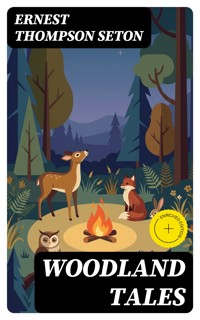
In "Woodland Tales," Ernest Thompson Seton masterfully weaves a tapestry of narratives that capture the essence of nature and wildlife through the eyes of various forest creatures. His vivid, anthropomorphic storytelling style resonates with the reader, creating intimate connections with the flora and fauna of North America. The book, rich in observations influenced by both naturalism and romanticism, reflects Seton's profound understanding of animal behavior and the interconnectedness of ecosystems. Each tale not only entertains but also serves as a moral lesson, urging readers to cultivate respect for the natural world. Ernest Thompson Seton was a pivotal figure in the development of the early conservation movement and an influential wildlife artist. His deep-seated love for nature, combined with his narrative prowess, derives from a lifetime spent observing the wilds of North America. Seton's commitment to educating the public about the importance of wildlife conservation and his experiences as a founder of the Woodcraft Indians—a movement that emphasized outdoor skills—greatly informed his writing, enriching the thematic content of this collection. "Woodland Tales" is highly recommended for readers of all ages and backgrounds, especially those who share a passion for adventure and animal life. It is not merely a children's book; rather, it is a profound exploration of the natural world that encourages empathy, understanding, and a sense of stewardship towards the environment. In this enriched edition, we have carefully created added value for your reading experience: - A comprehensive Introduction outlines these selected works' unifying features, themes, or stylistic evolutions. - A Historical Context section situates the works in their broader era—social currents, cultural trends, and key events that underpin their creation. - A concise Synopsis (Selection) offers an accessible overview of the included texts, helping readers navigate plotlines and main ideas without revealing critical twists. - A unified Analysis examines recurring motifs and stylistic hallmarks across the collection, tying the stories together while spotlighting the different work's strengths. - Reflection questions inspire deeper contemplation of the author's overarching message, inviting readers to draw connections among different texts and relate them to modern contexts. - Lastly, our hand‐picked Memorable Quotes distill pivotal lines and turning points, serving as touchstones for the collection's central themes.
Das E-Book können Sie in Legimi-Apps oder einer beliebigen App lesen, die das folgende Format unterstützen:
Veröffentlichungsjahr: 2022
Ähnliche





Woodland Tales
Table of Contents
Introduction
Woodland Tales gathers Ernest Thompson Seton’s nature writing into a single, season-spanning companion for readers who learn best by looking closely and doing. It is not a novel but a full array of short works, framed by a preface and introduction, and arranged through Things to See in Springtime, Summertime, Autumntime, and Wintertime, then Things to Know, Things to Do, and Things to Remember. Across Tales 1–107, Seton pairs delight with instruction, cultivating curiosity about nearby fields, woods, waters, and skies. The collection’s purpose is practical and humane: to teach observation and care for living things while telling engaging, memorable stories.
These pages present a mixed mode of genres. There are brief narratives that personify plants and animals, etiological tales that imagine how a feature began, and concise essays that deliver natural history. Observational guides introduce what to notice in each season; star-lore sketches explain the night sky; cautionary notes treat hazards in field and forest. Practical instruction appears in activity outlines and how-to passages, while reflective pieces summarize lessons to carry forward. The collection contains short stories, fables, essays, identification notes, and instructional texts; it does not collect plays, diaries, or correspondence, and it avoids the apparatus of scholarly annotation.
Seton’s seasonal architecture is central to the book’s method. Each Things to See section invites readers outdoors now, naming flowers, insects, birds, constellations, and weather marks that announce a particular window of time. The following tales return to those sightings in narrative form, so that hepatica, bloodroot, the bluebird, the humming-bird moth, and the monarch become neighbors rather than abstractions. In autumn and winter, attention shifts to seed, bark, tracks, and stars, teaching how life persists and how direction is found. The result is a field guide in spirit and a storybook in voice, designed for repeated, seasonal rereading.
The collection also engages with North American Indigenous imagery and woodcraft vocabulary, visible in titles such as The Cat’s-eye Toad, a Child of Maka Ina, The Animal Dance of Nana-bo-jou, Totems, and The Caribou Dance. Seton draws on folklore and campcraft traditions to frame moral themes and community practice. Readers today will recognize that these representations are mediated by the author’s perspective and by the era in which he wrote; they should be approached with attentiveness and respect for the cultures evoked. Within the book’s didactic intent, such pieces aim to connect natural observation with story, symbol, and ceremony.
Stylistically, Seton favors clear description, direct address, and an economy that suits reading aloud or in the field. He personifies without obscuring the observable traits of a plant or animal, often pairing a narrative premise with identification cues and behavior notes. The cumulative effect is a pedagogy of attention: names learned, forms recognized, habits inferred, and an ethic of care inferred from familiarity. This balance between wonder and fact underlies the enduring appeal of his work in nature education and popular natural history, where the goal is not exhaustive taxonomy but a habit of looking that leads to stewardship.
In the later sections, the teaching moves from knowledge toward practice and reflection. Things to Know surveys topics like tree growth, trail blazes, symbols, sign language, domestic animal behavior, and common dangers such as poison ivy and poisonous fungi. Things to Do and the Are You Alive group convert observation into action through bird-boxes, smoke prints, simple lamps, snow studies, tracking, sensory drills such as farsight and quicksight, and games that test aim and perception. Things to Remember closes with parables, ceremonies, calendars, and councils, reinforcing that nature study is communal, ethical, and rhythmic rather than merely episodic.
Read as a whole, Woodland Tales traces a circle: seeing, knowing, doing, and remembering. It is designed for flexible use—outdoor companions may dip into seasonal notes before a walk; classrooms may frame activities by the relevant tales; solitary readers may follow the year at their own pace. However approached, the unifying themes remain constant: attention to the near-at-hand, respect for living communities, and delight joined to responsibility. Seton’s signature lies in making nearby nature intelligible and inviting, so that story becomes a path to observation, and observation to care. That progression gives the collection its lasting value.
Historical Context
Woodland Tales emerged in the early twentieth-century United States, when Ernest Thompson Seton (born 1860 in England, raised in Canada) had become a celebrated naturalist-artist. After formative years observing wildlife on the Canadian prairie and later establishing a studio at Wyndygoul in Cos Cob, Connecticut, Seton turned to writing for young readers. Industrialization and rapid urban growth were reshaping North American life, intensifying anxieties about children’s distance from the outdoors. The book’s seasonal organization reflects Seton’s conviction that intimate, year-round acquaintance with nearby fields and woods could counter that drift. Its blend of sketches, observation, and story aligns with his career as both illustrator and field naturalist.
Seton wrote amid the Progressive Era conservation movement, which gave his nature ethics institutional form. The Lacey Act (1900) curbed wildlife trafficking; President Theodore Roosevelt expanded federal forests and, through the 1906 Antiquities Act, proclaimed national monuments; the U.S. Forest Service began in 1905; the National Park Service followed in 1916. Bird protection advanced with the National Association of Audubon Societies (1905) and the Migratory Bird Treaty Act (1918). Woodland Tales’ sympathetic portraits of birds, insects, and small mammals echo these reforms, inviting children to see species as neighbors under pressure from market hunting and habitat loss, and to practice protective, informed behavior outdoors.
Equally important was the Nature-Study movement in schools, which sought to replace rote learning with direct observation. Influential texts such as Anna Botsford Comstock’s Handbook of Nature Study (1911) and the pedagogical philosophy of John Dewey’s Democracy and Education (1916) encouraged seasonal walks, simple experiments, and notebook sketching. Seton’s seasonal framework, fieldcraft tips, and emphasis on noticing signs—tracks, seed pods, stars—fit that classroom culture while remaining pleasurable reading. Teachers and club leaders could lift an activity or tale for a lesson, reinforcing the period’s belief that moral character and scientific curiosity grew together when children investigated the living world just beyond the doorstep.
Seton’s parallel role in organized youth movements sharpened the book’s practical tone. At his Cos Cob, Connecticut home he launched the Woodcraft Indians in 1902, promoting outdoor skills, camp councils, and emblems. He helped found the Boy Scouts of America in 1910, served in its early leadership through the mid-1910s, and authored a widely used handbook. Across that network, songs, ceremonies, and merit-like tasks made nature knowledge social and memorable. Woodland Tales’ “Things to Do” and sensory-training sections echo this programmatic approach, translating field lore into games and challenges that a patrol, camp cabin, or classroom could adopt without specialized equipment or expense.
Composition and reception were also shaped by the Nature Fakers controversy (1903–1907), sparked when essayist John Burroughs attacked embellished animal stories and President Roosevelt publicly joined the critique. Seton, already famed for vivid animal biographies, was drawn into the debate over truthfulness in natural-history writing. Woodland Tales negotiates that climate by pairing mythic etiologies, star lore, and personified voices with cues for verification—field marks, life cycles, tracks, and habitats. The result reflects an era that demanded both enchantment and accuracy: stories calibrated to kindle sympathy while directing young readers back to what could be observed, collected responsibly, or recorded in notebooks.
The collection’s recurring Indigenous names and motifs arose from contemporaneous currents in American culture. Following the 1890 Census declaration that the frontier was “closed,” Frederick Jackson Turner’s 1893 thesis and popular Wild West imagery fostered nostalgia for preindustrial lifeways. At the same time, anthropology under Franz Boas professionalized the study of Native languages and stories, even as federal policies pushed assimilation; the Indian Citizenship Act passed in 1924. Seton admired Indigenous ecological skill and ceremonial order, yet often employed pan-Indian vocabulary and syncretic myths—Nanabozho, Maka Ina—that reflected romantic primitivism. While widely accepted then, those choices invite modern scrutiny regarding appropriation and accuracy.
Other sections register the period’s expanding popular science. The public’s fascination with the night sky around Halley’s Comet (1910) and the emergence of planetariums in the 1920s encouraged accessible star lore for families and clubs. Advances in halftone reproduction and Doubleday, Page & Company’s mass-market reach enabled Seton’s drawings to serve as teaching tools as well as decoration. Natural-history periodicals and early field guides accustomed readers to identifying species by pattern, behavior, and season. Woodland Tales capitalizes on that visual literacy, coupling narrative with instructive images and precise terms so that a child with a pencil and a backyard could practice observation.
Finally, the book reflects broader social shifts in recreation and mobility. As cities expanded and the automobile spread in the 1910s–1920s, summer camps, nature clubs, and youth organizations multiplied; the Camp Fire Girls took shape in 1910–1912, and the Girl Scouts of the USA were founded in 1912. Leaders needed structured, inexpensive activities that cultivated attention, cooperation, and respect for living things. Woodland Tales met that need with seasonally timed projects, tales suited to campfires, and star maps for winter nights. Its approachable pedagogy helped embed conservation-minded, hands-on natural history in American childhood, a legacy visible in later outdoor education programs.
Synopsis (Selection)
Woodland Tales (Collection Overview)
A season-by-season compendium of nature lore, origin tales, practical woodcraft, and sensory training aimed at young readers and outdoor learners.
Seton blends folkloric storytelling with field observation and hands-on exercises, emphasizing respect for wildlife, Indigenous-inspired motifs, and character-building through close attention to the living world.
Preface and Introduction
These opening notes set the pedagogical aim: to awaken curiosity and kindness toward nature through stories, simple science, and do-it-yourself activities.
They frame the collection’s blend of myth and method, inviting readers to see the woods as both classroom and community.
Things to See in Springtime (including Tales 1–16)
Short fables and field notes introduce early wildflowers, birds, and insects—hepatica, bloodroot, bluebird, robin, song sparrow, dogwood, woolly-bear, violets, cocoons, monarchs, and Solomon’s seals—through gentle origin tales and observable traits.
The tone is celebratory and tender, teaching renewal, naming, and careful looking as winter yields to first color and song.
Things to See in Summertime (including Tales 17–37)
Midsummer pieces roam meadows and gardens to profile clovers and shamrocks, edible and medicinal plants, traditional crafts, and showy moths and caterpillars, mixing cautionary notes with delight.
Seton’s voice grows playful and practical, highlighting interdependence, usefulness, and the surprises of metamorphosis and pollination.
Things to See in Autumntime (including Tales 38–48)
Autumn chapters meditate on changing leaves, small birds’ antics, witch-hazel blooms, wasp and cicada dramas, and the hazy spell of Indian Summer, balancing wonder with clear-eyed natural history.
Themes of preparation and transformation come forward as the year tips toward rest, with a reflective, fireside cadence.
Things to See in Wintertime (including Tales 49–59)
Winter entries turn skyward to star lore—North Star, Orion, Pleiades, and more—then ground the gaze in tracks, a rabbit’s life, hardy plants, and seasonal customs like Woodchuck Day.
Mythic constellations and practical tracking coexist, modeling resilience, orientation, and storytelling as tools for long nights.
Things to Know (Tales 60–72)
This toolkit explains reading the woods—pine stories, blaze marks, totems and symbols, sign language, and animal communications—alongside folk explanations for familiar behaviors.
It mixes safety lore and cautions about poisons with sky-borne medicine, embodying Seton’s didactic, emblem-rich woodcraft ethic.
Things to Do (Tales 73–84)
Hands-on projects lead readers outdoors to find winter nests, craft prints and pots, build bird boxes and lamps, explore ponds and snowflakes, and practice humane, observant fieldcraft.
The mood is encouraging and inventive, turning curiosity into skill while stressing care, restraint, and delight in making.
Are You Alive? (Tales 85–98)
A lively suite of sense-training games tests sight, hearing, touch, speed, estimation, aim, and tracking, often framed as playful quests and hunts.
Ceremonies, dances, and creative records channel Indigenous-inspired forms to cultivate attention, community, and self-mastery.
Things to Remember (Tales 99–107)
Closing tales and rituals—bird fables, storm scenes, night lights, seasonal marriages, councils, fire lore, calendars, and mountain climbs—gather the book’s lessons into memories and rites.
The tone becomes summative and aspirational, urging stewardship, seasonal awareness, and a lifelong practice of woodcraft.
Books by Ernest Thompson Seton (Back Matter)
A bibliographic list of Seton’s other works directs readers to further animal stories and woodcraft manuals.
It situates Woodland Tales within a broader oeuvre of naturalist storytelling and outdoor education.
By Mrs. Ernest Thompson Seton (Back Matter)
A companion list of titles by Mrs. Seton acknowledges collaborative currents in the woodcraft movement.
It extends the reading path and underscores the household’s shared commitment to nature study and campcraft.




