


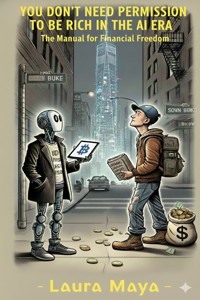
6,99 €
Mehr erfahren.
- Herausgeber: resourceinternet
- Sprache: Englisch
The Manual of Financial Freedom
You did everything you were told to do.
You studied hard, earned the degree, found the stable job, and followed the advice that promised security if you stayed disciplined long enough. And yet, despite doing everything "right," real freedom still feels out of reach.
This isn't because you failed.
It's because the rules changed.
You Don't Need Permission to Be Rich in the AI Era is a calm, practical guide to building wealth in a world reshaped by artificial intelligence, digital ownership, and open networks. Instead of hype or shortcuts, it explains why traditional advice—work harder, save more, wait longer—was designed for an economy that no longer exists.
Inside, you'll learn how to use free AI tools like a first employee, how to start micro-investing with as little as $10, and why modern wealth is increasingly built through ownership of digital assets rather than trading time for money. You'll also be introduced to Web3 not as speculation, but as a practical way to regain control of your money, data, and digital life.
The book includes a simple 90-day framework to help you build your first stream of owner-based income while keeping your day job—without risky bets or drastic moves.
This isn't about chasing trends. It's about creating options. About replacing anxiety with flexibility. And about realizing that wealth in the AI era isn't about what you know—it's about what you're willing to try.
You don't need special credentials.
You don't need connections.
And you don't need permission.
The door is already open.
You just need to walk through it.
Das E-Book können Sie in Legimi-Apps oder einer beliebigen App lesen, die das folgende Format unterstützen:
Veröffentlichungsjahr: 2026
Ähnliche





You Don’t Need Permission to Be Rich in the AI Era
The Manual Of Financial Freedom
Table of Contents
Title Page
Foreword
Introduction
Chapter 1 | The Old Rich vs. The New Rich—Why School Didn’t Prepare You for This Economy
Chapter 2 | Your First AI Employee (And It’s Free)
Chapter 3 | From $10 to $1,000—Micro-Investing in the AI Economy
Chapter 4 | Web3 for the Totally Clueless (Yes, You Can Start Tonight)
Chapter 6 | Build Your “AI-First” Side Hustle (Even If You Hate Sales)
Chapter 7 | Escape the Salary Trap—Without Quitting Your Job
Chapter 8 | The Psychology of the New Rich—Why Most Still Fail (And How to Not Be One of Them)
Chapter 9 | Your 90-Day AI Wealth Launch Plan
Chapter 10 | Your Wealth, Your Rules—Designing a Life That Fits You
Conclusion | You Don’t Need Permission to Be Rich in the AI Era
Foreword
I still remember the day I handed my father my college diploma. I was twenty two and wore a cheap suit I’d borrowed from my uncle because I couldn’t afford my own. My mom took three photos—I never printed any of them. My dad held the rolled-up paper for a long time before he finally spoke.
“You worked hard for this,” he said. “But I hope it doesn’t cost you your freedom.”
I laughed it off. At the time, I thought he was being dramatic.
After all, wasn’t this the plan?
School, degree, job, house, retirement?
That’s what everyone said. That’s what every book, every teacher, every career counselor had drilled into me since middle school: get educated, climb the ladder, be reliable. Good things come to those who wait.
So I waited.
I got the job—the one with health insurance and a 401k. I showed up early, stayed late, and said yes when I meant no. I bought the car with the monthly payment that made my stomach knot every time the email arrived. I paid my student loans like a good citizen.
And every Sunday night, I’d feel this quiet dread, like I was running on a treadmill that kept speeding up but never took me anywhere new.
Then, in 2023, something strange happened. My cousin Leo—who’d dropped out of community college to “mess with computers”—sent me a screenshot. He’d made $847 in three days. Not from a job. Not from Uber. From something called “AI art.”
I asked him how. He said, “I didn’t make it. My AI did. I just told it what to do.”
I rolled my eyes. Sounded like scam talk. But I looked it up. And what I found wasn’t magic. It wasn’t even complicated. It was just... different. People were using free tools—ones I’d never heard of—to write books, design logos, analyze stocks, even run customer service for small businesses. And they weren’t tech geniuses. One was a hairdresser in Ohio. Another was a retired teacher in Portugal. They weren’t getting rich overnight, but they were earning extra—sometimes more than their day jobs—without quitting, without debt, and without permission from a boss or a bank.
That’s when it hit me: the world had changed while I was busy following the old map.
I spent the next year trying to catch up. I felt stupid at first, like everyone else had gotten a memo I missed.
But slowly, I learned. I used AI to write cold emails for a side gig. I bought $10 of an AI-themed ETF just to see how it worked. I made a crypto wallet and sent myself $2 in Ethereum—just to prove I could. None of it felt like “investing” or “entrepreneurship.” It just felt like playing. But that play started paying me.
Today, I don’t work for a salary anymore—not in the old sense. I have three small income streams, none of which require me to clock in. I still work hard, but I work for myself. And the scariest part? It didn’t take genius. It took curiosity. And the willingness to try something that felt weird at first.
That’s why I’m writing this foreword—not as an expert, not as a guru, but as someone who almost stayed on the treadmill because I thought the rules were fixed. They’re not.
The richest people today aren’t always the ones with the fanciest degrees or the most hours logged. They’re the ones who saw a new tool and asked, “What can I do with this?”
This book isn’t about hype. It’s not about telling you to quit your job tomorrow or mortgage your house to buy Bitcoin.
It’s about showing you—gently, clearly, step by step—how ordinary people are using AI and Web3 to create real options.
Options your parents never had. Options your professors never taught.
Options that start small, cost little, and compound quietly.
You don’t need to be a coder. You don’t need to be young. You don’t even need to fully understand blockchain to begin.
You just need to be willing to try one small thing. Then another. That’s how freedom starts—not with a grand leap, but with a curious click.
I wish I’d had this book at twenty two. But I’m glad I have it now. And if you’re holding it, you’re already ahead of where I was. You’re asking the right question: Is there another way?
The answer is yes.
And it’s simpler than you think.
Introduction
Why You’re Still Broke After Reading Fifty Money Books
You just read a story about someone who made it out. Maybe it gave you hope. Maybe it made you wonder, “Could that be me?”
Let’s be honest. You’ve probably read a money book or two. Maybe more. Rich Dad Poor Dad. The Millionaire Next Door. Maybe something by Warren Buffett or Dave Ramsey. You’ve highlighted passages. You’ve made budgets in Excel that lasted three weeks. You’ve told yourself, “This time, I’ll stick to it.”
And yet—here you are.
Still trading hours for dollars. Still checking your bank balance with that familiar mix of hope and disappointment. Still wondering why, after doing everything you were told was “right,” real security feels just out of reach. Let alone wealth.
It’s not your fault.
Most money advice wasn’t written for the world you’re living in now. It was written for a time when a job was a career, when pensions existed, when “investing” meant calling a broker and buying shares of IBM. It assumed stability. It assumed that if you worked hard, saved consistently, and avoided mistakes, the system would eventually reward you.
But the system changed. And no one sent a memo.
Today, jobs disappear overnight. Inflation quietly eats savings. A college degree can cost more than a house did in 1990—and often delivers less security. Meanwhile, entirely new forms of wealth have been emerging in plain sight: digital products created by individuals, AI tools doing work that once required teams, regular people earning income from assets they own instead of hours they sell.
You don’t feel behind because you’re lazy.
You feel behind because the finish line moved—and nobody told you where it went.
Most people respond to this by trying harder at the wrong things. They budget more aggressively. They cut small pleasures. They read another book. They look for a better job. But those efforts rarely change the outcome, because they’re still operating inside an old framework—one built for a slower, more predictable economy.




