


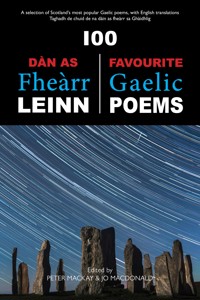
100 Dàn as Fheàrr Leinn E-Book
Erhalten Sie Zugang zu diesem und mehr als 300000 Büchern ab EUR 5,99 monatlich.
- Herausgeber: Luath Press
- Kategorie: Poesie und Drama
- Sprache: Englisch
A collection of 100 favourite Gaelic poems and songs – love poems and hymns, sea ditties and war poems, lullabies and elegies – many translated into English for the first time. Selected by Peter Mackay and Jo MacDonald, and including public nominations, these poems give a multi-layered taste of the full richness of Gaelic literature from the Middle Ages to the present day. Cruinneachadh de 100 dàn agus òran Gàidhlig de dh'iomadh seòrsa agus o iomadh linn – nam measg bàrdachd gaoil agus laoidhean, òrain mara agus òrain cogaidh, tàlaidhean agus marbhrainn. Air an taghadh le Pàdraig MacAoidh agus Jo NicDhòmhnaill, le molaidhean an t-sluaigh, tha an cruinneachadh seo a' toirt blasad de shàr-bheartas litreachas na Gàidhlig.
Sie lesen das E-Book in den Legimi-Apps auf:
Seitenzahl: 443
Veröffentlichungsjahr: 2020
Das E-Book (TTS) können Sie hören im Abo „Legimi Premium” in Legimi-Apps auf:
Ähnliche




















First published 2020
Reprinted 2023
ISBN: 978-1-910022-24-5
The Gaelic Books Council provided funding to assist with the publication of this book.
Typeset in 11 point itc Charter
The authors’ right to be identified as author of this work under the Copyright, Designs and Patents Act 1988 has been asserted.
© The Contributors, 2020
CLÀR / CONTENTS
RO-RÀDH / INTRODUCTION
TAING / ACKNOWLEDGEMENTS
NA DÀIN / THE POEMS
1 ’S i Ghàidhlig Donnchadh MacGuaire
Gaelic is Duncan MacQuarrie
2 A’ Chiad Òran Pòl MacAonghais
The First Song Paul MacInnes
3 Smeòrach Chloinn Dòmhnaill Iain MacCodrum
The Song Thrush of Clan Donald John MacCodrum
4 Bho ‘Moladh Beinn Dòbhrain’ Donnchadh Bàn Mac an t-Saoir
From ‘In Praise of Ben Dorain’ Duncan MacIntyre
5 Fhir a dhìreas am bealach Nighean Fhir na Rèilig
You who are climbing the pass The Daughter of the Laird of Rèilig
6 Is mairg dá ngalar an grádh Iseabail Ní Mheic Chailein
Pity one for whom love is a sickness Iseabail Ní Mheic Chailein
7 breisleach aonghas macneacail
delirium aonghas macneacail
8 Osag chùbhraidh nam beannaibh Aonghas Caimbeul (Am Bocsair)
The sweet breeze of the hills Angus Campbell
9 Beatha Ùr Niall O’Gallagher
New Life Niall O’Gallagher
10 Eubha Deborah Moffatt
Eve Deborah Moffatt
11 Iain Ghlinne Cuaich gun urra
John of Glen Quoich anon
12 Mo nighean donn à Còrnaig gun urra
My brown-haired girl from Còrnaig anon
13 Tha thu air aigeann m’ inntinn Iain Crichton Mac a’ Ghobhainn
At the bottom of my mind Iain Crichton Smith
14 Bho ‘Òran do dh’Alasdair MacColla’ Diorbhail Nic a’ Bhruthain
From ‘A Song to Alasdair Mac Colla’ Dorothy Brown
15 Alasdair à Gleanna Garadh Sìleas na Ceapaich
Alasdair of Glengarry Julia MacDonald
16 Òran air Latha Blàr Inbhir Lòchaidh eadar Clann Dòmhnaill agus na Caimbeulaich Iain Lom
A Song on the Battle of Inverlochy, between Clan Donald and the Campbells John MacDonald
17 Bho ‘An Claigeann’ Dùghall Bochanan
From ‘The Skull’ Dugald Buchanan
18 Mo Rùn Geal Òg Cairistiona NicFhearghais
My Bright Young Love Christina Ferguson
19 Òran Eile air Latha Chùil Lodair Iain Ruadh Stiùbhart
Another Song about the Day of Culloden John Roy Stuart
20 A Mhic Iain ’ic Sheumais A Mhuime NicCòiseam
Son of John son of James NicCòiseam
21 Bisearta Deòrsa mac Iain Dheòrsa
Bisearta George Campbell Hay
22 Stad tamall beag, a pheileir chaoil Murchadh Moireach
Stop a little, slender bullet Murdo Murray
23 Ar Gaisgich a Thuit sna Blàir Iain Rothach
Our Heroes who Fell in Battle John Munro
24 Bho ‘Smuaintean am Braighdeanas am Poland 1944’ Aonghas Caimbeul (Am Puilean)
From ‘Thoughts in Captivity in Poland 1944’ Angus Campbell
25 An Ataireachd Bhuan Dòmhnall MacÌomhair
The Endless Surge of the Sea Donald MacIver
26 Bho ‘Iorram na Sgiobaireachd’ Murchadh MacCoinnich
From ‘The Rowing Song of Skippering’ Murdo Mackenzie
27 faclan, eich mara Caomhin MacNèill
words, seahorses Kevin MacNeil
28 Bho ‘Birlinn Clann Raghnaill’ Alasdair mac Mhaighstir Alasdair
From ‘The Galley of Clan Ranald’ Alexander MacDonald
29 Òran Chaluim Sgàire Calum MacAmhlaigh
The Song of Calum, son of Zachariah Calum MacAulay
30 Òran Mòr Sgoirebreac gun urra
The Great Song of Scorrybreac anon
31 Bho ‘Do dh’Iain Garbh mac Gille Chaluim Ratharsaigh’ Màiri nighean Alasdair Ruaidh
From ‘For Iain Garbh, MacLeod of Raasay’ Mary MacLeod
32 Ailein Duinn Anna Chaimbeul
Brown-haired Alan Anne Campbell
33 M’ anam do Sgar Riomsa A-raoir Muireadhach Albannach Ó Dálaigh
My soul was ripped from me last night Muireadhach Albannach Ó Dálaigh
34 Na Lochlannaich a’ tighinn air tìr an Nis Ruaraidh MacThòmais
The Norsemen Coming Ashore at Ness Derick Thomson
35 An Tiona Pàdraig MacAoidh
The Tin Peter Mackay
36 Tiugainn a dh’iomain gun urra
Come to Play anon
37 Am Brù-dhearg gun urra
Robin Red-breast anon
38 An Luchag ’s an Cat gun urra
The Wee Mouse and the Cat anon
39 Eilidh Catriona NicGumaraid
Eilidh Catriona Montgomery
40 Dealbh mo Mhàthar Meg Bateman
Picture of my Mother Meg Bateman
41 Trod Tormod Caimbeul
Scolding Norman Campbell
42 Gobhar an Deucoin Coinneach “Red” MacLeòid
The Deacon’s Goat Kenneth MacLeod
43 Òran a’ Mhotor-càr Dòmhnall MacNèill
The Song of the Motor Car Donald MacNeill
44 An ràcan a bh’ againne gun urra
The drake that we had anon
45 Duanag don Uisge-bheatha Ailean Dall MacDhùghaill
A Little Song to Whisky Allan MacDougall
46 Òran na Cloiche Dòmhnall Ruadh Mac an t-Saoir
The Song of the Stone Donald MacIntyre
47 Rann Callainn Calum MacAsgaill
New Year Verse Calum MacAskill
48 Leanabh an Àigh Màiri NicDhùghaill
Child of Joy Mary MacDougall
49 Tàladh ar Slànaighear Mgr Raghnall MacFhraing
Lullaby for our Saviour Rev. Fr. Ronald Rankin
50 Bho ‘Òran do MhacLeòid Dhùn Bheagain’ An Clàrsair Dall
From ‘A Song to MacLeod of Dunvegan’ Roderick Morrison
51 Dèan Cadalan Sàmhach Iain MacRath
Sleep Peacefully John MacRae
52 Cumha do dh’Aonghas ’ic Ailein Dòmhnall Mac a’ Ghobhainn
An Elegy for Angus son of Alan Donald Smith
53 Guma Slàn do na Fearaibh Dòmhnall Caimbeul
Farewell to the Men Donald Campbell
54 Òran a’ Moladh Otàgo, New Zealand Alasdair A. MacRath
Song in Praise of Otago, New Zealand Alasdair A. MacRae
55 Bho ‘Òran do dh’Ameireaga’ Iain MacIlleathain
From ‘A Song to America’ John MacLean
56 Canada Àrd Anna Ghilios
Upper Canada Anne Gillis
57 Bho ‘Moladh Albainn Nuadh’ Ailean an Rids Dòmhnallach
From ‘In Praise of Nova Scotia’ Allan MacDonald
58 Bho ‘Fios chun a’ Bhàird’ Uilleam MacDhùnlèibhe
From ‘A Message for the Poet’ William Livingston
59 Bho ‘Spiorad a’ Charthannais’ Iain Mac a’ Ghobhainn
From ‘The Spirit of Compassion’ John Smith
60 Marbhrann do Chloinn Fhir Taigh Ruspainn Rob Donn MacAoidh
An Elegy for the Children of the House of Rispond Rob MacKay
61 Saighdear Chaluim Bhàin Ciorstaidh NicDhòmhnaill
Calum Bàn’s Soldier Kirsty MacDonald
62 Sìne Bhàn Donnchadh MacIain
Fair-haired Sheena Duncan Johnson
63 Bho ‘An Eala Bhàn’ Dòmhnall Ruadh Chorùna
From ‘The Fair Swan’ Donald MacDonald
64 Do làmh, a Chrìosda Dòmhnall Iain Dòmhnallach
Your Hand, O Christ Donald John MacDonald
65 Màiri Iain Mhurch’ Chaluim Anna C. Frater
Màiri Iain Mhurch’ Chaluim Anne C. Frater
66 Bàs Baile An t-Urr Iain MacLeòid
The Death of a Village Rev. John MacLeod
67 Bho ‘Òran don Mhorbhairne’ Donnchadh Mac a’ Phearsain
From ‘A Song for Morvern’ Duncan MacPherson
68 Bho ‘Nuair bha mi Òg’ Màiri Mhòr nan Òran
From ‘When I was young’ Mary MacPherson
69 An t-Eilean Muileach Dùghall MacPhàil
The Isle of Mull Dugald MacPhail
70 Bho ‘B’ annsa cadal air fraoch’ Gilleasbaig Dòmhnallach
From ‘I’d rather sleep on heather’ Archibald MacDonald
71 Eilean an Fhraoich Murchadh MacLeòid
The Island of Heather Murdo MacLeod
72 Bho ‘Eilean na h-Òige’ Mgr Ailean Dòmhnallach
From ‘The Isle of Youth’ Rev. Fr. Allan MacDonald
73 Bho ‘Madainn Samhraidh ann am Baile mo Bhreith’ Ciorstai NicLeòid
From ‘A Summer Morning in the Village where I was Born’ Kirsty MacLeod
74 Bho ‘Fàilte don Eilean Sgiathanach’ Niall MacLeòid
From ‘Hail to the Isle of Skye’ Neil MacLeod
75 Hallaig Somhairle MacGill-Eain
Hallaig Sorley MacLean
76 Uamh an Òir gun urra
The Cave of Gold anon
77 Bruadar Dheirdre gun urra
Deirdre’s Dream anon
78 Leabaidh Dhiarmaid is Ghràinne Rody Gorman
The Bed of Diarmad and Gràinne Rody Gorman
79 Guilbneach Murchadh Dòmhnallach
Curlew Murdo MacDonald
80 Clann Ghriogair air Fògradh gun urra
Clan Gregor in Exile anon
81 Chan e dìreadh na bruthaich Fearchar MacRath
It’s not climbing the brae Farquhar MacRae
82 Bothan Àirigh am Bràigh Raineach gun urra
A Sheiling Bothy on Brae Rannoch anon
83 Òran eile air an adhbhar cheudna Uilleam Ros
Another song on the same topic William Ross
84 Bho ‘Tha mi fo smuairean’ Iain MacIlleathain
From ‘I am dejected’ John MacLean
85 Gillean Ghleann Dail Iain Dubh MacLeòid
The Lads of Glendale John MacLeod
86 Tha an cuan eadarainn Mòrag NicGumaraid
The ocean is between us Morag Montgomery
87 Gur ann thall ann a Sòdhaigh gun urra
It was over in Sòdhaigh anon
88 An t-Eun Siubhail Iain Mac a’ Chlèirich
The Migrating Bird John Clerk
89 Cearcall a’ Chuain Calum agus Ruaraidh Dòmhnallach
The Ocean Cycle Calum and Rory MacDonald
90 Làmh a’ Bhuachaille gun urra
The Shepherd’s Hand anon
91 Caolas an Sgarp Aonghas MacIlleathain
The Sound of Scarp Angus MacLean
92 Bho ‘Gaol na h-Òige’ Uilleam MacCoinnich
From ‘Childhood Love’ William MacKenzie
93 Turas an Asainte Iain Moireach
Once in Assynt John Murray
94 Cànan nan Gàidheal Murchadh MacPhàrlain
The Language of the Gaels Murdo MacFarlane
95 Sibhse aig a bheil òige Mòrag Anna NicNèill
To the Younger Generation Morag Ann MacNeil
96 An Daolag Shìonach Crìsdean MacIlleBhàin
The Chinese Beetle Christopher Whyte
97 Port na h-eala air an tràigh gun urra
The song of the swan on the shore anon
98 Duan an Dannsair Flòraidh NicPhàil
The Dancer’s Song Flora MacPhail
99 Comharra-Stiùiridh Dòmhnall MacAmhlaigh
Landmark Donald MacAulay
100 Aibisidh Aonghas Pàdraig Caimbeul
ABC Angus Peter Campbell
RO-RÀDH / INTRODUCTION
Tha saidhbhreas iongantach de dhàin agus òrain anns a’ Ghàidhlig: mu ghaol, mun fhearann ’s mun mhuir, mu bhàs is cogadh is creideamh, sealg agus seòladh, duanagan mu bheathaichean agus eòin, tuiridhean mu charan an t-saoghail, tàlaidhean a tha uaireannan tiamhaidh, uaireannan dòchasach. Tha dualchas beò agus leantainneach na bàrdachd seo a’ dol air ais gu co-dhiù na meadhan-aoisean, gu linn far an robh cultar agus seanchas coitcheann eadar Alba agus Èireann. Chaidh dàin agus òrain a dhèanamh ann an tallachan nan caistealan ’s nan taighean mòra, fo rùm air longan eilthireachd, air sràidean coimheach bhailtean mòra, air raointean blàir, air an àirigh, anns an leabaidh; chaidh òrain a sheinn ri fuaim an druma, ri bualadh nan ràmh, ri luadh a’ chlò. Sgaoil cliù cuid de na bàird Ghàidhealach air feadh an t-saoghail ach tha gu leòr eile air nach eil lorg ach air na faclan aca a-mhàin.
Ciamar a nì duine taghadh às an stòras seo, à dàin agus òrain gun àireamh? A dh’innse na fìrinn, cha dèan ach air èiginn agus le làn fhios gu feum thu cuid de na dàin – agus na bàird – as fheàrr leat fhàgail às. Agus feumaidh tu taic. Thug sinn cuireadh do dhuine sam bith a thogradh innse dhuinn dè na dàin a b’ fheàrr leotha – agus fhuair sinn ceudan de fhreagairtean. An uair sin dh’iarr sinn air pannal eòlach agus toinisgeil – Iain Dòmhnallach, Dòmhnall U. Moireasdan, Eilidh NicCarmaig, agus Mòrag Anna NicNèill – ar cuideachadh gus an àireamh a ghearradh air ais, molaidhean eile a dhèanamh agus beàirn a chomharrachadh. Agus chaidh sinn fhìn, às dèidh sin uile, tro na liostaichean, a’ feuchainn ri bhith cinnteach gu robh farsaingeachd ann a thaobh cò às a thàinig na dàin, agus cuin’ a chaidh an dèanamh, gun robh duanagan cloinne ann agus laoidhean a cheart cho math ri bàrdachd cogaidh agus gaoil, agus gu robh Gàidheil thall thairis air an riochdachadh. Chuir sinn romhainn nach biodh againn ach aon dàn le bàrd no bana-bhàrd sam bith, agus far an robh taghadh ri dhèanamh, bha sinn dualtach dàn na bu ghiorra a thaghadh. Far nach robh sinn airson dàn fada fhàgail às, agus far an robh e iomchaidh, tha sinn air earrann a thaghadh às.
Am measg an taghaidh tha cuid de na dàin as ainmeile a tha sa Ghàidhlig: ‘Hallaig’ le Somhairle MacGill-Eain, ‘Nuair a Bha Mi For centuries Gaelic speakers have been writing poems and singing songs about love, the land, the sea, death, war, religion, travel, work, birds, change, dreams, emigration, home. There is a living and continuous tradition of Scottish Gaelic poetry and verse that stretches back to medieval times, to a period when there was a shared cultural hinterland between Ireland and Scotland (with hints and glimpses of even older stories, tales and songs). Poems were written in the great halls of the chiefs, in the holds of emigrant ships, on the unfamiliar streets of new worlds, in shielings and bothies, on battlefields, in bed; songs were sung to the beat of drum or the waulked tweed or the oars. The fame of some Gaelic poets travelled the world and endured for centuries (even when, as with ‘Ossian’, they never existed); many others, though, haven’t even left us their names, only their words, passed down over the generations.
How to choose one hundred poems or songs from among these centuries of singing and composing? With difficulty, help, and the unfortunate knowledge that there are many of our favourite poems – and poets – that we couldn’t include. We invited the public to nominate their favourites and got hundreds of suggestions; and we asked a knowledgeable panel – Eilidh Cormack, Iain MacDonald, Morag Anna MacNeill, Donald Morrison – for help in narrowing these down, and in identifying gaps or omissions. And then we pored over the selections, making sure that there was a historical and geographical range, that there were children’s rhymes and hymns, war poems and love songs, and that the international nature of Gaelic poetry was recognised. We wanted to make sure that as many different voices, audiences, themes and styles as possible were included; to that end we limited ourselves to one poem per poet and we tended towards shorter poems – but where we felt we couldn’t leave out a longer poem, and where it was possible, we’ve chosen an extract.
Among those we have chosen are some of the most famous and beloved Gaelic poems and songs: ‘Hallaig’ by Sorley MacLean, ‘When I Was Young’ by Mary MacPherson (“Màiri Mhòr nan Òran”), an extract from Duncan Bàn MacIntyre’s ‘In Praise of Ben Dorain’, the anonymous ‘Cave of Gold’, a song by the MacDonald brothers Òg’ le Màiri Mhòr nan Òran, earrann à ‘Moladh Beinn Dòbhrain’ le Donnchadh Bàn Mac an t-Saoir, ‘Uamh an Òir’, òran le na bràithrean Calum agus Ruaraidh aig Runrig, Anna C. Frater a’ meòrachadh air a seanmhair – agus a sean-seanair a chaochail air an Iolaire. Ach cuideachd – tha sinn an dùil – tha corra dhàn ann a bhios ùr do chuid agaibh, neo a tha sibh air a dhìochuimhneachadh: duanag mu chat acrach agus luchag fhaiceallach; ìomhaigh ghleansach dannsair le Flòraidh NicPhàil; moladh air Canada Àrd le Anna Ghilios; earrann à dàn fada iongantach Dhùghaill Bhochanain mu bheatha agus bàs. Cluinnear mòran de na h-òrain fhathast aig a’ Mhòd neo air BBC Radio nan Gàidheal; tha feadhainn eile, ge-tà, nach deach fhoillseachadh a-riamh, air neo tha ri lorg a-mhàin ann an irisean neo leabhraichean a tha a-mach à clò.
Tha làn fhios againn nach bi duine ag aontachadh gu tur leis an taghadh againn, gum bi sibh a’ dol tro na duilleagan a leanas agus ag ràdh “Obh obh, carson a tha an dàn seo ann, agus na dàin ud air am fàgail às?”. Tha sin mar bu chòir. Tha litreachas na Gàidhlig beairteach, lìonmhor agus a’ sìor atharrachadh: cha bhi na dàin as fheàrr a chòrdas ri aon neach tric ionann ri roghainn neach eile. Tha sinn an dòchas gun toir an taghadh seo dhuibh co-dhiù tomhas de dh’aoibhneas, eòlas, dibhearsain, sòlas. Gum meal is gun caith sibh e.
of Runrig, Anne C. Frater’s evocation of the death of her great-grandfather on the Iolaire. But there will also be – we hope – poems that are new to many of you, or that are perhaps half-forgotten: a childhood rhyme about a hungry cat and a cautious mouse; Flora MacPhail’s shimmering image of a dancer; Anne Gillis’s celebration of Upper Canada; an extract from Dugald Buchanan’s astounding philosophical meditation ‘The Skull’. Many of the songs are still widely sung; some of the poems are unpublished or only ever appeared in journals, magazines or long out-of-print books. All though, we hope, might be – in their own ways – a source of delight, or knowledge, or comfort. We know that there are gaps, that many of you will flick through the following pages and ask why this poem, and not that one. And that is as it should be. The Gaelic literary tradition is rich, fluid and changing – one person’s favourites will definitely not be another’s, and any book such as this is just one sounding-pole stuck into a living stream, or just one stone added to an ever-growing cairn.
TAING / ACKNOWLEDGEMENTS (AND A NOTE ON TRANSLATION)
We would like to thank everyone who sent in suggestions for inclusion in the book: these took us in many different, hugely enjoyable directions, and we are sorry that inevitably we could only include a selection of these suggestions. The help, energy and wisdom of our panel – Eilidh Cormack, Iain MacDonald, Morag Anna MacNeill, Donald Morrison – was invaluable, and the book would have been much less rich and fulfilling without their aid (any flaws or omissions are, though, entirely the editors’ responsibility). The book received generous funding from Comhairle nan Leabhraichean and Urras Shomhairle / The Sorley MacLean Trust, without which it could never have been published and for which we are extremely grateful. Alison Lang and John Storey at the Gaelic Books Council and Cairistiona NicCoinnich at Sabhal Mòr Ostaig have been hugely supportive throughout the process of preparing the book; as have Gavin MacDougall, Sophie Gillies and Carrie Hutchison at Luath Press in bringing it to press; we are thankful to Joan NicDhòmhnaill and Senga Fairgrieve for their careful copy-editing and typesetting, Margaret Soraya for permission to use one of her images on the front cover. Annella MacLeod at BBC Radio nan Gàidheal gave helpful advice about ways in which the project could develop.
We are grateful to the following poets, or the publishers and relatives of the poets, for permission to include material within copyright: Meg Bateman; Ina MacRitchie for Aonghas Caimbeul (Am Puilean); Cairistiona Smith for Aonghas Caimbeul (Am Bocsair); Catriona Lexy Campbell for Tormod Caimbeul; Anna C. Frater; Calum and Ruaraidh Dòmhnallach; Comann Eachdraidh Uibhist a Tuath for Dòmhnall Ruadh Chorùna; Margaret Campbell for Dòmhnall Iain Dòmhnallach; Murchadh Dòmhnallach; Rody Gorman; Donalda Henderson for Iain Crichton Mac a’ Ghobhainn; Cathlin MacAulay for Dòmhnall MacAmhlaigh; Carcanet Press for Somhairle MacGill-Eain; Kathreen Hunter for An t-Urr Iain MacLeòid; Donald John Cumming for Dòmhnall Mac an t-Saoir; Annot MacInnes for Pòl MacAonghais; Edith MacQuarrie for Donnchadh MacGuaire; Lena Morrison for Aonghas MacIlleathain; Crìsdean MacIlleBhàin; Peigi Flòraidh MacDonald and Mary Hardy for Coinneach “Red” MacLeòid; Aonghas MacNeacail; Caoimhin MacNèill; Lachie Gillies for Dòmhnall MacNèill; Angus Campbell for Murchadh MacPhàrlain; Danny Thomson for Ruaraidh MacThòmais; Mary MacIver for Murchadh Moireach; Alexander Murray for Iain Moireach; Deborah Moffat; Catriona NicGumaraid; Mòrag NicGumaraid; Catriona Dunn for Ciorstai NicLeòid; Morag Anna NicNèill; Flòraidh NicPhàil; Niall O’Gallagher. We have also drawn on the knowledge and expertise of friends and colleagues through the process of choosing and editing the poems: Ronald Black, Michel Byrne, Màiri Sìne Campbell, Catriona Dunn, Gwen Culbertson, Karen Elder, Sine Gillespie, Mairi Kidd, Margaret MacKay, Angus MacKenzie, Hugh Dan MacLennan, Gillebride MacMillan, Viktoria Marker (who provided us with information about Alasdair A. MacRath, who features in her PhD research), Christine Rintoul, Mary Schmoller, Donald W. Stewart, Maighread Stewart and Catherine Tinney.
For many of the contemporary poems there exist excellent translations by other poets and we have used these where we can; otherwise we have included translations by the Gaelic poets themselves where possible and appropriate. Although we are well aware of the issues associated with self-translation, it was preferable to give a sense of the different ways in which Gaelic poetry can be, and has been, translated recently. For older or untranslated poems, we have provided new updated versions (and these have been created by the editors with the help – where indicated – of Iain S. MacPherson); there are a very few cases where an existing translation was so iconic in its own right (such as Iain Crichton Smith’s version of ‘Moladh Beinn Dòbhrain’) that we have chosen to include this. And so many thanks are due to Iain S for his help, and to the following people for permission to reproduce translations: Meg Bateman; Iona Brown and Flòraidh NicPhàil; Aonghas Phàdraig Caimbeul; Catriona Tinney for John Campbell; Murchadh Dòmhnallach; Sally Evans; Anna C. Frater; Donalda Henderson for Iain Crichton Mac a’ Ghobhainn; Kathleen Jamie; Cathlin MacAulay for Dòmhnall MacAmhlaigh; Carcanet Press for Somhairle MacGill-Eain; Ùisdean MacIllInnein; Aonghas MacNeacail; Caoimhin MacNèill; Danny Thomson for Ruaraidh MacThòmais; Alexander Murray for Iain Moireach; Catriona NicGumaraid; Mòrag Anna NicNèill.
1
’S I GHÀIDHLIG
Donnchadh MacGuaire
’S i Ghàidhlig leam cruas na spiorad
’S i Ghàidhlig leam cruas na h-èiginn
’S i Ghàidhlig leam mo thoil inntinn
’S i Ghàidhlig leam mo thoil gàire
’S i Ghàidhlig leam mo theaghlach àlainn
’S i Ghàidhlig leam mo shliabh beatha
’S i Ghàidhlig leam luaidh mo chridhe
’S i Ghàidhlig leam gach nì rim bheò
Mur a b’ e i cha bu mhì
GAELIC IS
Duncan MacQuarrie
Gaelic to me is the hardness of spirit
Gaelic to me is the grit of distress
Gaelic to me is my mind’s satisfaction
Gaelic to me is the pleasure of laughing
Gaelic to me is my beautiful family
Gaelic to me is my life’s mountain
Gaelic to me is the love of my heart
Gaelic to me is everything in my life
If it didn’t exist I wouldn’t be me
2
A’ CHIAD ÒRAN
Pòl MacAonghais
Nuair chruinnich iad san uamhaidh aitidh,
’s a chaisg iad sgiùganaich nan con,
rinn teas an teine tròcair
air na cnàmhan reòthte ’s na cridheachan gealtach.
Thàinig misneachd gun glèidht’ iad o chunnart
’s o bheathaichean allaidh na h-oidhche.
Thàinig buidheachas mun bhlàths
’s mun là-seilge a chaidh leotha.
Thàinig lasadh nan sùil,
’s bha cumadh ùr air an còmhradh.
Agus chualas, gu socair, fròmhaidh,
a’ tighinn à sgòrnan feareigin,
na teudan diùid ud, a chuir umhail air na stallaichean.
Mar dheòir aoibhneach na talmhainn
bha snighe nan creag,
an oidhch’ ud a rugadh an ceòl.
THE FIRST SONG
Paul MacInnes
When they gathered in the damp cave,
and hushed the whimpering of the dogs,
the heat of the fire blessed
the frozen bones and fearful hearts.
They grew confident they were safe
from danger and the wild animals of night.
They gave thanks for the warmth,
for a successful day’s hunt.
A spark came to their eyes,
and there was a new shape to their conversation.
And they heard, gentle, gravelly,
rising from someone’s throat,
timid notes that made even the ledges listen.
As if the earth had tears of joy
the rocks wept
that night music was born.
3
SMEÒRACH CHLOINN DÒMHNAILL
Iain MacCodrum
Holibheag, hileabheag, hò-ail-il ò
Holibheag, hileabheag, hò ro ì,
Holibheag, hileabheag, hò-ail-il ò
Smeòrach le Clann Dòmhnàill mi.
Smeòrach mis’ air ùrlar Phabail:
Crùbadh ann an dùsal cadail,
Gun deòrachd a thèid nas fhaide;
Truimid mo bhròn, thòirleum m’ aigne.
Smeòrach mis’ air mullach beinne,
’G amharc grèin’ is speuran soilleir,
Thig mi stòlda chòir na coille –
Bidh mi beò air treòdas eile.
Smeòrach mis’ air bhàrr gach bidein,
Dèanamh mùirn ri driùchd na madainn,
Bualadh mo chliath-lùth air m’ fheadan,
Seinn mo chiùil gun smùr gun smodan.
Ma mholas gach eun a thìr fèin,
Cuim’ thar èis nach moladh mise?
Tìr nan curaidh, tìr nan cliar,
An tìr bhiadhchar, fhialaidh, mhiosail.
’N tìr nach caol ri cois na mara,
An tìr ghaolach, chaomhach, channach,
An tìr laoghach, uanach, mheannach,
Tìr an arain, bhainneach, mhealach.
THE SONG THRUSH OF CLAN DONALD
John MacCodrum
Holivag hilivag hò-ail-il ò
Holivag hilivag hò ro ì,
Holivag hilivag hò-ail-il ò
I’m a song thrush of Clan Donald.
I’m a song thrush on the plain of Paible,
Crouched down in a napping sleep,
Banished if I go any further;
My sadness heavy, my spirit weak.
I’m a song thrush up a mountain,
Watching the sun and the clear skies;
Composed, I go towards the forest –
I will live by other means.
I’m a song thrush on each summit peak,
Cheerful in the morning dew,
Hitting tuning notes on my chanter,
Singing my music clean and true.
If every bird praises its own land,
Why then should I not praise my own?
This land of heroes, land of poets,
Fruitful, hospitable, far-renowned.
The fertile land beside the sea,
Land that is lovely, kind and mild,
Land of calves and lambs and kids,
Land of bread and milk and honey.
An tìr riabhach, ghrianach, thaitneach;
An tìr dhìonach, fhiarach, fhasgach;
An tìr lèanach, ghèadhach, lachach,
’N tìr ’m bi biadh gun mhiadh air tàchdar.
An tìr chròiceach, eòrnach, phailte;
An tìr bhuadhach, chluanach, ghartach;
An tìr chruachach, sguabach, dhaiseach
Dlùth ri cuan gun fhuachd ri sneachda.
’S i ’n tìr sgiamhach tìr a’ mhachair,
Tìr nan dìthean mìogach dathte;
An tìr làireach, àigeach, mhartach,
Tìr an àigh gu bràth nach gaisear.
’N tìr as bòidhche ta ri faicinn;
’M bi fir òg’ an còmhdach dreachail;
Pailt’ na ’s leòr le pòr a’ mhachair;
Sprèidh air mòintich, òr air chlachan.
An Cladh Chòmhghain mise rugadh,
’N Àird an Runnair fhuair mi togail;
Fradharc a’ chuain uaibhrich, chuislich,
Nan stuagh guanach, cluaineach, cluicheach.
Measg Chlann Dòmhnaill fhuair mi m’ altrum,
Buidheann nan seòl ’s nan sròl daithte,
Nan long luath air chuantaibh farsaing,
Aiteam nach ciùin rùsgadh ghlaslann.
Na fir eòlach, stòlda, staideil,
Bha ’s a’ choimhstrith stròiceach, sgaiteach,
Fir gun bhròn, gun leòn, gun airtneal,
Leanadh tòir is tòir a chaisgeadh.
Buidheann mo ghaoil nach caoin caitean,
Buidheann nach gann greann ’s an aisith;
Bhuidheann shanntach ’n àm bhith aca,
Rùsgadh lann fo shranntraich bhratach.
The dappled, sunny, delightful land,
The safe, grassy, sheltered land,
The land of meadows, geese and wild ducks,
The land of food, provision for all.
The land of seaweed, barley, plenty,
Land of virtues, meadows and corn,
Land of stacks and sheaves and ricks,
Beside the sea, without cold or snow.
The machair land is a graceful land,
This land of sparkling coloured flowers,
Land of mares, stallions and cattle,
A land where fortune will never fade.
The loveliest land that could be seen,
Where young men dress in handsome clothes,
With plentiful crops on the machair,
Stock on the moors, gold on stones.
I was born in Comgan’s churchyard,
And raised in Àird an Runnair;
In sight of the proud, pulsating ocean,
The giddy, fickle, playful waves.
I was nursed among Clan Donald,
The folk of the sails and coloured flags,
The swift ships on the wide oceans,
People who’re ready to bare grey blades.
Men who are skilful, steady, stately,
Who were sharp and shredding in war;
Men without sadness, wounds or tiredness,
Who’d follow a rout or push it back.
The folk I love are not smoothly ruffled,
Folk who’d bristle in times of strife;
Who would be eager to go at them,
To bare their blades under whipping flags.
Bhuidheann uallach ’n uair na caismeachd,
Leanadh ruaig gun luaidh air gealtachd;
Cinn is guaillean cruaidh gan spealtadh,
Aodach ruadh le fuaim ga shracadh.
Buidheann rìoghail ’s fìorghlan alladh,
Buidheann gun fhiamh ’s ìotadh fal’ orr’;
Buidheann gun sgàth ’m blàr no ’n deannal,
Foinnidh, nàrach, làidir, fearail.
Buidheann mhòr ’s am pòr nach troicheil,
Dh’ fhàs gu meanmach, dealbhach, toirteil,
Fearail fo ’n airm – ’s mairg d’ a nochdadh,
Ri uchd stairm nach leanabail coltas.
Suidhmid mu ’n bhòrd, stòlda, beachdail;
’N t-sùil san dòrn nach òl a-mach i –
Slàint’ Shir Seumas, dheagh thighinn dachaigh;
Aon Mhac Dè mar sgèith do d’ phearsain.
Folk who are proud in times of marching,
Who’d follow the rout with no hint of fear;
Who’d cleave hard through heads and shoulders,
Ripping loudly through red cloth.
This royal folk, of purest fame,
Who have no fear when thirsting blood –
Folk without dread in battle or conflict,
Lively, modest, strong and brave.
Great folk, not from a stunted line,
Who grew up shapely, bold and strong:
Poor you if you face their weapons!
They look manly, not childlike, in war.
Let’s sit round the table, steady, thoughtful –
Your eye in your fist if you don’t toast this out:
‘The health of Sir James, may you safely come home,
God’s only son be a shield to your person’.
4
BHO ‘MOLADH BEINN DÒBHRAIN’
Donnchadh Bàn Mac An t-Saoir
’S i ’n eilid bheag bhinneach
Bu ghuiniche sraonadh,
Le cuinnean geur biorach
A’ sireadh na gaoithe:
Gasganach, speireach,
Feadh chreachainn na beinne,
Le eagal ro theine
Cha teirinn i h-aonach;
Ged thèid i na cabhaig,
Cha ghearain i maothan:
Bha sinnsireachd fallain;
Nuair shìneadh i h-anail,
’S toil-inntinn leam tannasg
Dha langan a chluinntinn,
’S i ’g iarraidh a leannain
’N àm daraidh le coibhneas.
’S e damh a’ chinn allaidh
Bu gheal-cheireach feaman,
Gu cabarach ceannard,
A b’ fharamach raoiceadh;
’S e chòmhnaidh ’m Beinn Dòbhrain,
’S e eòlach ma fraoinibh.
’S ann am Beinn Dòbhrain,
Bu mhòr dhomh ra innseadh
A liuthad damh ceann-àrd
Tha fantainn san fhrìth ud;
Eilid chaol-eangach,
’S a laoighean ga leantainn,
Len gasgana geala,
Ri bealach a’ dìreadh,
Ri fraigh Choire Chruiteir,
FROM ‘IN PRAISE OF BEN DORAIN’
Duncan MacIntyre
The hind that’s sharp-headed
is fierce in its speeding:
how delicate, rapid,
its nostrils, wind-reading!
Light-hooved and quick limbèd,
she runs on the summit,
from that uppermost limit
no gun will remove her.
You’ll not see her winded,
that elegant mover.
Her forebears were healthy.
When she stopped to take breath then,
how I loved the pure wraith-like
sound of her calling,
she seeking her sweetheart
in the lust of the morning.
It’s the stag, the proud roarer,
white-rumped and ferocious,
branch-antlered and noble,
would walk in the shaded
retreats of Ben Dorain,
so haughtily-headed.
O they are in Ben Dorain,
so numerous, various,
the stags that go roaring
so tall and imperious.
Hind, nimble and slender,
with her calves strung behind her
lightly ascending
the cool mountain passes
through Harper’s Dell winding
A’ chuideachda phìceach.
Nuair a shìneas i h-eangan
’S a thèid i na deannaibh,
Cha saltradh air thalamh
Ach barra nan ìnean:
Cò b’ urrainn ga leantainn
A dh’fhearaibh na rìoghachd?
’S arraideach, faramach,
Carach air grìne
A’ chòisridh nach fhanadh
Gnè smal air an inntinn;
Ach caochlaideach, curaideach,
Caol-chasach, ullamh,
An aois cha chuir truim’ orra,
Mulad no mì-ghean.
on their elegant courses.
Accelerant, speedy,
when she moves her slim body
earth knows nought of this lady
but the tips of her nails.
Even light would be tardy
to the flash of her pulse.
Dynamic, erratic,
by greenery spinning,
this troupe never static,
their minds free from sinning.
Coquettes of the body,
slim-leggèd and ready,
no age makes them tardy,
no grief nor disease.
Trans. Iain Crichton Smith
5
FHIR A DHÌREAS AM BEALACH
Nighean Fhir na Rèilig
Thig trì nithean gun iarraidh, an t-eagal, an t-iadach ’s an gaol;
’S gur beag a’ chùis mhaslaidh ged ghlacadh leo mis’ air a h-aon,
’S a liuthad bean uasal a fhuaradh sa chiont an robh mi,
A thug a gaol fuadain air ro bheagan duaise ga chionn.
Air fàillirinn ìllirinn ùilirinn ò-ho-ro laoi
’S cruaidh fhortan gun fhios a chuir mise fo chuing do ghaoil.
Fhir a dhìreas am bealach, beir soraidh don ghleannan fa thuath;
Is innis dom leannan gur maireann mo ghaol ’s gur buan;
Fear eile cha ghabh mi, ’s chan fhuiling mi idir a luaidh
Gus an dèan thu, ghaoil, m’ àicheadh, cha chreid mi bho chàch gur fuath.
Fhir nan gorm shùilean meallach on ghleannan am bitheadh an smùid,
Gam bheil a’ chaoin mhala mar chanach an t-slèibh fo dhriùchd;
Nuair re’adh tu air t’ uilinn bhiodh fuil air fear dhìreadh nan stùc,
’S nam biodh tu, ghaoil, mar rium cha b’ anait an cèile leam thu.
Nam faicinn thu tighinn is fios dhomh gur tusa bhiodh ann
Gun èireadh mo chridhe mar aiteal na grèin’ thar nam beann;
’S gun tugainn mo bhriathar gach gaoisdean tha liath ’na mo cheann
Gum fàsadh iad buidhe, mar dhìthein am bruthaich nan allt.
Cha b’ ann airson beairteis no idir ro phailteas na sprèidh;
Cha b’ fhear do shìol bhodach bha m’ osnaich cho trom às a dhèidh.
Ach sàr mhac an duin’ uasail fhuair buaidh air an dùthaich gu lèir;
Ged a bhitheamaid falamh ’s iomadh caraid a chitheadh oirnn feum.
Mur tig thu fèin tuilleadh gur aithne dhomh ’mhalairt a th’ ann
Nach eil mi cho beairteach ri cailin an achaidh ud thall.
Cha tugainn mo mhisneachd, mo ghliocas, is grinneas mo làimh
Air buaile chrodh ballach is cailin gun iùil ’nan ceann.
YOU WHO ARE CLIMBING THE PASS
The Daughter of the Laird of Rèilig
Three things come without asking – fear, envy, and love –
and it’s no shame for me to be one of those caught in their weave:
many great ladies have faced the same guilt that I have,
getting little reward for the fleeting love that they gave.
Air fàillirinn ìllirinn ùilirinn ò-ho-ro laoi
cruel fate put me, unwitting, in the yoke of your love.
You who are climbing the pass, bring my greeting to that northern glen:
tell my lover my love will endure – that it will not fade or abate.
Tell him I’ll have no one else, and will not even hear talk of it:
until, my love, you reject me, I won’t be convinced of your hate.
You of the teasing blue eyes, you from the glens of the mist,
whose eyebrows are gentle and mild like hill-cotton laden with dew,
when you rest on your elbow, and aim, you blood stags climbing the peaks,
if I had you here as my partner then I would not be ridiculed.
If I saw you approaching and knew that it really was you,
how my heart would leap up – like sunbeams crossing the hills;
and I would give you my promise that every grey hair on my head
would turn yellow like flowers on the banks of a stream.
It was not for riches, nor for an abundance of cows,
nor for a man of ill breeding that I sighed so deeply for you,
but for the great son of a noble, honoured all over the land:
we would never have wanted, so many would have lent a hand.
If you never come back, I’ll know the exchange you have made,
I know I’m not as well off as the girl of the fields over there.
But I’d not give my spirit, my wisdom, the skilful work of my hand,
for a fold of bright cattle and a clueless girl at their head.
Ma chaidh thu orm seachad gur taitneach, neo-thuisleach, mo chliù:
Cha d’ rinn mi riut comann ’s cha d’ laigh mi leat riamh ann an cùil.
Chan àirichinn arrachd do dhuine chuir ad air a chrùn;
On tha mi cho beachdail ’s gun smachdaich mi gaol nach fiù.
Bu lughaid mo thàmailt nam b’ airidh nì b’ fheàrr a bhiodh ann;
Ach dubh-chail’ a’ bhuachair nuair ghlacadh i buarach ’na làimh.
Nuair thig an droch earrach ’s a chaillear an nì ann sa ghleann;
Bitheas is’ air an t-shiulaid gun tuille dhe bunailteas ann.
Esan ga freagairt:
’S truagh nach robh mi ’s mo leannan sa chrannaig air stiùireadh le gaoith,
No ’m bùthaig bhig bharraich aig iomall a’ ghleannain leinn fhìn,
No ’n lòisdean den daraich ri taobh na mara fo thuinn,
Gun chuimhn’ air a’ chailin a dh’fhàg mi an caraibh chruidh-laoigh.
Even if you’ve rebuffed me, my honour remains unsullied,
because I never went with you, never lay with you out of sight.
I’d never have raised a runt for one who’d put a hat on his crown:
I’m smart enough to control love not worth its price.
I would have been less offended if she’d been more worthy than me,
but she is dirty-faced, mucky, from handling the fetters of cows:
in the storms of spring when her cattle are astray in the glen,
she’ll get her marching orders, her little security gone.
He answers:
O to be with my darling in a boat being steered by the wind,
or in a small leafy bothy on the edge of the glen by ourselves,
or in an oak-wood lodging beside the sea and the waves,
with no thought of the young girl I left looking after the cows.
6
IS MAIRG DÁ NGALAR AN GRÁDH
Iseabail Ní Mheic Chailein
Is mairg dá ngalar an grádh,
gé bé fáth fá n-abrainn é;
deacair sgarachtainn ré pháirt;
truagh an cás i bhfeilim féin.
An grádh-soin tugas gan fhios,
ó ’s é mo leas gan a luadh,
mara bhfhaigh mé furtacht tráth,
biaidh ma bhláth go tana truagh.
An fear-soin dá dtugas grádh,
’s nach féadtar a rádh ós n-aird,
dá gcuireadh sé mise i bpéin,
gomadh dó féin bhus céad mairg.
Mairg.
PITY ONE FOR WHOM LOVE IS A SICKNESS
Iseabail Ní Mheic Chailein
Pity one for whom love is a sickness –
no matter what reasons I give
it’s hard to escape from its hold:
I’m in a sorry state.
That love I gave without telling,
since it was better not to declare;
unless I find comfort soon
my bloom will wither and fade.
That man to whom I gave love,
(and this shouldn’t be said aloud)
if he ever causes me pain,
may he suffer it hundredfold.
Pity.
7
BREISLEACH
aonghas macneacail
chaidh mi ’n-dè dhan choille challtainn
shireadh chnòthan airson biadh
ach ’s e bh’ air a h-uile geug ach
d’ aodann-sa gam thriall.
chaidh mi ’n-dè gu tràigh a’ mhaoraich
lòn de choilleagan a bhuain
nochd a h-uile slige neamhnaid
d’ àilleachd-sa a luaidh
chaidh mi staigh dhan aon taigh-òsda
son do sgiùrsadh às mo cheann
h-uile glainne thog mi thaom do
mhaiseachd aist’ na deann.
chlaon mi tràth a-raoir dhan leabaidh
thusa ruagadh às le suain
ach cha tug thu cead dhomh cadal
gus an dèanainn duan
dh’iarrainn-sa bhith saor od thòireadh
ach gu bheil sinn roinnt o chèil’
do chumadh bhith an àit’ do shamhla
agam bhios an fhèill.
dh’fhàg thu mi ’nam bhaothair gòrach
bòdhradh chàirdean le do chliù
nuair a thig thu chì iad nach eil
mearachd ann am fhiù
DELIRIUM
aonghas macneacail
i went to the hazelwood yesterday
seeking hazelnuts for food
but on every branch and twig
was your pursuing face.
i went to the fertile shore yesterday
to gather cockles for a meal
every single shell was filled with
your beauty my love
i went into the alehouse
to expel you from my head
every glass I raised your beauty
overflowed from it.
i went early to bed last night
to escape you in sleep
but you kept me awake ’til
i’d make you a song
i’d wish we were torn asunder
were we not apart
let your presence replace my image of you
and how I’d rejoice.
you’ve brought me to foolish babbling
tiring friends with praise of you
when you return they’ll see that
my words are true
chì iad sgùrr a’ danns le saobh-shruth
famh is iolair’ anns an ruidhl’
stamh gu caomh ag altram sùbh-làir
mireadh mu an sùil.
chì iad mis’ is thusa sùgradh
bil ri bil ar n-anail aoint’
cniadachadh mar seo gu sìor le
chèile b’ e ar maoin
they’ll see mountains dance with ripples
mole and eagle step the reel
red rasp held by kind sea-tangle
sport before their eyes.
they’ll see you and me make merry
lip to lip our breath as one
caressing thus forever
together our reward
Trans. the author
8
OSAG CHÙBHRAIDH NAM BEANNAIBH
Aonghas Caimbeul (Am Bocsair)
Osag chùbhraidh nam beannaibh
A ruitheas siùbhlach air astar,
Giùlain uam-sa gach beannachd
Gu ainnir mo ghaoil.
’S neo-shuaimhneach mo leabaidh,
Fois chan eòl dhomh nam chadal,
Ann am bruadar ag aisling
Air ainnir mo ghaoil.
Cha dèan ceòl na pìob-mhàla
’S cha dèan òran nam bàrdaibh
’N tùrsa lìon mi a bhàthadh
On dh’fhàg mi do thaobh.
Bidh mi cuimhneach’ ’s mi ’m èislean
’N sòlas aoibhneach rinn gèilleadh;
B’ òg, a rìbhinn gheal spèiseil,
Thug mi fèin dhut mo ghaol.
B’ òg a bha mi ’s mo Mhàiri
Tional dhìthean nan àrd-bheann,
B’ e ’n ceòl binn leam do mhànran
Ann an àirigh an fhraoich.
’S tu bha dìreach, deas, fallain –
Mala shìobhalt’, sùil mheallach,
Gruaidh ròsach, fiamh aingil,
Slios mar chanach nan stùc.
THE SWEET BREEZE OF THE HILLS
Angus Campbell
The sweet breeze of the hills,
that runs nimbly at speed,
carries from me each blessing
to the young girl I love.
My bed is now restless,
I have no peace in my sleep,
as my dreams all imagine
the young girl who I love.
The music of the bagpipes
and the songs of the bards
won’t drown the sadness that’s filled me
since I left your side.
I remember, when I grieve,
yielding to joy and solace:
how young I was, my fond fair girl,
when I gave you my love.
Mary, we were young,
picking flowers among the hills;
your love-talk was sweet music,
in the shieling in the heather.
You were upright, quick and healthy,
your brow civil, your eyes alluring,
you’d rosy cheeks, the colour of angels’,
and sides like cotton-sedge.
O, ma chluinneas tu m’ òran,
Ged nach fhaicinn rid bheò thu,
Creid mun eucail ghlac òg mi
’S nach cur fòirneart an cùl.
Soraidh bhuan le mo Mhàiri –
’N gaol a thug mi cha bhàsaich
Gus an sìnear gu bràth mi
’N ciste chlàir anns an ùir.
O if you hear my song,
though I won’t see you in your lifetime,
know this affliction caught me young,
and violence won’t relieve it.
Farewell forever my Mary –
the love I gave will not die,
until I’m stretched out eternally
in a plain coffin in the soil.
9
BEATHA ÙR
Niall O’Gallagher
Seo na faclan leis an tòisich sinn
beatha ùr le dòchas agus gràdh.
Seo na geallaidhean a chumas sinn
a dh’aindeoin tìde, seargaidh no bàis.
Seo na bilean leis am pòg sinn
a’ cur ri ’r stòras toileachais is àigh.
Seo na sùilean leis an coimhead sinn
air a’ ghrèin dol fodha is a’ ghealaich làin.
Seo na casan leis an ceumnaich sinn
bho shlighean ìosal do na reultan àrd’.
Seo an talamh far an cuir sinn,
a bha roimhe falamh agus bàn.
Seo am baile far an coisich sinn
còmhla, a’ dèanamh gàire air gach sràid.
Seo na h-àiteachan don tèid sinn
’s sinn a’ siubhal, do làmh-sa na mo làimh.
Seo an leabaidh far am faigh sinn
tlachd tro oidhcheannan gu briseadh là.
Seo na siotan geala leis an seòl sinn
bho ar dachaigh an seo gu tìr thar cràidh.
Seo na fàinnean òr’ a bheir sinn,
nach brist ged a ruitheas gach ràith’.
Seo an gaol gun smal a th’ eadarainn
a bheòthaicheas gach sreath, gach rann, gach dàn.
NEW LIFE
Niall O’Gallagher
Here are the words with which we’ll start
a new life with hope and love
Here are the promises we will keep
time death decay in spite of
Here are the lips with which we’ll kiss
and add to our joy all kinds of
Here are the eyes with which we’ll see
the sun go down, the moon full of
Here are the feet with which we’ll step
from lower paths to the highest stars of
Here is the earth where we will reap
what was – before – bare, in need of
Here is the town in which we’ll walk
laughing together each street of
Here are the places where we’ll go
when we travel, hand in hand of
Here is the bed where we will get
delight through night till break of day of
Here are white sheets with which we’ll sail
from our home here to the land beyond pain of
Here are gold rings which we will give
which won’t break in spite each season’s run of
Here is the love without fault we’ll share
which quickens each line, each verse, each song of
10
EUBHA
Deborah Moffatt
A dh’aindeoin sin uile,
tha mi fhathast ann an Eden,
’s mi air mo ghlùinean a’ glanadh a’ ghàrraidh,
a’ spìonadh nan droigheann ’s nan cluaran,
a’ salachadh mo làmhan grinn geala
leis an ùir dhuibh thorraich,
seilcheagan slìom a’ sleamhnachadh thar na talmhainn,
boiteagan lùbarsaich a’ snìomh mu mo mheòir,
seanganan dìcheallach a’ ruith nan deann,
daolagan a’ dùsgadh às an suain leisg,
cuileagan ’s seillein a’ srannail
mu thimcheall mo chluasan,
brù-dhearg ladarna a’ goid nam boiteagan beaga
às an talamh, ’s rabaid reamhar shanntach
a’ criomadh nan lusan ùra,
clachagan falaichte anns an ùir a’ briseadh m’ ìnean,
’s sgealban biorach glainne a’ lotadh mo làmhan,
m’ fhuil a’ craobhadh asta,
’s mise, a’ saothrachadh ann am fallas mo ghnùise,
a’ tilleadh a dh’ionnsaigh na talmhainn
às an tugadh mi –
le mo shùilean fosgailte ’s fiosrach air math ’s olc,
tha mi fhathast ann an Eden,
a dh’aindeoin sin uile.
EVE
Deborah Moffatt
In spite of all that
I am still in Eden,
on my knees, cleaning the garden,
tearing up the thorns and thistles,
dirtying my elegant white hands
with the black fertile soil,
sleek slugs sliding across the ground,
contorting worms winding round my fingers,
diligent ants rushing headlong,
beetles waking out of their lazy sleep,
flies and bees humming
around my ears
a bold robin stealing small worms
from the ground and the fat greedy rabbit
nibbling on new plants,
pebbles hidden in the soil breaking my nails
and sharp shards of glass piercing my hands,
my blood gushing out of them,
and me, labouring through the sweat of my brow,
working back towards the ground
I grew out of –
with my eyes open, knowing about good and evil,
I am still in Eden,
in spite of all that.
11
IAIN GHLINNE CUAICH
gun urra
O Iain Ghlinne Cuaich, fear do choltais cha dual da fàs
Cùl bachlach nan dual ’s e gu camalubach suas gu bhàrr.
Thoir an t-soiridh seo bhuam dh’ ionns’ an fhleasgaich is uaisle dreach
Dh’ fhàg aiceid am thaobh, ’s a chuir saighead an aoig fo m’ chrios.
’S math thig siud air mo rùn-s’, boineid bhallach is dù-ghorm neul
Dos da ’n t-sìoda na cùl air a phleatadh gu dlù fo ’n t-snàth’d.
Mar ri còta cho daor do ’n bhreacan is craobh-dhearg reul
’S faighir an Rìgh gum bu bhriatha leam fhìn an Gàidheal.
Ach Iain, a ghaoil, cuime leig thu mi faoin air chùl,
Gun chuimhn’ air a’ ghaol a bh’ againn araon air tùs.
Cha tug mise mo spèis do dh’ fhear eil’ tha fon ghrèin ach thu,
’S cha tabhair nad dhèidh gus an càirear mi fhèin san ùir.
Do phearsa dheas ghrinn do ’n tug mise gaol thar chàch;
Chan eil cron ort ri inns’ o mhullach do chinn gu d’ shàil.
’S iomadh maighdeann ghlan òg thig le furan ad chòir air sràid,
Ged tha m’ fhortan-s’ cho cruaidh ’s gun d’ thug mi dhut luadh thar chàch.
Ach an trian chuid de d’ chliù s’, cha chuir mise, a rùin, an cèill
Gun eòlas às ùr, ’s gus am fiosraich mi thu nas feàrr.
Ach b’ e miann mo dhà shùil bhi ’coimhead gu dlùth ad dhèidh,
’S gum b’ airidh mo rùn-s’ air bean oighre a’ chrùin fo sgèith.
Bha mi uair ’s cha do shaoil gum bithinn cho faoin mu m’ fhèin,
’S gun tugainn mo ghaol do dh’ fhear a choimhdeadh cho faoin am
dhèidh.
JOHN OF GLEN QUOICH
anon
O John of Glen Quoich, your like’s not often seen,
A full, curly, wavy head of hair twisting up to its crown.
Take my farewell to the young man of the noblest proportions
Who pierced my side and thrust death’s arrow under my belt.
A speckled navy-blue bonnet well becomes my lover
A plume of silk at the back, sewn tightly with plaits.
With an expensive tartan coat, made of shining crimson,
At the King’s market: I’d so admire this Gael.
But John, my dear, why did you leave me lonely,
Not minding the love that we shared at first.
I didn’t give my affection to another man in the world,
And I won’t again till I’m put in the ground.
Above all others I loved your active sweet body,
No defects to report from your head to your heels.
Many innocent young women come to greet you in the street,
But my fortune’s so hard – I praised you over others.
But a third of your fame, my love, I couldn’t express
Without being more familiar, till I know you better.
But the desire of my eyes is to stare after you,
And my love would be worthy of a noble heiress.
I’d never once have thought that I would be so foolish:
As to love a man who would treat me triflingly.
Ach ’s e beus do gach aon de mhnathan an t-saoghail gu lèir,
Bhi gam mealladh araon le sgeulachdan faoin à beul.
An cuimhne leatsa an là a bha sinn san àth le chèil’
Cha dèanadh tu m’ àicheadh nam bithinn san àm ga d’ rèir.
Ach c’uime bhithinn-s’ fo ghruaim ged tha mi san uair gun chèill,
’S a’ chaora bhi slàn, ’s am madadh bhi làn da rèir.
Ach ged thug mise mo ghaol air dhòigh nach fhaod mi chleith,
Cha b’ e ’m balach neo-shuairc ris ’n do tharraing mi suas mar fhear;
Ach am fiùran deas ùr a dhìreadh an stùc-bheann bras,
Dhèanadh fuil air an driùchd leis a’ ghunna nach diùltadh srad.
Cha b’ ann o’ n doire nach b’ fhiù ’s an do chinnich am fiùran àrd
Ach a’ choille thiugh dhlùth bhiodh air a lùbadh le meas gu làr.
Bhiodh an t-abhall fo bhlàth anns a’ ghàrradh da ’m bi na seòid,
’S cha b’ e crìonach nan crann do ’n do chrom mi mo cheann ’s mi òg.
Ach Iain, a luaidh, nach truagh leat mi mar a tha,
Liuthad là agus uair chuir thu ’n cèill gum bu bhuan do ghràdh.
Ach ma rinn mi nì suarach, na ma choisinn mi t’ fhuath no t’ fhearg
Mo bheannachd nad dhèidh, fiach an glèidh thu dhut fèin nì ’s fheàrr.
C’ uime bhithinn fo bhròn ’s a liuthad gill’ òg tha ’m rèir
Nach caomhnadh an t-òr dhol a cheannach nan dròbh air fèill.
Ach imich thus’ mar is àill dh’ ionns’ na tè ’s feàrr leat fèin
Ach ma ’s mise tha ’n dàn cha tèid ise gu bràth fo bhrèid!
But every woman in the whole world has the habit
Of deceiving themselves with empty tall tales.
Do you remember the day we were together in the kiln?
You wouldn’t deny me if it suited you then.
But why now would I mope though I’m without my love
And the sheep is healthy, the hound seemingly full?
Though I gave my love in a way I cannot hide,
It wasn’t the ill-mannered boy that I chose as a man;
But the handsome young man who’d climb mountain crags quickly,
Leave blood on the dew with a gun that always sparked.
This tall sapling didn’t grow up in a worthless grove
But in the dense forest bent with fruit to the ground.
The orchard would bloom in the garden where heroes belong:
I didn’t bend my young head to brushwood that had withered.
But my dear John have you no pity for how I am now?
So many days and hours you said your love would endure.
If I did something mean, or earned your hatred or anger,
My blessing on you: try and win something better.
Why would I be sad with so many young lads after me
Who’d not spare their gold to buy a drove at the fair.
But go as you’d like, to the woman you find the best,
But if I am your fate, she’ll not wear a marriage head-dress.
Trans. PM & ISM
12
MO NIGHEAN DONN À CÒRNAIG
gun urra
Mo nighean donn à Còrnaig,
Gu robh thu buidhe bòidheach,
Mo nighean donn à Còrnaig.
Nuair chaidh càch don t-searman
Chaidh na sealgairean don Mhòintich
Gur olc an sgeul a chuala mi
Diluain an dèidh Didòmhnaich
Gun robh do chuailein slaodte riut
’S do lèine chaol na stròicean.
Do chìochan mìne, geala
’S iad a’ call na fala còmhla.
Mo nighean bhuidhe, bhadanach
Na cadal anns a’ Mhòintich.
Gur olc an obair mhaidne dhomh
Bhith cur nam fear an òrdan.
’S gur olc an obair feasgair dhomh
Bhith deasachadh do thòrraidh.
’S truagh nach robh mi ’n taice
Ris na gillean rinn an dò-bheart.
Nan robh claidheamh ruisgt’ agam
Gum feuchainn lùths mo dhòrn air.
Am fìon a bha gu d’ bhanais
Bha na galain air do thòrraidh.
MY BROWN-HAIRED GIRL FROM CÒRNAIG
anon
My brown-haired girl from Còrnaig
You were fair and beautiful
My brown-haired girl from Còrnaig.
When the others went to church
The hunters went to Moss.
Evil was the tale I heard
On Monday following (that) Sunday.
Your curly locks were hanging limp
And your chemise was in tatters.
Your soft white breasts
Were both bleeding profusely.
My fair wavy-haired girl
Was lying asleep in Moss.
What a dreadful morning’s work I had
Sorting out the men.
And dreadful was my evening’s work
Preparing your funeral.
If only I could get near
The young men who committed this wicked act.




