


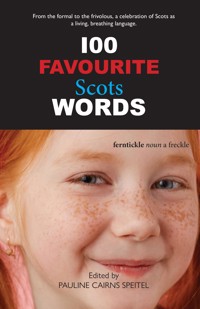
100 Favourite Scots Words E-Book
7,19 €
Mehr erfahren.
- Herausgeber: Luath Press
- Kategorie: Lebensstil
- Sprache: Englisch
affront • baffies • capercailzie • dingie • elderitch first fit • glaikit • hogmanay • jalouse • laldie • mar numpty • onding • pawkie • scunner • thrapple wean • yeukie • and mony mony mair tae whet yer thrapple... What is your favourite Scots word? Have you heard of a stushie or a stairheid rammy? Do you know a numpty who talks a lot of mince? For over a decade, The Herald has published the Scottish Language Dictionaries' Scots Word of the Week. This wee book gathers 100 of our favourites, showing the breadth and diversity of the Scots language over time, ranging from lesser-known Older Scots to formal language to contemporary slang. Uncover the surprising origins of well-known words such as numpty and wean, discover unusual ones like onding and gowan, and savour evocative gems like Robert Burns' 'blethering, blustering, drunken blellum'.
Das E-Book können Sie in Legimi-Apps oder einer beliebigen App lesen, die das folgende Format unterstützen:
Seitenzahl: 164
Veröffentlichungsjahr: 2020
Ähnliche




















PAULINE CAIRNS SPEITEL began her career in Scots dictionaries with the Scottish National Dictionary, continuing in 2002 with the formation of Scottish Language Dictionaries. Pauline has worked on many projects with SLD including the 2005 Supplement to the Scottish National Dictionary and was a major contributor to the latest publication of the second edition of the Concise Scots Dictionary.
RHONA ALCORN joined Scottish Language Dictionaries in 2017, having formerly lectured in the linguistic history of Scots at the University of Edinburgh.
ANN FERGUSON joined the SLD team of Editors in 2010. From a career in financial services, Ann segued to the world of Scots lexicography via a degree in English Language and Linguistics from the University of Edinburgh.
CHRISTINE ROBINSON served as SLD’s Director from 2004 until her retirement in 2015. She has taught Scots to hundreds of students at a number of Scottish Universities and is (co-)author of multiple Scots language titles, including Scotspeak: A Guide to the Pronunciation of Modern Urban Scots and Modren Scots Grammar.
MAGGIE SCOTT is the founding contributor of SLD’s Scots Word of the Week. She ran the column from its inception in 2005 until 2008, when she moved to the University of Salford, where she is now a Senior Lecturer in English Literature and Language and Associate Director of English and Creative Writing. Maggie has also taught Scots and English language and linguistics at the Universities of Glasgow and Edinburgh and what is now the Royal Conservatoire of Scotland.
First published 2019
ISBN: 978–1–912387–72–4
The paper used in this book is recyclable. It is made from low chlorine pulps produced in a low energy, low emission manner from renewable forests.
Printed and bound by iPrint Global, Ely
Typeset in 10.5 point Sabon by Lapiz
The authors’ right to be identified as authors of this work under the Copyright, Designs and Patents Act 1988 has been asserted.
© Scots Language Dictionaries
Contents
Foreword
Introduction
1. AFFRONT
2. AHINT
3. ANNAKER’S MIDDEN
4. AVIZANDUM
5. BAFFIES
6. BAM
7. BARRY
8. BEEK
9. BEJANT
10. BLACKMAIL
11. BLELLUM
12. BOORACH
13. BUCKIE
14. CADGER
15. CAIRD
16. CAPERCAILZIE
17. CARLIN, CARLINE
18. CARNAPTIOUS, CURNAPTIOUS
19. CHORE, CHORIE
20. CLABBYDHU
21. COLLIE BUCKIE
22. CONVOY
23. DAIDLE
24. DEVAL
25. DICHT
26. DINGIE, DINGY
27. DISJASKIT
28. DIZZY
29. DOUP, DOWP
30. DUX
31. DWAM
32. ELDRITCH
33. ETTLE
34. FANKLE
35. FERNTICKLE
36. FIRST FIT
37. FLEG
38. FURRY BOOTS CITY
39. GADGIE
40. GLAIKIT
41. GOWAN
42. HAFFET
43. HAGGIS
44. HANTLE
45. HAUGH
46. HOGMANAY
47. JALOUSE
48. JOCK
49. LALDIE. GIE SOMETHING LALDIE
50. LET-DE-CAMP
51. LORNE SAUSAGE
52. LUNCART
53. MAR
54. MINCE
55. NUMPTY
56. ONDING
57. PAGGER
58. PARTAN
59. PAWKIE
60. PECH
61. PIECE
62. PLAID, PLAIDIE
63. PURVEY
64. SCAFFIE
65. SCALDIE
66. SCART
67. SCOMFISH
68. SCOOBY
69. SCUNNER
70. SCUTTER
71. SHAN
72. SHILPIT
73. SHUNKIE, SHUNKEY
74. SKELF
75. SKITE
76. SLAISTER
77. SMIT
78. SNED
79. SNOTTUM
80. SOOK
81. SOUTER
82. SPEEL
83. SPIRTLE
84. STAIRHEID RAMMY
85. STOOKIE
86. STRAMASH
87. STRAVAIG
88. STUSHIE
89. SUMPH
90. SWALLIE
91. SYBOE
92. TENT
93. THRAPPLE
94. TUMSHIE
95. VAUNTIE
96. WEAN
97. WERSH
98. WIDDERSHINS
99. YEUKIE
100. YULE
Foreword
EDITORS AT SCOTTISH Language Dictionaries have supplied The Herald newspaper with a steady stream of Scots Words of the Week since 2005. By my reckoning, that’s more than 700 words to date. Each article in this long-running series is a 350-word nugget of painstaking scholarship that brings to light – and sometimes to life – the breadth and depth of the meanings and usages of a single piece of Scots vocabulary.
The present anthology includes a selection of 95 contributions from four of our former and current editors plus five previously unpublished pieces. The selection of 95 was made by Pauline Cairns Speitel, our Senior Editor, who truly agonised over what to include, or rather what to leave out. To this core selection, Pauline has added articles for bam, dux, mar, shunkie, and stravaig, which she has penned especially for this ‘wee book’, as she lovingly refers to it. Together, these 100 words provide a tiny glimpse into the richness and resilience of Scots vocabulary and the preoccupations of those who use it.
In declaring 2019 the Year of Indigenous Languages, the United Nations intends to raise awareness ‘not only to benefit the people who speak these languages, but also for others to appreciate the important contribution they make to our world’s rich cultural diversity.’ This perfectly describes our aspirations for this wee book too.
Rhona Alcorn
CEO, Scottish Language Dictionaries
Introduction
MORE THAN A decade ago, Scottish Language Dictionaries contacted The Herald about starting a Scots Word of the Week column. The intention then and now is to bring the riches of the Dictionary of the Scots Language (DSL) (www.dsl.ac.uk) to a wider audience.
These articles were distilled from the mighty DSL which is in fact two dictionaries: A Dictionary of the Older Scottish Tongue (DOST), which covers the earliest records through to 1700 in 12 volumes and which was 70 years in the making (1931 to 2002); and The Scottish National Dictionary (SND) which documents the vocabulary of Scots from 1700 to 1976 in ten volumes and which took a mere 45 years to compile (1931 to 1976).
In 2001, the bodies responsible for these dictionaries combined to form a new organisation, Scottish Language Dictionaries Ltd (SLD). SLD’s first goal was to digitise DOST and SND and to combine them to form the online DSL. Its second mission was to add a supplement to SND.
The digitisation of DOST and SND was undertaken by the University of Dundee’s English Language Department under the leadership of the late Victor Skretkowicz. The resulting DSL was made freely available online in 2004. During the digitisation phase, Iseabail Macleod and I compiled a supplement to SND, which updated the DSL to 2005.
After the publication of the 2005 SND supplement, Maggie Scott, one of our former editors, approached The Herald with her proposal for a column focusing on a single Scots word each week. The Herald was quick to see the potential and so began what has become a long-standing series. When Maggie left SLD in 2008, the baton was picked up by SLD’s then director, Chris Robinson, who ran the column almost single-handedly until her retirement in 2015. Authorship then passed to me and (occasionally) my fellow editor, Ann Ferguson. Latterly, Jeremy Smith, former Convener of SLD’s Board of Trustees and Professor of English Philology at the University of Glasgow, has led from the helm.
Although initially daunted by the responsibility of taking over this task, I have always approached it with enthusiasm. It has its challenges too, of course: the discipline of keeping to just 350 words greatly concentrates the mind, and one has to be ever mindful that The Herald is a family newspaper, which rules out a wheen of words from the DSL.
I was thrilled when this book was first suggested by Luath Press and delighted to be asked to select 100 words from the column’s back catalogue, although I knew I had a hard chore ahead of me. Where to start? With more than ten years of columns to choose from, the selection process was not easy. The diversity of coverage – from obsolete Older Scots words to the language spoken by today’s Scots – made the task, shall we say, tricky. And as a native of Edinburgh and a specialist in Modern Scots, I had to guard against skewing my selections to present-day Edinburgh or Central Belt Scots.
I have tried instead to choose words that represent the diversity of Scots across time and space and that show that it can veer from very formal legal language, for example Chris’ article on avizandum (consideration of a case out of court), to the language of the playground, as shown in my article on collie buckie (a piggy back). Ann Ferguson’s piece on luncart (a temporary shelter) is one of a number of studies which add a time depth to this anthology.
To ease their transition from newspaper to book, I have lightly edited some of the original articles. I hope not to have diminished the author’s original voice in the process. All of the articles include a number of authentic examples drawn from the DSL’s vast collection of quotations, which richly illustrate a centuries-long tradition of writing in Scots. I appreciate that the language of the examples might prove challenging for some: in those cases, I have added a gloss (for individual words) or footnote (for longer stretches) to help elucidate the excerpt.
Luath suggested I also include some words that had not yet been published in The Herald: these are included here for the first time. They were chosen for all the reasons listed above but of course they come with only my voice and therefore are mostly modern Scots.
I hope that in reading this book, readers will gain an insight into the scope of Scots as a living, breathing entity with a great heritage and continuum in both past and present times. I also hope that it will go some way into dispelling the myths that sometimes surround Scots either as a dead language, ie one that no one now speaks or understands, or even worse as ‘slang’. Please enjoy.
Pauline Cairns Speitel
AFFRONTverb to cause to feel ashamed
This comes from French afronter, meaning to strike on the forehead and, hence, to insult. The French word in turn goes back to frons, the Latin for forehead. Affront is not uncommon in English but Scots, seemingly in habitual paroxysms of black burning shame, have a particular partiality for the past participle. During my teenage years, my mother was regularly black affrontit at the shortness of my skirts. The DSL reveals some other causes and consequences of embarrassment. The theatre is none too respectable in Fergus Mackenzie’s Cruisie Sketches (1893): ‘I’m sair affrontit that she should set the countryside speakin’ in that play-actin’ business.’
Table etiquette causes discomfiture in Susan Ferrier’s Marriage (1818): ‘Div ye mind hoo ye was affronted because I set ye doon to a cauld pigeon-pie, an’ a tanker o’ tippenny… afore some leddies?’ SR Crockett in The Raiders (1894) draws attention to sartorial impropriety: ‘At your time o’ life, Jen, to dress up for a young man, I’m black affrontit.’ In R Trotter’s Galloway Gossip (1901) it is clear that a refusal of hospitality might cause offence: ‘Mr O – wusna the man tae affront folk by refusin their offers o’ refreshment.’ There are various metaphors for hiding one’s shame but this from George Macdonald’s Sir Gibbie (1879) suggests extreme mortification: ‘I… wuss him sae affrontit wi’ himsel’ er’ a’ be dune, ‘at he wad fain hide his heid in a midden.’
Overexposure brings immunity in JB Salmond’s My Man Sandy (1899): ‘What needs I care whuther fowk kens a’ aboot it, or no’? I’ve been black affrontit that often, I dinna care a doaken noo what happens.’ However, an insult, even in jest, can have regrettable consequences as this proverb from A Henderson’s collection warns: ‘Affront your friend in daffin, and tine him in earnest.’1
Chris Robinson
1Affront your friend in jest and lose him in earnest.
AHINTadverb, adjective, preposition behind
As an adverb, ahint can refer to place or time. This example in the DSL from Robert Ford’s Tayside Songs (1895) makes light of misfortune: ‘When Fortune jooks ahint An’ scuds ye wi’ her broom.’ In Sir Walter Scott’s The Bride of Lammermuir, ahint means ‘later in time’: ‘Mysie, kill the brood-hen without thinking twice on it; let them care that come ahint’
As an adjective, we find it in the sense of ‘behind’ schedule in Isabella Darling’s Poems (1889): ‘There was a time I channert sair like you, Oor wark ahin’ and weans aye in my road.’ The clock’s ahint means it is slow.
The DSL often classes as adverbs words which modern grammarians might be more inclined to view as adjectives. This is particularly the case where the verb ‘to be’ is involved as in WA Scott’s article on the ‘The Vernacular of Mid-Nithsdale’, in the Transactions of the Dumfries and Galloway Antiquarian Society (1925): ‘Hurry up, we’re gaun tae be clean ahint.’ If we think what other words we might put here, we see that ahint is really not an adverb. We might say ‘We’re gaun tae be slow’, but we could not say ‘We’re gaun tae be slowly.’
When it comes to recognising parts of speech, we are on safer ground with prepositions, but even here some of the senses may be unfamiliar. The usual sense is ‘behind’, as in ‘ahint the dyke’ but, in the north-east, it can also mean ‘after’, as in ‘ahint thon cairry-on last week, ye wadna ken whit tae expect’. It is in the north-east, too, that we find rare examples of ahint used as a conjunction. This startling one comes from Donald Campbell’s Kirsty’s Surprise (1930): ‘I’ve gotten snippets o’ ’t, but, ahin auld Leebie yokit tae gie me the news, she crackit the plate o’ her fause teeth on a pan-drop I gied her.’
Chris Robinson
ANNAKER’S MIDDENnoun a mess, a shambles
The DSL’s earliest example of the above phrase used in this sense from Central Scotland in 1962. This was firstly interpreted in the dictionary as ‘a knacker’s midden.’ Later research, recorded in the 2005 supplement, suggested that it originated instead from: ‘Annacker’s, a Glasgow pork butcher from 1853 to 1942; their messy bins were frequently raked through by the poor.’
Michael Munro in his Patter, Another Blast from 1988 traces the origin to a firm of pork butchers, sausage makers and ham curers: ‘Founded in 1853, at its height it was a chain of sixteen branches all over the city. The company also owned a sausage factory the last location of which was Naipiershall Street (near St George’s Cross). The People’s Palace has in its collection the shop sign from the Bridgeton Cross Branch.’
A quotation from Edinburgh in 1959 shows that as it spread eastwards, the phrase had developed an extended meaning: ‘There’s the Knacker’s midden at it again. Said of a person who is voracious.’
However, the original meaning of a scene of general chaos is still very much with us, as illustrated by an example from a guide to Scottish speech in the Daily Mail of 16 September 2005: ‘ANNACKER’S MIDDEN: A mess, a dreadful muddle.’ Greg Hemphill and Ford Kiernan writing in Still Game from 2004 describe a house after a ‘flitting’ as: ‘Look at this. It’s like Annicker’s Midden.’
Pauline Cairns Speitel
AVIZANDUMnoun the consideration of a case out of court
Green’s Encyclopaedia of the Laws of Scotland (1909) states avizandum is ‘the term employed when the Court takes further time for the consideration of a cause, instead of pronouncing an immediate decision upon it. The Court is said to “take the case ad avizandum” or to “make avizandum of the case”.’ This Latinate word is one of the many Scottish legal terms that is not heard in English Courts. We find it in documents from the early 17th century. The Diary of Sir Archibald Johnston of Wariston (1639) records that, The King went to a privat avisandum.
More recently, The Hawick Express (22 August 1924) reports: ‘Sheriff Orr said that he would take this motion to avizandum, and adjourned the diet until Thursday of next week.’ It starts to appear in a literary context with Allan Ramsay (1721): ‘Since dously ye do nought at Random, Then take my Bill to Avisandum’ and, in William Alexander’s Johnny Gibb of Gushetneuk (1871) we read: ‘Sandy Peterkin took the subject of the two marriages to avizandum.’
The word has even crossed the Atlantic to appear in Avizandum by Robert Henderson, an abstract of which appears in the New Yorker (1967): ‘The children speak as if he came from another world’ (he emmigrated from Scotland when he was 17). He recalls how his father often took things ‘ad avizandum, an old Scottish law term meaning “under advisement or scrutiny”.’ This is very much how my own mother used it, especially when she wished to prevaricate.
A particularly couthie example comes from a dialogue about a game of draughts in J Mackinnon’s Braefoot Sketches (1897): ‘Fat pleases me wi’ the souter’s play, lads, is the wy ’at he shifts withoot ever thinkin’ aboot it. He’s byous knackie at the shifts. Jeames, again, he tak’s a’ his tae avisnawdum [avizandum].’
Chris Robinson
BAFFIESnoun slippers
These comfortable items have been gaining linguistic ground over the course of the last century. The Transactions of the Scottish Dialects Committee (1914) give three references to ‘baffs’ which they define as ‘Old loose slippers, Coarse slippers used by women in the house and Large loose slippers’, used also to describe animals’ feet: ‘What baffs o’ paws the cat has.’
The DSL has nothing further to say on the matter apart from a brief addition in the first supplement recording the use of the diminutive ‘baffie’ in Angus and Fife in 1975 and of the participial adjective ‘baffied’ in the sense of wearing baffies, from The Sunday Post (1956).
When we get to the New Supplement online, however, there is no shortage of colourful quotations. In The Scotsman (1991), we read: ‘Quick as a flash she slips on her baffies, skites up the close stairs to her neighbour’s and chaps at the door.’ The Daily Record (1997) speculates on ‘a shoe-in for the Tories and Norma Major’s baffies might yet be under the Number 10 table.’ David Kay’s show at the Edinburgh Festival in 2003 is described in Scotland on Sunday as ‘more like a one-bar electric fire gently warming a pensioner’s baffies than a comedy inferno.’
Terpsichoreal feats are described in the Daily Mail (2003): ‘There were moments when they made the Red Arrows display team look like a squad of clumsy oafs, as students traced perfect figures of eight around and between each other, their feet flying across the floor like Darcey Bussell in feather baffies.’ More prosaic is this offering from the Sunday Mail (2004): ‘Shuffle into the kitchen in my baffies this morning to discover Sammy [the dog] has six eggs, two of Louis’ school socks and a wooden spoon in her basket.’
Chris Robinson
BAMnoun a stupid or incredulous person
Scots is a language rich in insulting vocabulary. When bam was first added to the 2005 supplement to the DSL it was thought to be a reduced form of bampot, which in its turn, is thought to be a Scots version of English barmpot – ‘a pot for storing barm; also figurative, an eccentric or mad person.’ (Oxford English Dictionary [OED] definition)
When revising the Concise Scots Dictionary, the editors discovered another and more likely etymology. The word is indeed probably a reduced form, but from bamboozle. In the OED, to bam someone meant to trick or deceive a person and was noted in 1738 by Jonathan Swift: ‘Her Ladyship was plaguily bam’d.’ A story intended to impose upon the credulous was noted earlier in The Life & Character of Harvey the Conjuror (1728) ‘He called the Profession of a Doctorship, in Physic, a Bamm upon the world…’




