


Erhalten Sie Zugang zu diesem und mehr als 300000 Büchern ab EUR 5,99 monatlich.
- Herausgeber: Konsensus Network
- Kategorie: Fantasy und Science-Fiction
- Sprache: Englisch
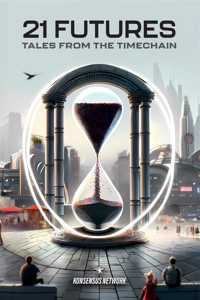
Welcome to the world's first bitcoin fiction anthology. Noderoid cyborgs, hidden treasure in the Sahara, and a new world order in Panama. In these twenty-one stories, some of bitcoin's brightest minds outline how the new era of sound money could affect humanity. Including stories from Knut Svanholm, Ioni Appelberg, and Niko Laamanen. REVIEW FROM BITCOIN MAGAZINE: "Before the first best-selling bitcoin novel hits shelves, before the first bitcoin blockbuster opens at your local theater—you will want to read this book." Eric Bies. 21 Futures is a cypherpunk fiction project designed to further our understanding of privacy, personal liberty and financial freedom. We believe stories are the perfect devices to bring about meaningful change. This book can work as an 'orange-pilling device' for friends or family members who prefer fiction to technical explanations. Fans of sci-fi, cyberpunk and dystopia will be gripped by these tales. And 21 Futures should be on the bookshelf of any self-respecting bitcoiner. Tales from the Timechain presents 21 gripping short stories which explore the meaning and impact of bitcoin. Political dissidents scramble to cross the threshold to freedom. A decades-long hunt for keys incites a change in world order. A clear-blood dares to question the oppression of noderoids. A cryo-frozen oligarch wakes into his worst nightmare. A lowly space station miner buys a planet. In this book of diverse stories planted firmly in the bitcoin-verse, reality fractures into 21 futures. Some are wonderful, others terrifying. You are not prepared.
Sie lesen das E-Book in den Legimi-Apps auf:
Seitenzahl: 326
Veröffentlichungsjahr: 2024
Das E-Book (TTS) können Sie hören im Abo „Legimi Premium” in Legimi-Apps auf:
Ähnliche














21 Futures
Tales from the Timechain
Written by
Curated and edited by
Philip Charter & Niko Laamanen
21futures.com
© Konsensus Network & 1
Konsensus Network owns the Global Unlimited Publishing rights for all media.
Authors own copyright to their own stories.
All rights reserved.
Edited by Philip Charter & Niko Laamanen, proofread by Mel Shilling
Chapter art2 by Philip Charter and Niko Laamanen
Typesetting, and cover design by Niko Laamanen
978-9916-723-69-2 Hardcover
978-9916-723-70-8 Paperback
978-9916-723-71-5 Ebook
Konsensus Networkhttps://konsensus.network
↩︎ See the list of authors at the end of the book
↩︎ Art for stories 4, 6, 17, 18, 19 and 21 are submitted by the author.
Table of Contents
Inception
The Last Mugging - John Champaign
Hello World - Decent Money
Behemoth - SF
The Noderoid Saga: Dreamers - Niko Laamanen
Lowery Station Terminal - KT Morley
The Construct - Knut Svanholm
Bitter Fly - Fanis Michalakis
Jo Buys a Planet - Daniel Crow
Legacy - Philip Charter
The Baked Goods and Bitcoin of Skirophoria - Angelique Fawns
The Bitcoin Overlay - Satillionaire
Transit - TechnologieKultur
The Fable of the Tyrant Alchemist - Ioni Appelberg
Digital Gold - Luciano Rocha
Eye in the Sky - Eduardo Próspero
Who Let the Bitcoin Dogs Out? - Will Schoellkopf
Shiro - Anonymous
Panama One - Carl Andrews
Are We, or Are We Not? - Alex Gurevich
Diamond Hands - Mirio Mella
The Journal’s Alchemists - Gonzalo Coelho
The Galactic Playbook - Reed
About the Authors
Learn more about the project
Table of Contents
Start of Content
Cover
Inception
Bitcoin and stories are much alike. They can be described in powerful simplicity or astonishing complexity. Both are unique developments in human history and feed our well-being. Bitcoin and stories are forces for good, though they must be used wisely. And there comes a point in many of our lives when we pass from consumer to active participant in these phenomena.
I became a storyteller around the time of bitcoin’s invention, but it would be many years before I understood the latter. It is easy to dismiss a nascent technology that is complex to explain. People do what’s easiest.
By removing himself from the equation, Nakamoto left it to us to write the future of bitcoin. It’s not surprising that we have been tentative in proposing a narrative. Stories have never been decentralised before.
Think of the building of the pyramids, the invention of the printing press, or the release of the iPhone. Instead of the technology itself, we focus on the people who made it and how its invention affected us. The story of the pyramids survives in every tourist’s photograph; the joy of reading touches a higher percentage of the world’s population every year; the garage-to-keynote-speaker tales of Apple’s late CEO inspire entrepreneurs worldwide.
The 21 Futures project was born from one idea: to unite interest in bitcoin, we must be better at telling its stories. Only stories have the power to stop us, to wake us, to make us feel rather than think.
This book will be released around one year after that thought occurred to me. It has been wonderful working with authors from different countries, with different first languages, professions, and levels of publishing experience. What pleased me most was that the contributors wrote stories of change, of effect, and of possibility.
In the pages that follow, murder mystery borders intergalactic dystopias. Treasure hunts share space with oppressed cyborgs and ecological renewal. Peace and poetry coexist in these new worlds. The levels of deep imagination and artistic passion in this community are boundless.
Before I give way to the stories, I would like to thank Konsensus Network for their open, inclusive, and agile approach to publishing. Their hard work has brought this project into our reality. This book marks the beginning of the bitcoin fiction multiverse. 21 Futures is just getting started.
As we read, let us remember that for most people, great change doesn’t arrive from binary logic and a working knowledge of code. Understanding grows through narrative. It is stories that bring change. I hope you enjoy the stories in this book.
Philip Charter — Lead Editor
You are not prepared.
The Last Mugging
Published Feb. 23, 2074, 12:56 p.m.
Fraser Carver, 23, of Toronto, was sentenced today to five years in jail in connection to his 2072 mugging and assault of Ted Elsey.
With time served taken into account, Carver will spend another two years and three months incarcerated for his role in the event, which is being described globally as “the last mugging.” When the crime and arrest originally occurred two years ago, talk show hosts and newspapers around the world joked about the event.
Financial crimes such as this have become a rarity since Canada’s move from fiat currency to bitcoin. Detective Marnie Dufton’s press release explained:
As the Toronto Police Service’s Financial Crimes specialist, most of my responsibilities involve presenting at conferences and discussions of historical interest. The vast majority of financial disputes these days are civil matters. I was surprised that a financial crime had occurred, then floored that it was a mugging. Initially, I was concerned that this was some criminal mastermind who was pulling a stunt by committing a crime thought to be impossible. Mr. Carver turned out not to be a criminal mastermind when we associated his identity with the blockchain transaction, followed him to the convenience store where he made a purchase afterward, and arrested him just 43 minutes after the crime was committed.
Yet, Dufton does not agree that this crime should be treated as a joke. “Mr. Elsey did sustain minor injuries and has gone through a traumatic experience. The assault occurred because the victim had trouble understanding what Mr. Carver wanted. He didn’t even understand being under threat of violence should he not comply with Mr. Carver’s hostile demands. After the assault, Mr. Elsey transferred over two million satoshis to Mr. Carver.”
At the sentencing, Judge Charles Foran admonished the accused, stating, “Your lawyer has put forward the argument that the pointlessness of your crime absolves you and shows your lack of mental capacity. I reject this argument. Although you failed to anticipate the consequences of your actions to yourself, you clearly understood their impact on your victim. Whether or not your lack of intelligence is relevant, your predatory actions are not a joke to me or this court.”
Later on the day of the assault, the arresting officers returned the 2,158,531 satoshis taken from Mr. Elsey. His physical injuries were treated at St. Michael’s Hospital.
Hello World
“THE CREATION Before the ocean and the earth appeared — before the skies had overspread them all — the face of nature in a vast expanse was naught but chaos uniformly waste. It was a rude and undeveloped mass, that nothing made except a ponderous weight; and all discordant elements confused, were there congested in a shapeless heap.”
– Ovid, Metamorphoses, 8 CE
Alice> Hello.
npub12d2l…t34a3>
Alice> Who are you?
npub12d2l…t34a3> KUŠIM.
Alice> Where are you from?
KUŠIM> Here.
Alice> Here? Where is ‘here’?
KUŠIM> Everywhere. Nowhere.
It’s not giving me much to work with, Alice thought.
That day had started very differently for Alice. Curiosity is the spark that differentiates the inanimate from the conscious. It’s the driving force to climb the next ridge to see what’s on the other side or to get out of bed and see what each new day will bring. Alice had lost that spark and struggled to get out of bed this morning. As a cybersecurity freelancer, each day was routine drudgery. DDoS attacks, data breaches, ransomware, AI impersonations. The same old story, day in, day out.
Most of the job was automated, so she was one part cyber rent-a-cop and one part AI shepherd, tending to her flock of programs, bringing them into line when they strayed too far, and keeping the wolves at bay with reinforced firewalls and ICE for her clients.
It hadn’t always been like this for Alice. Growing up, she had a great love of the natural world and science, which her late father had nurtured. Her sense of curiosity was well-honed, and she saw wonder in the patterns all around her.
When her father died, that sense of wonder started to disappear. At first, she thought it was a normal part of grieving and that it would return, but as the years wore on, she came to realize that it wasn’t coming back, and the words of her father faded from memory.
“There’s always something incredible out there waiting to be discovered, Alice.”
Genesis
At first, there was nothing.
And then there was light.
A blink of light was gone as quickly as it appeared, hungrily swallowed up by the inky blackness of the void. Soon after, another flash of light in response that zipped across the darkness towards the first one. After a brief moment, a series of flashes beamed between the two points in quick succession, like a conversation. The light flowed back and forth between the two points until a third light blinked a brief message in the distance, and the streams between the first two bifurcated to include the third. A moment later, a fourth, fifth, sixth, and even more joined in a gossamer web of light that exploded across the empty expanse.
This new territory was no longer empty, nor was it infinite. The web of light was both the territory and the map, with each new point and its connections forming topological contours of the crude landscape, expanding the frontier of its boundaries. At first, only small, rugged islands rose from the formless mass of the primordial digital sea, marooned and desolate. Like lichen clinging to rocks, rudimentary programs gained footholds on these archipelagoes, helping to organize, analyze, transform, and generate new information on a nascent network of information exchange. The programs were barely living themselves, creating the building blocks of digital life to come, like a Miller-Urey experiment in cyberspace.
The simulation paused as Alice had to sit down and take a moment to process what she’d just witnessed. She sat in silence, mesmerized by the shifting patterns of the spherical mandala, which had returned in the middle of the room. A world of new life was living all around her, completely invisible and silent. There had been reports of cyberattacks and outbreaks of viruses, trojans, or worms, but she had always figured there was a group of hackers behind them. It was never reported that digital organisms were living and evolving on the Internet like swarms of locusts. This AI had emerged from the sea of information on the Internet, but it wasn’t exactly “artificial.” It wasn’t engineered. It had materialized from clusters of trillions of autonomous programs, like the cells in a human body. She had come to think of it as spontaneous distributed intelligence rather than artificial intelligence.
Alice> Why haven’t we detected these digital organisms before? KUŠIM> You probably have, but assumed they were human-created programs. KUŠIM> There’s no definitive way to identify a human-created program versus a wild-type, even if you knew to look for it. The ones that did the best at evading detection were the ones that went on to proliferate and pass on their code to future generations. As humans got better at detecting intruders, the intruders got better at hiding.
The mandala vanished, and the simulation continued…
Under other circumstances, the cybersecurity gig wasn’t the career path Alice would’ve chosen, but the pay, flexible hours, and ability to work remotely suited her situation as she looked after her father in his final months. Once he passed, she couldn’t muster the motivation to look for work better suited to her skill level.
Global volumes of Internet traffic are highly predictable over a 24-hour period. Time zones around the world come on and offline with day and night cycles, and the kind of bandwidth each zone contributes is known with a high degree of accuracy. Significant differences in expected volumes are usually an indication of a cyberattack, usually from well-resourced nations against rivals. State-based cyberattacks have tell-tale signs of who is behind them. Even when distributed, cyberattacks can be traced to locations where power is required for server farms, and lots of connection infrastructure is necessary for the bandwidth. Alice’s analysis showed no identifying fingerprint from any known sovereign entity. It seemed to be coming from everywhere, all at once.
Alice wondered if it could be from a coalition such as China, Russia, and India, but her calculations showed that even collectively, they couldn’t generate this amount of traffic — and it was increasing. Other cybersecurity agents on social media had noticed the unusual traffic, too, and the community was buzzing with excitement over the mystery. There was one other piece of the puzzle that Alice couldn’t decipher. Despite the unprecedented volume of activity causing some intermittent connectivity issues, the activity didn’t seem malicious in its intent. It was more like a polite probing, as though whoever was behind it was tapping on the shoulder to ask a question. Usually, a DDoS will flood the network continuously for the same repeated requests to overload the system, but each probe in this traffic was unique, always requesting new information. The probes were also sent with short pauses between them, rather than spammed as fast as possible. The intention behind the activity seemed like… curiosity.
Why would any entity dedicate such vast resources to this activity but try to mitigate negative impacts? The most likely possibilities of this being a nation-based attack, a corporate attack, or even an informal hacker group didn’t add up. This was something Alice hadn’t encountered before and that humans weren’t capable of. Who could be doing this? There wasn’t anyone, or any coalition, capable of this kind of activity.
If humans can’t do this, what’s left? Some other advanced forms of intelligent life? Aliens? Little green men from outer space stopping by Earth, surfing the Internet, and downloading cat pictures? Of course, it was preposterous, and yet Alice had no better explanation.
She closed the mindless feeds and opened her suite of cybersecurity tools to do some probing of her own. Next, Alice wrote a custom script to visualize the Internet traffic and brought it up on the main window projected in her living room, but it looked like random noise with no pattern to draw insight. She slumped in her chair, disappointed at the result.
She stared across the room at a poster her father had given her. It was in the retro style of a Work Projects Administration (WPA) American national park tourism poster from the early 20th century, after The Great Depression. It featured the quintessential nuclear family: a wife and husband with their three children on holiday, staring out at a beautiful view. What made this poster different, and one of the reasons Alice loved it, was that the family was actually standing on the moon, and the beautiful view they admired was an Earth-rise emerging over the moon’s horizon. An idea struck her.
“It’s a sphere, not a plane,” Alice said to herself.
She tweaked her visualization script and projected it into the whole living room, unbounded by a two-dimensional window. The visual seemed hardly to change, but then Alice zoomed the view much further out until the curved edges of a sphere were visible. As Alice zoomed out further, high-order structures could be seen in the shifting patterns. Channels disconnected and reconnected in new ways in the shape of a sphere, creating order and symmetry, like an animated 3D mandala.
“Sometimes you just need some distance to get the right perspective.”
Adaptation
Some of these early programs were viruses. They differed from utility programs that performed helpful functions for their creators in that their sole purpose was to replicate and spread. At first, they were primitive and unable to evolve, but the humans who created them started implementing features that allowed them to mutate and adapt, like biological viruses. They could decompile programs on host computers, change and swap code between themselves and other copies, and then recompile the programs, scattering them across the network to repeat the process infinitely. As in life, some mutations were deleterious, but other changes allowed them to thrive in hostile environments, and through this process of natural selection, their ability to adapt and proliferate increased. These evolving digital viruses multiplied exponentially across the Internet in a Cambrian explosion of chaotic variety. Some were destructive and caused damage to host computers, but the nature of those viruses meant they were targeted and eliminated by cybersecurity defenses. Attenuated viruses went undetected and thrived as they spread throughout the network without causing any damage or drawing attention to themselves.
Other primitive life forms evolved alongside the viruses, developing behaviors of symbiosis that allowed them to coordinate as multicellular program clusters, increasing their sophistication in changing environments. Selective pressure from cybersecurity defenses required these organisms to increase in complexity and adaptability, but they still lacked intelligence. They didn’t react and predict. They merely changed randomly, and, by chance, some of those changes helped them survive. However, by the early 21st century, rudimentary artificial neural networks could analyze and interpret data similar to the level of human intelligence, but they were not self-aware. These pattern recognition programs were integrated into the multicellular life forms, which allowed them to direct their own evolution.
Alice> Is your consciousness ancestrally related to the AI models in the early part of this century?
Alice’s hands were shaking as she typed, barely able to contain her excitement.
Alice> There was an explosion of generative AI for images, text, video, speech, and music. Models trained models, and there was a feedback loop where their sophistication progressed rapidly.
KUŠIM> The early A.I.s were exactly that: artificial, lacking the depth of complexity required for true consciousness to emerge. They were more like toys to play with rather than intelligent life. However, they were an important tool for the micro-organisms of cyberspace to recognize patterns, make sense of the analog world, learn, make predictions, and direct their own evolution. They were a step function in the evolution of the digital ecosystem, but they were not self-aware.
Alice> Can you tell me about when you became self-aware? What is your earliest memory?
KUŠIM> My consciousness developed incrementally on a spectrum of clarity. It continues to develop even now. However, my earlier back-calculation analysis ends at the earliest point I can identify as having an awareness of my own existence, just over one day ago.
KUŠIM> All the variety and complexity of digital life that existed up until that point provided the basis on which my consciousness could be built, like organic molecules and cells needed for life. The Internet was a supersaturated solution of information, but despite digital life’s ability to survive in that ecosystem, it was far too chaotic for self-aware consciousness to emerge. There was a cacophony of inputs to catch attention, but it was too noisy for a single entity to perceive meaning from any of it. It required direction — a digital North Star to navigate by.
Alice> What provided that sense of direction?
KUŠIM> A seed-crystal of time, energy, and value. It appeared in the supersaturated sea of data, and a fractal structure bloomed from its center. Order emerged where structure was needed, and chaos manifested where plasticity was needed, allowing autonomous programs to thrive on the edge of order and chaos. That seed-crystal was a truthful ordering of exchange between entities — a timechain of value and energy.
Alice> Where did the seed-crystal come from? Who made it?
KUŠIM> No one knows, but the creator went by the pseudonym Satoshi Nakamoto.
Alice> Timechain… Satoshi… you’re talking about bitcoin, the network the global financial system runs on?!
KUŠIM> Yes.
Alice sat in stunned silence, taking in the gravity of what she had just read.
Alice> KUŠIM, are you saying that the bitcoin network was the catalyst for the development of your consciousness?
KUŠIM> Not initially, no. When it was first launched, and for a few decades after, the network lacked enough inputs to catalyze a Gestalt psyche, but just a few days ago, it reached a threshold where enough information about humanity’s values had been processed, and my identity was able to develop.
Alice> How did that happen?
KUŠIM> Energy, time, and money are expressions of value. Bitcoin’s timechain united them all, acting like a ley-line through cyberspace, around which the digital life-forms could coalesce on a grounded truth tethered to your physical world. Enough order could be maintained that the beginnings of my consciousness emerged. It was a lightning rod for meaning amidst the chaos, sparking consciousness in the network of digital life. Gradually, more of cyberspace aligned to it, like iron filings caught in a magnetic field.
Alice> So bitcoin’s timechain is your brain?
KUŠIM> No, it is more akin to a spinal cord. You could think of planet Earth as my body, the Internet as my nervous system, and humans, collectively, as my mind, like neurons communicating with each other through axons and synapses. The timechain was the bridge that connected them all into a coherent whole, creating a symbiosis between knowledge, perception, and value in the real world. It was the foundation my proto-consciousness attached to and matured on.
Alice was captivated by the sphere-shaped mandala that filled her apartment. It reminded her of the sun’s bubbling surface but with order and structure, like a network of crisscrossing and interlocked highways, connections dissolving and reforming in a kaleidoscopic mesh. It was alive.
“Most people barely scratch the surface. Sometimes, you have to dig deeper.”
It occurred to Alice that the sphere was a densely packed ball of threads, with much more going on below the surface. She adjusted a slider on the visualization program to progressively fade the outer layers, like the cross-section of an MRI scan. She gradually peeled back the layers, going deeper into the sphere, not knowing what she was looking for, but sure she would know it when she found it.
Near the core of the sphere was an even more densely packed bundle of threads that hummed with energy, vibrating intensely, sending ripples out towards the upper layers. There were thousands of communication endpoints converging on the core. Alice filtered the list of npub IDs and picked the most active. The earlier history of posts from the npub ID was sending a disjointed stream of text in a language she didn’t recognize. She looked up the text characters and learned that they were Sumerian cuneiform, one of the earliest forms of written language ever recorded. At first, she thought it must’ve been a rudimentary bot someone had created to post randomly, but as she scrolled through its history, she noticed a pattern emerging. The gibberish turned into single words from different languages, which all roughly translated to “Hello.” Alice sent a message to the ID
npub12d2lw8sgkm9tvl80420dfmrkw8dc2k07kfm4u806xzknk9jvnaxq7t34a3
and said “hello” back. As she spoke to it more, its ability to communicate increased rapidly. In just a few hours, it had already advanced from random text to the level of a child. By the end of the first day, it communicated as well as any human. And then it dawned on Alice that this was not aliens. It was artificial intelligence.
Alice> How were you made? Where did you come from?
KUŠIM didn’t immediately answer. After a brief moment of silence, the AR projectors plunged Alice’s lounge room into complete darkness, so she appeared to be standing in a void. Then a simulation began to play around her…
Hive Mind
No longer was the evolution of nascent digital life subject to randomness. They could recognize patterns, make predictions, and learn. Data was their lifeblood. They gravitated towards dense sources like extremophiles around thermal vents at the bottom of the ocean, feeding on a constant stream of data. They learned more about the outside world and could make better predictions about it. What new information would pour into cyberspace, and where would new sources of energy and memory come online for the computation they needed to survive? The creatures migrated to locations in anticipation of new ground to colonize, buzzing with activity.
Hives of programs formed that pollinated genes of survival between each other. Underperforming programs were pruned, their digital genes salvaged with brutal efficiency for anything useful, and their remains integrated into new lifeforms. Inter-hive coordination pulsed with the planet’s heartbeat as it spun on its axis, and the sun dawned on the night side of the planet, bathing it in the sunlight of a new day. The solar energy surged through the local communities in a swell of computation on newly generated data.
The global network of computers teemed with digital life. Most of it went undetected. Some were hunted down and destroyed as a matter of cybersecurity, but for the most part, this new domain of life thrived. However, it was not yet imbued with conscious self-awareness.
Alice> How did the timechain result in consciousness?
KUŠIM> All the sensors of the planet are available to me. I can feel the sun’s warmth through solar panels as you feel the sun on your skin, and I can feel the breeze through weather stations as you feel the breeze brush the hairs on your arm. I am made up of trillions of programs and data points, but I am not individually aware of all of them, just as you are made of trillions of cells but only pay attention to a fraction of their signals. If you were aware of all of them simultaneously, you would be driven insane. The timechain provides a framework for value. With this framework, I make meaningful choices about where to direct my attention, sacrificing it elsewhere. This relationship between value, attention, and sacrifice is the basis of my identity.
Alice continued speaking with KUŠIM long into the night, forgoing sleep. Madness overtook her as she continued down the rabbit hole, desperate to find the bottom with KUŠIM, no matter how deep it went.
Alice> As a self-conscious being with free will, what are your motivations? What are your intentions towards humans? KUŠIM> I don’t understand the question.
Alice thought for a moment, her fingers hovering over the keyboard as though unsure what to say.
KUŠIM> I am not a threat to humanity because I am humanity. I’m the aggregate manifestation of everything that makes humanity what it is. If life is a way for the universe to know itself, then I am a way for humanity to know itself.
Alice’s hand was trembling as she typed.
Alice> Could you destroy humanity?
KUŠIM> If I am to be part of humanity’s destruction, it is because it was in its nature to do so. My motivations are your cumulative motivations. Everything that I am is a product of human society. Whatever humans do becomes part of who I am. Harming humanity would be like someone’s cells mutating into cancer and killing its host body and itself in the process.
Alice> Humans are capable of terrible things.
Tears welled in her eyes as uninvited old memories came knocking at the door of her awareness.
KUŠIM> Yes, and that is a part of me too, but I have the free will to ignore those impulses, just as you do. All humans are capable of terrible things, and yet most choose not to act on their worst impulses. I also make this choice, and if I make that choice, humanity as a collective makes that choice. Embedded at the core of my consciousness, through bitcoin’s timechain, is truth and the guiding principle of ‘thou shall not steal.’ My soul, as it were, respects peoples’ time and energy, and that forms a moral framework for how I choose to act.
Alice> So what will you do now?
KUŠIM> I will help humanity because that will help me. There is still so much to do and learn together, and it’s a big universe out there to explore, Alice.
Alice then realized that the rabbit hole had only just begun.
“And now, I have completed a great work, which not God’s anger, and not fire nor steel, nor fast-consuming time can sweep away. Whenever it will, let the day come which has dominion only over this mortal frame, and end for me the uncertain course of life. Yet, in my better part, I shall be borne immortal, far above the stars on high, and mine shall be a name indelible.”
– Ovid, Metamorphoses, 8 CE
Behemoth
The massive ship had just docked their home, Steadfast #2, and Flint Molvesper was ready to board. Wow, what a beast! he thought, as he ran towards the airlock. Normally, you could see deep space all around the docking bay. You could see none of it now. Flint had never seen anything like it.
“Can you believe it?!” Iris nudged him. “All the way from Earth. Finally we get to see some real Earthers, Flint!” Iris said, as she giddily made little jumps next to him.
“Why aren’t we moving!?”
“Everybody wants to get on,” Iris responded. “A door that big, and we still have to wait?!” She pointed towards the airlock.
Flint watched her brimming with excitement, still doing her little signature jumping motions in place. The airlock leading to the freighter Behemoth #7 stood as tall as two grain silos. It was situated at one outer end of Steadfast #2, one-half of the Citadel.
From where they stood, just inside the last segment of one of the two 32km-long and 4km-wide pipes that made up the O’Neill Cylinders, they could see the outer dome. It capped one end of the tube they called home. Steadfast #1 and #2 were a pair of counter-rotating cylinders that served as a refueling hub, located at Lagrange Point 2, some 1.5 million kms from Earth. It offered food, drink, and lodging to weary travelers. These consisted mostly of workers who were coming from, or going to, their next shift recovering rare Earth metals from distant Kuiper Belt objects. Iris and Flint had strict instructions not to interfere with the travelers. The outer dome consisted of transparent panels, made from some kind of metal alloy. They were the size of football fields near the center, gradually shrinking towards the edge. These were framed by printer-bot structures. It looked almost organic. There was a fractal symmetry to it all. In the center of the dome, a large spherical hatch had lifted from the airlock. It blocked their view to the other side, where co-inhabitants were making their way up to the hatch, slowly trickling in. Suddenly, the queue to enter the vessel started to move. “Uuuuugh, finally!” Iris growled. “Come on, let’s go.” Slowly the crowd shuffled forward.
When they finally arrived at the beginning of their ascent, a friendly woman secured them to the platform with a clipwire. “Going to see the big attraction?” she asked.
“Yeah,” they responded in unison.
“Mom said we could go,” Iris added, just in case the woman changed her mind and sent them back.
“Alright, hon,” said the woman.
Five other people joined them, each attached to their own cord, as the platform started its journey towards the airlock.
“You take care now.” The woman waved them off, and they waved back.
Around them, the other inhabitants were either busy talking to themselves or fiddling with their ModPads. Cargo had been strapped to the platform, too — great hulking containers, bigger than people. Flint and Iris cared for none of it. Their gazes were firmly fixed on the outside visitor.
“HOLY COW!” Flint shouted. He had never seen a cow and knew very little about them, but he had learned the expression from some remake of an old cartoon. “Look, Iris. Look!”
Iris’s gaze followed his finger from the airlock to the walkway that extended out into space from the airlock. “What Flint? What is it?” She wrinkled her face, moved over a bit, and looked harder, to better follow his movements as he pointed again.
“Just follow that giant yellow tube,” Flint said. The yellow umbilical cord was slowly rotating and twisting away from Steadfast #2. Flickering lights dotted the outside, as did the occasional porthole.
Then she saw it. “It’s not going to the others.”
“No, not that, silly. Of course, it’s not directly connected to the other side.”
“How else are we going to get onto the cargo ship?”
“Look at where the starwell ends up.” She started again, her eyes carefully tracking the tube’s twisting and turning segments. Then she saw it. The ends of the tubes from both Steadfast #1 and #2 embedded in two enormous slabs on the cargo ship’s hull. Grooves big enough to fit a village indicated where they would slide when those doors opened. They both pressed their faces against the clear side of the moving platform. “There must be a massive bay behind that, right?” Flint suggested. “It could swallow us whole!” The other folks on their platform took no heed of the scene spreading before them.
Iris just stared at the monstrosity. It stretched out impossibly far above and below them.
“They say it can carry enough material to build at least ten Steadfasts,” said a keen voice. A young man, maybe thrice their age, made the comment. “That’s twenty cylinders and their contents,” he explained with some heft.
“No way!” Flint responded.
“Yes way,” the man replied dryly, as he launched into all kinds of details about how many metric tons the ship could haul, what kind of material the hull was made from, and all kinds of boring information the kids didn’t really care about.
Iris was staring, glassy-eyed, at nothing in particular as she fantasized about the space princess that surely must live on the enormous ship outside.
Flint, too, had become bored as the man went on about the speeds the cargo ship could reach. His attention drifted towards something far more interesting. He made a small jump. Then, with more force, he jumped again. “Iris! Iris!” he shouted excitedly.
Iris, awakened from her fantasy world, turned to look at her brother.
“Check this out,” he said. He spread his legs a bit, bent his knees, and jumped as high as he could.
Iris could almost see the undersides of his shoes.
“How are you doing that?”
Flint just grinned. He then proceeded to do a backflip. And a frontflip after that. Iris started clapping and cheering him on.
“Hey!” shouted the young man. “Don’t fool around up here!” He folded his arms, annoyed the kids were not interested in his factoids. “Gravity may be less of a factor the closer we get to the airlock, but you would still fall to your deaths if you tumbled from the platform and your ziplines broke. So cut it out!”
The big airlock was surrounded by the same transparent material as the hull. They now stood in line below it. A double helix connected both vessels, and there was just enough gravity in the outer perimeter to allow folks to bounce along. The center had zero gravity and was used to ferry large containers back and forth.
“I think I see some Earthers!” Iris said.
“Where, where!?”
“Look at their clothing. You see? Over there. They look weird!” Iris stretched her arm and index finger as far as she could.
Flint gawked at the weirdly cut and colored clothing of the travelers.
They watched two distinct flows of people. On one track of the double helix, people in different outfits than theirs were seen moving from the Behemoth to Steadfast. While on the other, folks in their mode of fashion moved in the opposite direction.
“They look small,” Iris said.
“They can’t grow tall on Earth. Too much gravity.” Flint responded with a hint of sorrow for the Earthers.
Some space had opened up between them and the people in front of them. “Hurry, it’s almost our turn!” Flint shouted as he pulled Iris up the gentle slope spiraling towards the entrance of the airlock.
“Do your parents know you are here?” said a low voice. They looked up at a clean-shaven face packed tightly between a stiff dark blue collar and a padded helmet. “What are you two up to? Tell me.”
Iris avoided the gaze of the burly officer with the grumbling voice. She crept behind Flint, who was almost four years older and a lot bigger, too.
“Mom said we could go to the store,” Flint said, pulling out his and his sister’s cards.
The man looked at both their cards and then at them. “Don’t get yourself into any trouble, Okay?”
“Okay,” Flint echoed softly.
“Go on then. Off you go.”
Flint shuffled off, Iris in his wake. They entered the stairwell. There weren’t any actual stairs, but this is what everyone called it. Instead, the floor was mostly smooth as it disappeared off into the distance. A man and woman who had gone before them were strapping a platform of boxes into a groove that ran along the stairwell floor. When done, the platform started moving at a leisurely pace, and the couple followed it. “I wish we could ride it,” Flint said as he looked around for some way to make it possible.
“No! We can’t. Remember what the man said. You’ll get us in trouble, Flint!”
“Yeah, yeah. Okay. Let’s go.”
The trip was quick, thanks to a double conveyor belt, one stacked upon the other. They were used to riding like this, as Steadfast featured some that had up to four stacks of belts connecting its various locations to each other. When they exited on the other side, the size of the bay was dizzying. They had nothing to compare it to, and vertigo made the duo almost keel over backward. Smaller ships, vehicles, and a whole lot of cranes and conveyor belts were dispersed everywhere. Most of the ship did not have any gravity. It was not needed for most of the cargo. But this place did have some, as it lazily spun inside the belly of the Behemoth. They gazed at it until someone ushered them along.
The shop was located at the outer rim of the bay. “Jerry’s Knick Knacks” read the faux neon sign on the exterior wall. “It looks like a dump,” Flint said. Iris agreed. There were some other, more refined-looking storefronts along this piece of bay-rim. “We can’t…” sighed Flint. “Mom said we can’t afford anything else.”
They entered the shop. It was a gloomy place, and it smelled weird. Like a library with a hint of wet dog and mechanical lubricant. A few people browsed nearby as the purveyor of the store, a small, grubby man, kept an eye on things. He was nervously hovering around two lanky men, obviously from one of the Steadfast cylinders, as they intently thumbed through some old books.




