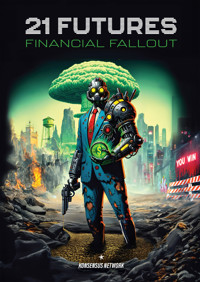
Financial Fallout
Written by 21 Authors
Curated and edited by
Philip Charter & Alex Boast
21futures.com
© Konsensus Network & 21 Authors [1]
Konsensus Network owns the Global Unlimited Publishing and distribution rights for all media.
Authors own copyright to their own stories.
All rights reserved.
Edited by Philip Charter & Alex Boast
Chapter art[2] by Niko Laamanen.
Typesetting, and cover design by Niko Laamanen.
ISBN 978-9916-749-32-6 Paperback
ISBN 978-9916-749-33-3 eBook
Konsensus Network
https://konsensus.network
Table of Contents
Foreword
Introduction
01 — The Big Slash
by
D.J. Bodden
02 — Crushing
by
KT Morley
03 — Yourself Myself E-self
by
Chris Griffiths
04 — Stumble
by
Fanis Michalakis
05 — Self-Immolation to Self-Custody
by
Will Schoellkopf
06 — Proxy — Temet Nosce
by
Decent Money
07 — Daria’s Delightful Dancing Emporium
by
Jillian Godsil
08 — The Currency of a Childhood
by
Praise Samuel-Imaikop
09 — The Confisco
by
Luciano Rocha
10 — Dreaming Big
by
Lindsay Burns
11 — The Last Days
by
Mariska van der Merwe
12 — Underworld
by
Max Hillebrand
13 — We Are Living Well
by
Anonymous
14 — The Fixer: Medical Device Exorcist
by
Eric Kay
15 — Infinite Debt
by
Graeme Shimmin
16 — Fork War
by
Alex Gurevich
17 — The Vision Solution
by
Ninja Grandma
18 — Beneath the Fall
by
SF
19 — Supplying the Slugs
by
T. M. de Saavedra
20 — The Rainmaker
by
Joseph Sidari
21 — The Last Node
by
Satillionaire
22 — The Final Monopoly
by
Alexander Reeve
About the Authors
Learn More
Foreword
Fiction has long been a powerful tool for understanding the complexities of our current social paradigm and extrapolating where it might lead us in the future. By exploring the possibilities of tomorrow, we can gain valuable insights into the consequences of our actions today and hopefully chart a course towards a less violent and more prosperous future.
The stories collected in this volume offer a glimpse into a wide range of possible futures, each one a thought-provoking commentary on the world we live in today. From the dystopian landscape of ‘Infinite Debt’, where individuals are trapped in a never-ending cycle of debt and control, to the post-apocalyptic world of ‘The Big Slash’, where society has broken down and people must adapt to survive, these tales challenge us to think critically about the systems and structures that govern our lives.
Other stories, such as Proxy — Temet Nosce and We Are Living Well, explore themes of identity, community, and resilience in the face of catastrophic change. They invite us to consider what it means to be ourselves in a world where technology is increasingly shaping our experiences and relationships. Meanwhile, ‘Supplying the Slugs’ offers a cautionary tale about the dangers of unchecked power and exploitation, highlighting the importance of responsibility and ethics in our interactions with others.
Yet, despite the challenges and dangers these stories portray, there is also a sense of hope and optimism that runs throughout this collection. For example, technologies like Bitcoin and Nostr are providing new opportunities for individuals to take control of their own lives and create more equitable systems. These freedom-enhancing technologies have the potential to decentralize power, promote transparency, and foster greater cooperation and collaboration.
As we look to the future, it is clear that our choices will have far-reaching consequences. The stories in this volume encourage us to think carefully about the kind of world we want to create and to work towards building a future that is more just, peaceful, and prosperous for all.
— Max Hillebrand
Introduction
As the ‘financial fallout’ of an inflation-driven nuclear winter fast approaches, we cling to the promise of a warmer spring, brought about by exciting new technologies and the familiar comfort of storytelling.
The cypherpunks have arisen — individuals who believe privacy enhances, not detracts from, our place in society. Individuals who believe that with new technology, we can empower each other and ourselves, and de-power those who would see us live as nothing more than digital serfs.
Individuals who believe.
These tales, from established writers and emerging talents, imagine worlds that could be free but aren’t, much like our own. As 21 Futures evolves from its bitcoin origins in Tales from the Timechain, we turn now to darker possible fates. Inspired by uncertainty, our writers hold the keys to brighter futures, if only we can survive the fallout.
From thought-provoking and funny to downright frightening, the stories in this anthology captured our hearts and minds. They grapple with the rise of surveillance capitalism, the erosion of privacy, and the struggle for economic freedom. Yet, amidst the dystopia, a glimmer of hope persists…these stories are not merely warnings; they are invitations to imagine — and ultimately, to build — a better future. We invite you to join us.
Infinite Debt, our top-prize story by Graeme Shimmin, asks its characters and our audience how far they might be willing to go to write off debt.
Proxy — Temet Nosce, offers a body-horror experience that is as frightening as it is entertaining when the protagonist is transformed into a NoBody.
The Big Slash offers a glimpse of what post-AI life might be like, and our joint runners-up stories, We are Living Well and Supplying The Slugs offer a more fantastical edge to the collection.
Underworld reveals a terrifying vision of government surveillance and the cypherpunk freedom fighters who fight the system.
Special thanks to Max Hillebrand for sponsoring this volume and contributing his work.
And so the Konsensus Network team, the editors, and the authors take on the role of doomed Prometheus, passing the fire of hope and the future to you, dear reader.
This is a short story collection for those who can see what’s coming, and choose hope instead of fear.
Enjoy.
— Alexander Boast & Philip Charter, Editors
Alex Boast — Editor| @alex_boast
Alex is a web3 writer, ghost writer and ghost story writer. He’s a novelist and poet from England who loves to work with other writers as a coach, mentor and friend. You can find him on LinkedIn.
Philip Charter — Editor| totallyhumanwriter.com
Philip Charter is a full-time writer and part-time cat herder. As well as writing for bitcoin founders and companies, he runs the 21 Futures fiction project.
We were never prepared.
The Big Slash
by D.J. Bodden
I was in a grocery store when The Big Slash happened. I was bagging my own groceries at the self-checkout stand, as is the right of every post-AI human. It was the end of the workday and near closing time, so the place was packed with tired, oblivious office workers who’d gone from one rat race to another. Some of them were like slow zombies, and some of them were fast, shoving and snarling like they needed to get somewhere other than a honeycomb pod motel.
I was uncomfortable and anxious. Some hulking gym bro who was ‘just buying a six-pack’ was breathing over my shoulder, the smell assaulting my personal space like an uninvited back rub. I’d just managed to stuff the last of my groceries into a biodegradable bag, gray veggie-plastic stretched almost transparent, and I just wanted to get out of there and back to my crappy apartment.
I punched the checkout button, swiped my hand over the reader, and grabbed my stuff. ‘Hey, buddy!’ the dude with the beer cans said, catching my elbow before I’d taken a second step. I flinched at the touch, turning with cosmic reluctance toward the possibility of confrontation, but Mr. Pecs-too-big-for-his-wife-beater was pointing at the register. Payment declined.
‘Sorry,’ I said without making eye contact, and I put my hand back on the terminal, making sure the RFID scanner got a good look at the chip in the meaty part of my hand. Payment declined.
Cold sweat dripped down my spine. Have you ever had that feeling? Sudden impotence. I turned to apologize to the man I’d been belittling in my head only moments before, but again, he wasn’t looking at me, so all I saw was the back of his head. He was looking at all the other registers, where dozens of other formerly confident and self-sufficient customers searched, helpless, for an attendant.
I don’t think I ever saw his face. I just remember the smell — sweat and halitosis. It was the first waft of a new world. The Big Slash had come for us all.
◆◆◆
I woke up the next morning in my small apartment. Well, not exactly mine. I owned an eighth of a year in a room that barely fit a single bed, some shelves, and a portable stove. Shared bathroom on every floor. It sucked.
Oh, and the door was broken. The lock had been keyed to my share tokens, and my chip still didn’t work. I was tired, hungry, and pissed off, so I did the manliest thing I’d done until that point in my life. What? No, of course I didn’t break the door down. I borrowed a pry bar from my ex-con neighbor, and it was scary as hell. Still better than sleeping in the hallway.
I’d woken up, hungry and still tired, immediately reaching for my tablet to sign into my chip. It was still locked, both main account and subaccounts, same as the dozen times before. I still remember that feeling. Not even anger or frustration, although there had been no shortage of that the night before. No, that morning, I felt a sense of doom that I can only describe as wide-eyed certainty my life was over. The chip was dead. My life went with it.
If you grew up after the Slash, you might not understand what I’m talking about, but the thing in my hand was called a wallet although, for reasons that don’t matter anymore, it should have been called a keyring. It held the keys to my money, my property, and my government ID. It unlocked proof of my bachelor’s degree, my work history, and my failed marriage to Jenny Larsh. I’d lost access to my streaming account, my music, and my books because I didn’t really own any of them, I just owned the right to access them. I could only log into the tablet as a guest, so I’d lost all of my contacts, and even if I’d had them, I could only call emergency services. I’d become a non-person overnight.
I hugged my arms across my chest, staring up at the ceiling, literally trying to get a hold of myself.
After a few hundred thunderous heartbeats, my faith in normality gasped for air. I could open a new wallet. I could get people who knew me to vouch for my existence. My family lived in a different town — so did I, seven-eighths of the year — but if I could get to them, I could partially prove my identity by association and maybe get my pre-college education restored.
I also had a physical copy of my passphrases buried in my parents’ back yard, but I wasn’t sure if that would fix this. The terminal wasn’t giving me the option to recover anything. I was just locked out without explanation or recourse, and that threatened to freeze me up again. First things first, I told myself, dragging myself back from the edge of hopelessness. I need to find someone who knows me, and maybe ask to borrow their tablet. As sad as it might sound, the only place for that was corporate headquarters since I worked remotely from my hometown most of the year.
I walked down the hall to take a quick shower, pulled some clothes from the suitcase I was living out of, and headed for work. I was expecting an hour-long walk — I didn’t have a way to pay for a self-driving commuter, and even public transportation required payment or a residency pass — but after just a few steps onto the sidewalk, I realized I had misunderstood the scope of the problem.
There were people everywhere, and they were lost, glassy-eyed, and vacant. They looked like I’d felt after checking my chip that morning. It was a feeling that hit us over and over in the days and weeks after The Big Slash, and we came up with all kinds of names for it — going tharn, blue screen of death, the freeze, or the deep chill. It was the response we all had to our lives going from math-driven economics to complete unpredictability. People only had what they wore or clutched to their chests. The very notion of ownership had been upended. And we didn’t know why.
It wasn’t all bad at first. There were some good people who hadn’t been Slashed and tried to help the rest of us out. The bus driver for Line 46 was one of them. She was an older lady called Sam, a veteran who didn’t get online much, and she let me ride to work for free.
◆◆◆
The office was a mess. I worked at Coinbase’s local campus, and normally, I never would have gotten through the front door, except the security team had all quit.
It turned out that the ability to protect physical property had just gotten a lot more valuable than the ability to program a computer. The speed of the change was stunning.
I made my way through the lobby. Big place, lots of glass and polished wood, and people standing in groups of two or three talking about the end of our world. These weren’t the hardcore devs who were all upstairs with the CTO trying to hack into our own systems.
I didn’t care about saving the company or the world. I just wanted my life back, so I headed to HR. That’s where I met Phil.
Phil was having a hard day. Phil was a non-technical guy in a technical company trying to explain to technical people why the technical stuff had been Rekt. Bricked, actually, because Rekt implied an attack, and Bricked was just incompetence or bad luck. Our bad luck had rushed together, pooled, and poured down on Phil’s head, which, in my mind, might have been why he was bald.
I don’t know that, mind you. And Phil wasn’t bald. He had a healthy crop of thick hair on the sides of his head, which he was clutching with his elbows on the table.
‘Hello?’ I said, leaning partly through the door.
Phil looked up at me, releasing those beautiful clouds of blond puff. ‘I can’t help you.’ ‘Oh.’
‘It’s not that I don’t want to,’ Phil said, apologetic and a little horrified. If I’d learned anything in the day since my chip went dead, it was that people — six-pack guy, ex-con neighbor, Sam the bus driver, and Phil in HR — were fundamentally more decent than I expected before I was forced to talk to them.
‘The computers don’t work,’ I offered.
‘I, uh,’ he started. ‘I made that mistake. I was told the computers work fine. Loudly.’
‘We just can’t access them.’
‘Yes,’ he said, brightening. ‘That’s what they said, too!’
I nodded. It had happened to me. I just didn’t realize it could happen to... I was going to say the whole company, but then I remembered the people on the street. It was happening to everyone. ‘Do you mind if I sit?’ ‘Please,’ Phil said.
Phil had been working late when The Big Slash hit, and he stayed to help people, only to spend the whole night and three hours of the morning getting yelled at by people who were smarter than him (his words, not mine). From my experience, seeing hidden patterns in code can blind you to other things.
Their loss, my gain, because Phil was the kind of HR guy desperate to help people, a real social worker type with an unstainable core of hope. While most people would have absorbed all that abuse and broken down, Phil had somehow pieced The Big Slash together before almost anyone else simply by being open-minded at the crossroads of competence and panic.
‘I think we’ve all been blacklisted,’ Phil said.
‘Okay,’ I said, trying not to look panicked. ‘What do you think that means?’ ‘It’s a...’ Phil looked down at a small sheet of paper he’d used to take notes in pencil, his spider scrawl filling most of the page. ‘It’s a cascading key revocation event caused by a sequential compliance violation that is triggering an infrastructure-level protective measure including irrevocable isolation.’ He looked up at me, unsure of what he’d said. I was probably the first person who’d listened.
My heart was caught in my throat. ‘And what do you think caused that?’
Phil frowned. ‘You’re not yelling at me.’
‘Everything you said made sense.’
Phil licked his lips. ‘I don’t understand what I said. I just puzzled it together from what the engineers, accountants, lawyers, and procurement people said. How bad is it?’
‘That depends on what caused it, Phil,’ I said, really straining not to be another person who’d yelled at him even though there was a scream building in my throat.
Phil went pale and spoke quietly. ‘I think it’s because we sanctioned Saudi Arabia for the link to terrorist financing. It was all over the news.’
‘But that happened decades ago.’
‘Yes, but... Hold on, let me find it.’ Phil looked back at his sheet. ‘We don’t need their fucking oil anymore.’
I sat back in my chair, feeling the deep chill grip my heart. What Phil had basically said, without realizing it, was that some politicians decided to score points by punishing the grandchildren of mass murderers, and the system everybody used to identify themselves and store their valuables had automatically cut the ‘bad people’ off and anybody related to them. Not by blood, mind you, but by commerce. But like Phil had said, we had used their oil. And McKensie had worked for them, and had also worked for all the big companies. And the big companies employed and sold things to all of us, meaning we were all connected and all cut off, quarantined from what we owned and from each other. Villagers in the heart of the Amazon still used toothpaste, baby formula, and tampons.
‘You look really scared,’ Phil said quietly. ‘Can’t they just take it back?’ ‘No. That’s what irrevocable means.’
‘But it’s all on the ledger, right? Can’t they just make a copy and start it up again?’ I smiled at him. ‘I’m sure they’ll try, but we all have to agree. Who do you trust to do that without fudging the numbers?’
Phil stared back at me across the table, the truth finally hitting him.
After a few more seconds, I stood up.
‘You’re leaving?’
I shrugged. ‘I have no way to prove I work here, and the company can’t pay me.’
‘But where will you go?’
‘Home,’ I told him with a sad smile. ‘You should get out of the city, Phil. I think things will get ugly here. I hope you have someplace you can go.’
That was the last time I saw him. I went back to the apartment, grabbed my things, and hitch-hiked to Tander, my hometown, relying on the kindness of strangers. There was a feeling on the road, in those early days, that we were all mourning a death and that, in times like these, we needed to stick together. Some people were stuck in denial, believing that at any moment, the government or the corporations would come up with a solution.
I watched it all through a dozen of rear-view mirrors. It got worse even faster than I’d feared.
◆◆◆
It’s important to understand why the world before The Big Slash was both better run and more fragile than any other period before it. Every human on the planet had been digitized. We had those keychains I was talking about, and each key gave us the ability to tell people who we were, what we could do, and what we owned. We could exchange those things between ourselves 24/7 and across the globe at next to no cost and swap like-for-like in a dizzying number of ways.
And it was all tracked to those wallets, everything we did, so that every good deed could be rewarded, every sin punished. We called those incentives, and the network was our all-seeing deity. We had more privacy and less anonymity than we’d ever had before, our identities specified to the tenth decimal.
Then our god turned away.
By the second day, the looting started. It was mostly non-violent, especially in the ‘big box’ stores that had policies against stopping shoplifters and hadn’t clued in that their parametric insurance claims could no longer be processed. The trucker I was riding with shook her head as we heard about it on the radio. Her rig could still pick up the old open-air stations, which were coming back online as governments and community leaders tried to reconnect with their constituents.
By the third day, the looters and store owners got organized, and hundred-strong groups of thieves raided outlets and malls defended by small phalanxes of employees equipped with sports equipment. Law enforcement and military, who had already suffered at close to eleven percent desertion rate but were still holding together, strong-pointed hospitals and pharmacies while grocery store owners encouraged people to ‘Take now and pay later’ because the food would spoil anyway.
Smaller family-owned businesses closed the security shutters and bunkered up, especially if grandma or grandpa had lived through COVID.
On the fourth day, I left the main highway and hitched with a van full of Swifties who were traveling north to attend the fifth stop of the septuagenarian’s grand tour. In between sing-alongs of her greatest hits from the 20s, I found out that while governments across the globe were scrambling to relearn how to print or mint physical currency, humans were reinventing a barter economy around the exchange of skills. People with useful skills, like plumbers, electricians, masons, carpenters, doctors, aid workers, soldiers, and especially teachers, traded time for supplies. People with useless skills, like stylists, lawyers, programmers, marketers, politicians, and anyone who had never learned to build things, joined the kleptocratic mobs that terrorized the wealthier neighborhoods.
We didn’t hear much from rural areas, except that some farming towns wouldn’t let refugees in. Our generation was hardening fast.
The chip in my hand itched.
On the sixth day, I left the Swifties, out of gas by the side of the road, and started the sixty-kilometer walk home. Cities were becoming feudal warzones without the logistics to supply them, especially in places where water and power had been decentralized. I passed a church that had been fortified by its parishioners. I saw a family living in the woods cooking a dog. I found a self-proclaimed billionaire beaten half to death at a rest stop, and he offered me a gold watch and a cold wallet with twenty million in meme coins on it, still white-listed, if I would just get him to a hospital.
I had to laugh, but I helped get him to a nearby veterinary center anyway. The time of worthless things had come to an end.
◆◆◆
It’s been three years. Things are quieter now. Seventy percent of the world’s population had lived in cities, dependent on society and networks. Not that many of them got out. Things got real hard when global shipping broke down, and that triggered the fertilizer shortage, but we didn’t lose everything from the old world. We’ve got power and running water. Our children are fed, learning, and safe. We’d learned to build ecosystems but, this time, we used people and relationships instead of beams and wires, and I know dozens of people who’d stand at my side or take me in if I called.
Sometimes, the scar on my hand between my index and thumb itches, and I remember what it was like before, but I don’t miss it at all.
Crushing
by KT Morley
Marvin eyed the news as he sipped coffee at the counter of his favorite diner, sunlight washing across the seats to his right and signaling the birth of a bright new day.
Kristi, the waitress, placed his order in front of him, leaned on the counter, and eyed him. ‘Thoughts, Marv?’ Her voice rattled in that early-morning smoker’s way.
He thought a second, letting the smells from his meal wash over him as the clatter of spatulas on the flattop back in the kitchen offered an offbeat staccato to the rest of the diner’s atmosphere. The crowd had thinned recently. Soaring prices for food and gas had culled the old-timers on a fixed income. Only diehards remained. Only diehards had the currency to spend on a meal and a cup of joe. Today was a ten-year bond auction, so he sat nearest the TV spewing financial jargon.
‘They’re stuck. Inflation is way too high. The only jobs available are part-time or government, and the bond market has been brutal for nearly a year: fat tails everywhere. It’s like an overfed Koi pond. Today could be messy.’
‘I’ll pretend I know what that means,’ Kristi laughed, and then, more seriously, ‘But what can we do?’
‘Physically? Nothing. Just take it like the beating it is. Hodl and all that. Financially, I’d get as much money out as you can. Put it in hard cash, canned or shelf-stable foods, plus gold, silver, and lead. If you can move over to bitcoin, do it. Like now.’
‘I’ve got the bitcoin in cold storage and stack like a pleb every day.’ She threw him a thumbs up before continuing, ‘Try to save my moves to meaningful amounts to control UTXOs. Didn’t know lead was valuable, though.’
‘That’s smart, Kristi. Keep fees as small as possible that way. And the lead, when backed by black powder, is for protecting the gold and silver.’ He raised his coffee cup to her. ‘And yourself, of course.’
She chuckled and nodded, moving down the counter, wiping it as she went, even though customers hadn’t been in those chairs in weeks. At the other end, she talked with another of the scant crowd, and only pieces of the conversation, mixed with the scattered sounds of the kitchen, made it to Marvin. Which was fine. He was here for coffee, eggs, and the strip sausage he could get nowhere else.
So far, the journos offered a litany of what should be interpreted as horrible news but were spinning it like cotton candy into a fluff of gotta-have BS. The fact that they supported valuation at 50-75 times earnings as if it was ordinary betrayed reality and cogent thought. Not an Austrian among them.
Everything shifted after the recent American election cycle. The economy started to groan meaningfully, and ‘soft landing’ seemed akin to slamming a jumbo jet into the side of a mountain. Sure, the politicians would have people believe it’s the other guy’s fault, the other party’s fault, hell, your fault. Anything but their fault. And that sounds nice, except it’s a thought trap inexplicably denying personal responsibility and assuming others are to blame.
Marvin reflected again; he has done that a lot these days. The bond auctions had turned south in a hard way during the previous election cycle. That was before the tails got wonky, like now. The government overhauled all banking charters, completely locking out shareholders and boards. The changes upped the mandates for purchasing bonds and the number of bonds each bank held as a percentage of their assets. The banks chafed, screamed loudly for all to hear, and were ignored by the common man. It appeared that banks had been abusing their authority for so long that the average person thought nothing of a bit of comeuppance in the banking sector. ‘Serves ‘em right,’ most said. Then, the government rewrote all the rules, and nationalized the entire industry. Of course, they didn’t call it that and had stacked the Supreme Court with additional Justices to back their perspective. Make it all legal-like and such.
Marvin had a different view. One that held a little closer to the idea of austerity being the best path forward. The American people, used to largesse, would not go along. They didn’t chafe at the nationalization of banking, after all. The country had morphed into a nation aligned to ‘of the bureaucrats, by the bureaucrats, and for the bureaucrats.’ Maintaining their seat at the table of politics overrode everything. Voters had primarily devolved into an ‘I’m all right, and you’re all wrong’ mindset. Marvin believed that any move by the government to curtail its debt-induced death spiral would come like a bolt of lightning from the clear blue sky. Only the bureaucrats would know, and not even all of them.
Not even most of them.
He had no idea what they would do or how it would go down, but it was coming.
The door creaked behind him, and John, another local who liked the sausage, came in and slid onto the stool next to Marvin. John nodded. ‘Mornin’.’
Marvin raised his glass. ‘Back at ya’, John.’
Kristi set a cup of coffee in front of him and gave him a warm smile. ‘The usual?’
John nodded as she placed the order. Picking up his cup, he held it under his nose and took a deep breath. Without turning, he asked, ‘You still on about financial ruin?’
‘It’s coming, John. Believe it or not, they need to do something. The interest on the debt is nearing TWICE what the country spends on defense. That’s a lot of scratch, and it’s being issued at 1100 basis points on its best day. The FED and Congress are using different playbooks and ignoring the realities each is writing.’
‘Meh, doesn’t matter. We can print all the money we want and can pay that debt off promptly if we want to.’
Marvin shook his head. ‘It’s that kind of thinking that got us into this mess.’
John slapped him on the back. ‘No worries, buddy. It’s all gonna be fine.’
Table of Contents
Cover
Table of Contents
Foreword
Introduction
The Big Slash
Crushing
Yourself Myself E-self
Stumble
Self-Immolation to Self-Custody
Proxy — Temet Nosce
Daria’s Delightful Dancing Emporium
The Currency of a Childhood
The Confisco
Dreaming Big
The Last Days
UNDERWORLD
We Are Living Well
The Fixer: Medical Device Exorcist
Infinite Debt
Fork War
The Vision Solution
Beneath the Fall
Supplying the Slugs
The Rainmaker
The Last Node
The Final Monopoly
About the Authors
Learn More
Landmarks
Cover