


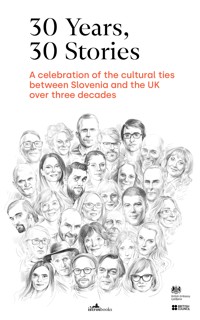
30 Years - 30 Stories E-Book
Erhalten Sie Zugang zu diesem und mehr als 300000 Büchern ab EUR 5,99 monatlich.
- Herausgeber: Istros Books
- Kategorie: Poesie und Drama
- Sprache: Englisch
30 Years – 30 Stories marks 30 years of diplomatic relations between Slovenia and the United Kingdom and the 30th anniversary of the British Council in Slovenia. Thirty writers and publicists (Slovene and British) present short stories describing their experiences, a historical event or person that in some way connects the United Kingdom and Slovenia.Contributors inlcude internaitonal best-seller, Evald Flisar, journalist Jela Krečič, author of 'Yugoslaiva, My Fatherland', Goran Vojnović and social philosopher, Renata Salecl. A rare collection of writing that summarizes a time and a place.
Sie lesen das E-Book in den Legimi-Apps auf:
Seitenzahl: 245
Veröffentlichungsjahr: 2023
Das E-Book (TTS) können Sie hören im Abo „Legimi Premium” in Legimi-Apps auf:
Ähnliche




















30 Years, 30 Stories
A celebration of the cultural ties between Slovenia and the UK over three decades
30 Years, 30 Stories is a promotional project marking 30 years of diplomatic relations between Slovenia and the United Kingdom and the 30th anniversary of the British Council in Slovenia. Thirty (mostly) Slovene writers and publicists have written short stories describing their experiences, a historical event or person that in some way connects the United Kingdom and Slovenia.
Authors
Janet AshtonEsad BabačićIgor E. BergantAndreja BrulcSteven DoswellEvald FlisarJasmin B. FrelihBoštjan Gorenc - PižamaKsenija HorvatDrago JančarJedrt Jež FurlanNina KojimaJela KrečičEva MahkovicLuka NovakRenata SaleclIfigenija SimonovićValentina Smej NovakTanja StaričDušan ŠarotarMilan ŠeljIrena ŠtaudoharMarcel Štefančič Jnr. Agata TomažičGorazd TrušnovecJana ValenčičRok VevarJani VirkGoran Vojnović Tadej ZupančičFanny Copeland walks the Vršič Pass
Janet Ashton
The road over the mountain was a doddle in physical terms. She was used to real climber’s climbs, to the challenge of ropes, crampons, hob-nailed boots, to help haul herself to the summit of some of the country’s least accessible peaks. This paved route from Kranjska Gora to Trenta, Yugoslavia to Italy, was just a long, stiff walk.
She enjoyed the hike; it was beautiful. At every one of the 50 hairpin bends that climbed up and over the pass and down the far side, a new view appeared: at one a green meadow; at another a forest of tree tops with white peaks behind. Or, a sudden drop might open before her, dizzying blue skies dotted with white cloud stretching away into the hazy distance.
She admired the road she was treading on too. It was a wonder of effective engineering, she thought, carefully paved in square stones carved from the mountain itself.
At various places, footpaths led off towards pastures and viewpoints or down into valleys. As she went higher, she took one of these as a short cut, marching steeply upwards across a number of the hairpins. Full of anticipation, she knew that just before the top of the Pass, one could look up and see the apparent face of a young girl hewn into the mountainside above. The name of the mountain was Prisojnik, and its eyes were on the road: not the eyes of the petrified nymph, the Ajdovska Deklica, condemned to spend eternity on the rockface as a penalty for predicting the death of the mythical Zlatorog or Goldenhorn goat, but also those of the mountain itself. There are two holes in the face of Prisojnik, staring down blindly at the white road below. Today, as she emerged from the footpath shortcut onto Bend 17 in the road, she could see a patch of snow beneath the western hole, a monstrous tear, she mused, a reaction to the sad history of that same perfect road.
She was deeply affected by the story of how the road was built, two decades before. Russian prisoners in the Great War had toiled to improve the enemy’s military transport system under the eyes of their Austro-Hungarian captors. Many of them died in the effort, killed by malnutrition, illness or the frequent landslides that also carried away some of their guards, and they were commemorated in roadside graves at intervals and in the small Orthodox chapel at one of the lower bends in the road. As a Scot, wartime ally of these prisoners, she felt their fate, but she also felt their fate as a scholar of Slavic languages and cultures. It was hard not to channel the feelings of the poor soldiers, children of the open steppe, as they toiled away on the narrow pass closed in between the lowering mountains, the beautiful road they were creating an instrument of torture to them, its white stones evocative of nothing so much as bleached bones. As dusk slowly began to fall around her, she almost fancied she could hear the stones weeping, reflecting the agony of the men who had laid them.
And yet it was the mountains that the Scottish woman loved more than anything. In the mountains she felt she’d found the soul of her new country as of her old, an unbreakable link drawing her from one to the other. The mountains opened up an entire national mythology to her and brought understanding of the differences between this country and even its own nearest neighbours.
Prompted by the military road, she found she was thinking of her days working for the Yugoslav Committee in London during the War. A refugee from an unhappy marriage, she had relished the chance to get her teeth into translation work. No doubt she should never have married at all but doing so had seemed her one escape from her tempestuous relationship with her mother. She knew that a fulfilling career in academia was not an option for a girl, though she might have preferred this, and – as a child of Scotland’s Astronomer Royal – might even have had an advantage in getting established if she had been a boy. Still, she was a forceful and positive person, and she brought the same grit to her translation work as she did to mountaineering and to music, another passion.
The exiled, predominantly Croatian, Yugoslav Committee was focused on breaking the Austro-Hungarian Empire apart and uniting the southern Slavs in it with the Serbs outside. The work she translated for them described these Slavs as one “race” living from the Alps to Macedonia, and even proclaimed their languages to be one, called “Serbo-Croatian”. The Slovenes, whom even many scholars of the area dismissed as too bound up with “the hereditary Habsburg lands” to have a future outside Austria, would be part of this new country alongside the once independent Croatia, with aspirations for renewed independence.
And now, as she turned back down the Pass and started her descent to daily life, back to the lights of Kranjska Gora in the twilight below, she relived her excitement at the end of war, when the “Yugoslav” country came into a sort of being, and she finally had a chance to visit this new-fangled Kingdom of Serbs, Croats and Slovenes. Next came the letter from the University of Ljubljana, asking her to take up a post teaching English. It was in accepting this work that she realised she had found her vocation – not as a teacher per se, but as a proselytiser and publicist for the Slovene people and the mountains that were an integral part of their national character.
Early on, she had set out to conquer three-headed Triglav, the symbol of the nation within a nation. With her rucksack and walking boots, she joined groups of intrepid students or went with older alpinists, all of them decrying the growing popularity of the ascent. It did not take long for her fellow mountaineers to disabuse her of her romantic notions about a south Slav unity of culture, with their acerbic comments on Croatian “trippers” or “tourists”, who – they claimed – set out in unsuitable footwear with pet dogs and left the mountain huts in disarray. She quickly decided that the Slovenes were equivalent to the Scots among the Yugoslav people, more practical and pragmatic than their southern neighbours. And that they too were a distinct people in their own right.
She still believed as strongly in Yugoslavia as she had done before it was formed, but she now saw it as a set of complementary nations in one, rather than a single culture and country. Her new raison d’etre was to impart her enthusiasm for the distinct landscape and culture of the Slovenes to more people, especially in her native Britain, and to protect this culture and these landscapes through the agency of new national parks as well. So now she was writing her own books on the mountains, and with delight she led groups of British geographers from the LePlay Society through the alpine valleys, collecting stories and noting details of costume and furnishings. Their work would be a model for regional studies, she was convinced.
It was getting darker, but she felt quite safe on the road with her torch in hand. There was time for a break in the mountain hut that now came into view below her, its windows brightly lit and people still on the benches outside. Their conversation drifted upwards, discussing tomorrow’s All Souls Day and how they had come to the valley with lights and lamps to pay their respects at the graves in nearby Dovje of the mountaineers who had met their end on Triglav over the years. “My mother isn’t keen for me to climb,” one young man was saying. “She understands that I respect their warnings as well as their achievements, but she still thinks I’ll end by sharing their fate!”
Fanny bought a bowl of soup and moved to join the boy and his friends. “I’ll talk to your mother if you can introduce me,” she volunteered. “Perhaps she would be happier with a woman’s reassurance. I have climbed many times, and you really can’t be called a Slovene until you do.”
“Triglav has no time for Sunday trippers,” she concluded, “but if you treat him with respect, he will welcome you to his bosom like a father.”
Fanny Susan Copeland, translator, musician, mountaineer, teacher, conservationist, born Parsonstown, Ireland, 1872; died Ljubljana, 1970, buried Dovje.
Janet Ashton is a historian by education and works with the British Library’s European Language Collections. She is the author of a number of monographs, chapters and articles, ranging from a study of the coronation of Tsar Nicholas II to a fictionalised biography of his wife Alexandra. Having started, like Fanny, by studying Russian, she found that the language helped open the door to other fascinating cultures, and for the last decade has been a constant visitor to and promoter of Slovenia.
Fog
Esad Babačić
translated from the Slovene by Gregor Timothy Čeh
We should never allow ourselves to be translated, just as we should never send letters that nobody replies to. In both cases too many words are wasted – apart from the rare occasions when one senses that they can hear the sound of some word at least roughly the way it was heard by the person who once wrote it, somewhere in some language unfamiliar to the reader that sounds entirely different in translation.
Danilo Kiš, the never-to-be winner of the Nobel Prize for Literature, was convinced that with certain words, the sound is even more important than the actual meaning. How exactly he imagined this will be understood and felt much more clearly if, for example, you pick up his ultimate work A Tomb for Boris Davidovich and read at least the introductory bars of this exceptional novel. In the original, of course, if possible. Kiš was not one of those writers who would write with an awareness that one day he would be translated into other, more significant languages. To him, all languages were equally important, and he did not differentiate between them – even more, he stood firm in his own language.
I have myself written quite a few poems that are essentially untranslatable, not in terms of the language itself, but untranslatable because I experienced them at a specific place, on a specific street, with a specific person. Here is one of them…
I like getting lost in the fog,
if it is yours.
The fog in this poem is unique, Ljubljana fog, thick and melancholy, of course, such as it was back in the early eighties when it mingled with the sadness of a people who slowly began to bid farewell to an unsuccessful project, a state that found itself in the middle of a huge socio-economic crisis (‘stabilisation’, high unemployment, low standard of living…), the state in which what we called ‘selling fog’, selling thin air, was a common, and for a select few, also a lucrative pursuit. Others got lost in this fog while we were still able to and were fortunately not yet issued with a bill for doing so. During this time of lost illusions, in another fog, across in London, punk had grown into an anti-establishment music movement. Reaching its peak between 1976 and 1980, it was initiated (and ended) by American and British bands such as the Ramones, the Sex Pistols, the Clash, U.K. Subs, and many others, and became a major cultural phenomenon in the United Kingdom. In 1981, when punk was already on the out, together with the London fog, soon to almost disappear entirely, the bass guitarist of the English post-punk band the Stranglers, born in Britain to French parents, Jean-Jacques Burnel, suggested that the group might record the song La Folie, inspired by the story of the Japanese Issei Sagawa, who cannibalized his student crush Renée Hartevelt. That, at least, was what those who branded Renée’s murder as a crime of passion believed. In keeping with this line of thought, Sagawa was found legally insane and even released from a French jail, later to be deported to Japan, where he was committed to a mental institution but eventually checked himself out. He went on to make a career first in film and then by giving talks. The breakthrough moment for him came while he was still being held in France and was visited by a Japanese author who wrote a book about him titled In the Fog.
Sagawa had invited his victim to his home under the pretext of translating poetry. When the tall and beautiful Dutch girl sat at his table and began reading poetry, Sagawa, who saw himself as short and ugly, shot her in the neck and then fainted. When he awoke, he first had sex with her corpse and then consumed various parts of her body. This story was too tempting for the group, which had already shown its dark side within the bounds of their new wave aesthetics, of course. In several interviews, band members stressed that La Folie speaks of a murder borne of love, despite this not really holding true in this case. The song inspired by this chilling story became one of the Stranglers’ greatest successes and also hit the streets of Ljubljana, where the reigning local band at the time was Otroci socializma (Children of Socialism), with lead singer and songwriter Brane Bitenc at its helm. He heard the song and immediately asked his ‘children’ whether they might record something similar themselves.
Bitenc had already written the lyrics for the song Pejd ga pogledat Brane (Go take a look at him, Brane), but had yet to find a musical basis for it. As soon as he heard La Folie, he knew this was the atmosphere he was looking for. The group’s bass guitarist, Andrej Štritof, played the first few notes of the song, which became one of the most depressive ballads ever created sung in Slovene. When his base intro tied in with Iztok Turk’s lyrical guitar, the piece was perfect. Brane’s recital was every bit as impressive as Jean-Jacques Burnel’s performance, which is probably a touch less melancholic and more narrative; Brane’s voice contains a fatalistic hue that can also not be translated into any other language, just as it is impossible to fully convey the depression of the young lad basically singing about his manic-depressive mother. Even so, the ballads are also very different, confirming the claim that we should not allow ourselves to be translated. After all, the gist of the Slovene punk phenomenon is, in its own particular image, linked to its specific cultural-historical surroundings. Punk in Britain was about rebellion against social conditions and mainstream culture, while in Slovenia it was about creating a space to explore individuality and express dissidence. Punk also allowed weakness, even madness, turning it into lyrics.
The piece Pejd ga pogledat Brane is a song about another kind of madness which occurred in the block of flats at number 1 Na Jami in a residential estate in the Ljubljana neighbourhood of Šiška and was only possible there and nowhere else. Brane asked himself whether this was total love, love that cannot exist without madness. And yes, in a way the answer was so very close, madly close.
I loved the film Lost in Translation as soon as I saw it, though not because of the title – what enthused me were the two protagonists, he with that melancholy and self-ironic expression of renouncement on his face; she with a gentle darkness behind which glowed a shattered hope of returning to the girlish playfulness someone had stolen from her eyes. They were beautiful, even as they took the lift in silence, each in their estrangement, and with them, Japan was almost perfect. Even the movements and gestures of the locals, who accept both of them with the deepest respect and courtesy, say more about the protagonists than the locals themselves. They were translated without words, so to say… and things were lost all around them. The world rolled along the silent tracks of a wasted love: hers one that was left behind at the hotel, his coming from the fax machine, on photocopies, as reminders that sometimes it is better not to even start. Otherwise… otherwise, madness ensues… madness, a word that sounds different in every language, especially when we begin to search within it for various different madnesses… every madness has its own face… each of us recognise it to the extent we dare recognise it, for as long as we are still able to recognise it.
Madness and love have always been close friends, complementing each other well. It is not surprising that it was Brane who came across the song La Folie, Brane, who was always open to the madness of others, helping him find his own madness. Of course, this madness somehow always managed to preserve itself upon the surface of a general normality, even as the lyrics of the song Pejd ga pogledat Brane were being written:
Our neighbour died one day. His wife cried, as is the custom.
My father used a black ribbon to tie his feet at the ankles,
so they would stay together as his body turned cold. I found it all
terribly annoying. But my mum kept going on at me. She said:
‘Go take a look at him, Brane, go, take a look, Brane, come on.’
There are two syringes on the top of the fridge and I would so like to
send a shot of air into my veins.
‘Go take a look at him, Brane, go, take a look, Brane, come on!’
Esad Babačić (born 1965) is a poet, writer, journalist and former frontman of the (post)punk group Via Ofenziva, also writing the lyrics for their songs. He has received numerous poetry awards for his work both at home and abroad, most recently the Rožanc Award for best collection of essays. In 2021 he published an anthology of Slovene punk poetry which also includes verses by Brane Bitenc. Another well-known Slovene poet Milan Dekleva noted that ‘in poetry à la Babačić there is no deception and beating about the bush: all that needs to be said – however cruel, rough, rude, gentle, intimate, or kind – is said in a straightforward way, without embellishment.’
The Five (Grand)Sons’ Wonderful Tribute
Igor E. Bergant
In the 77th minute of the game, the cheers of the crowd in the small stadium of the Railway Sports Club in Ljubljana grew even louder. The President of the Republic, Borut Pahor, enthusiastically waved the Slovenian flag in the main stand. When Jack Skofič, despite an injury, finally stepped onto the pitch and joined his four brothers – Archie, George, Frank and Max – in the closing stages of this memorable rugby union international, the emotions of the 2,500 spectators (as well as the 300 or so watching the online broadcast of the match) exploded. The five Skofič brothers had finally done it!
Yes, the achievement of having the most siblings in a rugby union international earned them a place in the Guinness Book of Records that day.
And yes, on their debut for the Slovenian men’s national rugby union team, the five Skofič brothers contributed significantly to a comfortable and decisive 43 – 17 victory over Bulgaria in the European Nations Cup Division Two relegation battle. It was probably the finest victory ever achieved by the “Encijani” (The Gentians, the nickname of the Slovenian national team), who are anything but a major force in the world of rugby. The Skofičs really made the difference with their physical play.
But the most important message of this game was the promise fulfilled by the five brothers to their late father, Jonathan Skofič, from whom they inherited their love of the game. At the same time, it was a touching tribute to their grandfather, Alojz (Joe) Skofič, who had settled in West Lancashire after being thrown from his native Slovenia into the dramatic events of the Second World War as a teenager.
Neither father Jonathan nor grandfather Joe had the privilege of witnessing the remarkable event in Ljubljana on 12 April 2014. Mother Pat and little sister Violet sat in the stands, as did dozens of friends of the Skofič brothers from the UK and the US. Relatives from Šentilj, a village on the border between Slovenia and Austria where the Skofič story began, were also there.
Alojz Skofič was born in 1924 and had a difficult start in life. He was conceived out of wedlock, to the young waitress Marija, who rejected him, largely ignored by the man who was supposedly his father. He was raised by his grandparents. Later, he was able to reconnect with his father’s new family, which included two half-sisters. Then, in 1941, Alojz’s youth was abruptly ended by the war. Nazi Germany occupied and annexed most of what is now Slovenia and soon afterwards he was called up to join the German Army. A refusal would probably have had severe consequences for him and his family.
Alojz Skofič was still a teenager when he took part in the horrors of war in France and later in Italy. It was a miracle that he survived the inferno of the Battle of Monte Cassino. Just days before his 20th birthday, he was captured and taken to a British POW camp in Bari on the Adriatic coast. All German prisoners of Yugoslav origin had the option of joining the Royal Air Force and helping the British and the Allies defeat Hitler. So, Alojz Skofič got a new uniform and trained to become a member of the RAF ground staff. He also got a new nickname – Joe – and a new life. He stayed with the RAF at various airfields in Italy until 1947, when he was discharged.
Returning to Slovenia would have been difficult at the time – Alojz-Joe had been drafted by the German enemy and then worked for the British, an unfriendly former ally for the new Communist rulers of Yugoslavia in a Europe torn apart by the Cold War. For a few years his family believed he was dead, but then his letters began to arrive.
Joe Skofič came to England in 1947 for demobilisation. He followed the last line of the discharge report, which recommended employment in agriculture. When he ended up working at Ribble Bank Farm near Hesketh Bank in West Lancashire, his life changed for the better: he met and married his employer’s daughter, Mary Slinger, started his own family and a small pig and mushroom farming business. He became a British citizen and re-established ties with his relatives in Šentilj.
While Joe’s grandchildren remember his stories about the war, he was not particularly interested in sport. A passion for rugby was brought into the Skofič family by Joe and Mary’s son Jonathan, who was born in 1959. He attended Hutton Grammar School in nearby Preston, with rugby a part of the physical education curriculum. Jonathan developed into a good and committed player who captained the Bath University rugby team and later played for the semi-professional team of Preston Grasshoppers.
The family’s enthusiasm for rugby grew even more when Jonathan and his wife Pat had five sons. To their father’s delight, they all became rugby players. Jonathan had helped found Tarleton RUFC in 1990, a dynamic, community-focused club open to all generations from age five to seniors. He watched his sons grow up and play there, and they saw their father occasionally suit up for Tarleton’s second team. Jonathan longed for the moment when he could see all five of his sons grow up and play together in a team, and maybe even be on the pitch with them.
But fate had other plans. Jonathan Skofič, a food and beverage expert with an MBA from Bath University and Harvard Business School, collapsed unexpectedly during a business trip in 2011 and died. He was only 52 years old.
It was a shock for the Skofič family and the rugby community in West Lancashire. The following year, the club and the Skofič brothers honoured their former chairman and father by organising a memorial tournament – the Jonathan Skofič Invitational Sevens. Four of the brothers played on the team. The youngest – Frankie – was still too young to meet the game’s strict age restrictions.
Either way, the success of the memorial sevens tournament was another important milestone. Members of the Rugby Union of Slovenia learned about the tournament at an international match in Paphos in Cyprus in late 2012 from UK-based members of the Cypriot national team, who were surprised that the Slovenians didn’t know anything about the popular Lancashire rugby family of Slovenian origin. Slovenian rugby representatives were amazed. Five motivated semi-professional players from the eighth tier of the English rugby union system would help the national team, which had still not recovered from its record defeat by Switzerland in May 2012 (0 – 88).
The Skofičs have intensified their contacts with the extended family in Slovenia since the country’s independence from Yugoslavia in 1991. Visits to Šentilj have become fairly regular, but the boys never really thought about playing rugby in the country their grandfather came from.
But then, in 2013, everything changed. Contacts were made and the idea of five brothers in the Slovenian national rugby team became a real option. In the 2013 Sevens Memorial, all five brothers were able to play together in the sevens for the first time. But the plan to honour their father went even further – all five brothers were signed up for the Slovenian Rugby Union XV national team.
When Joe Skofič’s extraordinary life story ended in December 2013, the (grand)sons’ commitment only grew. If they managed to play together for the Slovenian national team, it would be a double tribute – to their father, who brought rugby into the family, and to their grandfather’s country of origin.
That is why emotions ran so high throughout the match in Ljubljana on 12 April 2014. For the first time, Slovenian rugby received national and international attention. It was a remarkable turning point for a sport with only 200 players in an overachieving sporting nation of 2 million people. Slovenian rugby had always been considered something of a sideshow after the sport was imported to Slovenia by enthusiasts from the Croatian port city of Split in the 1960s.
Fortunately, the 2014 match against Bulgaria was only the beginning. The Skofič brothers remained loyal to the Slovenian national team while continuing their careers in England. Max Skofič even captained a consolidated national team in 2015, which he describes as one of the proudest moments in his life. Some of the brothers have started to learn their grandfather’s native language.
Slovenia is still not a rugby superpower and probably never will be. But it has a special place in the world of rugby, all because of the Skofičs’ extraordinary symbolic homecoming and a very special blessing for Slovenia from the home of rugby..
A Requiem for Anthony Minghella
Andreja Brulc
The 30th anniversary of diplomatic relations between the United Kingdom and Slovenia and the presence of the British Council in independent Slovenia coincides with my 30 years of living in the UK and it being 30 years since I met Anthony Minghella (1954–2008) for the first time. Anthony, the Oscar-winning filmmaker and citizen of the world, inspired and encouraged me to follow my heart into creative work.
In the autumn of 1992, I started working for Anthony and his wife, Carolyn Choa, a dancer and choreographer, looking after their seven-year-old son, Max – now following his father’s footsteps in the film industry, his talent recently shining through in his performance in the recent television adaptation of Margaret Atwood’s The Handmaid’s Tale. Both Anthony and Carolyn were children of immigrant ancestry – Italian and principally Cantonese Chinese respectively. They understood the surreal and disconcerting experience I had when entering the United Kingdom through the port of Dover in 1991, where I was classified as a refugee from war-torn Yugoslavia, and they helped me get through it emotionally, for which I am hugely grateful.




