


17,99 €
Mehr erfahren.
- Herausgeber: Independent Thinking Press
- Kategorie: Bildung
- Sprache: Englisch
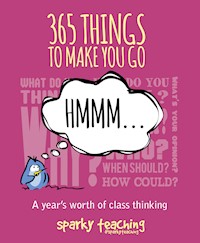
This book gives teachers ways to provoke thought and start discussion - something schemes of work don't always allow time for. With a curriculum that is getting increasingly content-heavy, it's important for teachers to look to develop thinking skills where they can. 365 Things to make you go hmm ... provides one opportunity a day (through questions / tasks) to develop skills like creative thinking, a sense of wonder, logic and decision-making. By getting pupils talking, classroom communities are built. Skills include: creative thinking, mathematical thinking, problem-solving, critical thinking, personal / inter-personal skills, a sense of wonder/curiosity about the world. For use by teachers from KS1 through to secondary teachers.
Das E-Book können Sie in Legimi-Apps oder einer beliebigen App lesen, die das folgende Format unterstützen:
Veröffentlichungsjahr: 2014
Ähnliche















For our wonderful parents Colin and Jean, Keith and Sheila.
Now that you’ve opened the book you are instantly faced with a decision – where do you go next?
If you are a teacher, turn to page 8.
If you are a parent, we hope you enjoy going through these with your child. Turn to page 8, ignoring any jargon you come across along the way, or just go directly to page 23.
If you are a young person, feel free to skip the next few pages. For best results, find someone else to discuss your ideas with and see what they think about each question – it makes things a lot more interesting. Dive straight into page 23.
If you’re the sort of person who reads the last page of the story first, here’s a spoiler: most of the questions here haven’t got a specific answer, but for those that do we’ve put a few on page 165.
If you don’t read small print, go straight to 365 THINGS TO MAKE YOU GO HMMM on page 23.
CONTENTS
INTRODUCTION
Apparently, Hull City is the only team in the football league whose name contains no letters you can colour in1 (unless you’re in Year 7, in which case you’ll see an immediate opportunity in the sixth letter).
Fascinating as that fact is, this book doesn’t provide you with a year’s worth of similarly useless-but-strangely-captivating trivia or general knowledge questions. Hopefully, 365 Things To Make You Go Hmmm … is slightly more than that. This is a collection of thought-provoking questions, activities and ideas chosen carefully to help you do four things:
Nurture a questioning culture in class. Or, more accurately, a questioning culture amongst your students in your classroom.Encourage openness.Develop your relationship with your class/child.Encourage a range of skills, including:a. problem-solving
b. mathematical thinking
c. logical thinking
d. literacy skills
e. creative thinking
f. personal and inter-personal skills
g. a sense of awe and wonder about the world
In short, this book tries to tread a line between interesting and important.
If you are a teacher, the idea is that you carve out a minimum of five minutes every day with the sole aim of discussing that particular day’s question. This could be during registration, at the end of the day or during snatched moments with your class.
Of course, you might want to use them more specifically. Some would serve well as lesson starters (#083), plenaries (#074) or mid-lesson activities to introduce a change of pace. Others deserve more time, so could be worked into a main lesson. You might decide #009 merits an entire maths lesson, #025 would make a great English session or a full Circle Time should be devoted to reflecting on #306. To help you with all of this, some of the questions have been indexed into categories on page 177.
A CASE STUDY
Worth mentioning is the way that Eirian Painter introduced and now uses this with the children at Liberty Primary School in Merton, London. It’s an excellent model if you’re looking for a way to embed these sorts of questions across your whole school.
Each week, one question is decided on and then announced to the school during assembly. Every classroom then has a poster of the ‘Hmmm’, as well as one on the school’s ‘Challenge of the Week’ display board.
During the week, specific time is allocated for pupils to respond to the question. They do so by writing their response or answer on colour-coded paper (one each for Early Years, KS1 and KS2) and posting it into the ‘Challenge Box’ attached to the main display.
The challenge is discussed during Friday’s whole-school celebration assembly and one answer from each phase is read out as the winner.
Each week’s challenge (and all its responses) is finally filed in a cabinet beneath the Challenge display and the school is steadily building up a powerful library of evidence of the way that children think across the age ranges.
Using weekly challenges in this way has encouraged our students to think things through more, rather than accepting a common answer. It’s a really useful way for them to deepen their knowledge and understanding of the world.
Eirian Painter, Deputy Head Teacher, Liberty Primary School, Merton
With their challenge, Liberty have developed the idea to serve the whole school. If only we’d thought of it, this would have been a lot quicker to write – 52 questions would have made a thinner book!
Although we’ve done our best to make this book as aesthetically pleasing as possible, its real worth doesn’t lie in the questions themselves. It’s your follow-up questions and the ensuing discussion that will make all the difference. This is a working document.
So, with this in mind, we’d like you to do something. Turn to page 182 and write down a quote you’ve heard recently that makes you think.
Come back when you’ve finished …
Like the best lesson plans, evaluations and Individual Education Plans, this book is much more useful if you view it as a work-in-progress. Please write in it. Highlight sections. Jot down how you’ve used follow-up questions to develop ideas. Note down inspiring quotes, new stories or website links. Let it become a journal – a home for your Hmmms.
365 IS JUST THE BEGINNING.
1 There’s no truth in the rumour that the reason Assem Allam (current Hull City owner) wants to change their name to Hull Tigers is because it would bring the letters ‘g’ and ‘e’ to the table.
THE LIFE CYCLE OF A HMMM-ING BIRD
Spring 2008 – The egg of an idea
365 Things started life as a classroom display. It featured enlarged photos of the heads of students with thought bubbles above each one. They then wrote the questions that were concerning/interesting them at that point in time. ‘I know what you should call it,’ said one student on their way out to lunch. ‘Things that make us go “Hmmm”.’ And so it began.
June 2009 – Sparky Teaching hatched
Sparky Teaching was created as a home on the web for teachers, parents and students who cared about creative teaching, creative learning and what we believed was the important stuff. Wherever you are in the world, many of the issues teachers face are the same. How can we find opportunities to emphasise character-based values when faced with an increasingly content-heavy curriculum? Is creativity being crowded out of the school day? Through slightly left field – but nonetheless incredibly important – resources, we tried to meet the needs of creatively-minded teachers and parents who didn’t mind doing things slightly differently in order to get learning to stick.
September 2009 – 365 Things flew solo
We started posting one big question every day to get students thinking and sharing their answers. Over the next few years, popularity steadily grew and we did our best to make the content as engaging as possible. To keep things fresh, we deleted the questions and started from #001 again at the end of each year. Every day a new question is still posted at http://sparkyteaching.com/resources/thinkingskills/hmmm.php and tweeted using the hashtag #HmmmsTheWord.
March 2013 – Some tweeting
After several tweets, emails and meetings with Ian Gilbert and Independent Thinking Press, it was decided that 365 Things To Make You Go Hmmm … might work well on paper as well as pixels.
June 2014 – The final migration
And so here we are. From classroom display, to website, to book. It’s been our intention to come up with something that is more intriguing and Hmmm-inducing than the website. Hopefully we’ve succeeded.
QUESTION QUESTIONS
How many questions get asked in your classroom every day?
In 1912, Stevens stated that approximately eighty percent of a teacher’s school day was spent asking questions to students. More contemporary research on teacher questioning behaviors and patterns indicate that this has not changed. Teachers today ask between 300-400 questions each day (Leven and Long, 1981)1.
Research by Littlewoods2 found that children ask their mothers between 140 and 390 questions a day, depending on their age and gender.
Of course, you didn’t need that data to know the following:
Young people are innately curious.As teachers, we have a tendency to ask too many questions (many of which can be wasted – closed, rhetorical, misdirected or orders disguised as questions).If every member of our class asked questions at mother-rate, we’d be in trouble.Children tend to open up more (and therefore ask more questions) when they’re on their own or in smaller groups.Who asks the most questions in your classroom?
How can we redress the balance of question power?
What opportunities can we give to our students to ask their own questions?
How can we ensure that those questions arise naturally, out of curiosity?
Picture yourself planning for a lesson that’s going to be observed. It is easy sometimes to almost decide the questions you want your students to ask beforehand. ‘I need them to ask this. And this.’ As someone once said, ‘I adore spontaneity. Providing it’s carefully planned.’
Perhaps if our lesson plans had a blank section for recording great questions that cropped up, it would show that, although we’d given it some thought, we didn’t have a definite line of enquiry we wanted students to go down. Instead, we could look forward to seeing what gems they came up with. Obviously, many classes need a little pointer or five, but don’t make this your default setting.
That sort of attitude would be really conducive to learning (and surely more impressive to anyone who had the good fortune to observe such a flexible practitioner in action).
How can we ensure that the questions our students ask are high-level ones? Should we be modelling good questioning techniques?
Spray questions around because some of them will hit the mark or limit yourself with a more direct, but risky, approach?
Can we think of them as arrows? We step up to the mark with a limited number in our quiver and each question we use cannot be wasted. They have to be insightful and precise.
When was the last time you stood in front of your class and started a sentence with, ‘What would happen if …’ and you didn’t know the answer already?
There’s an argument for us to be more genuine in our use of questions – more open about our own lack of knowledge. Despite the government’s best intentions, teaching is becoming less about standing at the front and telling a class what to know and more about standing next to them, facilitating their own independent learning.
Which reveals ignorance more: ‘I don’t know’ or ‘I’ve never thought about that’?
1 Brualdi Timmins, Amy C. (1998). Classroom Questions. Practical Assessment, Research & Evaluation, 6(6).
2 <http://www.telegraph.co.uk/news/uknews/9959026/Mothers-asked-nearly-300-questions-a-day-studyfinds.html>.
WONDER, WONDER AND WANDER
Three words. Two sounds. One letter difference. And they adeptly sum up something very special about the best classrooms. The most investigative, stimulating classrooms are those that are awe-inspiring, encourage young people to question the world and are not afraid to meander off the beaten lesson plan if it’s worth doing so.
The combination of allowing yourself to be amazed by the world and asking questions about it should lead to opportunities to digress productively from your planned outcomes. The key word in that sentence is productively. Allowing yourself to be led off on a tangent isn’t a great character trait to have as a teacher. Controlling that tangent is better.
We can create learning that places the child at the centre of the action where much of what happens can emerge through a supportive classroom climate, clever questioning and irresistible lures.
Hywel Roberts, Oops! Helping children learn accidentally (Independent Thinking Press, 2012)
TEACH WHAT COUNTS
What matters in your classroom?
It’s easy to answer that question with all sorts of worthy answers about the things that count to you or the things that you know should count.
But what if your students were consulted? What would they say if they were asked, ‘What matters most to your teacher? What do they talk about most? What messages do they send out?’ It might not be what you’d hope.
Given that very few 11-year-olds have calendars where they’re excitedly crossing off the days until their end-of-year tests, it’s probably safe to say that the above quote originated from their teacher (or, more accurately, from an education system that piles pressure onto schools to achieve certain SATs results).
15 weeks is more than a quarter of a year. What sort of message are we giving our students when we greet them back after Christmas with a 105-day countdown?
Something like this?
‘What matters in this classroom is the level you get in your SATs because for the majority of your final year here – when you’re at the peak of your time at primary school – you’ll be keeping half an eye on a couple of hours in May.’
And yet we’ve all done it. It’s incredibly easy to fall into this trap – spending more time at parents’ evenings talking about the test scores than the child, starting the term referring to the exams that are coming at the end of it and sending out the message: ‘In this classroom what you achieve is more important than who you are.’
Is it, though?
Whoever came up with the above aphorism1, it’s a precise one and it’s a good one. The big things in life are generally difficult to evaluate. How do you put a percentage on happiness or a value on family?
It takes a brave teacher to tell their students this, though.
Last year, in amongst the encouraging tweets and comments to A level students on results day, one sentence stood out. At first it seemed blunt and unsympathetic, but on a second look it was so true. It went something like this:




