


139,99 €
Mehr erfahren.
- Herausgeber: John Wiley & Sons
- Kategorie: Wissenschaft und neue Technologien
- Sprache: Englisch
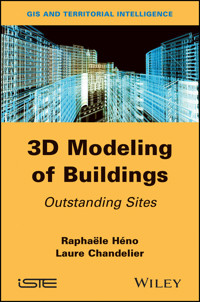
Conventional topographic databases, obtained by capture on aerial or spatial images provide a simplified 3D modeling of our urban environment, answering the needs of numerous applications (development, risk prevention, mobility management, etc.). However, when we have to represent and analyze more complex sites (monuments, civil engineering works, archeological sites, etc.), these models no longer suffice and other acquisition and processing means have to be implemented. This book focuses on the study of adapted lifting means for "notable buildings". The methods tackled in this book cover lasergrammetry and the current techniques of dense correlation based on images using conventional photogrammetry.
Sie lesen das E-Book in den Legimi-Apps auf:
Seitenzahl: 218
Veröffentlichungsjahr: 2014
Ähnliche



















Contents
Acknowledgements
Introduction
1 Specific Requirements for the 3D Digitization of Outstanding Sites
1.1. The current offer for high-resolution 3D data
1.2. Statement of requirements
1.3. Existing surveying methods
1.4. From building specifications to realization
1.5. Bibliography
2 3D Digitization Using Images
2.1. History in France
2.2. Equipment
2.3. Image acquisition
2.4. Image orientation
2.5. Production of 3D point clouds from images
2.6. 3D drawing by stereo or multi-image plotting
2.7. The software offer in close-range photogrammetry
2.8. Research prospects
2.9. Bibliography
3 3D Digitization by Laser Scanner
3.1. History
3.2. Equipment
3.3. Acquisition by lasergrammetry
3.4. Registration of laser stations
3.5. Qualification of the point clouds obtained
3.6. Bibliography
4 Complementarity of Techniques
4.1. Introduction
4.2. Comparison of techniques
4.3. Example of the survey of Amiens Cathedral
4.4. Bibliography
5 Point Cloud Processing
5.1. Visualization and organization of 3D point clouds
5.2. Preprocessing of the point clouds
5.3. From the point cloud to the 3D geometric model
5.4. By-products
5.5. Bibliography
6 Management and Use of Surveys
6.1. Introduction
6.2. Managing data conservation
6.3. Diffusion of data
6.4. Bibliography
Conclusion
C.1. Bibliography
Index
First published 2014 in Great Britain and the United States by ISTE Ltd and John Wiley & Sons, Inc.
Apart from any fair dealing for the purposes of research or private study, or criticism or review, as permitted under the Copyright, Designs and Patents Act 1988, this publication may only be reproduced, stored or transmitted, in any form or by any means, with the prior permission in writing of the publishers, or in the case of reprographic reproduction in accordance with the terms and licenses issued by the CLA. Enquiries concerning reproduction outside these terms should be sent to the publishers at the undermentioned address:
ISTE Ltd27-37 St George’s RoadLondon SW19 4EUUK
www.iste.co.uk
John Wiley & Sons, Inc.111 River StreetHoboken, NJ 07030USA
www.wiley.com
© ISTE Ltd 2014
The rights of Raphaële Héno and Laure Chandelier to be identified as the authors of this work have been asserted by them in accordance with the Copyright, Designs and Patents Act 1988.
Library of Congress Control Number: 2014941560
British Library Cataloguing-in-Publication DataA CIP record for this book is available from the British LibraryISBN 978-1-84821-536-8
Acknowledgements
First of all, we thank Anne Ruas, Director of Research at IFSTTAR, who suggested that we start out on this adventure. Without her invitation, the work carried out throughout the last few years could not have been capitalized upon in this book.
This book also gives us the opportunity to pay a special tribute to Yves Egels, geographical engineer who throughout his career at IGN, has tirelessly contributed to the development of photogrammetry, in general, and more specifically to the use of this technique for the documentation of heritage. An essential point of reference in photogrammetry, we owe our expertize in the field of architectural surveying to him.
Without the expert advice of our proofreaders, Yves Egels, Patrice Bueso and Jean-Charles Pruvost, this book as it is today would not have been possible and, therefore, we are grateful for the time spent and the constructive criticism given.
Many people, teachers from ENSG and instructors from IGN, have worked with us on the architectural projects which are the cornerstones of this book. We thank them for their commitment and enthusiasm.
It is also important to thank the project sponsors who created the projects and worked with us in carrying them out. A special mention should go to Marylène Barret for Yemen and El Mustapha Mouaddib for Amiens Cathedral.
Finally, although it is not possible to name them all, we thank all the students of ENSG and elsewhere who worked on the projects addressed in this book.
Introduction
Traditional topographic databases, usually created from aerial or satellite imagery, provide a simplified three-dimensional (3D) model of our urban environment which can be used for a number of applications, such as town planning, risk prevention and mobility management. However, in the case of representing and analyzing outstanding sites like monuments, works of art or archeological sites, these databases are insufficient and other ways of acquiring and processing data need to be employed. This book presents a state-of-the-art of the methods specifically adapted to outstanding sites and the research currently being carried out in this area. The methods addressed in this text range from lasergrammetry to current dense correlation techniques using images as well as traditional photogrammetry.
These methods allow for the surveying of outstanding sites, permitting the restitution of the structures’ form and appearance with a precision and a level of detail agreed upon in advance in a set of building specifications. They are due to takeover from techniques traditionally used for the creation of topographic databases, in the case of specific orders, such as the description of the relief of the façade and the complete 3D survey (interior and exterior) of a monument. In this text, digitization mainly involves 3D geometric rendering, and does not include the inventory, analysis of the construction materials, structural analysis of the building or its history.
First, it is necessary to define what is meant by the term “outstanding site”. These are buildings, collections of buildings, monuments or works of art which attract a level of interest to such an extent that any traditional 3D products which currently exist are not able to reproduce the vividness of the original. The size of the sites dealt with in this text is measured from ground level, including structures ranging from a small cellar to an entire district, as well as castles, churches, bridges and towers. Therefore, it is only static objects which will be dealt with in this text.
The aim is to give an overview of the range of current 3D surveying methods. It is neither a theoretical lecture, nor a collection of procedural manuals. The reader will find no detailed algorithms, but instead will find information on all working stages to create a 3D survey of an outstanding site. Advice and recommendations are also given, which the authors compiled paying close attention to produce a result which is as reliable, faithful and precise as the current methods will allow and should, therefore, be used simply as guidelines.
Some building specifications focus more on visual appearance than on overall accuracy. In this case, the demands on the data acquisition phase will be relaxed, while the post-processing cosmetic phases will be lengthened. Therefore, this text is relevant to anyone interested in high resolution 3D surveying, whether they are project managers, surveyors, heritage conservationists, town planners, computer graphics designers, or those who wish to learn about the technical methods available, possible methodologies and the steps to be followed in carrying out a project of this kind.
The text does not aim to provide an exhaustive list of methods or references but instead presents the views of the authors, which is manifestly influenced by their training and profession as photogrammetry engineers.
1
Specific Requirements for the 3D Digitization of Outstanding Sites
1.1. The current offer for high-resolution 3D data
In France, the IGN (Institut national de l’information géographique et forestière or the National Institute for Geographical and Forestry Information) produces and maintains the RGE1 (Référentiel à Grande Echelle or Large-scale reference) over the entirety of the territory, containing four levels of information: a high-resolution orthoimage, an “addresses” database, a georeferenced cadastral map and a 3D topographic database of metric precision containing a description of elements of the landscape, classed according to type. Work is underway on a new-generation RGE, which is more precise and gives better resolution and detail, largely due to the cooperation of a number of stakeholders who collect and manage geographical information throughout the territory.
The IGN is also implementing a semi-automatic production process using high-resolution aerial images (pixel size below 20 cm), which are highly redundant, (significant overlap between images) leading to the production of vector databases in line with the LOD2 () specifications of the CityGML standards. It has been implemented in some large French cities, such as Paris, Nantes, Rennes, Besançon and Marseille. It shows the various districts, roof structures, vegetation and generalized street furniture. This product, Bati3D [MAI 04], not only contains a survey of the buildings’ forms (or groups of buildings if they are connected), but also their appearance, since the volume reproduced via automated photogrammetric processes is textured by aerial images. It is possible to improve the rendering and the precision of the façades and street furniture by adding data acquired in the field by vehicles equipped with stereoscopic cameras, lasers scanners and direct georeferencing devices (GNSS antenna, inertial navigational system or odometer). These devices are rarely self-sufficient in urban environments, but are essential for initiating the georeferencing of images through photogrammetry.
Lesen Sie weiter in der vollständigen Ausgabe!
Lesen Sie weiter in der vollständigen Ausgabe!
Lesen Sie weiter in der vollständigen Ausgabe!
Lesen Sie weiter in der vollständigen Ausgabe!
Lesen Sie weiter in der vollständigen Ausgabe!
Lesen Sie weiter in der vollständigen Ausgabe!
Lesen Sie weiter in der vollständigen Ausgabe!
Lesen Sie weiter in der vollständigen Ausgabe!




