


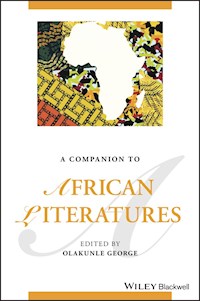
A Companion to African Literatures E-Book
170,99 €
Mehr erfahren.
- Herausgeber: John Wiley & Sons
- Kategorie: Geisteswissenschaft
- Serie: Blackwell Companions to Literature and Culture
- Sprache: Englisch
Rediscover the diversity of modern African literatures with this authoritative resource edited by a leader in the field
How have African literatures unfolded in their rich diversity in our modern era of decolonization, nationalisms, and extensive transnational movement of peoples? How have African writers engaged urgent questions regarding race, nation, ethnicity, gender, and sexuality? And how do African literary genres interrelate with traditional oral forms or audio-visual and digital media? A Companion to African Literatures addresses these issues and many more.
Consisting of essays by distinguished scholars and emerging leaders in the field, this book offers rigorous, deeply engaging discussions of African literatures on the continent and in diaspora. It covers the four main geographical regions (East and Central Africa, North Africa, Southern Africa, and West Africa), presenting ample material to learn from and think with.
A Companion To African Literatures is divided into five parts. The first four cover different regions of the continent, while the fifth part considers conceptual issues and newer directions of inquiry. Chapters focus on literatures in European languages officially used in Africa -- English, French, and Portuguese -- as well as homegrown African languages: Afrikaans, Amharic, Arabic, Swahili, and Yoruba. With its lineup of lucid and authoritative analyses, readers will find in A Companion to African Literatures a distinctive, rewarding academic resource.
Perfect for undergraduate and graduate students in literary studies programs with an African focus, A Companion to African Literatures will also earn a place in the libraries of teachers, researchers, and professors who wish to strengthen their background in the study of African literatures.
Sie lesen das E-Book in den Legimi-Apps auf:
Seitenzahl: 1397
Veröffentlichungsjahr: 2020
Ähnliche




















Table of Contents
Cover
Title Page
Copyright Page
Notes on Contributors
Preface
Part I: East and Central Africa
1 East and Central Africa: An Introduction
African‐Language Literatures and the Language Question
The Makerere Conference
The Abolition of the English Department
Selected Writers
Diasporic Imaginaries
Present Directions
Bibliography
2 Rereading East African Literature Through a Human Rights Lens: The Example of Ngugi wa Thiong’o’s
Weep Not, Child
Bibliography
Notes
3 Of Authenticity and Engagement in Francophone African Cultural Production
The African Author and the Duty Toward Engagement
Language and Postcolonial Performance
Cinema and African Postmodernisms
Writing Without France: Defining New Approaches
Bibliography
Notes
4 Literature and Hybridity in Mauritius and Réunion
Language and Literacy
The Colonial Novel and Hybridity
Fluid Hybridities in the Twentieth and Twenty‐First Centuries
Bibliography
Notes
5 The Representation of Nation and National Identity in Modern Amharic Literature
Constructing and Narrating the Modern Nation, 1896–1960
Walks on a Thin Line between Hope and Despair, 1960–1974
The Quest for
Hibretesebawinet
, 1974–1991
The Phoenix Rises from the Ashes of Ethnic Strife: 1991 to Present
The Politics of Authorship, Language, and Identity
Acknowledgments
Bibliography
Notes
6 Swahili Literature (
Fasihi ya Kiswahili
)
Introduction: The Intercultural Heritage
Oral Literature/Orature (
Fasihi Tamshi
)
Early Writing: Beginnings in Religious Verse
The Rise of Secular Writing
Poetry of the Nonconforming “Modernists”
Prose
Drama and Theater
Women Writers and Gender Concerns
Swahili Translations
Conclusion
Bibliography
Part II: North Africa
7 North Africa: An Introduction
The Nomenclature: North Africa, the Maghreb, the Mashriq, and Africa
Institutions of Literature
Vectors of Literary Traffic
The Multilingual Imperative
Dominant, Emergent, and Receding Voices and Forms
Conclusion
Bibliography
Notes
8 Nation and Identity in Modern Arabic Literature in Egypt
Bibliography
9 Hyphens & Hymens: francoarab Literature of the Maghreb
Our Letter
Hyphens
… & Hymens
Bibliography
Notes
10 Translation and North African Letters
Arab–Latin American Translation Flows
Sonallah Ibrahim:
Warda
from Egypt to Cuba
Mohamed Makhzangi: Clandestine in Chernobyl
Bibliography
Notes
11 Cross‐Pollination and Interweavings between the Maghreb and Sub‐Saharan Africa Through Art, Cinema, and Music
Artistic Mnemotechnical Devices to Fight the Intangible Appearance of Ghosts: Clarke, Attia, Koko Bi, Allouache, and Awadi
In Further Pursuit of Alliances and Modes of Resistance Through Contemplation: Zinoun, Sissako, Ndoye, and Abd Al Malek
Conclusion
Acknowledgment
Bibliography
Notes
12 France and North Africa: A Cinematic Retrospective of Centuries of Entangled Relations
Early Encounters Unfold in Film
The Birth of Cinema and the History of Cinematic Relation Between North Africa and France
North Africa in French Cinema
Film Producers of North African Descent in France
Amazigh and Women Filmmaking
Bibliography
Notes
Part III: Southern Africa
13 Southern Africa: An Introduction
Defining the Region
Southern African Literature: A Mirage?
Coda: Figures of the Frontline
Bibliography
Notes
14 Anglophone Literature of South Africa
British Imperialism and the Segregation Era
Apartheid and the “Interregnum”
Post‐Apartheid and the “Post‐Transition”
Acknowledgments
Bibliography
Selected Anthologies
Notes
15 The Machinery of Life‐Writing Under Zimbabwe’s Third Chimurenga
The Machinery of Life Writing: A Contextual Meaning
Transforming Lives Lived to Lives Told
Bibliography
Notes
16 The Afrikaans Cultural Expressions of the Powerless and Subjugated
Introduction
The Afrikaans of the Powerless and Subjugated
The Indigenous Oral Tradition and its Afrikaans Continuities
Carnivals, Choirs, and the Theater of Reclamation
Alternative Literacies and Religion
Our Foreigners: Kleurlingdigters and ’n Bantoeskrywer
Black Consciousness: Literature, Resistance, and Struggle
Post‐Apartheid: Self‐Discovery, Reclamation, and Dialect
Conclusion
Bibliography
Notes
17 Lusophone Southern African Literature (Angola, Mozambique)
Angola
Mozambique
Bibliography
Notes
18 A Socio‐Critical Survey of Black South African English Poetry, 1900–2000
Emergence of a Mission‐Educated African Elite
Protest Poetry of the 1930s and 1940s
Sharpeville: The Start of a Decade of Silence
The Protest Poets of the 1970s and 1980s
Bibliography
Notes
Part IV: West Africa
19 West Africa: An Introduction
Geographical Boundaries, Literary Horizons
Postcolonial Self‐Affirmations
Reading the Postnational Moment
Bibliography
Notes
20 West African Literature in English
Things Fall Apart
and a New Center
Making It New and African
After 1966
A Literature Reborn
Bibliography
Notes
21 Migration, Literary Imagination, and Mirages in the Francophone Text: Paths to Anthropological Mutilation
The “Lucky Generation” Takes Its Leave
Intertextuality: Textual Migrations and Literary Tradition
The Unrelenting Chimera
On the Road to Anthropological Mutilation
Creative Disorder
Conclusion
Bibliography
Notes
22 Reading Yorùbá Literature
Introduction
Yorùbá Poetry
Yorùbá Drama
Yorùbá Fiction
Conclusion
Bibliography
Note
Part V: Redoublings and Reconstellations
23 Post‐Hybrid Conjunctive Consciousness in the Literature of the New African Diaspora
I
II
III
IV
Bibliography
24 Outing Africa: On Sexualities, Gender, and Transgender in African Literatures
From the Mid‐Nineteenth Century Through the 1960s and 1970s
From the Late Twentieth Century through the “Turn of the Millennium” on to the Contemporary Moment
Trans Sahara and the New Media
Bibliography
Filmography
Notes
25 African Literature and the European Canon: From Past to Present and Back Again
Background
The Twenty‐First Century
J. E. Casely Hayford as African Comparatist
Bibliography
Notes
26 War, Human Rights, and Historical Representation: Torture as Synecdoche
I
II
III
IV
V
Bibliography
Notes
27 African Literature’s Other Media: Art Film, Nollywood
Nollywood and “Minor Transnationalism”
From Christianity to Corporate Sponsorship
Nollywood Stardom
Performing Ethnicity
Conclusions: The Video Aesthetic in African Cinema
Bibliography
28 Navigating Digital Worlds: African Literary Forms in the Digital Age
New Media Forms and Platforms
Digital Geographies
Facebook Fictionality
New Opportunities and Challenges
Bibliography
Notes
Index
End User License Agreement
List of Illustrations
Chapter 11
Figure 11.1 Bruce Clarke,
Fantôme 8
, oil on canvas, 200 x 100 cm, from ...
Figure 11.2 Jems Koko Bi,
Racine
, poplar wood, 290 x 350 x 350 cm, 2016. ...
Figure 11.3 Abdoulaye Ndoye,
Waramba
2, henna, acrylic, and litho pencil on
Guide
Cover Page
Series Page
Title Page
Copyright
Notes on Contributors
Preface
Table of Contents
Begin Reading
Index
WILEY END USER LICENSE AGREEMENT
Pages
ii
iii
iv
ix
x
xi
xii
xiii
xiv
xv
xvi
xvii
1
3
4
5
6
7
8
9
10
11
12
13
14
15
16
17
18
19
20
21
22
23
24
25
26
27
28
29
30
31
32
33
34
35
36
37
38
39
40
41
42
43
44
45
46
47
48
49
50
51
52
53
54
55
56
57
58
59
61
62
63
64
65
66
67
68
69
70
71
72
73
74
75
76
77
78
79
80
81
82
83
84
85
86
87
88
89
90
91
92
93
94
95
96
97
98
99
101
103
104
105
106
107
108
109
110
111
112
113
114
115
117
118
119
120
121
122
123
124
125
126
127
128
129
130
131
133
134
135
136
137
138
139
140
141
142
143
144
145
146
147
148
149
151
152
153
154
155
156
157
158
159
160
161
162
163
165
166
167
168
169
170
171
172
173
174
175
176
177
178
179
181
182
183
184
185
186
187
188
189
190
191
192
193
194
195
197
198
199
200
201
202
203
204
205
206
207
208
209
210
211
213
214
215
216
217
218
219
220
221
222
223
224
225
226
227
228
229
230
231
232
233
234
235
236
237
238
239
240
241
242
243
244
245
246
247
248
249
251
252
253
254
255
256
257
258
259
260
261
262
263
264
265
267
268
269
270
271
272
273
274
275
276
277
278
279
280
281
282
283
284
285
286
287
288
289
290
291
292
293
294
295
296
297
298
299
300
301
303
305
306
307
308
309
310
311
312
313
314
315
316
317
318
319
320
321
322
323
324
325
326
327
328
329
330
331
332
333
334
335
336
337
338
339
340
341
342
343
344
345
346
347
348
349
351
352
353
354
355
356
357
358
359
360
361
362
363
364
365
367
368
369
370
371
372
373
374
375
376
377
378
379
380
381
382
383
384
385
386
387
388
389
390
391
392
393
394
395
396
397
398
399
400
401
402
403
404
405
406
407
408
409
410
411
412
413
414
415
416
417
418
419
420
421
422
423
425
426
427
428
429
430
431
432
433
434
435
436
437
438
439
440
441
442
443
444
445
446
447
448
449
450
451
452
453
455
456
457
458
459
460
461
462
463
464
465
466
467
468
469
470
471
472
473
474
475
476
477
478
479
480
481
482
483
484
485
486
487
488
489
Blackwell Companions to Literature and Culture
This series offers comprehensive, newly written surveys of key periods and movements and certain major authors, in English literary culture and history. Extensive volumes provide new perspectives and positions on contexts and on canonical and post‐canonical texts, orientating the beginning student in new fields of study and providing the experienced undergraduate and new graduate with current and new directions, as pioneered and developed by leading scholars in the field.
Published Recently
78. A Companion to American Literary Studies Edited by Caroline F. Levander and Robert S. Levine
79. A New Companion to the Gothic Edited by David Punter
80. A Companion to the American Novel Edited by Alfred Bendixen
81. A Companion to Literature, Film, and Adaptation Edited by Deborah Cartmell
82. A Companion to George Eliot Edited by Amanda Anderson and Harry E. Shaw
83. A Companion to Creative Writing Edited by Graeme Harper
84. A Companion to British Literature, 4 volumes Edited by Robert DeMaria, Jr., Heesok Chang, and Samantha Zacher
85. A Companion to American Gothic Edited by Charles L. Crow
86. A Companion to Translation Studies Edited by Sandra Bermann and Catherine Porter
87. A New Companion to Victorian Literature and Culture Edited by Herbert F. Tucker
88. A Companion to Modernist Poetry Edited by David E. Chinitz and Gail McDonald
89. A Companion to J. R. R. Tolkien Edited by Stuart D. Lee
90. A Companion to the English Novel Edited by Stephen Arata, Madigan Haley, J. Paul Hunter, and Jennifer Wicke
91. A Companion to the Harlem Renaissance Edited by Cherene Sherrard‐Johnson
92. A Companion to Modern Chinese Literature Edited by Yingjin Zhang
93. A New Companion to Digital Humanities Edited by Susan Schreibman, Ray Siemens, and John Unsworth
94. A Companion to Virginia Woolf Edited by Jessica Berman
95. A New Companion to Milton Edited by Thomas Corns
96. A Companion to the Brontës Edited by Diane Long Hoeveler and Deborah Denenholz Morse
97. A Feminist Companion to Shakespeare, Second Edition Edited by Dympna Callaghan
98. A New Companion to Renaissance Drama Edited by Arthur F. Kinney and Thomas Hopper
99. A Companion to Literary Theory Edited by David Richter
100. A Companion to Literary Biography Edited by Richard Bradford
101. A New Companion to Chaucer Edited by Peter Brown
102. A Companion to African Literatures Edited by Olakunle George
A COMPANION TO AFRICAN LITERATURES
EDITED BY
OLAKUNLE GEORGE
This edition first published 2021© 2021 John Wiley & Sons Ltd
All rights reserved. No part of this publication may be reproduced, stored in a retrieval system, or transmitted, in any form or by any means, electronic, mechanical, photocopying, recording or otherwise, except as permitted by law. Advice on how to obtain permission to reuse material from this title is available at http://www.wiley.com/go/permissions.
The right of Olakunle George to be identified as the author of the editorial material in this work has been asserted in accordance with law.
Registered OfficeJohn Wiley & Sons, Inc., 111 River Street, Hoboken, NJ 07030, USA
Editorial OfficeThe Atrium, Southern Gate, Chichester, West Sussex, PO19 8SQ, UK
For details of our global editorial offices, customer services, and more information about Wiley products visit us at www.wiley.com.
Wiley also publishes its books in a variety of electronic formats and by print‐on‐demand. Some content that appears in standard print versions of this book may not be available in other formats.
Limit of Liability/Disclaimer of WarrantyWhile the publisher and authors have used their best efforts in preparing this work, they make no representations or warranties with respect to the accuracy or completeness of the contents of this work and specifically disclaim all warranties, including without limitation any implied warranties of merchantability or fitness for a particular purpose. No warranty may be created or extended by sales representatives, written sales materials or promotional statements for this work. The fact that an organization, website, or product is referred to in this work as a citation and/or potential source of further information does not mean that the publisher and authors endorse the information or services the organization, website, or product may provide or recommendations it may make. This work is sold with the understanding that the publisher is not engaged in rendering professional services. The advice and strategies contained herein may not be suitable for your situation. You should consult with a specialist where appropriate. Further, readers should be aware that websites listed in this work may have changed or disappeared between when this work was written and when it is read. Neither the publisher nor authors shall be liable for any loss of profit or any other commercial damages, including but not limited to special, incidental, consequential, or other damages.
Library of Congress Cataloging‐in‐Publication Data
Name: George, Olakunle, editor.Title: A companion to African literatures / edited by Olakunle George.Description: Hoboken, NJ : Wiley‐Blackwell, [2021] | Series: Blackwell companions to literature and culture | Includes bibliographical references and index.Identifiers: LCCN 2020024003 (print) | LCCN 2020024004 (ebook) | ISBN 9781119058175 (hardback) | ISBN 9781119058229 (adobe pdf) | ISBN 9781119058212 (epub)Subjects: CYAC: African literature–History and criticism.Classification: LCC PL8010 .C57 2020 (print) | LCC PL8010 (ebook) | DDC 809/.896–dc23LC record available at https://lccn.loc.gov/2020024003LC ebook record available at https://lccn.loc.gov/2020024004
Cover Design: WileyCover Image: © shuoshu/Getty Images
Notes on Contributors
Adélékè Adék is Humanities Distinguished Professor, English Department, at The Ohio State University. His primary research interests are Anglophone African literatures, pre‐1965 African American literature, and Yorubaphone culture and literature. His Arts of Being Yoruba: Divination, Allegory, Tragedy, Proverb, Panegyric (2017/2019) won the Best Book of the Year: Scholarship award of the African Literature Association. For Fagunwa Study Group, he co‐edited (with Akin Adéṣkàn) Celebrating D. O. Fagunwa: Aspects of African and World Literary History (2017), a selection for Top 20 Book of the Year List in Nigeria. His edition of the Rev. Philip Quaque’s missionary letters, Letters to London: 1765–1811, was published in 2017. Adék is also the author of Proverbs, Textuality, and Nativism in African Literature (1998) and The Slave’s Rebellion: Literature, History, Orature (2005). Adék’s main research focus at the present time is on the completion of a book on speech acts in poetry.
Fazia Aïtel is currently Associate Professor of French and Francophone Studies at Claremont McKenna College. Her research interests are African and especially North African literature, culture, and cinema as well as Amazigh studies, women’s writing, and immigration. Her publications include a co‐edited volume (with Valérie Orlando) on Algerian writer Nabile Farès, L’Exilé, l’étranger et l’autre dans les œuvres de Nabile Farès (2018). In 2014, she published We Are Imazighen: The Development of Algerian Berber Identity in Twentieth‐Century Literature and Culture 1930 to 2000. Aïtell also published articles on Algerian film (“Des images pour le dire: périple au cœur du silence algérien dans Le Repenti de Merzak Allouache”) and literature (“Kabylgeria or How to Write Algeria”). She is currently working on a book project on Amazigh women and the Algerian war.
Ahmed Idrissi Alami is Associate Professor of Arabic and Comparative Literature in the School of Languages and Cultures at Purdue University. In his research, he explores questions of cultural identity, migrancy, and constructions of Arab/Muslim subjectivities through North African, Middle Eastern, and Arab diasporic cultural production. He also examines issues of Islam, modernity, and reform within a global cultural context. In addition to his book Mutual Othering: Islam, Modernity, and the Politics of Cross‐Cultural Encounters in Pre‐Colonial Moroccan and European Travel Writing (2013), his articles have appeared in a variety of journals, including Journal of North African Studies, Journal of Contemporary Thought, Middle Eastern Literatures, South Central Review, and William & Mary Quarterly. Professor Idrissi Alami is currently working on research projects that explore the Maghreb through transatlantic discourse and culture, Arab and Muslim diasporic narratives, and nation and nationalism in Arabic literature and culture.
Peter Blair studied at the Universities of Oxford and York, completing some of his doctoral research at the University of KwaZulu‐Natal, Durban. He is now Senior Lecturer in English Literature at the University of Chester. He has two main research interests: South African literature, particularly the liberal and postliberal Anglophone novel, and flash fiction (very short stories). These have recently come together in a project on post‐apartheid flash. His publications include contributions to The Cambridge History of South African Literature (2012), The Encyclopedia of Postcolonial Studies (Wiley‐Blackwell, 2016), and the journals Modern Fiction Studies, Current Writing: Text and Reception in Southern Africa, Commonwealth Essays and Studies, and the Journal of Commonwealth Literature. He is founding co‐editor of Flash: The International Short‐Short Story Magazine.
Eleni Coundouriotis is Professor of English and Comparative Literary and Cultural Studies at the University of Connecticut. Her scholarship focuses on the engagement of literature with history in the postcolonial novel and human rights narratives. She is the author of Claiming History: Colonialism, Ethnography and the Novel (1999) and The People’s Right to the Novel: War Fiction in the Postcolony (2014). She is currently completing a monograph on “Narrating Human Rights in Africa.”
yasser elhariry is Associate Professor at Dartmouth College, where he teaches courses in French, Comparative Literature, Middle Eastern Studies, and Creative Writing. The recipient of the William Riley Parker Prize, he is the author of Pacifist Invasions: Arabic, Translation and the Postfrancophone Lyric (2017), co‐editor of Critically Mediterranean: Temporalities, Aesthetics and Deployments of a Sea in Crisis (2018), and guest editor of the special issue of Expressions maghrébines on Cultures du mysticisme (2017). His writing appears in PMLA, New Literary History, Yale French Studies, French Forum, Parade sauvage, Contemporary French Civilization, Francosphères, and in several edited volumes.
Tewodros Gebre is Associate Professor of Ethiopian Literature at Addis Ababa University. He is the author of Interdisciplinary Reading of Literature (Beyne‐Disiplinawi YeSine Tshuf Nibab in Amharic, 2009). His essays have appeared in several publications, including Callaloo, North East Africa Studies, and Journal of Ethiopian Studies. He is currently working on medical humanities and the interpenetration of verbal and visual arts.
Olakunle George is Professor of English and Africana Studies at Brown University. His academic interests are in African Literary and Cultural Studies, Black Atlantic Internationalism, and Anglophone Postcolonial Studies. He was Associate Editor of Wiley‐Blackwell’s Encyclopedia of the Novel (2011; paperback 2014), with Susan Hegeman, Efraín Kristal, and Peter M. Logan, General Editor. He is author of African Literature and Social Change: Tribe, Nation, Race (2017) and Relocating Agency: Modernity and African Letters (2003).
Stefan Helgesson is Professor of English at Stockholm University. His research interests include Southern African literature in English and Portuguese, Brazilian literature, postcolonial theory, translation theory, and theories of world literature. He is the author of Transnationalism in Southern African Literature (2009), co‐author (with Mads Rosendahl Thomsen) of Literature and the World (2020), and co‐editor of The De Gruyter Handbook of Anglophone World Literatures (2020).
Jeanne‐Marie Jackson is Assistant Professor of World Anglophone Literature at Johns Hopkins and received her PhD in Comparative Literature from Yale. Her first book is South African Literature’s Russian Soul: Narrative Forms of Global Isolation (2015), and her second, The African Novel of Ideas, is currently in press. In addition to her publications in a wide range of academic and public‐facing venues, she is also editor of Modernism/modernity’s “Field Reports” blog.
Cilas Kemedjio is Frederick Douglass Professor at the University of Rochester, NY, where he is Professor of French and Francophone Studies. His contributions in the fields of Caribbean and African literature and culture, postcolonial theory, and transnational black studies have earned him both national and international recognition. He is the author of two monographs, one edited volume, and over sixty articles. He is author of Maryse Condé, Édouard Glissant et la malédiction de la théorie (1999) and Mongo Beti: le combattant fatigué. Une biographie intellectuelle (2013). His edited volume is entitled Mémoires des années de braise. La grève estudiantine de 1991 expliquée/Remember the Flame: White Papers from the 1991 Yaoundé University Strikes (2013). His current project seeks to unearth the genealogies of humanitarian interventions in Africa, and their attendant uneasy connections with the multilayered sites of power. The provisional title of this project is “Ota Benga and the Fictions of Humanitarianism.”
Lokangaka Losambe is the Frederick M. and Fannie C. P. Corse Professor of English and a former Chair of the University of Vermont Department of English. He previously taught African, African Diaspora, and English literatures at universities in Nigeria, the Democratic Republic of Congo, Swaziland, and South Africa. His numerous publications include Borderline Movements in African Fiction; An Introduction to the African Prose Narrative Literature; Literature, the Visual Arts and Globalization in Africa and Its Diaspora (edited with Maureen Eke); and Pre‐colonial and Post‐colonial Drama and Theatre in Africa (edited with Devi Sarinjeive). He is currently working on a book entitled Postcolonial Constellations within the Imperial Order: The Congo Narrative. Dr. Losambe also served as President of the African Literature Association (ALA) in 2012–2013.
Luís Madureira is Professor in the Department of African Cultural Studies at the University of Wisconsin, Madison. His areas of research include Luso‐Brazilian colonial and postcolonial studies, modernism and modernity in Latin America, Africa, and the Caribbean, early modern and colonial studies, and theater and performance in Africa. He is author of Imaginary Geographies in Portuguese and Lusophone African Literature (2007) and Cannibal Modernities: Postcoloniality and the Avant‐garde in Brazilian and Caribbean Literature (2005). He is currently at work on two book‐length projects: one centers on Mozambican drama, the other on Luso‐African historical novels.
Katwiwa Mule is Associate Professor of Comparative Literature at Smith College, Massachusetts, where he teaches various courses on World Literatures. He holds a PhD in Comparative Literature and Women’s Studies from Pennsylvania State University. His research and teaching interests include contemporary African and African Diaspora literatures, human rights in world literature, and African theater. He is currently working on a book project on Fatima Dike’s Theater. He is the author of Women’s Spaces, Women’s Visions: Politics, Poetics and Resistance in African Women’s Drama (2007). His works include essays and book chapters that have appeared in numerous collections including Meridians, Kiswahili: Journal of the Institute of Kiswahili Research, and Mapping Africa in the English‐Speaking World: Issues in Language and Literature. He was also the Guest Editor of the Special Issue of Metamorphoses: Journal of the Five College Seminar on Literary Translation focusing on translation in Africa.
Grace A. Musila is Associate Professor in the Department of African Literature at the University of the Witwatersrand, Johannesburg. She is the author of A Death Retold in Truth and Rumour: Kenya, Britain and the Julie Ward Murder (2015), which explores Kenyan and British interpretations of the 1988 murder of British tourist Julie Ann Ward in Maasai Mara Game Reserve, Kenya. She also co‐edited (with James Ogude and Dina Ligaga) Rethinking Eastern African Intellectual Landscapes (2012). She has written articles and chapters on Eastern and Southern African literatures and popular cultures.
Evan Maina Mwangi is Professor of English and Comparative Literature at Northwestern University, and Professor Extraordinaire of English at Stellenbosch University. His books include Translation in African Contexts: Postcolonial Texts, Queer Sexuality, and Cosmopolitan Fluency (2017) and The Postcolonial Animal: African Literature and Posthuman Ethics (2018). His monograph in progress is on Indian Ocean cultures.
Tahia Abdel Nasser is Associate Professor of English and Comparative Literature at the American University in Cairo. She is the author of Literary Autobiography and Arab National Struggles (2017) and the editor of Nasser: My Husband (2013). Her research interests include twentieth‐ and twenty‐first‐century literature and Arabic and Latin American literatures. She is at work on a book that examines Arab and Latin American literary and cultural exchange in the twentieth and twenty‐first centuries and another book on cultural and literary ties between Palestine and Latin America.
Thengani H. Ngwenya is Associate Professor at the Durban University of Technology in South Africa where he is employed as the Director of the university’s Centre for Excellence in Learning and Teaching (CELT). His research interests include literary studies, higher education studies, autobiographical writing, and literary historiography.
Josiah Nyanda lectures in English and Critical Thinking at the University of the Witwatersrand. He is a visiting part‐time lecturer at the Great Zimbabwe University, where he teaches life writing and literary theory, and a fellow of the Literary Cultures of the Global South at Tübingen University. His areas of research interest include life writing, media studies, popular culture, and politics. His articles have appeared in such journals as Scrutiny 2, English Studies in Africa, Social Dynamics, Shakespeare in Southern Africa, and Contracampo. He also contributed chapters to the volumes Joshua Mqabuko Nkomo of Zimbabwe: Politics, Power and Memory (ed. Sabelo Ndlovu‐Gatsheni); and While the Harvest Rots: Possessing Worlds of Kudzanai Chiurai (eds. Robert Muponde and Emma Laurence).
Mohamed‐Salah Omri is Professor of Modern Arabic and Comparative Literature and Tutorial Fellow at St. John’s College, Oxford. He is member of the British Academy Advisory Panel MENA; the research networks Arab Revolutions and New Humanism; Literature and Democracy and Oxford Comparative Criticism and Translation, and member of the executive committee of the British Comparative Literature Association (BCLA). His publications include the books Minding Borders: Resilient Divisions in Literature, the Body and the Academy (co‐edited with Nicola Gardini, Matthew Reynolds, Adriana Jacobs, and Ben Morgan, 2017); University and Society within the Context of Arab Revolutions and New Humanism (with ElKhouni and Guessoumi, 2016); Confluency (tarafud) between Trade Unionism, Culture and Revolution in Tunisia (2016); and Nationalism, Islam and World Literature (2006). He has also published several essays on comparative literature and Arabic fiction and poetry. He has special focus on the Maghreb and cultural politics in Tunisia. Omri’s latest project, supported by a Leverhulme Trust Research Fellowship, is on authoritarianism and culture in the Arab world.
Anjali Prabhu is the Margaret E. Deffenbaugh and LeRoy T. Carlson Professor in Comparative Literature and Professor of French and Francophone Studies at Wellesley College, where she also teaches in the Cinema and Media Studies Program. The author of Hybridity: Limits, Transformations, Prospects and Contemporary Cinema of Africa and the Diaspora, she is completing a book on eighteenth‐century British and French implication in India as it pertains to the southern kingdom of Mysore. Her articles and essays have appeared in journals such as Cinema Journal, French Forum, Diacritics, PMLA, International Journal of French and Francophone Studies, Research in African Literatures, Levinas Studies, Journal of French and Francophone Philosophy, and Comparative Literature Studies. An active member of the Modern Language Association, she has served the organization in numerous elected and nominated capacities, including on the Editorial Board of PMLA and the Program Committee. She is currently a member of the Delegate Assembly Organizing Committee and the Executive Council.
Stephanie Bosch Santana is Assistant Professor of Comparative Literature at the University of California, Los Angeles. Her work, which has been supported by the Mellon Foundation and the American Council of Learned Societies, focuses on Anglophone and African‐language fiction from Malawi, South Africa, Zambia, and Zimbabwe. Her current book project traces an alternative history of African literary production from the mid‐twentieth century to the present by considering the way that writers have developed a range of new literary forms in periodical print and digital publications, from magazines and newspapers to Facebook. Bosch Santana’s work has been published in the Routledge Handbook to African Literatures, Research in African Literatures, the Journal of African Cultural Studies, Wasafiri, and the Johannesburg Salon. She is also an editor of the blog Africa in Words.
Neil ten Kortenaar teaches African and Caribbean literature at the University of Toronto. He is the author of Postcolonial Literature and the Impact of Literacy: Reading and Writing in African and Caribbean Fiction (2011), which examines Chinua Achebe and Wole Soyinka among others. His current project looks at how Nigerian novelists imagined the state and its institutions at the moment of independence.
Hélène Tissières is guest researcher at the Global Studies Institute in Geneva. She taught at the University of Texas at Austin and was Associate Professor of African Literature and Cinema (from North and sub‐Saharan Africa). She left her position in 2016 to settle back in Geneva. In 2011, she taught at Kwara State University in Nigeria and from 2003 to 2005 at Cheikh Anta Diop University in Dakar thanks to a Fulbright grant. She is the author of Transmigrational Writings between the Maghreb and Sub‐Saharan Africa: Literature, Orality, Visual Arts (2007/2012) and Créations et défis au Sénégal: Sembène, Diop, Diadji et Awadi (2013). Having followed the Dakar Biennale of Contemporary African Art since 2004, she curated an homage to this event in Switzerland during the summer of 2016, exhibiting the work of some thirty established artists at the Manoir in Martigny and throughout its city. She also edited the accompanying 150‐page catalogue. She presently is working on a book that is investigating literature, film, and contemporary art from the Sahel region.
Noah Tsika is Associate Professor of Media Studies at Queens College, City University of New York. He is the author of, among other books, Nollywood Stars: Media and Migration in West Africa and the Diaspora, Pink 2.0: Encoding Queer Cinema on the Internet, and Traumatic Imprints: Cinema, Military Psychiatry, and the Aftermath of War. He is a contributing editor of Africa Is a Country and is currently completing a history of film distribution and exhibition in Nigeria.
Brian Valente‐Quinn is Assistant Professor of Francophone African Studies at the University of Colorado, Boulder. Specialized in Theater and Performance Studies as well as in Francophone African literature, he is currently working on a book project exploring histories of stage performance in Senegal.
Hein Willemse is Professor of Literature and former Head of the Department of Afrikaans at the University of Pretoria. He has published widely on South African Literature with special reference to Black Afrikaans writers, writers of the Black Consciousness era in the 1970s and 1980s, and Afrikaans orature. His books include Aan die ander kant: Swart skrywers in die Afrikaanse letterkunde (“On the other side: Black writers in Afrikaans literature,” 2007), and he co‐edited texts such as More than Brothers: James Matthews and Peter Clarke at 70 (2000) and Achmat Davids’ The Afrikaans of the Cape Muslims (2011). His current research includes projects on the South African poet‐dramatist‐philosopher Adam Small, and the Afrikaans orature of Namibia and South Africa. He is a former Editor‐in‐Chief of Tydskrif vir Letterkunde (Journal of Literature) and a former President of the International Society for the Oral Literatures of Africa (ISOLA).
Chantal Zabus is Professor of Comparative Postcolonial and Gender Studies at the University Sorbonne Paris Nord. She is the author of over a hundred articles in peer‐reviewed journals and numerous books, including The African Palimpsest: Indigenization of Language in the African Europhone Novel (1991; 2nd ed. 2007; French trans. 2018); Out in Africa: Same‐Sex Desire in Sub‐Saharan Literatures and Cultures (2014); Between Rites and Rights: Excision in Women’s Experiential Texts and Human Contexts (2007; French trans. 2016); and Tempests after Shakespeare (2002). Her last two edited books are Transgender Experience: Place, Ethnicity, and Visibility (co‐edited with David Coad, 2014) and The Future of Postcolonial Studies (2015). She is currently working on transgender and transsexualism in African contexts. She is the Editor‐in‐Chief of one of the first journals on postcolonial studies online, Postcolonial Text (www.postcolonial.org).
Preface
A Companion to African Literatures is designed to serve as research resource for critics, teachers, and students of African literature and related fields like world literature, comparative literary studies, and postcolonial studies. In contemporary literary and cultural criticism, notions of “world literature” and “globalism” have become central and influential. Here, the notion of world literature is to be understood as a set of theoretical perspectives and protocols of interpretation, rather than simply a corpus of literary works. In the turn to broad transnational perspectives, however, there is always a risk of de‐emphasizing the specific backgrounds, thematic concerns, and significant transformations that characterize African literatures. This Companion addresses the need for richly contextualized accounts of the diversity of literary production on the African continent.
The book contains twenty‐eight historically grounded and theoretically informed chapters, written by an international team of distinguished as well as emerging leaders in the diverse subfields of the study of African literatures. One chapter has previously been published as a journal article. Taken as discrete individual chapters or as a whole, the volume will be useful to both advanced students and beginners in the academic study of modern African literatures. It will likewise be useful to teachers who seek rigorous and lucid essays that can be assigned in college courses.
A Companion to African Literatures is divided into five sections. The first four concentrate on the geographical regions into which Africa is conventionally divided: namely, East and Central Africa, North Africa, Southern Africa, and West Africa. Each of these sections begins with an introductory chapter that offers an overview of the region’s literary landscape and explores pertinent conceptual or historical questions. Chapters in the fifth section take up theoretical issues and material that range across the regions, or concentrate on film and digital media. With regard to genres and forms, the chapters discuss novels, poetry, dramatic literature, nonfiction, digital media, visual art, and film. The focus is mainly on modern African literatures from the nineteenth century to the present. Even though literatures in Amharic, Arabic, and Swahili date much farther back, in order to make the volume manageable the focus is on the historical span that extends from the nineteenth century to the twenty‐first.
One challenge that any volume on African literatures has to confront is that of practices of specialization. While some national literatures and languages are highly visible, others are marginalized or relatively less studied. In terms of the institutional organization of our field, the common practice is to specialize in literatures from a region, a national configuration, or one or two languages. It is not common to find individual scholars who possess the linguistic competencies to do African literary and cultural studies across multiple intra‐African regions, languages, and traditions. Even for comparatists, the tendency is most often to frame “African literature” as a composite unit of analysis, alongside one or more literary traditions from other parts of the world, one of which is usually Western European. As students of African literatures, then, the prevailing situation is such that we often end up knowing a lot about one region, and much less about other regional or national traditions. Against this background, each of the chapters that introduce the regions in Parts I–IV will be of interest to the reader whose primary area of interest lies elsewhere. The book’s organization allows readers to appreciate differences between the regions and see how, amid the differences, some issues and concerns recur, together with innovative artistic responses.
All the chapters are attentive to the rich discursive genealogies of African literatures even as they are informed by recent developments in literary and cultural criticism. Contributors speak in various ways to issues of nationhood, transnationalism, diaspora, media and digital culture, gender and sexuality, and race. They explore such questions as the following. How have the literatures taken shape since their current modern manifestation and proliferation? What are the major questions and lines of interpretation enlivening African literary and cultural criticism at the present time? Who are the most visible writers, and how do issues of marginality and exclusion emerge? What are the interactions between the literatures and audio‐visual forms made possible by digital media? How might the study of African literatures inflect ongoing conversations about nationalism, identities, and violence in the age of globalization? In addressing such questions, the chapters inform us and also model how we may approach specific texts and traditions within the wide span of African literatures.
There is more than one way of benefiting from A Companion to African Literatures. Readers can decide on specific sections or chapters upon which to concentrate, or undertake a methodical engagement of the entire volume. It is assumed that readers will probably come to the volume with different levels of prior grounding in African literatures. Depending on whether they are advanced interlocutors or non‐specialist beginners, readers will in all probability get varying rewards – varying but substantively robust – from the book. Indeed, only such variation will be properly commensurate with the breadth and heterogeneity of the literatures.
Considered as a whole, the volume raises questions and opens conversations; it does not close them. Contributors developed individual chapters in line with their methodological preferences, paying attention to issues that may be specific to the literary tradition or confluence of traditions. The chapters, including the introductory overviews that open Parts I–IV, do not take the form of simple “surveys” in the traditional sense, and coverage is not the goal. Rather, the approach is to explore the different literatures in relation to selected aesthetic, social, historical, or philosophical questions. Some chapters dig deep into well‐studied writers, others introduce less‐studied figures or newer artistic exertions. Contributors thereby elucidate the social conditions, intellectual contexts, and aesthetic textures of the literatures.
In a volume devoted to networks of cultural objects as capacious as “African literatures,” some gaps and omissions are unavoidable. Readers will undoubtedly see areas they would have liked covered or issues they would have liked taken up. As already indicated, the volume is not designed to accomplish what advocates of traditional literary studies would call “coverage.” The option adopted in A Companion to African Literatures is to be selective and cognizant of the advantages, as well as limits, of the choices made. To give one illustration: of the hundreds of non‐European languages in use in Africa, only literatures in Amharic, Arabic, Swahili, and Yoruba are represented in this book. It is of course always important to challenge conservative and essentialist views on indigeneity and foreign‐ness. Likewise, it is productive to take seriously the understanding that Afrikaans, English, French, and Portuguese are by now African languages too, used in official discourses as well as in the daily lives of Africans. Nonetheless, in a volume such as this, and without mystifying indigeneity as essence, the utmost ideal would be to have more chapters devoted to literary traditions in precolonial or “indigenous” African languages. That has not been possible here. However, the hope is that the chapters devoted to African literatures in the precolonial languages will serve to attune readers not only to these literatures in themselves, but also to the vibrancy of multiple languages, expressive practices, and literatures on the continent. Thus, by the lights of what it covers, A Companion to African Literatures hopefully draws attention to the need for, and possibilities of, further study.
Taken together, the chapters that follow confront us with questions and insights about language, the contact of histories and peoples, and the existential dimensions of African literatures and related arts. In this way, A Companion to African Literatures equips readers to appreciate anew the heterogeneity of Africa as well as the broadening meanings of the literatures it continues to set in motion.
Part IEast and Central Africa
1East and Central Africa: An Introduction
Grace A. Musila
Apart from the annual ritual of declaring Ngugi wa Thiong’o the preferred winner of the Nobel Prize for Literature, other tropes that come up when mapping Eastern and Central African literary imaginaries are: Taban lo Liyong’s infamous declaration of East Africa as a literary desert; the Makerere Conference of 1962; the abolition of the English Department; and the seeming overshadowing of Malawi, Zambia, Somalia, Rwanda, Burundi, Ethiopia, Eritrea, and Djibouti by the region’s literary and economic powerhouses, Kenya, Uganda, and Tanzania.
In his preface to a study of East African literature co‐authored with Evan Mwangi, Simon Gikandi underscores what he terms a “strong sense of regionality” in East African literatures, which he considers to be partly a result of the region’s attempt to sustain political and economic stability in the 1960s and 1970s, while other parts of the continent were rocked by strife; but also, because the region’s authors enjoyed access to a flourishing publishing industry and academy which were heavily invested in the promotion of literary culture (Gikandi and Mwangi 2007, vii). Gikandi also attributes the relative youth of Anglophone East African writing to three factors: the relative smallness of the region and its population; its belated colonial contact that meant late establishment of colonial institutions central to literary production; and its writers’ regional locatedness, in comparison to writers from elsewhere (vii). For Gikandi, this regionalized sensibility had two effects: regional household names such as Okot p’Bitek remained unknown elsewhere for a long time, while the region’s Anglophone writing found itself doubly‐marginal, both in African literary history and relative to the region’s indigenous‐language literatures. Remarkable in this regard is the case of Anglophone literatures in Tanzania and Ethiopia, both of which retain much stronger local language (Swahili and Amharic, respectively) literatures.
Ethiopia and Tanzania both have a much older and larger catalogue of African‐language writing compared to English‐language writing. In both cases, history has had a major hand in crafting this literary scene: Tanzania (formerly Tanganyika and Zanzibar) was initially a German colony (1880–1919); after World War I, Germany handed Tanganyika over to Britain. An important fragment for Tanzania’s literary history is the Maji Maji resistance (1905–1907), in which various communities of Southern Tanganyika came together to protest forced labor in cotton plantations, among other grievances. While Tanganyika suffered heavy fatalities due to German‐engineered famine and war casualties – prophet Kinjeketile Ngwale’s reassurance that the special water would render combatants bulletproof failed to materialize – the resistance nonetheless distilled local communities’ grievances and enabled them to articulate these to themselves and the Germans in ways that earned the resistance an iconic place in Tanzanian national history. The resistance is the subject of one of the best known and most widely performed and taught Tanzanian plays: Ebrahim Hussein’s Kinjeketile (1970), easily an anticolonial classic, in the same category as Ngugi wa Thiong’o and Micere Mugo’s The Trial of Dedan Kimathi (1977). L. A. Mbughuni (1984, 256–257) emphasizes that both plays cast a glance back at Kenyan and Tanzanian histories of anticolonial resistance, pivoting around iconic leaders, Kinjeketile Ngwale and Dedan Kimathi, who, despite losing the battle, retain moral victory that eventually translates to anticolonial victory.
Tanganyika’s unification with Zanzibar to form the United Republic of Tanzania in 1964 was soon followed by first president Julius Kambarange Nyerere’s launch of Ujamaa or African socialism. From 1967, Tanzania’s national development was framed around Ujamaa, whose insistence on self‐reliance and equality inevitably impacted cultural policy, particularly given Nyerere’s investment in Kiswahili as a unifying national language and as a literary language. Nyerere took literature and Kiswahili seriously enough to personally translate Shakespeare’s Julius Caesar and The Merchant of Venice into Kiswahili, in part because these two plays’ concerns resonated with Ujamaa’s political project. By the time Nyerere conceded that Ujamaa had failed in 1985, leading to the liberalization of Tanzania’s economy and politics, the cultural impact of Ujamaa had taken root, resulting in a vibrant Kiswahili literary scene which, while building on a legacy of over three hundred years, was nonetheless strengthened by Ujamaa’s principles, in ways that allow Kiswahili writing to retain literary prominence to date in Tanzania (Mbise 1984).
On its part, apart from the distinction of never being colonized, Ethiopia also holds the distinction of having “the only extended written tradition predating both the Arabic and European incursions into the continent,” initially in Geʿez, then in Amharic, whose literary tradition is over a thousand years old (Griffiths 2000, 262). Griffiths notes the influence of this tradition on English‐language Ethiopian writing, evident in works such as Sahle Sellassie’s Warrior King (1974) – a historical novel reimagining the unification of Ethiopia under Kassa Hailu aka Emperor Tewodros II – and plays such as Tsegaye Gabre‐Mehdin’s Collision of Altars (1977). For Griffiths, Ethiopian writing in English retains a fascination with historical settings, as seen in more recent writing such as Bereket Habte Sellassie’s reimagining of the unseating of Emperor Haile Selassie, in his 1993 novel Riding the Whirlwind. However, it is Daniachew Worku’s The Thirteenth Sun (1973) that Griffiths considers the most accomplished Ethiopian English novel of the twentieth century, in part owing to its sophisticated treatment of modern Ethiopian cultural struggles with the tensions between traditional animist practices and the equally traditional Ethiopian Coptic Christianity (Griffiths 2000, 263–264). Gebra Selasie Tesfay’s The Company of My Shadow (1993) offers autobiographical insights into the Mengistu Haile Mariam regime that succeeded Emperor Haile Selassie’s rule, by reflecting on the author’s own involvement in the Ethiopian People’s Revolutionary Democratic Front (EPRDF), which ousted the Mengistu‐led Derg regime in 1991. This is a subject he shares with Maaza Mengiste, whose debut novel Beneath the Lion’s Gaze (2010) reimagines the fall of the emperor and the transition into the Derg’s rule that plunged Ethiopia into a seven‐year reign of terror under the autocracy of Mengistu Haile Mariam. Hama Tuma’s The Socialist Witchdoctor and Other Stories (1993) uses black humor to sketch out the absurdities of the ostensibly socialist Derg regime in Ethiopia following Emperor Selassie’s deposition and death. Dinaw Mengestu’s writing too is preoccupied with the impact of the fall of the Selassie empire and the scarred lives that have since unfolded for Ethiopians in the diaspora. With three novels to his name so far – The Beautiful Things that Heaven Bears (2007), How to Read the Air (2010), and All Our Names (2014) – Mengestu’s meditations on the emotional costs of the displacement and the infinite betrayals of the American dream for African migrants remain remarkable in their sensitive rendition of the scalding emotional scars of migrant experience.
Gikandi considers East African writing over the last century as having been driven by “the dialectic between [the] forceful desire by European powers to reshape the region to serve imperial interests, and the equally powerful need of colonized Africans to secure their autonomy” (Gikandi and Mwangi 2007, 1). Yet, he is quick to point out the uniqueness of the region, owing to its encounters with the two forces that have proven decisive in shaping African literary imaginaries: globalization and Christianity. Of the former, growing scholarship on Indian Ocean Worlds emphasizes what Isabel Hofmeyr has described as Indian Ocean Worlds’ transnational modes of imagination that preceded European imperialism (Hofmeyr 2012, 585) and which were largely embedded in religious and cultural Islam. At the same time, while Christianity and the mission school remain key protagonists in East African letters, “Christianity in East Africa, introduced to Ethiopia from the Near East in the fourth century, is older than the European Christian church” (Gikandi and Mwangi 2007, 2). Despite seemingly pulling in different religious directions, the predominance of Islam in the Eastern African coast and its powerful imprint on Swahili literatures and cultures have meant that even decidedly Christian communities are in some ways culturally inflected with Islam, a scenario that is most visible in Tanzania and coastal Kenya.
Gikandi flags a number of historical moments in the region: the growth of mercantile civilizations along the East African coast between 1000 and 1500, coupled with the encounter with Portuguese explorer Vasco da Gama in 1498, resulting in a two‐century Portuguese reign over the region’s coastline before their expulsion in 1699. In the interior, Gikandi writes, 1600–1850 was marked by elaborate patterns of mobility, settlement, and resettlement of communities. This is followed by the rise of the East African slave trade, which reached its peak in the 1820s. The end of the East African slave trade in 1917 somewhat overlapped with the intensification of colonial rule in the region, predominantly British driven: “from 1844 to 1866, missionaries, traders and adventurers turned their attention to East Africa, finally ushering the region into the orbit of empire” (Gikandi and Mwangi 2007, 4). Further, he notes, the early decades of the twentieth century “focused on transforming the infrastructure of the countries of the region to fit the larger framework of colonial governance, [through] building of both the Kenya‐Uganda and central Tanganyika railways; the introduction of cash crops such as coffee, cotton and sisal as widely as possible; and the settlement of white settlers in Kenya,” along with the establishment of “the first institutions of colonial governance” (Gikandi and Mwangi 2007, 4).
World War II had two important effects on the East African region. Coming as it did five years after Italian dictator Benito Mussolini’s invasion of Ethiopia and exile of Emperor Selassie, the Italian alliance with Germany and their occupation of British Somaliland provoked Britain into mobilizing African troops against Italy, turning Northeast Africa into a fierce battle ground. Ethiopian Abbie Gubegna’s Defiance (1975) and compatriot Maaza Mengiste’s The Shadow King (2019) explore the Italian invasion of Ethiopia, while Somali British novelist Nadifa Mohamed revisits these histories in her 2009 novel, Black Mamba Boy, interweaving her father’s autobiographical tale with regional histories spanning Somalia, Ethiopia, Eritrea, and Djibouti. At the same time, the recruitment of young Africans to go and fight in India, Burma, and Palestine remains an important sliver of military histories in the region, since, as Gikandi notes, these young East Africans “were first exposed to the larger world, discovering other Africans and Asians whose colonial experiences and grievances mirrored their own and, in the process, cultivating the spirit of nationalism. Returning home after war, these young men radicalized the nature of politics in the region” (Gikandi and Mwangi 2007, 6). Indeed, a recurrent trope in African literature – and East Africa is no exception – is the figure of the Burma war veterans who return with a new sense of urgency and possibility of freedom. But these wars also wrought extensive damage to the region’s communities, not only as battle grounds, but in the shape of the loss of young energetic men. This loss is the subject of a distinct body of writing by Kenyan women novelists on the impact of World War II on the Nyanza basin. David Yenjela’s forthcoming work on the fiction of Marjorie Oludhe Macgoye, Grace Ogot, and Yvonne Owuor explores literary reflections on the cost of war on the region’s economies and histories.
Meantime, Somalia – which attained political independence in 1960, following the unification of British Somaliland and Italian Somaliland – is a country whose turbulent history puzzles many observers because, unlike many other ethnically and culturally diverse African countries haunted by conflict, Somalia is ethnically and linguistically homogeneous. After eight short years of relative peace, Somalia found itself under the military dictatorship of Mohamed Siad Barre, who remained in power until his deposal in 1991 and the subsequent secession of British Somaliland. Griffiths emphasizes the centrality of oral poetry in Somali literary imaginaries, where, in part owing to the clan system, “the poet plays a vital role in creating cohesion within the clan and in negotiating relationships between subgroups, as well as between conflicting internal factions” (2000, 267). Among the titles Griffiths surveys are translations of Somali oral poetry into English, including Canadian Margaret Laurence’s A Tree for Poverty: Somali Poetry and Prose (1954) and B. W. Andrzejewski’s Leopard among the Women: A Somali Play (1974). Early Somali writers in English include Omar Eby, whose anthology The Sons of Adam: Stories of Somalia was published in 1970; Ahmed Artan Hanghe’s autobiographically inflected The Sons of Somal (1993); and Ahmed Omar Askar’s biographical anthology, Sharks and Soldiers (1992). Apart from the prolific Nuruddin Farah (see below), three interesting women writers drawing international attention are the aforementioned Nadifa Mohamed, with two well‐received novels to her name; Somali‐Italian Christina Ali Farah, whose novel Little Mother (2011), translated from Italian, is a gripping portrait of the experiences of Somali migrants in Italy; and British Somali poet Warsan Shire, whose collections Teaching My Mother How to Give Birth (2011), Her Blue Body (2015), and Our Men Don’t Belong to Us (2015) have attracted widespread attention from scholarly and general readerships alike.
A different kind of conflict – the 1994 genocide – casts a massive shadow over the literary landscapes of Rwanda and, to some extent, neighboring Burundi, which is no stranger to conflict. The sheer volume of writing on the Rwanda genocide – primarily by non‐Rwandan authors – almost overshadows the country’s pre‐genocide literatures. However, before the massive and growing library of Rwandan writing in English and French on the Rwanda genocide, there were a number of other writers. Theologian, historian, and poet Alexis Kagame (1912–1981) is believed to be among the early Rwandan writers, whose interest was mainly in Rwandan oral history, although he also had a passion for poetry. A second early Rwandan writer is Saverio Naigiziki, author of a 1949 autobiography, Escapade rwandaise (Rwandan Adventure), and a novel, L’Optimiste (The Optimist), published in 1954, which examines inter‐ethnic marriage.
In a review essay on the film Hotel Rwanda, Kenneth Harrow offers a compelling argument against historicist readings of the Rwanda genocide which emphasize its exceptionality, and in the process occlude the role of international players and institutions in making the genocide possible. Harrow’s summary of the broad strokes of Rwanda’s history that often recurs in such historicist readings is instructive: Starting with an originary discourse of tensions between the Hutu and the Tutsi, Harrow writes that Rwanda’s history tends to be mapped by tracing the Hutu–Tutsi relations through German and Belgian colonial incursion and “the racist Belgian anthropologies, with the privileging of Tutsis in political and economic arenas; the build‐up of resentments; the Hutu Revolution of 1959 and the Hutu ascension to power with independence in 1962” (Harrow 2005, 223). He goes on to map the various factors and players believed to have conspired to produce the 1994 genocide, and the literature that emerged in response. Elsewhere, Mahmood Mamdani offers an equally fascinating meditation on these histories, by underlining the distinctions between racial and ethnic identities and noting that in colonial Rwanda, unlike other parts of the continent, “the census did not identify any tribes. It only identified races: Hutu as Bantu, and Tutsi as Hamites” (Mamdani 2004, 14). These distinctions would later be mobilized to mark boundaries of un/belonging and competing claims to indigeneity.
Perhaps the best known fiction on the Rwanda genocide emerged from the project commissioned by Chadian writer Nocky Djedanoum under the project “Rwanda: écrire par devoir de mémoire” (Rwanda: Writing Against Oblivion), which produced a range of powerful fiction in English and French, including Ivorian Véronique Tadjo’s The Shadow of Imana (2005) and Senegalese Boris Boubacar Diop’s Murambi: The Book of Bones (2006). Expectedly, much of the early writing on the Rwanda genocide was by non‐Rwandan authors, both from across the continent and beyond. Subsequently, a growing body of Rwandan‐authored life writing and fiction filtered through. Among these are Immaculée Ilibagiza’s Left to Tell: Discovering God Amidst the Rwandan Holocaust (2006) and Led by Faith: Rising from the Ashes of the Rwandan Genocide; and Marie Béatrice Umutesi’s memoir, Surviving the Slaughter: The Ordeal of a Rwandan Refugee in Zaire




