


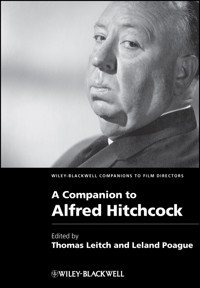
A Companion to Alfred Hitchcock E-Book
38,99 €
Mehr erfahren.
- Herausgeber: John Wiley & Sons
- Kategorie: Geisteswissenschaft
- Sprache: Englisch
The most comprehensive volume ever published on Alfred Hitchcock, covering his career and legacy as well as the broader cultural and intellectual contexts of his work.
- Contains thirty chapters by the leading Hitchcock scholars
- Covers his long career, from his earliest contributions to other directors’ silent films to his last uncompleted last film
- Details the enduring legacy he left to filmmakers and audiences alike
Sie lesen das E-Book in den Legimi-Apps auf:
Seitenzahl: 1441
Veröffentlichungsjahr: 2011
Ähnliche




















Contents
Notes on Contributors
Introduction Thomas Leitch and Leland Poague
Part I Background
1. Hitchcock’s Lives Thomas Leitch
2. Hitchcock’s Literary Sources Ken Mogg
3. Hitchcock and Early Filmmakers Charles Barr
4. Hitchcock’s Narrative Modernism: Ironies of Fictional Time Thomas Hemmeter
Part II Genre
5. Hitchcock and Romance Lesley Brill
6. Family Plots: Hitchcock and Melodrama Richard R. Ness
7. Conceptual Suspense in Hitchcock’s Films Paula Marantz Cohen
Part III Collaboration
8. “Tell Me the Story So Far”: Hitchcock and His Writers Leland Poague
9. Suspicion: Collusion and Resistance in the Work of Hitchcock’s Female Collaborators Tania Modleski
10. A Surface Collaboration: Hitchcock and Performance Susan White
Part IV Style
11. Aesthetic Space in Hitchcock Brigitte Peucker
12. Hitchcock and Music Jack Sullivan
13. Some Hitchcockian Shots Murray Pomerance
Part V Development
14. Hitchcock’s Silent Cinema Sidney Gottlieb
15. Gaumont Hitchcock Tom Ryall
16. Hitchcock Discovers America: The Selznick-Era Films Ina Rae Hark
17. From Transatlantic to Warner Bros. David Sterritt
18. Hitchcock, Metteur-en-scène: 1954–60 Joe McElhaney
19. The Universal Hitchcock William Rothman
Part VI Auteurism
20. French Hitchcock, 1945–55 James M. Vest
21. Lost in Translation? Listening to the Hitchcock–Truffaut Interview Janet Bergstrom
22. Text not available in this electronic edition
Part VII Ideology
23. Accidental Heroes and Gifted Amateurs: Hitchcock and Ideology Toby Miller with Noel King
24. Hitchcock and Feminist Criticism: From Rebecca to MarnieFlorence Jacobowitz
25. Queer Hitchcock Alexander Doty
Part VIII Ethics
26. Hitchcock and Philosophy Richard Gilmore
27. Hitchcock’s Ethics of Suspense: Psychoanalysis and the Devaluation of the Object Todd McGowan
28. Occasions of Sin: The Forgotten Cigarette Lighter and Other Moral Accidents in Hitchcock George Toles
Part IX Beyond Hitchcock
29. Hitchcock and the Postmodern Angelo Restivo
30. Hitchcock’s Legacy Richard Allen
Index
A Companion to Alfred Hitchcock
Wiley-Blackwell Companions to Film Directors
The Wiley-Blackwell Companions to Film Directors survey key directors whose work together constitutes what we refer to as the Hollywood and world cinema canons. Whether Haneke or Hitchcock, Bigelow or Bergman, Capra or the Coen brothers, each volume, comprised of 25 or more newly commissioned essays written by leading experts, explores a canonical, contemporary and/or controversial auteur in a sophisticated, authoritative, and multi-dimensional capacity. Individual volumes interrogate any number of subjects – the director's oeuvre; dominant themes, well-known, worthy, and under-rated films; stars, collaborators, and key influences; reception, reputation, and above all, the director's intellectual currency in the scholarly world.
Published
A Companion to Michael Haneke, edited by Roy Grundmann
A Companion to Alfred Hitchcock, edited by Thomas Leitch and Leland Poague
Forthcoming
A Companion to Rainer Fassbinder, edited by Brigitte Peucker
This edition first published 2011
© 2011 Blackwell Publishing Ltd except for editorial material and organization © 2011 Thomas Leitch and Leland Poague
Blackwell Publishing was acquired by John Wiley & Sons in February 2007. Blackwell’s publishing program has been merged with Wiley’s global Scientific, Technical, and Medical business to form Wiley-Blackwell.
Registered OfficeJohn Wiley & Sons Ltd, The Atrium, Southern Gate, Chichester, West Sussex, PO19 8SQ, United Kingdom
Editorial Offices350 Main Street, Malden, MA 02148-5020, USA9600 Garsington Road, Oxford, OX4 2DQ, UKThe Atrium, Southern Gate, Chichester, West Sussex, PO19 8SQ, UK
For details of our global editorial offices, for customer services, and for information about how to apply for permission to reuse the copyright material in this book please see our website at www.wiley.com/wiley-blackwell.
The right of Thomas Leitch and Leland Poague to be identified as the author(s) of the editorial material in this work has been asserted in accordance with the UK Copyright, Designs and Patents Act 1988.
All rights reserved. No part of this publication may be reproduced, stored in a retrieval system, or transmitted, in any form or by any means, electronic, mechanical, photocopying, recording or otherwise, except as permitted by the UK Copyright, Designs and Patents Act 1988, without the prior permission of the publisher.
Wiley also publishes its books in a variety of electronic formats. Some content that appears in print may not be available in electronic books.
Designations used by companies to distinguish their products are often claimed as trademarks. All brand names and product names used in this book are trade names, service marks, trademarks or registered trademarks of their respective owners. The publisher is not associated with any product or vendor mentioned in this book. This publication is designed to provide accurate and authoritative information in regard to the subject matter covered. It is sold on the understanding that the publisher is not engaged in rendering professional services. If professional advice or other expert assistance is required, the services of a competent professional should be sought.
Library of Congress Cataloging-in-Publication Data
A companion to Alfred Hitchcock / edited by Thomas Leitch and Leland Poague.
p. cm. – (Wiley-Blackwell companions to film directors)
Includes bibliographical references and index.
ISBN 978-1-4051-8538-7 (hardback)
1. Hitchcock, Alfred, 1899–1980–Criticism and interpretation. I. Leitch, Thomas M. II. Poague, Leland A., 1948–
PN1998.3.H58C63 2011
791.43′0233′092–dc22
2010051052
A catalogue record for this book is available from the British Library.
This book is published in the following electronic formats: ePDFs 9781444397307; Wiley Online Library 9781444397321; ePub 9781444397314
In memoriamRobin Wood1931–2009
Notes on Contributors
Richard Allen is Professor of Cinema Studies at New York University. He is author of Hitchcock’s Romantic Irony and co-editor of three anthologies dealing with Hitchcock’s work. With Sidney Gottlieb, he is co-editor of the Hitchcock Annual.
Charles Barr taught for many years at the University of East Anglia, helping to develop one of the pioneer British programs in Film Studies at undergraduate and graduate level. Since then, he has held Visiting Professorships at Washington University in St. Louis and at University College Dublin. His many publications on cinema include books on Ealing Studios, English Hitchcock, and Vertigo.
Janet Bergstrom, Professor of Cinema and Media Studies at UCLA, specializes in archivally-based, cross-national studies of such émigré directors as F.W. Murnau, Jean Renoir, Fritz Lang, and Josef von Sternberg. She pursues the same approach as Associate Editor of Film History, as curator of retrospectives and events (Cinema Ritrovato, Bologna), and in documentaries created for DVD –Murnau’s 4 Devils: Traces of a Lost Film (2003), Introduction to Phantom (2006), Murnau and Borzage at Fox – The Expressionist Heritage (2008), and Underworld: How It Came to Be (2010). She edited the anthology Endless Night: Cinema and Psychoanalysis, Parallel Histories and co-founded Camera Obscura: A Journal of Feminism and Film Theory.
Lesley Brill is the author of The Hitchcock Romance: Love and Irony in Hitchcock’s Films (1988) and of numerous essays on film and photography. His latest book is Crowds, Power, and Transformation in Cinema (2006). He teaches at Wayne State University in Detroit.
Paula Marantz Cohen is Distinguished Professor of English at Drexel University. She is the author of four nonfiction works, including Alfred Hitchcock: The Legacy of Victorianism, and four novels, including, most recently, What Alice Knew: A Most Curious Tale of Henry James and Jack the Ripper. Her essays, stories, and reviews have appeared in The Yale Review, The American Scholar, Raritan, The Southwest Review, The Times Literary Supplement, and other publications. She is the host of the Drexel InterView, a cable television show out of Philadelphia, and a co-editor of jml: Journal of Modern Literature.
Alexander Doty is a professor in the Department of Gender Studies and the Department of Communication and Culture at Indiana University–Bloomington. He has written Making Things Perfectly Queer and Flaming Classics, and co-edited Out in Culture: Essays on Gay, Lesbian, and Queer Popular Culture. He was recently the editor for two special issues of Camera Obscura titled “Fabulous! The Diva Issues.” His favorite (queer) Hitchcock film is Marnie, closely followed by Shadow of a Doubt.
Richard Gilmore is Associate Professor of Philosophy at Concordia College in Moorhead, MN. He is the author of Philosophical Health: Wittgenstein’s Method in “Philosophical Investigations” (1999) and Doing Philosophy at the Movies (2005).
Sidney Gottlieb is Professor of Media Studies at Sacred Heart University, in Fairfield, Connecticut. His publications on film include Hitchcock on Hitchcock (1995), Alfred Hitchcock: Interviews (2005), and Roberto Rossellini’s Rome Open City (2004). With Richard Allen, he edits the Hitchcock Annual.
Ina Rae Hark is Distinguished Professor Emerita of English and Film and Media Studies at the University of South Carolina. Among her twenty-five articles and chapters on film and media are five other pieces on Hitchcock. She is the author of Star Trek in the BFI Television Classics series and the forthcoming Deadwood for Wayne State UP’s TV Milestones series. She has also edited or co-edited Screening the Male, The Road Movie Book, Exhibition: the Film Reader, and American Cinema of the 1930s.
Thomas Hemmeter is Associate Professor of English at Arcadia University (Glenside, PA), where he teaches courses in British and American literature and in film studies. He has published on Hitchcock in various essay collections as well as film journals, including The Journal of Film and Video, PostScript, and the Hitchcock Annual, and devoted concerted attention to Robert Altman, Martin Scorsese, and recent Irish film.
Florence Jacobowitz teaches film and cultural studies at York University in Toronto and is an editor of CineAction magazine.
Noel King teaches in the Department of Media, Music, Communication and Cultural Studies at Macquarie University, Sydney, Australia. His current research includes Don DeLillo and film, Richard Hugo and film, and an ongoing study of “cultures of independence” in contemporary fiction and poetry publishing.
Thomas Leitch teaches English and directs the Film Studies program at the University of Delaware. His books include Find the Director and Other Hitchcock Games, The Encyclopedia of Alfred Hitchcock, and, most recently, Film Adaptation and Its Discontents: From Gone with the Wind to The Passion of the Christ.
Joe McElhaney teaches in the Department of Film and Media Studies at Hunter College and the Ph.D. program in Theatre at the City University of New York Graduate Center. He is the author of The Death of Classical Cinema: Hitchcock, Lang, Minnelli and Albert Maysles, and the editor of Vincente Minnelli: The Art of Entertainment. He is currently editing A Companion to Fritz Lang for Blackwell.
Todd McGowan teaches critical theory and film at the University of Vermont. He is the author of The Impossible David Lynch (2007), The Real Gaze: Film Theory After Lacan (2007), and Out of Time: Desire in Atemporal Cinema (2011), among other works. His work brings together psychoanalysis and Hegel as a way of thinking about the subject’s encounter with culture.
Toby Miller works in the Department of Media and Cultural Studies at the University of California, Riverside. His latest books are The Contemporary Hollywood Reader and Television Studies: The Basics.
Tania Modleski is Florence R. Scott Professor of English at the University of Southern California. Her The Women Who Knew Too Much: Hitchcock and Feminist Theory first appeared in 1988; a second edition came out in 2005. Among her other books are Loving with a Vengeance (1982, 2008) and Feminism without Women (1991).
Ken Mogg is a lifelong admirer, teacher, and proponent of Hitchcock’s films. His monograph “The Day of the Claw: A Synoptic Account of Alfred Hitchcock’s The Birds” has been published online in Senses of Cinema, issue 51, “Toward an Ecology of Cinema” (2009).
Richard R. Ness is Associate Professor of Film and Media Studies at Western Illinois University. He is the author of Alan Rudolph: Romance and a Crazed World and From Headline Hunter to Superman: A Journalism Filmography. His articles and reviews have appeared in Cinema Journal, the Hitchcock Annual, Quarterly Review of Film and Video, and the anthology Print the Legend: Cinema and Journalism.
Harry Oldmeadow is Coordinator of Religion and Spirituality Studies at La Trobe University Bendigo, where he also teaches Cinema Studies. He has published on a wide range of subjects, including the Australian cinema, John Ford, and postmodernist theory. His particular interests include classical Hollywood genres, especially the Western and the noir crime film, and the history of film criticism.
Brigitte Peucker is the Elias Leavenworth Professor of German and Professor of Film Studies at Yale University. She has published extensively on matters of film and the other arts. Her latest book is The Material Image (2007).
Leland Poague is Professor of English at Iowa State University. He is the author of books on Frank Capra, Ernst Lubitsch, and Howard Hawks, of the “Hollywood Professionals” volume on Billy Wilder and Leo McCarey, and the co-author, with William Cadbury, of Film Criticism: A Counter Theory (1982). He has edited books on Susan Sontag and Frank Capra, and with Marshall Deutelbaum co-edited A Hitchcock Reader, which recently appeared in its second edition (2009) from Wiley-Blackwell.
Murray Pomerance is Professor in the Department of Sociology at Ryerson University. His books include Magia D’Amore (1999), An Eye for Hitchcock (2004), Savage Time (2005), Johnny Depp Starts Here (2005), The Horse Who Drank the Sky: Film Experience Beyond Narrative and Theory (2008), Edith Valmaine (forthcoming), and Michelangelo Red Antonioni Blue: Eight Reflections on Cinema (forthcoming). He is editor of the Techniques of the Moving Image series at Rutgers University Press and the Horizons of Cinema series at SUNY Press, as well as co-editor, with Lester D. Friedman and Adrienne L. McLean respectively, of the Screen Decades and Star Decades series at Rutgers.
Angelo Restivo is the author of The Cinema of Economic Miracles: Visuality and Modernization in the Italian Art Film, as well as a number of essays on Hitchcock. He is currently working on two book projects on the relationship of modernization to formal questions of cinema and media. He is Associate Professor and Graduate Director of the Program in Moving Image Studies, Department of Communication, Georgia State University.
William Rothman is Professor of Motion Pictures and Director of the Graduate Program in Film Study at the University of Miami. He is the author of Hitchcock—The Murderous Gaze (1982), The “I” of the Camera: Essays in Film Criticism, History, and Aesthetics (1988; second edition, 2004), and Documentary Film Classics (1997). With Marian Keane, he co-authored Reading Cavell’s The World Viewed: A Philosophical Perspective on Film (2000) and has recently edited Cavell on Film (2005), Jean Rouch: A Celebration of Life and Film (2007), and Three Documentary Filmmakers: Errol Morris, Ross McElwee, Jean Rouch (2009).
Tom Ryall is Emeritus Professor of Film History at Sheffield Hallam University. His books include Alfred Hitchcock and the British Cinema (1986), Blackmail (1993), Britain and the American Cinema (2001), and Anthony Asquith (2005). He has contributed various articles on British and American cinema to such collections as The Oxford Guide to Film Studies (1998), The Cinema of Britain and Ireland (2005), and The British Cinema Book (2009).
David Sterritt is chair of the National Society of Film Critics, adjunct professor at Columbia University and the Maryland Institute College of Art, and professor emeritus at Long Island University. He is the film critic of Tikkun, chief book critic of Film Quarterly, and an editorial board member of Cinema Journal and Quarterly Review of Film and Video. He has been film and cultural critic of The Christian Science Monitor, co-chair of the Columbia University Seminar on Cinema and Interdisciplinary Interpretation, and a member of the New York Film Festival selection committee. His books include The Films Of Alfred Hitchcock (1993).
Jack Sullivan, Professor of English and Director of American Studies at Rider University, is the author most recently of New World Symphonies and Hitchcock’s Music, the winner of the ASCAP–Deems Taylor Award for best book of 2006 in the concert music category. His articles and reviews have appeared in The New York Times, The Wall Street Journal, Opera, The Chronicle Review and others.
George Toles is Distinguished Professor of Literature and Film and Chair of Film Studies at the University of Manitoba. He is the author of A House Made of Light: Essays on the Art of Film. For twenty-five years, he has been the screenwriting collaborator of director Guy Maddin. He has recently written an original screenplay for Maddin’s feature film Keyhole (2011).
James M. Vest is Professor Emeritus of French, Film Studies, and Interdisciplinary Humanities at Rhodes College. He has authored books and articles on topics ranging from the French origins and reception of Shakespeare’s Ophelia to French poetry and Hitchcock’s French connections. His current research centers on Hitchcock’s earliest films.
Susan White is Associate Professor of Literature and Film Studies in the Department of English at the University of Arizona. She is the author of The Cinema of Max Ophuls: Magisterial Vision and the Figure of Woman, and of numerous articles on gender and cinema, focusing especially on the works of Hitchcock, Kubrick, and Nicholas Ray. She has also produced several commentary tracks on Ophuls’s films for Criterion and Second Sight.
Introduction
Thomas Leitch and Leland Poague
Our dedication of this volume to the late Robin Wood honors one of the founding practitioners of Hitchcock studies. In looking backward to a departing generation of Hitchcock scholars that now sadly includes Raymond Durgnat, Eric Rohmer, and Claude Chabrol, it seeks to root the present volume in a rich tradition of Hitchcock commentary that now numbers hundreds of books and essays. Alfred Hitchcock and his films have been the subject of biographies, thematic surveys of his entire career, scholarly monographs on aspects ranging from Hitchcock’s Victorianism to his bi-textuality, case studies of individual films and even sequences from particular films, catalogues of Hitchcockian motifs, reference books, quiz books, and books for readers still too young to know what monster lurks in Norman Bates’s fruit cellar.
In considering our place in this tradition of Hitchcockiana, we are especially mindful of other collections of essays on the Master of Suspense. If Hitchcock has commanded vastly more scholarly attention than any other filmmaker, he has also been incomparably well served by the anthologies that have done so much to set the course of Hitchcock studies. Albert J. LaValley’s Focus on Hitchcock (Englewood Cliffs, NJ: Prentice-Hall, 1972), whose editor provided a masterful introduction to a potpourri of interviews, reviews, analyses, and polemics, went a long way toward consolidating Hitchcock’s position in film studies. The two editions of Marshall Deutelbaum and Leland Poague’s A Hitchcock Reader (Ames: Iowa State UP, 1986; Chichester, UK: Wiley-Blackwell, 2009), addressed alike to students in the university-level Hitchcock courses that LaValley’s anthology clearly anticipated, proposed the director’s work and its reception as embodiments of cinema’s leading traditions and developments. Walter Raubicheck and Walter Srebnick’s Hitchcock’s Rereleased Films: From Rope to Vertigo (Detroit: Wayne State UP, 1991) made a case for the centrality of five Hitchcock films – Rope (1948), Rear Window (1954), The Trouble with Harry (1955), The Man Who Knew Too Much (1956), and Vertigo (1958) – long kept from audiences by contractual negotiations that outlived the director himself. Slavoj Žižek’s Everything You Always Wanted to Know about Lacan (But Were Afraid to Ask Hitchcock) (London: Verso, 1992) placed the director, who had already played a leading role in Žižek’s shotgun wedding of Lacan and pop culture, front and center in debates about cultural signification. Later in the same decade, Jonathan Freedman and Richard Millington’s Hitchcock’s America (New York: Oxford UP, 1999) joined Žižek and company in shifting the grounds of Hitchcock studies from formal and thematic studies that focused on mining each film for meaning to a cultural-studies perspective that took each film, and Hitchcock in general, as symptoms of larger signifying patterns. The two anthologies with which Richard Allen and Sam Ishii- Gonzáles bookended the 1999 Hitchcock centennial conference – Alfred Hitchcock: Centenary Essays (London: BFI, 1999) and Hitchcock: Past and Future (New York: Routledge, 2004) – sought to reclaim film studies from the flattening sterility of reception studies, which too often saw the films as value-neutral or even pathologically symptomatic, and reestablish them as works of art. The two volumes of essays reprinted from the Hitchcock Annual – Framing Hitchcock: Selected Essays from the Hitchcock Annual, edited by Sidney Gottlieb and Christopher Brookhouse (Detroit: Wayne State UP, 2002), and The Hitchcock Annual Anthology: Selected Essays from Volumes 10–15, edited by Gottlieb and Allen (London: Wallflower, 2009) – offered specific suggestions for the responsible care and feeding of Hitchcock studies in light of the worrisome rise of “Big-Time Hitchcock” (Framing 15). And of course the venue in which the essays collected in these two volumes originally appeared, the Hitchcock Annual, is itself, like The MacGuffin, its sister publication edited by Ken Mogg, a constant source of new essays on Hitchcock.
Given such a long and varied tradition, not only of Hitchcock scholarship but of Hitchcock anthologies, why do we now extend the list with still another volume? Each of these earlier anthologies was organized more or less explicitly around a controversy. Was Hitchcock an artist or an entertainer? Did Hitchcock’s American films represent his crowning achievement or a falling-off from a series of faster-paced English films more immediately grounded in wit, brio, and social observation? How did the re-release of five long unavailable films reshape received wisdom about the shape of his career? What role did this most popular of genre filmmakers play in the commodification of meaning and the challenge to meaning-making systems? Could Hitchcock’s films more fruitfully be studied from aesthetic perspectives or when taken as symptomatic of the cultural pathologies of postmodern America or of global postmodernism more generally? How exactly was Big-Time Hitchcock to be managed?
Because Hitchcock always seems to be at the center of some controversy swirling around film studies or semiology or cultural studies, he has been incomparably useful in providing an accessible laboratory in which to test ideas about filmmakers, films, filmmaking, and popular culture. Even if there is always a Hitchcock controversy, however, the nature of the controversy is always shifting. In particular, each Hitchcock anthology has taken previous Hitchcock criticism as an indispensable part of its subject. Every one of these anthologies, even those that rely entirely on previously published material, uses the retrospective force of its survey of Hitchcock scholarship as the basis for an argument about how Hitchcock studies can shape the disciplinary future of film studies or cultural studies or new media studies and so forth.
So part of our purpose here has been to provide a retrospective overview of some of the leading controversies that have shaped Hitchcock studies, establishing and confirming it as a discipline and marking the principal stages in its development. These controversies begin long before Robin Wood’s pioneering interventions. They leave their traces in the extended 1950s debate in Cahiers du cinéma over Hitchcock’s status as a film artist, and in Lindsay Anderson’s even earlier dismissal of Hitchcock’s American films as “heavy, tedious, glossed, at their best, ingenious, expert, synthetically entertaining” (“Alfred Hitchcock,” in Focus on Hitchcock, LaValley, 1972, 48–59, at 59). But they are given their definitive articulation by the question with which Wood first called Hitchcock’s Films to order in 1965: “Why should we take Hitchcock seriously?” (Hitchcock’s Films Revisited. Rev. ed. New York: Columbia UP, 2002, 55) – a question that was enormously influential because it provided a primary impetus not only for Hitchcock studies but for cinema studies in general as it fought to establish its cultural and academic credentials by asserting that its subject, though originating as popular entertainment, could also have the power of art.
The present collection extends the tradition of anthologies that have sought to characterize Hitchcock studies by providing a retrospective snapshot, a time capsule of the debates that have shaped Hitchcock scholarship. But it differs from earlier collections in several important ways. The most obvious of these is its scope. Because we had the freedom to plan the collection on a generous scale, we sought to include as many approaches to Hitchcock, as many different Hitchcocks, as possible instead of focusing on a single aspect of Hitchcock’s work or a single definitive Hitchcock. Moreover, we planned the collection from the top down. Instead of asking potential contributors what they most wanted to write about, we approached them with specific topics in mind in hopes of producing a volume that would be at once comprehensive and integrated. We commissioned virtually every contribution expressly for this volume, and the few exceptions were extensively revised for their appearance here. Although James Vest and Jack Sullivan were obvious choices to write on the French reception of Hitchcock and on the director’s use of music, their essays extend rather than simply recapitulating their earlier work.
Our abiding concern was to nurture and extend the kind of productive debate that has been the lifeblood of Hitchcock studies. From its beginnings, the field has been driven by a series of antinomies that have allowed notable critics to weigh in on either side of the question. Cahiers contributors debated Hitchcock’s status as maker and artist, and Durgnat developed his reading of Hitchcock in direct response to Wood’s question, “Why should we take Hitchcock seriously?” Hitchcock studies ever since has developed through a series of theses and antitheses that have led to syntheses capable of generating new antitheses. This collection continues this Hegelian pattern by emphasizing questions capable of generating a range of useful answers. Is Hitchcock inimitable, or is he everywhere imitated? Richard Allen contends that his influence has been extensive and multifarious, but by no means indiscriminate. Is Hitchcock fundamentally a creator of original works or the leading member of a production team? Leland Poague, Tania Modleski, and Susan White develop an impressively wide range of models for discussing Hitchcockian collaboration. Should Hitchcock’s films be studied for their own virtues and values, or for what they can tell us about cultural currents, industry practices, and the nature of narrative suspense? Half a dozen different contributors show that his films can be at once admired and pressed into serving larger intellectual or cultural programs. Indeed, even those essays most overtly concerned with Hitchcock’s status as auteur director – those by James Vest, Janet Bergstrom, and Harry Oldmeadow – observe how thoroughly his reputation was constructed, by his detractors as well as his partisans, though they focus alike on the crucial role played by critics associated with Cahiers du cinéma, especially François Truffaut and Robin Wood.
In soliciting contributions, we have aimed for a balance between established and emerging scholars, notable Hitchcockians and contributors from outside Hitchcock studies who could bring a fresh perspective to familiar material. An earlier policy we set proved still more decisive. Because we had no desire to build our collection out of authorized readings of canonical films, we chose to organize our contributions in terms of topics and approaches instead of soliciting new readings of individual films. This decision had the effect of subordinating each contributor’s departures from scholarly consensus – how many of the numberless essays on Psycho (1960) cite earlier commentators on the film only to mark the given essay’s distance from them? – to potential disagreements among the present contributors, who felt free to range outside the individual preserve of The 39 Steps (1935) or Rear Window to which assignments to write on individual films might have safely confined them.
In lieu of essays devoted to individual films that offer interpretations explaining what the films mean, we sought contextual essays on the circumstances under which Hitchcock’s films have been produced and received, especially essays on topics most likely to lend themselves to productive debate. Ken Mogg and Charles Barr investigate the influence of earlier writers and filmmakers on a director notorious for the highly selective list of literary and cinematic influences he acknowledged. Thomas Hemmeter and Angelo Restivo consider Hitchcock’s credentials as an exemplary modernist and postmodernist in a pair of essays whose relation to each other is far more complex than simple opposition.
Although we gave each contributor a specific topic, the inevitably serendipitous development of essays as they moved from topics through premises and examples to conclusions led to a wealth of unexpected results. We anticipated a good deal of emphasis on Vertigo, but not nearly so much on Waltzes from Vienna (1933) or Under Capricorn (1949). Imagine our surprise, then, when Richard Ness announced his intention to focus on both of these neglected films in his essay on Hitchcockian melodrama. We were equally surprised by the number of contributors who wrote at length about Marnie (1964). In view of the fascinating differences that emerge from the considerations of Marnie in the essays by Tania Modleski, Brigitte Peucker, William Rothman, and Florence Jacobowitz, however, we were happy to be surprised, and we trust that readers will share our pleasure.
Enterprising readers might well imagine a collection using alternative topics for section headings or individual essays. To an extent, so did we, in that our table of contents shifted considerably as essays began to arrive and we saw how different authors treated their assigned topics, sometimes in ways we could not have anticipated. Our one obligatory section, the longest of our nine sections and the central one in the structure of the volume, surveys the historical development of Hitchcock’s career. But this section is more notable than any other for its variety of approaches. Sidney Gottlieb contends that Hitchcock’s silent films establish themselves as Hitchcockian years before he became identified with the thriller. Tom Ryall traces the relation between Hitchcock’s films for Gaumont British and other contemporaneous English films. Ina Rae Hark, adopting a more thematic approach to Hitchcock’s first American films, offers some highly original conclusions about Hitchcock and American masculine heroism. David Sterritt considers the ways in which Hitchcock’s brief period as an independent producer laid the groundwork for his subsequent films. Joe McElhaney’s emphasis on Hitchcock’s distinctive mise-en-scène provides new insight into his years at Paramount. And William Rothman, emphasizing the disappointments of Hitchcock’s last years at Universal, balances a sense of Hitchcock’s compromises and missteps with his achievements in films from The Birds (1963) through Family Plot (1976). Since Gottlieb begins with an account of The Blackguard (Graham Cutts, 1925), on which Hitchcock worked as assistant director, art director, and screenwriter before he directed The Pleasure Garden (1925), and Rothman provides an extended consideration of The Short Night, Hitchcock’s unproduced last project, this section on Hitchcock’s development is as comprehensive as it is varied.
Both inside and outside this section on Hitchcock’s development, there are many readings of individual films. McElhaney analyzes the ways Psycho marks a decisive turn in Hitchcock’s mise-en-scène. Paula Marantz Cohen uses Shadow of a Doubt (1943) to anchor a notion of “conceptual suspense” that sheds new light on Hitchcock and narrative suspense generally. George Toles’s meditation on the nature of moral experience in Hitchcock follows the affective itinerary of the cigarette lighter in Strangers on a Train (1951). In every case, the analysis of individual films illustrates a larger argument about Hitchcock, cinema, or storytelling.
Although we have not encouraged contributors to argue with each other directly, we must plead guilty as accessories before the fact in arranging categories and juxtapositions that would foster implicit controversy. Many of these essays, for example, dramatize a fundamental schism in Hitchcock studies between retrospective views that seek to consolidate Hitchcock’s position as an auteur, a brand name, an ascription of value, an historical function, or an otherwise privileged signifier, and prospective views that seek to expose ruptures in Hitchcock commentary in order to address a perceived absence. Lesley Brill looks backward at the enduring myths of Hitchcock romance; Thomas Leitch looks forward to ask whether Hitchcock’s biography has been exhausted and how it might be replenished. What is more surprising is how many of these essays embody both impulses in different combinations. Brigitte Peucker and Murray Pomerance both argue for a fundamental reassessment of Hitchcock’s visuals that would break sharply with earlier analyses. Yet their procedures – Peucker’s motivic examination of Hitchcock’s aestheticized public spaces versus Pomerance’s cornucopia of isolated visual moments that break free of their films’ narrative discipline – could not be more different from one another, even as they root themselves in earlier studies by Alenka Zupančič and Michel Mourlet respectively. No debate in contemporary cinema studies would seem more likely to divide conservatives from progressives than the question of whether films posed ethical dilemmas devised by individual filmmakers or were everywhere informed by deeper ideological commitments outside the control of any individual. Even so, both Toby Miller and Noel King’s take on the ideology of Hitchcock’s English spy films and Alexander Doty’s interrogation of the term “queer Hitchcock” illustrate a far more nuanced conception of ideology than the earlier commentary they consider. And if Richard Gilmore’s Socratic Hitchcock is a traditional ethicist in postmodern garb, Todd McGowan presents a director every bit as deeply invested in the ethical dimensions of experience who is still absolutely different from every other filmmaker.
Our effort to locate this anthology in the sequence of similar Hitchcock compendiums is, among other things, an acknowledgement of indebtedness to the larger critical tradition of Hitchcock scholarship. But many more specific debts require acknowledgment. Most of all, we are indebted to our contributors. This was a labor of love all around, in the sense that the main reward for participating in the project was the participation, the chance to contribute to an unprecedentedly compendious reassessment of Hitchcock’s crucial role in film culture and modern culture. We were deeply gratified at the generous responses we received to our initial queries and for the wonderful essays we finally received. Not only were contributors generous with their time and their words, they had reason to be generous with their patience as well, given the editorial necessity we encountered to urge economy. To each and all, we offer heartfelt thanks.
Warm thanks are also due our Wiley-Blackwell editor Jayne Fargnoli, who suggested the project in the first place. Jayne was also the lead editor on the second edition of Marshall Deutelbaum and Leland Poague’s A Hitchcock Reader, and it was midway through that effort that she posed the question to Marshall and Lee regarding their interest in joining her in yet another editorial project. Having recently retired, Marshall declined the opportunity while offering Lee steadfast encouragement. (Thanks, Marshall!) Lee Poague recruited Thomas Leitch to share editorial duties, and we soon confirmed our suspicion that there was work aplenty to go around. Though Jayne Fargnoli’s encouragement and sage counsel were exceptionally helpful, we are also eager to acknowledge and applaud the professionalism of Wiley-Blackwell editorial assistants Margot Morse and Matthew Baskin and production manager Lisa Eaton, and Revathy Kaliyamoorthy of SPi. Copyeditor Gillian Andrews did much to improve the volume, and we gladly express our gratitude for her conscientious editorial stewardship.
Portions of James Vest’s essay “French Hitchcock, 1945–1955” are based upon materials published in Vest’s earlier scholarship on Hitchcock and France, including his essay “The Emergence of an Auteur: Hitchcock and French Film Criticism, 1950–1954” in Hitchcock Annual (2001–02): 108–24 and his chapter “To Catch a Liar: Bazin, Chabrol, and Truffaut Encounter Hitchcock,” which appeared in Hitchcock: Past and Future, edited by Richard Allen and Sam Ishii-Gonzáles (London: Routledge, 2004, 109–18), both used and modified here with permission of the copyright holder and publishers. Portions are also derived from Hitchcock and France: The Forging of an Auteur, by James M. Vest. Copyright © 2003 by James M. Vest. Reproduced with permission of Greenwood Publishing Group, Inc., Westport, CT.
Toby Miller and Noel King’s essay “Accidental Heroes and Gifted Amateurs: Hitchcock and Ideology” borrows from Toby Miller’s “39 Steps to ‘The Borders of the Possible’: Alfred Hitchcock, Amateur Observer and the New Cultural History,” which appeared in Alfred Hitchcock: Centenary Essays, edited by Richard Allen and S. Ishii-Gonzáles (London: BFI, 1999): 316–31. The passages are reproduced here with the kind permission of Palgrave Macmillan. These involve Non-exclusive Print and Electronic rights in the English language for distribution in the following territory: World for one edition.
A shorter version of George Toles’s essay “Occasions of Sin: The Forgotten Cigarette Lighter and Other Moral Accidents in Hitchcock” appeared in Raritan 28.4 (2009). The material in this shorter version was published by arrangement with Wiley-Blackwell.
Between its initial publication as Hitchcock’s Films (London: A. Zwemmer; New York: A.S. Barnes, 1965) and its most recent iteration as Hitchcock’s Films Revisited, revised edition, no book has proven more essential to Hitchcock studies than Robin Wood’s. We are especially grateful to Columbia University Press for allowing us to quote extensively from Hitchcock’s Films Revisited, revised edition, by Robin Wood. Copyright © 2002, 1989 Columbia University Press. Reprinted with permission of the publisher.
Lee Poague is grateful to Iowa State University’s Center for Excellence in the Arts and Humanities for supporting both his research on Hitchcock’s writers and his editorial efforts, as did the ISU Department of English, especially former chair Charlie Kostelnick and former assistant chair Debra Marquart. For research assistance, he is indebted to the Interlibrary Loan staff at the Parks Library, to Dan Coffey of the Parks Library faculty, and to Amy Poague, who ran down obscure periodical sources in the library of the University of Iowa. His admiration of Thomas Leitch as a discerning and eloquent Hitchcock scholar occasioned the hope that Tom would agree to collaborate, and he is grateful that their collaboration proved so happily productive. Susan Poague has been patient beyond measure as the process of writing and editing has gone forward, but sympathetic and loving all the same, after all these years and Hitchcock books! Some debts defy repayment.
Thomas Leitch offers special thanks to Lee Poague for his example, wisdom, and patience, to Sidney Gottlieb and Ken Mogg for help above and beyond the duty of the most exemplary Hitchcockians, and to Lisa Elliott for her understanding, support, and love.
A word about style. Though we have done our best to follow the style mandates of the most recent MLA Handbook – still another way of trying the patience of our contributors – we have made no attempt to iron out all stylistic inconsistencies by making our contributors sound more like us. In addition, we have settled on several idiosyncratic or volume-specific usages. In honor of Robin Wood, for example, we spell CineAction with two capitals, though MLA style is clear about disregarding such accidentals. We have followed our contributors’ practice of referring to foreign language films by the titles most often used in the English-speaking film community, though we have on occasion given the original title followed by an English translation. Where foreign language articles are cited, we have followed a similar practice, especially in James Vest’s chapter. Except for the first film Hitchcock directed, The Pleasure Garden, which some authorities date to 1925, the year it was shot, and others to 1927, the year it was finally released, we have made every attempt to be consistent in providing the release date for each film (and the name of its director, if the director is not Hitchcock) and the name of the performer when a given film or character is first mentioned in a given essay.
In reviewing the contents of this volume, we are keenly aware of its omissions. There is nothing on Hitchcock’s collaboration with cinematographers, costume designers, or other visual artists; nothing on Bon Voyage (1944) or Aventure Malgache (1944); very little on Hitchcock’s work for television (though see Ness’s provocative remarks on “Incident at a Corner” [1960]); and hardly anything on the non-musical elements of his soundtracks. The neglect of Hitchcockian comedy that Gottlieb lamented in 1995 (Hitchcock on Hitchcock: Selected Writing and Interviews, Berkeley: U of California P, xxiii) continues here. And of course the same antinomies that have made films like North by Northwest (1959) and Psycho so central to the Hitchcock canon continue to marginalize films as different as Rich and Strange (1931), Jamaica Inn (1939), and The Trouble with Harry. Given our decision to avoid the close-reading format, we are proud of the comprehensive (dare we say catholic) treatment of Hitchcock’s work. We are well aware that this is not the ultimate Hitchcock anthology. But we hope the very omissions that make it less than definitive will help drive the continuing development of Hitchcock studies by provoking its readers to productive response. Although we are proud to salute the achievements of Hitchcock scholars past and present, we are convinced that the most exciting work on Hitchcock has yet to appear, and we hope that this collection will play a part in bringing it to birth.
PART I
Background
1
Hitchcock’s Lives
Thomas Leitch
The appearance of Donald Spoto’s Spellbound by Beauty (2008) marks a turning point in Hitchcock studies, though hardly for the reasons the author indicates. The dust-jacket description of the book as “the final volume in master biographer Donald Spoto’s Hitchcock trilogy” will not be taken seriously by anyone who has read The Art of Alfred Hitchcock, the formal and thematic study of Hitchcock’s films distinguished from other film-by-film surveys largely by Spoto’s access to the production of Family Plot (1976), or The Dark Side of Genius (1983), the full-dress biography that cast Hitchcock as a tormented loner who delighted in sadistically teasing and sometimes torturing audiences and colleagues alike. Despite publisher claims of a volume “[r]ich with fresh revelations based on previously undisclosed” testimony or with materials offering “important insights into the life of a brilliant, powerful, eccentric and tortured artist,” Spoto’s new book, accurately subtitled Alfred Hitchcock and His Leading Ladies, does not complete a trilogy because it is neither a sequel nor a complement to his earlier volumes. It is something altogether more interesting.
Spoto is admirably direct in explaining the reasons he returned to Hitchcock after The Dark Side of Genius launched his career as a celebrity biographer whose subjects have included Marilyn Monroe, Princess Diana, Joan of Arc, and Jesus of Nazareth. Several of the collaborators he interviewed in preparation for the earlier volume asked him “to omit certain comments either for some years or until after their own deaths” (xxi). So much of Hitchcock’s conduct toward his actresses “can only be called sexual harassment” that “his biography remains a cautionary tale of what can go wrong in any life” (xxi). Spoto felt particularly obliged to respond to legions of Hitchcock fans “who will not hear a syllable spoken against” him (xx). For Spoto, however, “the craft of biography requires that the shadow side of subjects be set forth and comprehended” (xx). Armed with previously withheld confidences and a more comprehensive sense of Hitchcock’s life, Spoto intends by focusing on the most problematic aspect of the director’s professional life – his relationships with the actresses “for whom he had a strange amalgam of adoration and contempt” (xviii) – to rescue Hitchcock in all his dark complexity from a horde of uncritical admirers by offering “new insights into Hitchcock the filmmaker – in particular, how he understood the element of collaboration” (xxiii).
But these claims ring just as hollow as the publisher’s claim that Spellbound by Beauty completes a trilogy. The new material at Spoto’s disposal is of five kinds: new interviews he conducted with Alida Valli, Gregory Peck, Ann Todd, Diane Baker, and especially Tippi Hedren; previously withheld comments from interviews with a somewhat wider array of sources; the interviews with and writings by Hitchcock that Sidney Gottlieb collected in and ; critical studies of Hitchcock’s life, films, and working habits by Leonard J. Leff, Bill Krohn, and Ken Mogg published since ; and intervening biographies of Hitchcock by Patrick McGilligan and Charlotte Chandler, as well as Patricia Hitchcock O’Connell’s biography of her mother, Alma Reville, Hitchcock’s wife.
Lesen Sie weiter in der vollständigen Ausgabe!
Lesen Sie weiter in der vollständigen Ausgabe!
Lesen Sie weiter in der vollständigen Ausgabe!
Lesen Sie weiter in der vollständigen Ausgabe!
Lesen Sie weiter in der vollständigen Ausgabe!
Lesen Sie weiter in der vollständigen Ausgabe!
Lesen Sie weiter in der vollständigen Ausgabe!
Lesen Sie weiter in der vollständigen Ausgabe!
Lesen Sie weiter in der vollständigen Ausgabe!
Lesen Sie weiter in der vollständigen Ausgabe!
Lesen Sie weiter in der vollständigen Ausgabe!
Lesen Sie weiter in der vollständigen Ausgabe!
Lesen Sie weiter in der vollständigen Ausgabe!
Lesen Sie weiter in der vollständigen Ausgabe!
Lesen Sie weiter in der vollständigen Ausgabe!
Lesen Sie weiter in der vollständigen Ausgabe!
Lesen Sie weiter in der vollständigen Ausgabe!
Lesen Sie weiter in der vollständigen Ausgabe!
Lesen Sie weiter in der vollständigen Ausgabe!
Lesen Sie weiter in der vollständigen Ausgabe!
Lesen Sie weiter in der vollständigen Ausgabe!
Lesen Sie weiter in der vollständigen Ausgabe!
Lesen Sie weiter in der vollständigen Ausgabe!
Lesen Sie weiter in der vollständigen Ausgabe!
Lesen Sie weiter in der vollständigen Ausgabe!
Lesen Sie weiter in der vollständigen Ausgabe!
Lesen Sie weiter in der vollständigen Ausgabe!
Lesen Sie weiter in der vollständigen Ausgabe!
Lesen Sie weiter in der vollständigen Ausgabe!
Lesen Sie weiter in der vollständigen Ausgabe!
Lesen Sie weiter in der vollständigen Ausgabe!
Lesen Sie weiter in der vollständigen Ausgabe!
Lesen Sie weiter in der vollständigen Ausgabe!
Lesen Sie weiter in der vollständigen Ausgabe!
Lesen Sie weiter in der vollständigen Ausgabe!
Lesen Sie weiter in der vollständigen Ausgabe!
Lesen Sie weiter in der vollständigen Ausgabe!
Lesen Sie weiter in der vollständigen Ausgabe!




