


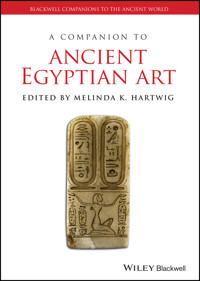
A Companion to Ancient Egyptian Art E-Book
149,99 €
Mehr erfahren.
- Herausgeber: John Wiley & Sons
- Kategorie: Geisteswissenschaft
- Serie: Blackwell Companions to the Ancient World
- Sprache: Englisch
How did ancient Egyptians define “art”—and how did the myriad of artistic works they produced mirror their worldview? A Companion to Ancient Egyptian Art presents a comprehensive collection of original essays exploring key concepts, critical discourses, and theories that shape the discipline of ancient Egyptian art. Themes and topics include methodological approaches and theoretical concepts, the development of Egyptian art and its connections with other cultures, technology and interpretation, and current debates surrounding field and museum conservation.
In addition to providing overviews of past and present scholarship on a broad range of topics relating to art in ancient Egypt, readings pave the way for new avenues of exploration that are certain to stimulate ongoing and future debate. With its unprecedented breadth of coverage and impeccable scholarship, A Companion to Ancient Egyptian Art is an indispensable reference resource for the field of ancient Egyptian art history.
Sie lesen das E-Book in den Legimi-Apps auf:
Seitenzahl: 1368
Veröffentlichungsjahr: 2014
Ähnliche




















Table of Contents
Blackwell Companions to the Ancient World
Title Page
Copyright
Notes on Contributors
Foreword
Preface
Acknowledgments
List of Abbreviations
List of Illustrations
Maps
Figures
List of Plates
Chronology of Egyptian Kings
Chronology of Kushite Rulers
Maps
Chapter 1: What Is Art?
Introduction: “Art” and the Aesthetic
The Aesthetic Context
The Aesthetic Community
Pictorial Representation
Idealization
Enactment
The Unity of Aesthetic Forms
Change and Tradition
What Is Distinctively Egyptian?
Guide to Further Reading
References
Part I: Methodological Approaches
Chapter 2: Historiography of Ancient Egyptian Art
Acknowledgment
Guide to Further Reading
References and Bibliography
Chapter 3: Style
Introduction
Early Studies
Formalistic Analysis
Stylistic Change and Its Meaning
Style and Iconography
Style and Egyptian Proportions
Semiotics, Hermeneutics, and Style
The Reception of Style
Conclusion
Acknowledgment
Guide to Further Reading
References
Chapter 4: Connoisseurship
Introduction
Predynastic Period
Early Dynastic Period and Old Kingdom
Middle Kingdom
New Kingdom
Third Intermediate Period
Late Period
Guide to Further Reading
References
Chapter 5: Iconography and Symbolism
Introduction: What Is Iconography?
First Phase of Iconographical Research: Emergence (ca. 1900–1950)
Second Phase of Iconographical Research: Consolidation (ca. 1950–1980)
Third Phase of Iconographical Research: New Horizons (ca. 1980–2010)
Showing, Propagating, and Discussing Iconography: The New Mass Media
Theoretical Reflection on Iconography, Iconology, and Symbolism
Guide to Further Reading
References
Internet Resources
Chapter 6: Semiotics and Hermeneutics
Semiotics
Hermeneutics
Conclusion – Conception vs Reception: The Role of the Interpreter
Guide to Further Reading
References
Chapter 7: Gender and Sexuality
What Are Gender and Sexuality?
Gender in Ancient Egyptian Art
Elite Male and Female Figures
Non-elite Figures
Figures of Children
Figures of the King and Royal Women
Figures of Male and Female Deities
Gender Structure and Organization in Ancient Egyptian Society
Sexuality
Sexuality and Elite Figures
Nude Female Images
Guide to Further Reading
References
Chapter 8: Reception and Perception
Reception and Perception of Art
Reception and Perception of Ancient Egyptian Art
Aesthetics
Conditions of Reception and Perception
Guide to Further Reading
References
Chapter 9: Representing the Other: Non-Egyptians in Pharaonic Iconography
The Other
The Cosmological Role of Foreigners
Foreigners and Kingship
Internal Divisions among Foreigners
The Nine Bows and “Egyptian Foreigners”
The Old and Middle Kingdoms
The New Kingdom and Later
Conclusion
Guide to Further Reading
References
Chapter 10: Interpreting Ancient Egyptian Material Culture
The Parameters of Ancient Egyptian Material Culture
Problems in the Interpretation of Ancient Egyptian Material Culture, General and Specific
Ways of Looking, or Methodologies of Interpretation
Potential Avenues for Exploration
Guide to Further Reading
References
Part II: Materials and Mediums
Chapter 11: Sculpture
Introduction
Development of Sculpture
Methodological Analysis of Egyptian Sculpture
Guide to Further Reading
References
Chapter 12: Relief
Introduction
Chronological Development
Stylistic Analysis of Relief
Context and Function: Interpreting the Significance of Egyptian Relief
Guide to Further Reading
References
Chapter 13: Painting
Introduction
The Early Steps of Egyptian Painting
The Innovative Strength of Dynasty 4
Painting as Alternative to Painted Relief
Painting as Incompleteness, and Incompleteness as an Expression of Eternity
The First Intermediate Period—Catching the Most Colorful Moments of Life
The Middle Kingdom—the Province as a Center
The Second Intermediate Period
The “Minoan Painting” of Palace F at Tell el-Dab'a
The New Kingdom and the Peak of Egyptian Painting
The Palatine Painting of Mid Dynasty 18
The Royal Tombs of the New Kingdom
Ramesside Painting
The First Millennium
BCE
Guide to Further Reading
References
Chapter 14: Coffins, Cartonnage, and Sarcophagi
The Function of the Body Container
Coffin Types
Coffins and Ancient Egyptian Society
Coffin Studies Methodologies
Coffin Development
Guide to Further Reading
References
Chapter 15: Luxury Arts
Nothing Can Compare…
Gifts for the Gods
Royal Treasures
Courtiers' Tickets to Heaven
Manufacturing Secrets of Antiquity's High-Tech Materials
Guide to Further Reading
References
Part III: Concepts in Art
Chapter 16: Ideology and Propaganda
Introduction
Accessibility
Royal Propaganda
Private Propaganda
Guide to Further Reading
References
Chapter 17: Religion and Ritual
Introduction
Art and Architecture as Reflections of Religion
Festivals and Their Impact upon Architectural Forms
Religion and Art in the Amarna Period
Conclusion
Guide to Further Reading
References
Chapter 18: Narrative
Definition of Narrative and Narratology
Visual Narrative
Visual Narrative in Ancient Egypt
Examples of Visual Narrative in Ancient Egyptian Art
Conclusion
Guide to Further Reading
References
Chapter 19: The Ordering of the Figure
Guide to Further Reading
References
Chapter 20: Portraiture
Approaches to and Definitions of the “Portrait” in the Late Nineteenth and Early Twentieth Centuries: Appreciation and Growth of Collections
Descriptive Analysis
Physiognomy and Race
Individual Likeness and Its Interpretation
Twentieth-Century Portraiture Scholarship and the Formalist Methodologies
Current Trends in Portrait Analysis
Guide to Further Reading
References
Part IV: Interconnections with the Larger World
Chapter 21: Egyptian Connections with the Larger World: Greece and Rome
Overview
Egypt and the Aegean Islands
Egypt and Greece: The Late Period
Egypt and Greece: The Hellenistic Period
Egypt and Rome
Guide to Further Reading
References
Chapter 22: Egyptian Connections with the Larger World: Ancient Near East
Introduction
Predynastic Egypt and Western Asia
Predynastic Egypt and Early Dynastic Mesopotamia
The Old Kingdom
The Middle Kingdom
The New Kingdom
New Kingdom Egypt and the Iron Age in Ancient Mesopotamia
Western Asia and the “Eastern High Gate” at Medinet Habu
Ancient Egypt and the Achaemenid Persian Empire
Acknowledgment
Guide to Further Reading
References
Chapter 23: The Art and Architecture of Kushite Nubia
The Origins of the Kushite Empire
Dynasty 25
Napatan Sculpture
The Meroitic Period
The Post-Meroitic Period
Guide to Further Reading
References
Part V: Reception of Ancient Egyptian Art in the Modern World
Chapter 24: Egyptomania: Fascination for Egypt and Its Expression in the Modern World
Guide to Further Reading
References
Part VI: Technology and Interpretation
Chapter 25: Interpretation
Traditional Methods, and Their Advantages and Disadvantages
Possible Productive Future Approaches
Conclusion
Guide to Further Reading
References
Chapter 26: Technology
Questions Science Can Address
Pigments and Painting
Vitreous Materials
Glass
Metals
Ceramics
Organic Materials Used in Coatings, Paint Binders, and Adhesives
Conclusion
Guide to Further Reading
References
Chapter 27: Conservation of Egyptian Objects: A Review of Current Practices in the Field and in Museum Settings
Introduction
The Nature of Egyptian Collections
The Conservation Profession and Current Trends with Special Reference to Egypt
Egyptian Materials and Their Deterioration
Field Conservation
Conservation in Museums
Conclusion
Guide to Further Reading
References
Index
Supplemental Images
End User License Agreement
Pages
ix
x
xi
xii
xiii
xiv
xv
xvi
xvii
xviii
xix
xxi
xxii
xxiii
xxiv
xxv
xxvi
xxvii
xxviii
xxix
xxxi
xxxii
xxxiii
xxxiv
xxxv
xxxvi
xxxvii
xxxviii
xxxix
xli
xlii
xliii
xvl
xlvi
xlvii
xlviii
1
2
3
4
5
6
7
8
9
10
11
12
13
14
15
16
17
18
19
20
21
25
26
27
28
29
30
31
32
33
34
35
36
37
38
39
40
41
42
43
44
45
46
47
48
49
50
51
52
53
54
55
56
57
58
59
60
61
62
63
64
65
66
67
68
69
70
71
72
73
74
75
76
77
78
79
80
81
82
83
84
85
86
87
88
89
90
91
92
93
94
95
96
97
98
99
100
101
102
103
104
105
106
107
108
109
110
111
112
113
114
115
116
117
118
119
120
121
122
123
124
125
126
127
128
129
130
131
132
133
134
135
136
137
138
139
140
141
142
143
144
145
146
147
148
149
150
151
152
153
154
155
156
157
158
159
160
161
162
163
164
165
166
167
168
169
170
171
172
173
174
175
176
177
178
179
180
181
182
183
184
185
186
187
188
191
192
193
194
195
196
197
198
199
200
201
202
203
204
205
206
207
208
209
210
211
212
213
214
215
216
217
218
219
220
221
222
223
224
225
226
227
228
229
230
231
232
233
234
235
237
236
238
239
240
241
242
243
244
245
246
247
248
249
250
251
252
253
254
255
256
257
258
259
260
261
262
263
264
265
266
267
268
269
270
271
272
273
274
275
276
277
278
279
280
281
282
283
284
285
286
288
287
289
290
291
292
293
294
295
296
297
298
299
300
301
302
303
304
305
309
310
311
312
313
314
315
316
317
318
319
320
321
322
323
324
325
326
327
328
329
330
331
332
333
334
335
336
337
338
339
340
341
342
343
344
345
346
347
348
349
350
351
352
353
354
355
356
357
358
359
360
361
362
363
364
365
366
367
368
369
370
371
372
373
374
375
376
377
378
379
380
381
382
383
384
385
386
387
388
389
390
391
392
393
394
395
396
399
400
401
402
403
404
405
406
407
408
409
410
411
412
413
414
415
416
417
418
419
420
421
422
423
424
425
426
427
428
429
430
431
432
433
434
435
436
437
438
439
440
441
442
443
444
445
446
447
448
449
450
451
452
453
454
455
456
457
458
459
460
461
462
465
466
467
468
469
470
471
472
473
474
475
476
477
478
479
480
481
485
486
487
488
489
490
491
492
493
494
495
496
497
498
499
500
501
502
503
504
505
506
507
508
509
510
511
512
513
514
515
516
517
518
519
520
521
522
523
524
525
526
527
528
529
530
531
532
533
534
535
536
537
538
539
540
541
542
543
545
546
547
548
549
550
551
552
553
554
555
556
557
558
559
560
561
562
563
564
565
566
567
568
569
570
571
572
573
Guide
Cover
Table of Contents
Foreword
Preface
Part I: Methodological Approaches
Begin Reading
List of Illustrations
Figure 0.1
Figure 0.2
Figure 0.3
Figure 1.1
Figure 1.2
Figure 1.3
Figure 3.1
Figure 3.2
Figure 3.3
Figure 4.1
Figure 4.2
Figure 4.3
Figure 4.4
Figure 4.5
Figure 5.1
Figure 5.2
Figure 6.1
Figure 6.2
Figure 6.3
Figure 6.4
Figure 6.5
Figure 7.1
Figure 7.2
Figure 9.1
Figure 9.2
Figure 9.3
Figure 9.4
Figure 10.1
Figure 10.2
Figure 10.3
Figure 11.1
Figure 11.2
Figure 11.3
Figure 11.4
Figure 11.5
Figure 11.6
Figure 11.7
Figure 11.8
Figure 12.1
Figure 12.2
Figure 12.3
Figure 12.4
Figure 12.5
Figure 12.6
Figure 13.1
Figure 13.2
Figure 14.1
Figure 14.2
Figure 14.3
Figure 14.4
Figure 14.5
Figure 14.6
Figure 15.1
Figure 15.2
Figure 15.3
Figure 15.4
Figure 16.1
Figure 16.2
Figure 16.3
Figure 16.4
Figure 16.5
Figure 16.6
Figure 17.1
Figure 17.2
Figure 17.3
Figure 17.4
Figure 18.1
Figure 18.2
Figure 18.3
Figure 18.4
Figure 18.5
Figure 19.1
Figure 19.2
Figure 19.3
Figure 19.4
Figure 19.5
Figure 19.6
Figure 20.1
Figure 20.2
Figure 20.3
Figure 20.4
Figure 20.5
Figure 20.6
Figure 20.7
Figure 20.8
Figure 21.1
Figure 21.2
Figure 21.3
Figure 21.4
Figure 21.5
Figure 22.1
Figure 22.2
Figure 22.3
Figure 22.4
Figure 22.5
Figure 22.6
Figure 23.1
Figure 23.2
Figure 23.3
Figure 23.4
Figure 23.5
Figure 23.6
Figure 23.7
Figure 23.8
Figure 23.9
Figure 24.1
Figure 24.2
Figure 24.3
Figure 24.4
Figure 24.5
Figure 24.6
Figure 26.1
Figure 26.2
Figure 26.3
Figure 27.1
Figure 27.2
Figure 27.3
Figure 27.4
Figure 27.5
Figure 27.6
Blackwell Companions to the Ancient World
This series provides sophisticated and authoritative overviews of periods of ancient history, genres of classical literature, and the most important themes in ancient culture. Each volume comprises approximately twenty-five and forty concise essays written by individual scholars within their area of specialization. The essays are written in a clear, provocative, and lively manner, designed for an international audience of scholars, students, and general readers.
Ancient History
A Companion to the Roman Army
Edited by Paul Erdkamp
A Companion to the Roman Republic
Edited by Nathan Rosenstein and Robert Morstein-Marx
A Companion to the Roman Empire
Edited by David S. Potter
A Companion to the Classical Greek World
Edited by Konrad H. Kinzl
A Companion to the Ancient Near East
Edited by Daniel C. Snell
A Companion to the Hellenistic World
Edited by Andrew Erskine
A Companion to Late Antiquity
Edited by Philip Rousseau
A Companion to Ancient History
Edited by Andrew Erskine
A Companion to Archaic Greece
Edited by Kurt A. Raaflaub and Hans van Wees
A Companion to Julius Caesar
Edited by Miriam Griffin
A Companion to Byzantium
Edited by Liz James
A Companion to Ancient Egypt
Edited by Alan B. Lloyd
A Companion to Ancient Macedonia
Edited by Joseph Roisman and Ian Worthington
A Companion to the Punic Wars
Edited by Dexter Hoyos
A Companion to Augustine
Edited by Mark Vessey
A Companion to Marcus Aurelius
Edited by Marcel van Ackeren
A Companion to Ancient Greek Government
Edited by Hans Beck
A Companion to the Neronian Age
Edited by Emma Buckley and Martin T. Dinter
Literature and Culture
A Companion to Classical Receptions
Edited by Lorna Hardwick and Christopher Stray
A Companion to Greek and Roman Historiography
Edited by John Marincola
A Companion to Catullus
Edited by Marilyn B. Skinner
A Companion to Roman Religion
Edited by Jörg Rüpke
A Companion to Greek Religion
Edited by Daniel Ogden
A Companion to the Classical Tradition
Edited by Craig W. Kallendorf
A Companion to Roman Rhetoric
Edited by William Dominik and Jon Hall
A Companion to Greek Rhetoric
Edited by Ian Worthington
A Companion to Ancient Epic
Edited by John Miles Foley
A Companion to Greek Tragedy
Edited by Justina Gregory
A Companion to Latin Literature
Edited by Stephen Harrison
A Companion to Greek and Roman Political Thought
Edited by Ryan K. Balot
A Companion to Ovid
Edited by Peter E. Knox
A Companion to the Ancient Greek Language
Edited by Egbert Bakker
A Companion to Hellenistic Literature
Edited by Martine Cuypers and James J. Clauss
A Companion to Vergil's
Aeneid
and its Tradition
Edited by Joseph Farrell and Michael C. J. Putnam
A Companion to Horace
Edited by Gregson Davis
A Companion to Families in the Greek and Roman Worlds
Edited by Beryl Rawson
A Companion to Greek Mythology
Edited by Ken Dowden and Niall Livingstone
A Companion to the Latin Language
Edited by James Clackson
A Companion to Tacitus
Edited by Victoria Emma Pagán
A Companion to Women in the Ancient World
Edited by Sharon L. James and Sheila Dillon
A Companion to Sophocles
Edited by Kirk Ormand
A Companion to the Archaeology of the Ancient Near East
Edited by Daniel Potts
A Companion to Roman Love Elegy
Edited by Barbara K. Gold
A Companion to Greek Art
Edited by Tyler Jo Smith and Dimitris Plantzos
A Companion to Persius and Juvenal
Edited by Susanna Braund and Josiah Osgood
A Companion to the Archaeology of the Roman Republic
Edited by Jane DeRose Evans
A Companion to Terence
Edited by Antony Augoustakis and Ariana Traill
A Companion to Roman Architecture
Edited by Roger B. Ulrich and Caroline K. Quenemoen
A Companion to Sport and Spectacle in Greek and Roman Antiquity
Edited by Paul Christesen and Donald G. Kyle
A Companion to Plutarch
Edited by Mark Beck
A Companion to Greek and Roman Sexualities
Edited by Thomas K. Hubbard
A Companion to the Ancient Novel
Edited by Edmund P. Cueva and Shannon N. Byrne
A Companion to Ethnicity in the Ancient Mediterranean
Edited by Jeremy McInerney
A Companion to Ancient Egyptian Art
Edited by Melinda K. Hartwig
A COMPANION TO ANCIENT EGYPTIAN ART
Edited by
Melinda K. Hartwig
This edition first published 2015
© 2015 John Wiley & Sons Ltd
Registered Office
John Wiley & Sons Ltd, The Atrium, Southern Gate, Chichester, West Sussex, PO19 8SQ, UK
Editorial Offices
350 Main Street, Malden, MA 02148-5020, USA
9600 Garsington Road, Oxford, OX4 2DQ, UK
The Atrium, Southern Gate, Chichester, West Sussex, PO19 8SQ, UK
For details of our global editorial offices, for customer services, and for information about how to apply for permission to reuse the copyright material in this book please see our website at www.wiley.com/wiley-blackwell.
The right of Melinda K. Hartwig to be identified as the author of the editorial material in this work has been asserted in accordance with the UK Copyright, Designs and Patents Act 1988.
All rights reserved. No part of this publication may be reproduced, stored in a retrieval system, or transmitted, in any form or by any means, electronic, mechanical, photocopying, recording or otherwise, except as permitted by the UK Copyright, Designs and Patents Act 1988, without the prior permission of the publisher.
Wiley also publishes its books in a variety of electronic formats. Some content that appears in print may not be available in electronic books.
Designations used by companies to distinguish their products are often claimed as trademarks. All brand names and product names used in this book are trade names, service marks, trademarks or registered trademarks of their respective owners. The publisher is not associated with any product or vendor mentioned in this book.
Limit of Liability/Disclaimer of Warranty: While the publisher and author have used their best efforts in preparing this book, they make no representations or warranties with respect to the accuracy or completeness of the contents of this book and specifically disclaim any implied warranties of merchantability or fitness for a particular purpose. It is sold on the understanding that the publisher is not engaged in rendering professional services and neither the publisher nor the author shall be liable for damages arising herefrom. If professional advice or other expert assistance is required, the services of a competent professional should be sought.
Library of Congress Cataloging-in-Publication Data
A companion to ancient Egyptian art / edited by Melinda K. Hartwig.
pages cm
Includes bibliographical references and index.
ISBN 978-1-4443-3350-3 (cloth)
1. Art, Egyptian. 2. Art, Ancient—Egypt. I. Hartwig, Melinda K., editor of compilation.
N5350.C66 2014
709.32—dc23
2014015282
A catalogue record for this book is available from the British Library.
Cover image: Votive tablet with kneeling king and the cartouches of Aton, Echnaton, and Nofrete. © Photo Scala, Florence / BPK
Cover design by Workhaus
Notes on Contributors
Valérie Angenot
teaches Art, Civilizations, and Archaeology of Egypt and the Ancient Near East at the University of Louvain (Belgium), and is Research Associate at the Department of Rhetoric and Semiotics (Languages Sciences) at the University of Liège (Belgium). She is the author of several articles dealing with semiotics and hermeneutics of the ancient Egyptian image.
Mehmet-Ali Ataç
is Associate Professor of Classical and Near Eastern Archaeology at Bryn Mawr College. A scholar of the art of ancient Mesopotamia and its interconnections with the artistic traditions of Syria, Egypt, and Anatolia, he is the author of
The Mythology of Kingship in Neo-Assyrian Art
(2010).
John Baines
is Research Officer in the University of Oxford. He has held visiting appointments in universities and research institutions in several countries. His chief research interests are in Egyptian art, religion, literature, and the comparative modeling of social forms and institutions. His most recent books are
Visual and Written Culture in Ancient Egypt
(2007) and
High Culture and Experience in Ancient Egypt
(2013).
Diane Bergman
is Griffith Librarian in the Sackler Library, one of the Bodleian Libraries of the University of Oxford. Formerly she was the Librarian of the Wilbour Library of Egyptology in the Brooklyn Museum. She has contributed to the establishment of the Online Egyptological Bibliography in the Griffith Institute of the University of Oxford. She is also on the board of the Committee for Egyptology in ICOM (CIPEG).
Nadja S. Braun
received her PhD from the University of Leipzig and is currently Studienrätin at the Hochfranken-Gymnasium Naila. Her PhD thesis
Pharao und Priester
(2006) is about the conception of sacral kingship. She works across the fields of Egyptology, history, literary studies, and linguistics with the main focus of her research being on the conception of images, visual history, and visual narrative. Her recent publications include
Visual History – Bilder machen Geschichte
(2009) and
The Ancient Egyptian Conception of Images
(2010).
Betsy M. Bryan
is Alexander Badawy Professor of Egyptian Art and Archaeology at the Johns Hopkins University and Director of the Johns Hopkins University Archaeology Museum. Her research interests are the social and religious points of convergence in art production and in Egyptian cult. She is preparing the publication of thirteen years of excavation at the Mut Temple precinct in south Karnak.
Kathlyn M. Cooney
is Associate Professor of Egyptian Art and Architecture in the Department of Near Eastern Languages and Cultures at the University of California, Los Angeles. She is a specialist in funerary arts, particularly coffins of the New Kingdom and Dynasty 21, and author of
The Cost of Death: The Social and Economic Value of Ancient Egyptian Funerary Art in the Ramesside Period
(2007).
Susanne Gänsicke
is Conservator of Objects in the Department of Conservation and Collections Management, Museum of Fine Arts, Boston. She has worked as a site conservator on the New York University Apis Expedition in Memphis, Egypt, and on the Museum of Fine Arts Expedition at Gebel Barkal in Karima, Sudan. She recently taught in the Conservation Field School of the American Research Center in Luxor, Egypt. Her research interests include the study of ancient metalwork and technologies, and issues of site preservation.
Melinda K. Hartwig
is Professor of Ancient Egyptian and Near Eastern Art and Archaeology at Georgia State University and received her PhD from the Institute of Fine Arts, New York University in 2000. She specializes in object-centered, interdisciplinary applications of science and social theory to ancient Egyptian art. Her books include
Tomb Painting and Identity in Ancient Thebes
(2004) and
The Tomb Chapel of Menna (Theban Tomb 69): The Art, Culture and Science of Painting in an Egyptian Tomb
(2013).
Jean-Marcel Humbert
has a Doctorate in History (Egyptology), Paris IV-Sorbonne (1975), and is Docteur d'Etat ès-Lettres et Sciences humaines, Paris IV-Sorbonne (1987). A museum curator and Director of the French National Museums (Ministry of Culture) since 1974, he recently retired from his professional career and continues his research as a freelance specialist. He has curated many national and international exhibitions, including Bonaparte and Egypt (2008–2009), Dream of Egypt (1998), Egypt in Paris (1998), and Egyptomania (1994–1995).
Salima Ikram
is Professor of Egyptology in the Department of Sociology, Anthropology, Psychology, and Egyptology at the American University in Cairo. She has authored several books on different aspects of funerary practices of the ancient Egyptians, animal mummies, and numerous articles using material culture to interpret ancient Egyptian culture and society. She has worked on sites throughout Egypt, and reinstalled two galleries in the Cairo Museum.
Jack A. Josephson
, a student of the late Bernard V. Bothmer, is currently Research Associate at the Institute of Fine Arts of New York University and formerly Distinguished Visiting Professor at the American University, Cairo. He has published several volumes on Egyptian art as well as numerous journal articles about art historical topics ranging throughout the 3,000 years of that civilization, although his specialization is Late Period sculpture.
Arielle P. Kozloff
was Curator of Ancient Art at the Cleveland Museum of Art, producing many exhibitions including Egypt's Dazzling Sun: The World of Amenhotep III (1992) and co-authoring its catalog. She has written dozens of articles, book chapters, and catalogs. Favorite subjects include ancient animal imagery, luxury arts (especially of Dynasty 18), re-cut statuary, the history and importance of collecting, and the mechanics of organizing collections and exhibitions. She is now an independent scholar and private consultant.
Peter Lacovara
is Senior Curator of Ancient Egyptian, Nubian and Near Eastern Art at the Michael C. Carlos Museum of Emory University. Before coming to Atlanta, he was at the Museum of Fine Arts, Boston and received his PhD from the University of Chicago. Dr Lacovara has excavated at Abydos, Giza, Gebel Silsila, the Valley of the Kings at Thebes, Hierakonpolis, the city of Deir el-Ballas, and is currently co-directing the Joint Expedition to Malkata with the Metropolitan Museum of Art. His publications include:
The New Kingdom Royal City
(1997); as co-author,
Mummies and Magic: The Funerary Arts of Ancient Egypt
(1998); and he also co-edited
Ancient Nubia: African Kingdoms on the Nile
(2012).
Ronald J. Leprohon
is Professor of Egyptology in the Department of Near and Middle Eastern Civilizations at the University of Toronto. He is the author of
The Great Name: Ancient Egyptian Royal Titulary
, Writings from the Ancient World 33 (2013). He has also written on versification in non-literary texts, funerary and mythological texts, administration in ancient Egypt, and Egypt's relations with Nubia.
Barbara Mendoza
is an adjunct instructor of Ancient and Medieval Art History in the Art Department of Solano Community College. She graduated in 2006 from the University of California, Berkeley with a PhD in Near Eastern Studies, specializing in Greco-Egyptian Art and Archaeology. She is the author of
Bronze Priests of Ancient Egypt from the Middle Kingdom to the Graeco-Roman Period
(2008), and articles on her research areas, the intercultural connections between Egypt and Crete, Greco-Roman Egypt, Hellenistic art, and bronze working in the ancient world.
Maya Müller
is an Egyptologist and art historian who has specialized in the history of ancient Egyptian art for more than three decades. After retirement as a curator in the Museum of Cultures, Basel, she is now active in the international working group Textiles of the Nile Valley (Late Antique, Byzantine, and Islamic iconography). Her research focuses on themes from Dynastic Egypt, the realistic portrait, the creative process in art, and the history of Egyptological writing on art.
Richard Newman
is Head of Scientific Research at the Museum of Fine Arts (MFA), Boston. He has written or co-written publications on many kinds of cultural artifacts, most involving works of art in the MFA collections, including ancient Egyptian objects. He works with curators and conservators, addressing a wide range of questions involving authenticity, previous restorations and condition, and detailed technical studies of materials and manufacturing techniques.
William H. Peck
is the former Curator of Ancient Art at the Detroit Institute of Arts and the Co-field Director of the Brooklyn Museum excavations in the Precinct of the Goddess Mut, Karnak. He is the author of
Drawings from Ancient Egypt
(1978) (with French, German, and Arabic translations) as well as a number of publications on the art of ancient Egypt including “Methods of Representation” in the Egyptian section of the
Grove Dictionary of Art
.
Gay Robins
studied Egyptology as an undergraduate at the University of Durham, England, and then obtained a DPhil from Oxford University in 1981. From 1979 to 1983 she was the Lady Wallis Budge Research Fellow in Egyptology at Christ's College, Cambridge. She is now Samuel Candler Dobbs Professor of Art History at Emory University. She is the author of numerous articles and books including
Egyptian Painting and Relief
(1986) and
Women in Ancient Egypt
(1993).
Ann Macy Roth
is a Clinical Associate Professor in the departments of Hebrew and Judaic Studies and of Art History at New York University. Author of
Egyptian Phyles in the Old Kingdom
(1991) and
A Cemetery of Palace Attendants
(1995), her principal interests lie in the archaeology and decoration of non-royal Egyptian tombs, particularly but not exclusively those of the Old Kingdom Period.
Nigel Strudwick
has worked in Luxor since 1984, and his research is centered on Theban tombs and archaeology, and also on various aspects of the texts and administration of the Old Kingdom. He has particular related interests in the recording of standing monuments and the uses of technology in Egyptology. He was a curator at the British Museum, and teaches in the Department of Art at the University of Memphis.
Emily Teeter
is an Egyptologist, Research Associate, and Coordinator of Special Exhibits at the Oriental Institute Museum of the University of Chicago. Most of her research focuses on religion and temple cults. Her most recent monographs are
Religion and Ritual in Ancient Egypt
(2011) and
Baked Clay Figurines and Votive Beds from Medinet Habu
(2010). She also edited the exhibition catalog
Before the Pyramids: The Origins of Egyptian Civilization
in 2011.
Francesco Tiradritti
is an Assistant Professor of Egyptology at the University of Enna “Kore” and Director of the Italian Archaeological Mission to Luxor. He has organized several exhibitions and is author of
Ancient Egypt
(2000) and
Egyptian Wall Painting
(2008). He is also the editor of
Egyptian Treasures from the Egyptian Museum in Cairo
(1998).
Alexandra Verbovsek
is Akademische Oberrätin at the Egyptological Institute of Munich University (LMU). Her publications include monographs on sculptures of non-royal persons in temples during the Old and Middle Kingdoms (2004), on the so-called “Hyksos monuments” (2006), and on theory and methodology of Egyptian history of art (2005). In her research, she uses a broad range of interdisciplinary approaches in order to gain new perspectives on Egyptian art as well as on other aspects of ancient Egyptian culture (emotions, rituals, and so on). She is editor of the journal
Imago Aegypti
, and of
Methodik und Didaktik in der Ägyptologie
(2011), a volume on methodology and didactics in Egyptology.
Alexandra Woods
is Lecturer in the Department of Ancient History at Macquarie University, Sydney, Australia. Since 2003, she has been involved in archaeological fieldwork with the Macquarie University Expedition at Saqqara, Meir, and Beni Hassan. Her area of research is in Old and Middle Kingdom history and art history with a special interest in the social and cultural contexts of art in temple and tomb environments.
Foreword
When I began my career as an Egyptologist in the early 1960s I was fortunate to have excellent teachers and mentors in the areas of language, material culture, architecture, and history (Raymond Faulkner, Anthony Arkell, Walter B. Emery, and Margaret Drower); but I do not remember Egyptian art being much discussed, or deployed so as to at least illuminate these other aspects of ancient Egypt. I suspect these circumstances were then true throughout much of the Egyptological world, comprised of philologists and archaeologists, and focused on history; on religious and literary studies; and on material remains, with relatively few scholars who could be identified as art historians. And if today this situation is improved, it is not as markedly as one might wish; the relatively slow development of art historical studies is evident from Diane Bergman's historiographical essay in this volume, listing the small number of outstanding treatments of ancient Egyptian art over the last 100 years.
This is one reason, among many, that makes Wiley Blackwell's A Companion to Ancient Egyptian Art, expertly edited by Melinda Hartwig, both so welcome and so stimulating. The essays it contains are not only invaluable in themselves, but also take us back to the salient aspects of earlier phases in the study of Egyptian art, and point the way to exciting developments—already emerging—in the future. Students reading these essays (all presented in highly accessible style) will be encouraged to consider Egyptian art history as one of the desirable specializations that they might choose; while many philologists and archaeologists are likely to be stimulated to integrate art historical material more extensively in their work. It has I think become increasingly clear that full understanding of ancient Egypt depends on three pillars that are of equal importance: written (and inscribed) sources; archaeological data: and art in all its multiple manifestations. Practicalities may require a strong degree of specialization, but a book like this should persuade all of us that students need to be taught the full range of these three areas, and encourage mature scholars to recognize more fully the interrelationships between them.
To return briefly to my own personal experiences in these regards, it is useful to note that my involvement in the study of Egyptian art was a gradual process, necessarily so in the absence of any formal training. During my years as a professor at the University of Pennsylvania, and curator of the Egyptian and Nubian collection of its Penn Museum, and subsequently as a professor at the Institute of Fine Arts at New York University, I increasingly found that in both research and teaching, the analysis of art historical materials, as well as as much as that of written and archaeological evidence, was essential to both my own understanding of the sometimes astounding complexities of Egyptian culture and my responsibility to convey that richness to undergraduate and graduate students.
In particular, my archaeological interests included the study of ancient Egyptian urbanism, but in particular its possible cosmological dimensions (already well proven for temples and tomb chapels), which in turn, led me to Tell el-Amarna, the only extensively excavated city available to us, even today. This kind of research naturally involved reference to written sources, but also to the revealing interplay between the city's remains and the style and content of the scenes displayed on the walls of el-Amarna's elite tomb chapels. Amarna art of course has its unusual and even unique aspects, but my work on these materials began to reveal for me the visual and conceptual complexities and subtleties of Egyptian art in general, on which Amarna art is basically a variation. Since then, my published work has often involved the interface between art and text in ancient Egypt, and between these and architecture and landscape as well. These experiences have also persuaded me that Egyptian art should be defined as broadly as possible, so as to include “the art of small things” (John Mack, The Art of Small Things, Harvard University Press, Cambridge, MA, 2007) and thus be inclusive of not only temple and chapel art, but also the aesthetic, symbolic, and compositional aspects of such “minor arts” as decorated cosmetic implements and erotic papyri.
To return to A Companion to Ancient Egyptian Art, there are several reasons for it to be recognized as a landmark publication in the study of art and as a revelation of the recent achievements in that field, which may be a surprise to many Egyptologists. Each contributor is an expert in the topic of his or her contribution, and on top of all the relevant recent publications and projects, makes the Companion an invaluable reference work. Even more importantly, each contributor is a leading researcher in their own right, full of original and stimulating insights, and provides colleague and student alike with the freshest thought in the field. I have already noted the accessibility of each essay, providing clear and jargon-free coverage of topics that could be intimidating, such as semiotics, reception and perception, and narrative theory. And finally, the treatment is fully comprehensive, covering all relevant topics; citing relevant materials of many periods (from prehistoric times to the periods of Greek and Roman rule) that are genuinely illuminating; and taking up theoretical issues in depth. Comprehensiveness is evident also in the valuable essays covering the mutual patterns of influence between Egyptian art and that of Nubia, the Near East, and Greece and Rome, treatments rarely attempted in histories of Egyptian art. Indeed, this Companion will surely be a great attraction to scholars of art in general, and in all fields as much as the ancient, for it has no rival as an up-to-date treatment of Egyptian art of great intellectual distinction.
David O'ConnorLila Acheson Wallace Professor of Ancient Egyptian ArtNew York UniversityOctober 20, 2013
Preface
A Companion to Ancient Egyptian Art is intended as a first-of-a-kind reference work that explores key concepts, critical discourses, and theories in the art of ancient Egypt and its interconnections. The discipline has diversified to the extent that it now incorporates subjects ranging from gender theory, hermeneutics, and hybridity to “X-ray fluorescence” and “3-D recording.” As a result, ancient Egyptian art stands at the threshold of a new era of critical and interdisciplinary scholarship. This volume provides the discipline with the first comprehensive synthesis of many of the issues that shape ancient Egyptian art history today as a whole. The Companion presents overviews of past and present scholarship and suggests new avenues of analysis to stimulate debate and allow for critical readings of individual monuments and artworks. The aim of this book is to convey a full sense of ancient Egyptian art history through the various concepts and approaches within the field.
This Companion is intended to fit into the Blackwell Companions to the Ancient World series that provides sophisticated and authoritative overviews of the most important themes in ancient culture. While many surveys on Egyptian art are organized chronologically, I chose to organize this Companion thematically in order to highlight the methodological, material, sociocultural, and technological debates in art. Written by noted international specialists in their field, each author brings their significant expertise to bear on the nature of ancient Egyptian art. In my guidelines to the authors, I asked that they examine well-established and widely accepted methodologies, but also offer new suggestions for productive future approaches. Where opinions differ between authors, the reader will find critical points of debate that can stimulate dialogues about art, both in and out of the classroom. The chapter length in the Companion allows contributors to explore the breadth and depth of their subjects, imparting a state-of-the-art synthesis to this textbook that can be used by scholars, advanced students, and interested general readers.
This Companionbegins with posing a critical question: how did the ancient Egyptians define art? The book is then divided into six parts. Part I treats the methods and terminology used by art historians to examine Egyptian art. Beginning with a thorough chapter on the historiography of ancient Egyptian art, this section includes important discussions on formalism and the meaning of style, iconography and analysis of data, the principals of semiotics and the interpretation of meaning, the social and cultural construction of gender, the criteria of aesthetic pleasure, the conventions of constructing the “Other,” and the cultural meanings of art. Part II anchors methodological discourse in specific materials and mediums. Since the Companion series consists of authoritative overviews and reference works, this section provides a chronological summary of the development of sculpture, relief, painting, coffins, and luxury arts from the Predynastic to Roman periods and beyond. The main foci of these chapters are the various concepts and theoretical methods used to examine these mediums—both traditional and innovative—and their inherent problems and potentials. Part III explores the basic constructs of ancient Egyptian art and their development in scholarship. This includes discussions on the tenets of ideology and propaganda, the synergy of ritual action on artistic expression and individual beliefs, the visual narrativity of monoscenic and concurrent images, the intentionality of the proportional system in art, and the contextualization of portraiture in the discourse of Egyptian art history. Part IV moves beyond the boundaries of Egypt to explore how art intersected with the visual culture of the ancient Mediterranean basin, the Near East and Nubia, through Egypt's cultural formation to the Roman period. These chapters illustrate the transmission of models through conquest and trade, and the impact of local foreign communities on Egyptian art. Part V investigates the phenomenon of “Egyptomania”—the modern reception of ancient Egyptian art. Part VI covers the role of technology in ancient Egyptian art, including how line drawings interpret (or can misinterpret) information, the contributions of modern science toward understanding material culture, and the various techniques of object conservation, both in the field and in the laboratory
The goal of this Companion is to shed light on Egyptian art and its interconnections by using the tools that art historians wield today. The methods, concepts, influences, and devices discussed in this book comprise the current dialogue that forms and will continue to define the field of ancient Egyptian art history. It is my sincere hope that the unprecedented breadth of coverage and impeccable scholarship in A Companion to Ancient Egyptian Art will make it an indispensable reference resource for scholars and students of the ancient world as well as general readers who are captivated by the art of ancient Egypt.
Melinda K. HartwigGeorgia State UniversityAugust 27, 2013
Acknowledgments
“It was he who made his hieroglyphs (and figures) in [a type of] drawing that cannot be erased”
(Panel from the tomb of Nefermaat and Atet, Meidum, Old Kingdom, Oriental Institute Museum inv. no. 9002)
A volume such as this depends on the expertise, help and support of many people. First of all, I would like to extend my heartfelt thanks to the gifted scholars who took the time to research and write the magisterial essays that make up this volume. I also owe a huge debt to my amazing graduate students, Megan O'Neill and Laura Hunt, who helped proofread the manuscript, edit and check the bibliographies, and secure the myriad of illustrations that this work required. I am especially beholden to the Classics and Ancient History editor at Wiley-Blackwell, Haze Humbert, who helped shepherd my ideas from proposal to publication, as well as project editors Allison Kostka, Ben Thatcher, Galen Smith, Belle Mundy and their assistants Allison Medoff and Elizabeth Saucier, who provided help and support at critical points in the lifecycle of this volume. A special thank you goes to my dear friends, Gay Robins who suggested me as editor for the Companion and Ray Johnson who allowed me to stay at Chicago House in Luxor with its amazing scholarly resources so I could complete my essays for this volume. My other terrific colleagues—Betsy Bryan, Marie Bryan, Marjorie Fisher, Salima Ikram, Jack Josephson, Peter Lacovara, David O'Connor, Catharine Roehrig, and the three anonymous reviewers of my initial proposal—offered much in the way of advice and guidance. My deep gratitude also goes to these colleagues and the following, who granted or helped acquire the many photographic permissions for this book: Effy Alexakis, Brian Alm, Guillemette Andreu, Valérie Angenot, Mehmet-Ali Ataç, John Baines, Nadja Braun, Susanne Gänsicke, Yvonne Harpur, Jean-Marcel Humbert, Naguib Kanawati, Stephanie Kaiser, Chris Kosman, Ron Leprohon and Barbara Ibronyi, Barbara Mendoza, Maya Müller, Richard Newman, William Peck, Ann Macy Roth, Kathleen Scott, Paolo Scremin, Yasmin el-Shazly, Emily Teeter, Francesco Tiradritti, André Wiese, Alexandra Woods. Also a number of institutions willingly granted permission to publish photographs of their objects: Ägyptisches Museum und Papyrussammlung, Berlin; American Research Center in Egypt; Antikenmuseum Basel und Sammlung Ludwig; Archaeological Museum, Samos Island, Greece; Ashmolean Museum, Oxford; Australian Center for Egyptology; Trustees and Staff of the British Museum; Brooklyn Museum of Art; Cleveland Museum of Art; Egyptian Museum, Cairo; Kelsey Museum of Anthropology; the World Museum of the National Museums, Liverpool; Louvre Museum; MAIL (Italian Archaeological Mission to Luxor); Metropolitan Museum of Art, New York; Michael C. Carlos Museum of Art; Miho Museum; Museum of Fine Arts, Boston; Nelson-Atkins Museum of Art; Oriental Institute of the University of Chicago; Roemer- und Pelizaeus-Museum, Hildesheim; Schott-Archiv (Ägyptologie der Universität Trier); and Worcester Art Museum. Last, but definitely not least, I am especially grateful to my husband, Jeff Jeruss, whose extraordinary patience and great sense of humor sustained me during the three years it took to complete this volume.
Melinda K. HartwigApril 12, 2014
List of Abbreviations
CG
Catalogue General (Egyptian Museum, Cairo)
LD
Lepsius, R. (1849–1859),
Denkmäler aus Ägypten und Äthiopien: nach den Zeichnungen der von Seiner Majestät dem Könige von Preussen Friedrich Wilhelm IV. nach diesen Ländern gesendeten und in den Jahren 1842–1845 ausgeführten wissenschaftlichen Expedition
. 12 vols. Berlin.
Lexikon der Ägyptologie
Helck, W., Otto, E., and Westendorf, W., eds. (1972–1992),
Lexikon der Ägyptologie
. 7 vols. Wiesbaden.
MFA
Museum of Fine Arts (Boston)
pBM
papyrus British Museum (London)
PM
Porter, B. and Moss, R.L.B., with Burney, E.W. and Málek, J. (1927–2012),
Topographical Bibliography of Ancient Egyptian Hieroglyphic Texts, Reliefs and Paintings
. 8 vols. 2nd edition 1960–. Oxford.
TT
Theban tomb
Urk
. I
Sethe, K. (1903, 1933),
Urkunden des Alten Reichs
. Leipzig.
Urk
. IV
Sethe, K. and Helck, W. (1906–1958),
Urkunden der 18. Dynastie
. Leipzig.
List of Illustrations
Maps
0.1
Egypt and Nubia in the Pharaonic Period.
0.2
Ancient Near East (after P. Harper et al., eds. (1992),
The Royal City of Susa
, xiv. New York).
0.3
Ancient Eastern Mediterranean (after V. Karageorghis (2000),
Ancient Art from Cyprus: The Cesnola Collection in the Metropolitan Museum of Art
, xiv. New York).
Figures
1.1
Standing figure of Kagemni in his tomb at Saqqara, room IV, west wall, Old Kingdom, early Dynasty 6. Photo Paolo Scremin. By kind permission of Paolo Scremin and Yvonne Harpur. © Oxford Expedition to Egypt.
1.2
Group of donkeys threshing; one opens its mouth and lowers its head to eat some of the grain. Saqqara, tomb of Ti, chapel, east wall, north section, second register from bottom, Old Kingdom, late Dynasty 5. After Epron, Daumas, and Wild (1939–1966, III pl. clv).
1.3
“Girdle” bearing the name of Ramesses III in a hieratic annotation; linen, length ca. 5.2 m. National Museums Liverpool (World Museum). After Van Gennep and Jéquier (1916), pl. 10.
3.1
Stela from a house shrine showing Akhenaten and Nefertiti with three of their daughters beneath the rays of the Aten, New Kingdom, Dynasty 18, ca. 1340
BC
, from Tel el-Amarna, limestone, height 32.5 cm (12¾ in.). Ägyptisches Museum, Berlin, ÄM 14145. © bpk / Ägyptisches Museum und Papyrussammlung, SMB / Margarete Büsing.
3.2
Semiotic lexicon of subject-action-object using an agricultural scene from the tomb of Menna (TT 69). Courtesy of Melinda Hartwig.
3.3
Fishing and fowling scene from the tomb of Menna (TT 69), Thebes, tp. Amenhotep III, New Kingdom. Reproduced by permission of the American Research Center in Egypt, Inc. (ARCE).
4.1
Detail of a wooden panel carved in raised relief of Hesire depicted as a young man, Dynasty 3, reign of Djoser, Saqqara, mastaba of Hesire. Egyptian Museum, Cairo CG 1430. Photograph: © Jack Josephson.
4.2
Detail of a wooden panel carved in raised relief of Hesire before an offering table who is depicted as an old man, Dynasty 3, reign of Djoser, Saqqara, mastaba of Hesire. Egyptian Museum Cairo, CG 1427. Photograph: © Jack Josephson.
4.3
Head of a nobleman (the Josephson Head), Egyptian, Middle Kingdom, late Dynasty 12. Object place: Egypt, possibly Memphis (on basis of style), quartzite, 24 × 18.5 × 21 cm (9
× 7
× 8
in.), Museum of Fine Arts, Boston, 2003.244. Photograph: © Jack Josephson.
4.4
Sunk relief of a dog lying under its owner's chair, tomb of Karakhamun (TT 223), early Dynasty 25, South Asasif, Thebes, Egypt. Photograph: © Jack Josephson.
4.5
Bust of Mentuemhat portraying him as a begging priest, early Dynasty 26, from Thebes, Karnak Temple of Mut. Black granite, height 48 cm × width 47 cm, Egyptian Museum Cairo, CG 647. Photograph: © Jack Josephson.
5.1
“Osiris in the tree” on a mummy sheath, Dynasty 22, ca. tenth/ninth centuries
BCE
, Museum of Cultures Basel, inv. III 129a. Photograph: Maya Müller.
5.2
“Dionysus in the vine” tapestry roundel, ca. sixth/ninth centuries
CE
, Museum of Cultures Basel, inv. III 575. Photograph: Peter Horner.
6.1
Scene from the tomb of Raemka and the economy between text and image (line drawing by Valérie Angenot).
6.2
The semiotic depiction of a banquet in the tomb of Wah (TT 22), Thebes, New Kingdom, Dynasty 18, time of Thutmose III, 1479–1425
BCE
. Reproduced by permission of the Department of Egyptology, University of Trier.
6.3
The
densified
semiotic depiction of a banquet from the tomb of Nebamun (TT E2), New Kingdom, Dynasty 18, time of Amenhotep III, ca. 1350
BCE
. © The Trustees of the British Museum.
6.4
Syntagmatic and paradigmatic axes.
6.5
Donkeys and oxen brought to the threshing floor in the mastaba of Ptahhotep (after Davies 1901) and in the Dramatic Ramesseum Papyrus (after Sethe (1928), pl. 5).
7.1
Fertility figurine in the form of a nude woman lying on a bed with a child by her side, Dynasties 19 to 20, painted limestone. © Trustees of the British Museum.
7.2
Fragmentary ostrakon showing a woman suckling a child, probably from Deir el-Medina, Dynasties 19 to 20, painted limestone. © Trustees of the British Museum.
9.1
The kilt of a king decorated with a smiting scene; exterior east screen wall, northern panel, Roman mammisi, Dendera Temple. Drawn from Daumas (1959), pl. 53A. Drawing: Ann Macy Roth.
9.2
Names of (a) King ‘Aha smiting a generic enemy, and (b) Ramesses III smiting a Nubian and one of the Sea Peoples. Drawn (a) from Petrie (1902), pl. 3; and (b) from a photograph by the author. Drawing: Ann Macy Roth.
9.3
A scene depicting a Libyan, a Nubian, and an Asiatic captive from the mortuary temple of Sahure at Abu Sir. Drawn from a photograph, in consultation with Borchardt (1913), pl. 6, and better-preserved representations on the same wall. Drawing: Ann Macy Roth.
9.4
Three tiles from Medinet Habu temple (Dynasty 20, reign of Ramesses III) showing a Libyan, a Nubian, and an Asiatic prisoner. Drawn from Saleh and Sourouzian (1987), cat. 226. Drawing: Ann Macy Roth.
10.1
Nile silt vessel with painted decorations, Nagada II. Photograph: Salima Ikram.
10.2
Scene from the Tomb of Nefer (ca. 2452–2385
BCE
) at Saqqara showing the collection of taxes. Photograph: Salima Ikram.
10.3
Pottery vessels illustrating Petrie's sequence dating. © Brian Alm.
11.1
Head of Senuseret III, Egyptian, Middle Kingdom, Dynasty 12, ca. 1837–1819
BCE
. Yellow quartzite, 17
× 13
× 17 in. (45.1 × 34.3 × 43.2 cm). The Nelson Atkins Museum of Art, Kansas City, Missouri. Purchase: William Rockhill Nelson Trust, 62–11. Photograph: Jamison Miller.
11.2
Seated Statue of Hemiunu, Old Kingdom, Dynasty 4, ca. 2530
BC
, Giza, Western Cemetery, G 4000. Limestone, traces of paint, height 5
in. Roemer- und Pelizaeus-Museum, Hildesheim, inv. no. 1962. Courtesy of the Roemer- und Pelizaeus-Museum.
11.3
Large statue of a striding man (the Hierakonpolis Torso), from Hierakonpolis, northern gateway of the town wall, Nagada III–early Dynasty 1. Limestone, height 120 cm (47
in.). Ashmolean Museum of Art and Archaeology, Oxford AN1896-1908.E.3925.
11.4
Kneeling statue of Pepy I, Old Kingdom, Dynasty 6, Brooklyn Museum, Charles Edwin Wilbour Fund, 39.121. © Brooklyn Museum photograph.
11.5
Drawing of Colossi of Amenemhet III at Biahmu. Petrie (1889), pl. 26.
11.6
Kneeling figure of Hatshepsut depicted in male garb offering
Ma‘at
to Amun, New Kingdom, Dynasty 18, from the Funerary Temple of Hatshepsut at Deir el-Bahri. Metropolitan Museum of Art, New York, Rogers Fund, 1929 29.3.1. Photograph courtesy of Melinda Hartwig.
11.7
Colossal statue of Amenhotep IV/Akhenaten, New Kingdom, Dynasty 18, Temple of Aten, Karnak. Sandstone, Egyptian Museum Cairo, JE 49529. Photograph courtesy of Melinda Hartwig.
11.8
Royal head, Egyptian. Late Dynasty 18–early Dynasty 19, red granite. 2003.56.1. Egyptian Purchase Fund. Courtesy of the Michael C. Carlos Museum of Emory University. Photograph by Bruce M. White, 2005.
12.1
Raised relief from the tomb of Ihy, reused by Idut, late Dynasty 5/reused early Dynasty 6, Saqqara, painted limestone. © Photograph by Effy Alexakis, Photowrite.
12.2
Sunk relief on the facade of the tomb of Nikauissesi, early Dynasty 6, Saqqara, limestone. © Photograph by Effy Alexakis, Photowrite.
12.3
The tomb owner viewing (
m33
) various activities from the tomb of Pepyankh-heryib, Meir, late Dynasty 6. N. Kanawati (2012). Courtesy of Naguib Kanawati, the Australian Centre for Egyptology.
12.4
The stela in the tomb of Amenemone, Saqqara, late Dynasty 18. Ockinga (2004), pl. 55. Courtesy of B.G. Ockinga.
12.5
The tomb owner receiving a bouquet of flowers from the tomb of Anhurmose, El-Mashayikh, Dynasty 20. Courtesy of B.G. Ockinga.
12.6
The major figure fowling in the marshlands in the tomb of Senbi (B1), Meir, early Dynasty 12. Courtesy of Naguib Kanawati, the Australian Centre for Egyptology.
13.1
Banquet, tomb of Rekhmire (TT 100), New Kingdom, Dynasty 18, Thebes. Photograph: MAIL (Italian Archaeological Mission to Luxor); © Ass. Cult. Per lo Studio dell'Egitto e Sudan NGO.
13.2
A cat killing a snake under the shadow of the Ished-tree (Book of the Dead, Chapter 17), tomb of Inher-khau (TT 359), New Kingdom, Dynasty 20, Deir el-Medina. Photograph: MAIL (Italian Archaeological Mission to Luxor); © Ass. Cult. Per lo Studio dell'Egitto e Sudan NGO.
14.1
Old Kingdom red granite sarcophagus from Giza with palace facade decoration, British Museum EA 71620. © Trustees of the British Museum.
14.2
Yellow coffin set of Masaharta, from the Deir el-Bahari cache DB 320, Dynasty 21, Egyptian Museum Cairo, CG 61027 (after Daressy (1909), pl. XXXVI).
14.3
Middle Kingdom inner coffin of Sobekhotep, from the tomb of Sebekhetepi in Beni Hasan, Dynasty 12, British Museum EA 41572. © Trustees of the British Museum.
14.4
Middle Kingdom outer coffin of Gua, showing depiction of the interior with Book of Two Ways decoration, from the tomb of Gua, Deir el-Bersha, Dynasty 12, British Museum EA 30839. © Trustees of the British Museum.
14.5
Late Period coffin belonging to Wennefer, a Dynasty 25 Monthu priest, Egyptian Museum Cairo, CG 41046 (after Gauthier, 1913).
14.6
Coffin of Cleopatra (interior), from Qurna, Thebes, Roman Period, early second century
CE
, British Museum EA 6706. © Trustees of the British Museum.
15.1
Diadem of Khnumet, Middle Kingdom, Dynasty 12, reign of Amenemhet II, from Dahshur. © The Art Archive / Egyptian Museum Cairo / Araldo De Luca.
15.2
Faience hippopotamus, Middle Kingdom, Dynasties 11–12, 5 in. (12.8 cm) long. © The Miho Museum, Japan.
15.3
Glass vessel in the form of a “bulti” fish, el-Amarna, Dynasty 18. © The Trustees of the British Museum.
15.4
Cosmetic spoon of young girl swimming: purchased 1834; N 1704, New Kingdom, late Dynasty 18, ca. 1400–1300
BC
. Partially painted carob wood, sculpture in the round, L. 34 cm; W. 7 cm. © RMN-Grand Palais (musée du Louvre) / Hervé Lewandowski.
16.1




