


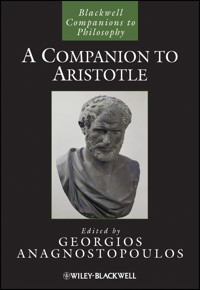
A Companion to Aristotle E-Book
39,99 €
Mehr erfahren.
- Herausgeber: John Wiley & Sons
- Kategorie: Geisteswissenschaft
- Serie: Blackwell Companions to Philosophy
- Sprache: Englisch
The Blackwell Companion to Aristotle provides in-depth studies of the main themes of Aristotle's thought, from art to zoology.
- The most comprehensive single volume survey of the life and work of Aristotle
- Comprised of 40 newly commissioned essays from leading experts
- Coves the full range of Aristotle's work, from his 'theoretical' inquiries into metaphysics, physics, psychology, and biology, to the practical and productive "sciences" such as ethics, politics, rhetoric, and art
Sie lesen das E-Book in den Legimi-Apps auf:
Seitenzahl: 1797
Veröffentlichungsjahr: 2013
Ähnliche




















Table of Contents
Blackwell Companions to Philosophy
Title page
Copyright page
Dedication
Notes on Contributors
Preface
Abbreviations of Aristotle’s Works
Part I: Aristotle’s Life and Works
1 Aristotle’s Life
Early Years in Stageira
First Athenian Period
Period of Travels
Second Period in Athens
Last Year in Chalcis, Euboia
2 Aristotle’s Works and the Development of His Thought
Catalogues and Editions of Aristotle’s Works
Chronology of Aristotle’s Works
The Development of Aristotle’s Thought
Part II: The Tools of Inquiry
3 Deductive Logic
Introduction
Statements
The Square of Opposition
Figure and Mood
Deduction
Counterexamples
Independence
Soundness
Completeness: Syllogistic Arguments
Completeness: Categorical Arguments
Completeness: Arguments in General
4 Aristotle’s Theory of Demonstration
Necessity and Predication “Through Itself”
Demonstrations, Universals, and the Objects of Scientific Knowledge
The Route to the Principles
Axioms, Common Principles, and Self-evidence
Demonstration and Analysis
5 Empiricism and the First Principles of Aristotelian Science
I
II
III
IV
6 Aristotle on Signification and Truth
Signification
Truth
7 Aristotle’s Methods
Introduction
Aristotle’s Presuppositions and Demonstration
Induction (epagôgê) and Comprehension or Intuition (nous)
Collecting Facts and Finding Causes
Dialectic and its Uses
Part III: Theoretical Knowledge
A. Metaphysics
8 The Science and Axioms of Being
Aristotle’s Declaration of a General Science of Being qua Being
A Problem for the Science of Being
The Content of the General Science of Being
Including Axioms in the General Science of Being
The Notion of the Firmest Principle
Proving Something about an Axiom: the Indubitability Proof of PNC
PNC as the Ultimate Principle
Defending an Axiom: the Elenctic Proof of PNC
Theology and the General Science of Being
9 Aristotelian Categories
The Fourfold Classification
Tropes
Aristotle’s Principle
In a Subject
Owen’s Reading
Frede’s Reading
Differentiae
Options for “In a Subject”
The Tenfold Classification
Substance
Relatives
The Place of the Categories in Aristotle’s Thought
Being Said in Many Ways
Two Systems?
The Afterlife of the Doctrine of Categories
10 Form and Matter
Some Metaphysical Preliminaries
The Introduction of Matter and Form
The Hierarchy of Form and Matter
Matter and Potentiality, Form and Actuality; the Teleological Conception of Matter
Form, Matter, and the “Unity of Substance”
Prime Matter
Entrapment and the Homonymy of the Body and Its Organs
11 Aristotle on Universals
I
II
III
12 Substances
The Categories
Metaphysics Z
The Inconsistency
13 Causes
Aristotle and His Predecessors
The Theory of the Physics
The Model Applied: Causation in Nature
The Relations between the Causes
Chance and Explanation
Explanation and Generality
Explanation, Necessity, and Finality
14 Heavenly Bodies and First Causes
B. Physics
15 Mixing the Elements
The Early Elements
Aristotle’s Elements
Combining the Elements
Mixing by Division
The Account of Mixing and Potential Persistence
Further Considerations on the Mechanism of Mixing
16 Aristotle on the Infinite, Space, and Time
Aristotle on the Infinite (to apeiron): From Cosmological Principle to Mathematical Operation
Aristotle on Space: Magnitude (megethos) and Place (topos)
Aristotle on Time: The “Number of Motion” and “Ever-rolling Stream”
17 Change and Its Relation to Actuality and Potentiality
The Account of Change in Physics III.1–3
Some Problems for This Account of Change
C. Psychology
18 The Aristotelian Psuchê
Aristotle’s Middle Way
The Background Assumptions of Hylomorphism
The Basic Theses of Aristotle’s Psychological Hylomorphism
Two Arresting Consequences of Hylomorphism
A Concluding Complication
19 Sensation and Desire
Sensation
Desire
20 Phantasia and Thought
Phantasia
Thought
D. Biology
21 Teleology in Living Things
Artifacts and the Four Causes
Goals vs. Functions
The Argument from Non-Coincidence
Craft, Form, and Spontaneity
Non-bodily Causes
Global Teleology
22 Form, Essence, and Explanation in Aristotle’s Biology
Introduction
Essence and Explanation in Theory and Practice
Form, Function, and Biological Essentialism
The Priority of Being to Generation
Conclusion
23 Generation of Animals
The Place of GA in Aristotle’s Philosophy
Male and Female as archai
The Nature of Sperma
The Transmission of Soul: GA II.3
Reproductive Hylomorphism
Inheritance
Individual Forms
Four Causes of Generation
Part IV: Practical Knowledge
A. Ethics
24 Happiness and the Structure of Ends
The Good Conceived as an End
The Good as a Convergent End
The Meaning of “Eudaimonia”
Happiness vs. the Happy Life
The Finality Criterion
The Self-sufficiency Criterion
Inclusivism
The Shape of the Happy Life
Concluding Remarks
25 Pleasure
Introduction
Should We Look for a Unified Theory of Pleasure?
The Phenomenon of Sensate Pleasure and the Restoration Theory
How Aristotle Refutes the Restoration Theory
Two Objections to Aristotle’s Refutation
Actualizing Potentials and Acts of Power
Levels of Completeness of Act
Reply to First Objection: False Pleasure
Reply to Second Objection
Unforced Acts of Power Are Complete Human Acts
Beauty in Act
Impeded and Unimpeded Complete Human Acts
Counterfeit Pleasure
Complete Acts Relative to the Agent’s Nature
Absolutely Complete Acts
Pleasure as Flow
Divine Act
Conclusion
26 Human Excellence in Character and Intellect
Initial Survey: The Role of the Human Excellences in Aristotle’s Practical Philosophy
The Nature of Virtue and the Doctrine of the Middle/Mean (DOM)
27 Courage
Introduction
Courage and Self-control
The Object of Cheer
Danger as the Object of Cheer
Safety as the Object of Cheer
Success as the Object of Cheer
Horatius at the Bridge
Acting for the Sake of the Fine
When is Death Fine?
28 Justice
Introduction
Preliminaries
Universal vs. Particular Justice
The Scope of Particular Justice
Justice and the Doctrine of the Mean: The Problem
Distributive and Corrective Justice
Political Justice
Pleonexia
Justice and the Doctrine of the Mean: Aristotle’s Solution
Conclusion
29 Friendship
Two Initial Difficulties
Three Kinds of Friendship
Resolution of the Difficulties
Egoism and Altruism in Friendship
Extended Friendships
A Friend as “Other Self”
30 Voluntary, Involuntary, and Choice
Agent Causation
Choice
Agent Causation (Cont.)
Knowledge
Moral Responsibility
Moral Responsibility for Virtue and Vice
Determinism and Compatibilism
Criticisms
31 Aristotle on Action, Practical Reason, and Weakness of the Will
Aristotle on Action
Aristotle on Practical Reason
Aristotle on Weakness of the Will
B. Politics
32 The Naturalness of the Polis in Aristotle
Natural Beings
The Polis as a Natural Phenomenon
Correct and Deviant Constitutions
The Naturalness of the Best Constitution
33 Rulers and Ruled
Mastery: Rule over Slaves
Parental Rule and Marital Rule
Contra Plato
Political Rule
The Kingship Problem
34 Aristotle on the Ideal Constitution
Problems Concerning Aristotle’s Ideal Constitution
Ideal Theory and Political Practice
Criticisms of Previous Ideal Constitutions
Aristotle’s Ideal State
Aristotle Legacy to Ideal Theory
35 Excellences of the Citizen and of the Individual
Virtues of Citizens Distinguished from Complete Moral Virtue
Civic Virtue as Excellence in Civic Function
Different Constitutions and Different Virtues
Good Men in Bad Cities
36 Education and the State
Part V: Productive Knowledge
A. Rhetoric
37 The Nature and Goals of Rhetoric
The Dialectical Approach
The Moral-psychological Approach
Rhetoric as Dealing with Accepted Beliefs (endoxa)
The Stylistic Approach
The Conventional Approach
The Purpose Of Rhetoric
38 Passions and Persuasion
The Rhetoric’s Conception of the Passions
Persuasion and the Passions
Rousing the Passions
Tactics
The Legitimacy of the Passions
B. Art
39 Aristotle’s Poetics: The Aim of Tragedy
What Is Tragedy?
Mimesis
Understanding
Katharsis
Five Questions for Interpreters
A Short History of Katharsis Interpretation
The Nature of Our Question
40 The Elements of Tragedy
Introduction
The Elements of Tragedy and Its Definition
Plot and Character
Simple and Complex Plots
Good and Bad Tragic Plots
Conclusion
Index
Blackwell Companions to Philosophy
This outstanding student reference series offers a comprehensive and authoritative survey of philosophy as a whole. Written by today’s leading philosophers, each volume provides lucid and engaging coverage of the key figures, terms, topics, and problems of the field. Taken together, the volumes provide the ideal basis for course use, representing an unparalleled work of reference for students and specialists alike.
Already published in the series:
This paperback edition first published 2013
© 2013 Blackwell Publishing
Edition history: Blackwell Publishing Ltd (hardback, 2009)
Blackwell Publishing was acquired by John Wiley & Sons in February 2007. Blackwell’s publishing program has been merged with Wiley’s global Scientific, Technical, and Medical business to form Wiley-Blackwell.
Registered Office
John Wiley & Sons Ltd, The Atrium, Southern Gate, Chichester, West Sussex, PO19 8SQ, UK
Editorial Offices
350 Main Street, Malden, MA 02148-5020, USA
9600 Garsington Road, Oxford, OX4 2DQ, UK
The Atrium, Southern Gate, Chichester, West Sussex, PO19 8SQ, UK
For details of our global editorial offices, for customer services, and for information about how to apply for permission to reuse the copyright material in this book please see our website at www.wiley.com/wiley-blackwell.
The right of Georgios Anagnostopoulos to be identified as the author of the editorial material in this work has been asserted in accordance with the UK Copyright, Designs and Patents Act 1988.
All rights reserved. No part of this publication may be reproduced, stored in a retrieval system, or transmitted, in any form or by any means, electronic, mechanical, photocopying, recording or otherwise, except as permitted by the UK Copyright, Designs and Patents Act 1988, without the prior permission of the publisher.
Wiley also publishes its books in a variety of electronic formats. Some content that appears in print may not be available in electronic books.
Designations used by companies to distinguish their products are often claimed as trademarks. All brand names and product names used in this book are trade names, service marks, trademarks or registered trademarks of their respective owners. The publisher is not associated with any product or vendor mentioned in this book. This publication is designed to provide accurate and authoritative information in regard to the subject matter covered. It is sold on the understanding that the publisher is not engaged in rendering professional services. If professional advice or other expert assistance is required, the services of a competent professional should be sought.
Library of Congress Cataloging-in-Publication Data
A companion to Aristotle / edited by Georgios Anagnostopoulos.
p. cm. – (Blackwell companions to philosophy)
Includes bibliographical references and index.
ISBN 978-1-4051-2223-8 (hardcover : alk. paper); ISBN 978-1-118-59243-4 (pbk. : alk. paper)
1. Aristotle. I. Anagnostopoulos, Georgios.
B485.C59 2009
185–dc22 2008036223
A catalogue record for this book is available from the British Library.
Cover image: Roman bust of Aristotle. Naples, National Museum. Photo © 1990 Scala, courtesy of the Ministero Beni e Att. Culturali.
Cover design by Workhaus.
(1904–2006)
Notes on Contributors
Georgios Anagnostopoulos is a Professor of Philosophy at the University of California, San Diego. His research interests primarily focus on ancient Greek philosophy, ethics, and metaphysics. He has authored Aristotle on the Goals and Exactness of Ethics (1994), edited Law and Rights in the Ancient Greek Tradition (a supplementary volume of Philosophical Inquiry, 2006), and has published a number of articles on ancient Greek philosophy and medicine.
Elizabeth Belfiore is Professor of Classics at the University of Minnesota, Twin Cities. Her two main areas of research are ancient philosophy and Greek tragedy. She is the author of Tragic Pleasures: Aristotle on Plot and Emotion (1992), Murder Among Friends: Violation of Philia in Greek Tragedy (2000), and numerous articles in these fields.
Sarah Broadie taught at the University of Edinburgh, the University of Texas at Austin, Yale, Rutgers, and Princeton, before taking up her present position at the University of St. Andrews. She has wide interests in philosophy and her collection Aristotle and Beyond: Essays in Metaphysics and Ethics was published in 2007.
Victor Caston is Professor of Philosophy and Classical Studies at the University of Michigan. His research concentrates on issues in the philosophy of mind throughout antiquity, and he has published extensively on Aristotle, including papers on perception, phantasia, and intellect, with a focus on mind–body issues, mental causation, intentionality, and consciousness. He is currently at work on a book on the problem of intentionality in ancient philosophy.
S. Marc Cohen is Professor of Philosophy at the University of Washington, where he teaches courses in the history of ancient Greek philosophy, logic, and the philosophy of language. He has also taught at Minnesota, Rutgers, Berkeley, and Indiana. His publications have mainly concerned the metaphysics and epistemology of Plato and Aristotle. He is co-editor of Readings in Ancient Greek Philosophy (2005) and co-author of Ammonius: On Aristotle’s Categories (1991).
Ursula Coope is Fellow of Corpus Christi College and University Lecturer at Oxford University. She is the author of Time for Aristotle: “Physics” IV.10–14 (2005).
Paolo Crivelli teaches philosophy at New College, Oxford. His areas of research are Ancient Philosophy, mainly Plato, Aristotle, and the Stoics. He has published a book Aristotle on Truth (2004) and several articles in various journals (Archiv fuer Geschichte der Philosophie, Phronesis, Oxford Studies in Ancient Philosophy, among others), along with collections of essays.
Norman O. Dahl is Professor of Philosophy, Emeritus, University of Minnesota. His main areas of research interest are ethics and ancient Greek philosophy. Publications in the latter area include: Practical Reason, Aristotle, and Weakness of the Will, (1984); “Plato’s Defense of Justice,” Philosophy and Phenomenological Research (1991); “Sub-stance, Sameness, and Essence in Metaphysics VII 6,” Ancient Philosophy (2007); and Nicomachean Ethics Books III–IV, “Theses and Arguments” and “Alternative Interpretations,” Project Archelogos.
Michael Ferejohn is an Associate Professor of Philosophy at Duke University, and specializes in Platonic and Aristotelian metaphysics and epistemology and Socratic ethics. He is the author of The Origins of Aristotelian Science (1991) as well as numerous articles on Plato and Aristotle in scholarly journals.
R. J. Hankinson was educated at Oxford and Cambridge, and is Professor of Philosophy and Classics at the University of Texas at Austin. He has also taught at McGill University, and was a Research Fellow of King’s Cambridge. He has published numerous articles on various aspects of Greek philosophy and science, and is the author of several books, including The Sceptics (1995) and Cause and Explanation in Ancient Greek Thought (1998). He is currently working on a history of the concept of demonstration.
Robert Heinaman of University College London specializes in ancient philosophy. His recent publications include: “Why Justice Does Not Pay in Plato’s Republic,” Classical Quarterly (2004); “Actuality, Potentiality and De Anima II.5,” Phronesis (2007); and “Aristotle on the Activity Eudaimonia,” Oxford Studies in Ancient Philosophy (2007).
Devin M. Henry of the University of Western Ontario, researches in ancient philosophy and science, and philosophy of biology. Selected publications include: “Organismal Natures,” Apeiron (2008); “How Sexist is Aristotle’s Developmental Biology?” Phronesis (2007); “Aristotle on the Mechanisms of Inheritance,” Journal of the History of Biology (2006); “Embryological Models in Ancient Philosophy,” Phronesis (2005), and “Themistius and Spontaneous Generation in Aristotle’s Metaphysics,” Oxford Studies in Ancient Philosophy (2003).
David Keyt is a professor of philosophy at the University of Washington. His current research is on Plato and Aristotle. He is the author of Aristotle: Politics V and VI (1999) and co-editor with Fred D. Miller, Jr. of A Companion to Aristotle’s Politics (1991), and Freedom, Reason, and the Polis: Essays in Ancient Greek Political Philosophy (2007).
Gavin Lawrence is Professor at the Department of Philosophy, UCLA. He works mainly in ancient philosophy, practical philosophy, and later Wittgenstein.
Gabriel Richardson Lear is Associate Professor of Philosophy at the University of Chicago. She is currently writing about topics in Plato’s and Aristotle’s ethics and aesthetics. Her publications include: Happy Lives and the Highest Good: An Essay on Aristotle’s “Nicomachean Ethics” (2004) and “Aristotle on Moral Virtue and the Fine” in The Blackwell Guide to Aristotle’s “Nicomachean Ethics” (2005).
Stephen Leighton is Professor of Philosophy at Queen’s University, Canada. His research interests include Plato, Aristotle (particularly their philosophical psychologies and understandings of value), theories of the emotions, and value theory.
James G. Lennox is Professor of History and Philosophy of Science at the University of Pittsburgh. His research focuses on the history and philosophy of biology and especially on Aristotle and the Aristotelian tradition and Charles Darwin and Darwinism. His publications include a translation with commentary of Aristotle: On the “Parts of Animals” I–IV (2001) and a collection of essays entitled Aristotle’s Philosophy of Biology: Studies in the Origins of Life Science (2001).
Frank A. Lewis is Professor of Philosophy at the University of Southern California. He is the author of Substance and Predication in Aristotle (1991), and co-editor (with Robert Bolton) of Form, Matter, and Mixture in Aristotle (1996). Recent publications deal mostly with topics in Aristotle’s metaphysics and natural philosophy.
Michael J. Loux is Shuster Professor of Philosophy at the University of Notre Dame. His areas of research include metaphysics and Aristotle. Among his publications are: Substance and Attribute, Primary Ousia, Metaphysics: A Contemporary Introduction (3rd edn.), and Nature, Norm, and Psyche.
Mohan Matthen is Canada Research Chair in Philosophy, Perception, and Com-munication at the University of Toronto. Previously he taught at the University of British Columbia and the University of Alberta. He has worked on ancient science and metaphysics, and on connections between the two. Currently, his main area of research is the philosophy of perception: Seeing, Doing, and Knowing: A Philosophical Theory of Sense-perception (2005).
Gareth B. Matthews is Emeritus Professor of Philosophy at the University of Massachusetts, Amherst. He taught previously at the University of Virginia and the University of Minnesota. He is the author of a number of books and articles on ancient and medieval philosophy, including Socratic Perplexity and the Nature of Philosophy (1999) and Augustine (2005).
Robert Mayhew is Professor of Philosophy at Seton Hall University. His research interests include the moral and political thought of Plato and Aristotle, and the twentieth-century novelist-philosopher Ayn Rand. His recent books are The Female in Aristotle’s Biology: Reason or Rationalization (2004) and Plato: “Laws” 10 (2008). He has recently finished a book on Prodicus of Ceos and is currently working on a revised edition of the Aristotelian Problemata.
Fred D. Miller, Jr. is Professor of Philosophy and Executive Director of the Social Philosophy and Policy Center at Bowling Green State University. He is the author of Nature, Justice, and Rights in Aristotle’s Politics (1995) and co-editor of numerous collections, including A Companion to Aristotle’s Politics (1991), of Freedom, Reason, and the Polis: Essays in Ancient Greek Political Philosophy (2007), and A History of the Philosophy of Law from the Ancient Greeks to the Scholastics, volume 6 of A Treatise of Legal Philosophy and General Jurisprudence (2007).
Deborah Karen Ward Modrak is a Professor of Philosophy at the University of Rochester. She has published articles on a wide range of topics in ancient Greek philosophy. She is the author of Aristotle: The Power of Perception (1987) and Aristotle’s Theory of Language and Meaning (2001).
Michael Pakaluk is Professor of Philosophy and Director of Integrative Research at the Institute for the Psychological Sciences in Arlington, VA. His work currently focuses on Aristotelian psychology, moral psychology, and philosophy of action. His books include the Clarendon Aristotle volume on Nicomachean Ethics, Books VIII and IX, Aristotle’s Nicomachean Ethics: An Introduction (2005), and Aristotelian Moral Psychology and Philosophy of Action (with Giles Pearson, forthcoming).
Christof Rapp is Professor of Philosophy at the Humboldt-University at Berlin. His areas of research include ancient philosophy, ontology, ethics, philosophy of rhetoric. Among his publications are: Vorsokratiker (1997, 2007), Aristoteles zur Einführung (2001, 2008), Aristoteles, Werke in deutscher Übersetzung, Bd. 4: “Rhetorik” (2002).
C. D. C. Reeve is Delta Kappa Epsilon Distinguished Professor of Philosophy at the University of North Carolina at Chapel Hill. He works in ancient Greek philosophy, ethics, metaphysics, and the philosophy of film. He is the author of Love’s Confusions (2005), Women in the Academy (2001), Substantial Knowledge (2000), Practices of Reason (1992), Socrates in the Apology (1989), and Philosopher-Kings (1988, 2006). He has translated Plato’s Cratylus (1997), Euthyphro, Apology, Crito (2002), Republic (2004), Meno (2006), and Aristotle’s Politics (1998).
Jean Roberts is an Associate Professor of Philosophy at the University of Washington, Seattle. She has written mainly on Plato’s and Aristotle’s moral and political theory and is working on a book on Aristotle’s Politics.
George Rudebusch is Professor of Philosophy at Northern Arizona University. He is the author of Socrates, Pleasure, and Value (1999) and Socrates (forthcoming).
Theodore Scaltsas, University of Edinburgh, works on ancient philosophy and contemporary metaphysics. His books include: Substances and Universals in Aristotle’s Metaphysics, Unity, Identity and Explanation in Aristotle’s “Metaphysics,” the Philosophy of Zeno, the Philosophy of Epictetus. His recent articles are on the topics of plural subjects and relations in Plato, ontological composition, and being determinate in Aristotle. He is the founder and director of Project Archelogos.
Christopher Shields is Fellow of Lady Margaret Hall and Professor of Classical Philosophy in the University of Oxford. He is the author of Aristotle, Order in Multiplicity: Homonymy in the Philosophy of Aristotle, Aristotle, “De Anima”: Translation and Commentary, Classical Philosophy: A Contemporary Introduction, and (with Robert Pasnau) The Philosophy of Thomas Aquinas. He is also editor of The Blackwell Guide to Ancient Philosophy and The Oxford Handbook on Aristotle.
Robin Smith is Professor of Philosophy at Texas A&M University. His areas of research include ancient Greek philosophy, especially Aristotle and ancient logic. Among his publications are Aristotle, “Prior Analytics,” (1989) and Aristotle, Topics I, VIII and Selections (1997).
Richard Stalley is Professor of Ancient Philosophy at the University of Glasgow. He has worked mainly on the moral and political philosophy of Plato and Aristotle and on Scottish Philosophy. His publications include An Introduction to Plato’s Laws (1983) and Aristotle’s “Politics” (1995).
Michael V. Wedin is Professor of Philosophy at the University of California, Davis. Apart from a brace of articles on Wittgenstein’s Tractatus, and an occasional foray into Plato, his essays focus chiefly on Aristotle’s logic and semantics, philosophy of mind, and metaphysics. Lengthier efforts include Mind and Imagination in Aristotle (1988) and Aristotle’s Theory of Substance: The “Categories” and “Metaphyiscs” Zeta (2000). He has also completed a book on the logical structure of Parmenides’ “Way of Truth.”
Michael J. White is Professor of Philosophy at Arizona State University and Professor of Law at the Sandra Day O'Connor College of Law, Arizona State University. His principal areas of research are history of philosophy, of natural science, and of mathematics, political philosophy, jurisprudence, and mathematical logic. His publications include: “Plato and Mathematics,” in A Companion to Plato (2006); “On Doubling the Cube: Mechanics and Conics, Apeiron, 2006; “Stoic Natural Philosophy (Physics and Cosmology),” in The Cambridge Companion to the Stoics (2003), and “The Problem of Aristotle’s Nous Poiêtikos” (Review of Metaphysics (2004)).
Paul Woodruff is Darrell K. Royal Preofessor of Ethics and American Society at the University of Texas where he serves in the departments of philosophy and classics. With Peter Meineck, he has published a complete translation of Sophocles’ plays. One of his recent books is The Necessity of Theater: The Art of Watching and Being Watched.
Charles M. Young is Professor of Philosophy at Claremont Graduate University. He is currently completing a monograph on Aristotle’s accounts of virtue and the virtues and the module on Nicomachean Ethics V for Project Archelogos, after which he plans work on Aristotelian grace (the impulse to return good for good received) and on Aristotle’s Rhetoric and Shakespeare’s Julius Caesar.
Preface
The present volume does not provide a survey of all of Aristotle’s thought, and it was not intended to do so. Its aim is to treat some central topics of his philosophy in as much depth as is possible within the space of a short chapter. Ancient and later biographers and historians of philosophy attribute to Aristotle a large number of works, two-thirds of which have not survived. Even what has survived is an astounding achievement, both in its size and scope. Aristotle’s extant works add up to more than two thousand printed pages and range over an astonishingly large number of topics – from the highly abstract problems of being, substance, essence, form, and matter to those relating solely to the natural world, and especially to living things (e.g., nutrition and the other faculties of the soul, generation, sleep, memory, dreaming, movement, and so on), the human good and excellences, the political association and types of constitutions, rhetoric, tragedy, and so on.
Clearly, not all the topics Aristotle examines in his works could be discussed in a single volume, and choices had to be made as to which ones to include. The choices were guided by an intuitive consideration – e.g., the centrality a topic has in the totality of the Aristotelian corpus (e.g., substance, essence, cause, teleology) or in a single, major work (e.g., the categories, the soul, and the generation of animals are the central topics in three different Aristotelian treatises). These considerations produced a first list. Still, the list was too long for a single volume, and had to be shortened. The topics that made the final list seemed to the editor to be the ones that any volume with the objectives of this one has to include. Others might have come up with different lists, but they would not be radically different from this. The overwhelming majority of the topics discussed below would be on every list that was aiming to achieve the objectives of this volume. Individually, each one of these topics receives an extensive treatment in Aristotle’s works, and the views he articulates on them, when put together, give a good sense of the kinds of problems that exercised Aristotle’s mind and the immense and lasting contributions he made in his investigations of them.
The contents of the volume are divided into five parts, with part I covering Aristotle’s life and certain issues about the number, edition, and chronology of his works. The division of the remaining chapters is based on the way Aristotle frequently characterizes groups of inquiries in terms of their goals. Thus, part II consists of a number of chapters discussing topics from the treatises that have been traditionally called Organon, i.e., those studying the instruments or tools for reasoning, demonstrating and, in general, attaining knowledge and truth. Aristotle does not label these works (Categories, On Interpretation, Prior Analytics, Posterior Analytics, Topics, On Sophistical Refutations) Organon, but in several passages in his extant works he indicates that he views them as the instruments of inquiry and knowledge. The division of the remaining chapters into three parts – Theoretical, Practical, and Productive Knowledge – is, of course, based on the way Aristotle himself frequently divides the various inquiries on the basis of their ultimate goals – knowledge, action, and production. The chapters included in each one of these parts are further subdivided into groups on the basis of the subfield of Aristotelian philosophy to which a topic or the work(s) treating it belong – Metaphysics (seven chapters), Physics (three), Psychology (three), Biology (three) in part III (theoretical knowledge); Ethics (eight) and Politics (five) in part IV (practical knowledge); and Rhetoric (two) and Art (two) in part V (productive knowledge). Of course, several topics (e.g., cause, teleology, substance) are discussed in many different Aristotelian treatises, with some of them falling into different groups with respect to their ultimate goals – e.g., substance is explored in both the Categories (Organon) and the Metaphysics (theoretical knowledge).
The contributors to the volume are many, and no attempt was made to impose a uniform style with respect to writing, presentation, or argumentation. Each contributor was left free to use her/his favored approach, except in the way references to Aristotle’s works or citations of specific passages in them are made – a uniform system has been adopted. Although in some instances the whole title of a work (e.g., Politics) is given, most frequently an abbreviation is used (e.g., Pol: see list of abbreviations). Citations of passages in the Aristotelian corpus are made by giving: (1) the title of the specific work, (e.g., Pol or An for de Anima); (2) the Book for those Aristotelian treatises that are divided into Books in Roman numerals (e.g., I, II) – except for Met where Books are identified by uppercase Greek letters (e.g., Γ, Θ) and lowercase alpha (α) for the second Book; (3) the chapter within the Book or treatise in Arabic numerals; (4) and the Bekker page and line number – e.g., An II.1 412a3, or Met Γ.4 1008b15. Each chapter includes a short bibliography listing the sources cited in it and in some cases additional works on the topic discussed that might be of interest to the reader. Space limitations did not permit the inclusion of a comprehensive bibliography on Aristotle.
Working on the volume gave me the opportunity to reconnect with colleagues I have known over the years and to come in contact with others with whom I had no previous exchanges. Collaborating with them has been rewarding in more than one way, and I want to thank all of them for accepting the invitation to be a part of the project and for their contributions. I also wish to thank several people at Blackwell who made the publication of the volume a reality and, most of all, for their patience: Nick Bellorini for inviting me to edit the volume, Liz Cremona, and Graeme Leonard.
Abbreviations of Aristotle’s Works
Categories (Categoriae)
Cat
Eudemian Ethics (Ethica Eudemia)
EE
Generation of Animals (de Generatione Animalium)
GA
History of Animals (Historia Animalium)
HA
Interpretations (de Interpretatione)
Int
Magna Moralia
MM
Metaphysics (Metaphysica)
Met
Meteorology (Meteorologica)
Meteor
Movement of Animals (de Motu Animalium)
MA
Nicomachean Ethics (Ethica Nicomachea)
NE
On Dreams (de Insomniis)
Insomn
On Generation and Corruption (de Generatione et Corruptione)
GC
On the Heavens (de Caelo)
Cael
On Memory (de Memoria et Reminiscentia)
Mem
On the Soul (de Anima)
An
On the Universe (de Mundo)
Mund
On Virtues and Vices (de Vertutibus et Vitiis)
VV
Parts of Animals (de Partibus Animalium)
PA
Physics (Physica)
Phys
Poetics (Poetica)
Poet
Politics (Politica)
Pol
Posterior Analytics (Analytica Posteriora)
An. Post
Prior Analytics (Analytica Priora)
An. Pr
Problems (Problemata)
Prob
Progression of Animals (de Incessu Animalium)
IA
Rhetoric (Rhetorica)
Rhet
Sense and Sensibilia (de Sensu et Sensibilibus)
Sens
Sophistical Refutations (Sophistici Elenchi)
SE
Topics (Topica)
Top
Part I
Aristotle’s Life and Works
1
Aristotle’s Life
GEORGIOS ANAGNOSTOPOULOS
To many, Aristotle is the last great figure in the distinguished philosophical tradition of Greece that is thought to begin with Thales (ca. 600 BCE). Of course, Greek philosophy did not end with Aristotle; it continued for several centuries in the various schools – those of the Epicureans, Skeptics, and Stoics as well as Plato’s Academy and Aristotle’s own Peripatetic School – that flourished in Athens and elsewhere up to the early centuries of the Byzantine Empire. Yet there is considerable truth in the opinion of the many, if viewed as a claim about great individual figures in the Greek philosophical tradition. For Aristotle was the last great individual philosopher of ancient times, one of the three thinkers – the others being Socrates (470–399 BCE) and Plato (427–347 BCE) – that comprise what many consider to be the greatest philosophical trio of all time. Their philosophical careers span more than a hundred years, and all three were major figures in the lively philosophical scene of fifth- and fourth-century Athens. It was a unique moment in the history of philosophy, one that saw Socrates engaging in discussions with Plato – by far the most distinguished of his followers – and Plato instructing and debating with Aristotle – by far the most eminent student to graduate from and do research in his own school, the Academy.
While Socrates and Plato were born and spent their entire lives in Athens – indeed, Socrates took pride in the fact he left Athens only for military service (Plato, Crito 52b–c) – Aristotle was not born in Athens, never became a citizen of it and, according to some, never felt at home in it, despite his extended stays there. He spent most of his life and died away from his birthplace. Aristotle’s life may conveniently be divided into the following five periods, which correspond to his residency in certain parts of the Greek world and, according to some, to the main stages of his intellectual growth.
Early Years in Stageira
Aristotle spent the first seventeen years of his life in the ancient Greek city-state of Stageira, where he was born in 384 BCE. Stageira, colonized by Andros (an Aegean island) and Chalcis of Euboia, is located in the eastern-most finger of the Chalcidici Peninsula, a region of the ancient Greek world located about 500 km north of Athens. His father’s family had its origins in Messenia at the south-western tip of the Peloponnesos; the family of his mother, Phaistis, came from Chalcis of Euboia, an island on the Aegean Sea, a few kilometers west of Athens. While there is no evidence that Aristotle retained any contact with Messenia, he stayed connected to his mother’s family and estate in Chalcis; he spent the last year of his life and died there. Aristotle’s father, Nicomachos, belonged to the Asclepiadae medical guild and served as a court physician to the Macedonian King Amyntas II. Aristotle probably spent some of his childhood in the Macedonian palace in Pella, thus establishing connections with the Macedonian monarchy that were to last throughout his whole life. Both of Aristotle’s parents died when he was still a boy, and his upbringing was entrusted to a family relative named Proxenos, whose own son, Nicanor, was later adopted by Aristotle.
The paucity of information on Aristotle’s childhood has made it difficult to answer questions about influences on him during the early, formative years of his life, and it has provided ample ground for speculation. Some have wondered how one of the world’s greatest and most influential minds could have come from a rather remote part of the Greek world and far away from Athens. Such wondering seems unfounded. As G. E. R. Lloyd (1968: 3) observes, in the ancient Greek world, many great thinkers were born or flourished in places far away from Athens. Democritus, whose atomistic conception of matter has shaped the scientific account of the natural world for centuries, came from a place (Abdera) that is farther away from Athens than is Aristotle’s birthplace. It is perhaps more interesting to ask about the influence his early surroundings may have had on Aristotle’s attitudes or ideas. For example, one might puzzle about the personal basis of Aristotle’s views on the ideal size of a polis (city-state). At the time he was articulating these views, Alexander the Great was creating a political entity that extended eastward from the Greek mainland to India, something Aristotle would not identify as a polis on account of its size. Many of the Greek city-states that were most familiar to Aristotle, including those of Athens and Sparta, far exceeded in size his ideal polis which, according to him: (a) should be self sufficient (Pol VII.5 1326b26 and throughout this work); (b) should have a population “that is the largest number sufficient for the purposes of life and can be taken at a single view” (VII.4 1326b25); and (c) its territory must be able to be taken in at one view (VII.5 1327a3). Of course, Aristotle gives arguments in support of his views, and any assessment of the plausibility of the latter would solely depend on the soundness and validity of these arguments. Yet it is striking how well Aristotle’s birthplace met the requirements he sets for his ideal city. Its timber,1 mining, and fishing industries probably provided enough for the sustenance of its citizens, and from the highest point of the site that is now identified with ancient Stageira one can see in one view what most likely was the whole city-state. Also, its proximity to the sea satisfied Aristotle’s defense and commercial requirements (VII.5, 6). Its relatively small number of citizens would also have made it possible for its residents to know each other and develop the kind of friendship among themselves that Aristotle considers desirable in a polis. It is not unreasonable to suppose that his childhood experiences of living in Stageira left lasting impressions in Aristotle’s mind and colored his attitudes toward and beliefs about aspects of the polis.
Scholarly opinion is almost unanimous in supposing Aristotle’s interest in biology and on the empirical approach to inquiry, both evident throughout his works, were due to his father’s influence during his childhood years. He and his associates compiled a vast body of facts and developed some far-reaching theories about nearly every biological phenomenon with which they were familiar. Indeed, Aristotle seems to be startled by the phenomena of living things, even ordinary ones (e.g., that trees have roots), and his desire to find explanations for them and, in turn, fit these into a comprehensive explanatory scheme is boundless. Members of the Asclepiadae guild were well-known in antiquity for carrying on empirical research that included dissections and, according to Galen (On Anatomical Procedures II.1), they also trained their sons in such research, suggesting that Aristotle’s strong interest in the study of living things, his strong reliance on observation in such studies, and the doing of dissections were learned from his father and instilled in him from his early childhood. In his biological works, he makes references to dissections and even to works titled Dissections, which appear on the ancient lists of his writings but have not survived. These same lists include lost works on medicine.2 It is apparent from the frequent references to medicine throughout his extant corpus that he had well-defined views about medicine as a scientific inquiry and healing art (Sens 436a17, and throughout his ethical works and Met). In addition, the surroundings of Aristotle’s childhood were an ideal environment for the interest that was kindled by the family to flourish. The densely wooded area of his birthplace was teeming with animals as was the Aegean Sea with marine life, providing a large variety of specimens for observation and study, further exciting Aristotle’s inquisitive mind.
First Athenian Period
In 367 and at the age of seventeen/eighteen, Aristotle entered Plato’s Academy, where he stayed for the next nineteen years, until Plato’s death. The specific reasons that led Aristotle to join Plato’s school are not known and, once more, scholarly speculation tries to fill the void. Thus W. D. Ross (1995: 1) surmises that “We need not suppose that it was any attraction to the life of philosophy that drew him to the Academy; he was simply getting the best education that Greece could offer.” Given that in Plato’s/Aristotle’s time philosophy encompassed all disciplines – including mathematics, physics, astronomy, biology, politics, ethics, etc. – it is difficult to make sense of the distinction between education and philosophy Ross wishes to draw. More importantly, given the fact that Aristotle lived the life of philosophy and in his ethics defends the view that the ideal life for a human is the contemplative life, it is quite likely that what attracted him to Plato’s Academy was precisely the life of philosophy.
Whatever Aristotle’s reasons for entering the Academy, his long stay makes it abundantly clear that he found the aims, intellectual approaches, and research endeavors of the school to his liking. It seems that Aristotle did not have personal contact with or come under the direct influence of Plato in the first two years in the Academy, since the latter was absent in Sicily. But there is no doubt that those responsible for his instruction while he was a student were following the instructional guidelines of the Academy, which reflected Plato’s own approach to education and the main tenets of his philosophical thinking. Aristotle, as was probably the case with the other prominent members of the Academy, shared some of the main tenets of Platonism, first as a student and then as an associate in the school, when he participated in teaching and engaged in research. According to Diogenes Laertius (third century CE) – one of our important sources of information on Aristotle’s life – he was “the most genuine student of Plato” (V.1). Years after his sojourn in Plato’s school, he continues to speak with affection toward those sharing the Platonist outlook, some of whom had been his associates in the Academy, considers them friends, and appears to include himself among the followers of Plato (NE I.6 1096a11).
What survives from his early writings during his stay in the Academy clearly reflects his general, but not necessarily complete, adherence to Platonism with respect to the topics he discussed, the views he articulated, and even the genre of writing he chose for expressing these views. Like the master of the Academy, he chose the dialogue as the vehicle of philosophical inquiry, writing a number of dialogues, some having titles identical to dialogues of his teacher. While only fragments of these early writings survive, it appears that he was quite successful in the use of Socrates’ and Plato’s favorite way of philosophizing. The praise he received in antiquity from Cicero and Quintilian for his graceful style is probably for his dialogues. But the issues examined in his early writings are also within that set of questions that were Plato’s main concern during his middle years – education, immortality of the soul, the nature of philosophy – and his own positions on them do not stray far from those of his teacher. But even in these early writings one can see that Aristotle does not hesitate to pursue lines that deviate from those of Plato. And if the works included in the Aristotelian Organon belong, as is commonly thought, to Aristotle’s period in the Academy, Plato’s student did not hesitate at all to challenge the teacher – indeed, to question some of the pillars of the edifice of Platonism. The relation of Aristotle’s thought to that of his teacher is a rather complicated matter, and it will be touched on in the next chapter. What I wish to stress here is that, while we may all agree that Platonism left an indelible mark on Aristotle’s thinking, it would be simplistic to suppose that we can identify a stage in his life, or that his stay in the Academy was precisely that stage, during which he was a blind follower of his teacher. Conversely, while Aristotle struck out in many new directions that are different from those taken by Plato and advanced competing theories that challenge fundamental Platonic tenets, it would also be equally simplistic to suppose that we can identify a stage in Aristotle’s life when he cleanly and irrevocably broke away from Platonism, thereafter writing works that bear no connection to any of the views or approaches of his teacher.
Scholarly controversies also abound about Aristotle’s departure from the Academy, both about the time it happened and his reasons. While Diogenes Laertius reports that Aristotle left the Academy while Plato was still alive, most scholars today believe that he departed soon after Plato died in 347. But what led Aristotle to leave the most prestigious and intellectually stimulating institution of learning of his time? Various reasons have been proposed. I. Düring (1957: 459), for example, has suggested that Aristotle’s departure was in response to the rising anti-Macedonian sentiment in Athens after the sacking of Olynthus by Philip in 348. Most likely, this was a factor in Aristotle’s decision. But many scholars believe that Aristotle’s reasons primarily had to do with the choice of Plato’s successor as head of the Academy, the changes that occurred in Plato’s school following his death, and Aristotle’s deteriorating relationship with him. There might be some truth to the last claim, which is echoed in Plato’s alleged remark that “Aristotle spurns me, as colts kick the mother who bore them” (Diogenes Laertius V.1.2). But the most important reason, supposedly, was that he, like Xenocrates (another prominent member of the Academy), was not chosen to succeed Plato as director of the Academy on account of “doctrinal unorthodoxy” (G. E. R. Lloyd 1968: 4–5), with the position going instead to Plato’s nephew, Speusippus.
We hardly have any direct evidence as to why Aristotle was bypassed for the directorship of the Academy. But it is unlikely that the decision in favor of Speusippus and against both Aristotle and Xenocrates had much to do with doctrinal orthodoxy/unorthodoxy. Speusippus was no more doctrinally orthodox than the other two, having been openly critical of the canonical theory of Forms.3 W. Jaeger, one of the twentieth century’s most eminent Aristotelian scholars, took the opposite line: He recognized Speusippus’ supposed unorthodoxy (Jaeger 1962: 111) and argued in support of Aristotle’s and Xenocrates’ faithfulness to Platonism, seeing the break of the latter two from the Academy as their response to the choice of a successor to Plato who did not represent Platonism. According to him, “Aristotle’s departure from Athens was the expression of a crisis in his inner life” and “The departure of Aristotle and Xenocrates from the Academy was a secession: They went to Asia Minor in the conviction that Speusippus inherited merely the office and not the spirit [of the Academy]” (pp. 110–11). Jaeger may be right in stressing Speusippus’ deviation from aspects of Platonism, but his assumptions that Aristotle faithfully adhered to Platonism at this stage of his life – a central element in Jaeger’s account of Aristotle’s philosophical development (see ch. 2) – that a doctrinal chasm existed between him and Plato’s successor, and that the latter was the sole reason for Aristotle’s not being chosen to succeed Plato are questionable. As Lloyd (1968: 5) points out, Xenocrates, who eventually succeeded Speusippus, was the one who remained faithful to Platonism and, if that were the basis of choosing Plato’s successor, he, and not Speusippus, should have been the clear choice.
More recently, scholars have posited pragmatic reasons for bypassing Aristotle (and Xenocrates) for head of the Academy that had nothing to do with doctrinal differences among the eligible candidates. Aristotle and Xenocrates were not citizens of Athens and, as a consequence, they faced legal barriers with respect to owning property in the city. Speusippus, on the other hand, was an Athenian citizen and, most importantly, Plato’s relative. This last fact might have been a major factor in his being appointed head of the Academy; it guaranteed that Plato’s property remained in the family. At the same time, Aristotle’s decision to leave Plato’s school and Athens may have had as much, and possibly more, to do with an exceptional opportunity that arose around the time of Plato’s death – namely, to carry out research, with his close associates at an almost ideal setting – than with his being bypassed as Plato’s successor or with alleged doctrinal disagreements among the most prominent members of the Academy. In any case, his leaving Athens does not necessarily mean that he moved away from the circle of the Academy.
Period of Travels
Around the time of Plato’s death, Aristotle was invited by Hermeias, a former fellow-student in Plato’s Academy who had risen from slavery to become the ruler of Atarneus and Assos in the north-western coast of Asia Minor and who maintained close connections with the Macedonian palace, to join a small group of other Academics gathered around him that included Erastus and Coriscus. The Sixth letter attributed to Plato indicates that he viewed Hermeias’ Academic circle as an extension of the Academy. Aristotle moved to Hermeias’ court with Xenocrates, to be joined later by Theophrastus of Lesbos – a life-long associate of Aristotle who eventually succeeded him as director of his school upon his death – and Aristotle’s nephew Callisthenes. Thus Aristotle’s departure from Athens need not imply a complete break from the Academic circle. In the view of Jaeger “nothing more than a colony of the Athenian Academy was taking shape in Assos at this time, and there was laid the foundation of the school of Aristotle.” (p. 115) In speaking of “the foundation of the school of Aristotle,” Jaeger is thinking of areas of study and approaches to inquiry that are associated with Aristotle and his school – i.e., the study of living things, and nature in general, and the empiricist approach. The evidence bears this out. While at the court of Hermeias, Aristotle and his associates embarked on an extensive research program in biology, especially a study of the marine life of the area, which was essentially empirical in its character. It continued when he and his team moved to the nearby island of Lesbos. Place-names in his biological treatises, especially HA, indicate that the north-western coast of Asia Minor, the Hellespont, and the Propontis were frequented by Aristotle while carrying out his biological investigations (see Lee 1948; Thompson 1913).
Aristotle’s relationship to Hermeias was a close one. He married his niece and adopted daughter, Pythias, with whom he had a daughter by the same name. After Pythias’ death, Aristotle lived till his death with a native of Stageira named Herpyllis who, according to Diogenes Laertius (V.1), bore him a son,4 Nicomachos, for whom his Nicomachean Ethics is named. The closeness of the relationship between Aristotle and Hermeias is evident in a hymn and epitaph (see Diogenes Laertius V.6, 7–8) the philosopher composed for his friend; both are highly laudatory of his friend and for that reason they were used against Aristotle in his final days in Athens (see below).
In 342, King Philip of Macedon invited Aristotle to his palace and entrusted him with the education of his son Alexander, who was at the time thirteen years old. Aristotle accepted the invitation, and spent two years in Pella and at the royal estate in Mieza, where there was a complete school. Again, we possess very little concrete information about what Aristotle taught the young Alexander, the future general and empire-builder, and about the kind of relationship the two had, thus leaving much room for speculation. Most scholars believe that while Aristotle’s teaching relied heavily on Homer and the tragic poets, he also introduced the young Alexander to political studies and possibly wrote for him two works: on Monarchy and on Colonies, which are included in lists of Aristotle’s works in antiquity but have not survived. Most likely, it was at this time that Aristotle also embarked on his major project of studying many of the existing constitutions (158 of them) in the Greek world.
The relationship between Aristotle and Alexander probably lasted until the latter died. Although tradition has it that Alexander contributed a major sum of money toward Aristotle’s school in Athens, it is unlikely that the two were close.5 Whatever the nature of the relationship was, it was not based on an affinity of their respective views on the end of human life or the best political association for humans. For Aristotle, the contemplative life is the best, happiest, and most pleasant one a human can attain, and he lived such a life. Alexander, on the other hand, chose the life of action and of empire-building. Aristotle argues that war cannot be the final end of human life (NE X.7), and while it is most likely that the ultimate objectives of Alexander and his father aimed beyond warfare and conquest – possibly the Hellenizing of the world of the East – Aristotle seems to have had deep doubts and profound reservations about such a project. He had advised Phillip against trying to build a mixed empire of Hellenic and non-Hellenic subjects, and his steadfast defense of the city-state as the ideal political community reveals his strong opposition to Alexander’s objectives. He thought that a state like the one his former pupil was aiming to build was neither conducive to nor necessary for the kind of human flourishing the polis, according to Aristotle, aims to achieve. His remark at NE X.8 1179a10 that “it is possible to perform noble acts without being ruler of land and sea,” makes clear what he thought of Alexander’s kind of undertaking: conquering the world, building an empire, and engaging in endless warfare are not necessary for attaining the highest goals a human being can aim at. Again, his remarks on states and rulers bent on or giving primacy to war, warrior virtues, and despotic rule over non-free subjects (Pol VII.13) are at odds with his former pupil’s ambitions.
In 340 Aristotle returned to Stageira, where he stayed until the death of Philip and the latter’s succession by Alexander in 336, settling shortly after in Athens once more.
Second Period in Athens
Aristotle’s second stay in Athens, 335–323, is considered the most productive period of his life, the time when he composed or completed most of his major philosophical treatises. This is also the time when he established, with financial support from Alexander, his own school, the Lyceum, named after the area of Athens located just outside the city between the Hill of Lycabettus and the Illisos River, often frequented by Socrates. In the mid-1990s, archaeologists excavated ruins of several structures located in what was the Lyceum area of ancient Athens, which they believe to have been a part of Aristotle’s school. Aristotle, not being a citizen of Athens, could not own the property constituting his school; he rented it. The wooded grove of the Lyceum provided an ideal setting for what tradition reports as his favorite way of teaching – taking a walk (peripatos) “up and down philosophizing together with his students … hence the name ‘Peripatetic’ ” (Diogenes Laertius V.2). The school is reputed to have had a major library, which contained hundreds of manuscripts, maps, and other objects essential to the teaching of natural science, and became the model of the great libraries of antiquity in Alexandria and Pergamon.6
Aristotle spent half his life in Athens, longer than he resided anywhere else. Yet evidence suggests that the city might have never felt like home to him and it, in turn, might not have been very warm to him. As a foreigner non-citizen (metic), he did not enjoy all the rights or privileges of Athenians. In a letter to his close friend, Antipater, he complains that “In Athens the same things are not proper for a foreigner as they are for a citizen; it is difficult to stay in Athens” (see Vita Marciana in Düring 1957: 105, and the latter’s comments, p. 459). Undoubtedly he was self-conscious of his own status as a foreigner in Athens, and when in Pol VII.2 1324a14 he asks “which life is more choice-worthy, the one that involves taking part in politics with other people and participating in a city-state or the life of an alien cut off from the political community?” he is probably articulating something of personal and profound significance to himself.7 His critical attitude towards Athenian participatory democracy might have rubbed the wrong way ardent supporters of it, especially his exact contemporary Demosthenes,8 and raised suspicions about him. His stay in Athens came to an abrupt end when Alexander died in 323. Diogenes Laertius (V.1.6) reports that he “was indicted for impiety by Eurymedon” or “according to Favorinus, by Demophilus, the ground of the charge being the hymn he [Aristotle] composed to … Hermeias as well as the … inscription for his [Hermeias’] statue at Delphi.”
The impiety charge by Eurymedon may not be altogether baseless, given Aristotle’s views on the gods. In the Met (983a6, 1072b13, 1074b33) Aristotle sees god as engaging only in self-contemplation; in NE he speaks of the gap separating gods from humans (VIII.7) and of the senselessness of thinking about the gods as acting like humans (X.7), claims that sharply contrast with popular religious beliefs of his time. At Met Λ.8 1074b Aristotle questions and rejects even more openly the anthropomorphism of popular religion and sides with the view of earlier thinkers that the natural world or the first substance are gods.9 Eurymedon’s charge of impiety brings to mind the similar charge against Socrates. The latter argues in Plato’s Apology




