


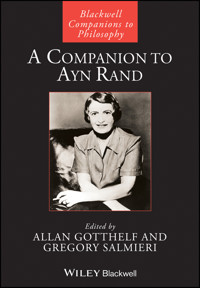
A Companion to Ayn Rand E-Book
40,99 €
Mehr erfahren.
- Herausgeber: John Wiley & Sons
- Kategorie: Geisteswissenschaft
- Serie: Blackwell Companions to Philosophy
- Sprache: Englisch
The first volume to offer a comprehensive scholarly treatment of Rand’s entire corpus (including her novels, her philosophical essays, and her analysis of the events of her times), this Companion provides vital orientation and context for scholars and educated readers grappling with a controversial and understudied thinker whose enduring influence on American (and world) culture is increasingly recognized.
- The first publication to provide an in-depth scholarly treatment ranging over the whole of Rand’s corpus
- Provides informed contextual analysis for scholars in a variety of disciplines
- Presents original research on unpublished material and drafts from the Rand archives in California
- Features insightful and fair-minded interpretations of Rand’s controversial positions
Sie lesen das E-Book in den Legimi-Apps auf:
Seitenzahl: 1569
Veröffentlichungsjahr: 2015
Ähnliche




















Blackwell Companions to Philosophy
This outstanding student reference series offers a comprehensive and authoritative survey of philosophy as a whole. Written by today's leading philosophers, each volume provides lucid and engaging coverage of the key figures, terms, topics, and problems of the field. Taken together, the volumes provide the ideal basis for course use, representing an unparalleled work of reference for students and specialists alike.
Already published in the series:
The Blackwell Companion to Philosophy, Second Edition
Edited by Nicholas Bunnin and Eric Tsui-James
A Companion to Ethics
Edited by Peter Singer
A Companion to Aesthetics, Second Edition
Edited by Stephen Davies, Kathleen Marie Higgins, Robert Hopkins, Robert Stecker, and David E. Cooper
A Companion to Epistemology, Second Edition
Edited by Jonathan Dancy, Ernest Sosa, and Matthias Steup
A Companion to Contemporary Political Philosophy (two-volume set), Second Edition
Edited by Robert E. Goodin and Philip Pettit
A Companion to Philosophy of Mind
Edited by Samuel Guttenplan
A Companion to Metaphysics, Second Edition
Edited by Jaegwon Kim, Ernest Sosa, and Gary S. Rosenkrantz
A Companion to Philosophy of Law and Legal Theory, Second Edition
Edited by Dennis Patterson
A Companion to Philosophy of Religion, Second Edition
Edited by Charles Taliaferro, Paul Draper, and Philip L. Quinn
A Companion to the Philosophy of Language
Edited by Bob Hale and Crispin Wright
A Companion to World Philosophies
Edited by Eliot Deutsch and Ron Bontekoe
A Companion to Continental Philosophy
Edited by Simon Critchley and William Schroeder
A Companion to Feminist Philosophy
Edited by Alison M. Jaggar and Iris Marion Young
A Companion to Cognitive Science
Edited by William Bechtel and George Graham
A Companion to Bioethics, Second Edition
Edited by Helga Kuhse and Peter Singer
A Companion to the Philosophers
Edited by Robert L. Arrington
A Companion to Business Ethics
Edited by Robert E. Frederick
A Companion to the Philosophy of Science
Edited by W. H. Newton-Smith
A Companion to Environmental Philosophy
Edited by Dale Jamieson
A Companion to Analytic Philosophy
Edited by A.P. Martinich and David Sosa
A Companion to Genethics
Edited by Justine Burley and John Harris
A Companion to Philosophical Logic
Edited by Dale Jacquette
A Companion to Early Modern Philosophy
Edited by Steven Nadler
A Companion to Philosophy in the Middle Ages
Edited by Jorge J.E. Gracia and Timothy B. Noone
A Companion to African-American Philosophy
Edited by Tommy L. Lott and John P. Pittman
A Companion to Applied Ethics
Edited by R.G. Frey and Christopher Heath Wellman
A Companion to the Philosophy of Education
Edited by Randall Curren
A Companion to African Philosophy
Edited by Kwasi Wiredu
A Companion to Heidegger
Edited by Hubert L. Dreyfus and Mark A. Wrathall
A Companion to Rationalism
Edited by Alan Nelson
A Companion to Pragmatism
Edited by John R. Shook and Joseph Margolis
A Companion to Ancient Philosophy
Edited by Mary Louise Gill and Pierre Pellegrin
A Companion to Nietzsche
Edited by Keith Ansell Pearson
A Companion to Socrates
Edited by Sara Ahbel-Rappe and Rachana Kamtekar
A Companion to Phenomenology and Existentialism
Edited by Hubert L. Dreyfus and Mark A. Wrathall
A Companion to Kant
Edited by Graham Bird
A Companion to Plato
Edited by Hugh H. Benson
A Companion to Descartes
Edited by Janet Broughton and John Carriero
A Companion to the Philosophy of Biology
Edited by Sahotra Sarkar and Anya Plutynski
A Companion to Hume
Edited by Elizabeth S. Radcliffe
A Companion to the Philosophy of History and Historiography
Edited by Aviezer Tucker
A Companion to Aristotle
Edited by Georgios Anagnostopoulos
A Companion to the Philosophy of Technology
Edited by Jan-Kyrre Berg Olsen, Stig Andur Pedersen, and Vincent F. Hendricks
A Companion to Latin American Philosophy
Edited by Susana Nuccetelli, Ofelia Schutte, and Otávio Bueno
A Companion to the Philosophy of Literature
Edited by Garry L. Hagberg and Walter Jost
A Companion to the Philosophy of Action
Edited by Timothy O'Connor and Constantine Sandis
A Companion to Relativism
Edited by Steven D. Hales
A Companion to Hegel
Edited by Stephen Houlgate and Michael Baur
A Companion to Schopenhauer
Edited by Bart Vandenabeele
A Companion to Buddhist Philosophy
Edited by Steven M. Emmanuel
A Companion to Foucault
Edited by Christopher Falzon, Timothy O'Leary, and Jana Sawicki
A Companion to the Philosophy of Time
Edited by Heather Dyke and Adrian Bardon
A Companion to Donald Davidson
Edited by Ernie Lepore and Kirk Ludwig
A Companion to Rawls
Edited by Jon Mandle and David Reidy
A Companion to W.V.O. Quine
Edited by Gilbert Harman and Ernie Lepore
A Companion to Derrida
Edited by Zeynep Direk and Leonard Lawlor
A Companion to David Lewis
Edited by Barry Loewer and Jonathan Schaffer
A Companion to Kierkegaard
Edited by Jon Stewart
A Companion to Locke
Edited by Matthew Stuart
A Companion to Hermeneutics
Edited by Niall Keane and Chris Lawn
A Companion to Ayn Rand
Edited by Allan Gotthelf and Gregory Salmieri
A Companion to Ayn Rand
Edited by
Allan Gotthelf and Gregory Salmieri
This edition first published 2016 © 2016 John Wiley & Sons, Ltd
Registered OfficeJohn Wiley & Sons, Ltd, The Atrium, Southern Gate, Chichester, West Sussex, PO19 8SQ, UK
Editorial Offices350 Main Street, Malden, MA 02148-5020, USA 9600 Garsington Road, Oxford, OX4 2DQ, UK The Atrium, Southern Gate, Chichester, West Sussex, PO19 8SQ, UK
For details of our global editorial offices, for customer services, and for information about how to apply for permission to reuse the copyright material in this book please see our website at www.wiley.com/wiley-blackwell.
The right of Allan Gotthelf and Gregory Salmieri to be identified as the authors of the editorial material in this work has been asserted in accordance with the UK Copyright, Designs and Patents Act 1988.
All rights reserved. No part of this publication may be reproduced, stored in a retrieval system, or transmitted, in any form or by any means, electronic, mechanical, photocopying, recording or otherwise, except as permitted by the UK Copyright, Designs and Patents Act 1988, without the prior permission of the publisher.
Wiley also publishes its books in a variety of electronic formats. Some content that appears in print may not be available in electronic books.
Designations used by companies to distinguish their products are often claimed as trademarks. All brand names and product names used in this book are trade names, service marks, trademarks or registered trademarks of their respective owners. The publisher is not associated with any product or vendor mentioned in this book.
Limit of Liability/Disclaimer of Warranty: While the publisher and authors have used their best efforts in preparing this book, they make no representations or warranties with respect to the accuracy or completeness of the contents of this book and specifically disclaim any implied warranties of merchantability or fitness for a particular purpose. It is sold on the understanding that the publisher is not engaged in rendering professional services and neither the publisher nor the author shall be liable for damages arising herefrom. If professional advice or other expert assistance is required, the services of a competent professional should be sought.
Library of Congress Cataloging-in-Publication Data applied for.
Cloth: 9781405186841
A catalogue record for this book is available from the British Library.
Cover image: Photo of Ayn Rand, 1957. © Everett Collection Historical / Alamy Stock Photo
In the pages that follow, you will read a great deal about a heroism that consists in loving one's life and living it fully. This book is dedicated to the memory of two of its authors who were such heroes – men who, throughout their lives, projected a profound benevolence and love of this world; and who, during their battles with cancer, often served as a comfort and an inspiration to the friends who sought to comfort them.
To John David Lewis (1955–2012), a consummate fighter for his values.
And to Allan Gotthelf (1942–2013), whose spirit and wisdom have informed every page of this Companion, both through his own editorial work and through his influence on those of us who live on – his coeditor, especially.
CONTENTS
Notes on Contributors
Acknowledgments
A Note on Abbreviations and References
Part I Context
1 An Introduction to the Study of Ayn Rand
Taking Rand Seriously
Some Challenging Features of Rand’s Ideas and Writings
Rand’s Works and Related Sources
Organization of the
Companion
Notes
References
2 The Life of Ayn Rand: Writing, Reading, and Related Life Events
Leaving Russia (1905–1926)
Early Career as an American Writer (1926–1936)
The Fountainhead
: The Creation of Her First Ideal Man (1936–1943)
Atlas Shrugged: The Mind on Strike (1943–1957)
Objectivism: A Philosophy for Living on Earth (1957–1982)
Appendix: Concerning Biographical Sources
Notes
References
Part II Ethics and Human Nature
3 The Act of Valuing (and the Objectivity of Values)
Living and Valuing in
The Little Street
and
We the Living
The Fountainhead
on the Activity of Valuing
The Fountainhead
on Work as the Meaning of Life
The Choice to Live and the Objectivity of Values in
Atlas Shrugged
and Later Works
Acknowledgment
Notes
References
4 The Morality of Life
A New Concept of Morality
Why Man Needs a Code of Values
Man’s Life as the Standard of Value
The Value of Reason and the Virtue of Rationality
Purpose and Productiveness
Self-Esteem and Pride
The Range of Life-Sustaining Values
The Selfishness of Virtue
Independence, Integrity, Honesty, and Justice as Aspects of Rationality
Morality and Heroism
Notes
References
5 A Being of Self-Made Soul
Free Will
The Primary Choice and an Individual’s Social Environment
Reason and Emotion
Self-Esteem
Sense of Life
Psycho-Epistemology
Conclusion
Acknowledgment
Notes
References
6 Egoism and Altruism
Situating Rand’s Egoism
Altruism: The Morality of Self-Sacrifice
Rand’s Objections to Altruism
Rand’s Reclamation of “Selfishness”
Acknowledgment
Notes
References
Part III Society
7 “A
Human
Society”
Man as an End in Himself
The Question of Conflicts of Interest
Individual Rights
A “Society of Traders”
Notes
References
8 Political Theory
The Nature and Need of Government
Proper Functions of Government
Capitalism and Property
Intellectual Property
Conclusion
Notes
References
9 Objective Law
Rand’s Condemnation of Non-Objective Law
The Nature and Need of Objective Law
Rand
vis-à-vis
Traditional Debates
Conclusion
Acknowledgments
Notes
References
10 “A Free Mind and a Free Market Are Corollaries”
Preliminaries: Knowledge, Values, and Man’s Life
The Free Market: Rule by Producers
Statist Economies: The Destruction of Producers
Conclusion
Acknowledgments
Notes
References
Part IV The Foundations of Objectivism
11 Objectivist Metaphysics
The Axioms of Existence and Identity
The Epistemological Basis and Function of the Axioms
Entities
Causality
Consciousness
The Primacy of Existence
Free Will
The Distinction Between the Metaphysically Given and the Man-Made
Objectivity as Respect for the Primacy of Existence
Notes
References
12 The Objectivist Epistemology
The Earlier Advocates of Reason: Rand and the Enlightenment
Consciousness and Sense Perception
The Process of Concept-Formation
The Objectivity of Conceptual Knowledge
Definitions and the Objectivity of Essences
Standards of Conceptualization
Acknowledgments
Notes
References
Part V Philosophers and Their Effects
13 “Who Sets the Tone for a Culture?”
Ayn Rand’s Approach to the History of Philosophy
Lessons from History
Ayn Rand on Kant and Aristotle
Acknowledgments
Notes
References
14 Ayn Rand’s Evolving View of Friedrich Nietzsche
Notes
References
15 A Philosopher on Her Times
1
Early Individualist and Anti-Communist Writing and Activism (1936–1946)
“An Age of Moral Crisis”: 1959–1961 Pieces on the State of the Culture
“Choose Your Issues”: The Menaces of Antitrust and Censorship
“The Last Ideological Administration”: Kennedy’s Presidency and the 1964 Election
Pragmatist Politics: The Johnson and Nixon Administrations and the Mixed Economy
Foreign Policy: The “Cold War,” Vietnam, and the Draft
Racism, Sexism, and The Civil Rights and Women’s Liberation Movements
Civil Disobedience and the Rise of Political Violence
The Intellectual Establishment and its Products
The Envious New Left: Environmentalism, Egalitarianism, and the 1972 Election
The Libertarian Movement
The Religious Right and the Right to Abortion
The American Sense of Life
Notes
References
Part VI Art
16 The Objectivist Esthetics
Art as the Voice of Philosophy
Art’s Function
The Definition of Art
Two Special Cases: Architecture and Music
The Esthetic Response
Esthetic Judgment
Romanticism
Notes
References
17 Rand’s Literary Romanticism
Romanticism, Classicism, and Naturalism
Plot and the Projection of Values
Romantic Characterization
Plot and Theme
The Projection of a Self-Made Soul
Romantic Art as a Product of Imagination
The Objectivity of the Romantic Method
Acknowledgment
Notes
References
Coda
18 Hallmarks of Objectivism
Notes
References
Annotated Bibliography of Primary and Quasi-Primary Sources
I. Rand’s Works and the Objectivist Corpus
II. Posthumously Published Materials
III. Unpublished Archival Materials
IV. Works Based on Courses Authorized by Rand
Index
EULA
Guide
Cover
Table of Contents
Part
Pages
ii
iv
v
ix
x
xi
xii
xiii
xiv
xv
1
3
4
5
6
7
8
9
10
11
12
13
14
15
16
17
18
19
20
21
22
23
24
25
26
27
28
29
30
31
32
33
34
35
36
37
38
39
40
41
42
43
44
45
47
49
50
51
52
53
54
55
56
57
58
59
60
61
62
63
64
65
66
67
68
69
70
71
72
73
74
75
76
77
78
79
80
81
82
83
84
85
86
87
88
89
90
91
92
93
94
95
96
97
98
99
100
101
102
103
104
105
106
107
108
109
110
111
112
113
114
115
116
117
118
119
120
121
122
123
124
125
126
127
128
129
130
131
132
133
134
135
136
137
138
139
140
141
142
143
144
145
146
147
148
149
150
151
152
153
154
155
156
157
159
160
161
162
163
164
165
166
167
168
169
170
171
172
173
174
175
176
177
178
179
180
181
182
183
184
185
186
187
188
189
190
191
192
193
194
195
196
197
198
199
200
201
202
203
204
205
206
207
208
209
210
211
212
213
214
215
216
217
218
219
220
221
222
223
224
225
226
227
228
229
230
231
232
233
234
235
236
237
238
239
240
241
242
243
245
246
247
248
249
250
251
252
253
254
255
256
257
258
259
260
261
262
263
264
265
266
267
268
269
270
271
272
273
274
275
276
277
278
279
280
281
282
283
284
285
286
287
288
289
290
291
292
293
294
295
296
297
298
299
300
301
302
303
304
305
306
307
308
309
310
311
312
313
314
315
316
317
318
319
321
322
323
324
325
326
327
328
329
330
331
332
333
334
335
336
337
338
339
340
341
342
343
344
345
346
347
348
349
350
351
352
353
354
355
356
357
358
359
360
361
362
363
364
365
366
367
368
369
370
371
372
373
374
375
376
377
378
379
380
381
382
383
384
385
386
387
388
389
390
391
392
393
394
395
396
397
398
399
400
401
402
403
405
406
407
408
409
410
411
412
413
414
415
416
417
418
419
420
421
422
423
424
425
426
427
428
429
430
431
432
433
434
435
436
437
438
439
440
441
442
443
444
445
446
447
448
449
451
453
454
455
456
457
458
459
460
461
463
464
465
466
467
468
469
471
472
473
474
475
476
477
478
479
480
481
482
483
484
485
486
487
488
490
491
492
493
494
495
496
497
498
499
500
501
502
503
504
505
506
507
508
509
510
511
512
513
514
515
516
517
518
519
520
521
Notes on Contributors
Harry Binswanger, who was an associate of Ayn Rand in her final years, teaches philosophy at the Objectivist Academic Center of the Ayn Rand Institute. He has taught, and lectured on, esthetics at Pratt Institute and elsewhere and has taught philosophy at Hunter College (City University of New York) and the University of Texas at Austin. He edited The Ayn Rand Lexicon (Penguin, 1986) and coedited (with Leonard Peikoff) the expanded second edition of Rand’s Introduction to Objectivist Epistemology (Penguin, 1990). He is the author of The Biological Basis of Teleological Concepts (ARI Press, 1990) and How We Know: Epistemology on an Objectivist Foundation (TOF Publications, 2014).
Tore Boeckmann is an independent scholar of Romanticism in art. He has lectured and written extensively on Ayn Rand’s novels and literary esthetics, and he edited for publication her guide to literature, The Art of Fiction (Plume, 2000). His most significant recent work includes an essay on the painter Caspar David Friedrich; his most delightful work includes an essay on the literary origins of Rand’s flamboyant playboy hero Francisco d’Anconia in Robert Mayhew (ed.), Essays on Ayn Rand’s Atlas Shrugged (Lexington Books, 2009). He is currently writing a book on Romanticism from Victor Hugo to Ayn Rand.
Onkar Ghate is a senior fellow at the Ayn Rand Institute, where he specializes in philosophy. He teaches in the Institute’s Objectivist Academic Center and serves as a writer, media spokesman, and senior editor for the Institute. He publishes both scholarly and popular articles on Rand’s fiction and philosophy. Recent essays include “Atlas Shrugged: America’s Second Declaration of Independence,” in Debi Ghate and Richard E. Ralston (eds.), Why Businessmen Need Philosophy (New American Library, 2nd edition, 2011) and “The Plight of Leo Kovalensky,” in Essays on Ayn Rand’s We the Living (Lexington Books, 2nd edition, 2012). His current research focuses on religion and morality and the separation of church and state.
Allan Gotthelf (1942–2013) was, at the time of his death, Anthem Foundation Distinguished Fellow for Research and Teaching in Philosophy at Rutgers University and Professor Emeritus of Philosophy at The College of New Jersey. From 2003 to 2012 he was Visiting Professor of History and Philosophy of Science at the University of Pittsburgh, where he held an Anthem Fellowship for the Study of Objectivism. He was a founding member of the Ayn Rand Society and served as chair of its steering committee (from 1990 until his death) and as the primary editor of the Society’s Philosophical Studies series. He is the author of On Ayn Rand(Wadsworth, 2000), and of many articles on Aristotle, 15 of which are collected in his Teleology, First Principles, and Scientific Method in Aristotle’s Biology (Oxford University Press, 2012).
Lester H. Hunt is Professor of Philosophy at the University of Wisconsin, Madison. He has also taught at Carnegie-Mellon University, the University of Pittsburgh, and Johns Hopkins University. He is the author of Nietzsche and the Origins of Virtue (Routledge, 1990), Character and Culture (Rowman & Littlefield, 1997), and Anarchy, State, and Utopia: An Advanced Guide (Wiley-Blackwell, 2015) and is editor of two books of original essays: Grade Inflation: Academic Standards in Higher Education (SUNY, 2008) and (with Noel Carroll) Philosophy in the Twilight Zone (Wiley-Blackwell, 2009). He has also written several dozen scholarly articles on ethics, social and political philosophy, the presentation of philosophical ideas in literature and film, and problems in the history of philosophy.
John David Lewis (1955–2012), after a 25-year career in business, changed direction and earned a PhD in Classics at the University of Cambridge in 2001. At the time of his death, in 2012, he was Visiting Associate Professor in the Philosophy, Politics, and Economics Program at Duke University and Adjunct Associate Professor of Business at the University of North Carolina at Chapel Hill. He published three books, Solon the Thinker: Political Thought in Archaic Athens (Bristol Classics, 2006), Early Greek Lawgivers (Bloomsbury Academic, 2007), and Nothing Less than Victory: Decisive Wars and the Lessons of History (Princeton University Press, 2010), and many articles and reviews in academic journals and the public press.
James G. Lennox is Professor of History and Philosophy of Science at the University of Pittsburgh. He was one of the founding members of the Ayn Rand Society, and is currently co-chair of the Society’s steering committee and coeditor of its Philosophical Studies series. He is author of Aristotle’s Philosophy of Biology (Cambridge University Press, 2001) and Aristotle on the Parts of Animals I–IV (Oxford University Press, 2001), and coeditor of Philosophical Issues in Aristotle’s Biology (Cambridge University Press, 1987), Concepts, Theories, and Rationality in the Biological Sciences (University of Pittsburgh Press, 1995) and Being, Nature, and Life in Aristotle: Essays in Honor of Allan Gotthelf (Cambridge University Press, 2010). Currently he is working on a book on Aristotle’s norms of inquiry and collaborating on a translation and commentary of Aristotle’s Meteorology IV.
Shoshana Milgram is Associate Professor of English at Virginia Tech, where she has taught since earning her PhD in Comparative Literature from Stanford University. She has published articles on nineteenth- and twentieth-century writers in French, Russian, and English/American literatures, including Victor Hugo, George Sand, Chekhov, Dostoevsky, Tolstoi, Victoria Cross, George Eliot, John Fowles, W.S. Gilbert, Ursula K. LeGuin, Nabokov, Herbert Spencer, Steinbeck, E.L. Voynich, and Ayn Rand. She has also published articles on “Capitalism,” “Cinema,” and “Leader” in J.C. Seigneuret’s Dictionary of Literary Themes and Motifs, as well as introductions to editions of Hugo’s Toilers of the Sea and The Man Who Laughs and Nevil Shute’s The Seafarers. She is at work on a book-length study of Ayn Rand’s life from birth to 1957.
Fred D. Miller, Jr. is Research Professor at the Center for the Philosophy of Freedom at the University of Arizona and Emeritus Professor of Philosophy and Executive Director of the Social Philosophy and Policy Center at Bowling Green State University. He is author of Nature, Justice, and Rights in Aristotle’s Politics (Oxford University Press, 1995) and coeditor of A Companion to Aristotle’s Politics (Blackwell, 1995), Freedom, Reason, and the Polis: Essays in Ancient Greek Political Philosophy (Cambridge University Press, 2007), A History of the Philosophy of Law from the Ancient Greeks to the Scholastics (Springer, 2007), and Reason and Analysis in Ancient Greek Philosophy (Springer, 2012). He is also Executive Editor of Social Philosophy & Policy. He is currently preparing a translation of Aristotle’s De Anima and Parva Naturalia for Oxford University Press.
Adam Mossoff is Professor of Law at George Mason University School of Law and a co-founder of and Director of Academic Programs at the Center for the Protection of Intellectual Property at Mason Law. He has published numerous book chapters, essays, and journal articles on topics in patent law, property law, legal history, and legal philosophy, including “Saving Locke from Marx: The Labor Theory of Value in Intellectual Property Theory” (Social Philosophy and Policy, 29(2), 2012). He has testified before the Senate and House on patent legislation, and he is a frequent speaker at professional and academic conferences, as well as at the PTO, the DOJ, the National Academy of Sciences, and the Smithsonian Institution, on topics in intellectual property policy.
Jason G. Rheins is Assistant Professor of Philosophy at Loyola University Chicago. He was a Visiting Assistant Professor at the University of North Carolina, Chapel Hill, and has held teaching positions at St. John’s University, Swarthmore College, and the University of Pennsylvania, where he received his PhD in Philosophy in 2010 with a dissertation on Plato’s theology and its place within his ontology and natural philosophy. He has published articles on topics in the philosophy of science and Ancient Greek philosophy. His current research focuses on metaphysical issues related to the cosmology and theology of Plato, Aristotle, and their successors.
Gregory Salmieri holds a fellowship in philosophy at the Anthem Foundation and teaches at Rutgers University. He received his PhD in philosophy from the University of Pittsburgh in 2008, and subsequently held teaching and research positions at the University of North Carolina, Chapel Hill (2008–2012) and at Boston University (2012–2014). He has published on issues in Aristotle’s epistemology and ethics and on Rand’s philosophy and novels. He is co-chair of the Ayn Rand Society’s Steering Committee, and coeditor of its Philosophical Studies series. He is also the editor of a forthcoming multi-author volume on Aristotle’s epistemology.
Tara Smith is Professor of Philosophy at the University of Texas at Austin, where she holds the BB&T Chair for the Study of Objectivism and is the Anthem Foundation Fellow. She is the author of Judicial Review in an Objective Legal System (Cambridge University Press, 2015), Ayn Rand’s Normative Ethics: The Virtuous Egoist (Cambridge University Press, 2006), Viable Values: A Study of Life as the Root and Reward of Morality (Rowman & Littlefield, 2000), and Moral Rights and Political Freedom (Rowman & Littlefield, 1995), as well as numerous articles in moral, legal, and political philosophy.
Darryl Wright is Professor of Philosophy at Harvey Mudd College (The Claremont Colleges). He works in the areas of moral and political philosophy and has published several articles on Ayn Rand’s ethical thought as well as articles on G.E. Moore and F.H. Bradley. Recent publications include “Evaluative Concepts and Objective Values: Rand on Moral Objectivity” (Social Philosophy and Policy, 25(1), 2008) and “Reasoning About Ends: Life as a Value in Ayn Rand’s Ethics,” in A. Gotthelf and J.G. Lennox (eds.), Metaethics, Egoism, and Virtue: Studies in Ayn Rand’s Normative Theory (University of Pittsburgh Press, 2011). He is currently writing a book on Ayn Rand’s ethics and its relation to contemporary (meta)ethical theories.
Acknowledgments
Work on this book began in December of 2006 when Allan Gotthelf and I first discussed the possibility of a companion-style volume on Ayn Rand. He was my teacher and dear friend, and his death in 2013, after a 15-year battle with prostate cancer, was a loss to the philosophy profession and a profound loss to me personally. Our collaboration on this project was one of the great joys of my life, and I wish he could have lived to see its completion. Now that the work is finished, I can find no better way to express my gratitude to Allan than by repeating the words of a friend to whom he introduced me 17 years ago: (Aristotle, Nicomachean Ethics 1164b2–6).
There are many others who deserve thanks for their role in making this book possible. First, I trust that I speak for all the contributors to this Companion when I acknowledge the great debt we owe to Leonard Peikoff, who has been a teacher to all of us (whether in person or through his books and recorded courses). The many citations to him throughout this book are testament to this debt. Moreover, as the executor of Rand’s estate he is responsible for making available the many posthumously published and archival materials that have enriched all of our understanding of Rand’s thought and life.
This brings me to the subject of the Ayn Rand Archives. Thank you to Mike Berliner, Jeff Britting, and Jenniffer Woodson for building and maintaining the Archives, for making it available to us, and for all of your help navigating it over the years. The Ayn Rand Institute, of which the Archives is a department, has been responsible for a host of programs and events over the past 30 years that contributed immeasurably to the work and intellectual development of many of the contributing authors (myself included).
The last decade of Allan’s life was a period of great productivity made possible by the support of the Anthem Foundation for Objectivist Scholarship, which has also supported my research since 2008. I would like to acknowledge three people at Anthem in particular. John McCaskey, who founded Anthem and was its first president, created the fellowship that brought Allan to the University of Pittsburgh in 2003 (when I was a graduate student there) and put him in a position to organize workshops and conferences that raised the scholarly level of work on Rand immeasurably. John was also instrumental in placing me in my first job in 2008, and he has been a source of professional advice in the years since. Debi Ghate, Anthem’s president 2009–2013, was a constant supporter of my and Allan’s careers and an able executive in difficult times. The same is true of Yaron Brook, the executive director of the Ayn Rand Institute, who also serves as the chairman of Anthem’s board of directors and who took over as president when Debi left.
Thank you also to Jim Lennox, for being an excellent doctoral advisor, for his role in bringing Allan to Pittsburgh, for being a vital part of the intellectual community there, and for his continuing support and advice in countless matters big and small.
Our editors at Wiley Blackwell, several of whom have come and gone while we were working on this book, have displayed supernatural patience. I am grateful to all, but I’d like to thank especially Nick Bellorini, with whom we signed our contract in 2008, and Deirdre Ilkson, who proposed incorporating the book into the Blackwell Companions to Philosophy series. Thanks also to Fiona Screen, who shepherded this book through the production process, and to our two copyeditors, Michael Coultas and Anna Oxbury. All three have been a consistent pleasure to work with, despite my frustrating habit of introducing changes (and lengthening chapters) long after submission of the manuscript. Michael and I made most of the decisions concerning formatting and style together, and he copyedited more than half of the book before unexpectedly passing away. We did not meet in person, but his emails revealed him to be a kind and thoughtful man who loved his work and took pride in doing it well. Anna, working with remarkable speed, both maintained the high standard Michael had set and finished the copyediting in time to meet our production schedule.
I would like to acknowledge several friends and colleagues to whom Allan and I turned for advice either about individual chapters or the design of the book as a whole: Geoff Sayre-McCord, James Brazell, Mary Ann Sures, and Shoshana Milgram. Mike Mazza, in his capacity as a research assistant, checked most of the quotes in the book and made many helpful suggestions about the content of various chapters. Three other friends – Matt Bateman, Ben Bayer, and Onkar Ghate – took on significant editorial work, each on a different chapter, during a period when Allan’s health prevented him from working and I was overwhelmed. They have my deep gratitude both for their friendship and for their excellent work.
Thank you to all of the contributors to this volume both for bearing with our sometimes demanding editorial style, and for their patience with the many delays on the road to publication.
Finally, I’d like to thank my wife, Karen, both for her help with this project (which took many forms) and for everything she’s brought to my life. And I’d like to thank Cass Love and her husband Ron for all of their help with this project, for their friendship, and for the unique role they played in Allan’s life.
Gregory Salmieri
A Note on Abbreviations and References
Rand’s own works and certain others that we have identified as “quasi-primary sources” are listed in the annotated bibliography at the end of this volume and cited in the text by the abbreviations indicated below. The numbers after the abbreviations indicate where they can be found in the bibliography.
In some cases, where a passage exists in two sources, we cite it to both separated by a slash. In such cases, the quoted material (if any) is as it appears in the first of the two citations. This format is used (among other times) when quoting from the original archival sources of material by Rand that has been posthumously published in an edited form.
Citations to works by figures in the history of philosophy are given in the standard formats used by scholars of those figures: Bekker numbers for Aristotle, Academy numbers for Kant, and so on. Other works are cited in the author/date format; bibliographic information for these works can be found in the references at the end of each chapter. Multiple works by an author from the same calendar year are distinguished by letters, and these references are standardized throughout the volume; so, for example, Allan Gotthelf’s essay on “Dagny’s Final Choice” is referenced as Gotthelf 2009b even in chapters that do not also make reference to Gotthelf 2009a.
Answers
Ayn Rand Answers: The Best of Her Q&A.
#46.
Anthem
Revised edition of
Anthem.
#3.
Anthem38
1938 edition of
Anthem.
#3.
AOF
The Art of Fiction: A Guide for Writers and Readers.
#44.
AON
The Art of Nonfiction: A Guide for Writers and Readers.
#45.
ARL
The Ayn Rand Letter.
#18.
Atlas
Atlas Shrugged.
#5.
Biographical Interviews
Biographical interviews of Ayn Rand conducted by Barbara and Nathaniel Branden in 1960–1961. #49.
Column
The Ayn Rand Column.
#14.
CUI
Capitalism: The Unknown Ideal.
#8.
Early
The Early Ayn Rand.
#36.
Fountainhead
The Fountainhead.
#4.
FTNI
For The New Intellectual: The Philosophy of Ayn Rand.
#6.
HOP1
Leonard Peikoff.
Founders of Western Philosophy: Thales to Hume
. #32.
HOP2
Leonard Peikoff.
Modern Philosophy: Kant to the Present
. #33.
Ideal
Ideal: The Novel and the Play
. #39.
ITOE
Introduction to Objectivist Epistemology
. #9.
Journals
Journals of Ayn Rand
. #42.
Letters
Letters of Ayn Rand
. #41.
Marginalia
Ayn Rand’s Marginalia: Her Critical Comments on the Writings of over 20 Authors
. #40.
OPAR
Leonard Peikoff.
Objectivism: The Philosophy of Ayn Rand
. #52.
Papers
The Ayn Rand Papers, a collection of the Ayn Rand Archives. #48.
Parallels
Leonard Peikoff.
The Ominous Parallels: The End of Freedom in America
. #35.
Playboy Interview
Ayn Rand’s interview in
Playboy Magazine
. #23.
Plays
Three Plays
. #37.
PWNI
Philosophy: Who Needs It
. #12.
RM
The Romantic Manifesto: A Philosophy of Literature
. #10.
ROTP
Return of the Primitive: The Anti-Industrial Revolution
. #15.
Russian Writings
Russian Writings on Hollywood
. #43.
Speaking
Objectively Speaking: Ayn Rand Interviewed
. #47.
TIA
The Intellectual Activist
. #19.
TO
The Objectivist
. #17.
TOF
The Objectivist Forum
. #20.
TON
The Objectivist Newsletter
. #16.
TPO
Leonard Peikoff.
The Philosophy of Objectivism
. #34.
Unconquered
The Unconquered
with another, earlier adaptation of
We the Living
. #38.
VAR
Nathaniel Branden.
The Vision of Ayn Rand: The Basic Principles of Objectivism
. #51.
VOR
The Voice of Reason
. #13.
VOS
The Virtue of Selfishness: A New Concept of Egoism.
#7.
WIAR
Nathaniel Branden.
Who Is Ayn Rand?
#31.
Workshops
Transcript of the Objectivist Workshops. #50.
WTL
Revised edition of
We the Living
. #1.
WTL36
1936 edition of
We the Living
. #1.
Part IContext
1An Introduction to the Study of Ayn Rand
GREGORY SALMIERI
“Ayn Rand … is among the most outspoken – and important – intellectual voices in America today,” wrote Playboy Magazine in 1964. “She is the author of what is perhaps the most fiercely damned and admired best seller of the decade, Atlas Shrugged.” The magazine goes on to describe the novel’s impressive sales (“more than 1,200,000 copies since its publication six years ago”), the discussion groups and debate it spawned on college campuses, and the thousands of people who subscribed to Rand’s Objectivist Newsletter or attended lecture courses on her philosophy.
That any novel should set off such a chain reaction is unusual; that Atlas Shrugged has done so is astonishing. For the book, a panoramic novel about what happens when the “men of the mind” go on strike, is 1,168 pages long. It is filled with lengthy, sometimes complex philosophical passages; and it is brimming with as many explosively unpopular ideas as Ayn Rand herself. Despite this success, the literary establishment considers her an outsider. Almost to a man, critics have either ignored or denounced the book. She is an exile among philosophers, too, although Atlas is as much a work of philosophy as it is a novel. Liberals glower at the very mention of her name; but conservatives, too, swallow hard when she begins to speak. For Ayn Rand, whether anyone likes it or not, is sui generis: indubitably, irrevocably, intransigently individual. (Playboy Interview 35)
Over 50 years later, and 33 years after her death, Rand remains one of the most important intellectual voices in our culture. In the last six years alone (2009 through 2014) Atlas has sold 2.25 million copies – one million more than in the six years immediately after its publication. In total, more than 30 million copies of Rand’s books have been sold.1 Her ideas are as radical today as they were during her lifetime. And there remains a pronounced disconnect between the inspiration (both esthetic and intellectual) that so many readers take from her books and the dismissive or scornful response that these same books still often meet in academia.
In the political arena, liberals still despise and mock her, as do many leaders of the Christian right, neo-conservative, and libertarian movements. Yet Rand’s influence is always evident wherever one finds morally self-confident opposition to regulation, taxes, or entitlements, and wherever one sees celebrations of business and the free market. Thus, sales of Rand’s books soared to record levels in 2008 and 2009 as Americans struggled to make sense of the financial crisis, and slogans referencing John Galt (the hero of Atlas) were ubiquitous at the early “Tea Party” protests against the interventionist measures by which the Bush and Obama administrations responded to the crisis. Rand has been frequently referenced in American political discourse since, both by those who cite her as an inspiration and by commentators who attribute many of the nation’s ills to Rand’s influence.2 But references to Rand, on both sides, are usually superficial. They are attempts to evoke or to smear – but not to engage with – that strand in the American consciousness which resonates to Rand’s distinctive vision of what a human life can and should be.
She described this vision as “the concept of man as a heroic being, with his own happiness as the moral purpose of his life, with productive achievement as his noblest activity, and reason as his only absolute” (Atlas 1070).3 Rand viewed “man” as a “heroic being” in the sense that she thought that human nature sets a demanding ideal that each individual can and should achieve in his own life and character (though few people do achieve it). This ideal is the fit object of the emotion of reverence, and Rand sometimes speaks of “worshiping” it or the people (real or fictional) who embody it. This ideal – the life proper to a human being – is egoistic in the sense that an individual leading such a life is dedicated as a matter of moral principle to his own happiness. Happiness, for Rand, is not mere pleasure or desire-satisfaction. It is that state of “non-contradictory joy” (Atlas 1022) that is the concomitant of achieving what one has rationally identified as objectively good. A heroic human being is committed to the fullest use of his reason; and he uses it to conceive ambitious, life-sustaining goals, and to achieve them via productive activity. All the aspects of this vision and Rand’s arguments for them are discussed in detail in later chapters. So are other aspects of her thought, including the view that, because such a life requires the political freedom to live by one’s own judgment, laissez-faire capitalism is the only moral social system. It is enough for now to note that this vision evokes intense reactions in many people: some are inspired; others, revolted; some find it profound; others, juvenile.
Rand used the phrase “sense of life” to designate the aspect of a person’s or a culture’s psychology that generates the differing emotional reactions we have to artworks and (especially) to the view of the world and of humanity that they project. A sense of life is an implicit worldview – a “pre-conceptual metaphysics” that is experienced as a “constant, basic emotion” and expressed in a person’s “widest goals or smallest gestures” (“Philosophy and Sense of Life” RM 8, 18, 22).4 Part of maturing, Rand held, is translating one’s sense of life into conscious convictions, which one can rationally evaluate; correct, if necessary; and then consistently implement. Adopting this terminology, then, we can say that, for better or for worse, Rand’s vision holds a deep and enduring appeal for something in “the American sense of life” – or, at least, for a sense of life that is shared by many Americans and that contributes to the character of the nation. If so, then engagement with her works and thought is a crucial means by which scholars can help America to understand itself, and by which they can help the many people, in every country, who find Rand inspiring or repugnant to understand one another.5
Taking Rand Seriously
The scholarly study of Rand’s works was postponed by two generations of academics who found her vision appalling and thought or hoped that she was a passing fad, and that their students’ attraction to her was a youthful indiscretion. These hopes have been dashed. Decades after her death, Rand’s appeal and influence cannot be denied; and very often something of her heroic vision of man remains even in the souls of readers who “outgrow” her and resign themselves (sadly or smugly) to a world in which they believe the kind of life she projects is impossible or vicious.
Happily, these facts are beginning to be recognized. Rand’s novels have, perhaps grudgingly, been admitted to the literary canon. They are seldom discussed in journals, but one increasingly finds Anthem and The Fountainhead taught in high school English courses or listed on summer reading lists, and Atlas Shrugged has begun to appear in university syllabi. Objectivism, as Rand called her philosophical system, may still be regarded as a curiosity by most philosophy professors, but her defense of egoism is now often covered in ethics textbooks, excerpts from her essays are widely anthologized, and there are entries on Rand in the two major encyclopedias of philosophy.6 Moreover, there is a small but growing number of scholars and advocates of Objectivism within the philosophy departments of America’s colleges and universities.7
Indeed, the last decade saw a boom in quality Rand scholarship. Among the highlights are Tara Smith’s (2006) Ayn Rand’s Normative Ethics, Robert Mayhew’s (2004, 2005a, 2007, 2009, 2012a) edited collections of essays on each of Rand’s novels, and the first two volumes of the Ayn Rand Society’s Philosophical Studies series: Metaethics, Egoism, and Virtue (2011) and Concepts and Their Role in Knowledge (2013), both edited by Allan Gotthelf and James Lennox. Since its founding in 1987, the Society (of which I am co-secretary) holds sessions on Rand’s ideas at meetings of the American Philosophical Association. There have been 30 such meetings, collectively involving 48 panelists who represent 41 academic departments from institutions on three continents.8 Some of these panelists are advocates for Objectivism; many are not; but all are participating in the stimulating exchange of ideas that occurs whenever philosophers take Rand’s works seriously.
Turning from scholarly to popular books, two biographies of Rand were published in 2009, by Jennifer Burns and Anne C. Heller. Burns’s book, especially, is less informative than one might hope about Rand’s ideas and intellectual development; and both authors, in what seem to be attempts to create what they regard as a satisfying narrative about Rand’s later life, emphasize the painful episodes and underplay the bright points; but each biography is a significant improvement over any previously available book-length treatment of Rand’s life.9 There is also Gary Weiss’s (2012) Ayn Rand Nation, which, though not very deep and rife with inaccuracies, clearly recognizes the need for sustained reflection by leftists about the nature of Rand’s ideas and the source of their appeal.10 Weiss is trying to combat Rand’s influence, but there have also been several recent books put out by major publishing houses that expound some of Rand’s ideas sympathetically for a popular audience: Donald Luskin and Andrew Greta’s (2011) I Am John Galt: Today’s Heroic Innovators Building the World and the Villainous Parasites Destroying It, Yaron Brook and Don Watkins’s (2012) Free Market Revolution: How Ayn Rand’s Ideas Can End Big Government, and Peter Schwartz’s (2015) In Defense of Selfishness: Why the Code of Sacrifice Is Unjust and Destructive.
There are other books that could be named as well, but this list is sufficient to illustrate a growing recognition – both within academia and without, in several disciplines, and across the ideological spectrum – that Ayn Rand should be taken seriously.
To take an author seriously means to read her, not with an eye toward confirming one’s prejudices (whether favorable or unfavorable), but simply with an eye to understanding what she thinks and why. If one finds her approach unfamiliar and difficult, it means working to overcome that. If one finds what she says implausible or unmotivated, it means taking the time to consider why it seems otherwise to her and to the readers who find her convincing – and it means giving thought to the question of whether it is you or she who is mistaken. By the same token, if she strikes you as obviously correct with respect to an issue where you know many people find her views counterintuitive, it means working to identify the premises that you share with her and not with them, and then figuring out how to determine whether those premises are true.
This approach is especially important in the case of Rand, because she is (as Playboy put it) “brimming” with “explosively unpopular ideas.” In particular, she maintained that our society is unjust in deep and pervasive ways, and that at the heart of this corruption are the moral ideals by which we are taught to live our lives, and on which we are taught to base our self-esteem. Rand is thus a radical critic of society. In this respect she is analogous to other radical thinkers of various stripes – nineteenth-century abolitionists, twentieth-century Marxists, and those who inveigh against what they see as the inherent racism, sexism, or imperialism of Western culture.
As with many such thinkers, Rand’s writing often has a confrontational character. For example, she explains, in the introduction to The Virtue of Selfishness, that she gave the work the title she did “For the reason that makes you afraid of it” (VOS vii). The title is frightening. It challenges our fundamental moral beliefs – beliefs that are central to all of our goals, to our sense of self- esteem. It takes courage and a commitment to introspective honesty to consider challenges to such beliefs. When one’s sense of self-worth is threatened, there is always a temptation to seize upon any convenient rationalization for rejecting the challenge (and the challenger) rather than taking the time, and putting forth the effort, required to understand and evaluate it. On the other hand, if one feels alienated from or unappreciated by one’s fellow human beings, a radical criticism of one’s society can serve as a rationalization for these feelings and a weapon with which one can lash out against others. Whether one finds Rand appealing or repugnant, the sorts of issues that she raises are fraught with temptations for intellectual dishonesty, and one will find no shortage of facile reasons to dismiss or embrace her ideas too quickly.
Readers who resist these temptations, and approach Rand seriously, will, I think, find her to be a powerfully unconventional artist and a philosopher of great breadth and subtlety. They may also come to see her, as I do, as the discoverer of some profound and empowering truths. But it is not my aim here to argue for this evaluation of Rand, nor is that the purpose of any of the chapters in this book. All of the contributing authors are professional intellectuals who have made mastering Rand’s works and philosophy a significant part of their careers, despite working in fields where she is too seldom taken seriously and where a perceived interest in her can be a professional liability. It stands to reason that we would all be great admirers of her, and two of us (Allan Gotthelf and Harry Binswanger) counted her as a mentor and a personal friend. In other contexts, many of us have written as defenders of her philosophy, but our purpose throughout this book is to serve, not as advocates, but as guides. This is something that Allan Gotthelf and I, in our capacity as editors, stressed throughout the editorial process, from our initial invitations to the contributors, to our (often extensive) feedback on drafts.
The consistent aim of the book is to facilitate the study of Rand’s works and thought by identifying Rand’s key theses and methods and her reasons for them, by tracing the role that these theses and methods play in her thought, by showing the evidence in her texts for all of our interpretive conclusions, and by drawing illuminating comparisons between Rand and other thinkers. Of course, there are many occasions when the contributing authors (myself included) have found that this end is best served by raising and/or responding to objections to Rand’s positions, but such arguments are presented here only as means to clarification. We hope that the book will be useful to critics and admirers of Rand alike, and that it will thereby help to increase the intellectual sophistication and scholarly rigor of the discourse about her both within the academy and in the culture at large.
Some Challenging Features of Rand’s Ideas and Writings
Reading Rand seriously, as opposed to merely reacting passively to her writings, is demanding intellectual work. This is true to some extent of all authors, but there are several features of Rand’s corpus and of her position in the culture that make it particularly difficult in her case.
Scholars and students of philosophy trained in analytic departments (as were most of the contributors to this volume) may find that Rand’s philosophical essays read as though they come from an alien tradition. She addresses recognizable philosophical issues, but they are framed differently; the context and values she assumes are unfamiliar, as are her methods of argument and analysis. In all these respects, reading Rand is like reading a figure from a different philosophical school (or a different period in the history of philosophy). However, she is not only an outsider to the specific tradition of analytic philosophy; she is (as Playboy put it) sui generis. Rather than working within an established school of thought, Rand’s essays are addressed either to a general audience or (more often) to the audience that she herself created. Most of her non-fiction was written for her own periodicals, and it sometimes presumes familiarity with her novels and with the ideas expounded in earlier issues.
When Rand does engage with the intellectual traditions of her time, she does so as an outsider – often a hostile one. In this respect, she is like such early modern intellectuals as Bacon, Descartes, Locke, and Spinoza. The comparison I am making is not to the intellectual stature of these thinkers, but to their relation to the intellectual establishment of their day. When they wrote, the universities were dominated by Scholasticism, an entrenched intellectual tradition with an established vocabulary, shared assumptions, an institutional structure, conventions of discourse, and a credentialing method. Rather than developing and presenting their ideas within this structure, the early modern intellectuals struck out on their own. They found their own audience and often explained their ideas in ways that made little reference to the establishment. When they did discuss Scholasticism it was in broadsides that the scholastics must have thought missed the nuances of their arguments and trivialized the differences between their positions (e.g., the differences between Scotists and Thomists). Likewise, Rand’s often contemptuous remarks about the academic philosophy of the mid-twentieth century did not win her many friends in the philosophy departments of the time. However, 50 years later, most academic philosophers do not have much more regard for the positions Rand dismissed (e.g., logical positivism and flagrant subjectivism about ethical principles) than she did in the 1960s.11
The philosophers with reference to whom Rand situates herself are not her contemporaries in the academy, but world historical figures – chiefly, Plato, Aristotle, and Kant. And, rather than engaging in minute scholarship of these thinkers, she speaks of them as they most often spoke of one another – in essentialized sketches. (See James Lennox’s discussion of Rand’s take on the history of philosophy, Chapter 13, below.)
Like these world historical philosophers, Rand aimed to be systematic. Objectivism (as she called her philosophy) comprises five branches: metaphysics, epistemology, ethics, political theory, and esthetics. It also includes theses that we might describe as belonging to philosophical psychology, the philosophy of economics, and the philosophy of history. In many essays, Rand used this system as a framework within which to interpret the events of her time, and to recommend courses of political action and cultural activism.
There is a definite hierarchical structure to her thinking. At the base of this system is the metaphysical conviction that Rand called “The Primacy of Existence” – the thesis “that the universe exists independent of consciousness (of any consciousness), that things are what they are, that they possess a specific nature, an identity. The epistemological corollary is the axiom that consciousness is the faculty of perceiving that which exists” (“The Metaphysical Versus the Man-Made” PWNI 32). (See Jason Rheins’s discussion in Chapter 11, below.) The distinctively human form of consciousness is reason, which enables us to understand the world and to guide our actions by means of a system of concepts that are formed, ultimately, on the basis of sense-perception. Unlike sense-perception, which Rand regarded as a direct, inerrant, and automatic awareness of external objects, reason is volitional and (consequently) fallible. Because of this, human beings need epistemology, the “science devoted to the discovery of the proper methods of acquiring and validating knowledge” (ITOE 36). The centerpiece of Rand’s epistemology is her theory of concept-formation. In Chapter 12, I examine this theory, and explain the role that Rand thought her theory (and epistemology as a whole) played in enabling human beings to achieve objectivity in their thinking. This thinking includes, importantly, the reasoning by which we validate moral principles and by which each of us conceives and pursues personal values. Thus Rand’s ethics rests on her epistemology and metaphysics.
In ethics, Rand articulates the essential values that constitute “man’s life” (the moral ideal we discussed earlier); she argues that these values are based in the requirements of human survival, and she shows how they form a standard by reference to which an individual can form and pursue rational goals. These issues are the subjects of the chapters that make up Part II of this volume. Part III concerns her social theory – especially her endorsement of capitalism as the ideal social system. I indicated earlier how this endorsement follows from her ethics.
In esthetics, Rand’s aim is to identify the essence of art and the human need that it serves. Doing so makes possible objective standards by which art can be evaluated. The function of art, she maintains, is to enable a human being to experience concretely his (or another’s) sense of life. Rand explores the epistemological function of a sense of life, and its nature as a psychological phenomenon. A sense of life is a body of implicit metaphysical convictions, and Rand defines the school of art to which she belongs by identifying its core metaphysical conviction: “Romanticism is a category of art based on the recognition of the principle that man possesses the faculty of volition” (“What Is Romanticism?” RM 91).




