


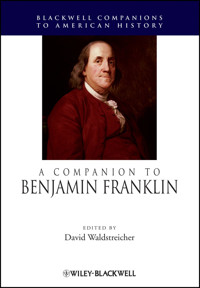
A Companion to Benjamin Franklin E-Book
166,99 €
Mehr erfahren.
- Herausgeber: John Wiley & Sons
- Kategorie: Geisteswissenschaft
- Serie: Blackwell Companions to American History
- Sprache: Englisch
This companion provides a comprehensive survey of the life, work and legacy of Benjamin Franklin - the oldest, most distinctive, and multifaceted of the founders. * Includes contributions from across a range of academic disciplines * Combines traditional and cutting-edge scholarship, from accomplished and emerging experts in the field * Pays special attention to the American Revolution, the Enlightenment, journalism, colonial American society, and themes of race, class, and gender * Places Franklin in the context of recent work in political theory, American Studies, American literature, material culture studies, popular culture, and international relations
Sie lesen das E-Book in den Legimi-Apps auf:
Seitenzahl: 1214
Veröffentlichungsjahr: 2011
Ähnliche




















Contents
List of Figures
About the Contributors
Introduction
Part I Biography
Chapter One Franklin’s Boston Years, 1706–1723
1.1 Parents
1.2 Childhood and Education
1.3 Apprenticeship
1.4 Journalistic Debut
1.5 Controversy over Inoculation
1.6 Blossoming
1.7 Women
1.8 Slavery
1.9 Crises and Runaway
Chapter Two The Philadelphia Years, 1723–1757
2.1 Establishing a Career
2.2 Clubs and Emerging Public Life
2.3 Personal Life
2.4 Printer, of Philadelphia
2.5 Natural Philosopher
2.6 Politician
Chapter Three The Making of a Patriot, 1757–1775
3.1 Benjamin Franklin’s Political Philosophy
3.2 The Campaign for Royal Government
3.3 The Stamp Act: 1765–1766
3.4 Townshend and Beyond: 1767–1770
3.5 The Cockpit: 1774
3.6 The Final Days
Chapter Four Franklin Furioso, 1775–1790
Part II Franklin and Eighteenth-Century America
Chapter Five Benjamin Franklin and Colonial Society
5.1 The Analytical Category of Class in Early American Historiography
5.2 The Analytical Category of Class in Scholarship on Franklin
5.3 The Analytical Category of Class in Scholarship on Eighteenth-Century Philadelphia and London
5.4 Conclusion
Chapter Six Benjamin Franklin and Pennsylvania Politics
Chapter Seven Benjamin Franklin and Religion
7.1 Early Religious Influences
7.2 A Dissertation on Liberty and Necessity, Pleasure and Pain (1725)
7.3 Articles of Belief and Acts of Religion
7.4 On the Providence of God in the Government of the World (1732)
7.5 The Hemphill Affair (1735) and the “Zealous Presbyterians”
7.6 Franklin, George Whitefield, and Eighteenth-Century Evangelicalism
7.7 Franklin and the Quakers
7.8 Moral Perfection and the Art of Virtue
7.9 Conclusion
Chapter Eight Benjamin Franklin and the Coming of the American Revolution
8.1 Franklin’s Reputation as a Revolutionary
8.2 The Imperial Franklin
8.3 Briton to American
8.4 The Political and the Personal
8.5 Franklin’s Revolutionary Role
Chapter Nine Benjamin Franklin and Native Americans
9.1 “Doing Business with those Barbarians”
9.2 “Different Tribes, Nations and Languages”
9.3 “Merciless Indian Savages”
9.4 “Savages We Call them, Because their Manners Differ from Ours”
9.5 “The Lovely White and Red”
Chapter Ten The Complexion of My Country: Benjamin Franklin and the Problem of Racial Diversity
10.1 Making “Good Subjects”
10.2 Between Empire and Nation
10.3 Revolutionary Legacies
10.4 Conclusion
Chapter Eleven Benjamin Franklin, Capitalism, and Slavery
Chapter Twelve Benjamin Franklin and Women
12.1 What is to be Done?
Part III Franklin the Writer and Thinker
Chapter Thirteen “The Manners and Situation of a Rising People”: Reading Franklin’s Autobiography
Chapter Fourteen Poor Richard’s Almanac
Chapter Fifteen Benjamin Franklin and Journalism
15.1 Printers and Self-Made Newspapermen
15.2 Modern Journalism: Independent and Professional
15.3 Literary Canon
15.4 Freedom of the Press and History of the Book
15.5 Biography and Journalism
15.6 Epilogue: Mash-Up
Chapter Sixteen Benjamin Franklin, the Science of Flow, and the Legacy of the Enlightenment
16.1 The Spirits of Marshes and Bogs
16.2 The Fire Within
16.3 Fire, Water, and Fur
Chapter Seventeen Benjamin Franklin, Associations, and Civil Society
Chapter Eighteen Empire and Nation
18.1 Trade and Empire
18.2 The American Revolution
18.3 American Icon
Chapter Nineteen Franklin’s Pictorial Representations of British America
Part IV Franklin and the Categories of Inquiry
Chapter Twenty American Literature and American Studies
20.1 Early Assessments: Celebration and Ambivalence
20.2 Mid-TwentiethCentury Debates: Character and Representativeness
20.3 Later Twentieth-Century Innovations: Rhetoric and Representation
20.4 Recent Developments and Future Directions
Chapter Twenty-one Benjamin Franklin’s Material Cultures
Chapter Twenty-two Benjamin Franklin and Political Theory
Chapter Twenty-three Benjamin Franklin and International Relations
23.1 Overview
23.2 Colonial Pennsylvania’s International Relations
23.3 Franklin’s Colonial Agency and International Relations
23.4 Franklin’s Revolutionary Diplomacy
Chapter Twenty-four Benjamin Franklin in Memory and Popular Culture
Bibliography
Index
BLACKWELL COMPANIONS TO AMERICAN HISTORY
This series provides essential and authoritative overviews of the scholarship that has shaped our present understanding of the American past. Edited by eminent historians, each volume tackles one of the major periods or themes of American history, with individual topics authored by key scholars who have spent considerable time in research on the questions and controversies that have sparked debate in their field of interest. The volumes are accessible for the nonspecialist, while also engaging scholars seeking a reference to the historiography or future concerns.
Published:
A Companion to the American RevolutionEdited by Jack P. Greene and J.R. Pole
A Companion to 19th-Century AmericaEdited by William L. Barney
A Companion to the American SouthEdited by John B. Boles
A Companion to American Indian HistoryEdited by Philip J. Deloria and Neal Salisbury
A Companion to American Women’s HistoryEdited by Nancy Hewitt
A Companion to Post-1945 America
Edited by Jean-Christophe Agnew and Roy Rosenzweig
A Companion to the Vietnam WarEdited by Marilyn Young and Robert Buzzanco
A Companion to Colonial AmericaEdited by Daniel Vickers
A Companion to 20th-Century AmericaEdited by Stephen J. Whitfield
A Companion to the American WestEdited by William Deverell
A Companion to American Foreign RelationsEdited by Robert Schulzinger
A Companion to the Civil War and ReconstructionEdited by Lacy K. Ford
A Companion to American TechnologyEdited by Carroll Pursell
A Companion to African-American HistoryEdited by Alton Hornsby
A Companion to American ImmigrationEdited by Reed Ueda
A Companion to American Cultural HistoryEdited by Karen Halttunen
A Companion to California HistoryEdited by William Deverell and David Igler
A Companion to American Military HistoryEdited by James Bradford
A Companion Los AngelesEdited by William Deverell and Greg Hise
A Companion to American Environmental HistoryEdited by Douglas Cazaux Sackman
A Companion to Benjamin FranklinEdited by David Waldstreicher
In preparation:
A Companion to American Urban HistoryEdited by David Quigley
PRESIDENTIAL COMPANIONS
Published:
A Companion to Franklin D. RooseveltEdited by William Pederson
A Companion to Richard M. NixonEdited by Melvin Small
In preparation:
A Companion to Abraham LincolnEdited by Michael Green
A Companion to Thomas JeffersonEdited by Francis D. Cogliano
A Companion to George WashingtonEdited by Edward G. Lengel
A Companion to Harry S. TrumanEdited by Daniel S. Margolies
A Companion to Theodore RooseveltEdited by Serge Ricard
A Companion to Lyndon B. JohnsonEdited by Mitchell Lerner
A Companion to Andrew JacksonEdited by Sean Patrick Adams
A Companion to Woodrow WilsonEdited by Ross A. Kennedy
A Companion to Dwight D. EisenhowerEdited by Chester J. Pach
A Companion to Ronald ReaganEdited by Andrew L. Johns
A Companion to James Madison and James MonroeEdited by Stuart Leibiger
A Companion to John Adams and John Quincy AdamsEdited by David Waldstreicher
A Companion to the Antebellum Presidents, 1837–61Edited by Joel Silbey
A Companion to the Reconstruction Presidents, 1865–81Edited by Edward Frantz
This edition first published 2011© 2011 Blackwell Publishing Limited
Blackwell Publishing was acquired by John Wiley & Sons in February 2007. Blackwell’s publishing program has been merged with Wiley’s global Scientific, Technical, and Medical business to form Wiley-Blackwell.
Registered OfficeJohn Wiley & Sons Ltd, The Atrium, Southern Gate, Chichester, West Sussex, PO19 8SQ, United Kingdom
Editorial Offices350 Main Street, Malden, MA 02148-5020, USA9600 Garsington Road, Oxford, OX4 2DQ, UKThe Atrium, Southern Gate, Chichester, West Sussex, PO19 8SQ, UK
For details of our global editorial offices, for customer services, and for information about how to apply for permission to reuse the copyright material in this book please see our website at www.wiley.com/wiley-blackwell.
The right of David Waldstreicher to be identified as the author of the editorial material in this work has been asserted in accordance with the UK Copyright, Designs and Patents Act 1988.
All rights reserved. No part of this publication may be reproduced, stored in a retrieval system, or transmitted, in any form or by any means, electronic, mechanical, photocopying, recording or otherwise, except as permitted by the UK Copyright, Designs and Patents Act 1988, without the prior permission of the publisher.
Wiley also publishes its books in a variety of electronic formats. Some content that appears in print may not be available in electronic books.
Designations used by companies to distinguish their products are often claimed as trademarks. All brand names and product names used in this book are trade names, service marks, trademarks or registered trademarks of their respective owners. The publisher is not associated with any product or vendor mentioned in this book. This publication is designed to provide accurate and authoritative information in regard to the subject matter covered. It is sold on the understanding that the publisher is not engaged in rendering professional services. If professional advice or other expert assistance is required, the services of a competent professional should be sought.
Library of Congress Cataloging-in-Publication Data
A companion to Benjamin Franklin / edited by David Waldstreicher. p. cm. – (Blackwell companions to American history) Includes bibliographical references and index.
ISBN 978-1-4051-9996-4 (hardback)1. Franklin, Benjamin, 1706-1790. 2. Statesmen–United States–Biography. 3. Scientists–United States–Biography. 4. Inventors–United States–Biography. 5. Printers–United States–Biography. 6. United States–Intellectual life–18th century. 7. United States–History–Colonial period, ca. 1600-1775. 8. United States–History–Revolution, 1775-1783. I. Waldstreicher, David. E302.6.F8C69 2011
973.3092–dc22 [B]
2011006753
A catalogue record for this book is available from the British Library.
This book is published in the following electronic formats: ePDFs 9781444342123; Wiley Online Library 9781444342154; ePub 9781444342130; Mobi 9781444342147
To the editors ofThe Papers of Benjamin Franklin1959 to the present
But especiallyKate OhnoBarbara ObergJonathan DullEllen CohnFor being interestingCuriousFriendlyAnd helpfulLike Franklin
List of Figures
19.1 “The Franklin Medal,” 1784. Medium: silver, bronze or brass medal, maker: Augustin Dupré, size: 1 3/4" diameter. Photograph courtesy of the American Philosophical Society.
19.2 “JOIN, or DIE,” Pennsylvania Gazette, May 9, 1754, p. 2, col. 2. maker: [Benjamin Franklin], publisher: Benjamin Franklin and David Hall, medium: newspaper, 2 7/8" × 2". Photograph courtesy of the Library of Congress.
19.3 MAGNA Britannia: her Colonies REDUC’D,” Benjamin Franklin, [circa 1766]. medium: print, size: 4 1/8" × 5 7/8". Photograph courtesy of The Library Company of Philadelphia.
19.4 “One Sixth of a Dollar,” 1776. publisher: [David] Hall and [William] Sellers, medium: colonial currency, size: 3 1/4" × 2 1/2". Photograph courtesy the Library of Congress, Thatcher Collection.
19.5Libertas Americana, proposed and commissioned by Benjamin Franklin, executed by Augustin Dupré, 1783. Photograph courtesy of the British Museum, Department of Coins and Medals. © The Trustees of the British Museum.
19.6 “JOIN, or DIE,” from “Copies & Extracts of Several Newspapers, printed in New England, Sept.-Nov. 1765, and referred to in Gov. Bernard’s letters (108 pp.),” masthead (p. 3), February 1766. Parliamentary Archives, London.
About the Contributors
George W. Boudreau teaches history and humanities at Penn State’s Capital College. A 1998 Ph.D. in history and American studies from Indiana University, his research explores American cultural history, ranging from readership to material culture, built environments, and public history. He was founding editor of Early American Studies: An Interdisciplinary Journal as well as co-editor of Explorations in Early American Culture. He has received numerous research fellowships, and in addition to his current teaching assignment, he directs summer research workshops for K-12 teachers from around the country, which explore the life and times of Benjamin Franklin.
Edward Cahill is an Assistant Professor of English and American Studies at Fordham University, where he teaches early American literature and culture. His essays have appeared in American Literature, Early American Literature, Early American Studies, and Common-Place. His first book, Liberty of the Imagination: Aesthetic Theory, Literary Form, and Politics in the Early United States, is forthcoming from the University of Pennsylvania Press.
Benjamin L. Carp is Associate Professor of History at Tufts University. He is the author of Rebels Rising: Cities and the American Revolution (Oxford University Press, 2007) and Defiance of the Patriots: The Boston Tea Party and the Making of America (Yale University Press, 2010).
Konstantin Dierks is Associate Professor of History at Indiana University, Bloomington, and author of In My Power: Letter Writing and Communications in Early America (University of Pennsylvania Press, 2009). He is currently working on a book on American imaginaries of the wider world from the mid-seventeenth to the mid-nineteenth century.
Jonathan R. Dull is a descendant of one of the Palatine boors about whom Franklin warned. For 31 years he served on the staff of The Papers of Benjamin Franklin, retiring in 2008 as Senior Associate Editor. Author of twenty articles and six books, including Franklin the Diplomat: The French Mission (Philadelphia, 1982), A Diplomatic History of the American Revolution (New Haven, 1985) and Benjamin Franklin and the American Revolution (Lincoln, Nebraska, 2010), he has received American, Canadian, and French literary awards.
John Fea is Associate Professor of History and Chair of the History Department at Messiah College in Grantham, Pennsylvania. He is the author of The Way of Improvement Leads Home: Philip Vickers Fithian and the Rural Enlightenment in Early America (Pennsylvania, 2008) and Was America Founded as a Christian Nation: A Historical Introduction (Westminster/John Knox, 2011). His articles on early American religion have appeared in The Journal of American History, Explorations in Early American History and Culture, Nineteenth-Century American History, and Common-Place.
Eliga H. Gould teaches history at the University of New Hampshire. He is the author most recently of An Unfinished Peace: The American Revolution and the Legal Transformation of the European Atlantic (2011).
Nicholas Guyatt teaches American history at the University of York in England. He is the author of Providence and the Invention of the United States (Cambridge, 2007), and the co-editor of Race, Expansion and War, 1770–1830 (Palgrave, 2010). He has been a graduate fellow at the Princeton Center for Human Values and a faculty fellow at the Stanford Humanities Center, and is currently working on a book about the relationship between ideas of racial equality and schemes for racial separation in the early United States.
Nian-Sheng Huang is Professor of History at California State University Channel Islands. Working with Professor Michael Kammen, he received the doctorate in history from Cornell University in 1990. He is the author of Benjamin Franklin in the American Thought and Culture (1994) and Franklin’s Father Josiah (2000), both published by the American Philosophical Society. His current research studies poverty and the poor in early Massachusetts.
Susan E. Klepp is Professor of History at Temple University and editor of the Journal of the Early Republic. Her recent book, Revolutionary Conceptions: Women, Fertility and Family Limitation in America, 1760–1820 (2009) was awarded the AHA/Joan Kelly Memorial Prize in Women’s History.
Albrecht Koschnik is an independent scholar living in Philadelphia, Pennsylvania. He received his Ph.D. in American History from the University of Virginia in 2000. His articles have appeared in the William and Mary Quarterly and the collection Beyond the Founders: New Approaches to the Political History of the Early American Republic, among other venues, and he is the author of “Let a Common Interest Bind Us Together”: Associations, Partisanship, and Culture in Philadelphia, 1775–1840 (2007). Currently he is at work on a book manuscript describing American conceptions of civil society from the American Revolution to the Civil War.
David Paul Nord is Professor of Journalism and Adjunct Professor of History at Indiana University. He is author of Faith in Reading: Religious Publishing and the Birth of Mass Media in America (2004), and Communities of Journalism: A History of American Newspapers and Their Readers (2001), and co-editor of A History of the Book in America, Vol. 5: The Enduring Book: Print Culture in Postwar America (2009).
Lester C. Olson is a Professor of Communication at the University of Pittsburgh, where he specializes in public address, visual rhetoric, and human rights advocacy. His books include Emblems of American Community in the Revolutionary Era (1991), Benjamin Franklin’s Vision of American Community (2004), and, with co-editors Cara A. Finnegan and Diane S. Hope, Visual Rhetoric (2007). His essays concerning Audre Lorde’s public advocacy can be found in the Quarterly Journal of Speech (1997, 1998), Philosophy & Rhetoric (2000), American Voices (2005), Queering Public Address (2007), and The Responsibilities of Rhetoric (2010).
William Pencak is Professor of History and Jewish Studies at the Pennsylvania State University. He has edited the journal Pennsylvania History (1994–2002), founded the journal Explorations in Early American Culture (now Early American Studies) in 1997, and edited six books for Penn State Press on Pennsylvania and early American history. He is now writing a biography of William White, the first bishop of the Episcopal Church in Pennsylvania.
Laura Rigal is an Associate Professor of American Studies and English at the University of Iowa. She has published widely in the field of eighteenth and nineteenth-century American history and culture, and is the author of The American Manufactory: Art, Labor, and the World of Things in the Early Republic (Princeton University Press, 1998). She is presently writing a cultural history of fluid dynamics, Rivers of Light: American Hydrodynamics and the Empire of Enlightenment, 1750–1900, as well as an environmental history of an urban creek, Forgetting Ralston Creek: The Environmental History of an Urban Waterway.
Leonard J. Sadosky is an independent scholar and holds a Ph.D. from the University of Virginia (2003) and is a past fellow at both the Robert H. Smith International Center for Jefferson Studies at Monticello and Johns Hopkins University. He is the author of Revolutionary Negotiations: Indians, Empires, and Diplomats in the Founding of America (2009) and co-author with Peter S. Onuf of Jeffersonian America (2002).
Andrew M. Schocket is Associate Professor of History and American Culture Studies at Bowling Green State University. Author of Founding Corporate Power in Early National Philadelphia (2007) and various articles in peer-reviewed journals, and a frequent writer for the History News Service, he is now writing a book on the American Revolution in contemporary popular culture and politics.
Timothy J. Shannon is a Professor of History at Gettysburg College in Gettysburg, Pennsylvania. He is the author of several books, including Indians and Colonists at the Crossroads of Empire: The Albany Congress of 1754 (2000) and Iroquois Diplomacy on the Early American Frontier (2008).
Ormond Seavey is Professor of English at the George Washington University. He is the author of Becoming Benjamin Franklin: the Autobiography and the Life (1988) and the editor of Franklin, Autobiography and Other Writings (Oxford World’s Classics, 1993).
Sheila L. Skemp is the Clare Leslie Marquette Chair of American History at the University of Mississippi, where she has taught since 1980. She is the author of William Franklin: Son of a Patriot, Servant of a King (Oxford, 1990) and William and Benjamin Franklin: Patriot and Loyalist, Father and Son (Bedford, 1994) as well as articles about Franklin in the Pennsylvania Magazine of History and Biography, and Time magazine.
Alan Tully is the Eugene C. Barker Centennial Professor of American History and Department Chair at the University of Texas at Austin. He is the author of Pennsylvania Politics, 1746–1770. The Movement for Royal Government and Its Consequences (1972), William Penn’s Legacy: Politics and Social Structure in Provincial Pennsylvania, 1726–1755 (1977) and Forming American Politics: Ideas, Interests, and Institutions in Colonial New York and Pennsylvania (1994).
David Waldstreicher is Professor of History at Temple University and the author of In the Midst of Perpetual Fetes: The Making of American Nationalism, 1776–1820 (1997), Runaway America: Benjamin Franklin, Slavery, and the American Revolution (2004) and Slavery’s Constitution: From Revolution to Ratification (2009).
Megan E. Walsh is Assistant Professor of English at the Ohio State University at Lima. She is currently working on a book about the connections between visual media, literary culture, and politics in the early republic.
Jerry Weinberger is Professor of Political Science at Michigan State University, where he is also Director of the LeFrak Forum and Co-Director of the Symposium on Science, Reason, and Modern Democracy. His latest book is Benjamin Franklin Unmasked: On the Unity of His Moral, Religious, and Political Thought (University Press of Kansas, 2005, paperback 2008). He is currently at work on a book on the political thought of Martin Heidegger and is an occasional contributor to City Journal.
INTRODUCTION
David Waldstreicher
“But do you like Benjamin Franklin?” It’s a question I have fielded dozens of times. After writing a book about Franklin’s relationship to America’s original sin, slavery (Waldstreicher, 2004), I suppose I should have been prepared for it. Still the question always flummoxed me. I always answered yes, and meant it. Of course I like Franklin. How could anyone not like Franklin?
Not just because he was one of the most interesting people who lived in eighteenth-century America. Not just because he invented or had a hand in inventing a lot of useful things, like a stove, bifocals, and the Constitution of the United States of America. Not just because he was a shrewd, artful, sometimes hilarious writer. But because I think of myself as indebted to him in more ways that I can account for – and because I would like to build on but move beyond him in at least a few ways. Americans today are Benjamin Franklin. We can’t help but be. And we are not. We can’t help that, either.
Jill Lepore (2010) has recently written of the desire of some Americans to treat history as a religion, in which the founding fathers have all the answers and our job is to stay true to their words and actions. With Franklin it goes even deeper than deep politics, or religion. The fact that The Autobiography of Benjamin Franklin remains a classroom standard and that biographies and television series rolled off the presses for the tercentenary of his birth, makes the problem of our relationship to him rather more complicated as well as ubiquitous.
One of Franklin’s great legacies to Americans was his willingness, indeed, to run away from home, to start something new. And one of the great questions in studying Franklin is to comprehend how this talented young troublemaker became the earnest artisan who became the even-tempered politician who became the sage of Philadelphia and the Western world. As one historian has remarked of another eighteenth-century New Englander, again and again Franklin seems to have been “a person with enough sense of [him]self to become someone else.” (Young, 2005: 88).
The scholars in this volume do not always agree about what is important about Benjamin Franklin. But they ask the right questions, give us a cornucopia of good answers about his long career. They introduce us to what a broad swath of scholars have been saying about him and his world for the past hundred or more years. They make it clear what the difference is between hero worship and careful interpretation based on examination of the original sources. Even more, they show how good scholarship always builds on, rather than arrogantly ignoring, the work that has come before.
It is always fashionable and even expected in academia to say that scholarship on one subject or another has been advancing by leaps and bounds since, say, whoever is writing joined the enterprise. Actually, in the case of Franklin, one can detect certain lulls, but actually there have always been interesting, original books – and there have also always been derivative knockoffs and myth-building fictions. One can still pick up older biographies by Carl Van Doren (1939), Verner W. Crane (1954), Ronald Clark (1983), and even John Bach McMaster (1893), and be struck by the careful and insightful qualities, even though they did not have the modern editions of The Papers of Benjamin Franklin (thirty-nine volumes to date) ready at hand. These books are still a good place to start – and in some respects better than recent bestselling biographies by H.W. Brands (2000) and Walter Isaacson (2003), good writers who got a tremendous head start by standing on the shoulders of generations of scholars but who then failed to fully acknowledge their debts.
Recent brief overviews by leading scholars such as Jonathan R. Dull, Edmund S. Morgan, and Gordon S. Wood, are also fine starting points. The present volume has more to offer. By beginning with interpretive overviews of four parts of Franklin’s life, it introduces the biggest issues surrounding the life of Franklin. The next section covers key aspects of Franklin’s experience in the eighteenth-century world. Because Franklin was a printer who did much by writing (and much else while writing), the next group of essays deals with key aspects of his mind and his literary productions, assaying his contributions to American culture and politics. The final section addresses Franklin’s place in five key interdisciplinary areas where a sense of his importance has been building as those areas of inquiry have changed in recent years. The authors in this collection have drawn on their own research and the tremendous output of several disciplines presented in the bibliography at the end of the book.
I have come up with a new answer to the question I started out with – but being a professor, I like to turn answers into new questions. Sure I like Franklin … but which Franklin do I like best? Sometimes I like the younger Franklin better than the senior statesman. With power comes responsibility. But in general, I like all the Franklins more all the time – because scholars keep making him more interesting.
Part I
BIOGRAPHY
Chapter One
FRANKLIN’S BOSTON YEARS, 1706–1723
Nian-Sheng Huang
Few Bostonians noticed the birth of Benjamin Franklin on a wintry Sunday in 1706, which has become one of the most memorialized events in history. The future printer, publisher, writer, inventor, scientist, patriot, and diplomat of international renown was the son of Abiah (Folger) and Josiah Franklin, a tallow chandler in town. The infant was baptized the same day on January 6 (Old Style; January 17, New Style) at the Old South Church, right across from the family’s small tenement house in Milk Street. A growing urban center itself, colonial Boston played a crucial role in shaping the formative years of this young boy, whose energy, prodigy, ambition, and rebellion would soon make him someone to reckon with in this orthodox Puritan community. Franklin’s Autobiography describes many major events in his childhood, the information of which modern scholars continue to rely on (unless otherwise indicated, many quotes in this chapter also came directly from part one of that book). Yet they differ in emphases. Whereas biographers from Carl Van Doren, Esmond Wright and H.W. Brands to Walter Isaacson chronicled this period, Arthur B. Tourtellot remains the one who has focused on the young Franklin in Boston. Through extensive studies of Franklin’s writings in the New-EnglandCourant and other contemporary publications, Perry Miller and J.A. Leo Lemay demonstrate not only how society has shaped Franklin, but also how he has fought against tradition and orthodoxy by searching for a novel voice of personal expressions at a very young age.
1.1 Parents
The Franklins came from Ecton, a hamlet only a few miles outside Northampton in England, where the family had a small estate and a blacksmith shop. Born in 1657, Josiah Franklin was the youngest son of Jane White and Thomas Franklin 2nd. Their oldest son, Thomas 3rd, inherited the family estate but mistreated the father who, in 1666, moved to stay with his second son John at Banbury in the neighboring Oxfordshire. A gentle and agreeable person, John also took Josiah, then about nine years old, as apprentice in his dyeing business. Within ten years Josiah finished his apprenticeship, married Anne Child of Ecton in 1677, and had their first child Elizabeth the next year. Things then turned sour, however. Shortly after Anne gave birth to a son Samuel in 1681, Josiah’s father passed away. Brother John, now thirty-nine, was finally getting married and so was another brother Benjamin, who returned to Banbury from London where his business had not gone well. All three brothers were dyers, raising their families, and trying to make it in the same town, which also had other dyers. As the youngest, Josiah wanted no competition and decided to leave. Along with Anne, five-year-old Elizabeth, two-year-old Samuel, and the infant Hannah, he left Banbury for Boston in New England in the summer of 1683.
At that time Massachusetts law (in 1651, 1662, and 1672) forbade “men or women of mean condition” to imitate the fashion of the upper class by wearing silk. A provincial town of under ten thousand souls, Boston did not have a rich clientele large enough to support newly arrived dyers until an influx of royal officials later that decade when Massachusetts became a crown colony. Not the least would it favor those dyers who were unable to establish a calender house for a heavy press to scour woolens, silk, and other delicate material. Struggling to survive but limited by resources, Josiah Franklin decided to adapt. His versatility, mechanical dexterity, and a strong personal determination, all of which were a trademark of the Franklins, helped in this transition. He tried several different businesses and finally settled as a soap boiler and candle maker, a profession he kept for the rest of his life.
After giving birth to seven children in twelve years, Anne Franklin did not survive the transatlantic migration for long and died in July 1689. In November the Reverend Samuel Willard, pastor of the Old South Church, officiated Josiah’s marriage to Abiah Folger, daughter of Mary (Morrill) and Peter Folger of Nantucket. Both Abiah and Josiah later became church members and were married for more than fifty years. Fellow parishioner Samuel Sewall, in his diaries, recorded praying with them at least ten times. Josiah died in Boston in 1745 at the age of 88, and Abiah in 1752 at 85. The couple had ten children. Although never as pious as his parents, Benjamin Franklin’s childhood resembled that of his father’s – both were the youngest son in the family, both were apprenticed to their older brother, both were hard-working, ingenious, multi-talented, gregarious, and public-spirited, and yet both were forced to leave and seek a new life somewhere else away from their birthplace.
Lesen Sie weiter in der vollständigen Ausgabe!
Lesen Sie weiter in der vollständigen Ausgabe!
Lesen Sie weiter in der vollständigen Ausgabe!
Lesen Sie weiter in der vollständigen Ausgabe!
Lesen Sie weiter in der vollständigen Ausgabe!
Lesen Sie weiter in der vollständigen Ausgabe!
Lesen Sie weiter in der vollständigen Ausgabe!
Lesen Sie weiter in der vollständigen Ausgabe!
Lesen Sie weiter in der vollständigen Ausgabe!
Lesen Sie weiter in der vollständigen Ausgabe!
Lesen Sie weiter in der vollständigen Ausgabe!
Lesen Sie weiter in der vollständigen Ausgabe!
Lesen Sie weiter in der vollständigen Ausgabe!
Lesen Sie weiter in der vollständigen Ausgabe!
Lesen Sie weiter in der vollständigen Ausgabe!
Lesen Sie weiter in der vollständigen Ausgabe!
Lesen Sie weiter in der vollständigen Ausgabe!
Lesen Sie weiter in der vollständigen Ausgabe!
Lesen Sie weiter in der vollständigen Ausgabe!
Lesen Sie weiter in der vollständigen Ausgabe!
Lesen Sie weiter in der vollständigen Ausgabe!
Lesen Sie weiter in der vollständigen Ausgabe!
Lesen Sie weiter in der vollständigen Ausgabe!
Lesen Sie weiter in der vollständigen Ausgabe!
Lesen Sie weiter in der vollständigen Ausgabe!
Lesen Sie weiter in der vollständigen Ausgabe!
Lesen Sie weiter in der vollständigen Ausgabe!
Lesen Sie weiter in der vollständigen Ausgabe!




