


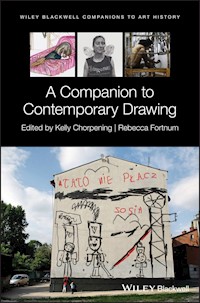
A Companion to Contemporary Drawing E-Book
170,99 €
Mehr erfahren.
- Herausgeber: John Wiley & Sons
- Kategorie: Geisteswissenschaft
- Serie: Blackwell Companions to Art History
- Sprache: Englisch
The first university-level textbook on the power, condition, and expanse of contemporary fine art drawing
A Companion to Contemporary Drawing explores how 20th and 21st century artists have used drawing to understand and comment on the world. Presenting contributions by both theorists and practitioners, this unique textbook considers the place, space, and history of drawing and explores shifts in attitudes towards its practice over the years. Twenty-seven essays discuss how drawing emerges from the mind of the artist to question and reflect upon what they see, feel, and experience.
This book discusses key themes in contemporary drawing practice, addresses the working conditions and context of artists, and considers a wide range of personal, social, and political considerations that influence artistic choices. Topics include the politics of eroticism in South American drawing, anti-capitalist drawing from Eastern Europe, drawing and conceptual art, feminist drawing, and exhibitions that have put drawing practices at the centre of contemporary art. This textbook:
- Demonstrates ways contemporary issues and concerns are addressed through drawing
- Reveals how drawing is used to make powerful social and political statements
- Situates works by contemporary practitioners within the context of their historical moment
- Explores how contemporary art practices utilize drawing as both process and finished artifact
- Shows how concepts of observation, representation, and audience have changed dramatically in the digital era
- Establishes drawing as a mode of thought
Part of the acclaimed Wiley Blackwell Companions to Art History series, A Companion to Contemporary Drawing is a valuable text for students of fine art, art history, and curating, and for practitioners working within contemporary fine art practice.
Sie lesen das E-Book in den Legimi-Apps auf:
Seitenzahl: 1362
Veröffentlichungsjahr: 2020
Ähnliche




















Table of Contents
Cover
Title Page
Copyright Page
List of Illustrations
Notes on Contributors
Acknowledgments
Introduction
References
Further Reading
Part I: The Power of Drawing
1 The Black Index
Kenyatta A.C. Hinkle:
The Evanesced
Titus Kaphar:
Asphalt and Chalk
Whitfield Lovell:
Rounds
Double Take
References
2 A State of Alert
Defining South American Drawing
The Politics of Drawing Maps
Away with These Ancient Disabilities: Erotic Drawing in Brazil
Outside the Boundaries of the Normal: Drawing and Pornography Toward Greater Freedom
Epilogue
References
3 Graphic Witness
References
4 Drawn from Communism
Dialectics of Black and White
(Not‐So) White Cube
Working as Drawing
Baddrawing
Sistine Chapel of Egalitarian Art
Interpretation as Practice
Drawing as a Tool
Drawing's Pedagogical Turn
Drawing Surplus Population
Drawing as the Brechtian Actor
References
5 Differencing Drawing
Encounter I: The Line of Christine Taylor Patten (USA, b.1940)
Encounter II: Eva Hesse (b.1936) and Surface
Encounter III: Claudette Johnson (b.1959) with Adrian Piper (b.1948)
Encounter V Differencing: Some Theoretical Reflections
References
6 A Dirty Double Mirror
Autobiography and Drawing
Portraits and Self‐Portraits
Autobiographical Fictions
Fool, of Thyself Speak Well: Fool, Do Not Flatter
Self‐Made
The Graphic Arts
Through a Glass, Darkly
References
Video
Artworks cited
Further Reading
7 Between the Sky and the Handle
Drawing and Conceptual Art in Contemporary Indian art
Acknowledgment
References
Further Reading
8 Drawing as Contagion
9 Curating Drawing
Introduction
Drawing, Now and Then
Drawing as Center
References
Part II: The Condition of Drawing
10 Observation and Drawing
A Line of Thought
The Looking Encounter
References
11 “Drawing's Impropriety”
The Subjectile
The Ground
Blank Silence
Appendix
References
12 Drawing in Atopia
References
13 Works on/in/with Paper
The First Drawings, or Appropriating the Surface
Working with What Is in the Surface
The First Drawings Revisited, or Being Beside the Surface
Following the Mark, Following the Surface
References
14 Indexical Drawing
Indexicality
Max Ernst
Rosalind Krauss on the Index
Michelle Stuart
Masao Okabe
Do Ho Suh
Anna Barriball
References
15 Ground as Critical Limit
Claiming the Surface
Concealment
Production of the Ground
Terminology
References
16 Drawing's Finish
Acknowledgments
References
17 Radical Antinomies
Drawing as Thinking
The Mediated Mark
Paperwork
Wall Drawings
Withdrawing
Academy of the Erased de Kooning
References
18 Drawing Desires
References
19 Drawing from Life and the Twenty‐first Century Art School
Introduction
Changes in Art Education
The Agency of Drawing
Drawing, Photography and the Mass Sharing of Images
Barbara Walker
Robert Longo
Spatial Drawing, William Kentridge and Tatiana Trouvé
Acknowledgments
References
Further Reading
Part III: The Expanse of Drawing
20 Marking Time, Moving Images
Marking Time
Cinematic Drawing
Repetition, Silence, and Futility
Film Stills and Transferred Photographs
Rohfilm
and Direct Animation
Drawings for Projection
Conclusion: Time Held Up
References
21 Digital Drawing
Transmission in Analogue Drawing
Early Analogue Computer Drawing
Digital Drawing Begins
Toward Transparency
A Longer Continuity: The Appeal of Transparency
Resisting Transparency
Digitized Continuity
Digitally Native Continuity
Conclusion: Whatever Else We Miss
References
22 The Dot and the Line
Medium Specificity, Drawing and the Digital
The Beginning of Drawing with Computers
Computer Drawings and Specific Objects
Drawing Machines
Autonomy and Algorithms
Digital Drawing's esthetic
References
23 Installation/Drawing
The Space in Drawing
Figures of Spaces
Spaces of Representation
Grounds for Drawing
The Space of Drawing
References
24 Informational Drawing
References
25 Drawing Towards Sound – Notation, Diagram, Drawing
Sound, Symbol, Notation
Graphics, Chance, and Indeterminacy
Performing Events
Toward an Interdisciplinary Dialogue
References
26 Chinese Calligraphy
Speaking Forms
Calligraphic Materials
Fit to Use
Alliances and Critical Vectors
Recently
Final Remarks
References
Further Readings
Reproductions
27 The Enduring Power of Comic Strips
References
Index
End User License Agreement
List of Illustrations
Chapter 0
Figure 0.1 Kelly Chorpening (2019) A Quiet Interior, Pencil and acrylic on p...
Figure 0.2 ‘Phantom Limn’ residency at Dovecot Studios, Edinburgh, 2017
Figure 0.3 Frank Auerbach (1990) from Seven Portraits, Michael. Etching on p...
Figure 0.4 John and Yves Berger drawing at Camberwell College, University of...
Figure 0.5 Rebecca Fortnum (2013), Eyes Wide Shut (Billie). Pencil, wax and ...
Chapter 1
Figure 1.1 Kenyatta A.C. Hinkle (2016)
The Evanesced
. India ink and watercol...
Figure 1.2 Titus Kaphar (2015)
The Jerome Project (Asphalt and Chalk) XV
. Ch...
Figure 1.3 Whitfield Lovell (2006–2011)
The Card Series II: The Rounds
. 54 c...
Figure 1.4 Whitfield Lovell (2006–2011)
The Card Series II: The Rounds (Deta
...
Chapter 2
Figure 2.1 Anna Bella Geiger (1978)
Equações, série De Rerum Artibus
...
Figure 2.2 Teresinha Soares (1970)
Corpo a Corpo in Cor‐pus Meus
(Body...
Figure 2.3 Nahum B. Zenil (1996)
¡Oh, Santa Bandera! (a Enrique Guzmán)
...
Figure 2.4 Miguel Angel Rojas (1975)
ATENAS C.C. (Cine Contiguo #1–4)
...
Figure 2.5 José Leonilson Bezerra Dias (1990)
Favorite game
. Permanent ink o...
Chapter 3
Figure 3.1 Lorna Simpson (2008)
Bed Green
. Graphite and ink on paper. 27.9 ×...
Figure 3.2 Catherine Anyango Grünewald (2015)
Live, Moments ago (The Death o
...
Figure 3.3 Nidhal Chamekh (2017)
Calais, studies and fragments of memories
. ...
Figure 3.4 Andrea Bowers (2015)
Badass Girls (May Day, Los Angeles 2014
), de...
Figure 3.5 Mounira Al Solh (2012‐ongoing)
I Strongly Believe in Our Right to
...
Chapter 4
Figure 4.1 Tamas St.Turba/Tamás Szentjóby (2012)
We’re Not Talented Enough
...
Figure 4.2 János Sugár (2003)
Oneway Design
. Ready‐made (pair of workers glo...
Figure 4.3 Łukasz Surowiec (2015)
“Daddy, don't cry. Zosia.”
Figure 4.4 GLUKLYA /Natalia Pershina‐Jakimanskaya, formerly: Factory of Foun...
Figure 4.5 Fokus Grupa (2011 ‐ ongoing)
I Sing to Pass the Time
.
Figure 4.6 Marina Naprushkina and the Office for Antipropaganda (2012)
Self#
...
Chapter 5
Figure 5.1 Christine Taylor Patten
Imagine
5
(to the Fifth Power)
, (2007) Crow...
Figure 5.2 Eva Hesse
No title
. (1969) Gouache, watercolor, silver ink, and g...
Figure 5.3 Claudette Johnson
Untitled
. (2015) Pastel on paper, 154 × 104 cm....
Figure 5.4 Adrian Piper
The Barbie Doll Drawings
. (1967) Series of 35 drawin...
Chapter 6
Figure 6.1 Louise Bourgeois (1994)
Sculptress
. Drypoint on paper, 33.2 × 20....
Figure 6.2 Nicola Tyson (2015)
Pre Non‐Snowstorm Self‐Portrait
. ...
Figure 6.3 Frances Stark (2010) Pull After “Push”. Latex, printed matter, li...
Figure 6.4 Emma Talbot
Candlewick
. Watercolor on paper. 24 × 30 cm.
Chapter 7
Figure 7.1 Shilpa Gupta (2014)
100 Hand drawn Maps of Country
. Carbon tracin...
Figure 7.2 Shilpa Gupta (2016)
Untitled
. Tracings: pencil on paper; 8.3 × 11...
Figure 7.3 Shilpa Gupta (2012)
Stars in Flags of the World, July 2011
. Embro...
Chapter 8
Figure 8.1 Jade Montserrat (2017)
No Need for Clothing
. Drawing installation...
Figure 8.2 Jade Montserrat (2019)
Instituting Care
. Installation view at Blu...
Figure 8.3 Jade Montserrat (2018)
Untitled (The Wretched of the Earth, After
...
Chapter 10
Figure 10.1 Henry Tonks (c. 1900–1925) Henry Tonks. Pencil, 36.6 × 26.2 cm. ...
Figure 10.2 David Garshen Bomberg
(1931) David Bomberg
. Charcoal and wash, 4...
Chapter 11
Figure 11.1 Tal‐Coat (1982–1983), Lavis sur papier. Ink wash on paper, 50 × ...
Figure 11.2 Tal‐Coat (1977) Crayon sur papier. Pencil on paper, 12 × 37 cm....
Figure 11.A.1
Chapter 12
Figure 12.1 Henri Matisse (1906) Small Light Woodcut, Woodcut, 45.8 × 29 cm....
Figure 12.2 Roland Barthes (1971) Drawing dated 15 December 1971, labeled no...
Figure 12.3 Beth Harland (2016)
Methods of Modern Construction, part 1
. Mixe...
Figure 12.4 Beth Harland (2016)
Methods of Modern Construction, part 3
. Oil ...
Chapter 13
Figure 13.1 Dorothea Rockburne (1973)
Drawing Which Makes Itself: FPI 16
. Fo...
Figure 13.2 Louise Hopkins,
Untitled (0100)
, 2000. Pencil on crumpled paper....
Figure 13.3 Lai Chih‐Sheng,
Drawing Paper
(detail), 2012. Pencil, paper. 76 ...
Chapter 14
Figure 14.1 Do Ho Suh (2015–2016)
Rubbing/Loving Project: 348 West 22nd Stre
...
Figure 14.2 Anna Barriball (2008)
Sunset/Sunrise
. V. Pencil on paper, 85 × 1...
Figure 14.3 Mona Hatoum (1999) Untitled (passoire de J‐L). Japanese wax pape...
Chapter 15
Figure 15.1 Daniel Buren (2001)
Photos‐souvenirs: Who's afraid of Peter Eise
...
Figure 15.2 Daniel Buren (2001)
Photos‐souvenirs: Who's afraid of Peter Eise
...
Figure 15.3 Daniel Buren (2001)
Photos‐souvenirs: Who's afraid of Peter Eise
...
Chapter 16
Figure 16.1 Ed Ruscha (1965),
Thayer Avenue
. Graphite and pencil on paper mo...
Figure 16.2 Vija Celmins (1968)
Hiroshima
. Graphite on acrylic ground on pap...
Figure 16.3 Kate Davis (2008)
Who is a Woman now? II
. Framed pencil drawing ...
Chapter 17
Figure 17.1 Robert Rauschenberg (1953)
Erased de Kooning Drawing
. Traces of ...
Figure 17.2 John Latham (1970)
One Second Drawing
.
Figure 17.3 Howardena Pindell (1975)
Untitled #3
. Ink on paper, collage; 16....
Chapter 18
Figure 18.1 Henri Michaux (1980)
Saisir
.
Figure 18.2 Jitish Kallat (2015)
Wind Study (the hour of the day of the mont
...
Figure 18.3 Sally Morfill, from Sally Morfill and Ana Čavić (2015)
Th
...
Figure 18.4 Ana Čavić, from Sally Morfill and Ana Čavić (2015)...
Chapter 19
Figure 19.1 Barbara Walker (2018)
Backdrop
. Graphite on embossed paper, 63 ×...
Figure 19.2 Robert Longo (2017)
Untitled (X‐Ray of A Bar at the Folies‐Bergè
...
Figure 19.3 William Kentridge (2015)
More Sweetly Play the Dance
. 8‐channel ...
Figure 19.4 Tatiana Trouvé (2007)
Untitled
. Sand, copper, soil, formica, woo...
Chapter 20
Figure 20.1 Susan Morris (2009)
Plumb Line Drawing No. 10
. Black pigment (vi...
Figure 20.2 Vivienne Koorland (2006)
The Kapo Tallies His Human Losses for t
...
Figure 20.3 Oscar Muñoz (2003)
Re/Trato (Portrait / I Try Again)
, Video, 28 ...
Chapter 21
Figure 21.1 Susan Turcot (2004)
British Embassy
. One of twelve drawings in t...
Figure 21.2 Jochem Hendricks (2001)
“EYE”
. Produced for the San ...
Figure 21.3 Charlotte and Arthur Webb (2015)
Flickr Nude (or Noodle) Descend
...
Chapter 22
Figure 22.1 Charles Csuri (1967)
Random War
. Laminates and lightjet – plotte...
Figure 22.2 Antoine Schmitt (2000)
Avec Détermination
, algorithmic mate...
Figure 22.3 Antoine Schmitt (2013)
Swarm
. Generative work. Computer, specifi...
Figure 22.4 Zachary Lieberman (2006)
Drawn
. Drawings, interactive computer p...
Figure 22.5 Zachary Lieberman (2006)
Drawn
. Drawings, interactive computer p...
Chapter 23
Figure 23.1 Monika Grzymala (2012)
Raumzeichnung/Spatial Drawing
. Site‐speci...
Figure 23.2 Sophia Banou (2012)
Weaving Lines/Looming Narratives
. Tracing pa...
Figure 23.3 Metis: Mark Dorrian and Adrian Hawker (2014)
On the Surface
. Exh...
Chapter 24
Figure 24.1 Matthew Ritchie (2018)
The Temptation of the Diagram
. Getty Rese...
Figure 24.2 Faraday's magnetic field drawings (1852). Magnetic field drawing...
Figure 24.3 Georgiana Houghton (c. 1868)
Glory be to God
. Watercolor on pape...
Figure 24.4 James Clerk Maxwell's Diagram of the lines on Gibb's thermodynam...
Figure 24.5 Jean Perrin (1909)
Mouvement brownien et realité moléculaire
...
Chapter 25
Figure 25.1 John Cage (1957–1958)
Concert for Piano
.
Figure 25.2 Anton Lukoszevieze (2015)
Untitled
. Acrylic paint, collage, copy...
Figure 25.3 Anton Lukoszevieze (2014)
Braxton
. Silver gelatin photogram, 12....
Figure 25.4 Hallveig Àgùstdòttir (2013) “
21 sound drawings
” series 1, nr. 4....
Figure 25.5 Hallveig Àgùstdòttir (2013) “
21 sound drawings
” series 1, nr. 7....
Chapter 26
Figure 26.1 Dong Qichang (1555–1636).
The Song of Leshou Hall
. 1635. Two pag...
Figure 26.2 Details of four Northern Wei epigraphs, sixth century CE. Ink on...
Figure 26.3 Yi Bingshou (1754–1815).
Potted Chrysanthemums
. 1808. Ink on pap...
Figure 26.4 Qiu Zhijie 1992.
Copying the “Orchid Pavilion Preface” One Thous
...
Chapter 27
Figure 27.1 Catherine Anyango (2010).
Heart of Darkness
. London: SelfMadeHer...
Figure 27.2 R. J. Ivankovic (2017).
H. P. Lovecraft’s The Call of Cthulhu: (
...
Guide
Cover
Table of Contents
Begin Reading
Pages
ii
iv
ix
x
xi
xii
xiii
xiv
xv
xvii
xviii
xix
xx
xxi
xxii
xxiii
xxv
1
2
3
4
5
6
7
8
9
10
11
13
14
15
16
17
18
19
20
21
22
23
24
25
26
27
29
30
31
32
33
34
35
36
37
38
39
40
41
42
43
44
45
46
47
48
49
50
51
52
53
54
55
56
57
58
59
60
61
62
63
64
65
66
67
68
69
71
72
73
74
75
76
77
78
79
80
81
82
83
84
85
86
87
88
89
90
91
92
93
94
95
96
97
98
99
100
101
102
103
104
105
106
107
108
109
110
111
112
113
114
115
116
117
118
119
120
121
123
124
125
126
127
128
129
130
131
132
133
134
135
136
137
138
139
140
141
142
143
144
145
147
148
149
150
151
152
153
154
155
156
157
158
159
161
162
163
164
165
166
167
168
169
170
171
172
173
174
175
176
177
178
179
180
181
182
183
185
186
187
188
189
190
191
192
193
194
195
196
197
198
199
200
201
203
204
205
206
207
208
209
210
211
212
213
214
215
216
217
218
219
221
222
223
224
225
226
227
228
229
230
231
232
233
234
235
236
237
239
240
241
242
243
244
245
246
247
248
249
250
251
252
253
254
255
257
258
259
260
261
262
263
264
265
266
267
268
269
270
271
272
273
274
275
276
277
278
279
280
281
282
283
284
285
286
287
288
289
290
291
292
293
294
295
296
297
298
299
300
301
302
303
304
305
306
307
308
309
310
311
312
313
314
315
316
317
318
319
320
321
322
323
324
325
326
327
328
329
330
331
332
333
334
335
336
337
338
339
340
341
343
344
345
346
347
348
349
350
351
352
353
354
355
356
357
358
359
360
361
362
363
364
365
367
369
370
371
372
373
374
375
376
377
378
379
380
381
382
383
384
385
386
387
389
390
391
392
393
394
395
396
397
398
399
400
401
402
403
404
405
407
408
409
410
411
412
413
414
415
416
417
418
419
420
421
422
423
424
425
426
427
428
429
431
432
433
434
435
436
437
438
439
440
441
442
443
444
445
446
447
448
449
450
451
452
453
454
455
456
457
458
459
460
461
462
463
464
465
466
467
468
469
471
472
473
474
475
476
477
478
479
480
481
482
483
484
485
486
487
488
489
490
491
493
494
495
496
497
498
499
500
501
502
503
504
505
506
507
508
509
510
511
513
514
515
516
517
518
519
520
521
522
523
524
525
526
527
528
529
531
532
533
534
535
536
537
538
539
540
541
542
543
544
545
546
547
548
549
550
551
WILEY BLACKWELL COMPANIONS TO ART HISTORY
These invigorating reference volumes chart the influence of key ideas, discourses, and theories on art, and the way that it is taught, thought of, and talked about throughout the English‐speaking world. Each volume brings together a team of respected international scholars to debate the state of research within traditional subfields of art history as well as in more innovative, thematic configurations. Representing the best of the scholarship governing the field and pointing toward future trends and across disciplines, the Blackwell Companions to Art History series provides a magisterial, state‐of‐the‐art synthesis of art history.
A Companion to Contemporary Art since 1945
edited by Amelia Jones
A Companion to Medieval Art
edited by Conrad Rudolph
A Companion to Asian Art and Architecture
edited by Rebecca M. Brown and Deborah S. Hutton
A Companion to Renaissance and Baroque Art
edited by Babette Bohn and James M. Saslow
A Companion to British Art: 1600 to the Present
edited by Dana Arnold and David Peters Corbett
A Companion to Modern African Art
edited by Gitti Salami and Monica Blackmun Visonà
A Companion to Chinese Art
edited by Martin J. Powers and Katherine R. Tsiang
A Companion to American Art
edited by John Davis, Jennifer A. Greenhill and Jason D. LaFountain
A Companion to Digital Art
edited by Christiane Paul
A Companion to Dada and Surrealism
edited by David Hopkins
A Companion to Public Art
edited by Cher Krause Knight and Harriet F. Senie
A Companion to Islamic Art and Architecture, Volumes 1 and 2
edited by Finbarr Flood and Gulru Necipoglu
A Companion to Modern Art
edited by Pam Meecham
A Companion to Contemporary Design since 1945
edited by Anne Massey
A Companion to Illustration
edited by Alan Male
A Companion to Modern and Contemporary Latin American and Latino Art,
edited by Alejandro Anreus, Robin Greeley, and Megan Sullivan
A Companion to Feminist Art
edited by Hilary Robinson and Maria Elena Buszek
A Companion to Curation
edited by Brad Buckley and John Conomos
A Companion to Korean Art
edited by JP Park, Burglind Jungmann, and Juhyung Rhi
A Companion to Contemporary Drawing
edited by Kelly Chorpening and Rebecca Fortnum
A Companion to Contemporary Drawing
Edited by
Kelly Chorpening and Rebecca Fortnum
This edition first published 2020© 2020 John Wiley & Sons, Inc.
All rights reserved. No part of this publication may be reproduced, stored in a retrieval system, or transmitted, in any form or by any means, electronic, mechanical, photocopying, recording or otherwise, except as permitted by law. Advice on how to obtain permission to reuse material from this title is available at http://www.wiley.com/go/permissions.
The right of Kelly Chorpening and Rebecca Fortnum to be identified as the authors of the editorial material in this work has been asserted in accordance with law.
Registered Office(s)John Wiley & Sons, Inc., 111 River Street, Hoboken, NJ 07030, USAJohn Wiley & Sons Ltd, The Atrium, Southern Gate, Chichester, West Sussex, PO19 8SQ, UK
Editorial OfficeThe Atrium, Southern Gate, Chichester, West Sussex, PO19 8SQ, UK
For details of our global editorial offices, customer services, and more information about Wiley products visit us at www.wiley.com.
Wiley also publishes its books in a variety of electronic formats and by print‐on‐demand. Some content that appears in standard print versions of this book may not be available in other formats.
Limit of Liability/Disclaimer of WarrantyWhile the publisher and authors have used their best efforts in preparing this work, they make no representations or warranties with respect to the accuracy or completeness of the contents of this work and specifically disclaim all warranties, including without limitation any implied warranties of merchantability or fitness for a particular purpose. No warranty may be created or extended by sales representatives, written sales materials or promotional statements for this work. The fact that an organization, website, or product is referred to in this work as a citation and/or potential source of further information does not mean that the publisher and authors endorse the information or services the organization, website, or product may provide or recommendations it may make. This work is sold with the understanding that the publisher is not engaged in rendering professional services. The advice and strategies contained herein may not be suitable for your situation. You should consult with a specialist where appropriate. Further, readers should be aware that websites listed in this work may have changed or disappeared between when this work was written and when it is read. Neither the publisher nor authors shall be liable for any loss of profit or any other commercial damages, including but not limited to special, incidental, consequential, or other damages.
Library of Congress Cataloging‐in‐Publication Data
Names: Chorpening, Kelly, editor. | Fortnum, Rebecca, editor.Title: A companion to contemporary drawing / edited by Kelly Chorpening & Rebecca Fortnum.Description: First edition. | Hoboken, NJ : Wiley‐Blackwell, 2020. | Series: Wiley Blackwell companions to art history | Includes bibliographical references and index.Identifiers: LCCN 2019045090 (print) | LCCN 2019045091 (ebook) | ISBN 9781119194545 (hardback) | ISBN 9781119194569 (adobe pdf) | ISBN 9781119194576 (epub)Subjects: LCSH: Drawing–21st century–Themes, motives.Classification: LCC NC96 .C66 2020 (print) | LCC NC96 (ebook) | DDC 741–dc23LC record available at https://lccn.loc.gov/2019045090LC ebook record available at https://lccn.loc.gov/2019045091
Cover Design: WileyCover Image: Łukasz Surowiec (2015) “Daddy, don’t cry. Zosia”. Painting on the wall and drawing of miner’s daughter transferred onto the wall of family house, Katowice. Photo: Dawid Chalimoniuk, courtesy of Łukasz Surowiec, Davido/Katowice City of Gardens. Emma Talbot (2013) Candlewick. Watercolour on paper, 24 × 30 cm. Reproduced by permission of the artist; Andrea Bowers (2015) Badass Girls (May Day, Los Angeles 2014), detail. Graphite on paper, 62 × 43 cm (24.4 × 16.9 inches). Source: © Andrea Bowers. Courtesy the artist and kaufmann repetto, Milan/New York. Photo: Andrea Rossetti; Jade Montserrat (2018) Untitled (The Wretched of the Earth, After Frantz Fanon). Drawing Installation, ‘The Last Place They Thought Of’ exhibition, Institute of Contemporary Art, University of Pennsylvania. Photo: Constance Mensh. Reproduced by permission of the artist.
List of Illustrations
0.1
Kelly Chorpening (2019) A Quiet Interior. Pencil and acrylic on paper mounted to steel 77 × 65 × 64 cm. Source: Courtesy of Kelly Chorpening.
0.2
‘Phantom Limn’ residency at Dovecot Studios, Edinburgh, 2017, Source: courtesy of Kelly Chorpening.
0.3
Frank Auerbach (1990) from Seven Portraits, Michael. Etching on paper Dimensions: image: 178 × 147 mm © Tate, London 2019.
0.4
John and Yves Berger drawing at Camberwell College, University of the Arts London, 2007. Source: Courtesy of Craig Dow.
0.5
Rebecca Fortnum (2013), Eyes Wide Shut (Billie). Pencil, wax and oil on paper, 2013 Each image 70 × 100 cm. Source: Courtesy Rebecca Fortnum.
1.1
Kenyatta A.C. Hinkle (2016)
The Evanesced
. India ink and watercolour on recycled paper. Each 30.5 × 22.9 cm (12 × 9 inches). Source: Courtesy the artist. Photo: Michael Underwood.
1.2
Titus Kaphar (2015)
The Jerome Project (Asphalt and Chalk) XV
. Chalk on asphalt paper, 124.5 × 91.4 cm (49 × 36 inches). Fund for the Twenty‐First Century. The Museum of Modern Art, New York, U.S.A. © Titus Kaphar. Digital Image © The Museum of Modern Art/Licensed by SCALA/Art Resource, NY. Courtesy of the artist.
1.3
Whitfield Lovell (2006–2011)
The Card Series II: The Rounds
. 54 cards, charcoal pencil on paper with attached playing card. Each 30.5 × 22.9 cm (12 × 9 inches). Source: Collection of the Smithsonian National Museum of African American History and Culture, exhibition: Walter Larrimore/NMAAHC. © Whitfield Lovell. Reproduced with permission.
1.4
Whitfield Lovell (2006–2011)
The Card Series II: The Rounds (Detail card X)
. Charcoal pencil on paper with attached playing card. 30.5 × 22.9 cm (12 × 9 inches). Source: Collection of the Smithsonian National Museum of African American History and Culture © Whitfield Lovell. Reproduced with permission.
2.1
Anna Bella Geiger (1978)
Equações, série De Rerum Artibus
(Equations, De Rerum Artibus series). Graphite, frottage and crayons on lined notebook sheet. 24 × 33 cm. © Anna Bella Geiger.
2.2
Teresinha Soares (1970)
Corpo a Corpo in Cor‐pus Meus
(Body to Body in Colour‐Pus of Mine). Painted wood. Dimensions variable. © Teresinha Soares.
2.3
Nahum B. Zenil (1996)
¡Oh, Santa Bandera! (a Enrique Guzmán)
(Oh, Saint Flag! – To Enrique Guzmán). Triptych. Mixed media on paper. 238 × 71.5 cm. Colección MUAC, UNAM.
2.4
Miguel Angel Rojas (1975)
ATENAS C.C. (Cine Contiguo #1–4)
(ATENAS CC – Contiguous Cinema #1–4). Graphite on paper. 90 × 69 cm. © Miguel Angel Rojas.
2.5
José Leonilson Bezerra Dias (1990)
Favorite game
. Permanent ink on paper. 21 × 13.5 cm. Source: Photo: Rubens Chiri / © Projeto Leonilson.
3.1
Lorna Simpson (2008)
Bed Green
. Graphite and ink on paper. 27.9 × 21.6 cm (11 × 8.5 inches). Source: © Lorna Simpson. Courtesy the artist and Hauser & Wirth
3.2
Catherine Anyango Grünewald (2015)
Live, Moments ago (The Death of Mike Brown, Ferguson, 9.8.14)
. Film still. Source: © Catherine Anyango Grünewald. Courtesy the artist.
3.3
Nidhal Chamekh (2017)
Calais, studies and fragments of memories
. Graphite and transfer on cotton paper. 100 × 140 cm (39.3 × 55.1 inches). Source: © Collection Frac Centre-Val de Loire. Photography: Blaise Adilo.
3.4
Andrea Bowers (2015)
Badass Girls (May Day, Los Angeles 2014)
, detail. Graphite on paper, 62 × 43 cm (24.4 × 16.9 inches). Source: © Andrea Bowers. Courtesy the artist and kaufmann repetto, Milan / New York. Photo: Andrea Rossetti.
3.5
Mounira Al Solh (2012‐ongoing)
I Strongly Believe in Our Right to Be Frivolous
. Mixed media on legal paper. Each 30 × 21 cm (11.8 × 8.2 inches). Source: The Art Institute of Chicago. © Mounira Al Solh. Courtesy the artist and Sfeir-Semler Gallery, Beirut / Hamburg.
4.1
Tamas St.Turba/Tamás Szentjóby (2012)
We’re Not Talented Enough
(Banner‐plot). Drawing, India ink on paper, 15.1 × 21.3 cm. Source: Courtesy of Tamás Szentjóby.
4.2
János Sugár (2003)
Oneway Design
. Ready made (pair of workers gloves with palmistry lines). Source: Courtesy of János Sugár.
4.3
Łukasz Surowiec (2015) “
Daddy, don’t cry. Zosia
”. Painting on the wall, drawing of miner’s daughter transferred onto the wall of family house, Katowice. Photo: Dawid Chalimoniuk, Courtesy of Łukasz Surowiec, Davido/Katowice City of Gardens.
4.4
GLUKLYA /Natalia Pershina‐Jakimanskaya, formerly: Factory of Found Clothes (2010)
Against the commercial shit
. Drawing for the Chto Delat newspaper issue Tragedy or Farce. Source: Courtesy of GLUKLYA /Natalia Pershina‐Jakimanskaya.
4.5
Fokus Grupa (2011 - ongoing)
I Sing to Pass the Time
. Pencil on paper. Source: Courtesy of Fokus Grupa.
4.6
Marina Naprushkina and the Office for Antipropaganda (2012)
Self#governing
. Page from the Newspaper. Source: Courtesy of Marina Naprushkina and the Office for Antipropaganda.
5.1
Christine Taylor Patten (2007)
Imagine
5
(to the Fifth Power)
. Crow quill and ink on paper, 56 × 261.6 cm. (Photograph Daniel Barsotti) with 24/2000 micros, between 1355 AD and 1382 AD. Crow quill and ink on paper, 2.5 × 2.5 cm. Source: Courtesy the artist.
5.2
Eva Hesse
No title
. (1969) Gouache, watercolor, silver ink and graphite on laid paper, 22 1/8 × 15 inches (56.2 × 38.1 cm). Source: Collection of Gail and Tony Ganz, Los Angeles. © The Estate of Eva Hesse. Courtesy Hauser & Wirth.
5.3
Claudette Johnson (2015)
Untitled
. Pastel on paper, 154 × 104 cm. Source: Courtesy the artist and Hollybush Gardens, London.
5.4
Adrian Piper (1967)
The Barbie Doll Drawings
. Series of 35 drawings: Indian ink and Rapidograph and/or pencil on paper. Each 8.5 × 5.5 inches (21.5 × 14 cm). Detail: drawing # 7 of 35. Collection of the Museum of Modern Art, New York. Source: © Adrian Piper Research Archive Foundation Berlin.
6.1
Louise Bourgeois (1994)
Sculptress.
Drypoint on paper, 33.2 × 20.7 cm. Part of the Autobiographical Series. Source: © The Easton Foundation/VAGA at ARS, NY and DACS, London 2018.
6.2
Nicola Tyson (2015)
Pre Non‐Snowstorm Self‐Portrait
. Graphite on paper. 19.05 × 19.05 cm (7.5 × 7.5 inches). Source: Courtesy the artist and Petzel, New York.
6.3
Frances Stark (2010)
Pull After “Push”
. Latex, printed matter, linen tape, stickers on panel.175.26 × 226.06 cm (69 × 89 inches). Source: Photo by Robert Wedemeyer. Courtesy the artist.
6.4
Emma Talbot (2013). Watercolour on paper. 24 × 30 cm. Reproduced by permission of the artist.
7.1
Shilpa Gupta (2014)
100 Hand drawn Maps of Country
. Carbon tracings on paper; 30 × 22 in. (17 × 56 cm). Source: Courtesy of The Artist & Galleria Continua / Le Moulin, San Gimignano / Beijing / Les Moulins / Habana. Photographer: Ela Bialkkowska. 100 people were invited to make a hand drawn map of their country – in Mumbai.
7.2
Shilpa Gupta (2016)
Untitled
. Tracings: pencil on paper; 8.3 × 11.7 in. (21 × 29.7 cm). Source: Courtesy of The Artist and Dvir Gallery, Tel Aviv. Photographer: Elad Sarig.
7.3
Shilpa Gupta (2012)
Stars in Flags of the World, July 2011
. Embroidery on cloth; 82 × 58 × 6 in. (209 × 148 ×15 cm). Source: Courtesy of The Artist & Galleria Continua / Le Moulin, San Gimignano / Beijing / Les Moulins / Habana.
8.1
Jade Montserrat (2017)
No Need for Clothing
. Drawing installation at Cooper Gallery/DJCAD. Source: Photo: Jacquetta Clark.
8.2
Jade Montserrat (2019)
Instituting Care
. Installation view at Bluecoat, Liverpool, United Kingdom.
8.3
Jade Montserrat (2018)
Untitled (The Wretched of the Earth, After Frantz Fanon)
. Drawing Installation, ‘The Last Place They Thought Of’ exhibition, Institute of Contemporary Art, University of Pennsylvania. Photo: Constance Mensh.
10.1
Henry Tonks (c. 1900–1925)
Henry Tonks
. Pencil, 36.6 × 26.2 cm. Given by executors of Henry Tonks, 1937, NPG 3072(7). Source: © National Portrait Gallery, London.
10.2
David Garshen Bomberg (1931)
David Bomberg
. Charcoal and wash, 49.5 × 32.4 cm. Purchased, 1970, NPG 4821. Source: © National Portrait Gallery, London.
11.1
Tal‐Coat (1982–83) Lavis sur papier. Ink wash on paper, 50 × 65 cm. Courtesy, Galerie Clivages, photograph Jean‐Louis Losi.
11.2
Tal‐Coat (1977) Crayon sur papier. Pencil on paper, 12 × 37 cm. Source: Courtesy, Galerie Clivages, photograph Jean‐Louis Losi.
12.1
Henri Matisse (1906) Small Light Woodcut. Woodcut, 45.8 × 29 cm. The Baltimore Museum of Art: The Cone Collection, formed by Dr. Claribel Cone and Miss Etta Cone of Baltimore, Maryland BMA 1950.12.237. Photography: Mitro Hood.
12.2
Roland Barthes (1971) Drawing dated 15 December 1971, labeled no.159, ink on paper, 21 × 26.5 cm. Source: Bibliothèque nationale de France.
12.3
Beth Harland (2016)
Methods of Modern Construction, part 1
. Mixed media, 205 × 135 cm. Source: © Collection of Artist.
12.4
Beth Harland (2016)
Methods of Modern Construction, part 3
. Oil on canvas, 26 × 21 cm each panel. Source: © Collection of Artist.
13.1
Dorothea Rockburne (1973)
Drawing Which Makes Itself: FPI 16
. Folded paper and ink. 76.2 × 101.5 cm. Blanchette Hooker Rockefeller Fund. The Museum of Modern Art, New York, NY, U.S.A. Source: © 2018 Dorothea Rockburne / Artists Rights Society (ARS), New York. Digital Image © The Museum of Modern Art/Licensed by SCALA/Art Resource, NY.
13.2
Louise Hopkins (2000)
Untitled (0100)
. Pencil on crumpled paper. 49.5 × 60 cm. Source: Courtesy the artist. © Louise Hopkins.
13.3
Lai Chih‐Sheng (2012)
Drawing Paper
(detail). Pencil, paper. 76 × 103 cm. Source: Courtesy the artist. © Lai Chih‐Sheng.
14.1
Do Ho Suh (2015–2016)
Rubbing/Loving Project: 348 West 22nd Street, New York, NY 10011, USA
. Coloured pencil on vellum; 240 × 420 × 670 cm. Source: © Do Ho Suh. Courtesy the Artist, Victoria Miro, and Lehmann Maupin Gallery, New York and Hong Kong (Photography Chris Payne).
14.2
Anna Barriball (2008)
Sunset/Sunrise
. V. Pencil on paper, 85 × 110 cm. Source: Courtesy the artist and Frith Street Gallery.
14.3
Mona Hatoum (1999) Untitled (passoire de J-L). Japanese wax paper, 43.5 × 54.5 cm (17 1/4 × 19 3/4 in.) © Mona Hatoum. Courtesy Le Creux de l’Enfer (Photo: Joël Damase).
15.1
Daniel Buren (2001)
Photos‐souvenirs: Who’s afraid of Peter Eisenman?
. Work in situ, in “As Painting: Division and Displacement”. Wexner Center for the Arts, Columbus (Ohio), May 2001. Source: © DB‐ADAGP, Paris. Photo by Daniel Buren (2001). Courtesy the artist.
15.2
Daniel Buren (2001)
Photos‐souvenirs: Who’s afraid of Peter Eisenman?
. Work in situ, in “As Painting: Division and Displacement”. Wexner Center for the Arts, Columbus (Ohio), May 2001. Source: © DB‐ADAGP Paris. Photo by Daniel Buren (2001). Courtesy the artist.
15.3
Daniel Buren (2001)
Photos‐souvenirs: Who’s afraid of Peter Eisenman?
, Work in situ, in “As Painting: Division and Displacement”. Wexner Center for the Arts, Columbus (Ohio), May 2001. Source: © Daniel Buren / ADAGP, Paris. Courtesy the artist.
16.1
Ed Ruscha (1965),
Thayer Avenue
. Graphite and pencil on paper mounted on paper; 14 × 22‐5/8 inches. Source: © Ed Ruscha, reproduced by permission the artist and Gagosian Gallery.
16.2
Vija Celmins (1968)
Hiroshima
. Graphite on acrylic ground on paper; 34.5 × 45.5 cm. Source: © Vija Celmins, reproduced by permission the artist and Matthew Marks Gallery.
16.3
Kate Davis (2008)
Who is a Woman now? II
. Framed pencil drawing and silkscreen print on paper; 170 × 130 cm. Source: © Kate Davis. Courtesy the artist.
17.1
Robert Rauschenberg (1953)
Erased de Kooning Drawing
. Traces of ink and crayon on paper, with mat, and hand‐lettered label in ink, in gold‐leafed frame; 25 1/4 × 21 3/4 × 1/2 inches (64.1 × 55.2 × 1.3 cm); San Francisco Museum of Modern Art, Purchase through a gift of Phyllis C. Wattis. Source: © Robert Rauschenberg Foundation.
17.2
John Latham (1970)
One Second Drawing
. Source: © The John Latham Foundation. Courtesy Lisson Gallery.
17.3
Howardena Pindell (1975)
Untitled #3
. Ink on paper, collage; 16.5 × 17.1cm (6 ½ × 6 ¾ in.), frame: 37.4 × 37.4 × 3.8 cm (14 ¾ × 14 ¾ × 1 ½ in.). Museum purchase, Laura P. Hall Memorial Fund, 2015‐6688. Source: Princeton University Art Museum / Art Resource, NY.
18.1
Henri Michaux (1980)
Saisir
. Source: © ADAGP, Paris and DACS, London 2018.
18.2
Jitish Kallat (2015)
Wind Study (the hour of the day of the month of the season)
. Burnt adhesive and graphite on Arches paper, 67 × 45 in./ 170 × 114 cm. Source: © Jitish Kallat. Courtesy of artist.
18.3
Sally Morfill, from Sally Morfill and Ana Čavić (2015).
The Naturalness of Strange Things
. Pencil drawing on 100 gsm Munken pure rough, 297 × 420 mm. Source: © Sally Morfill. Courtesy the artist.
18.4
Ana Čavić, from Sally Morfill and Ana Čavić (2015)
The Naturalness of Strange Things
. ‘Take me with you’, sculpture poem. Adhesive vinyl on paper, 210 × 297 mm. Source: © Ana Čavić. Courtesy the artist.
19.1
Barbara Walker (2018)
Backdrop
. Graphite on embossed paper, 63 × 46 cm. Source: © Barbara Walker. Courtesy the artist.
19.2
Robert Longo (2017)
Untitled (X‐Ray of A Bar at the Folies‐Bergère, 1882, After Manet)
. Charcoal on mounted paper. Overall Dimensions: 243.8 × 330.8 cm (95.98 × 130.24 in), Framed Dimensions: 261.8 × 348.8 × 10.2 cm (103.07 × 137.32 × 4.02 in). Source: © Robert Longo. Photo: Studio Robert Longo. Courtesy Galerie Thaddaeus Ropac, London · Paris · Salzburg.
19.3
William Kentridge (2015)
More Sweetly Play the Dance
. 8‐channel HD video installation with 4 megaphones, sound; 15 min. Installation at Marian Goodman Gallery, New York, 2016. Source: Courtesy of the artist and Marian Goodman Gallery. Photo credit: Cathy Carver.
19.4
Tatiana Trouvé (2007)
Untitled
. Sand, copper, soil, formica, wood, metal, Plexiglas. 310 × 425 × 650 cm. Source: Courtesy of artist and König Galerie. Photo credit: Marc Domage. Image courtesy of the artist and KÖNIG GALERIE.
20.1
Susan Morris (2009)
Plumb Line Drawing No. 10
. Black pigment (vine ash) on paper, 158 × 347 cm. Source: © Susan Morris. Courtesy of artist.
20.2
Vivienne Koorland (2006)
The Kapo Tallies His Human Losses for the Day
. Oil on canvas, 61 × 69 cm. Source: © Vivienne Koorland. Courtesy of artist.
20.3
Oscar Muñoz (2003)
Re/Trato (Portrait / I Try Again).
Video, 28 minutes (still). Source: © Oscar Muñoz. Courtesy of artist.
21.1
Susan Turcot (2004)
British Embassy
. One of twelve drawings in the series Self‐Service. Pencil on paper, 30 × 40 cm. Source: © Susan Turcot. Courtesy of the artist.
21.2
Jochem Hendricks (2001) “
EYE
”. Produced for the San Francisco Museum of Modern Art and based on the San Jose Mercury News. “EYE” is the second version of “Newspaper” (1994), which was based on the Frankfurter Allgemeine Zeitung. Source: © Jochem Hendricks. Courtesy of the artist.
21.3
Charlotte and Arthur Webb (2015)
Flickr Nude (or Noodle) Descending a Staircase
. This staircase was created 26 February 2018. Source: © Charlotte Webb. Courtesy of the artist.
22.1
Charles Csuri (1967)
Random War
. Laminates and lightjet – plotter drawings from a computer programming, 104 × 229 cm. Source: © Charles Csuri. Courtesy of the artist.
22.2
Antoine Schmitt (2000)
Avec Détermination
, algorithmic material and computer screen. Source: © Antoine Schmitt. Courtesy the artist.
22.3
Antoine Schmitt (2013)
Swarm
. Generative work. Computer, specific program, video projector. Source: © Antoine Schmitt. Courtesy the artist.
22.4
Zachary Lieberman (2006)
Drawn
. Drawings, interactive computer program, projector. Source: © Zachary Lieberman. Courtesy the artist.
22.5
Zachary Lieberman (2006)
Drawn
. Drawings, interactive computer program, projector. Source: © Zachary Lieberman. Courtesy the artist.
23.1
Monika Grzymala (2012)
Raumzeichnung/Spatial Drawing
. Site‐specific installation presented at Crone Gallery, Berlin. Source: © Monika Grzymala. Courtesy of the artist.
23.2
Sophia Banou (2012)
Weaving Lines/Looming Narratives
. Tracing paper, laser‐engraved plywood panels and thread. Site‐specific installation, presented at the Newcastle University School of Arts and Cultures. Source: Copyright Sophia Banou.
23.3
Metis: Mark Dorrian and Adrian Hawker (2014)
On the Surface
. Exhibition presented at Arkitektskolen Aarhus, Denmark. Source: © Adrian Hawker and Mark Dorrian. Courtesy of the artist. Photo: Gert Skærlund Andersen
24.1
Matthew Ritchie (2018)
The Temptation of the Diagram
. Getty Research Institute, Los Angeles 2018. Source: © J. Paul Getty Trust.
24.2
Faraday’s magnetic field drawings (1852). Magnetic field drawings. Source: Diagrams by the English physicist Michael Faraday (1791–1867) of the magnetic fields around various configurations of magnets. Published in the Philosophical Transactions of the Royal Society. Source: Reproduced by permission of Science Photo Library.
24.3
Georgiana Houghton (c. 1868)
Glory be to God
. Watercolour on paper, 49 × 55 cm. Source: Victorian Spiritualists’ Union, Melbourne, Australia. Reproduced with permission.
24.4
James Clerk Maxwell (1875) Diagram of the lines on Gibb’s thermodynamic surface, 8 July 1875 (Number 564). Source: Courtesy of Special Collections, The McClay Library, Queen’s University Belfast. Thomson Collection MS13/M/22/A.
24.5
Jean Perrin (1909)
Mouvement brownien et realité moléculaire
. Published in Perrin, Jean. 1916.
Atoms
. New York: D. Van Nostrand Company: 115 (Digitized Archive. Org.).
25.1
John Cage (1957–8)
Concert for Piano
. Source: Copyright © 1960 by Henmar Press Inc. All rights reserved. Used by permission of C.F. Peters Corporation.
25.2
Anton Lukoszevieze (2015)
Untitled
. Acrylic paint, collage, copy paper transfer (the black lines), 29.7 × 21 cm. Source: © Anton Lukoszevieze. Courtesy of artist.
25.3
Anton Lukoszevieze (2014)
Braxton
. Silver gelatin photogram, 12.7 × 17.8 cm. Source: © Anton Lukoszevieze. Courtesy of artist.
25.4
Hallveig Àgùstdòttir (2013) “
21 sound drawings
” series 1, nr. 4. Pencil, graphite, ink and acrylic on 250 g/m
2
Bristol paper, mounted on wood, 29.7 × 21 cm. Source: © Hallveig Àgùstdòttir. Courtesy of artist.
25.5
Hallveig Àgùstdòttir (2013) “
21 sound drawings
” series 1, nr. 7. Pencil, graphite, ink and acrylic on 250 g/m
2
Bristol paper, mounted on wood. 29.7 × 21 cm. Source: © Hallveig Àgùstdòttir. Courtesy of artist.
26.1
Dong Qichang (1555–1636).
The Song of Leshou Hall. 1635
. Two pages of album with rubbings of engravings of same pages. Ink on paper. 21 × 11.8 cm. Private collection. Source: Reproduced by permission of Eric Otto Wear.
26.2
Details of four Northern Wei epigraphs, sixth century CE. Ink on paper. Private collection. Source: Reproduced by permission of Eric Otto Wear.
26.3
Yi Bingshou (1754–1815).
Potted Chrysanthemums
. 1808. Ink on paper. 98.5 × 27.5 cm. Private collection. Source: Reproduced by permission of Eric Otto Wear.
26.4
Qiu Zhijie (1992).
Copying the ‘Orchid Pavilion Preface’ One Thousand Times
. Ink on paper. 69 × 160 cm. Source: Reproduced by permission of Qiu Zhijie.
27.1
Catherine Anyango (2010)
Heart of Darkness
. London: SelfMadeHero. 49 and 50. Source: Reproduced by permission of Catherine Anyango.
27.2
R. J. Ivankovic (2017)
H. P. Lovecraft’s The Call of Cthulhu: (for beginning readers).
Hayward: Chaosium. 44 and 45. Source: Reproduced by permission of Chaosium Inc.
Notes on Contributors
Sophia Banou is a Lecturer in Architecture at the University of the West of England. She has studied architecture at the National Technical University of Athens (Architecture and Engineering Diploma, 2008), and the University of Edinburgh, holding an MSc in Advanced Architectural Design and a PhD in Architecture by Design (2016). Her doctoral research examined architectural representation and the status of architectural drawing conventions through a critical‐historical approach to urban representation. She has previously practiced architecture in Greece and taught architectural design and theory at the Newcastle University (UK) and the University of Edinburgh. She is a co‐editor at Drawing On: Journal of Architectural Research by Design and Charrette. Her research is concerned with questions of representation, mediality, and mediation in architecture. Her work has been published and exhibited internationally, and can be found in permanent collections in Europe and the USA.
Kelly Chorpening holds a BFA from the Cleveland Institute of Art and MFA from Hunter College, City University of New York. In 2016 she was shortlisted for both the Derwent and Jerwood drawing prizes and had a solo exhibition at Horatio Jr., London. Many of her projects are co‐developed as books, published by Studio International (USA), Loughborough University/Marmalade Press, RGAP (UK), Sint‐Lucas Visual Arts and OPAK, FAK, KULeuven (Belgium). She has been an invited speaker for public talks at Borough Road Gallery, ICA London, National Gallery London, Tate Britain, RMIT Melbourne, American University Dubai, Royal Society London and Carnegie Mellon University, USA. Her teaching of drawing extends beyond art to students of archeology (The New School and New York University), engineering (Kings College London), architecture (The AA Schools), and choreography (Trinity Laban). She was the Course Leader for BA (Hons) Drawing from 2006–19 and is now Programme Director Fine Art: Painting, Drawing and Printmaking at Camberwell College of Arts, University of the Art London.
Bridget R. Cooks is Associate Professor in the Department of Art History and the Department of African American Studies at the University of California, Irvine. She also serves as core faculty in the PhD Programs in Visual Studies, and Culture and Theory. Her research focuses on African American artists, Black visual culture, and museum criticism. Cooks authored the book, Exhibiting Blackness: African Americans and the American Art Museum (University of Massachusetts Press, 2011). She is currently working on her second manuscript titled, A Dream Deferred: Art of the Civil Rights Movement and the Limits of Liberalism.
Parul Dave Mukherji is professor at the School of Arts and Aesthetics, Jawaharlal Nehru University, New Delhi, India. She holds a PhD from Oxford University. She has received fellowships such as the British Academy award, 2011; Baden Württemberg, Heidelberg University, Germany, 2013 and Clark Art Institute fellowship, USA, 2014. Her publications include InFlux‐ Contemporary Art in Asia, (co‐edited) New Delhi, Sage, 2013; ASA volume Arts and Aesthetics in a Globalizing World, co‐edited with Ramindar Kaur, London: Bloomsbury, 2014 and “Who is Afraid of Mimesis: Contesting the Common Sense of Indian Aesthetics through the Theory of Mimesis or Anukaran̦a Vāda” in The Bloomsbury Research Handbook of Indian Aesthetics and the Philosophy of Art, ed. Arindam Chakrabarty, London, New York, Bloomsbury, 2016.
Jane de Almeida is professor at the Graduate Studies in Education, Art and History of Culture at Mackenzie University (São Paulo, Brazil) and has been visiting professor at University of California, San Diego. She was a visiting fellow at the History of Art and Architecture department at Harvard University and artist in residency at the Arthur C. Clarke Center for Human Imagination (UCSD, 2018). Recently she curated the Programming the Visible exhibition about Harun Farocki's works (2017) and directed the StereoEssays São Paulo film (2018). Jane is curator of film and art exhibitions and has published articles and books on the relationship between digital and contemporary film art.
Rebecca Fortnum is an artist and academic. She has been a Reader in Fine Art at University of the Arts London, Professor of Fine Art at Middlesex University and is currently Professor of Fine Art at the Royal College of Art, where she leads the research programme in the School of Arts & Humanities. She was Visiting Research Fellow in Creative Arts at Merton College, Oxford in 2019. Her books include, Contemporary British Women Artists; in their own words and On Not Knowing; how artists think, which she co‐edited with Lizzie Fisher and she is the Founding Editor of the Journal of Contemporary Painting published by Intellect. Solo exhibitions include Absurd Impositions, at the V&A's Museum of Childhood (2011), and Self Contained, at the Freud Museum London (2013). In 2020 a monograph about her painting, A Mind Weighted with Unpublished Matter, was published by Slimvolume. She is the co‐editor of A Companion to Contemporary Drawing with Kelly Chorpening.
Sofia Gotti is a scholar and curator. She is currently a Leverhulme Early Career Fellow at the University of Cambridge and was a lecturer at Nuova Accademia delle Belle Arti (NABA), Milan. Her research centers on feminist art practices in Latin America and Italy. She completed an AHRC Collaborative PhD with Tate Research and Chelsea College of Art, she worked at Castello di Rivoli Museo d'Arte Contemporanea Rivoli‐Torino and The Feminist Institute in New York City. Sofia has previously taught at The Courtauld Institute of Art, at University of the Arts London, and in 2015–2016 she was the Hilla Rebay International Curatorial Fellow at the Solomon R. Guggenheim Foundation.
Simon Grennan is a scholar of visual narrative and graphic novelist. He is author of A Theory of Narrative Drawing (2017), Drawing in Drag by Marie Duval (2018) and Dispossession, a graphic adaptation of a novel by Anthony Trollope (2015 – one of The Guardian Books of the Year). He is co‐author, with Roger Sabin and Julian Waite, of Marie Duval: Maverick Victorian Cartoonist (2020), Marie Duval (2018) and The Marie Duval Archive (www.marieduval.org) and co‐editor, with Laurence Grove, of Transforming Anthony Trollope: ‘Dispossession’, Victorianism and 19th century word and image (2015), among others. Since 1990, he has been half of the international artists' team Grennan & Sperandio, producer of over 40 comics and books. Dr. Grennan is Leading Research Fellow at the University of Chester and Principal Investigator for the project Marie Duval presents Ally Sloper: the female cartoonist and popular theatre in London 1869–1885, funded by an AHRC Research Grant: Early Career (2014).
Beth Harland (1964–2019) artist, Professor of Fine Art, Lancaster University and Associate Editor of the Journal of Contemporary Painting, exhibited and curated widely. She was awarded a number of artist residencies including British School at Rome; Cité des Arts, Paris; Milchof, Berlin and iAIR at RMIT, Melbourne. Recent exhibition projects include “Impermanent Durations; On Painting and Time,” exhibited in Singapore (2016), Australia (2016), UK (2017), and USA (2019). Her publications include a four‐volume co‐edited work, Painting: Critical and Primary Sources, Bloomsbury (2015) and a series of articles linked to the research project Modes of Address in Pictorial Art in collaboration with psychologists at Liverpool Hope and UCLAN Universities, published in Leonardo (2014), Art and Perception (2016) and Psychology of Aesthetics, Creativity and the Arts (2017).
Margaret Iversen is Professor Emerita of Art History and Theory at the University of Essex. Her books include Alois Riegl: Art History and Theory (1993), Beyond Pleasure: Freud, Lacan and Barthes (2007), Writing Art History (with Stephen Melville) and Chance (both 2010). She co‐edited two special issues of journals: “Photography after Conceptual Art” for Art History and “Agency and Automatism” for Critical Inquiry. A book called Photography, Trace, and Trauma appeared in 2017.
Marina Kassianidou is Assistant Professor in the Department of Art and Art History, University of Colorado Boulder. Her art practice focuses on relationships between mark and surface. She has exhibited work in Europe, the USA, and Australia. Selected awards include fellowships at the Ragdale Foundation and Virginia Center for the Creative Arts. She is a recipient of the 2016 Joan Mitchell Foundation Painters and Sculptors Grant. Her publications include When Words Enter the Picture (in Greek, Visual Artists Association EI.KA, 2017) and the artist books How to Know: A Space (Thkio Ppalies, 2016) and Exercise Book (P.S. Artist‐Led Projects, 2018).
Ed Krčma is Senior Lecturer in Art History at the University of East Anglia. His research focuses upon post‐war and contemporary drawing, and has been published in journals such as Art History, Oxford Art Journal, Master Drawings and the Burlington Magazine. His monograph, Rauschenberg/Dante: Drawing a Modern Inferno, was published by Yale University Press in 2017.
Laura Lisbon is an artist and professor at The Ohio State University. She has exhibited internationally. In 2010, she exhibited works in “Le Paradox du Diaphane et du Mur” in Amilly, France. In 2017, she participated in “Impermanent Durations: On Painting and Time” in Lancaster, UK as well as “Gray Matters” at the Wexner Center for the Arts, Columbus, USA. In 2001, Lisbon co‐curated “As Painting: Division and Displacement” at the Wexner Center for the Arts. She has published in La Part de l'Œil and is on the Editorial Board of the Journal of Contemporary Painting.
Anna Lovatt is Assistant Professor of Art History at Southern Methodist University. Her research focuses on the art of the 1960s and 1970s and its legacies, particularly drawing in the context of post‐Minimal and Conceptual art. She has published articles on artists including Trisha Donnelly, Janice Kerbel, Sol LeWitt, Michelle Stuart, Dorothea Rockburne, and Anne Truitt. Her book Drawing Degree Zero: The Line from Minimal to Conceptual Art was published by Penn State University Press in 2019.
Kate Macfarlane is a curator and writer based in London and is co‐founder and co‐director of Drawing Room, London. Recent curatorial projects include A Slice through the World: Contemporary Artists' Drawings (Drawing Room and Modern Art Oxford) 2018; Dove Allouche – Mea Culpa of a Sceptic (The Fondation d'entreprise Ricard, Paris) 2016; Line (Lisson Gallery, London) 2016. Recent writing includes: “Intimate Reflections” in Auto Fictions – Contemporary Drawing, Wilhelm‐Hack‐Museum, Germany (2018); “Drawing as Thinking through Material Encounter,” in A Slice through the World: Contemporary Artists' Drawings (Modern Art Oxford, 2018).
Sunil Manghani is Professor of Theory, Practice and Critique at Winchester School of Art, University of Southampton (UK). He teaches and writes on various aspects of critical theory, visual arts, and image studies. He is author of Image Studies: Theory and Practice (2013) and an editor of Seeing Degree Zero (2019) India's Biennale Effect: A Politics of Contemporary Art (2016), Barthes/Burgin: Notes Towards an Exhibition (2016), Farewell to Visual Studies (2015), Images: A Reader (2006), and Images: Critical and Primary Sources (2013).
Lucien Massaert studied drawing and mural painting at the Royal Academy of Fine Arts in Brussels. He was head of the drawing department in the same institution until 2015. His research and publications mainly concern an attempt to elaborate a structural theory of the visual arts starting from the works of Algirdas Julien Greimas, Jean Petitot and François. Wahl. He is co‐founder with Luc Richir of the journal of aesthetics La Part de l'Œil.
Jade Montserrat is the recipient of the Stuart Hall Foundation Scholarship which supports her PhD (via MPhil) at The Institute for Black Atlantic Research, The University of Central Lancashire (Race and Representation in Northern Britain in the context of the Black Atlantic: A Creative Practice Project) and the development of her work from her black diasporic perspective in the North of England. She was awarded one of two Jerwood Student Drawing Prizes in 2017 for No Need for Clothing, a documentary photograph of a drawing installation at Cooper Gallery DJCAD by Jacquetta Clark. Recent selected screenings, performances and presentations include, The Bluecoat, Liverpool, 2018–2019 (solo show), SPILL Festival of Performance (2018) SPACE studios (2018), ICA Philadelphia (2018), Arnolfini, and Spike Island, Bristol (2017), Alison Jacques Gallery (2017) and Princeton University (2016).
Paul Moorhouse is an independent curator, writer and art historian. Currently Chief Executive of The Anthony Caro Studio, he was Senior Curator, Twentieth Century and Head of Displays at the National Portrait Gallery from 2005 to 2017; before that, he was Senior Curator at the Tate. He has organized numerous exhibitions internationally, including major retrospectives devoted to Sherman, Hodgkin, Giacometti, Richter, Warhol, Caro, Riley, Kossoff and Andrews. His extensive publications include the recent books Salvador Dali: The Impossible Collection; Bridget Riley: A Very Very Person, John Virtue, Cindy Sherman and Alberto Giacometti: Pure Presence. He is currently curating the exhibition Makers of the Modern, a major twentieth‐century survey of artists portraying each other, which opens in Moscow in 2021.
Tamarin Norwood is an artist and writer. She gained her doctorate (Drawing: the Point of Contact) in 2018 as a Clarendon Scholar at the Ruskin School of Art, University of Oxford. Her artwork has been shown in the UK and abroad including at Tate Britain, ICA Philadelphia and MOCCA Toronto. She has most recently undertaken residencies at Spike Island, Bristol researching movement in drawing through 3D printing and sign language poetry with the support of Arts Council England, and researching doodling, mind wandering and rest as part of Hubbub, the Wellcome Collection's inaugural interdisciplinary residency.
Griselda Pollock is Professor of Social and Critical Histories of Art and Director of the Centre for Cultural Analysis, Theory and History (CENTRECATH) at the University of Leeds. Committed to creating and extending an international, postcolonial, queer feminist analysis of the visual arts, visual culture and cultural theory, she researches issues of trauma and the aesthetic in contemporary art and contemporary art under the concept: “the virtual feminist museum” (Encounters in the Virtual Feminist Museum: Time, Space and the Archive, 2007; After‐affects/After‐images: Trauma and Aesthetic Transformation in the Virtual Museum, Manchester, 2013; Art in the Time‐Space of Memory and Migration, Freud Museum & Wild Pansy Press, 2013). Since 2007, she has elaborated the concept of concentrationary memory in relation to the Arendtian critique of totalitarianism, in four publications with Max Silverman, Concentrationary Cinema (Berghahn, 2011) Concentrationary Memories: Totalitarian Terror and Cultural Resistance (I B Tauris, 2013), Concentrationary Imaginaries: Tracing Totalitarian Violence in Popular Culture (I B Tauris, 2015), and Concentrationary Art (2018). In 2018 she published a major monograph on a major modern artwork: Charlotte Salomon: The Nameless in the Theatre of Memory (Yale, 2018). Forthcoming are Is Feminism a Bad Memory? (Verso, 2019), The Case against “Van Gogh”: Memory, Place and Modernist Disillusionment (Thames & Hudson, 2019) and Monroe's Mov(i)es: Class, Gender and Nation in the work, image‐making and agency of “Marilyn Monroe” (2020).
Magdalena Radomska is Post‐Marxist art historian and historian of philosophy, Assistant Professor at Adam Mickiewicz University in Poznan, Poland. She holds a PhD in art history, and has received scholarships at the Courtauld Institute of Art in London, the Hungarian Academy of Sciences in Budapest and at the Eötvös Loránd University in Budapest. She was a director and lecturer of the course Writing Humanities after the Fall of Communism in 2009 at Central European University in Budapest. In 2013 her book The Politics of Movements of Hungarian Neoavantgarde (1966–1980)




