


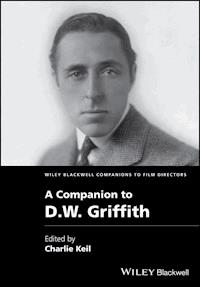
A Companion to D. W. Griffith E-Book
177,99 €
Mehr erfahren.
- Herausgeber: John Wiley & Sons
- Kategorie: Geisteswissenschaft
- Serie: WBCF - Wiley-Blackwell Companions to Film Directors
- Sprache: Englisch
The most comprehensive volume on one of the most controversial directors in American film history
A Companion to D.W. Griffith offers an exhaustive look at the first acknowledged auteur of the cinema and provides an authoritative account of the director’s life, work, and lasting filmic legacy.
The text explores how Griffith’s style and status advanced along with cinema’s own development during the years when narrative became the dominant mode, when the short gave way to the feature, and when film became the pre-eminent form of mass entertainment. Griffith was at the centre of each of these changes: though a contested figure, he remains vital to any understanding of how cinema moved from nickelodeon fixture to a national pastime, playing a significant role in the cultural ethos of America.
With the renewed interest in Griffith’s contributions to the film industry, A Companion to D.W. Griffith offers a scholarly look at a career that spanned more than 25 years. The editor, a leading scholar on D.W. Griffith, and the expert contributors collectively offer a unique account of one of the monumental figures in film studies.
- Presents the most authoritative, complete account of the director’s life, work, and lasting legacy
- Builds on the recent resurgence in the director’s scholarly and popular reputation
- Edited by a leading authority on D.W. Griffith, who has published extensively on this controversial director
- Offers the most up-to-date, singularly comprehensive volume on one of the monumental figures in film studies
Sie lesen das E-Book in den Legimi-Apps auf:
Seitenzahl: 1353
Veröffentlichungsjahr: 2017
Ähnliche




















Table of Contents
Cover
Title Page
Contributors
Preface
Introduction
Griffith then and now
Griffith as stylist
Griffith and other media forms
Griffith’s exploration of gender in the progressive era
Griffith in the 1920s
The reception of Griffith’s films
References
Part One: Griffith Redux
1 Disciplinary Descent: Film Studies, Families, and the Origins of Narrative Cinema
The rise of the mythical father and the fall of the realist text
Griffith’s melodramatic imagination and cinema’s mother tongue
Coupling space and time: Technology’s family
Coda
Biographical note
Acknowledgments
References
2 Griffith’s Moral Profile
Griffith as melodramatic moralist
Griffith as moralistic moralist
Griffith as immoral moralist
Griffith as antimoralist moralist
Griffith as conflicted moralist
Conclusion
Biographical note
References
3 “The Beauty of Moving Wind in the Trees”: Cinematic Presence and the Films of D.W. Griffith
Photogénie
and the “seaside despair” film
Bazinian ontology and the urban topical film
The
plan straubien
in two Griffith films
Biographical note
References
Part Two: Style in the Biograph Era
4 D.W. Griffith and the Emergence of Crosscutting
Types of spatial relations in cinema
Actorial and narratorial cuts
Conclusion
Before Griffith (1906–1908)
Griffith’s first eleven months as a director (1908–1909)
Biographical notes
References
5 D.W. Griffith and the Primal Scene
Griffith’s cinematic weave of space
Breaking down and building up the scene
Griffith’s primal scene: Crossing the threshold of intimacy
The intimate Griffith: The triangle of filmmaker, character, and viewer
Biographical note
References
6 Griffith’s Biograph Shorts: Electric Power and Film Style, from East to West
From New York to California
Biograph’s New York studio
Electrifying the California studios
Shooting in California
Contiguous spaces
Editing
Actors on the frontline
Griffith and Hollywood
Biographical note
References
Part Three: Imagery and Intermediality
7 Deep Theatrical Roots: Griffith and the Theater
Approaches to film performance
Griffith the theatergoer
Griffith the stage actor
Griffith the playwright
Griffith the film actor
Griffith and civil war dramatizations
Dance as performance
Griffith’s features and melodrama
Biographical note
References
8 Notes on Floral Symbolism, Allegory, and Intermediality in the Films of D.W. Griffith
“The Wild Duck”
Love in the air
Love’s despair
“The Browning Series”
The White Rose
A conclusion of sorts
Biographical note
References
9 Living Portraits: Signs of (the) Time in D.W. Griffith
“Near and dear…”
Time’s arrow
“Great and good…”
The seen and the unseen
Biographical note
References
Part Four: Gender and Progressivism
10 Griffith’s Body Language and Film Narration: “The Voluptuary” Versus “the Spirituelle”
Comedy, genre, and feminist film theory
An Unseen Enemy
: At the limits of pathos
Women in a hierarchy of discourses
“The weakness”: A slapstick comedienne in three melodramas
Conclusions: Between slapstick and melodrama
Biographical note
References
11 Cross‐dressing in Griffith’s Biograph Films: Humor, Heroics, and Edna “Billy” Foster’s Good Bad Boys
Power and punishment in Griffith’s cross‐dressing comedies
Heroic female cross‐dressing
Edna “Billy” Foster’s short career as a Biograph boy
Biographical note
References
12 Space, Gender, Oversight, and Social Change: Progressivism and the Films of D.W. Griffith, 1909–1916
Private life and public spaces
Vision and oversight
The feminine presence
Biographical note
References
13 Progressive Pastoral: Social Justice Reforms and Biograph Films, 1908–1911
Agrarian Progressives in
1776
,
or The Hessian Renegades
Adventures of Dollie
in a naturalistic urban park
A Child of the Ghetto
saved from congestion
The moral amusement of landscape in
The Country Doctor
Conclusion
Biographical note
References
Part Five: Revisiting Failed Features
14 Gendering Ministry and Reform: Griffith and the Plight of Protestant Uplift
Biographical note
References
15 “Squalid Without Being Tragic”: Griffith’s “
Isn’t Life Wonderful
”
Shooting “
Isn’t Life Wonderful
” overseas
Griffith and the French occupation
Griffith and Major Geoffrey Moss
Griffith back home: Finishing the film and the demise of Mamaroneck
First critical response
Publicity and distribution
Selling “
Isn’t Life Wonderful
” abroad
Analyzing a simple film
Conclusion
Biographical note
Acknowledgments
References
16 Faust at Famous Players
Biographical note
References
17 Griffith in a Minor Key: Early Art Cinema Looking Backward
A production with posthumous aesthetic
A windfall for critics
Networks of critics and intellectual histories
Biographical note
References
Part Six: Reception at Home and Abroad
18 “Damage Unwittingly Done”: D.W. Griffith and the Re‐
Birth
of the Ku Klux Klan
Birth
in Atlanta, 1915
The new
face
of the Klan, 1920
Afterlife in the 1920s
Griffith’s legacy in America
Biographical note
Acknowledgments
References
Newspapers
Collections
19 “History by Lightning”: D.W. Griffith in South Africa
Biographical note
Acknowledgments
References
20
Blossoms
Breaking at the Dawn of Cinephilia: The Reception of D.W. Griffith in France
A lecture in good taste:
Broken Blossoms
at the Salle Marivaux
Whistling down
Broken Blossoms
From cinematic crisis to cinephile opportunity
Conclusion: Creating an audience for Griffith
Biographical note
References
Newspapers and periodicals
21 The Legacy of
Intolerance
“A story in this manner”: Reception of
Intolerance
in 1916
Intolerance
in the 1920s
Reception in France
Intolerance
and Soviet filmmakers
Intolerance
and the development of film culture: The first revivals and MoMA
Intolerance
and mid‐century cine‐clubs
Intolerance
today
Biographical Note
References
Index
End User License Agreement
List of Tables
Chapter 04
Table 4.1 Spatial articulation between two shots.
Table 4.2 Typology of cuts between shots of a sequence presenting a form of alternation (obtained by applying our hypothesis on actorial cuts and narratorial cuts to our theory of the articulations of spatial language).
Table 4.3 Typology of cuts connecting shots in a crosscutting sequence.
List of Illustrations
Chapter 02
Image 2.1 Cartoon from Griffith’s self‐published anti‐censorship pamphlet
The Rise and Fall of Free Speech in America
.
Image 2.2 Cartoon from Griffith’s self‐published anti‐censorship pamphlet
The Rise and Fall of Free Speech in America
.
Chapter 04
Image 4.1 Shots 106 and 107.
Image 4.2 Shot 108.
Image 4.3 Shots 29 to 32.
Image 4.4 Shots 61 and 62.
Image 4.5 Shots 13 and 14.
Image 4.6 Shots 35 and 36.
Image 4.7 Shots 8 and 9
Image 4.8 Shots 70 and 71.
Chapter 06
Image 6.1 A frame from
The Sealed Room
(1909).
Image 6.2 A frame from
The Lesser Evil
(1912).
Image 6.3 A frame from
One Is Business, The Other Crime
(1912).
Image 6.4 A frame from
The Mothering Heart
(1913).
Image 6.5 Chart 1: Mean average shot lengths for interior and exterior scenes in forty‐seven Griffith Biographs released subsequent to 1909.
Image 6.6 Chart 2: The percentage of screen time given to four shot types for sixty‐six Griffith biographs.
Image 6.7 A frame from
The Unchanging Sea
(1910).
Image 6.8 A frame from
Death’s Marathon
(1913).
Chapter 08
Image 8.1 The two engagement scenes and the final unions with novel partners. The gardener (Arthur V. Johnson) is a few steps behind the Lady (Marion Leonard) on the stairs while the Lord (Henry B. Walthall) and the lace‐Maker (Mary Pickford) climb the stairs side by side. Frame enlargements from
Love Among the Roses
(1910)
Image 8.2 The Mother’s despair among the roses after her husband’s perfidy and the loss of her child.
Image 8.3 Illicit love between the minstrel (Henry B. Walthall) and the Countess (Marion Leonard). They’re lethally punished by the Count (Arthur V. Johnson) as he bricks up the exit from the love nest.
Image 8.4 Frame enlargement from the final episode of
Home, Sweet Home
(1914). Blanche Sweet and Courtenay Foote among the roses and lilies that first appeared in the opening scene.
Image 8.5 The verdant setting for the lovemaking in
The White Rose
(1923). Ivor Novello (John) and Mae Marsh (Teazie).
Chapter 09
Image 9.1 Elsie Stoneman’s framed portrait.
Images 9.2 and 9.3 Framed portraits of the suitors.
Image 9.4 Dora’s final emblematic shot.
Image 9.5 Mother’s portrait on the wall.
Image 9.6 The wedding portrait.
Images 9.7 and 9.8 Comparative family portraits, in the first and final shots of
What Drink Did
.
Chapter 10
Image 10.1 The tramp (Mack Sennett) pops out of the wardrobe while Claire (Florence Lawrence) laughs at the wealthy “fossil” (Arthur V. Johnson).
Image 10.2 The two sisters (Lillian and Dorothy Gish) respond with alarm when the slattern maid (Grace Henderson) points a gun at them through a hole in the wall
Image 10.3 The Weakness (Mabel Normand) spies on the Net‐Mender (Mary Pickford) and her Sweetheart (Charles West).
Chapter 11
Image 11.1 Jim (James Kirkwood, on knees) demonstrates his devotion to the mysterious woman at the dance, who is actually Bud (Billy Quirk) in disguise, as Mary (Mary Pickford, far right) looks on.
Image 11.2 Tomboy Nellie (Florence Lawrence), in disguise, commands her sister (Claire McDowell) to return home, as a boatman (George Gebhardt) looks on.
Image 11.3 Bobby (Edna Foster) realizes that his parents may be taken away from him.
Chapter 12
Image 12.1 Interlocking tenement spaces forge family and community, ameliorating loneliness.
Image 12.2 Griffith’s working girls as respected professionals and colleagues.
Image 12.3 Unadorned femininity linked to madness and the loss of self.
Chapter 13
Image 13.1 Rescue charge through a picturesque valley in
1776, or
The Hessian Renegades
(1909).
Image 13.2 Varied spatial depth and volume recall Olmsted’s park design. Shots 1–2 (above) and shots 4‐5 (below).
Image 13.3 The parade of girls with flowers in
A Child of the Ghetto
resembles collective activities of the “reform park.”
Image 13.4 Freely gazing and strolling are “moral amusements” when set in pastoral beauty.
Chapter 14
Image 14.1 D.W. Griffith and the cast of
The White Rose
(front row: Mae Marsh, “Uncle” Tom Jenkins [probable], Carol Dempster; middle row: Ivor Novello and Neil Hamilton; back row: Griffith and Lucille La Verne, holding an unidentified child).
Image 14.2 Mae Marsh as Bessie/Teazie (production still).
Image 14.3 Mae Marsh as Bessie/Teazie and Ivor Novello as Joseph Beaugardé (production still).
Chapter 15
Image 15.1 Neil Hamilton is still one of Germany’s Gruen Polizei who has been gassed in a French‐inspired riot, posed in front of a swanky department store on Unter den Linden. He would later become a Polish First World War vet.
Image 15.2 Inga passes by Hungry Ones, including veteran stage actors Hans von Schlettow and Robert Scholz.
Image 15.3 Carol Dempster (as Inga) visits her chickens in Werder, near the bank of the Havel River.
Image 15.4 On location in a Berlin slum.
Image 15.5 Neil Hamilton, now a Polish war veteran, looks for work on the Berlin docks at the bottom of Mühlen Strasse.
Image 15.6 An example of Hendrik Sartov’s strong backlist exteriors: Inga (Carol Dempster) arm‐in‐arm with her brother Theodor (Frank Puglia) and sweetheart (Neil Hamilton).
Image 15.7 Paul’s homecoming. A classic example of Griffith’s staging non‐reciprocal glances to create a sense of isolation, even in crowded compositions.
Image 15.8 Carol Dempster with townspeople and trained actors waiting for horsemeat at an actual Berlin butcher shop.
Image 15.9 Griffith returns to classic Biograph framing, balancing his two principals (Carol Dempster and Frank Puglia) against a pair of anonymous workers, offsetting the symmetries of the famous Oberbaumbrücke towers.
Chapter 16
Images 16.1 and 16.2 Geoffrey and Mavis in their apartments, establishing their screen positions.
Image 16.3 Prince Lucio stands “between” Geoffrey and Mavis.
Chapter 17
Image 17.1 Citational shadow compositions in the final scene of
The Sorrows of Satan
(1926).
Image 17.2 Living statues in Griffith’s representation of a decadent party.
Image 17.3 A final glance at a mirror after taking a fatal dose of poison.
Chapter 18
Image 18.1 Advertising the newly‐formed Knights of the Ku Klux Klan, alongside
The Birth of a Nation
in Atlanta (
Atlanta Journal
, December 9 1915).
Image 18.2 An advertisement for
The Birth of a Nation
in the Klan press (
The Fiery Cross
, August 10 1923, p. 3).
Image 18.3 The riding Klansmen featured in Warren A. Newcombe’s painting of D.W. Griffith c. 1924. (
Photoplay
, June 1925, p. 69).
Chapter 19
Image 19.1 The Zulus grieve.
Image 19.2 The Zulu comforts the child.
Image 19.3 The Zulus attack.
Image 19.4 The white footprints.
Image 19.5 Dingaan.
Image 19.6 “Oom” Paul appears.
Image 19.7 Ploughing.
Chapter 21
Image 21.1 Ad for a ten‐volume history set, from Babylon to the present day. (
Photoplay
, March 1917, p. 7.)
Image 21.2 Intolerance fashions inspired by ancient Babylon. (
Photoplay
April 1917, p. 39.)
Guide
Cover
Table of Contents
Begin Reading
Pages
ii
iii
iv
viii
ix
x
xi
1
2
3
4
5
6
7
8
9
10
11
12
13
14
15
17
18
19
20
21
22
23
24
25
26
27
28
29
30
31
32
33
34
35
36
37
38
39
40
41
42
43
44
45
46
47
48
49
50
51
52
53
54
55
56
57
58
59
60
61
62
63
64
65
66
67
68
69
70
71
72
73
74
75
76
77
78
79
80
81
82
83
84
85
86
87
88
89
90
91
92
93
94
95
96
97
98
99
100
101
102
103
105
107
108
109
110
111
112
113
114
115
116
117
118
119
120
121
122
123
124
125
126
127
128
129
130
131
132
133
134
135
136
137
138
139
140
141
142
143
144
145
146
147
148
149
150
151
152
153
154
155
156
157
158
159
160
161
162
163
164
165
166
167
168
169
170
171
173
175
176
177
178
179
180
181
182
183
184
185
186
187
188
189
190
191
192
193
194
195
196
197
198
199
200
201
202
203
204
205
206
207
208
209
210
211
212
213
214
215
216
217
218
219
220
221
222
223
224
225
226
227
228
229
230
231
232
233
234
235
236
237
238
239
240
241
243
245
246
247
248
249
250
251
252
253
254
255
256
257
258
259
260
261
262
263
264
265
266
267
268
269
270
271
272
273
274
275
276
277
278
279
280
281
282
283
284
285
286
287
288
289
290
291
292
293
294
295
296
297
298
299
300
301
302
303
304
305
306
307
308
309
310
311
312
313
314
315
316
317
318
319
320
321
322
323
324
325
326
327
328
329
330
331
332
333
334
335
336
337
338
339
340
341
342
343
344
345
346
347
348
349
350
351
352
353
354
355
356
357
359
361
362
363
364
365
366
367
368
369
370
371
372
373
374
375
376
377
378
379
380
381
382
383
384
385
386
387
388
389
390
391
392
393
394
395
396
397
398
399
400
401
402
403
404
405
406
407
408
409
410
411
412
413
414
415
416
417
418
419
420
421
422
423
424
425
426
427
428
429
430
431
432
433
434
435
436
437
438
439
440
441
442
443
444
445
446
447
448
449
450
451
452
453
454
455
456
457
458
459
460
461
463
464
465
466
467
468
469
470
471
472
473
474
475
476
477
478
479
480
481
482
483
484
485
486
487
488
489
490
491
492
493
494
495
496
497
498
499
500
501
502
503
504
505
506
507
508
509
510
511
512
513
514
515
516
517
518
519
520
521
522
523
524
525
526
527
528
529
530
531
532
533
534
535
536
537
538
539
540
541
542
543
544
545
546
547
548
549
550
551
552
553
554
555
556
557
558
559
560
561
562
563
564
565
566
567
568
569
570
571
572
573
574
575
576
577
578
579
580
581
582
583
584
585
586
587
588
589
590
591
592
593
594
595
596
597
598
599
600
601
602
603
604
605
606
607
608
609
610
Wiley Blackwell Companions to Film Directors
The Wiley Blackwell Companions to Film Directors survey key directors whose work together constitutes what we refer to as the Hollywood and world cinema canons. Whether Haneke or Hitchcock, Bigelow or Bergmann, Capra or the Coen brothers, each volume, comprised of 20 or more newly commissioned essays written by leading experts, explores a canonical, contemporary and/or controversial auteur in a sophisticated, authoritative, and multi‐dimensional capacity. Individual volumes interrogate any number of subjects—the director’s oeuvre; dominant themes, well‐known, worthy, and under‐rated films; stars, collaborators, and key influences; reception, reputation, and above all, the director’s intellectual currency in the scholarly world.
Published
A Companion to Michael Haneke
, edited by Roy Grundmann
A Companion to Alfred Hitchcock
, edited by Thomas Leitch and Leland Poague
A Companion to Rainer Werner Fassbinder
, edited by Brigitte Peucker
A Companion to Werner Herzog
, edited by Brad Prager
A Companion to Pedro Almodóvar
, edited by Marvin D’Lugo and Kathleen Vernon
A Companion to Woody Allen
, edited by Peter J. Bailey and Sam B. Girgus
A Companion to Jean Renoir
, edited by Alastair Phillips and Ginette Vincendeau
A Companion to François Truffaut
, edited by Dudley Andrew and Anne Gillian
A Companion to Luis Buñuel
, edited by Robert Stone and Julián Daniel Gutiérrez‐Albilla
A Companion to Jean‐Luc Godard
, edited by Tom Conley and T. Jefferson Kline
A Companion to Martin Scorsese
, edited by Aaron Baker
A Companion to Fritz Lang
, edited by Joseph McElhaney
A Companion to D.W. Griffith
, edited by Charlie Keil
Under Contract
A Companion to John Ford
, edited by Peter Lehman
A Companion to Wong Kar‐wai
, edited by Martha P. Nochimson
A Companion to Robert Altman
, edited by Adrian Danks
A Companion to D.W. Griffith
Edited by
Charlie Keil
This edition first published 2018© 2018 John Wiley & Sons, Inc.
All rights reserved. No part of this publication may be reproduced, stored in a retrieval system, or transmitted, in any form or by any means, electronic, mechanical, photocopying, recording or otherwise, except as permitted by law. Advice on how to obtain permission to reuse material from this title is available at http://www.wiley.com/go/permissions.
The right of Charlie Keil to be identified as the author of the editorial material in this work has been asserted in accordance with law.
Registered Office(s)John Wiley & Sons, Inc., 111 River Street, Hoboken, NJ 07030, USA
Editorial Office9600 Garsington Road, Oxford, OX4 2DQ, UK
For details of our global editorial offices, customer services, and more information about Wiley products visit us at www.wiley.com.
Wiley also publishes its books in a variety of electronic formats and by print‐on‐demand. Some content that appears in standard print versions of this book may not be available in other formats.
Limit of Liability/Disclaimer of WarrantyWhile the publisher and authors have used their best efforts in preparing this work, they make no representations or warranties with respect to the accuracy or completeness of the contents of this work and specifically disclaim all warranties, including without limitation any implied warranties of merchantability or fitness for a particular purpose. No warranty may be created or extended by sales representatives, written sales materials or promotional statements for this work. The fact that an organization, website, or product is referred to in this work as a citation and/or potential source of further information does not mean that the publisher and authors endorse the information or services the organization, website, or product may provide or recommendations it may make. This work is sold with the understanding that the publisher is not engaged in rendering professional services. The advice and strategies contained herein may not be suitable for your situation. You should consult with a specialist where appropriate. Further, readers should be aware that websites listed in this work may have changed or disappeared between when this work was written and when it is read. Neither the publisher nor authors shall be liable for any loss of profit or any other commercial damages, including but not limited to special, incidental, consequential, or other damages.
Library of Congress Cataloging‐in‐Publication Data
Names: Keil, Charlie editor.Title: A companion to D.W. Griffith / [edited by] Charlie Keil, University of Toronto.Description: First edition. | Hoboken : Wiley, 2018. | Series: Wiley Blackwell companions to film directors | Includes bibliographical references and index. |Identifiers: LCCN 2017023330 (print) | LCCN 2017034832 (ebook) | ISBN 9781118341216 (pdf) | ISBN 9781118341223 (epub) | ISBN 9781118341254 (cloth)Subjects: LCSH: Griffith, D. W. (David Wark), 1875‐1948–Criticism and interpretation.Classification: LCC PN1998.3.G76 (ebook) | LCC PN1998.3.G76 C66 2017 (print) | DDC 791.4303/33092–dc23LC record available at https://lccn.loc.gov/2017023330
Cover Image: Portrait of D.W. Griffith, courtesy of Culver Pictures Inc.Cover Design: Wiley
Contributors
Kaveh Askari, Michigan State University, East Lansing, MI 48823, USA
Jennifer M. Bean, University of Washington, Seattle, WA 98105, USA
Nicole Devarenne, University of Dundee, Scotland, DD1 4HN, UK
Daniel Fairfax, Yale University, New Haven, CT 06520, USA
Annie Fee, University College London, WC1E 6BT, UK
André Gaudreault, Université de Montréal, QC H3T 1 J4, Canada
Philippe Gauthier, University of Ottawa, ON, K1N 6N5, Canada
Tom Gunning, University of Chicago, IL 60637, USA
Maggie Hennefeld, University of Minnesota, Minneapolis, MN 55455, USA
Laura Horak, Carleton University, Ottawa, ON K1S 5B6, Canada
Joyce E. Jesionowski, Binghamton University (emerita), NY 13902, USA
Moya Luckett, NYU’s Gallatin School, New York, NY 10003, USA
David Mayer, University of Manchester, M13 9PL, UK
Paul McEwan, Muhlenberg College, Allentown, PA 18104, USA
Russell Merritt, University of California, Berkeley, CA 94720, USA
Anne Morey, Texas A&M University, College Station, TX 77843, USA
Andrew Patrick Nelson, Montana State University, Bozeman, MT 59717, USA
Charles O’Brien, Carleton University, Ottawa, ON K1S 5B6, Canada
Jan Olsson, Stockholm University, 114 18, Sweden
Tom Rice, University of St. Andrews, KY16 9AJ, UK
Ben Singer, University of Wisconsin – Madison, WI 53706, USA
Grant Wiedenfeld, Sam Houston State University, Huntsville, TX 77340, USA
Preface
Paolo Cherchi Usai
Time has not been kind to D.W. Griffith. His reputation among non‐specialists is tainted by the infamy surrounding The Birth of a Nation, the film you love to despise because of its inflammatory racial politics. The curse had taken full effect through the hate mail and phone threats received by Griffith in his room at the Knickerbocker Hotel in Los Angeles, where the secluded drunkard spent the last days of his life; Jack Shea, president of the Directors Guild of America, formalized the verdict on December 14, 1999 with the announcement that the D.W. Griffith Award, established in 1953 and recently conferred to Stanley Kubrick, would be renamed as the DGA Lifetime Achievement Award, because Griffith “helped foster intolerable racial stereotypes.” Griffith is persona non grata in film museums, too. Public showings of The Birth of a Nation are an unlikely and highly unwelcome occurrence in the United States. Reconstructing the film’s original version is not an impossible feat (the available versions are mostly from the amended 1921 reissue), but the film’s centennial came and went, with no restoration project in sight.
If the editor, authors, and publisher of this book are to be applauded for its very appearance, it’s because at the present time – with or without The Birth of a Nation – D.W. Griffith is a profoundly unfashionable film director. Outside the realm of academic literature, critical assessment of his work is dependent upon two mirroring mantras. For a silent majority, Griffith’s shorts of the so‐called Biograph period all look alike, but we can’t really appreciate Intolerance without ticking off some of the early work. Conversely, a small but vocal patrol of devotees has argued that the Biograph years are Griffith’s most inventive, and that he might as well have retired after Broken Blossoms and Way Down East. Both approaches have an element of truth. They do, however, perpetuate the parallel myths of a deterministic creative trajectory (with Intolerance as the fulfillment of Biograph’s promises) and of film style as a poetic messenger of conservative ideals (with The Birth of a Nation as their most despicable expression). Either way, D.W. Griffith elicits deference rather than empathy. He may well be admired as long as he is kept at arm’s length.
A different but no less depressing fate has been bestowed upon Griffith’s longtime cameraman, G.W. Bitzer. The pictorial beauty of the films they made together from 1908 to the 1920s is nothing short of breathtaking, and yet very little of it can be seen today, aside from for a handful of titles. Bitzer was proud of what he could achieve with his Biograph camera and its Zeiss Tessar lenses, and was more than reluctant to settle for a Pathé replacement when Griffith left his alma mater company in 1913. In spite of this, generations of scholars have looked at Griffith’s early films through faint 16 mm reproductions of the paper prints deposited at the Library of Congress. The irony of this situation is that virtually all the films are still extant, a case with no equal in the cinema of the first two decades. Many titles survive as gorgeous‐looking camera negatives. If copied properly, the paper prints are almost as beautiful. It is way too late for a resurrection of the complete works of D.W. Griffith in their original medium and format. A “critical edition” in digital form may come to exist some day. Don’t hold your breath.
Back in 1996, not despite but thanks to those murky 16‐mm prints, an international team of scholars undertook the task of examining every single film directed by D.W. Griffith for a multi‐volume publication commissioned by the Pordenone Silent Film Festival, where all the films were screened in the best available prints. It took twelve years to complete the job. Charlie Keil was one of the most eminent collaborators in The Griffith Project. This book is the tangible evidence of his awareness that Pordenone’s endeavor was nothing but a point of departure. D.W. Griffith is still waiting to be taken on his own terms, as we would do with Herman Melville when reading Benito Cereno, or with Richard Wagner when listening to Parsifal. To justify or condemn them won’t take us far. Their ideas about art and those about society are inextricably linked to each other. We need to know more about both. Griffith’s Biograph films should all be returned to the form in which Billy Bitzer wanted them to appear onscreen. An attempt should be made to restore The Birth of a Nation to its 1915 release version. Whether or not this will be achieved, concealing it from public sight won’t make us good citizens. Our civil conscience ought to be mature enough to look into the tragedies of our past without fear.
The depth and scope of the contributions presented in this volume are the most eloquent proof that today’s film scholarship is ready to undertake the task. D.W. Griffith’s most undervalued works, his views on gender and morality, and the reception of his films are given here the renewed attention they have long deserved. The essays on the Biograph period are testimony to the inexhaustible source of knowledge embedded in Griffith’s early output. Most heartening of all, however, is the fact that such knowledge comes from scholars of younger generations as much as from well‐established authorities in the field. In this sense, A Companion to D.W. Griffith is the fulfillment of The Griffith Project’s ultimate goal: to be a bridge between past and future research, a catalyst of intellectual discovery about one of the greatest filmmakers of all time.
Rochester, April 2015
Introduction
Charlie Keil
In a startling coincidence, the fall of 2016 saw the release of two films that explicitly referenced D.W. Griffith’s The Birth of a Nation, though in distinct ways. Nate Parker’s identically titled The Birth of a Nation, a black‐authored filmic depiction of the 1831 Nat Turner slave rebellion, deliberately name‐checks its notorious racist antecedent produced a century earlier. Replicating the title of the earlier feature is a provocative act of appropriation,1 inverting the racial logic of the previous film while displacing its claims to cinematic singularity. Meanwhile, Ava DuVernay’s 13th, a documentary decrying the racist roots of mass incarceration in the USA, devotes a notable chunk of its running time to the role Griffith’s film played in demonizing the black slave, the antecedent to today’s African‐American convict. Together, these films emphatically drive yet another nail into the coffin of D.W. Griffith’s authorial legend, providing further confirmation of how his work, when invoked publicly, invites denigration and disdain.
It has been this way for quite some time: in 1990 Toronto’s Cinemathèque Ontario launched a membership drive, offering prospective members different levels of sponsorship, each level identified by a celebrated film director’s name, such as “Lang” and “Hitchcock.” The highest level was labeled “Griffith,” and that decision invited such a hailstorm of criticism that the campaign had to be revised, resulting in the elimination of the director’s name from the list of auteurs chosen. Similarly, as Paolo Cherchi Usai recounts in the Preface, in 1999 the Directors Guild of America dropped the original name of its lifetime achievement award – inaugurated in 1953 as the D.W. Griffith Award – not because its namesake’s talent was under dispute, but because his most famous film had “fostered intolerable racial stereotypes.” All of these examples signal the current truism about Griffith: too important to ignore, but too controversial to revere.
If the disparagement of Griffith’s first feature as a racist relic has tarnished his critical standing, the director’s uneven record of achievement following the triumphant commercial success of The Birth of a Nation has fueled the suspicion that his overall body of work may not warrant serious consideration. The whiff of decline sets in by 1921, the release year for Orphans of the Storm, the last of his features normally accorded more praise than scorn. Beset both by the opprobrium of intolerance and the stigma of artistic failure, Griffith’s reputation rests more and more on the signal developments of his early career, 1908–1916. And yet, even those achievements have been scrutinized, with some scholars questioning the typicality of Griffith’s contributions and challenging the idea that he proved central to the changes in cinematic form forged during those pivotal years.
Still, it is no exaggeration to say that cinema in its current state owes a tremendous debt to the accomplishments of D.W. Griffith. Griffith stands as possibly the medium’s first acknowledged auteur and his contributions to the development of American film are significant for both their range and importance. No other figure defines the contours of the silent period more commandingly than Griffith, and few filmmakers pose such an historiographical challenge to scholars wishing to reconcile the role of the individual to the forces of industrial change, sociocultural context, and aesthetic norms. To properly situate Griffith is to engage with the dynamics of cinema’s own development during the years when narrative became the dominant mode, when the short gave way to the feature, when film became the foremost form of mass entertainment, and when movies began to play a significant role in the cultural ethos of America. Griffith was at the center of each of these phenomena, though his changing fortunes during the twenty‐five‐year period stretching from 1907 to 1931 constituted a distinct career arc, one that would become a template for many film artists whose output eventually fell out of step with the trends established by an industry courting the favor of a public primed for diversion. Eventually regarded as irrelevant by a Hollywood that he helped to establish, Griffith remains vital to our attempts to understand how cinema moved from nickelodeon fixture to a national pastime.
During the time he worked at the Biograph Company (1908–1913), Griffith became the preeminent directorial figure within the American film industry. Though not publicized by name by Biograph, Griffith’s centrality to the establishment of new forms of style and narrative tied to the demands of the single‐reel format became apparent as the company vaulted to the forefront of the industry. Griffith dominated the transitional era in a commanding fashion and his experimentation with editing, his facility in eliciting powerful performances from his stable of actors (particularly many of his younger actresses), and his handling of the expressive capacity of the mise‐en‐scène marked him as a figure who could convert the telling of brief narratives into an involving and dynamic process.
After his departure from Biograph, Griffith proved his self‐proclaimed importance by directing two of the most influential features in the history of cinema, films that helped establish the artistic and commercial viability of the extended format and the potentially epic scale of the multi‐reeler: The Birth of a Nation and Intolerance. The former became a box‐office sensation, drawing interest for its formal ambitions from critical quarters that had previously ignored motion pictures. At the same time, the film invited controversy and even outrage for its reductive vision of the still recent American Civil War and its aftermath, precisely because the narrational power of The Birth of a Nation rendered its understanding of racial politics – and the American body politic – so incendiary. As contested as the film’s reception was, it proved that a motion picture could become a national sensation and capture the imagination of the public in a way the medium had not achieved previously. Designed as a response to criticisms of The Birth of a Nation, Intolerance was even more elaborate than its predecessor, spanning multiple historical epochs and intertwining them via a complicated temporal structure that baffled audiences even as it demonstrated the potential of cinema to move beyond straightforward storytelling into the realm of metaphor and sustained suggestive parallelism.
Intolerance’s massive budget and concomitant failure at the box‐office marked the beginning of a series of setbacks and reassessments of Griffith’s significance to the fast‐growing American film industry that would persist for the next decade. Often derided but rarely ignored, Griffith’s efforts throughout the late 1910s and into the 1920s still marked him as one of the most intriguing of American directors. Yet his pertinence to an industry intent on establishing standards of efficiency and predictability remained an open question, as many found his idiosyncratic approach to filmmaking to be at odds with an era defined by studio manufacture tailored to a reliance on genres and stars. Griffith’s maverick status derived as much from his distinctive style as it did his adherence to modes of expression deemed out of step with popular taste, whether the mode be Victorian melodrama (Way Down East, 1920), the pastoral (True Heart Susie, 1919), or the tone poem (Broken Blossoms, 1919). Nonetheless, Griffith’s reputation as America’s first Great Director persisted, cemented by his participation in the founding of United Artists, a company formed to resist the power of an increasingly oligopolistic film industry; significantly, Griffith was the only one of UA’s originators whose fame did not derive from movie stardom.
During the 1920s, Griffith continued to make films, but his relevance to the American cultural landscape became progressively less evident. By the time that sound arrived, the trailblazer had become a relic of a bygone era, largely disregarded in the remaining years of his life. Though some of his contemporaries (DeMille, Dwan, and Ford among them) retained their popularity into the sound era, these other directors had all learned to work within the constraints of the studio system and tailor their style to the demands of classicism. Griffith, much like von Stroheim, served as proof that those who could not accommodate themselves successfully to the homogenizing forces of the now‐established film industry were doomed to exist outside of it, relegated to the occasional advisorial role, effectively prohibited from making features under that industry’s auspices.
Years after his death, Griffith enjoyed a second life of sorts with the advent of auteurism in the 1960s, when critical recognition of a distinct authorial personality and recurring thematic preoccupations served to revive interest in directors whom history had seemingly left behind. An even greater boon to Griffith’s reputation was the subsequent historical turn within film studies that led to scholarly rehabilitation of the previously under‐regarded early cinema era in general and a closely observed reappraisal of Griffith’s Biograph period in particular. Aided by the comparatively comprehensive existing record of Biograph’s output during these years, numerous young early cinema scholars devoted book‐length works to Griffith’s filmmaking activity in the crucial years of 1908–1913, ensuring the director’s centrality to any understanding of the transitional period.2 In more recent times, the combined efforts of the multi‐volume Griffith Project and an exhaustive retrospective mounted by the Giornate del Cinema Muto, both spearheaded by Cherchi Usai, have prompted wholesale reevaluation of the director’s entire oeuvre.
Where, then, does that leave present‐day scholars, faced with the prospect of writing about D.W. Griffith for a volume such as this? Is there anything left to discover about a figure like him, and even so, why should we bother? As it turns out, and as the essays in this volume readily attest, there is plenty yet to say. In some cases, as with studies of the director’s vaunted handling of editing, a return to the study of Griffith means drilling down for an even more exact understanding of an inexhaustible topic. In others, it entails examining the director within an apt context, such as the Progressivism of early twentieth‐century America that further enriches our sense of his films’ social effectivity. And, in still others, it involves pursuing avenues that have remained relatively underexplored, whether it be the reception of Griffith’s films in cultural contexts beyond those of the USA or the complicated gender politics of the Biograph films. While a wealth of monographs has increased our knowledge of Griffith’s contributions, the type of insight produced by the variety of perspectives that an edited collection can provide has been in short supply. A Companion to D.W. Griffith fills this void, affording its readership a comparative and developmental study of this important figure.
Griffith then and now
To say that if Griffith hadn’t existed we would have had to invent him, has become something of an historiographical truism. Griffith has played so many roles in the history of the development of the medium one has difficulty keeping track of them all: cultural legitimator, stylistic maverick, architect of classicism, original auteur, artistic martyr, industrial savior, and so on. Initial reflection on Griffith typically sought to prove the director’s importance and, by extension, elevate his stature by confirming his distinctiveness. In effect, Griffith performed two functions at once: in his singularity, he bore the mantle of creative genius, singlehandedly pulling cinema out of the morass of primitivism to which the pre‐1908 years were often relegated; in his devotion to editing, he played a crucial role in the narrative of that technique’s evolution, bringing the early experiments of Porter and the Brighton School to their inevitable culmination in his deft handling of crosscutting. Depending on the historical argument, Griffith served as either a crucial missing link, connecting earlier tendencies to the emergence of classical‐era continuity editing, or embodied a seismic shift, heralding – and shepherding – the onset of character‐centered storytelling totally divorced from the days of trick films and féeries.
As many have pointed out, our limited knowledge of, and access to, the output of Griffith’s peers has rendered it difficult to assess accurately the director’s status during the Biograph period, when he worked for the same company for nearly six years, responsible for a prodigious number of short films, the vast majority of which are still extant. No other filmmaker of the period can lay claim to a body of work so extensive and few others were lifted out of the slough of anonymity that producing companies of the day favored for their directors. As such, Griffith has benefited doubly; both from an accident of preservation that saw almost all of his Biograph films saved, and from a self‐engineered campaign of promotion that ensured his work for that company would forever be tied to his name, despite Biograph’s efforts to the contrary. When he departed Biograph, Griffith took out an advertisement in the trade press that explicitly catalogued his stylistic achievements; in many cases, the ad erroneously gives Griffith credit for the “invention” of techniques that preexisted his directing debut in 1908. But, as I and others have argued, the ad is less important for its tenuous claims to accuracy and much more so for its overt positioning of Griffith as the premier auteur of the cinema (Keil 2011). With this ad, Griffith established the legend of his aesthetic preeminence that would forever mark his time at Biograph as the origins of “mature film language.” (Later, more sophisticated approaches would discern Griffith’s voice in his films’ distinctive narration.)
One finds traces of the ad’s language (and legacy‐building) in the early historical accounts that position Griffith as a redemptive creative force, vanquishing the backward babbling that prevailed prior to his arrival. From Terry Ramsaye to Benjamin Hampton, Lewis Jacobs to Georges Sadoul, Arthur Knight to David Cook, historiographical orthodoxy anointed Griffith as the founding father of both a normative cinema (because its language was recognizable) and a cinema predicated on a personal vision (because its language was distinctive). Jennifer Bean, in this volume’s first chapter, focuses productively on Griffith’s nominal status as the medium’s patriarch, contemplating both how Griffith figures in histories of cinema’s form and as a touchstone for changing critical approaches, from structuralism to feminism. Such an approach demonstrates how Griffith’s “utility” for film studies continues to transmute over time, a measurement of both the director’s changing status and the shifting priorities of the discipline.
Ben Singer takes up Griffith’s changeability as well, but Singer’s exacting focus on Griffith as a (multi‐faceted) moralist forces us to reexamine our judgments of the director’s moral shortcomings. Griffith’s reliance on the tropes of melodrama has been understood by many (including, ironically, the director himself) as a key aesthetic limitation. But Singer believes we have underestimated both the capacity of melodrama to represent a range of moral positions and the director’s complex handling of same. Moreover, Griffith’s melodramatic moralism informs many of the other labels thrust upon him and the positions that he adopted, from racist to didact to anti‐reformer to confused champion of anti‐melodramatic art. Singer examines them all, asking for a more nuanced understanding of the invariably conflicted meanings generated by Griffith’s films and his statements about filmmaking.
Daniel Fairfax sees Griffith as the thread linking a number of disparate theorists and filmmakers whose ideas about cinematic presence find telling illumination in the director’s Biograph films. Fairfax’s efforts tie the director to theoretical tendencies not typically associated with Griffith’s work, including photogénie and Bazinian realism. No less surprisingly, Fairfax makes the case for the affinity of Straub/Huillet’s materialist praxis for Griffith’s transitional‐era experimentation. Reluctant to label Griffith himself a modernist, Fairfax nonetheless expands our sense of the director’s aesthetic legacy, reminding us that Griffith’s influence extends in unpredictable and generative directions.
Griffith as stylist
Fairfax’s chapter crystallizes one of the challenges that the Biograph era poses for Griffith scholars: how does one reconcile the notion of Griffith‐as‐proto‐classicist with his reputation as an innovator? One approach is to study Griffith with the precision exercised by the authors of the three chapters devoted to stylistic analysis of the director’s shorts from this period. André Gaudreault and Philippe Gauthier raise the perennial issue of Griffith’s centrality to the development of crosscutting, exhaustively demonstrating how the director dissects space in the canonical Biograph one‐reeler, The Lonedale Operator (1911), before asserting that Griffith did indeed appear to inaugurate the coupling of crosscutting and the last‐minute rescue, and usher in a distinct approach to cinematic narration in line with an increased institutionalization of the medium’s formal properties.
Aligning editing with a particular narrational approach has been a hallmark of Tom Gunning’s work on Griffith, and in his contribution to this volume he concentrates on the importance of editing to character development. Rather than Gaudreault and Gauthier’s attention to crosscutting, Gunning examines scene analysis, as typified by a multi‐shot sequence in The Lady and the Mouse (1913). Gunning asserts that Griffith’s approach to the close‐up, still evident in a later film such as Orphans of the Storm, demonstrates a devotion to intimacy and direct address more so than spatial coherence. Through such stylistic observation, we gain greater insight into Griffith’s idiosyncratic relationship to developing classical norms.
Close‐ups figure in Charles O’Brien’s analysis of Griffith’s Biograph films as well, but O’Brien chooses to view stylistic development in the director’s shorts as facilitated in part by changing production conditions. In particular, O’Brien looks to Biograph’s move to the West Coast as signaling a change in lighting technique: the natural light afforded by the strong California sun negated the need for artificial lighting, leading to new approaches to staging and the length of shots, and a greater reliance on a nine‐foot frontline, resulting in the effect of actors appearing closer to the camera. O’Brien demonstrates that stylistic tendencies in Griffith’s Biograph shorts emerge out of a combination of directorial innovation and unpredictable filming circumstances, such as the form of electricity available.
Griffith and other media forms
Griffith began his career in the theater, and that is the contemporary medium to which he is most often linked, evidenced by David Mayer’s continuing research in this vein. For Mayer, theater stood as Griffith’s chief source of inspiration, influencing every aspect of the director’s work, from generic traditions and storylines to rehearsal methods. Griffith’s theatrical roots reveal themselves in a wide variety of works, encompassing numerous dance sequences, the vaunted cycle of Civil War films, and, of course, his many features patterned after Victorian melodramas. But other media forms also intersect with Griffith’s work, as Joyce Jesionowski’s examination of photography and Jan Olsson’s exploration of poetry and music attest.
Olsson mines Griffith’s films for their imagistic density, concentrating on the floral motif within his oeuvre, its origins detectable in a poem the director published in Leslie’s Magazine the year before he began his filmmaking career. Poetry as source material, specifically the “Browning Series” inaugurated with Pippa Passes (1909), provides Griffith the platform for combining his penchant for floral imagery with an interest in the affective potential of music. Music also functions as art, allowing Griffith to align the musician figure with the artist struggling to be recognized within the constraining form of the one‐reeler. The self‐conscious strain for expressive meaning finds its most obvious outlet in allegorical flourishes, a third tendency Olsson identifies in the director’s films, culminating in his most overtly artistic work, Intolerance. Jesionowski sees Griffith as participating in “the photographic imagination” of post‐Civil War America that both captured character essence and prompted social typing. The potential of the photograph to override time’s bounds, to exceed defined roles, and to pit the static against the dynamic, animates Griffith’s enlistment of photographic portraiture, lending an imagistic complexity to his films that neither surface sentimentality nor narrative imperatives can occlude, despite the director’s own Manichean tendencies.
Griffith’s exploration of gender in the progressive era
Jesionowski also sees Griffith’s exploration of the photograph in gendered terms, with the portrait barely containing the potentially disruptive force of “woman,” a force typically subdued through the comforting invocation of hearth and home. Gender as disturbance serves as the focal point of several essays that concentrate on underexamined aspects of Griffith’s engagement with sexuality. Maggie Hennefeld, for her part, turns her attention to the “voluptuary,” the functional counterpart to the director’s preferred “spirituelle,” a virginal ideal typified by Lillian Gish. Hennefeld sees the tension between these two types as endemic to Griffith’s development of narrative cinema during the Biograph period, and chooses, quite provocatively, to concentrate on the director’s oft‐dismissed comic films to prove her point. The outsized corporeal gestures that define the comic presence of the voluptuary in the Biograph comedies infuse what Hennefeld labels the director’s “slapstick‐inflected melodramas;” ultimately, Hennefeld argues, the voluptuary’s bodily performance works to produce narrative integration by prefiguring editing techniques even as it announces its own excess in ways that those techniques will foreswear.
If Hennefeld focuses on the dichotomous relationship between the spirituelle and the voluptuary, Laura Horak seeks out those instances when Griffith indulged in less binaristic representations of gender, specifically in those Biograph films that feature cross‐dressing. Putting women in men’s clothing gave Griffith license to imagine gender as performance and to complicate the representational conventions so commonly attributed to him. Far from seeing figures like the cross‐dressing Edna “Billy” Foster as contravening Victorian‐era norms of social behavior, Horak insists on viewing them as products of their times: they stand as proof that both Griffith and his cultural influences possessed a greater potential for identity indeterminacy than we have allowed for.
Like Horak, Moya Luckett questions the ready identification of Griffith as “Victorian,” shorthand to indicate that he possessed a limited and outdated worldview. Instead, Luckett prefers to understand him as a Progressive filmmaker, one whose treatment of space and gender reveals an ambivalent posture toward modernity. The contradictory nature of Progressivism’s policies, which balanced social improvement with excessive monitoring of the citizenry, finds its counterpart in Griffith’s often sympathetic depictions of tenement denizens even while his camera’s prying gaze studies the increasingly public life of women with apprehension.
For Grant Wiedenfeld, Griffith’s films also resonate with Progressive ideals, none more so than his pastorals. More than simply a nostalgic invocation of the past, for both Progressives and Griffith, the pastoral represents a mode that allows a staging of agrarian activism (within farms), shared communal values (on front porches and lawns), and alleviation of urban stress (through the pleasure grounds of public parks). Griffith’s sylvan landscapes, typically read as timeless images set in contradistinction to his modern urban settings, become in Wiedenfeld’s reading part of a rich composite that cinema seems uniquely equipped to offer, wherein the pastoral paradoxically comes to life through technological reproduction.
Griffith in the 1920s
Anne Morey also finds Griffith engaged with his social context even as she shifts the timeframe from the Biograph era of Wiedenfeld’s study to the early 1920s, a period when the director would find earning unalloyed critical praise an increasingly difficult proposition. Analyzing The White Rose (1923), a feature that both Ben Singer and Jan Olsson also spend time discussing, Morey uses its focus on religion to draw comparisons between Griffith’s film and a novel by Thomas Dixon, The One Woman, as both feature a preacher as protagonist. Unlike his former collaborator, Griffith imagines his central character as a somewhat neutered fallen clergyman, which allows other figures in the narrative, principally an African‐American woman, to assume religious authority. The White Rose failed to appease reform‐minded critics, even as it opposed Dixon’s vision of black religion as a failed enterprise. Ultimately, Morey argues, both Dixon and Griffith in their own ways saw film as “a new form of evangelism” and fervently believed in its potential for uplift. For Griffith, then, the moral instruction imparted by film still rivaled the interventions of Progressivism, long after the Biograph period ended.
Griffith’s belief that his films could serve as strongly moral artistic statements, a position examined by Singer, continued to fuel his projects during the 1920s, even as they met with box‐office indifference and critical ambivalence. Griffith has often been portrayed as the auteur‐as‐victim, but that characterization does a disservice both to the complexities of commercial feature‐film production and notions of agency and collaborative decision‐making that now inform most models of cinematic authorship. Seeing Griffith merely as a martyr results in both an overly aggrandized notion of the director at the same time that it diminishes (or, at the very least, simplifies) his actual accomplishments. We still know so little about the way films were made in the 1910s and 1920s that we should take every opportunity to use the example of Griffith to expand that knowledge, even if questions of his typicality remain.
Russell Merritt does exactly that, in his exhaustively researched account of the making of “Isn’t Life Wonderful”3 (1924); in the process, he helps us understand how the Griffith of the mid‐1920s fit into the broader international filmmaking context of that period. “Isn’t Life Wonderful” is a particularly apt case study, as Griffith actually traveled to Germany for part of its filming. Yet Merritt’s account depicts a director unsure of how to sustain (or salvage) his artistic legacy; certainly, Griffith rejects the Germanic penchant for glistening mise‐en‐scène, moody lighting, and dynamic moving camera to produce instead a throwback to his social dramas of the Biograph era. “Isn’t Life Wonderful” represents the director’s most restrained work of the decade, disturbing its own cinematographer with its “dreariness.”
Still, Griffith could not resist tinkering with the film, resulting in an unfortunate epilogue that dissipates much of the dark force of the preceding narrative. And the failure of “Isn’t Life Wonderful” seemed to close off the potential to pursue projects with a social ambition suffused with a realist aesthetic. As Merritt puts it, “watching his [subsequent] Paramount and Art Cinema films we see a major director freeze and vanish inside the high‐tech polish of studio concoctions.” Andrew Nelson and Kaveh Askari each devote a chapter to one such “concoction,” the 1926 Paramount release, Sorrows of Satan, long considered a Griffith film maudit. Nelson firmly situates Sorrows within the director’s move to Paramount, coupling an analysis of the film with consideration of its immediate predecessor, Sally of the Sawdust (1925). The earlier release was an unexpected box‐office success, but lacked the artistic aspirations of Sorrows. Nelson’s analysis of Sorrows reveals a film that combines striking lighting effects with obtrusive contrastive editing and subtle approaches to staging; the result may not have invited widespread critical praise, but still earned recognition for Griffith’s distinctiveness as a filmmaker.
Griffith’s reputation as a director with artistic pretensions stands at the center of Kaveh Askari’s approach to Sorrows of Satan. Borrowing a term from critic Vachel Lindsay, Askari explores Sorrows as a “minor‐key work,” understanding such a term to intimate a connection to art cinema tendencies of the 1920s. Though Broken Blossoms tends to be the film designated as Griffith’s primary art cinema effort, Askari sees in Sorrows a deliberate artistic self‐consciousness that aligns it with art films of this period. But more pertinent yet for Askari is the way in which discussion of Sorrows among critics contributed to a debate about Griffith’s overall role in the ascendancy of art cinema and how this helped construct a mythos of the director not quite being of his time. Askari embeds this assessment within a broader context of critical discourse during the 1920s that elevated the pictorial and promoted particular notions of aestheticism. Even if Sorrows emerged as ultimately unsuccessful, its role in advancing a revised account of Griffith’s strengths lends it renewed importance.
The reception of Griffith’s films
Askari’s careful reading of the critical reaction to Griffith in the 1920s finds echoes in many of the chapters of this collection, but attention to reception of the director’s films becomes the primary focus in the volume’s final section. As I indicated at the outset, no film has defined Griffith’s critical legacy more emphatically than The Birth of a Nation




