


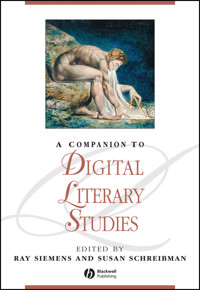
A Companion to Digital Literary Studies E-Book
39,99 €
Mehr erfahren.
- Herausgeber: John Wiley & Sons
- Kategorie: Geisteswissenschaft
- Serie: Blackwell Companions to Literature and Culture
- Sprache: Englisch
This Companion offers an extensive examination of how new technologies are changing the nature of literary studies, from scholarly editing and literary criticism, to interactive fiction and immersive environments.
- A complete overview exploring the application of computing in literary studies
- Includes the seminal writings from the field
- Focuses on methods and perspectives, new genres, formatting issues, and best practices for digital preservation
- Explores the new genres of hypertext literature, installations, gaming, and web blogs
- The Appendix serves as an annotated bibliography
Sie lesen das E-Book in den Legimi-Apps auf:
Seitenzahl: 1409
Veröffentlichungsjahr: 2013
Ähnliche




















Contents
Notes on Contributors
Editors’ Introduction
Part I Introduction
1 Imagining the New Media Encounter
Part II Traditions
2 ePhilology: When the Books Talk to Their Readers
Introduction
Background
The Future in the Present
Building the Infrastructure for ePhilology
Cultural Informatics
Conclusion
3 Disciplinary Impact and Technological Obsolescence in Digital Medieval Studies
Premature Obsolescence: the Failure of the Information Machine
Content as End-product: Browser-based Projects
SGML-based Editions
XML, XSLT, Unicode, and Related Technologies
Tools and Community Support
Future Trends: Editing Non-textual Objects
Collaborative Content Development
Conclusion
4 ‘‘Knowledge will be multiplied’’: Digital Literary Studies and Early Modern Literature
Developing a Canon
Electronic Texts
Literary Scholarship and Criticism Online
Renaissance Information
Case Study – A Funeral Elegy
5 Eighteenth‐Century Literature in English and Other Languages: Image, Text, and Hypertext
Introduction
Bibliographies and Related Resources
Texts
Project Sites and E-journals
Conclusion
6 Multimedia and Multitasking: A Survey of Digital Resources for Nineteenth‐Century Literary Studies
Introduction
Nineteenth-Century Multimedia
Electronic Scholarship and the Digital Guild
The Nineteenth Century as the Final Frontier
Survey
Additional Resources
7 Hypertext and Avant‐texte in Twentieth‐Century and Contemporary Literature
1. Time
2. Space
3. Toward Hyperfiction: Translation into a Digital Format
4. The Interaction between Hyperfiction and Print
5. Time and Space: the Hypertextual Structure of Literary Geneses
Part III Textualities
8 Reading Digital Literature: Surface, Data, Interaction, and Expressive Processing
Introducing Digital Literature
Models for Reading Digital Literature
Reading Tale-Spin ’s Outputs
Locating Tale-Spin ’s Traversal Function
Tale-Spin ’s Simulation
Observations on the Simulation
Tale-Spin ’s Traversal Function
A New Model
Employing the Model
Resurfacing
9 Is There a Text on This Screen? Reading in an Era of Hypertextuality
A Mythical Cyberspace
What Texts Are We Reading?
The Linked Computer
Constraints on the Act of Reading
Risks of Manipulation
A Logic of Revelation
Conclusion
10 Reading on Screen: The New Media Sphere
From Print to Screen
The Issue of Legibility
Handling the Flow of Text
The Advent of Hypertext
The Disappearance of the Column
The Birth of the E-book
The Future of Reading
11 The Virtual Codex from Page Space to E‐space
12 Handholding, Remixing, and the Instant Replay: New Narratives in a Postnarrative World
13 Fictional Worlds in the Digital Age
1. The Pleasures of World-building
2. Worlds as Playgrounds
3. Expandable Worlds and Worlds out of Worlds
4. Living Worlds
5. Online Worlds between Fiction and Reality
14 Riddle Machines: The History and Nature of Interactive Fiction
Introduction
A Brief History
Contexts of Interactive Fiction
Suggestions for Play
Conclusion
15 Too Dimensional: Literary and Technical Images of Potentiality in the History of Hypertext
Vannevar Bush and Memex
Doug Engelbart and NLS/Augment
Ideas and their Interconnections: Xanadu
The Thin Blue Line: Images of Potentiality in Literary Hypertext
Hypertext’s Long Shadow
16 Private Public Reading: Readers in Digital Literature Installation
Introduction
Site-specificity
The Third (or Fourth) Dimension
Materiality and/of the Text
Embodied Reading
Public Reading
Closing
17 Digital Poetry: A Look at Generative, Visual, and Interconnected Possibilities in its First Four Decades
Introductory Overview of Forms
Contemporary Perspective
In a Literary Context
Theoretical Touchstones
Critical Commentary
18 Digital Literary Studies: Performance and Interaction
Hypermedia and Performance Pedagogy
Modeling Performance Spaces
Digital Simulations of Live Performance
Computers in Performance
Telematic Performance
Net Performance
Conclusions and Queries
19 Licensed to Play: Digital Games, Player Modifications, and Authorized Production
Introduction
Post-Fordism, Ideal Commodities, and Knowledge Flow
Modding History
Unleashing Doom
Managing Modding: Communities and End-User License Agreements
Relations in Flux
20 Blogs and Blogging: Text and Practice
Weblogs
Constituent Technologies of Blogging
Genres of Blogs
Reading Blogs
Writing
Blogging in Literary Studies
Part IV Methodologies
21 Knowing … : Modeling in Literary Studies
Introduction
Modeling
In Humanities Computing: an Example
Experimental Practice
Knowledge Representation and the Logicist Program
22 Digital and Analog Texts
Digital and Analog Systems
Minds and Bodies
The Nature of Texts
23 Cybertextuality and Philology
What is Cybertextuality?
Cybertextual Simulations
The Cybertextual Cycle
The Author’s Self-monitoring
Computer Text Analysis and the Cybertextual Cycle
A New Philology
24 Electronic Scholarly Editions
Why Are People Making Electronic Editions?
Digital Libraries and Scholarly Editions
Unresolved Issues and Unrealized Potentials
Cost
Presses and Digital Centers
Audience
Possible Future Developments
Translation
25 The Text Encoding Initiative and the Study of Literature
Introduction
Principles of the TEI
Textual Criticism and the Electronic Edition
Customization: Fragmentation or Consolidation?
Conclusions
26 Algorithmic Criticism
27 Writing Machines
Writing
Topographies for Transmutation
Art
28 Quantitative Analysis and Literary Studies
History, Goals, and Theoretical Foundation
Methods
Applications
Four Exemplary Studies
A Small Demonstration: Zeta and Iota and Twentieth-Century Poetry
The Impact, Significance, and Future Prospects for Quantitative Analysis in Literary Studies
29 The Virtual Library
Introduction
Discovery
Mass: Virtual Library Collections
Mass Ambitions
Malleability
The Library as Laboratory
The Library as Repository and Publisher
Conclusion
30 Practice and Preservation – Format Issues
Introduction
XML
Portable Document Format (PDF)
TIFF and JPEG
31 Character Encoding
Introduction
Character Encoding and Writing Systems
What is a Character?
History of Character Encoding
Unicode
Representing Characters in Digital Documents
Conclusions
Annotated Overview of Selected Electronic Resources
Introduction
Digital Transcriptions and Images
Born-Digital Texts and New Media Objects
Criticism, Reviews, and Tools
Index
Blackwell Companions to Literature and Culture
This series offers comprehensive, newly written surveys of key periods and movements and certain major authors, in English literary culture and history. Extensive volumes provide new perspectives and positions on contexts and on canonical and post-canonical texts, orientating the beginning student in new fields of study and providing the experienced undergraduate and new graduate with current and new directions, as pioneered and developed by leading scholars in the field.
64. A Companion to Twentieth-Century United States Fiction
Edited by David Seed
65. A Companion to Tudor Literature
Edited by Kent Cartwright
66. A Companion to Crime Fiction
Edited by Charles Rzepka and Lee Horsley
67. A Companion to Medieval Poetry
Edited by Corinne Saunders
68. A New Companion to English Renaissance Literature and Culture
Edited by Michael Hattaway
69. A Companion to the American Short Story
Edited by Alfred Bendixen and James Nagel
70. A Companion to American Literature and Culture
Edited by Paul Lauter
71. A Companion to African American Literature
Edited by Gene Jarrett
72. A Companion to Irish Literature
Edited by Julia M. Wright
73. A Companion to Romantic Poetry
Edited by Charles Mahoney
74. A Companion to the Literature and Culture of the American West
Edited by Nicolas S. Witschi
75. A Companion to Sensation Fiction
Edited by Pamela K. Gilbert
76. A Companion to Comparative Literature
Edited by Ali Behdad and Dominic Thomas
77. A Companion to Poetic Genre
Edited by Erik Martiny
78. A Companion to American Literary Studies
Edited by Caroline F. Levander and Robert S. Levine
79. A New Companion to the Gothic
Edited by David Punter
80. A Companion to the American Novel
Edited by Alfred Bendixen
81. A Companion to Literature, Film, and Adaptation
Edited by Deborah Cartmell
82. A Companion to George Eliot
Edited by Amanda Anderson and Harry E. Shaw
83. A Companion to Creative Writing
Edited by Graeme Harper
This paperback edition first published 2013© 2013 Blackwell Publishing Ltd, except for editorial material and organization ©2013 by Ray Siemens and Susan Schreibman
Edition history: Blackwell Publishing Ltd (hardback, 2007)
Registered OfficeJohn Wiley & Sons, Ltd, The Atrium, Southern Gate, Chichester, West Sussex, PO19 8SQ, UK
Editorial Offices350 Main Street, Malden, MA 02148-5020, USA 9600 Garsington Road, Oxford, OX4 2DQ, UKThe Atrium, Southern Gate, Chichester, West Sussex, PO19 8SQ, UK
For details of our global editorial offices, for customer services, and for information about how to apply for permission to reuse the copyright material in this book please see our website at www.wiley.com/wiley-blackwell.
The right of Ray Siemens and Susan Schreibman to be identified as the authors of the editorial material in this work has been asserted in accordance with the UK Copyright, Designs and Patents Act 1988.
All rights reserved. No part of this publication may be reproduced, stored in a retrieval system, or transmitted, in any form or by any means, electronic, mechanical, photocopying, recording or otherwise, except as permitted by the UK Copyright, Designs and Patents Act 1988, without the prior permission of the publisher.
Wiley also publishes its books in a variety of electronic formats. Some content that appears in print may not be available in electronic books.
Designations used by companies to distinguish their products are often claimed as trademarks. All brand names and product names used in this book are trade names, service marks, trademarks or registered trademarks of their respective owners. The publisher is not associated with any product or vendor mentioned in this book.
Limit of Liability/Disclaimer of Warranty: While the publisher and author(s) have used their best efforts in preparing this book, they make no representations or warranties with respect to the accuracy or completeness of the contents of this book and specifically disclaim any implied warranties of merchantability or fitness for a particular purpose. It is sold on the understanding that the publisher is not engaged in rendering professional services and neither the publisher nor the author shall be liable for damages arising herefrom. If professional advice or other expert assistance is required, the services of a competent professional should be sought.
Library of Congress Cataloging-in-Publication Data
A companion to digital literary studies / edited by Ray Siemens and Susan Schreibman.p. cm.—(Blackwell companions to literature and culture)Includes bibliographical references and index.
ISBN 978-1-4051-4864-1 (cloth) – 978-1-118-49227-7 (pbk)1. Literature and the Internet. 2. Electronic publications. 3. Literature—Computer network resources.4. Digital libraries. 5. Hypertext systems. I. Siemens, Raymond George, 1966– II. Schreibman, Susan.PN56.I65C66 2007802.85—dc22
2007003822
A catalogue record for this book is available from the British Library.
Cover image: William Blake, Newton, color print finished in ink and watercolor, 1795/c. 1805; © Tate, London 2006Cover design by Richard Boxall Design Associates
Notes on Contributors
Editors
Ray Siemens is Canada Research Chair in Humanities Computing and Professor of English at the University of Victoria. He is President (English) of the Society for Digital Humanities / Société pour l’étude des médias interactifs, Visiting Senior Research Fellow at the Centre for Computing in the Humanities at King’s College London, and Visiting Research Professor at Sheffield Hallam University. Director of the Digital Humanities Summer Institute, and founding editor of the electronic scholarly journal Early Modern Literary Studies, he is also author of works chiefly focusing on areas where literary studies and computational methods intersect, is editor of several Renaissance texts, is series co-editor of Topics in the Digital Humanities (University of Illinois Press) and is co-editor of several book collections on humanities computing topics, among them the Blackwell Companion to Digital Humanities (2004) and Mind Technologies (University of Calgary Press, 2006).Susan Schreibman is Assistant Dean and Head of Digital Collections and Research at University of Maryland Libraries. She received her PhD in Anglo-Irish Literature and Drama from University College Dublin (1997). She is the founding editor of The Thomas MacGreevy Archive, Irish Resources in the Humanities, and principle developer of The Versioning Machine. She is the author of Collected Poems of Thomas MacGreevy: An Annotated Edition (1991), co-editor of A Companion to Digital Humanities (Blackwell, 2004), co-translator of Siete poetas norteamericanas (1991); and co-series editor of Topics in the Digital Humanities (University of Illinois Press).
Contributors
David Bamman is a computational linguist for the Perseus Project at Tufts University, focusing especially on natural language processing for Latin. David received a BA in Classics from the University of Wisconsin and an MA in Applied Linguistics from Boston University. He is currently leading the development of the Latin Dependency Treebank.Belinda Barnet (belinda.barnet@gmail.com) is Lecturer in Media and Communications at Swinburne University of Technology, Melbourne. She has a PhD in Media and Communications from the University of New South Wales, and research interests in digital media, the evolution of technology, convergent journalism, and the mobile internet. Prior to her appointment at Swinburne, Belinda was Service Delivery Manager at Ericsson Australia. Her work has been published in a variety of books and journals, including CTHEORY, Continuum, Fibreculture, The American Book Review, and Convergence.Marc Bragdon is Electronic Services Librarian with the University of New Brunswick Libraries Electronic Text Centre. Marc plays a lead role in the ongoing development of digital preservation strategies for UNB Libraries that incorporate international standards in digital imaging and information exchange as well as associated networked indexing and search/retrieval applications.Alan Burk (burk@unb.ca) is the Associate Director for the Libraries at the University of New Brunswick and was the founding director of the Electronic Text Centre from 1996–2005. His broad research interests are in the areas of Humanities Computing and Electronic Publishing. He has been involved in many grants, including a recent Canada Foundation for Innovation award for $11,000,000 to build a Pan-Canadian electronic publishing and research infrastructure. One of his main research interests, supported by a research agreement with Elsevier and a grant from the New Brunswick Innovation Fund, is in using applications of machine learning to automatically build metadata to describe scholarly information on the Web.Lisa Charlong is Assistant Director and Coordinator of XML and SGML Initiatives at The Electronic Text Centre at University of New Brunswick Libraries. Lisa has been involved with numerous scholarly communications and publishing projects, including: The Atlantic Canada Portal and the Chadwyck-Healey-published Canadian Poetry online collection. Lisa’s background is in information technology, education, archives, and art. Her current research interests revolve around the creation and use of structured data and digital collections as educational resources.G. Sayeed Choudhury (sayeed@jhu.edu) is the Associate Director for Library Digital Programs and Hodson Director of the Digital Knowledge Center at the Sheridan Libraries of Johns Hopkins University. He serves as principal investigator for projects funded through the National Science Foundation, Institute of Museum and Library Services, and the Mellon Foundation. He has oversight for the digital library activities and services provided by the Sheridan Libraries at Johns Hopkins University. Choudhury has served on program committees for Open Repositories, the Joint Conference on Digital Libraries, Web-Wise, the ISMIR music retrieval conference, Document Analysis for Image Libraries, and the IEEE Advances in Digital Libraries. He has provided presentations at the following conferences or meetings: Digital Curation Centre, American Library Association, Association of College and Research Libraries, the International Federation of Library Associations, Educause, Coalition for Networked Information, the Digital Library Federation, American Society for Information Science and Technology, and Web-Wise. Choudhury has published papers in D-Lib, the Journal of Digital Information, and First Monday.Tanya Clement (tclement@umd.edu) is an English PhD candidate at the University of Maryland, College Park. Her focus of study is textual and digital studies as it pertains to applied humanities computing and modernist American literature. She has an MFA in Fiction from the University of Virginia, and was trained in Humanities Computing at Virginia’s Electronic Text Center and the Institute for Advanced Technology in the Humanities. At the University of Maryland, she was a program associate at the Maryland Institute for Technologies in the Humanities from 2002 to 2005. Presently, she is the project manager for the Dickinson Electronic Archives and a research associate for MONK (Metadata Offers New Knowledge), a Mellon-funded project which seeks to integrate existing digital library collections and large-scale, cross-collection text mining and text analysis with rich visualization and social software capabilities.Gregory Crane (gregory.crane@tufts.edu) is Winnick Family Chair of Technology and Entrepreneurship, Professor of Classics, and Director of the Perseus Project at Tufts University. Originally trained as a classicist, his current interests focus more generally on the application of information technology to the humanities.James Cummings (james.cummings@computing-services.oxford.ac.uk) works for the Oxford Text Archive at the University of Oxford which hosts the UK’s Arts and Humanities Data Service: Literature, Languages, and Linguistics (AHDS:LLL). His PhD from the University of Leeds was in the field of medieval studies on records of early entertainment. He is on the Executive Board and Editorial Committee of the Digital Medievalist project. He has been elected multiple times to the Technical Council of the Text Encoding Initiative, where he has worked hard to further the development of the TEI Guidelines. In his work for AHDS:LLL he advises UK funding applicants on recommended practices in text encoding. He lectures on both medieval and humanities computing topics at a number of institutions, and publishes in both these disciplines.Peter Damian-Grint (peter.damian-grint@voltaire.ox.ac.uk) is CorrespondenceEditor of Electronic Enlightenment, a Web 2.0 e-publishing research project of the University of Oxford; he previously worked for the Oxford Dictionary of National Biography and Studies on Voltaire and the Eighteenth Century. A medievalist by training, he teaches Old French at the University of Oxford and has written widely on Old French literature, especially historiography. He is the author of The New Historians of the Twelfth-Century Renaissance (1999) and editor of a collection of essays, Medievalism and manière gothique in Enlightenment France (2006).Johanna Drucker (jrd8e@virginia.edu) is the Robertson Professor of Media Studies at the University of Virginia. She has published and lectured widely on topics in the aesthetics of digital media, graphic design, experimental typography, artists’ books, and contemporary art. Her most recent title, Sweet Dreams: Contemporary Art and Complicity, was published by the University of Chicago Press in 2005. She is currently finishing work on a critical history of graphic design, with collaborator Emily McVarish, which will appear in 2008 from Prentice Hall. With Jerome McGann she co-founded SpecLab at the University of Virginia and was involved in developing the prototypes for several key projects, including Temporal Modeling and IVANHOE. Her current digital project is <http://www.ArtistsBooksOnline.org>.Poet, editor, multimedia artist, and critic Christopher Funkhouser (funkhouser@ adm.njit.edu), an Associate Professor at New Jersey Institute of Technology, was awarded a Fulbright Scholarship to lecture and conduct research on ‘‘hypermedia writing’’ in Malaysia in 2006, where his CD-ROM e-book, Selections 2.0, was issued by Multimedia University. In 2007 two books, Prehistoric Digital Poetry: An Archaeology of Forms, 1959–1995, and a bilingual collection, Technopoetry Rising: Essays and Works, will be published.Bertrand Gervais (gervais.bertrand@uqam.ca) is full Professor in Literary studies at the University of Québec in Montréal (UQAM). He is the director of Figura, the Research Center on Textuality and the Imaginary, and of NT2, the Research Laboratory on Hypermedia Art and Literature (<http://www.labo-nt2.uqam.ca>). He teaches American literature and literary theories, specializing in theories of reading and interpretation. He has published essays on literary reading and twentieth-century American literature. His current work focuses on obsession, on the apocalyptic imagination, as well as on the Labyrinth in contemporary literature and film. He is also a novelist.Gretchen Gueguen (ggueguen@umd.edu) is a member of the Digital Collections Library in the Digital Collections and Research Department of the University of Maryland Libraries. She has worked at the Maryland Institute for Technology in the Humanities on The Thomas MacGreevy Archive and as an assistant in the Digital Collections and Research division of the University of Maryland Libraries. Most recently, she has co-edited (with Ann Hanlon) The Library in Bits and Bytes: A Digital Publication, the proceedings of The Library in Bits and Bytes: A Digital Library Symposium.Carolyn Guertin (guertin@uta.edu) is Assistant Professor of Digital Media and Director of the eCreate Lab, a graduate student research and development laboratory, in the Department of English at the University of Texas at Arlington. During the 2004 to 2006 academic years, she was a Senior McLuhan Fellow and SSHRC Postdoctoral Fellow in the McLuhan Program in Culture and Technology at the University of Toronto, and most recently gave the closing keynote address at ‘‘Re-Reading McLuhan: An International Conference on Media and Culture in the 21st Century’’ at the University of Bayreuth in Germany. She does both theoretical and applied work in cyberfeminism, digital narrative, digital design, media literacy (or postliteracy) and performance. She is a founding editor of the online journal MediaTropes, curator and founder of Assemblage: The Women’s Online New Media Gallery, and a literary advisor to the Electronic Literature Organization. She has written textbooks on hypertext and literature and information aesthetics, and is working on a new book called Connective Tissue: Queer Bodies, Postdramatic Performance and New Media Aesthetics.David L. Hoover (david.hoover@verizon.net) is currently Professor of English at New York University, and has been working in the areas of humanities computing, linguistic stylistics, and text alteration for twenty years. He has published two books, both of which use computer-assisted techniques: A New Theory of Old English Meter and Language and Style in The Inheritors (on William Golding’s style). His current research is focused on authorship attribution, statistical stylistics, and corpus stylistics.Alison Jones is a researcher at the Perseus Digital Library. She has a BA in History from Mount Holyoke College and an MLS from Simmons College. Her current research interests include digital library interfaces and the digitization of historical collections.Ian Lancashire (ian@chass.utoronto.ca), Professor of English at the University of Toronto, founded the Center for Computing in the Humanities there in 1986 and codeveloped TACT (Text Analysis Computing Tools). He is currently editing Representative Poetry Online (1994–), Lexicons of Early Modern English (2006–), and a volume of essays about online teaching for the Modern Language Association of America. His historical research treats the growth of Early Modern English vocabulary, and his theoretical writings concern cybertextuality. He presided over a Canadian learned society, now called the Society for Digital Humanities (SDH-SEMI), from 1992 to 2003 and is now active in the TAPoR and Synergies consortia.John Lavagnino (John.Lavagnino@kcl.ac.uk) studied physics at Harvard University and English at Brandeis University, where he took his PhD in 1998; he is now Senior Lecturer in Humanities Computing at the Centre for Computing in the Humanities, King’s College London. He and Gary Taylor are general editors of The Collected Works of Thomas Middleton, and he is also collaborating with Peter Beal and Henry Woudhuysen on the Catalogue of English Literary Manuscripts 1450–1700.Mark Leahy (m.leahy@dartington.ac.uk) is a writer and curator who works with text, objects, and performance. Recent critical essays include ‘‘Plantation and Thicket: A Double (Sight) Reading of Sir Thomas Browne’s ‘Garden of Cyrus’,’’ in Performance Research 10.2; ‘’ ‘I might have been a painter’: John James and the Relation between Visual and Verbal Arts’’ in The Salt Companion to John James, edited by Simon Perrill (due summer 2007). He is curator of the exhibition ‘‘Public Pages’’ as part of the conference Poetry and Public Language at the University of Plymouth (April 2007). Since September 2005 he has been Director of Writing at Dartington College of Arts, England.Alan Liu (ayliu@english.ucsb.edu) is Professor in the English Department at the University of California, Santa Barbara. He is the author of Wordsworth: The Sense of History (Stanford University Press, 1989); The Laws of Cool: Knowledge Work and the Culture of Information (University of Chicago Press, 2004); and Local Transcendence: Essays on Postmodern Historicism and the Database (forthcoming, University of Chicago Press). He is principal investigator of the UC Multi-campus Research Group, Transliteracies: Research in the Technological, Social, and Cultural Practices of Online Reading; principal investigator of the UCSB Transcriptions Project (Literature and the Culture of Information); and co-director of his English Department’s undergraduate specialization on Literature and the Culture of Information. His other online projects include Voice of the Shuttle and (as general editor) The Agrippa Files. Liu is also a member of the Board of Directors of the Electronic Literature Organization (ELO). He is Editor of the UC New Media directory.Andrew Mactavish (mactavish@mcmaster.ca) is Director of Humanities Media and Computing and Associate Professor of Multimedia in the Department of Communication Studies and Multimedia at McMaster University. He researches theories and practices of digital games, humanities computing, and multimedia. He currently holds a research grant from the Social Sciences and Humanities Research Council of Canada to study the cultural politics of digital game play.Willard McCarty (PhD, Toronto) (willard.mccarty@kcl.ac.uk) is Reader in Humanities Computing, Centre for Computing in the Humanities, King’s College London, recipient of the 2006 Richard W. Lyman Award and, with Jean-Claude Guédon, of the 2005 Award for Outstanding Achievement, Society for Digital Humanities / Société pour l’étude des médias interactifs. He is the founding editor of Humanist (1987–) and author of Humanities Computing (Palgrave, 2005). The aim of his work is to build the theoretical basis for diverse and vigorous research programmes in the digital humanities. His primary focus is on modeling, with a particular interest in the Metamorphoses of Ovid.Nick Montfort (nickm@nickm.com) is Assistant Professor of Digital Media at MIT. He writes and programs interactive fiction, including Book and Volume ([auto mata], 2005), and frequently collaborates on online literary projects, including Implementation (2005) and 2002: A Palindrome Story (2002). His recent work is on the human and machine meanings of code, on the role of computing platforms in creative production, and on how the narrative discourse can be varied independently of the content in interactive fiction. He wrote Twisty Little Passages: An Approach to Interactive Fiction (MIT Press: 2003) and co-edited The New Media Reader (MIT Press: 2003).Aimée Morrison (ahm@uwaterloo.ca) is Assistant Professor of English at the University of Waterloo. Her research focuses on the materialities of digital culture, from videogaming, to linguistic nationalism, to preservation. She teaches courses in media, multimedia, and electronic text and has recently published on the pedagogy of humanities computing and the rhetoric of internet democracy.Jason Nugent is the Senior Programmer and Database Developer at the Electronic Text Centre at University of New Brunswick Libraries. He has been heavily involved with web and database development for over a decade, and is a regular contributor to open-source software projects on SourceForge. Before working with the ETC, he taught web development, UNIX administration, and relational database theory at Dalhousie University, and also worked in the private sector, developing innovative web solutions for a number of organizations. He holds an honors degree in Chemistry.Daniel Paul O’Donnell (daniel.odonnell@uleth.ca) is Department Chair and Associate Professor of English at the University of Lethbridge. He publishes primarily in Anglo-Saxon studies and Digital Humanities. His digital-and-print edition of the earliest known English poem, Cædmon’s Hymn, was published by D. S. Brewer in 2005. He also writes a regular column on humanities computing for Heroic Age. He is currently director of the Digital Medievalist Project and Co-editor of the associated scholarly journal Digital Medievalist. Since the fall of 2006 he has been Chair of the Text Encoding Initiative.Kenneth M. Price (kprice@unlnotes.unl.edu) is University Professor and Hillegass Chair of American literature at the University of Nebraska, Lincoln. He is the author of Whitman and Tradition: The Poet in His Century (Yale UP, 1990) and To Walt Whitman, America (University of North Carolina Press, 2004). He recently co-authored with Ed Folsom Re-Scripting Walt Whitman: An Introduction to His Life and Work (Blackwell, 2005). He is the co-editor of The Walt Whitman Archive and codirector of the Center for Digital Research in the Humanities at Nebraska.Stephen Ramsay (sramsay@arches.uga.edu) is Assistant Professor of English and a Fellow at the Center for Digital Research in the Humanities at the University of Nebraska, Lincoln. He specializes in text analysis and visualization, and has lectured widely on subjects related to the computational analysis of literary texts and software design for the humanities.Marie-Laure Ryan (marilaur@gmail.com) is an Independent Scholar specializing in how (new) media influence narrativity. Her Narrative as Virtual Reality: Immersion and Interactivity in Literature and Electronic Media (2001) has won the MLA Comparative Literature award. She is the editor of the Routledge Encyclopaedia of Narrative Theory (2005) and member of the editorial board of the book series Frontiers of Narrative, published by the University of Nebraska Press. She has published widely on narratology, possible worlds theory, and cyberculture. Marie-Laure Ryan was born in Geneva, Switzerland and currently resides in Bellvue, Colorado.David Z. Saltz (saltz@uga.edu) is Associate Professor of Drama at the University of Georgia. He is Principal Investigator of Virtual Vaudeville: A Live Performance Simulation System, funded by the NSF, and has published essays about performance theory and interactive media in scholarly books and journals, including Theatre Research International, Performance Research, and the Journal of Aesthetics and Art Criticism. He is also a practicing director and installation artist whose work focuses on the interaction between digital media and live performance.David Seaman (david.seaman@dartmouth.edu) is Associate Librarian for Information Management at Dartmouth College Library, and was until December 2006 the Executive Director of the Digital Library Federation (DLF). David joined the DLF in 2002 from the Electronic Text Center at the University of Virginia Library, where he was the founding Director (1992–2002). In this role, he oversaw the creation and development of an online archive of XML and SGML texts, of which many are available in multiple e-book formats. In addition, he has lectured and published extensively in the fields of humanities computing and digital libraries, and since 1993 has taught e-text and internet courses at the annual summer Book Arts Press Rare Book School at UVA.Matthew Steggle (m.steggle@shu.ac.uk) is Reader in English at Sheffield Hallam University. He has published extensively on early modern literature, including the books Richard Brome: Place and Politics on the Caroline Stage (2004) and Laughing and Weeping in Early Modern Theatres (2007). He is the editor of the peer-reviewed e-journal Early Modern Literary Studies.Darren Tofts (dtofts@groupwise.swin.edu) is Associate Professor of Media and Communications, Swinburne University of Technology, Melbourne. His most recent book is Interzone: Media Arts in Australia (Thames & Hudson, 2005).Christian Vandendorpe (cvanden@uottawa.ca) is full Professor in the Department of Lettres françaises at the University of Ottawa, and Director of the Writing Centre. Specialized in the theory of reading, he was a pioneer in research on the changes in reading habits caused by the arrival of hypertext and new media for the display of texts. His essay Du papyrus à l’hypertexte (1999), published in Paris and Montréal, has been translated into Spanish and Polish, and an English version is forthcoming. He is the editor of Hypertextes. Espaces virtuels de lecture et d’écriture (2002) and Les défis de la publication sur le web : hyperlectures, cybertextes et méta-éditions (2004). He is also responsible for a large publicly accessible database of dream narratives (<http://www.reves. ca/>). For more information: <http://www.lettres.uottawa.ca/vanden.html>.Dirk Van Hulle (vanhulle@uia.ua.ac.be) is Associate Professor of Literature in English at the James Joyce Centre, University of Antwerp, Belgium. He is editor of the online journal Genetic Joyce Studies, member of the editorial board of Samuel Beckett Today / Aujourd’hui, and author of Textual Awareness, a genetic study of late manuscripts by Joyce, Proust, and Mann (University of Michigan Press, 2004) and Joyce and Beckett, Discovering Dante (National Library of Ireland, 2004). He edits the Beckett Endpage (<http://www.ua.ac.be/beckett>) and is currently working on a genetic edition of Samuel Beckett’s last bilingual works.John A. Walsh (jawalsh@indiana.edu) is an Assistant Professor in the School of Library and Information Science at Indiana University, where he teaches and conducts research in the areas of digital humanities and digital libraries. His research interests include the application of digital technologies and media formats to transform traditional humanities scholarship and to create new modes of scholarly discourse; semantic web and metadata technologies as tools for the discovery and analysis of humanities data; and digital editing, markup, and textual studies. Current projects include the Swinburne Project (<http:// www.swinburneproject.org/>), the Chymistry of Isaac Newton (<http://www.dlib.indiana.edu/collections/newton/>), and Comic Book Markup Language (<http://www.cbml.org/>).Noah Wardrip-Fruin (nwf@ucsd.edu) of Brown University approaches digital media as a humanist and as a writer/artist. He has recently edited three books: The New Media Reader (2003, with Nick Montfort); First Person: New Media as Story, Performance, and Game (2004, with Pat Harrigan); and Second Person: Role-Playing and Story in Games and Playable Media (2007, also with Harrigan), all published by The MIT Press. His writing/art for digital media has been presented by galleries, arts festivals, scientific conferences, DVD magazines, VR Caves, and the Whitney and Guggenheim museums – as well as discussed in books such as Digital Art (2003) and Art of the Digital Age (2006). He is currently an Assistant Professor in the Communication department at UC San Diego as well as a Vice President of the Electronic Literature Organization and a relatively active blogger at <http://grandtextauto.org>.William (Bill) Winder (winder@interchange.ubc.ca) is Assistant Professor of French at the University of British Columbia’s French, Hispanic, and Italian Studies Department. He is on the board of directors of the Consortium for Computers in the Humanities and the editorial board of TEXT Technology, and he co-edits Computing in the Humanities Working Papers. His interests lie in computational and formalist approaches to the semantics of language and literature. See his website (<http://www.fhis.ubc.ca/winder>) for recent publications and research.Christian Wittern (wittern@kanji.zinbun.kyoto-u.ac.jp) is Associate Professor at the Documentation and Information Center for Chinese Studies, Institute for Research in Humanities, Kyoto University. He holds a PhD in Chinese Studies from Göttingen University. His research interests include history of thought and religion in medieval China, encoding of premodern Chinese texts, and methods of Humanities Computing. He has been a member of the TEI Technical Council since 2002.
Editors’ Introduction
Intended to suggest a broad range of interests found in the field of literary studies and their confluence with the creative activities, analytical methodologies, and disseminative possibilities presented by computation and the electronic medium . . . intending to suggest all this, the phrase ‘‘digital literary studies’’ does little justice to what is a meeting of interests that, it may be argued, represents the most important change occurring in the field of literary studies today. That change is not driven by theoretical concerns, although it clearly is informed by them as much as it is, in turn, informing them; it is not posited solely by the necessities of bibliographic pursuits, though quite certainly the computational tractability of such pursuits has strongly encouraged material, textual, and other bibliographic endeavor; and it is not championed only by professional interests, although the pragmatics of our profession do play a large role. Rather, the change is driven chiefly by that which has always driven key aspects of society’s engagement with text: the socially accessible technologies that govern the storage, transmission, and reception of textual material.
The way in which one might approach the engagement of computing in literary studies – a discipline as vast as it is deep – is through a multifaceted approach, understanding its relationship not only to the wider concerns of literary studies, which one might argue is its own present, but also to its own past. The origin of digital literary studies is typically located at the mid-point of the last century with the work of Father Roberto Busa, the Jesuit priest who used computational means to create the Index Thomisticus. The Index Thomisticus is, in itself, both a pre-history of the field as well as an active participant in contemporary technologies and theoretical perspectives. The raw material which formed the palimpsest of the published volumes (first to print formats, and most latterly in digital form) was migrated over a 49-year period onto a variety of media, from punch cards, to tape, to CDs, to the internet and, ultimately, to DVD. With each migration, the data was reformatted and its output re-visualized for a new generation of readers. Busa’s engagement with one text across many generations of computer hardware and software forms a pre-history for the rich and varied methodologies, theoretical perspectives, and computational means that today comprise the field of digital literary studies: text encoding, e-literature, linguistic analysis, data mining, new media studies, hypertext studies, and well beyond.
Other perspectives abound. There are, indeed, many further acknowledged milestones to which one could draw attention amongst those in a recent history; one that could be seen to begin with John Smith’s seminal article, ‘‘Computer Criticism’’ (1978), and extend through Roseanne Potter’s Literary Computing and Literary Criticism (1989), Gregory Colomb and Mark Turner’s ‘‘Computers, Literary Theory, and the Theory of Meaning’’ (1989), Charles Faulhaber’s ‘‘Textual Criticism in the 21st Century’’ (1991), Paul Delany and George Landow’s Hypermedia and Literary Studies (1991), Landow’s HyperText (1992), Delany’s ‘‘From the Scholar’s Library to the Personal Docuverse’’ (1993), Geoffrey Nunberg’s ‘‘The Place of Books in the Age of Electronic Reproduction’’ (1993), Richard Finneran’s The Literary Text in the Digital Age (1996), Janet Murray’s Hamlet on the Holodeck (1997), Espen Aarseth’s Cybertext (1997), Jerome McGann’s Radiant Textuality: Literary Studies after the World Wide Web (2001), N. Katherine Hayles’ Writing Machines (2002) and so on, up to this day; but here, already, the documentation of such an energetic and, from our current perspective, resounding engagement – a thing of beauty in itself – reflects quite significantly the literary-critical perspective, the eye, of the beholder.
Even so, far from a Busaian past, and the largely textual focus of scholarship at the end of the previous century, are the perspectives of game studies, social and ubiquitous computing, e-literature, and visualization, among many others. It is all these methodologies, perspectives, and means that intersect to form a roadmap through this dynamically evolving and richly experimental field. Yet, the sum of the chapters in this volume is much more than a survey of current concerns, which is, perhaps, best reflected in one’s specific approach to, and entry into, the discipline itself. From our current perspective, we have the considerable luxury of being able to draw upon any number of the contemporary points of engagement being actively pursued in digital literary studies and seeing active representation in this volume. Thus, as we cast our eyes backward, we can construct a number of rich, informative histories while, at the same time, pointing toward new paths for future research. This meeting of past and future is nowhere more evident than in the introductory chapter to this volume, Alan Liu’s ‘‘Imagining the New Media Encounter.’’
Upon Liu’s foundation, the remainder of the volume is divided into three broad sections, Traditions, Textualities, and Methodologies; it concludes with a useful annotated bibliography, a starting point for the consideration of a number of the many exemplary initiatives in the area. The first section, Traditions, views digital literary studies much as our academic units do, from the perspective of disciplinary periodicity: classical, medieval, early modern, eighteenth-century, nineteenth-century, and twentieth-century and contemporary. Contributions to Textualities embrace notions of that ever-problematized entity, the “text,” as those who engage literary text do so within the context of the manifold possibilities presented by new media. Lastly, Methodologies explores the new ways in which we engage in such pursuit.
The editors express their most sincere gratitude to all those involved in the conception, the shaping, and the production of this volume. Particular thanks go to Emma Bennett, our editor at Blackwell who embraced the idea for the volume and whose support throughout the production process has been unwavering, Annette Abel, who firmly and kindly oversaw the copyediting and page-proofing associated with the collection, and to Sean Daugherty (Maryland), Karin Armstrong (Victoria), and Anne Correia (Victoria), who assisted with many of the pragmatics of getting the volume ready for the press.
Ray SiemensSusan Schreibman
WORKS CITED
Aarseth, Espen (1997). Cybertext: Perspectives on Ergodic Literature. Baltimore: Johns Hopkins University Press.
Busa, Roberto (Ed.). (1974–). Index Thomisticus; Sancti Thomae Aquinatis operum omnium indices et concordantiae; consociata plurium opera atque electronico IBM automato usus digessit Robertus Busa. Stuttgart: Frommann Verlag.
Colomb, Gregory, and Mark Turner (1989). ‘‘Computers, Literary Theory, and the Theory of Meaning.’’ In Ralph Cohen (Ed.). The Future of Literary Theory. New York: Routledge, pp. 386–410.
Delany, Paul (1993). ‘‘From the Scholar’s Library to the Personal Docuverse.’’ In The Digital Word: Text-Based Computing in the Humanities. Cambridge, MA: MIT Press, pp. 189–199.
Delany, Paul, and George P. Landow (Eds.). (1991). Hypermedia and Literary Studies. Cambridge, MA: MIT Press.
Faulhaber, Charles B. (1991). ‘‘Textual Criticism in the 21st Century.’’ Romance Philology 45: 123–148.
Finneran, Richard J. (Ed.). (1996). The Literary Text in the Digital Age. Ann Arbor: University of Michigan Press.
Hayles, N. Katherine (2002). Writing Machines. Cambridge, MA: MIT Press.
Landow, George P. (1992). HyperText: The Convergence of Contemporary Critical Theory and Technology. Baltimore: Johns Hopkins University Press.
McGann, Jerome (2001). Radiant Textuality: Literary Studies after the World Wide Web. New York: Palgrave/Macmillan.
Murray, Janet (1997). Hamlet on the Holodeck: The Future of Narrative in Cyberspace. New York: Free Press.
Nunberg, Geoffrey (1993). ‘‘The Place of Books in the Age of Electronic Reproduction.’’ Representations 42: 13–37.
Potter, Roseanne (Ed.). (1989). Literary Computing and Literary Criticism: Theoretical and Practical Essays on Theme and Rhetoric. Philadelphia: University of Pennsylvania Press.
Smith, John B. (1978). ‘‘Computer Criticism.’’ Style 12.4: 326–56.
Part I
Introduction
1
Imagining the New Media Encounter
Alan Liu
This volume in the Blackwell Companion series convenes scholars, theorists, and practitioners of humanities computing to report on contemporary “digital literary studies.” Perhaps the best way to characterize their collective account is to say that it depicts a scene of encounter. A Companion to Digital Literary Studies is fundamentally a narrative of what may be called the scene of “new media encounter” – in this case, between the literary and the digital. The premise is that the boundary between codex-based literature and digital information has now been so breached by shared technological, communicational, and computational protocols that we might best think in terms of an encounter rather than a border. And “new media” is the concept that helps organize our understanding of how to negotiate – which is to say, mediate – the mixed protocols in the encounter zone.1
But if the Companion is an account of new media encounter, then it also belongs to a long lineage of such “first contact” narratives in media history. New media, it turns out, is a very old tale.
To help define the goals of this volume, it will be useful to start by reviewing the generic features of this tale. There are more and less capable imaginations of the new media encounter moment, and it is important to be able to tell the difference before we turn specifically to the digital literary studies scene.
Lesen Sie weiter in der vollständigen Ausgabe!
Lesen Sie weiter in der vollständigen Ausgabe!
Lesen Sie weiter in der vollständigen Ausgabe!
Lesen Sie weiter in der vollständigen Ausgabe!
Lesen Sie weiter in der vollständigen Ausgabe!
Lesen Sie weiter in der vollständigen Ausgabe!
Lesen Sie weiter in der vollständigen Ausgabe!
Lesen Sie weiter in der vollständigen Ausgabe!
Lesen Sie weiter in der vollständigen Ausgabe!
Lesen Sie weiter in der vollständigen Ausgabe!
Lesen Sie weiter in der vollständigen Ausgabe!
Lesen Sie weiter in der vollständigen Ausgabe!
Lesen Sie weiter in der vollständigen Ausgabe!
Lesen Sie weiter in der vollständigen Ausgabe!
Lesen Sie weiter in der vollständigen Ausgabe!
Lesen Sie weiter in der vollständigen Ausgabe!
Lesen Sie weiter in der vollständigen Ausgabe!
Lesen Sie weiter in der vollständigen Ausgabe!
Lesen Sie weiter in der vollständigen Ausgabe!
Lesen Sie weiter in der vollständigen Ausgabe!
Lesen Sie weiter in der vollständigen Ausgabe!
Lesen Sie weiter in der vollständigen Ausgabe!
Lesen Sie weiter in der vollständigen Ausgabe!
Lesen Sie weiter in der vollständigen Ausgabe!
Lesen Sie weiter in der vollständigen Ausgabe!
Lesen Sie weiter in der vollständigen Ausgabe!
Lesen Sie weiter in der vollständigen Ausgabe!
Lesen Sie weiter in der vollständigen Ausgabe!
Lesen Sie weiter in der vollständigen Ausgabe!
Lesen Sie weiter in der vollständigen Ausgabe!
Lesen Sie weiter in der vollständigen Ausgabe!
Lesen Sie weiter in der vollständigen Ausgabe!
Lesen Sie weiter in der vollständigen Ausgabe!
Lesen Sie weiter in der vollständigen Ausgabe!
Lesen Sie weiter in der vollständigen Ausgabe!




